
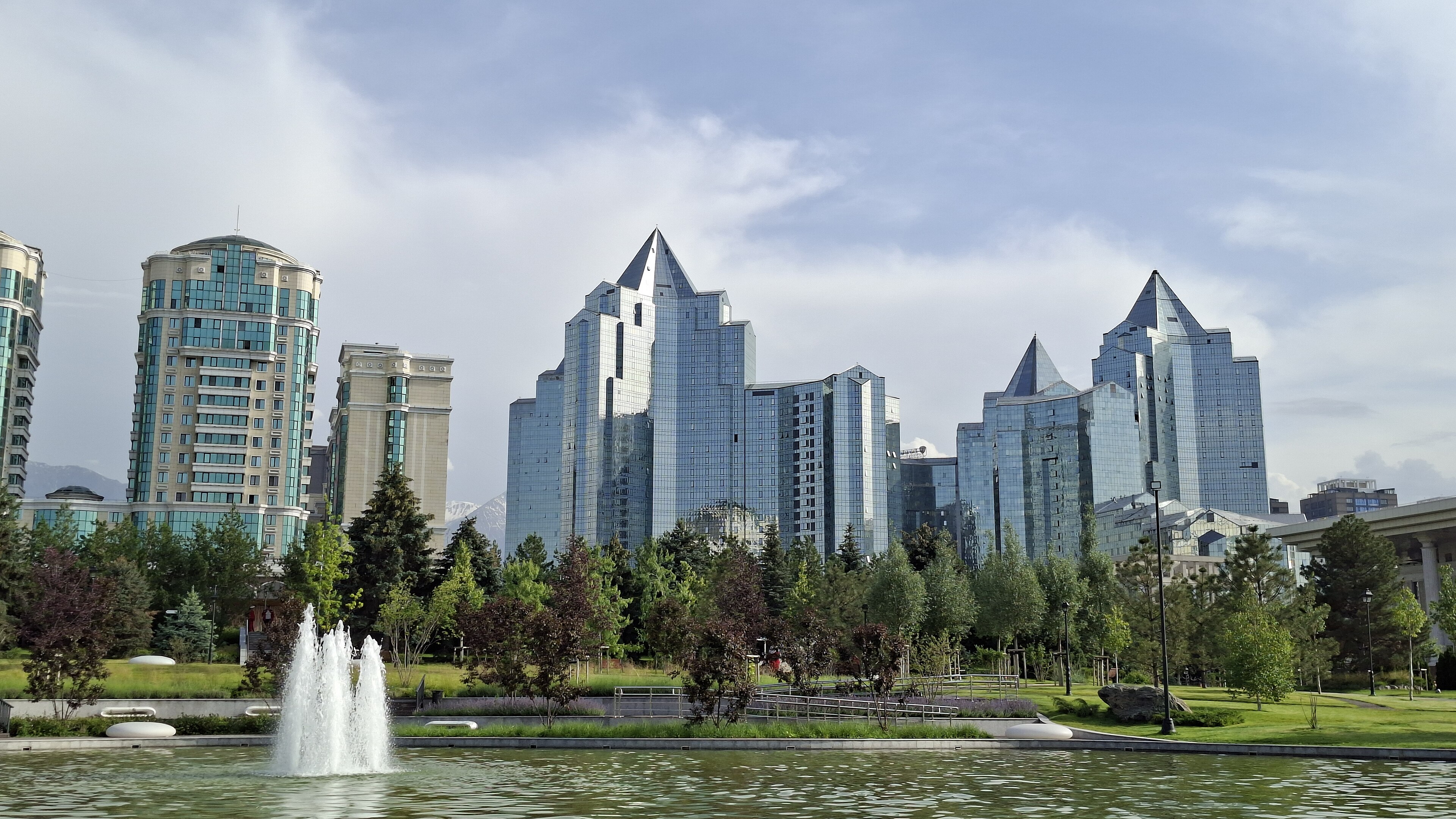
The Fastest Way to Improve Almaty
First, Find Out What Almaty Actually Is Now
CivilisationOS Recommendation — Almaty Rebuild, Article 1
Start Here: https://edukatesg.com/portfolio/civilisation-os-organisation-immediate-boost-vs-best-boost/
Before we recommend another road, railway, park, housing programme, clean-air measure or economic-development project for Almaty, we have to do something that sounds obvious but is often skipped:
Find the actual present state of Almaty.
This matters because Almaty in 2026 is not the same city we analysed in the earlier Immediate Boost article.
The city has moved.
Projects have started.
Budgets have changed.
Infrastructure is being upgraded.
New transport systems are entering the pipeline.
Air-quality regulation has tightened.
Utilities are being rebuilt.
Population continues to grow.
And several things that might previously have appeared to be recommendations are now already being attempted by the city.
So if we simply repeat the old recommendations, CivilisationOS fails its own test.
We would be prescribing medicine to a patient whose condition has already changed.
The correct first move is therefore:
Recalibrate Almaty.
Quick Read
Almaty is not presently a failing city waiting for someone to tell it what to build.
It is a rapidly growing, economically productive city undergoing a large infrastructure transition while carrying significant inherited distribution, environmental and network constraints.
That distinction is important.
As of 1 June 2026, Almaty had about 2.37 million residents. It continues to receive positive migration, including a net internal migration gain. Construction, investment and passenger movement are also growing.
At the same time, the city has launched or is advancing:
- metro expansion;
- BRT development;
- an LRT programme;
- road rehabilitation;
- water and sewer expansion;
- electricity-network upgrades;
- drainage and storm-water works;
- gas conversion of major heat generation;
- cleaner public transport;
- low-emission-zone mechanisms;
- seismic-resilience programmes;
- and a new 2026–2030 development plan.
Therefore the new diagnosis is already different from the old one.
Almaty’s immediate problem is not principally absence of development.
Its emerging problem is:
Can all these separate upgrades be converted into a coherent improvement in the experienced city faster than population, traffic, land development and system load increase?
That is an EnDist problem.
And it may become the central Almaty problem.
1. Start With the City That Exists
The first CivilisationOS rule is:
Declared city ≠ formal city ≠ functioning city ≠ experienced city.
Almaty’s official 2026–2030 programme is substantial.
The city identifies seven broad priorities including economic growth, integrated transport development, urban quality, social stability and resilience, ecology, digital transformation and safety. It aims for gross regional product of about ₸70 trillion by 2030, roughly double the level referenced by the city administration when presenting the plan.
This tells us something important about Declared Almaty.
The city government already recognises many of the same systems that a CivOS diagnosis would identify.
That is good.
But it does not prove that the resulting capabilities are yet:
Available → Deployable → Exercised → Effective.
That requires another layer of analysis.
2. Almaty Is Growing While We Are Trying to Fix It
This may be the most important starting condition.
Almaty’s population reached approximately 2,366,500 people on 1 June 2026.
During January–May alone, its migration balance was positive by more than 11,000 people, with the majority coming from internal migration.
That means the city-improvement problem is dynamic.
If Almaty adds:
10 units of transport capacity
while demand rises by:
8 units,
the experienced improvement is only:
+2
If it adds 10 while demand grows by 12:
the city has invested heavily and nevertheless becomes worse.
This is why:
Infrastructure growth cannot be evaluated independently from load growth.
CivilisationOS therefore cares about relative movement, not merely absolute construction.
3. The Almaty Power Plant Is Strong
This recalibration also prevents us from describing Almaty only through its problems.
Its generation side is considerable.
During January–June 2026:
construction activity was about 22.5% higher than the equivalent period of 2025;
more than 1.4 million square metres of housing entered operation;
fixed-capital investment exceeded ₸1 trillion;
and the city had more than 164,000 registered legal entities by July, overwhelmingly smaller organisations with fewer than 100 employees.
Passenger turnover also rose strongly.
That is not the profile of a city without energy.
It is the profile of a city producing and attracting substantial activity.
So our first major correction is:
Almaty’s primary weakness is unlikely to be insufficient raw city energy.
It has people.
It has businesses.
It has investment.
It has construction.
It has universities and skills.
It has national and international connectivity.
It has cultural attraction.
It has tourism.
It has financial capability.
It has significant government expenditure.
The Power Plant is running.
The more interesting question is:
How efficiently is that power being converted into lived capability?
4. This Is Where EnDist Appears
Suppose Almaty’s economic and institutional Power Plant generates increasing capability.
That capability must still travel through:
transport,
land,
housing,
utilities,
public institutions,
streets,
digital systems,
energy,
air,
water,
and social interfaces
before reaching people.
Every one of those pathways introduces possible resistance.
This gives us:
Generated Capability
↓
Interface Processors
↓
Distribution Network
↓
Receiver
↓
Experienced Capability
If the middle of the chain cannot keep pace with the generator, the system develops pressure.
And we can already see signs of precisely that.
5. Transport: The City Is Already Applying Force
The old analysis might have said:
Improve public transport.
That recommendation is now insufficient.
Almaty is already doing it.
The city’s 2026 programme includes development of BRT and LRT, while metro expansion continues. Current plans include a metro extension from Kalkaman toward the Barlyk area and an LRT connection envisaged between the Barlyk transport hub and the Eastern Gate corridor, implemented in stages.
This fundamentally changes our diagnostic question.
It is no longer:
Does Almaty need more mass transit?
It becomes:
What prevents the new transit investments from producing their maximum network effect?
Now we must inspect:
feeder access,
interchanges,
walking,
bus priority,
fare integration,
parking,
road competition,
last kilometre,
residential growth,
employment geography,
service frequency,
reliability,
station-area land use,
and cross-boundary metropolitan trips.
That is an Interface Processor problem.
6. A Rail Line Does Not Transport a Passenger
A railway transports trains.
The passenger has to reach it.
This distinction sounds trivial until cities spend billions constructing excellent trunk infrastructure whose realised catchment remains weak.
The actual mobility chain is:
Door
→ walk / feeder / bicycle / bus / car
→ station or stop
→ wait
→ trunk service
→ transfer
→ final stop
→ last kilometre
→ destination.
If any component contains severe friction, the capability of the entire chain falls.
This is precisely why the new Almaty analysis cannot simply recommend more metro.
Metro may indeed be valuable.
But the Immediate Boost may lie somewhere much smaller in its distribution network.
7. Transport and Air Are Now the Same System
Here the updated architecture becomes particularly useful.
Almaty’s air-quality problem cannot be treated as a separate environmental chapter.
According to city figures based on the emissions inventory for the Almaty agglomeration, roughly 60% of Almaty’s pollutant emissions are attributed to road transport.
This joins two apparently separate policy areas:
Mobility
and
Air quality.
If mobility can shift toward lower-emission transport while preserving accessibility, the same intervention potentially improves:
travel,
health,
street conditions,
energy use,
noise,
public space,
and environmental quality.
That is exactly the kind of multi-output intervention CivOS searches for.
But there is a warning.
8. Electrifying or Replacing Vehicles Is Not Enough
In the first half of 2026, city monitoring found emission-standard violations among a substantial portion of buses inspected.
Of 1,407 buses checked in repeated inspections through 30 June, 596 were reported above relevant toxicity or smoke standards.
Separately, more than 116,000 measurements were conducted at 19 stationary ecological posts in early 2026, detecting over 13,000 instances of vehicles exceeding applicable emission limits.
This is an important CivOS clue.
There is a difference between:
fleet specification
and:
fleet experienced condition.
The interface includes:
procurement,
maintenance,
inspection,
fuel,
catalytic systems,
enforcement,
and operating discipline.
So again:
Buying capability is not the same as retaining capability.
Maintenance is part of the Power Plant.
9. Almaty Is Already Changing the Energy Side
Another former recommendation might have been:
Reduce coal-related heating emissions.
Again, the present state has changed.
City plans call for completion of the conversion of CHP-2 to natural gas by the end of 2026, followed by reconstruction of CHP-3 using combined-cycle technology. The administration says the two measures together are expected to reduce emissions from heat sources substantially.
It also intends to extend gas supply throughout the private sector.
Therefore the CivOS question again moves downstream.
Not:
Should Almaty clean up heat generation?
But:
Does completing the transition actually remove the expected pollutants at receiver level, and what sources dominate after the transition?
Once one major source declines, the city’s bottleneck changes.
That is exactly why recalibration matters.
10. The Constraint Can Move
Imagine Almaty’s pollution composition as:
Transport + Heat + Industry + Private combustion + Construction + Other
If heat emissions fall dramatically, transport becomes proportionally more important.
Then the optimisation map changes.
The correct intervention in:
2024
may not be the correct intervention in:
2027.
This is the ECU principle.
The city should not execute a fixed environmental plan blindly for ten years.
It should repeatedly recalculate:
What now dominates the loss?
11. The Hidden System: Water and Utilities
Another major recalibration emerges beneath the visible city.
Almaty is simultaneously rebuilding substantial portions of its utility networks.
In 2026 the city aims to reduce water-network wear to around 49% and sewer-network wear to around 48%.
Other announced works include new water-intake facilities and hundreds of kilometres of water infrastructure intended to improve supply reliability for large numbers of residents.
In individual districts, large electricity, water, sewer, heat and gas upgrades are also under way.
This matters enormously.
A city can appear prosperous above ground while carrying infrastructure debt underground.
CivilisationOS must therefore distinguish:
visible city
from:
supporting city.
12. The Supporting City Is the BaseFloor
Water.
Sewerage.
Drainage.
Electricity.
Heat.
Gas.
Road surface.
Bridges.
Emergency access.
Communications.
These systems are usually unglamorous.
But they form the BaseFloor beneath almost everything else.
If they fail, the higher-level city loses capability rapidly.
That gives us:
Protect before Create.
A spectacular new district built upon overstressed utilities may increase gross output while decreasing system resilience.
Therefore part of Almaty’s immediate improvement programme may actually be maintenance and network reinforcement.
That is not a secondary concern.
It is civilisation protection.
13. Water Also Reveals an Interface Problem
In the Medeu district, groundwater well capacity had reportedly declined enough in earlier years to trigger new network construction, and tens of thousands of residents have subsequently been connected or are due to be connected to centralised water and sewer systems.
Meanwhile, the city has completed work on a master plan for integrated water-resource management that includes proposals for better institutional integration and even a unified operator.
This is particularly interesting to CivOS.
The problem is not merely:
water exists / does not exist.
It is simultaneously:
resource,
capture,
storage,
network,
institution,
information,
maintenance,
allocation,
and receiver.
The city itself has therefore encountered what our architecture calls an Interface Processor problem.
14. Drainage Is Not Just Drainage
Almaty’s storm-water and арык irrigation/drainage network is also undergoing substantial reconstruction in western, central and eastern sections of the city.
Why does this matter to a civilisation model?
Because drainage sits at the intersection of:
weather,
mountain hydrology,
streets,
transport,
urban greenery,
flooding,
maintenance,
public space,
and emergency resilience.
A drainage project can therefore have far greater system value than its budget line suggests.
The correct unit of analysis is not:
drainage infrastructure.
It is:
what chains of failure does drainage prevent?
That is the Propagation test.
15. And Then There Is the Mountain
Almaty’s geography gives it extraordinary advantages.
But the same geography also creates constraints.
The mountains contribute to:
identity,
tourism,
water,
climate,
landscape value,
recreation,
and global distinctiveness.
They also interact with:
air circulation,
development geography,
hydrology,
slope stability,
and earthquake exposure.
So the mountain is neither simply an asset nor simply a hazard.
It is part of the city’s substrate.
Atlas matters.
16. Seismic Risk Changes the Definition of “Best”
Almaty continues to develop seismic-resilience measures.
A 2026–2035 action plan for improving the seismic resistance of housing and social facilities has been approved following building surveys conducted in 2023–2024, while a multi-year programme is mapping tectonic faults and geodynamic activity across the agglomeration.
This creates an important CivOS constraint.
The Best Boost cannot simply optimise:
economic output,
land value,
or transport accessibility.
It must also consider:
expected survivability under low-frequency, high-consequence shock.
Otherwise the city can increase apparent capability while quietly accumulating catastrophic fragility.
17. This Changes Housing Analysis Too
Almaty put more than 1.4 million square metres of housing into operation during the first half of 2026.
That sounds unequivocally positive.
But CivOS asks more questions.
Where?
Connected to what transport?
Connected to what schools?
Connected to what water?
Connected to what sewage?
Connected to what employment?
At what seismic standard?
What traffic does it generate?
What happens to land prices?
Who can afford it?
What infrastructure burden does it add?
Housing is therefore not simply:
units delivered.
It is a receiver-and-network insertion.
18. We Can Now See the Shape of Almaty’s Problem
The city seems to be experiencing something more interesting than a conventional infrastructure deficit.
Almaty has significant Power Plant output.
It is also investing heavily in increasing capacity.
But many systems are being upgraded simultaneously because the city’s load has grown and continues to grow.
This suggests a preliminary diagnosis:
Almaty is transitioning from an infrastructure-deficit problem toward an integration-and-throughput problem.
That is a major change.
19. The Danger: More Power Into an Unintegrated Machine
Suppose Almaty simultaneously adds:
new housing,
new businesses,
more vehicles,
new metro,
BRT,
LRT,
new utility capacity,
new districts,
tourism,
digital infrastructure,
and investment.
Every addition can be individually rational.
But they interact.
If coordination is weak, the city can experience:
construction conflicts,
duplicated works,
road closures,
utility relocations,
poor interchange design,
capacity mismatch,
development ahead of infrastructure,
new congestion around successful nodes,
land-price distortions,
maintenance liabilities,
and institutional overload.
In other words:
A city can suffer from the success of too many improvements arriving badly sequenced.
This is the Bernoulli/flow insight entering city improvement.
The narrowing may be at the interface rather than the generator.
20. Preliminary Power Plant Diagnosis
So, at this first pass, we can classify Almaty approximately as follows.
Generation
Strong and rising
Economic activity, construction, investment, population attraction and institutional expenditure indicate substantial generation capability.
Conversion
Moderate to strong, but uneven
The city can build and operate complex systems, but older utility networks, emissions problems and infrastructure gaps show incomplete conversion.
Distribution
Likely major constraint
Mobility, utility access, metropolitan growth and spatial mismatch increasingly determine whether generated capability reaches receivers efficiently.
Retention
Mixed
Infrastructure wear, pollution, congestion and maintenance requirements consume part of the value being generated.
Regeneration
Emerging
The city’s long-term transport, utility, environmental and resilience programmes could create regenerative capability — but only if implementation produces institutional learning and not merely individual projects.
This is not yet a final score.
It is the first system map.
21. Preliminary EnDist Diagnosis
The first candidate high-loss channels are:
Mobility friction
↓
Air-quality loss
↓
Infrastructure wear
↓
Peripheral accessibility
↓
Transport–land-use mismatch
↓
Utility expansion lag
↓
Inter-agency interface friction
↓
Maintenance loss
↓
Metropolitan boundary mismatch
↓
Seismic and environmental risk accumulation
But we cannot yet assume the first item is the binding constraint.
That comes next.
22. Almaty’s Most Important New Variable May Be Coordination
This is perhaps the biggest change from the old Immediate Boost analysis.
If the city were doing very little, CivOS would search for missing investment.
But Almaty is now doing a lot.
Therefore the marginal value of coordination rises.
The system increasingly needs to know:
Which project goes first?
Which road should be opened before another is closed?
Which housing development depends upon which utility upgrade?
Which transit corridor changes land development?
Where should buses feed rail?
Which air-quality intervention still matters after CHP conversion?
What capacity becomes the next constraint after each project opens?
This is no longer just planning.
It is scheduling the city Power Plant.
23. Immediate Boost May Therefore Have Changed
The earlier Immediate Boost might reasonably have prioritised visible physical interventions.
The updated CivOS model now points toward a different possibility.
The most powerful immediate intervention might be a citywide integrated operating layer linking:
transport,
road works,
utility works,
development approvals,
air-quality data,
land use,
population movement,
emergency resilience,
and actual receiver experience.
Not another master plan.
Not another dashboard containing hundreds of indicators.
But an operational state estimator and scheduler.
We should not lock this yet.
It must survive the Causal Gate.
But it is now a serious candidate.
24. Why This Could Beat Another Large Project
Because Almaty already possesses many projects.
If:
Project A = 100 capability
Project B = 100
Project C = 100
but interface friction causes each to realise only:
70
then the system obtains:
210
instead of:
300.
If improved coordination raises realised performance to:
85
the city gains:
255
without constructing another project.
That is:
+45 realised capability
from reducing loss.
This is exactly why EnDist matters.
25. But We Must Not Jump Yet
CivilisationOS should not fall in love with its own diagnosis.
So this remains a hypothesis:
H₁: Almaty’s highest-value immediate intervention may increasingly lie in reducing distribution and coordination losses across upgrades already under way rather than adding another standalone megaproject.
We now attack that hypothesis.
Could the real constraint instead be:
air pollution?
road capacity?
public transport?
utilities?
housing affordability?
municipal authority?
metropolitan governance?
earthquake resilience?
water?
land-use structure?
maintenance?
We have to find out.
26. The Almaty State Vector — First Estimate
Using the new Dashboard grammar:
S — State
A large, growing, economically energetic metropolis in a substantial infrastructure-modernisation cycle.
M — Motion
Generally upward in investment and capability, but accompanied by rising system load.
G — Gap
Large gaps remain between planned modernisation and fully realised receiver experience, especially across transport, environment and inherited infrastructure.
C — Control
Relatively high in some municipal systems, but fragmented across functions and constrained by metropolitan and national interfaces.
R — Resilience
Mixed: major modernisation is improving resilience, while seismic risk, utility wear, pollution and continued growth remain significant.
P — Propagation
High. Transport, land development, utilities, air quality and economic activity are strongly coupled.
U — Uncertainty
Moderate. We possess good macro evidence, but still need much higher-resolution receiver and network evidence before selecting the precise first intervention.
That last point is important.
We have reached Decision Resolution 1.
Not yet sufficient for commitment.
27. What We Have Learned Already
The old question:
What should Almaty improve?
has effectively disappeared.
It is too crude.
The new question is:
Which part of Almaty’s increasingly powerful city machine is now limiting the conversion of all this investment and activity into realised human capability?
And that takes us directly to the next stage.
Conclusion: Do Not Add Power Until We Find the Narrowing
Almaty is not standing still.
It is growing.
Building.
Connecting.
Repairing.
Modernising.
Cleaning.
Extending.
Digitising.
And strengthening.
That is precisely why the next recommendation must be more careful than the old one.
Because the danger is no longer simply:
too little investment.
It may also be:
too much independent force entering a machine whose interfaces are not improving at the same speed.
The first updated CivilisationOS rule for Almaty therefore becomes:
Do not ask what else Almaty can add until we locate where the capability it already generates is being constrained, lost or badly routed.
That is our next task.
Where Is Almaty’s Binding Constraint?
Finding the Narrowing in the City Power Plant
CivilisationOS Recommendation — Almaty Rebuild, Article 2
The previous article established something important:
Almaty is not short of activity.
It is not short of projects.
It is not short of investment.
It is not even obviously short of infrastructure ambition.
The city is simultaneously expanding transport, repairing utilities, improving drainage, modernising heating, tightening environmental controls, constructing housing and increasing economic activity.
So the next CivilisationOS question is not:
What problem does Almaty have?
Almaty has many problems.
The harder question is:
Which problem is presently constraining the largest amount of useful city capability?
That is the binding constraint.
And it may not be the most visible problem.
⸻
Quick Read
After testing the main candidate constraints against one another, the preliminary conclusion is:
Almaty’s present binding constraint is not one physical shortage. It is a coupled accessibility–distribution–coordination constraint centred on metropolitan mobility.
Transport is its most visible expression.
Air pollution is one consequence.
Land-use mismatch is another.
Peripheral inequality is another.
Infrastructure sequencing is another.
Time loss is another.
Economic accessibility is another.
But simply calling the problem “traffic” is too shallow.
The deeper problem is:
too much of Almaty’s capability still depends upon moving people, vehicles, services and resources through a metropolitan geometry that is becoming more difficult to traverse efficiently as the city grows.
That makes mobility a distribution layer of the Almaty Power Plant.
And because that distribution layer touches so many other systems, repairing it potentially unlocks more than transport alone.
⸻
1. What Is a Binding Constraint?
Suppose a city has five major systems:
A → B → C → D → E
and their usable capacities are:
100 → 90 → 45 → 80 → 100
The city does not have an effective capacity of 100.
Its flow is constrained around:
45
Improving system E from:
100 → 150
does almost nothing.
Improving A from:
100 → 130
also does almost nothing.
The bottleneck remains.
But improving C:
45 → 65
can raise the output of the entire chain.
This is why CivilisationOS does not ask:
Which problem is biggest?
It asks:
Which constraint currently prevents the largest amount of existing capability from becoming useful?
⸻
2. The Candidate Constraints
For Almaty, several candidates initially look plausible:
- air pollution;
- traffic congestion;
- insufficient public transport;
- ageing utilities;
- water;
- housing;
- road capacity;
- seismic exposure;
- metropolitan growth;
- municipal coordination;
- maintenance;
- peripheral infrastructure;
- land-use mismatch.
All are real.
But they are not equally likely to be the current binding constraint.
We therefore test them.
⸻
3. Candidate One: Water
Water is a serious BaseFloor system.
Almaty still carries heavily worn water and sewer networks. In 2026, the city is targeting water-network wear of about 49% and sewer-network wear of about 48%, after large-scale construction and modernisation programmes. (Government of Kazakhstan)
There are also neighbourhoods where new water intakes and distribution systems remain necessary.
So water clearly matters.
Could water be Almaty’s binding constraint?
At certain local zooms:
yes.
For a household without reliable centralised supply, water is absolutely the binding constraint.
For a new development whose utility connection is inadequate, it may also be the binding constraint.
But at citywide scale, the evidence suggests something different.
Almaty is already mounting a very large utility response, including new water intakes, hundreds of kilometres of network construction and major sewer collectors. (Government of Kazakhstan)
That makes water a major BaseFloor repair programme, but not yet the strongest candidate for the citywide bottleneck.
So:
Water = critical constraint locally
but probably:
not the primary metropolitan binding constraint.
⸻
4. Candidate Two: Ageing Infrastructure
What about infrastructure wear generally?
This is stronger.
Almaty has inherited networks constructed over different periods, and official plans acknowledge the need for continual renewal. Heat, electricity, water and sewer systems are all being modernised. (Government of Kazakhstan)
Again, however, we encounter the same issue.
Infrastructure wear is significant, but it is distributed across several systems.
It behaves more like:
a persistent drag on the city Power Plant
than a single current narrowing.
CivilisationOS would therefore classify it as:
high Retention loss + Resilience risk
rather than the dominant citywide throughput constraint.
Still important.
Not yet first.
⸻
5. Candidate Three: Air Pollution
Air quality is much harder to dismiss.
Official Almaty figures attribute around 60% of city air emissions to road transport, with transport accounting for roughly 113,000 tonnes of an estimated 189,000 tonnes of city emissions in the referenced inventory. (Government of Kazakhstan)
This is substantial.
Air pollution reaches enormous numbers of receivers.
It affects:
health,
comfort,
outdoor activity,
attractiveness,
children,
workers,
tourism,
and the overall quality of the urban environment.
Could air pollution therefore be the binding constraint?
Possibly.
But we must examine its causal structure.
⸻
6. Air Pollution Looks Like an Output of Something Deeper
The moment we inspect the emissions structure, an important fact appears.
Transport produces around 60% of the pollution inventory.
So part of the air problem is generated by another system.
The causal chain looks more like:
Urban form
↓
Travel requirement
↓
Transport choice
↓
Vehicle kilometres
↓
Congestion + engine operation
↓
Emissions
↓
Receiver exposure
That makes air pollution partly a downstream receiver loss generated by mobility.
This matters enormously.
If we attack only:
pollution
we may treat the output.
If we improve:
mobility distribution
we may alter the source.
Air therefore remains one of Almaty’s largest harms, but it may not be the deepest constraint.
⸻
7. Candidate Four: Bad Vehicles
Perhaps the binding constraint is simply the quality of the vehicle fleet.
This is also plausible.
Kazakhstan’s registered fleet is old overall, and as of 1 May 2026 Almaty alone had approximately 226,700 registered vehicles over 20 years old. (National Statistics Bureau of Kazakhstan)
Inspections have also found buses and other vehicles exceeding emissions standards.
So perhaps the solution is:
replace old cars.
That would help air pollution.
But it would not solve:
congestion,
travel time,
road demand,
parking demand,
spatial separation,
road-space competition,
or access inequality.
A clean car can still sit in traffic.
One million electric cars can still produce one million cars’ worth of spatial demand.
Therefore:
vehicle technology is part of the solution, but it does not remove the mobility constraint.
⸻
8. Candidate Five: Road Capacity
Now we reach the obvious answer.
Almaty has too many cars.
Build more roads.
Except the numbers tell us how difficult that strategy is.
City officials have reported that more than 1.1 million vehicles move through Almaty daily. (Government of Kazakhstan)
Meanwhile, registered vehicles in Almaty reached about 733,300 by 1 July 2026, the highest concentration of any region listed in national statistics. (Government of Kazakhstan)
And this excludes an important conceptual issue:
the moving city is larger than the registered city.
Vehicles enter from the surrounding region.
People commute.
Goods move.
The agglomeration interacts with the municipal boundary.
This means the problem is not simply:
Almaty residents own too many cars.
It is:
the metropolitan movement demand placed on Almaty exceeds what a car-dominant surface network can distribute efficiently.
That is a different diagnosis.
⸻
9. Why More Roads Cannot Be the Main Compiler
Road capacity remains necessary.
Almaty plans to maintain around 95% of roads in good condition, including substantial annual road repairs. (Government of Kazakhstan)
That is sensible.
Roads are still required for:
buses,
emergency services,
freight,
trades,
deliveries,
taxis,
cars,
maintenance,
and many other functions.
But road expansion has a structural limitation.
A road lane has finite throughput.
A car generally carries a small number of people while occupying a relatively large amount of space.
As metropolitan travel demand grows, there comes a point where the city cannot solve mobility simply by allocating more surface area to automobiles.
This is not ideology.
It is geometry.
⸻
10. The Bernoulli Analogy Appears Again
Imagine a large amount of fluid approaching a narrowing pipe.
Pressure accumulates.
Increasing upstream pressure does not necessarily improve throughput proportionally.
At some point the narrowing dominates system behaviour.
Almaty resembles this in several places.
The Power Plant is creating:
more people,
more housing,
more employment,
more investment,
more services,
more trips,
more freight,
more consumption.
But those flows repeatedly encounter a constrained spatial network.
That produces:
congestion,
delay,
emissions,
crowding,
parking pressure,
land-value effects,
and unreliable journey times.
The city is generating more activity than its existing distribution geometry can comfortably absorb.
That is much closer to the underlying problem.
⸻
11. So Is Transport the Binding Constraint?
Almost.
But transport is still too broad.
Because Almaty is already investing in transport.
Its 2026–2030 development plan includes metro expansion, BRT, LRT and wider improvements to public and micromobility systems. (Government of Kazakhstan)
The long-term master plan also explicitly seeks to integrate metro, BRT and LRT and establish major interchange hubs. (Government of Kazakhstan)
So again:
the city already knows that mass transit matters.
The next question becomes:
What inside transport is actually constraining the system?
⸻
12. The Answer Is Accessibility
Mobility and accessibility are different.
Mobility asks:
How much movement can we produce?
Accessibility asks:
How easily can a receiver reach what they need?
Those are not the same thing.
A person who lives:
5 minutes from work,
school,
food,
healthcare,
and recreation
may require little mobility but possess high accessibility.
Another person may travel 35 kilometres per day just to maintain ordinary life.
They have high mobility demand but potentially poor accessibility.
The city should therefore not optimise:
kilometres travelled.
It should optimise:
useful access with minimum unnecessary movement cost.
That changes everything.
⸻
13. Almaty’s Constraint Is Spatial
Why are so many vehicles moving?
Because people and needs are distributed across space.
Housing is here.
Employment is there.
Schools elsewhere.
Hospitals somewhere else.
Shopping elsewhere.
Regional commuters enter from outside the city.
New residential districts create new trip patterns.
Successful commercial areas attract more trips.
This means traffic is partly a land-use output.
And land use is partly a transport input.
The two cannot be separated.
So the causal system becomes:
Land use ↔ Transport
not:
Land use + Transport
That is one of the most important upgrades in the new Almaty model.
⸻
14. And Then the Agglomeration Appears
The municipal boundary is another artificial narrowing.
Almaty does not stop operating at the administrative line.
People travel into the city from surrounding areas.
Goods cross the boundary.
Housing development outside Almaty changes traffic inside Almaty.
Transport infrastructure inside the city changes land prices outside it.
Pollution also ignores the boundary.
Indeed, Almaty’s own emissions analysis now explicitly considers the wider agglomeration. (Government of Kazakhstan)
Therefore the correct receiver system is increasingly:
Almaty Metropolitan System
not merely:
Almaty Municipality.
That is an Atlas correction.
⸻
15. This Is Why Coordination Becomes the Second Half of the Constraint
If mobility were only a transport-engineering problem, one department could solve it.
But the real accessibility system includes:
roads,
buses,
metro,
future LRT,
BRT,
walking,
cycling,
parking,
housing,
business location,
development approvals,
utilities,
regional commuting,
air quality,
schools,
construction works,
and policing.
No single piece owns the whole causal chain.
This makes the bottleneck partly institutional.
The city may have:
Transport Department capability
and:
Urban Planning capability
and:
Utility capability
and:
Environmental capability
while still lacking sufficient:
cross-system operating capability.
That is an Interface Processor failure.
⸻
16. A Very Important Distinction
This does not mean:
Almaty government is badly coordinated.
We do not yet possess enough evidence to make that claim.
It means something more precise:
The city’s dominant emerging problem requires increasingly high coordination capacity because more of its critical systems are now tightly coupled.
That is structural.
Even excellent institutions become stressed when interdependency rises faster than coordination capacity.
⸻
17. The City Is Already Showing Signs of Integration
It would also be wrong to imply that nothing is being integrated.
The city is creating transport hubs.
It is introducing new public-transport routes.
It is modernising its electronic fare system.
It is planning BRT, LRT and metro expansion as parts of a broader transport network. (Government of Kazakhstan)
Water-resource planning has independently reached a similar conclusion: the city’s completed water-management master plan recommends better integration among organisations and proposes a unified operator and stronger information-analytical support. (Government of Kazakhstan)
This is a powerful clue.
Different sectors are encountering the same pattern:
The components increasingly need an integration layer.
That is exactly what CivilisationOS predicted.
⸻
18. The Constraint Test
We can now run the candidate constraints against five questions.
Test 1 — Does relieving it affect many receivers?
Mobility/accessibility:
Yes.
Virtually everyone interacts with it.
Test 2 — Does it affect several other systems?
Yes.
Air, labour, housing, land values, health, commerce, public transport, emergency access and infrastructure all interact with it.
Test 3 — Does it constrain capability that already exists?
Yes.
Existing jobs, schools, services and facilities lose value when accessing them is costly.
Test 4 — Is demand likely to grow?
Yes.
Population, construction and economic activity continue expanding.
Test 5 — Can improvement unlock later interventions?
Yes.
Better network accessibility changes the value of transit expansion, housing development, low-emission zones, public space and even economic geography.
This makes mobility/accessibility exceptionally strong as a binding-constraint candidate.
⸻
19. But Mobility Alone Fails One Test
There is one problem.
Suppose Almaty builds excellent mass transit.
But housing continues expanding in places poorly aligned with that network.
Suppose roadworks block feeder routes.
Suppose utility reconstruction repeatedly disrupts transit.
Suppose parking remains easier than public transport at the relevant origin.
Suppose interchange quality is poor.
Suppose regional commuters cannot conveniently transfer before entering the urban core.
Then physical transit capacity improves but accessibility improves less.
So the real binding constraint cannot simply be:
insufficient transit capacity.
It is:
insufficiently integrated metropolitan accessibility.
Now we are much closer.
⸻
20. The Binding Constraint
The current CivOS diagnosis is therefore:
Almaty’s principal citywide binding constraint is the efficiency with which its increasingly large metropolitan system distributes access between people, housing, employment, services and opportunities.
It manifests through:
- heavy automobile dependence;
- high traffic volume;
- air pollution;
- travel-time loss;
- peripheral access problems;
- transport/land-use mismatch;
- interchange friction;
- metropolitan-boundary effects;
- infrastructure sequencing;
- and rising coordination requirements.
We can compress it to:
Accessibility Distribution Constraint
or:
ADC
⸻
21. The Causal Chain
The tentative causal chain is:
Population + Economic Growth
↓
Spatial Expansion + Trip Demand
↓
Transport Network Load
↓
Automobile Dependence / Network Friction
↓
Congestion + Delay + Emissions
↓
Reduced Effective Accessibility
↓
Lost Household Time + Business Friction + Health Loss + Public-Space Loss
↓
Reduced Realised City Capability
This passes the first Causal Gate.
Not perfectly.
But strongly enough to continue.
⸻
22. Why Air Pollution Still Matters Enormously
Calling accessibility the binding constraint does not downgrade air quality.
It strengthens the air-quality strategy.
Because now we can distinguish:
source intervention
from:
receiver mitigation.
For example:
Low-emission zones attack vehicle emissions.
Vehicle inspection attacks dirty emitters.
Gasification attacks heating sources.
Cleaner buses attack fleet emissions.
These are all useful.
But an accessibility strategy potentially changes:
how much motorised travel is required
and:
which mode receives that travel demand.
So air quality becomes one of the largest co-benefits of relieving the mobility constraint.
⸻
23. Why the Old Solution Would Have Been “More Metro”
This is exactly where our old Immediate Boost model could have stopped too early.
The reasoning would have been:
Traffic bad.
Air bad.
Metro good.
Therefore:
build more metro.
But Almaty is already building and planning mass transit.
The upgraded model asks:
How do we make every kilometre of existing and future high-capacity transport produce more accessibility?
That is a different problem.
And potentially a much cheaper first move.
⸻
24. We Have Now Found the Narrowing
The narrowing is not the rail tunnel.
It is not the road.
It is not the bus.
It is not the car.
It is the handoff between urban systems that determines how efficiently people reach things.
That handoff includes:
origin
↓
first kilometre
↓
feeder
↓
interchange
↓
high-capacity transport
↓
last kilometre
↓
destination
and surrounding it:
land use + scheduling + pricing + parking + information + safety + weather + accessibility + maintenance.
That entire chain is the Interface Processor.
⸻
25. Immediate Boost Is Beginning to Emerge
We can now see why Article 1 detected something unusual.
The next Immediate Boost may not be:
a new metro line,
a new BRT corridor,
a new road,
or a new fleet.
Those projects may all remain important components of the Best Boost.
But the next state transition may be:
make the existing and already-funded transport system behave as one accessibility network.
That means finding the highest-friction interfaces and repairing those first.
⸻
26. What Would That Look Like?
Potential interventions now include:
- timed interchange coordination;
- feeder redesign;
- bus-priority improvements;
- walking access to major stations;
- safer crossings;
- parking restructuring around transit;
- peripheral park-and-transfer nodes;
- integrated real-time passenger information;
- reliability monitoring;
- transport/land-use coordination;
- construction scheduling around critical corridors;
- transit-oriented development rules;
- regional transfer management;
- targeted congestion management;
- low-emission zones aligned with viable transport alternatives.
Notice what happened.
We moved from:
one giant project
to:
a portfolio of bottleneck repairs.
That is the new Immediate Boost logic.
⸻
27. The Minimum Sufficient Force Principle
Suppose one intersection causes buses to lose eight minutes.
Suppose one interchange requires a 700-metre unsafe walk.
Suppose one district has ample buses but poor frequency coordination.
Suppose thousands of commuters drive into central Almaty because no viable transfer hub exists upstream.
Each may be smaller than a new metro station.
But relieving several such bottlenecks could generate more immediate realised accessibility per unit time and capital.
This is the Apple-tree principle again.
Do not shake the entire tree harder.
Find the branch that is preventing the fruit from reaching the basket.
⸻
28. The New Almaty Improvement Hierarchy
We can now define a preliminary hierarchy.
Layer 0 — Protect BaseFloor
Water.
Heat.
Electricity.
Sewerage.
Drainage.
Seismic safety.
Critical maintenance.
These cannot be traded away.
Layer 1 — Repair Distribution
Mobility/accessibility.
Network interfaces.
Interchanges.
Travel reliability.
Peripheral connectivity.
Layer 2 — Reduce Loss
Air pollution.
Congestion.
Time loss.
Maintenance loss.
Energy loss.
Layer 3 — Increase Generation
Jobs.
Investment.
Tourism.
Skills.
Innovation.
Development.
Layer 4 — Regenerate
Build institutions, data systems, maintenance capability and adaptive planning that make future improvements easier.
Almaty is already strong in Layer 3.
That is precisely why Layers 1 and 2 are becoming more important.
⸻
29. The First Major Conclusion
This gives us our first decisive Almaty result:
The fastest way to improve Almaty is probably not to make the city generate substantially more activity first. It is to make more of the activity and infrastructure it already possesses accessible, usable and mutually reinforcing.
In Power Plant language:
Generation is no longer the first place to push.
We should first improve:
EnDist.
⸻
30. But There Is One More Layer
We still have not calculated the actual intervention.
Because “improve accessibility” is still a strategy, not a deployable module.
We now need to determine:
Where exactly?
For whom?
At what zoom?
Which interface?
How much?
Who owns it?
How quickly?
What does it cost?
What other systems move?
And crucially:
Which first intervention changes the largest amount of Almaty’s next-state possibility space?
That requires Article 3.
⸻
Conclusion
We began with perhaps a dozen candidate Almaty problems.
After following their causal chains, several collapsed into one another.
Air pollution partly points upstream toward transport.
Traffic points upstream toward travel demand.
Travel demand points toward spatial accessibility.
Accessibility points toward land use and transport together.
And both increasingly point toward the need to coordinate an expanding metropolitan system.
The binding constraint therefore appears not to be a single missing asset.
It is a distribution problem.
Almaty is generating substantial civilisation capability.
But too much of that capability still has to squeeze through a mobility and accessibility system whose load is increasing rapidly.
The new CivilisationOS diagnosis is:
Almaty’s immediate bottleneck is the Metropolitan Accessibility Distribution Constraint: the friction between where people are, where capabilities are located, and the networks through which people reach them.
That is much more useful than saying:
Almaty has traffic.
Because now we know what kind of machine we have to repair.
And that gives us our next question:
What Is the Smallest Intervention That Unlocks Almaty?
Running the CivilisationOS Module Factory
CivilisationOS Recommendation — Almaty Rebuild, Article 3
We now know enough to stop describing Almaty and start intervening.
The first two articles produced a preliminary diagnosis:
Almaty is already generating substantial capability, but too much of that capability is being lost through the metropolitan accessibility and distribution system.
The binding constraint is therefore not simply:
traffic.
Nor:
air pollution.
Nor:
lack of metro.
Nor:
lack of roads.
It is the friction between:
people
and
the things they need to reach.
This includes:
employment,
schools,
healthcare,
businesses,
government,
recreation,
transport,
housing,
and each other.
So now we ask the decisive question:
What is the smallest intervention that materially loosens this constraint without waiting years for the entire city to be rebuilt?
This is the Immediate Boost calculation.
Quick Read
The answer is not another megaproject.
Almaty already has megaprojects under way.
The strongest Immediate Boost is:
Create an Almaty Metropolitan Accessibility Runtime that continuously finds and removes the highest-value friction points across the existing transport network and the major transport investments already being built.
In plain English:
Make the network Almaty already has work together better, corridor by corridor, interchange by interchange, before demanding substantially more infrastructure.
The first operational target should be:
High-Friction Accessibility Corridors
Find the trips where large numbers of people lose the most:
time × reliability × access × air quality × network capacity
then intervene with the smallest available combination of:
- bus priority;
- signal priority;
- route restructuring;
- feeder redesign;
- safer walking access;
- interchange repair;
- parking management;
- real-time information;
- construction coordination;
- transfer optimisation;
- and targeted enforcement.
This is not a replacement for metro, BRT or LRT.
It is the operating layer that makes all of them more valuable.
1. The Module Factory
CivilisationOS does not jump from diagnosis to one favourite solution.
It generates competing intervention modules.
For Almaty, we begin with seven plausible first moves.
Module A
Build more roads.
Module B
Accelerate metro construction.
Module C
Replace dirty vehicles rapidly.
Module D
Introduce strong citywide driving restrictions.
Module E
Massively expand bus supply.
Module F
Create a Metropolitan Accessibility Runtime and systematically remove high-friction network bottlenecks.
Module G
Do nothing new and allow current projects to mature.
All seven are defensible at first glance.
Now we attack them.
2. Module A — Build More Roads
This is perhaps the most intuitive response.
Congestion means insufficient road capacity.
Therefore:
build more road capacity.
Almaty does require good roads.
The city plans to maintain approximately 95% of its road network in good condition and undertake substantial annual repair. That is important BaseFloor maintenance. (Government of Kazakhstan)
But there is a difference between:
maintaining road functionality
and:
using road expansion as the principal solution to metropolitan accessibility.
The latter has problems.
3. The Geometry Problem
Cars require substantial road space per passenger.
Even if every vehicle became electric tomorrow, the spatial problem would remain.
More:
people
- ●
more:
economic activity
- ●
more:
development
can continue producing:
more trips.
Road expansion may temporarily reduce local friction.
But if improved road conditions attract additional driving, traffic can eventually consume some of the new capacity.
This does not mean roads should never be built.
It means:
road expansion alone is unlikely to unlock the entire accessibility system.
Module A verdict
Useful supporting intervention.
Fails as the primary Immediate Boost.
4. Module B — Build the Metro Faster
This is much stronger.
Metro has enormous long-term potential because high-capacity rail can transport large numbers of people efficiently through constrained urban space.
And Almaty is already expanding it.
The city’s current development programme includes an extension from Kalkaman toward Barlyk, alongside BRT and LRT development. (Government of Kazakhstan)
The long-term transport framework also envisages integration between metro, BRT and LRT and major interchange hubs. (Government of Kazakhstan)
So metro clearly belongs inside Almaty’s Best Boost.
But does it win Immediate Boost?
No.
5. Why Metro Loses the Immediate Test
Metro infrastructure requires:
planning,
construction,
capital,
land,
utility relocation,
engineering,
stations,
rolling stock,
testing,
and long implementation periods.
More importantly, metro does not automatically solve:
first kilometre,
last kilometre,
feeder connections,
walking conditions,
parking,
interchanges,
route integration,
or land-use mismatch.
Metro can increase trunk capacity enormously.
But:
trunk capacity ≠ door-to-door accessibility.
Therefore:
Module B verdict
Potentially fundamental to Best Boost.
Too slow and incomplete to be the first Immediate Boost by itself.
6. Module C — Replace the Old Vehicle Fleet
This intervention has obvious environmental value.
Kazakhstan’s vehicle stock remains old, and national statistics recorded around 226,700 vehicles more than 20 years old registered in Almaty as of 1 May 2026. (National Statistics Bureau of Kazakhstan)
Replacing highly polluting vehicles could therefore reduce emissions.
But it fails another test.
A clean car still:
occupies road space,
requires parking,
experiences congestion,
creates junction demand,
and contributes to total vehicle kilometres.
Fleet replacement attacks:
emissions per vehicle
but not necessarily:
mobility demand per person.
Module C verdict
Strong Clean-Air module.
Important supporting programme.
Does not remove the accessibility bottleneck.
7. Module D — Restrict Cars Aggressively
Perhaps Almaty should simply make driving much harder.
Congestion pricing.
Large low-emission areas.
Road closures.
Parking restrictions.
Vehicle quotas.
Some of these mechanisms could eventually be useful.
But there is a CivilisationOS problem.
The receiver.
If a household currently depends upon a car because:
public transport is poorly connected,
the nearest high-capacity line is inaccessible,
the interchange is unreliable,
or a regional commuter lacks a viable transfer point,
then restricting the car first may reduce that receiver’s capability.
The policy may improve:
traffic
while harming:
access.
This would violate the Apple-tree principle.
8. Sequence Matters
The correct sequence is usually closer to:
create viable alternative
↓
make alternative reliable
↓
make transfer easy
↓
then change driving incentives
rather than:
remove driving option
↓
hope another system absorbs demand.
That does not mean transport restrictions are wrong.
It means they are sequence-dependent.
Module D verdict
Potential later-stage optimisation tool.
Fails the Immediate Boost sequencing test when applied too broadly before alternatives are ready.
9. Module E — Buy Many More Buses
Now we reach an interesting candidate.
Buses are relatively fast to deploy.
They use existing infrastructure.
Routes can change.
Capacity can be added.
Modern buses can reduce emissions.
And Almaty is already expanding and adjusting its network.
In 2026, new routes including No. 96, 130 and 145 have been launched, while the electronic fare system is being modernised. (Government of Kazakhstan)
Routes have also been altered in response to new road sections and dedicated public-transport lanes, explicitly to improve speed and regularity. (Government of Kazakhstan)
This tells us something valuable.
The city already possesses a mechanism for operational network adjustment.
But simply adding buses has a weakness.
10. More Buses Can Enter the Same Bottleneck
Suppose a bus currently requires:
45 minutes
to traverse a corridor.
We double the buses.
Passenger waiting time may improve.
But if the bottleneck is:
junction delay,
mixed traffic,
bad interchange,
route duplication,
poor boarding,
or road congestion,
the buses still lose time.
In some corridors, adding buses may even increase bus bunching.
So again:
more power
does not necessarily solve:
the narrowing.
Module E verdict
High-value flexible tool.
But must be targeted after locating network friction.
11. Module G — Let Existing Projects Finish
This is worth testing because Almaty is already executing substantial transport transformation.
The city is starting BRT and LRT projects in 2026 and continuing metro expansion. (Government of Kazakhstan)
Perhaps the correct move is simply:
wait.
Let the projects complete.
Then reassess.
This has one advantage.
It avoids unnecessary intervention.
But it also wastes something extremely valuable:
time.
Almaty’s population was already about 2.37 million by June 2026 and continued showing positive migration. (National Statistics Bureau of Kazakhstan)
The system does not pause while infrastructure is being built.
Travel demand continues.
Development continues.
Construction itself adds disruption.
So waiting has an opportunity cost.
Module G verdict
Fails because the city continues moving while long-term projects mature.
12. Module F — The Accessibility Runtime
We now reach the remaining candidate.
Instead of asking:
What large project should Almaty build next?
ask:
Where does the existing metropolitan movement system currently lose the most useful accessibility?
Then repair those points continuously.
This produces a different kind of intervention.
Not:
one structure.
But:
a control system.
13. What Is the Almaty Metropolitan Accessibility Runtime?
It is an operational layer sitting above individual transport modes.
Call it:
AMAR
Almaty Metropolitan Accessibility Runtime
Its job is simple:
Continuously identify where large quantities of receiver capability are being lost through avoidable movement friction, then deploy the smallest feasible intervention that removes the loss.
It does not own every transport asset.
It sees the whole chain.
14. AMAR Does Not Optimise Traffic
This distinction is critical.
A conventional traffic-control system may optimise:
vehicle speed.
AMAR optimises:
human accessibility.
Those can conflict.
For example, giving vehicles longer green lights might improve car throughput.
But if doing so creates an extremely long pedestrian crossing cycle around a metro station, total accessibility may worsen.
Likewise:
eliminating one bus stop may increase average bus speed
while making elderly receivers walk much further.
Therefore the optimisation target cannot simply be:
traffic velocity.
It should be something closer to:
useful destinations reachable per receiver within an acceptable time, reliability, cost and burden envelope.
15. The Receiver Is the Unit
AMAR therefore asks:
How long does the trip actually take?
How variable is it?
How many transfers?
How far does the passenger walk?
Is the route safe?
Is it affordable?
Can children use it?
Can elderly residents use it?
Can someone with reduced mobility use it?
Does it still function in winter?
Does construction break it?
Can a regional commuter transfer before reaching the central city?
How much pollution does the trip create?
The city begins measuring:
experienced accessibility
rather than:
only infrastructure.
16. Find the Accessibility Loss
For each major movement corridor, AMAR can estimate something conceptually like:
Accessibility Loss
=
Receiver Volume
×
Time Loss
×
Reliability Penalty
×
Access Friction
×
Propagation Weight
×
Burden Weight
We do not yet need perfect coefficients.
Decision Resolution matters.
The purpose is first to distinguish:
a junction wasting 20 seconds for 500 people
from:
an interchange wasting 12 minutes for 40,000 people.
That difference changes intervention priority.
17. The Friction Map
Almaty therefore needs a continuously updated:
Friction Map
Potential friction objects include:
intersections,
bus corridors,
rail transfers,
pedestrian crossings,
station approaches,
roadworks,
school peaks,
market areas,
parking interfaces,
regional entry points,
bus bunching locations,
construction zones,
poorly connected residential areas,
and overloaded transfer nodes.
Each object receives a state:
S — Current condition
M — Direction of change
G — Accessibility gap
C — Controllability
R — Resilience
P — Propagation
U — Uncertainty
Now the Dashboard grammar becomes operational.
18. Example: A Junction
Imagine 25 bus routes crossing one junction.
Each bus loses:
4 minutes
during the peak.
Suppose:
20,000 passengers
experience some part of that delay each day.
A junction intervention that costs a fraction of a new road project could potentially recover thousands of passenger-hours.
Possible intervention:
signal priority.
Dedicated turn phases.
Lane redesign.
Enforcement.
Stop relocation.
Pedestrian redesign.
Nothing spectacular.
But enormous receiver effect.
That is an Immediate Boost.
19. Example: A Metro Station
Suppose a metro station has spare rail capacity.
Yet neighbouring residents must:
cross a dangerous six-lane road,
walk around barriers,
or take an indirect feeder route.
The infrastructure exists.
The capability exists.
The distribution interface is broken.
A:
pedestrian crossing,
covered walkway,
bus-stop relocation,
short feeder route,
or junction redesign
may significantly enlarge the station’s effective catchment.
This is:
Interface Capacity amplification.
20. Example: Regional Commuters
Now consider vehicles entering Almaty from surrounding settlements.
If thousands of commuters drive deep into the city because transfer options are inconvenient, the city absorbs:
road demand,
parking demand,
air pollution,
and congestion.
A well-designed metropolitan transfer node may allow:
car / regional bus
↓
high-capacity transit
before the traveller enters the most constrained network.
Almaty’s long-term plans already envisage major transport-interchange hubs including Barlyk, Almaty-2, Eastern Gate and North. (Government of Kazakhstan)
AMAR therefore does not invent a competing strategy.
It helps determine:
how to make those assets actually work as interfaces.
21. Example: Bus Priority
Almaty is already implementing dedicated public-transport lanes.
For example, 2026 route changes accompanied a newly opened section of Saina Street and a dedicated public-transport lane. (Government of Kazakhstan)
Another BRT-related reconfiguration on Zheltoksan Street is intended to create a continuous high-speed bus connection linking existing and developing BRT sections. (Government of Kazakhstan)
This is important.
It means the Immediate Boost is not hypothetical technology.
The city is already producing the components.
The missing upgrade is to turn these individual interventions into a continuous:
measure → diagnose → intervene → verify → recompute
runtime.
22. The Causal Gate
Now we test AMAR.
Proposed chain:
Identify high-volume accessibility friction
↓
apply targeted intervention
↓
reduce journey time / variance / transfer burden
↓
increase public-transport usefulness
↓
increase effective access to destinations
↓
reduce unnecessary car dependence at the margin
↓
reduce congestion pressure and emissions
↓
increase realised city capability
Does this causal chain make sense?
Yes.
Can every link be assumed?
No.
That is why AMAR measures the outcome after each intervention.
So the Causal Gate passes conditionally:
Intervention remains active or expands only if receiver-level accessibility actually improves.
23. The Scientific Feasibility Gate
Does reducing transport friction improve accessibility?
Yes.
Does better transit priority generally improve the speed and reliability of public transport?
Yes.
Does easier transfer enlarge effective network usefulness?
Yes.
No speculative technology is required.
Gate
PASS
24. The Engineering Feasibility Gate
Can Almaty implement:
signal changes,
route adjustments,
bus lanes,
stop relocations,
interchange modifications,
parking changes,
pedestrian improvements,
and digital information?
Yes.
The city is already implementing several of these classes of intervention. (Government of Kazakhstan)
Gate
PASS
25. The Institutional Feasibility Gate
This is more difficult.
The runtime crosses:
road management,
public transport,
planning,
police/enforcement,
digital systems,
construction,
utilities,
district administration,
and potentially regional authorities.
No single institutional unit necessarily controls the entire chain.
Therefore AMAR needs an explicit:
Outcome Owner.
Not simply:
transport-project owners.
The outcome should be:
metropolitan accessibility improvement.
This requires cross-system authority.
Gate
PASS WITH INSTITUTIONAL DESIGN CONDITION
26. The Execution Feasibility Gate
Unlike metro construction, many AMAR interventions can be implemented using existing systems and existing contractors.
The main requirements are:
data integration,
analytical capability,
operational authority,
rapid engineering teams,
measurement,
and intervention budgets.
This is considerably more deployable than building another major transport line.
Gate
PASS
27. The Agency Gate
Who needs to act?
At minimum:
- Almaty transport authorities;
- road-traffic management;
- district administrations;
- city planning;
- digital/data functions;
- relevant enforcement bodies;
- utility/project owners where construction interferes with corridors.
For metropolitan interfaces:
regional coordination may also be necessary.
The precise authority topology must be mapped before implementation.
But importantly:
Almaty already possesses organisations carrying out all major intervention types.
Therefore the missing agency problem is mainly:
coordination and outcome ownership
rather than:
absence of implementing institutions.
Gate
PASS CONDITIONALLY
28. The Burden Export Test
Suppose we create a bus lane.
Traffic worsens on an adjacent street.
Did we improve the city?
Maybe.
Maybe not.
Suppose we eliminate parking.
Businesses lose customers.
Suppose we optimise vehicle speed.
Pedestrians become less safe.
Suppose we reroute buses.
One neighbourhood gains while another loses service.
Therefore every intervention must measure:
benefit location
and:
burden location.
This is where conventional traffic optimisation often becomes insufficient.
AMAR must continuously ask:
Where did the friction go?
Not merely:
Did it disappear from this road?
29. The Multi-Zoom Test
Every intervention is evaluated at:
Z0 — Individual
Travel time.
Cost.
Safety.
Comfort.
Z1 — Household
Combined school/work/service accessibility.
Z2 — Neighbourhood
Local connectivity.
Traffic displacement.
Noise.
Z3 — Corridor
Throughput and reliability.
Z4 — District
Access to employment and services.
Z5 — City
Network performance.
Z6 — Metropolitan Area
Inbound and cross-boundary flows.
Z7 — National
Economic productivity and strategic connectivity.
Z8 — Future
Land-use and infrastructure effects.
This prevents a local improvement from masquerading as a metropolitan improvement.
30. Why This Is Cheap Compared With the Alternatives
AMAR does not mean zero expenditure.
Some interventions will require construction.
But the system primarily seeks:
high realised capability gain per unit of intervention force.
Some solutions may cost millions.
Others billions.
But many will be tiny compared with rail infrastructure.
The important metric is:
Δ Realised Accessibility / Cost × Time
rather than:
Project Size.
This is why Immediate Boost and Best Boost diverge.
31. Speed Matters
Imagine metro expansion produces enormous benefit in five years.
Good.
Keep building it.
But AMAR can begin improving corridors:
this year.
Some interventions can be measured within weeks or months.
That creates a second advantage.
Learning.
Every intervention teaches the city more about:
travel behaviour,
receiver response,
traffic redistribution,
transfer elasticity,
and operational constraints.
So AMAR does not merely create accessibility.
It creates:
knowledge about Almaty.
32. That Makes It Regenerative
This is where Module F decisively separates itself from the others.
A road project creates a road.
A bus purchase creates buses.
A metro project creates metro infrastructure.
AMAR creates:
improvement capability.
Each cycle increases the city’s ability to find the next bottleneck.
The sequence is:
Sense
↓
Find Loss
↓
Intervene
↓
Measure
↓
Learn
↓
Warehouse
↓
Recalibrate
↓
Find Next Loss
That is a regenerative system.
33. The Warehouse
Every experiment goes into persistent memory.
For example:
Object
Intersection X.
Hypothesis
Bus delay caused primarily by signal timing.
Intervention
Transit signal priority.
Expected Effect
−3 minutes peak bus travel.
Observed Effect
−2.4 minutes.
Secondary Effect
+40 seconds cross-street vehicle delay.
Receiver Benefit
12,800 daily bus passengers.
Burden
4,100 cross-street motorists.
Safety
No significant change.
Decision
Retain and recalibrate.
The next intervention starts with more knowledge than the previous one.
That is civilisation learning.
34. The First AMAR Rule
Do not begin citywide.
Begin with:
the ten highest-confidence, highest-volume accessibility-loss objects that can be modified quickly and reversibly.
This is important.
We do not need to redesign Almaty before learning anything.
Start with ten.
Measure.
Then twenty.
Then fifty.
Then the runtime begins to scale.
35. Reversibility
Initial interventions should preferably be reversible.
Paint.
Signal timing.
Bus routing.
Temporary barriers.
Parking arrangements.
Stop locations.
Pilot pedestrianisation.
Peak-period controls.
Why?
Because uncertainty remains.
Reversible interventions allow Almaty to learn cheaply.
If:
good → retain and strengthen.
If:
mixed → modify.
If:
bad → reverse.
That is safer than committing immediately to irreversible infrastructure.
36. Then Permanent Infrastructure Follows Evidence
Suppose a temporary bus-priority treatment works exceptionally well.
Then:
make it permanent.
Suppose a temporary interchange reveals massive latent demand.
Then:
build the permanent interchange.
Suppose a transfer hub changes regional commuting strongly.
Then:
increase its capacity.
The intervention ladder becomes:
Observe
↓
Pilot
↓
Validate
↓
Scale
↓
Permanent Build
This creates an evidence pathway between Immediate Boost and Best Boost.
37. AMAR and the Big Projects
This is crucial:
AMAR does not compete with:
metro,
LRT,
BRT,
new buses,
roads,
or transport hubs.
It makes them more intelligent.
Almaty’s long-term plan envisages a substantially expanded rapid-transit network, including new LRT, BRT and metro capacity. (Government of Kazakhstan)
The runtime asks:
Where should feeder services change when the line opens?
Which parking arrangement maximises useful transfer?
Where will land values change?
Which intersection becomes the new bottleneck?
Which buses should stop duplicating the trunk route?
Which corridors need additional capacity?
The larger the transport network becomes, the more valuable the operating layer becomes.
38. This Changes the Future Bus Network
There is already an important clue in Almaty’s transport planning.
Earlier official descriptions of the future network envisaged high-speed transport becoming the backbone while ordinary city routes increasingly assume feeder roles, with much shorter intervals than older peak-period patterns. (Government of Kazakhstan)
That is almost exactly an Interface Processor model.
Trunk
- ●
Feeder
- ●
Transfer
rather than:
every route attempting to perform every function.
AMAR accelerates this logic.
39. The Immediate Boost Formula
We can now define the intervention selection rule.
For candidate intervention i:
IBᵢ =
Receiver Gain
×
Propagation Benefit
×
Speed
×
Reversibility
×
Option Creation
×
Execution Probability
divided by:
Cost
×
Risk
×
Burden Export
×
Future Lock-In
This is not yet intended as a universal numeric equation.
Some variables may initially remain ordinal.
The purpose is decision structure.
40. Why Module F Wins
Roads
Useful but capital-heavy and structurally limited.
Metro
Powerful but slow.
Vehicle replacement
Strong for pollution but narrow.
Driving restrictions
Potentially effective but sequencing-sensitive.
More buses
Fast but may enter existing bottlenecks.
Waiting
Loses time and learning.
Accessibility Runtime
Fast.
Relatively low-cost.
Reversible.
Cross-system.
Receiver-focused.
Compatible with existing projects.
Generates learning.
Improves later investments.
And potentially reduces several losses simultaneously.
Therefore:
Module F Wins the Immediate Boost Calculation.
41. The Upgraded Immediate Boost for Almaty
We can now state it precisely.
Almaty’s Immediate Boost should be the creation of a metropolitan accessibility optimisation runtime that identifies the highest-volume avoidable friction in the existing movement network and rapidly removes it through targeted, measurable and reversible interventions, while continuously integrating the city’s expanding metro, BRT, LRT, bus, walking, road and interchange systems.
That is very different from saying:
Improve public transport.
It is executable architecture.
42. Phase 0 — Protect
Before optimisation:
do not weaken:
emergency access,
essential freight,
disabled access,
critical utilities,
school access,
or vulnerable receivers.
Every intervention begins with a:
BaseFloor Gate.
If it risks pushing an essential receiver below minimum operating conditions:
modify it.
43. Phase 1 — Sense
Combine:
public-transport GPS,
road speeds,
passenger volumes,
fare data,
intersection data,
air-quality sensors,
construction closures,
complaints,
pedestrian observations,
land-use data,
and targeted travel surveys.
Not because more data is automatically good.
Only enough data to locate:
high-value friction.
44. Phase 2 — Select Ten
Identify ten initial friction objects using:
volume
×
loss
×
controllability
×
confidence.
Do not initially choose the politically most visible ten.
Choose the objects where improvement is most likely to reveal whether the compiler works.
45. Phase 3 — Intervene
Possible interventions:
bus priority,
signal changes,
stop changes,
route changes,
walking connections,
junction redesign,
parking management,
transfer coordination,
enforcement,
information,
construction sequencing.
Apply:
minimum sufficient force.
46. Phase 4 — Measure the Receiver
Did:
door-to-door journey time improve?
Reliability improve?
Access improve?
Safety improve?
Air exposure improve?
Did ridership change?
Did traffic move elsewhere?
Did another receiver suffer?
If not:
the intervention failed regardless of how technically impressive it appeared.
47. Phase 5 — Learn
Store:
hypothesis,
intervention,
outcome,
side effect,
cost,
receiver effect,
and uncertainty.
Then recompute the map.
48. Phase 6 — Scale
Only scale interventions that survive:
Causal Gate
- ●
Receiver Gate
- ●
Burden Export Gate
- ●
Future Floor Gate.
This is how the Immediate Boost becomes safe.
49. What Happens to Air Quality?
Now the co-benefit appears.
If public transport becomes:
faster,
more predictable,
and easier to access,
its effective attractiveness improves.
At the margin, some trips can shift away from private vehicles.
At the same time:
high-emitting vehicle enforcement,
fleet modernisation,
cleaner heating,
and low-emission measures
continue independently.
The pollution strategy therefore becomes multi-vector:
reduce emissions per source
- ●
reduce unnecessary high-emission movement
- ●
improve transport alternatives
- ●
reduce receiver exposure.
That is considerably stronger than any single clean-air intervention.
50. What Happens to Housing?
Better accessibility changes the effective geography of Almaty.
A neighbourhood does not become more useful only by moving physically closer to the centre.
It can become effectively closer through:
better transit.
That can increase access to:
employment,
education,
healthcare,
and services
without requiring every receiver to live in the same high-demand district.
Thus mobility becomes part of housing policy.
51. What Happens to the Economy?
Travel time is an economic input.
Reliability is an economic input.
Labour catchment is an economic input.
If a business can reach:
more workers
and workers can reach:
more jobs
within the same practical travel envelope,
the city gains effective labour-market scale.
No new worker had to appear.
No new firm had to appear.
Existing capability simply became better connected.
That is:
EnDist improvement.
52. What Happens to Time?
This may be one of the largest hidden gains.
Suppose one million daily travellers recover only:
10 minutes.
That is:
10 million minutes.
Or:
more than 166,000 hours
of human time.
Every day.
This illustrates why tiny network improvements can matter enormously when multiplied across large receiver populations.
The city does not necessarily need to create this time.
It can stop destroying it.
53. The First CivilisationOS Principle for Almaty
We can therefore lock the first city-specific rule:
Almaty should treat unnecessary metropolitan travel friction as recoverable civilisation capability.
Congestion is not merely annoying.
Delay is not merely inconvenience.
Poor transfer is not merely bad transport design.
They consume:
human time,
energy,
health,
economic opportunity,
institutional capacity,
and environmental quality.
That is lost power.
54. But This Is Still Only Immediate Boost
We must not confuse this with the final city design.
AMAR repairs the current machine while larger structural transformations continue.
The long-term system may still require:
much more metro,
BRT,
LRT,
transit-oriented development,
polycentric growth,
clean energy,
better utilities,
seismic strengthening,
green infrastructure,
and metropolitan governance.
Those belong to:
Best Boost.
Immediate Boost answers:
What do we do first?
Best Boost answers:
What machine are we trying to become?
55. The Answer to Article 3
We began by asking:
What is the smallest intervention that unlocks Almaty?
The answer is not one intersection.
Nor one bus lane.
Nor one metro station.
It is:
Give Almaty the capability to continuously discover which intersection, bus lane, interchange, feeder, crossing, parking system or corridor matters most next — and then fix that before applying more force elsewhere.
That is the true intervention.
The individual projects become modules.
The runtime chooses among them.
Conclusion
The old city-improvement model would probably have ended with a ranked list:
- Metro.
- Buses.
- Clean air.
- Roads.
- Cycling.
- Housing.
- Utilities.
The updated CivilisationOS model produces something fundamentally different.
Almaty already has:
roads.
buses.
metro.
new BRT.
new LRT.
major infrastructure investment.
And more of each is coming.
The city’s highest-value immediate move is therefore increasingly not:
Add another component.
It is:
make the components behave like one system.
That means continually locating where large quantities of human capability are being lost through avoidable accessibility friction and repairing those points with the minimum sufficient intervention.
So the upgraded recommendation is:
Build the Almaty Metropolitan Accessibility Runtime.
Sense.
Locate friction.
Repair the interface.
Measure the receiver.
Check where the burden went.
Learn.
Recompute.
Then do it again.
That is the Immediate Boost.
But something very interesting now happens.
Once Almaty possesses this runtime, we can ask a much larger question:
If we are no longer limited to what can improve Almaty immediately, what sequence of transformations would produce the best Almaty that can realistically be reached?
That is no longer an Immediate Boost problem.
That is:
The Best Boost for Almaty
Designing the Trajectory, Not the Project
CivilisationOS Recommendation — Almaty Rebuild, Article 4
The previous article answered the Immediate Boost question.
Almaty should not wait for every megaproject to finish before improving the city.
It should build an Almaty Metropolitan Accessibility Runtime and start removing high-value friction from the network it already has.
That is the next move.
But it is not the destination.
Now we ask the much larger question:
If Almaty can choose the sequence of improvements over the next 10–20 years, what trajectory gives it the strongest, safest and most regenerative future?
This is Best Boost.
And unlike Immediate Boost, Best Boost cannot be one project.
It is a path.
Quick Read
The Best Boost for Almaty is not:
more metro,
more roads,
more housing,
cleaner air,
more jobs,
more parks,
or more utilities
considered separately.
It is the transition from a highly productive but increasingly friction-constrained metropolis into a:
polycentric, transit-connected, clean-air, infrastructure-secure, earthquake-resilient, capability-dense metropolitan system in which everyday necessities become easier to reach without requiring ever-increasing movement through the historic core.
The trajectory is:
1. Sense and remove friction
→ 2. Build a high-capacity metropolitan accessibility spine
→ 3. Reorganise buses, walking and micromobility around that spine
→ 4. Align housing, jobs and services into genuine polycentres
→ 5. Repair and expand utilities ahead of load
→ 6. Reduce pollution at source and through travel-demand change
→ 7. Strengthen seismic, hydrological and infrastructure resilience
→ 8. Convert improved accessibility into economic and human capability
→ 9. Preserve the mountain, green system and urban identity
→ 10. Continuously recalibrate as the city changes
That is not a project plan.
It is a civilisation trajectory.
1. Immediate Boost and Best Boost Now Separate
We can state the difference clearly.
Immediate Boost asks:
What is the best next reachable state?
Best Boost asks:
What chain of reachable states leads toward the strongest future operating configuration?
So:
S₀ → S₁
is Immediate Boost.
But:
S₀ → S₁ → S₂ → S₃ → S₄ → … → Sₙ
is Best Boost.
The path matters because the later states may be impossible without earlier ones.
2. Why Almaty Cannot Jump Directly to the End State
Imagine saying:
Almaty should become a clean, polycentric, transit-oriented city.
Fine.
But how?
If housing decentralises before employment does:
commuting may increase.
If cars are restricted before public transport becomes sufficiently useful:
household accessibility may fall.
If high-density development arrives before water, power and drainage capacity:
infrastructure risk rises.
If major transport is constructed without good feeder systems:
the trunk network underperforms.
If economic growth accelerates without pollution and resilience improvements:
the city may become richer while becoming less liveable.
That means the final configuration has a dependency graph.
Sequence is part of the design.
3. Almaty’s Own Plans Are Already Moving in This Direction
This is important.
CivilisationOS is not arriving with a completely alien vision.
Almaty’s official planning already contains several components of the trajectory.
The 2040 General Plan establishes a move from a monocentric toward a polycentric metropolitan structure. Detailed planning documents describe this explicitly, while current revisions continue to emphasise transport, polycentric development, public space and preservation of the foothill environment.
The transport framework also envisages major expansion of metro, LRT and BRT, including interchange hubs connecting the network.
So our recommendation is not:
throw away the plan.
It is:
turn the separate components of the plan into a sequenced operating architecture.
That is a very different contribution.
4. The End-State We Are Trying to Reach
Let us first define the desired operating condition.
The future Almaty should allow a large majority of residents to reach:
employment,
education,
healthcare,
food,
government,
culture,
parks,
and everyday services
without requiring long, unreliable car journeys.
It should also maintain:
cleaner air,
reliable utilities,
reasonable travel time,
seismic survivability,
water security,
green space,
economic dynamism,
cultural continuity,
and access to the mountain environment.
That gives us an overall target:
High Capability Density
Not maximum building density.
Not maximum population density.
Capability density.
Meaning:
How much useful life can a receiver access within a reasonable amount of time, cost and friction?
That is a better urban target than simply making the city bigger.
5. Phase 1 — Install the Runtime
The Immediate Boost becomes the first stage of Best Boost.
Deploy:
AMAR — Almaty Metropolitan Accessibility Runtime
and establish the loop:
Sense → Diagnose → Intervene → Measure → Learn → Recalibrate
Why first?
Because every later transport investment becomes easier to optimise if Almaty can already measure:
where accessibility is poor,
where transfers fail,
where buses lose time,
where walking breaks the chain,
where congestion migrates,
and where new infrastructure generates unexpected load.
So the runtime is not merely a short-term fix.
It becomes the city’s nervous system.
6. Phase 2 — Build the Accessibility Backbone
Then comes the large infrastructure.
This is where:
metro + LRT + BRT
become fundamental.
Almaty’s existing 2040 planning framework envisages an enlarged network of all three modes, together with major interchange hubs. The approved plan included 45 km of LRT by 2030, further LRT and BRT growth toward 2040, and metro extension.
This is broadly the right direction.
Why?
Because a growing metropolis needs a transport mode whose passenger throughput is not tied linearly to road-space consumption.
High-capacity transit becomes the arterial system.
But the Best Boost contains one crucial condition:
Build the network for accessibility, not merely kilometres.
A 10 km line serving badly positioned origins and destinations can have less value than a shorter line joining major receiver flows.
7. The Backbone Must Become a Network, Not Three Technologies
Almaty should resist thinking in separate boxes:
Metro Department.
Bus Department.
LRT project.
BRT project.
Instead:
Metro + LRT + BRT + buses + walking + cycling + transfer hubs
must become:
One Accessibility Network
The user should not care which agency owns each section.
The trip should behave as one system.
That means:
one coherent fare logic,
one journey-information layer,
coordinated transfers,
understandable wayfinding,
high-quality interchanges,
reliable frequencies,
and physical walking connections.
That is the Interface Processor requirement.
8. The Bus System Changes Function
Once the backbone matures, buses do not disappear.
They become more important.
But their role changes.
Instead of trying to carry every passenger across the whole metropolis, a larger share of routes can perform:
local collection → high-capacity trunk → local distribution
This has already appeared in Almaty’s official transport thinking: high-speed transport is intended to form the backbone, while conventional routes increasingly provide feeder functions.
This creates:
Trunk Capacity
- ●
Feeder Flexibility
which is much more powerful than either alone.
9. Phase 3 — Make Walking the Glue
This part is usually underestimated.
Every public-transport trip begins and ends as a pedestrian trip.
Even a metro passenger walks.
So:
A broken pedestrian network is a broken public-transport network.
The Best Boost therefore requires high-quality walking zones around:
metro stations,
LRT stops,
BRT stations,
major bus stops,
schools,
markets,
hospitals,
and polycentre cores.
The revised General Plan already places significant emphasis on pedestrian infrastructure, public spaces and connected green areas.
CivilisationOS gives this a stronger interpretation:
Walking infrastructure is not cosmetic beautification.
It is last-metre transport infrastructure.
10. Phase 4 — Change the Geometry of Almaty
Now we reach one of the most consequential parts.
Almaty is historically highly centre-oriented.
If the metropolis keeps growing while:
jobs,
specialist services,
education,
culture,
and administration
remain excessively concentrated,
the city creates increasing travel demand toward the same places.
You can build transport indefinitely.
But the generator continues producing more trips.
The deeper Best Boost is therefore:
change the geography of necessity.
That is where polycentric development enters.
11. What a Real Polycentre Is
A polycentre is not:
a cluster of apartment blocks.
It is not:
a shopping centre.
It is not:
a name drawn on a planning map.
A genuine polycentre requires enough:
jobs,
schools,
healthcare,
government services,
commerce,
recreation,
public space,
transport,
and housing
that a substantial fraction of ordinary life can occur locally.
During discussions around Almaty’s General Plan, experts explicitly warned that polycentricity only works if the new centres contain real employment and social infrastructure rather than being nominal labels.
That is exactly the CivilisationOS interpretation.
12. Polycentricity Is an EnDist Intervention
Why?
Because it shortens capability routes.
Imagine:
House → 18 km → Work
becoming:
House → 5 km → Work
No transport technology has changed.
Yet the distribution problem has improved.
This is critical.
Transport planning usually asks:
How do we move people faster?
Polycentric planning can ask:
Why must some of those trips be so long in the first place?
That attacks the generator of travel demand.
13. The 30-Minute Metropolis
We should not turn this into a rigid slogan.
Not every job.
Not every university.
Not every hospital.
Not every cultural institution
can be duplicated every few kilometres.
Specialisation creates value.
But ordinary capability should become increasingly local.
A useful direction is:
most everyday needs reachable within roughly 15–30 minutes, while high-capacity transit provides efficient access to specialised metropolitan functions.
That creates:
local convenience + metropolitan opportunity.
Those two need not compete.
14. Phase 5 — Align Housing With Accessibility
Now housing becomes part of the trajectory.
The wrong sequence is:
build large housing district
↓
wait
↓
discover enormous transport demand
↓
build transport later.
The better sequence is:
Accessibility Plan
- ●
Utility Capacity
- ●
Service Capacity
↓
Housing Development
The city should increasingly ask of major development:
What jobs can residents reach?
Which schools?
Which transport?
Which water source?
Which sewage system?
Which emergency route?
Which seismic risk?
Which green space?
Housing is not just floor area.
It is an insertion into the Power Plant.
15. Transit-Oriented Does Not Mean Maximum Density Everywhere
This is important.
The Best Boost should not become:
build towers around every station.
That can create:
local overload,
shadowing,
heat,
loss of character,
utility pressure,
land speculation,
and excessive crowding.
The correct question is:
What intensity can this location support while preserving receiver quality and infrastructure margins?
Density is a parameter.
Not a virtue.
CivilisationOS optimises the whole receiver state.
16. Phase 6 — Utility Capacity Must Run Ahead of Load
This may be one of the most important sequencing locks.
Water.
Sewerage.
Electricity.
Heating.
Drainage.
Digital infrastructure.
Waste.
Emergency capability.
These should not permanently chase development from behind.
Where large new growth is planned:
BaseFloor capacity should be upgraded before or alongside load arrival.
Almaty’s current 2026–2030 programme already contains major utility modernisation alongside its transport and development agenda.
Best Boost binds these together.
17. The Power Plant Cannot Outgrow Its Cooling System
Here the power-plant analogy becomes literal.
A power station that generates enormous energy but cannot:
cool itself,
maintain itself,
or distribute output
will fail.
A city is similar.
Economic development increases:
water demand,
energy demand,
sewage,
waste,
travel,
housing,
school demand,
health demand,
and infrastructure wear.
So:
economic growth without supporting-system growth
can reduce rather than increase long-run civilisation output.
This gives Almaty a fundamental rule:
Every growth target needs a corresponding support-capacity map.
18. Phase 7 — Turn the Clean-Air Programme Into a Structural Transition
Almaty’s pollution strategy should eventually become more than emission enforcement.
It needs four layers.
Layer A — Stationary Sources
Complete cleaner heat and power transitions.
Layer B — Vehicle Quality
Remove or repair disproportionately dirty vehicles.
Layer C — Modal Shift
Make cleaner modes genuinely more useful.
Layer D — Travel Demand
Reduce the amount of long motorised travel required for ordinary life.
This is why the Best Boost is stronger than a clean-air programme.
Pollution is attacked at multiple positions in the causal chain.
19. Do Not Punish Before Providing
Again, sequence matters.
A powerful future Almaty may eventually use:
low-emission zones,
parking charges,
road-space pricing,
or stronger access restrictions.
But these should follow the creation of credible alternatives.
The sequence is:
Alternative becomes viable
↓
Alternative becomes reliable
↓
Alternative becomes legible and convenient
↓
Then price the external cost of high-friction modes more accurately
This produces much less receiver damage.
20. Phase 8 — Build Seismic Resilience Into Every Layer
Almaty cannot optimise itself like a city on a geologically quiet plain.
Earthquake exposure changes the objective function.
The city has already adopted a 2026–2035 programme aimed at improving seismic resistance of housing and social facilities, alongside further geodynamic and fault studies.
That means every major Best Boost component must ask:
What happens after a major earthquake?
Transport?
Water?
Electricity?
Hospitals?
Communications?
Housing?
Emergency access?
The city should not merely be efficient under normal conditions.
It should possess a degraded operating mode.
21. Graceful Degradation
This is a core CivilisationOS concept.
A resilient system should not move directly from:
100%
to:
0%
under stress.
It should degrade like:
100
→ 80
→ 60
→ emergency mode
→ recovery.
That means:
redundant water pathways,
emergency power,
distributed response capability,
multiple transport routes,
structurally safe refuge spaces,
communications redundancy,
and local response capacity.
Best Boost therefore includes:
designing failure deliberately.
Not because failure is desired.
Because some failure is inevitable.
22. Phase 9 — Use the Green System as Infrastructure
Almaty’s trees, parks, waterways, foothills and green corridors are not just visual assets.
They can contribute to:
temperature regulation,
storm-water management,
air quality,
walking,
recreation,
mental restoration,
biodiversity,
tourism,
and city identity.
Current General Plan revisions propose a unified network of parks, squares, boulevards and forest-park areas and seek significantly greater provision of public greenery by 2040.
That should be treated as:
Green Infrastructure
not decoration.
23. Protect the Foothills
This is particularly important for Almaty.
The mountains are part of the city’s most valuable long-duration capital.
They provide:
identity,
tourism,
ecosystem services,
recreation,
and landscape value.
Development that captures short-term land value while degrading that substrate may appear economically productive but actually consume the generator.
Current revisions to the General Plan include protection of the foothill zone from development.
CivOS strongly supports the principle.
This is the Future Floor Test.
24. Phase 10 — Convert Accessibility Into Economic Capability
Once accessibility improves, Almaty gains something more valuable than shorter journeys.
Its effective labour market becomes larger.
A worker can reach:
more employers.
An employer can reach:
more workers.
A student can reach:
more education.
A business can reach:
more customers.
A hospital can reach:
more patients.
This increases the productive value of assets that already exist.
That is a very powerful form of growth because it does not necessarily require proportional growth in physical inputs.
It comes from:
better connection between existing capabilities.
25. This Is Where the Power Plant Starts Amplifying Itself
Suppose better transport causes:
better job matching.
Better job matching raises:
productivity.
Higher productivity increases:
income and fiscal capacity.
Fiscal capacity improves:
maintenance and services.
Better services increase:
city attractiveness.
Attractiveness brings:
talent and investment.
But now we have a danger.
More attractiveness can create:
more population,
more housing demand,
more congestion,
and more environmental load.
The success loops back.
Therefore even positive feedback needs control.
26. The Recalibration Kernel Never Stops
This is why Best Boost cannot have a fixed 2040 configuration.
Suppose by 2032:
autonomous vehicles change travel behaviour.
Or:
remote work changes commuting.
Or:
climate conditions alter water availability.
Or:
migration accelerates.
Or:
economic geography shifts.
The correct transport and land-use map changes.
Therefore:
the plan provides direction; the runtime provides adaptation.
The city needs both.
27. What Should Be Fixed and What Should Be Adaptive?
This produces an important distinction.
Long-Duration Locks
Protect:
mountain substrate,
critical water sources,
seismic safety,
essential green corridors,
major transport rights-of-way,
utility reserves,
basic human floors.
These are expensive or impossible to recover once lost.
Adaptive Variables
Continuously recalibrate:
bus routes,
signal timings,
parking,
fares,
land-use intensity,
development sequencing,
service locations,
public-space allocation,
operational rules.
This is how Almaty remains flexible without becoming directionless.
28. The Five Polycentres Become Experiments
Rather than building all future centres identically, CivilisationOS would treat them as controlled learning opportunities.
Each can test combinations of:
housing,
jobs,
schools,
parks,
mobility,
public services,
retail,
and local identity.
But all should share one outcome target:
reduce unnecessary dependence on the old centre while increasing local capability without isolating residents from metropolitan opportunity.
This is polycentricity with a measurable purpose.
29. Do Not Clone Central Almaty Five Times
That would defeat the point.
Different polycentres may develop different strengths.
One may have:
education and research.
Another:
industry and logistics.
Another:
creative and cultural functions.
Another:
health and life sciences.
Another:
commercial and residential capability.
This creates:
specialisation + local completeness + network connection.
Think of them as modules inside one metropolitan organism.
30. The Metropolitan Layer Becomes Essential
At this stage we encounter an institutional issue.
Traffic entering Almaty originates partly outside Almaty’s municipal boundary.
Housing outside the boundary affects roads inside.
Air pollution crosses boundaries.
Water systems cross boundaries.
Economic activity crosses boundaries.
Therefore some of the Best Boost cannot be delivered at municipal zoom alone.
The operational object eventually has to become:
Greater Almaty Metropolitan System
That does not necessarily require merging governments.
It does require cross-boundary coordination for systems whose causal fields ignore administrative lines.
31. Governance Must Match the Physics
This is a fundamental CivilisationOS law.
If:
problem geography > authority geography
coordination costs rise.
For example:
municipality controls buses
while:
region controls another part of commuter movement.
Then the interface matters.
The answer is not automatically centralisation.
It may instead be:
shared data,
joint standards,
coordinated timetables,
common planning,
shared outcomes,
or metropolitan authorities for specific functions.
Architecture should match the causal problem.
32. The Best Boost Sequence
We can now assemble the trajectory.
Stage 0 — Protect
Keep water, power, heat, sewage, drainage, emergency capacity and seismic safety above their critical floors.
Stage 1 — Sense
Deploy AMAR and the broader CivOS state-estimation layer.
Stage 2 — Remove Friction
Fix high-value transport and interface bottlenecks immediately.
Stage 3 — Build the Backbone
Expand metro, LRT, BRT and interchange capacity.
Stage 4 — Reconfigure Feeders
Make buses, walking, cycling and local networks serve the backbone.
Stage 5 — Reconfigure Urban Geometry
Develop genuine polycentres containing jobs and services, not merely housing.
Stage 6 — Align Growth
Put housing and development where transport, utilities and services can support it.
Stage 7 — Reduce Loss
Cut pollution, excessive travel, infrastructure leakage and maintenance debt.
Stage 8 — Increase Resilience
Seismic, hydrological, energy and emergency redundancy.
Stage 9 — Amplify Capability
Use improved accessibility to strengthen education, productivity, innovation, tourism and enterprise.
Stage 10 — Regenerate
Turn every intervention into institutional knowledge and continuously recalculate.
That is the Best Boost.
33. Notice the Order
We do not begin with:
more economic growth.
Almaty already generates strongly.
We first improve:
conversion and distribution.
Then additional growth becomes less destructive.
In shorthand:
Protect
↓
Route
↓
Reduce Loss
↓
Create More
↓
Regenerate
This is a different development philosophy.
34. Why This Could Produce More Growth Anyway
Paradoxically, not prioritising raw growth first may produce more sustainable growth.
Because reducing:
traffic loss,
pollution loss,
infrastructure failure,
poor job matching,
travel unreliability,
and utility constraints
raises the productivity of existing resources.
So Almaty may obtain:
more realised output
without demanding:
proportionally more input.
That is efficiency in the deeper civilisation sense.
35. The Best Boost Is Not a Perfect City
There is no final ideal Almaty.
There are trade-offs.
High accessibility may raise land prices.
New transit may shift development pressure.
Polycentricity may weaken some central businesses.
Cleaner streets may inconvenience motorists.
Greater density may create local opposition.
Green-space protection may constrain development supply.
Seismic requirements increase construction cost.
All of these are real.
So Best Boost does not mean:
everyone wins from every intervention.
It means:
the whole trajectory creates more durable realised capability than it destroys, while unacceptable burdens are identified and mitigated rather than hidden.
36. Cultural Fit Matters
Almaty should also not become an imitation of:
Singapore,
Tokyo,
Copenhagen,
Paris,
or Seoul.
Those cities can provide modules.
Not blueprints.
Almaty’s:
climate,
history,
street patterns,
mountain relationship,
social behaviour,
economic structure,
housing,
institutions,
and cultural expectations
are different.
Universal grammar does not mean universal coefficients.
The architecture transfers.
The configuration must be Almaty’s.
37. The Mountain Changes the Answer
This deserves repeating because it is one of Almaty’s strongest differentiators.
Many cities must create an artificial global identity.
Almaty does not.
Its mountain edge is already extraordinary.
A Best Boost that improves economic throughput while obscuring, damaging or commodifying that relationship too aggressively would be self-defeating.
The city’s strongest future may come from becoming:
more metropolitan
while simultaneously becoming:
more unmistakably Almaty.
That is not contradictory.
38. The City Should Become Easier, Not Merely Bigger
This may be the simplest description of the Best Boost.
For the resident:
work becomes easier to reach.
School becomes easier to reach.
A hospital becomes easier to reach.
The air becomes easier to breathe.
The city becomes easier to walk.
Utilities become more dependable.
An earthquake becomes more survivable.
Government becomes easier to interact with.
Recreation becomes easier to access.
Economic opportunity expands.
And the mountain remains present.
That is civilisation improvement at receiver level.
39. Best Boost Dashboard
The long-run programme should therefore not be judged primarily by:
kilometres of road,
kilometres of metro,
number of apartments,
amount invested,
or GDP alone.
Those are inputs and intermediate states.
The Dashboard should increasingly ask:
Accessibility
How many useful destinations can people reach within reasonable time?
Reliability
How predictable are essential systems?
BaseFloor
Are water, power, heat, housing and safety secure?
Air
How much harmful exposure reaches receivers?
Time
How much human time is destroyed by avoidable friction?
Resilience
Can the city continue operating after shocks?
Regeneration
Are today’s interventions increasing tomorrow’s capability?
Burden
Who is paying for the improvement?
Those metrics tell us whether the city actually became better.
40. Immediate Boost vs Best Boost — Almaty
We can now finally put the two beside each other.
Immediate Boost
Almaty Metropolitan Accessibility Runtime
Find and remove the highest-value friction in the city now.
Best Boost
Metropolitan Capability Reconfiguration
Use that runtime to guide the transition toward:
high-capacity transit
- ●
polycentric accessibility
- ●
aligned land use
- ●
strong utilities
- ●
clean air
- ●
seismic resilience
- ●
green infrastructure
- ●
economic amplification
- ●
continuous adaptation.
The first improves the next state.
The second improves the path.
41. The Critical Insight
The Best Boost is not:
the biggest thing Almaty can build.
It is:
the sequence that progressively removes the need for increasingly large corrective interventions.
A well-designed future city should become easier to operate.
Not harder.
Less dependent upon heroic fixes.
Less dependent upon endless road enlargement.
Less dependent upon emergency utility repair.
Less dependent upon residents spending enormous amounts of time compensating for urban geometry.
That is a mature city Power Plant.
42. The Regenerative End State
Eventually something powerful happens.
The city becomes capable of improving itself continuously.
Sensors reveal change.
The Dashboard identifies drift.
AMAR detects accessibility loss.
Atlas reveals spatial effects.
EnDist traces propagation.
CivOS selects interventions.
The Module Factory constructs responses.
The Warehouse remembers outcomes.
Institutions execute.
Receivers provide the reality check.
The Recalibration Kernel adjusts the operating map.
Then:
the city learns.
At that point, CivilisationOS is no longer an outside recommendation.
It has become an internal capability.
Conclusion
Almaty does not need a single grand answer.
It already possesses many of the ingredients of its next transformation.
Its current plans include a transition toward polycentric development, major rapid-transit expansion, stronger public transport, expanded green space and significant infrastructure modernisation.
The missing step is to make these components behave as a sequence rather than a collection.
So the Best Boost for Almaty is:
First make the current city easier to traverse. Then construct the high-capacity network. Use that network to change the geography of opportunity. Put jobs, housing and services into genuine polycentres. Build utilities before overload appears. Reduce pollution by changing both technology and movement demand. Protect the mountain and green substrate. Design for earthquakes and failure. Convert better accessibility into economic and human capability. And continuously recalibrate as the city changes.
In compact form:
Sense → Unblock → Connect → Reorganise → Protect → Amplify → Regenerate
That is the trajectory.
And now something important remains.
We have described the Best Boost from the city’s point of view.
But CivilisationOS has another test:
Does this trajectory actually fit the people who live there?
A technically beautiful city plan can still fail if it fights:
culture,
daily behaviour,
existing livelihoods,
housing preferences,
informal practices,
identity,
trust,
or what residents themselves actually want.
So the next article has to attack our own recommendation.
Would Almaty Actually Want This?
The Receiver, Culture and Friction Attack on the Best Boost
CivilisationOS Recommendation — Almaty Rebuild, Article 5
A technically elegant city plan can still fail.
It can fail because residents do not trust it.
It can fail because the burden falls on the wrong people.
It can fail because the plan removes something people value.
It can fail because a new transport system is objectively efficient but practically inconvenient.
It can fail because the planner optimises the city at metropolitan scale while the resident experiences the change at household scale.
It can fail because the city becomes cleaner but less affordable.
Or faster but less humane.
Or more efficient but less recognisably Almaty.
So before accepting the Best Boost developed in Article 4, CivilisationOS performs a hostile test:
Would the people who actually live in Almaty experience this trajectory as an improvement?
The answer is:
Potentially yes — but only if the system is built with receivers rather than merely applied to them.
That condition changes several parts of the plan.
Quick Read
Our Best Boost survives the receiver attack, but not unchanged.
The strongest risks are:
- imposing car restrictions before viable alternatives exist;
- treating every district as though residents have the same needs;
- allowing transit investment to raise land values while displacing existing residents;
- confusing beautification with accessibility;
- forcing polycentric development through administrative designation rather than real local demand;
- breaking small-business access while improving corridor performance;
- overlooking elderly, disabled, child and household travel;
- and designing Almaty according to imported urban ideals rather than Almaty’s own social and geographical logic.
The resulting rule is:
No Almaty improvement is complete until the benefit survives the Experienced OS test.
The city may formally improve while a receiver becomes worse.
CivilisationOS must detect that.
1. Start With the Three Almatys
The updated governance architecture distinguishes three different operating realities.
Declared OS
What the city says it is doing.
Revealed OS
What institutions, budgets, projects and behaviour show is actually being done.
Experienced OS
What the receiver encounters.
This distinction becomes extremely important in Almaty.
For example:
Declared OS:
Public transport is being improved.
Revealed OS:
new BRT, LRT, metro extension, bus lanes, routes and fare-system upgrades are actually occurring.
Experienced OS:
Can I get my child to school and reach work reliably without needing a car?
That final question decides whether capability has reached the receiver.
2. The First Attack: Cars
Our Best Boost gradually reduces automobile dependence.
Technically, this makes sense.
Almaty experiences enormous vehicle flows, and official emissions inventories attribute around 60% of city pollutant emissions to road transport.
But now switch lenses.
Imagine a household living in a peripheral neighbourhood.
One parent works somewhere else in the metropolis.
Another trip involves school.
Then shopping.
Perhaps an elderly relative.
Public transport requires several transfers.
Walking conditions are poor.
Travel after dark feels inconvenient.
The car is not necessarily a luxury.
It may be the household’s mobility buffer.
Remove it too quickly and CivOS has not improved that household.
It has reduced capability.
3. Therefore Car Dependence and Car Preference Are Different
This distinction is essential.
A person may drive because:
I prefer driving.
Or because:
the alternative is bad.
Those are completely different policy problems.
CivilisationOS must distinguish:
Preference Car Use
from:
Constraint Car Use.
If driving is constraint-driven, punishment without alternative provision fails the Receiver Gate.
Therefore the earlier sequence remains locked:
Alternative first. Restriction later.
This matters because Almaty is already moving toward low-emission-zone mechanisms. Its first LEZ technical pilot began on 28 April 2026 in a central area, initially without access restrictions, charges or fines. Earlier city statements explicitly connected future LEZ and parking measures with expansion of rapid public transport and interchange facilities. (Government of Kazakhstan)
That sequencing is important.
4. The LEZ Becomes a Perfect CivOS Test
A low-emission zone can improve:
air quality,
street conditions,
noise,
and public health.
But ask:
Who owns older vehicles?
Who can afford replacement?
Where do those residents live?
Do they have high-quality transport alternatives?
Are small businesses dependent on vans?
What happens to tradespeople?
Do costs shift into delivery prices?
Does traffic divert into surrounding streets?
A technically successful LEZ can therefore still export burden.
CivilisationOS would not ask merely:
Did emissions inside the zone decline?
It would ask:
What happened to the whole receiver field?
5. The Second Attack: The Centre
Our Best Boost supports polycentricity.
Again, this looks sensible.
But central Almaty already contains substantial accumulated capability:
culture,
commerce,
institutions,
restaurants,
education,
employment,
public space,
identity,
and social networks.
A crude polycentric policy could accidentally interpret:
reduce overdependence on the centre
as:
weaken the centre.
That would be a mistake.
The correct objective is:
increase capability elsewhere without destroying the capability already accumulated in central Almaty.
Polycentricity should create:
more centres
not:
less centre.
6. The Third Attack: Can Government Simply Declare a Polycentre?
No.
This is one of the strongest attacks on Article 4.
A planning map can label an area:
new urban centre.
But the actual city may respond:
No.
People may continue travelling elsewhere.
Businesses may not locate there.
Schools may be inadequate.
Public spaces may feel empty.
Housing may dominate.
A genuine centre emerges when multiple capabilities reinforce one another.
So the sequence cannot be:
draw centre → build centre → assume demand.
It needs to be:
observe demand
↓
identify latent local capability
↓
connect transport
↓
add missing anchors
↓
allow economic and social clustering
↓
measure receiver behaviour
↓
scale.
Polycentricity must be partly cultivated rather than commanded.
7. Almaty’s Own Planning Process Gives Us Useful Evidence
This is where the receiver test gets interesting.
Almaty’s detailed planning work has already incorporated public input at significant scale.
For previously developed detailed planning projects, the city reported receiving around 500 proposals through public hearings and analysing more than 17,000 resident questionnaires, alongside meetings with residents and activists concerning low-rise and individual housing areas. (Government of Kazakhstan)
The updated General Plan has also been subjected to public-hearing processes, including a strategic environmental assessment hearing held on 30 June 2026. (Government of Kazakhstan)
This matters.
Almaty already possesses some receiver-sensing infrastructure.
The upgrade is not to invent participation.
It is to integrate that participation directly into the operating model.
8. Participation Is Not Yet the Same as Receiver Modelling
A consultation commonly asks:
What do you think about this project?
CivilisationOS needs a slightly different question:
What capability will this project change in your actual life?
These are not identical.
Residents may oppose something because of:
construction disruption,
parking loss,
fear of displacement,
noise,
trees,
business effects,
or mistrust.
Those are not automatically irrational objections.
They are information.
The runtime should classify them.
For example:
temporary burden
versus:
permanent burden
versus:
perceived burden
versus:
distributional burden
versus:
identity loss
versus:
actual BaseFloor threat.
Then planners know what kind of friction they are dealing with.
9. The Fourth Attack: Small Businesses
Consider a street redesign.
The city adds:
bus lanes,
wider pavements,
trees,
cycling,
and less parking.
At metropolitan scale:
excellent.
But a small shop may depend on:
short-duration customer parking,
loading,
deliveries,
or taxi access.
If those interfaces disappear, the business experiences a capability loss.
This does not mean the redesign should be cancelled.
It means:
business logistics must be designed into the transition.
Examples might include:
loading windows,
side-street loading,
short-stay spaces,
delivery consolidation,
better walking catchments,
or phased implementation.
The correct question is not:
cars or pedestrians?
It is:
what configuration increases total street capability?
10. The Fifth Attack: Families Do Not Travel Like Commuters
Transport planning often models:
home → work.
But households behave differently.
A morning can be:
home
↓
school
↓
work
↓
shop
↓
elderly parent
↓
home.
These are trip chains.
A system optimised only around radial work commuting may perform badly for:
parents,
caregivers,
part-time workers,
or people with multiple daily responsibilities.
So AMAR must not merely model:
origin–destination pairs.
It needs:
receiver journey chains.
This is a major upgrade.
11. Children Change the Network
A city can claim excellent accessibility while children cannot safely use it independently.
That matters because child mobility affects:
parents’ time,
car use,
school congestion,
household schedules,
and independence.
A safe:
crossing,
footpath,
bus stop,
or local school route
can therefore propagate through an entire household.
The receiver is not always one person.
Sometimes:
the household is the correct receiver unit.
12. Older Residents Change It Again
Imagine a transfer rated by the transport model as:
300 metres.
For one commuter:
easy.
For an older person in winter:
perhaps not.
The physical distance is identical.
The receiver friction is different.
Therefore CivilisationOS cannot use universal coefficients.
The architecture is universal.
The weights are not.
We need receiver classes.
13. Preliminary Receiver Classes for Almaty
The accessibility runtime should at minimum recognise:
R1 — Daily commuter
R2 — School-age child
R3 — Parent / caregiver
R4 — Older resident
R5 — Reduced-mobility receiver
R6 — Student
R7 — Small business / worker
R8 — Freight / service operator
R9 — Peripheral household
R10 — Regional commuter
R11 — Tourist / visitor
R12 — Emergency system
The same intervention can produce twelve different outcomes.
That is why average travel time alone is insufficient.
14. The Sixth Attack: Affordability
Now we encounter one of the most dangerous second-order effects.
Better transit makes locations more accessible.
Greater accessibility makes land more valuable.
Higher land value can create:
investment,
development,
and better services.
But it can also create:
higher rents,
higher property costs,
commercial displacement,
and pressure on existing households.
So an accessibility intervention can paradoxically reduce accessibility for the people it was supposed to help.
The chain becomes:
better transit
↓
higher location value
↓
higher housing cost
↓
receiver displaced farther away
↓
longer travel distance
↓
accessibility loss.
That is a classic second-order reversal.
15. Therefore Housing Affordability Joins the Transport Runtime
This is important.
If AMAR only measures travel time, it can miss the problem.
It must eventually observe:
effective accessibility after housing cost.
A household does not have useful access to central Almaty if the only way to obtain it is to pay an unaffordable housing cost.
Best Boost therefore needs:
transit
- ●
land use
- ●
housing affordability
to remain coupled.
We do not necessarily need one agency controlling all three.
But the runtime must see all three.
16. The Seventh Attack: Beautification
Almaty is undertaking substantial public-space work.
For 2026–2027, city leadership announced creation or reconstruction of 38 public spaces and renewal of 68 streets, including pavements, lighting and surrounding urban improvements. (Government of Kazakhstan)
This can be extremely valuable.
But CivilisationOS asks:
Is this:
beautification
or:
capability creation?
Sometimes it is both.
A new pavement can improve:
walking,
safety,
business footfall,
accessibility,
social activity,
and urban comfort.
But decorative expenditure that does not address a relevant receiver need may rank below a mundane crossing or drainage repair.
So:
beauty is valuable, but beauty should not hide weak functionality.
The best public space does both.
17. Culture Is Not an Obstacle Variable
Now we reach a deeper question.
When planners talk about “cultural resistance,” culture can sound like something the system must overcome.
That framing is dangerous.
Culture is part of the system.
Almaty’s social life, housing preferences, food culture, street habits, family structures, linguistic environment, public-space use and relationship with the mountains all form part of the receiver architecture.
CivilisationOS should therefore ask:
What forms of improvement amplify Almaty’s own desirable modes of life?
not:
How do we make Almaty behave like another city?
18. Almaty Should Not Become Copenhagen With Mountains
Nor:
Singapore with snow.
Tokyo with wider streets.
Paris under the Tian Shan.
These cities contain useful modules.
But importing the visual appearance of another successful city is not system transfer.
We want:
mechanism transfer.
For example:
from Tokyo:
network integration.
From Singapore:
transport–land-use coordination.
From Copenhagen:
safe active mobility.
From Seoul:
rapid transit and urban restoration.
But:
the configuration must remain Almaty’s.
19. The Mountain Is a Receiver Too
This sounds strange until we apply the regenerative model.
The mountain system provides:
water,
ecology,
climate regulation,
tourism,
identity,
recreation,
and landscape value.
If urban development destroys that substrate, future receivers lose capability.
So the receiver model cannot be limited to present human users.
We also need:
ecological receiver
and:
future receiver.
This explains why protection of foothill areas in the evolving General Plan is so important.
The mountain cannot complain at a public hearing.
The model still has to represent it.
20. The Eighth Attack: Construction
Even good future projects can make the present city worse while they are built.
Metro construction.
Utility replacement.
BRT conversion.
Roadworks.
Drainage.
Streetscape reconstruction.
Each produces temporary friction.
When many programmes overlap, those temporary losses can interact.
This is a critical Almaty problem because so much work is occurring simultaneously.
The runtime therefore needs:
Construction Burden Scheduling
Not simply:
project schedule.
It should ask:
How much receiver disruption can one corridor or district absorb simultaneously?
This is a new constraint.
21. Improvement Can Saturate the Receiver
Imagine:
street reconstruction
- ●
water works
- ●
new bus routing
- ●
building construction
- ●
parking removal
all occurring in one neighbourhood.
Every project may be correct.
Collectively:
the receiver can experience overload.
This is analogous to medicine.
Five useful treatments can become harmful when combined badly.
Therefore:
Intervention density matters.
CivilisationOS needs a local Change Load gauge.
22. Change Load
For each receiver area:
CL = Intervention Magnitude × Simultaneity × Duration × Uncertainty
A district already undergoing high CL should face a higher threshold for additional non-essential disruption.
This is especially important for:
business continuity,
older residents,
school access,
and trust.
A city can become exhausted by improvement.
23. The Ninth Attack: Trust
Even a technically correct policy becomes harder to implement if residents expect:
poor enforcement,
unequal treatment,
temporary works that never finish,
or hidden development motives.
Trust therefore affects execution.
This is not philosophical.
It changes:
compliance,
participation,
information quality,
political feasibility,
and intervention cost.
So Trust acts partly like an Interface Capacity multiplier.
High trust:
less enforcement force required.
Low trust:
more resistance and transaction cost.
24. Participation Can Build Interface Capacity
Almaty already runs participatory mechanisms beyond formal planning hearings.
For example, its Participatory Budget allows residents to submit and vote on local improvement projects; in the Almaly district alone, 45 resident-led projects were implemented in 2025, with another 19 planned for 2026. (Government of Kazakhstan)
This gives us another useful discovery.
Almaty already possesses a primitive form of:
local Module Factory.
Residents identify a local problem.
Ideas compete.
Projects are selected.
The city implements them.
That could potentially be connected to CivOS.
25. The Receiver Sensor Network Already Exists
Put together:
public hearings,
questionnaires,
district meetings,
Open Almaty,
Participatory Budget,
complaints,
travel data,
air sensors,
fare data,
and local project outcomes.
Almaty already has many individual sensor channels.
The upgrade is:
join them into a structured receiver state estimator.
This is far more realistic than inventing an entirely new public-participation bureaucracy.
26. The Tenth Attack: The Average Resident Does Not Exist
Perhaps the biggest danger is aggregation.
Suppose average travel time improves by:
8%.
Looks excellent.
But:
wealthier central residents improve 20%.
Peripheral residents worsen 3%.
The average is still positive.
CivilisationOS must therefore resist the:
Average Receiver Trap.
Every major intervention should look at:
distribution.
At minimum:
median,
worst-affected groups,
geographical variation,
and vulnerable receiver classes.
27. An Improvement Can Be Positive and Still Require Compensation
This is an important nuance.
Suppose a BRT corridor produces:
very large citywide benefit
but causes a small set of businesses to lose loading access.
The correct result is not automatically:
cancel BRT.
Nor:
ignore businesses.
It may be:
proceed + mitigate.
CivilisationOS can therefore classify outcomes:
Win–Win
Benefit without material burden.
Net Positive + Mitigation
Large benefit, identifiable local burden.
Trade-Off
Material winners and losers requiring explicit choice.
Burden Export
Apparent benefit produced mainly by shifting cost.
Reject
Net capability loss or unacceptable BaseFloor violation.
This is much more useful than pretending every improvement is universally beneficial.
28. The Best Boost Survives, But Its Governance Changes
After the receiver attack, the trajectory remains valid:
high-capacity transit,
polycentric development,
cleaner air,
utility resilience,
green systems,
seismic strength,
and better accessibility
still make sense.
But the implementation model changes.
Instead of:
plan → build → announce success
we need:
sense receiver
↓
design
↓
predict burden
↓
co-design where useful
↓
pilot
↓
measure Experienced OS
↓
mitigate
↓
scale
↓
learn.
The Receiver Gate becomes permanent.
29. The Receiver Gate
Before consequential intervention:
Question 1
Who gains?
Question 2
Who loses?
Question 3
Is the losing receiver already vulnerable?
Question 4
Is the burden temporary or permanent?
Question 5
Can it be mitigated?
Question 6
Does the affected receiver have an alternative?
Question 7
Did we measure their actual behaviour or merely assume it?
Question 8
What happens if our behavioural assumption is wrong?
Only then:
act.
30. Culture Gate
Add a second gate.
Does this intervention require Almaty residents to behave in a way the present system gives them little reason to behave?
If yes:
the intervention is incomplete.
For example:
telling residents to use public transport
without making it competitive
is not a behavioural strategy.
Telling people to walk
without safe pavements
is not active mobility policy.
Telling businesses to accept reduced parking
without solving loading or access
is not street improvement.
The system must create the behaviour pathway.
31. Agency Is Also Receiver-Side
The earlier Agency Gate asked:
Who has the authority to implement the intervention?
Now we add:
Does the receiver have the practical agency required to adapt?
If a policy assumes someone can:
move home,
replace a vehicle,
change work hours,
walk further,
pay more,
or use an app,
that ability cannot simply be presumed.
Agency exists on both sides:
institutional agency
and:
receiver agency.
That is an important CivOS upgrade.
32. The Best Boost Becomes Adaptive Rather Than Prescriptive
This may be the strongest conclusion of the attack.
The final Almaty configuration cannot be completely specified today.
Because residents will respond.
Businesses will respond.
Developers will respond.
Land prices will respond.
Transport demand will respond.
Technology will change.
The environment will change.
Therefore the Best Boost should specify:
direction + protected invariants + feedback architecture
rather than:
every final detail.
That is much more robust.
33. What Becomes Non-Negotiable?
After the receiver attack, several things remain strong enough to lock.
Protect BaseFloor
Water, heat, power, housing safety, emergency capability.
Protect Future Floor
Mountains, water system, critical green infrastructure, seismic margins.
Improve Real Accessibility
Not simply vehicle speed.
Build Viable Alternatives Before Restriction
Especially for car-dependent receivers.
Prevent Burden Hiding
Measure displacement, affordability and local losses.
Preserve Local Identity
Mechanism transfer, not city imitation.
Use Receiver Evidence
Experienced OS overrides declarations of success.
These become invariants.
34. What Remains Flexible?
Routes.
Parking configurations.
Street allocation.
Density.
Pricing.
Polycentre mix.
Public-space design.
Fare structures.
Traffic controls.
Implementation timing.
These should remain adjustable because receiver response will reveal the correct coefficients.
That is ECU governance again.
35. A More Complete Best Boost
We can now rewrite Article 4’s trajectory more precisely.
Stage 0 — Protect
Do not let critical receivers fall below the floor.
Stage 1 — Sense
Measure both system flow and receiver experience.
Stage 2 — Remove Friction
Start with reversible high-confidence interventions.
Stage 3 — Build Alternatives
Improve public transport and accessibility before imposing heavy restrictions.
Stage 4 — Build the Backbone
Metro + BRT + LRT + high-quality transfer.
Stage 5 — Grow Polycentres Organically
Anchor them with real jobs, services and demand.
Stage 6 — Protect Affordability and Access
Watch displacement and land-price effects.
Stage 7 — Align Infrastructure
Utilities and social services ahead of load.
Stage 8 — Reduce Pollution
At source, through technology and through reduced dependency on unnecessary movement.
Stage 9 — Protect Substrate
Mountains, green systems and resilience.
Stage 10 — Amplify
Turn accessibility gains into education, enterprise and opportunity.
Stage 11 — Recalibrate
Use actual resident behaviour to remap the next move.
Now it is much stronger.
36. The Human Definition of Success
At the end of all this, a resident does not experience:
“polycentricity.”
They experience:
My journey is easier.
They do not experience:
“EnDist.”
They experience:
The bus arrives reliably.
They do not experience:
“transport-oriented development.”
They experience:
I can afford to live somewhere that gives my family reasonable access to work and school.
They do not experience:
“green-infrastructure strategy.”
They experience:
My neighbourhood is cooler, safer and pleasant to walk through.
They do not experience:
“seismic resilience.”
They experience:
My building did not collapse.
This is the Experienced OS.
That is where the theory has to terminate.
37. The Strongest Receiver-Level Metric
We can compress much of the city into one question:
How difficult is ordinary life here?
Not hardship in the abstract.
Daily friction.
How much:
time,
money,
risk,
uncertainty,
effort,
coordination,
and compensation
must a household expend simply to obtain normal capability?
A powerful city lowers that burden.
That may eventually become one of the most useful CivOS gauges:
Ordinary Life Friction
or:
OLF
38. Ordinary Life Friction
Conceptually:
OLF = Time + Cost + Uncertainty + Physical Effort + Administrative Friction + Risk + Coordination Burden
again weighted by receiver.
A rich household and a low-income household can live in the same city and experience radically different OLF.
That matters.
Improvement should reduce:
unnecessary OLF
without destroying useful cultural texture or agency.
39. Almaty Has an Advantage Here
Almaty already possesses characteristics that people value beyond pure efficiency.
Street life.
Food.
Culture.
Greenery.
Mountain access.
Social networks.
Distinct neighbourhood character.
A civilisation optimisation engine should not flatten these into:
throughput.
The goal is not:
maximum efficiency.
It is:
maximum useful capability within a humanly desirable system.
That distinction protects the city from becoming mechanically efficient but culturally sterile.
40. Final Attack: Could Doing Nothing Be Better?
One last hostile question.
Could the CivOS trajectory itself create more disruption than benefit?
Yes.
If implemented too aggressively.
That is precisely why the final architecture uses:
reversibility,
minimum sufficient force,
receiver measurement,
burden limits,
and recalibration.
The Best Boost is therefore not a giant transformation programme executed regardless of feedback.
It is a controlled sequence of transformations whose next move remains conditional on evidence from the last move.
That is much safer.
Conclusion
The Best Boost survives the receiver attack.
But it emerges with a more important constraint:
Almaty must not optimise the city faster than its receivers can beneficially adapt to the optimisation.
That applies to:
drivers,
businesses,
families,
children,
older residents,
peripheral communities,
workers,
visitors,
developers,
and even the ecological substrate.
The city already has meaningful participatory machinery: previous detailed-planning processes incorporated hundreds of public proposals and more than 17,000 questionnaires, current General Plan revisions have undergone public hearings, and participatory-budget programmes continue to convert resident proposals into local projects. (Government of Kazakhstan)
So the next step is not to invent “participation.”
It is to transform those channels into part of the city’s control system.
The upgraded Almaty runtime now becomes:
Sense the City
- ●
Sense the Receiver
↓
Estimate State
↓
Find Constraint
↓
Generate Intervention
↓
Causal Gate
↓
Agency Gate
↓
Receiver Gate
↓
Culture Gate
↓
Burden Export Test
↓
Pilot
↓
Measure Experienced OS
↓
Learn
↓
Recalibrate
That is much harder than conventional planning.
But it is also much closer to how a living city actually works.
And it gives us the next question.
Continue Here: https://edukatesg.com/portfolio/civilisation-os-recommendation-immediate-boost-of-almaty-part-2/