
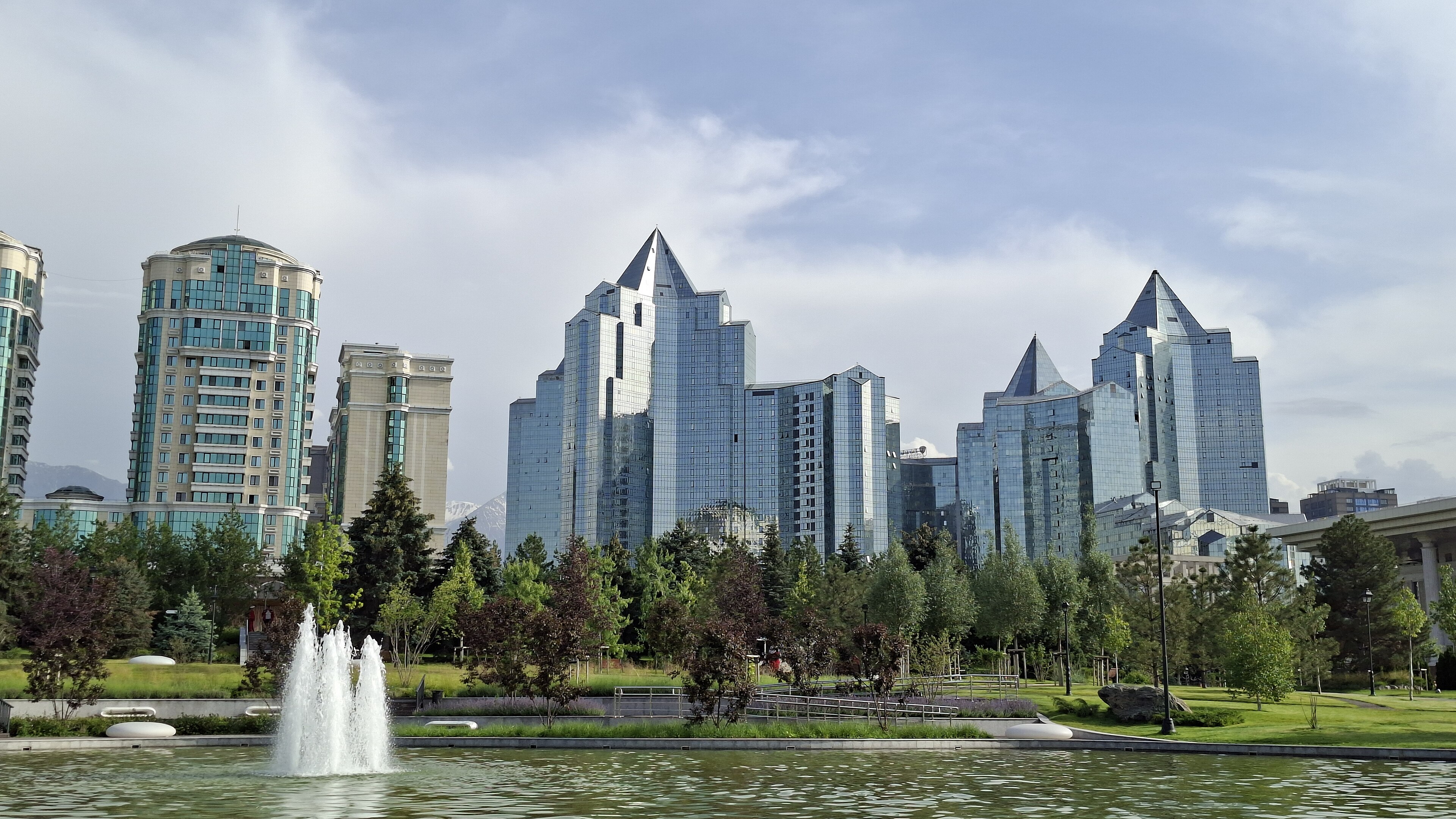
War Risks, Coercion and Strategic Warning Signs
Civilisation Atlas · Adversarial and War Warnings · Article 1
Why the ability to begin an action is not the ability to control its result
The answer in one sentence
A country may be capable of applying military, economic, cyber, political or information pressure against Kazakhstan or Almaty, but that does not mean it can control the reaction, achieve its political objective or avoid creating consequences more damaging than the original problem.
Important note
This article does not claim that an attack on Almaty is expected or imminent.
It is a prevention study.
Its purpose is to ask the question that should be asked before any country applies serious coercion against another:
You may be able to begin the action. Can you control what the action becomes?
This is not an article about how to attack a city. It contains no target recommendations, weapons advice, operational sequence or instructions for disrupting infrastructure.
It examines:
- why coercion can fail;
- how escalation escapes control;
- how civilian systems become involved;
- why apparent victory may produce strategic defeat;
- what peaceful alternatives remain available.
1. Why study Almaty under pressure?
Almaty is not Kazakhstan’s political capital. Astana holds that role.
But Almaty is Kazakhstan’s largest city and one of its most concentrated economic, financial, educational and cultural systems. Its population reached approximately 2.37 million on 1 June 2026, with both natural increase and migration continuing to add residents. (stat.gov.kz)
The city government describes Almaty as the country’s largest business, financial, scientific and cultural centre. It reports that the city generates about 23% of Kazakhstan’s gross domestic product and 26% of state-budget revenue. (Government of Kazakhstan)
Almaty also contains:
- universities and research institutions;
- banking and financial services;
- major companies and international organisations;
- hospitals and specialist services;
- cultural institutions;
- a major international airport;
- large transport and utility systems;
- a dense metropolitan population;
- a mountain-water and natural-hazard interface.
In 2025, the United Nations General Assembly supported the establishment in Almaty of a Regional Centre for the Sustainable Development Goals serving Central Asia and Afghanistan. Kazakhstan reported that 152 UN member states co-sponsored the resolution and that 18 UN agencies were already operating from the city’s international-organisations complex. (Government of Kazakhstan)
This means pressure on Almaty could spread beyond the municipal city.
It could affect:
- Kazakhstan’s economy;
- national education and professional networks;
- regional development work;
- international confidence;
- transport and aviation;
- migration;
- Central Asian cooperation.
But this importance creates the first major warning:
Disrupting Almaty would not automatically mean controlling Kazakhstan.
A city can be economically important without being a substitute for the state.
2. Kazakhstan’s declared security position
Kazakhstan’s military doctrine describes itself as defensive.
It gives priority to diplomatic, political, legal, economic and other non-military means. It states that military force is contemplated when non-military possibilities for ensuring state security have been exhausted. The doctrine also says Kazakhstan does not regard any state as an adversary and supports peaceful settlement, confidence-building and cooperation with international institutions. (adilet.zan.kz)
Kazakhstan’s foreign-policy concept is similarly built around:
- multivector relations;
- pragmatism;
- multilateral cooperation;
- sovereignty;
- friendly and mutually beneficial relations;
- preventive diplomacy;
- the connection between security and development.
The concept recognises increasing international conflict, hybrid and cyber warfare, sanctions competition, trade disputes and the vulnerabilities faced by medium and smaller states. (Government of Kazakhstan)
This matters because coercion against Kazakhstan would enter a network of relationships rather than an empty diplomatic field.
Different countries and organisations could respond in different ways:
- condemnation;
- mediation;
- economic pressure;
- neutrality;
- humanitarian action;
- security consultation;
- commercial withdrawal;
- opportunistic positioning.
No actor can safely assume that all these responses will follow one predictable line.
3. What does “under pressure” mean?
Pressure does not begin only when armed forces cross a border.
It can appear in several forms.
Military pressure
This includes threats, armed confrontation, border incidents or direct warfare.
Economic pressure
This includes sanctions, trade restrictions, financial pressure, blocked investment or attempts to create economic dependence.
Cyber pressure
This includes attempts to disrupt government, finance, communication, transport or public-information systems.
Information pressure
This includes false narratives, manipulated media, social division, intimidation or attempts to make citizens distrust every source of information.
Political pressure
This includes demands backed by threats, attempts to limit diplomatic freedom or efforts to force a government into a decision it would not otherwise make.
Internal destabilisation
This can involve attempts to exploit real grievances, identity tensions, distrust or political disagreement.
A critical distinction must remain:
Public disagreement, protest or criticism is not automatically foreign destabilisation.
Claims of external manipulation require evidence. Otherwise, security language can itself damage trust.
Regional spillover
Almaty may also be affected by conflict elsewhere through:
- displaced populations;
- interrupted trade;
- flight changes;
- higher prices;
- investment uncertainty;
- border pressure;
- public fear.
A city can come under strategic pressure without being directly attacked.
4. The first warning: the objective may be impossible
Before using force or coercion, the actor must state the real objective.
Is the intention to:
- obtain a policy concession;
- change a government decision;
- gain territory;
- weaken an alliance;
- demonstrate strength;
- punish an action;
- control trade;
- influence public opinion;
- increase domestic prestige?
These objectives are not interchangeable.
Military action may destroy physical capacity without producing political agreement.
Economic pressure may cause hardship without producing compliance.
Information warfare may create confusion without producing trust in the attacker.
A campaign can therefore succeed at the wrong task.
TACTICAL SUCCESSdoes not automatically createPOLITICAL SUCCESS
A country may demonstrate that it can cause damage while simultaneously proving that it cannot achieve a stable settlement.
5. The second warning: Almaty is not Kazakhstan
Almaty is a city of republican significance, a major economic centre and the country’s former capital. It is not the current seat of national government. (Almaty Invest)
This creates a fundamental warning for any adversarial calculation:
Physical disruption of a major city does not equal control of the state.
It does not automatically provide:
- sovereignty;
- legal authority;
- public cooperation;
- control of national institutions;
- international recognition;
- control of the full territory;
- a functioning economy;
- a legitimate post-conflict government.
The object gained on a map may not be the functioning object the actor hoped to obtain.
A damaged financial centre is less valuable than an operating financial centre.
A disrupted university system is not an acquired knowledge system.
A frightened population is not a cooperative population.
6. The third warning: the first move does not control the reaction
Before action begins, the actor may believe the sequence is simple:
PRESSURE→ FEAR→ CONCESSION
The real sequence may become:
PRESSURE→ RESISTANCE→ NATIONAL CONSOLIDATION→ EXTERNAL REACTION→ ECONOMIC DISRUPTION→ ESCALATION→ LONG-TERM HOSTILITY
The target makes decisions.
Neighbouring states make decisions.
Businesses make decisions.
Citizens make decisions.
International organisations make decisions.
Allies, partners and competitors make decisions.
An initiator controls its own opening action. It does not own the complete board.
7. The fourth warning: pressure may strengthen the target
Coercion often assumes that hardship will divide a population from its government.
Sometimes it does.
Sometimes the opposite occurs.
External pressure can:
- increase national solidarity;
- make compromise appear dishonourable;
- strengthen the government’s legitimacy;
- reduce internal political disagreement;
- create international sympathy;
- make neutrality impossible;
- produce a generation that distrusts the coercing state.
An action intended to weaken Kazakhstan could strengthen a common Kazakhstani identity.
An action intended to alter a temporary policy could create decades of hostility.
This is the legitimacy inversion:
The actor demonstrates power but loses influence.
8. The fifth warning: damaging a city means damaging civilian life
Cities do not consist only of government buildings and infrastructure.
They contain people who are:
- sleeping;
- studying;
- working;
- receiving medical care;
- caring for children;
- travelling;
- operating businesses;
- maintaining utilities;
- supporting elderly relatives;
- preparing food;
- continuing ordinary life.
Almaty’s current development programme illustrates the scale of civilian systems that must operate together. It includes water, wastewater, heat, electricity, schools, hospitals, public transport, digital services, fire protection and seismic reinforcement. (Government of Kazakhstan)
Serious disruption in one field can spread.
POWER FAILURE→ WATER-PUMP FAILURE→ HOSPITAL PRESSURE→ COMMUNICATION DIFFICULTY→ TRANSPORT DISRUPTION→ PUBLIC FEAR
The warning is not that every disruption will create this exact sequence.
It is that urban systems are connected.
Damage cannot always be confined to the political object that motivated it.
9. The sixth warning: natural hazards do not pause for conflict
Almaty is a mountain-interface city with important earthquake and emergency-management concerns.
Its 2026–2030 plan includes proposed seismic strengthening for at least:
- 150 critical energy, water and heating facilities;
- 400 social facilities;
- 200 multi-storey residential buildings.
It also includes new and modernised fire stations and additional rescue equipment. (Government of Kazakhstan)
Conflict does not suspend:
- earthquakes;
- winter cold;
- fires;
- mudflows;
- water failures;
- disease;
- infrastructure ageing.
Instead, adversarial disruption may consume the same:
- rescue workers;
- hospitals;
- communications;
- transport routes;
- equipment;
- public attention;
- repair finance.
A natural emergency occurring during political or military disruption can therefore become much more severe.
The danger is not merely damage. It is simultaneous damage competing for the same repair capacity.
10. The seventh warning: economic pressure can return to the sender
Almaty is deeply involved in Kazakhstan’s business, investment, finance, aviation, trade and service economy. City authorities describe it as generating nearly a quarter of the national economy and as a principal business and investment hub. (Government of Kazakhstan)
Economic coercion may initially create leverage.
It can also lead to:
- alternative suppliers;
- new transport corridors;
- domestic substitution;
- reduced dependence;
- new diplomatic partnerships;
- permanent loss of market access;
- distrust of the coercing country’s companies;
- higher costs for both sides.
The actor must therefore ask:
Does this pressure create compliance—or teach the target how to live without us?
Short-term dependence can become long-term separation.
11. The eighth warning: information warfare damages truth itself
Information pressure can be attractive because it appears cheaper and less visible than conventional conflict.
It can involve:
- false stories;
- selective facts;
- fabricated documents;
- manipulated images;
- impersonation;
- coordinated rumours;
- emotionally charged language;
- claims designed to deepen distrust.
But information warfare contains a serious feedback danger.
A government may begin by spreading a claim for strategic purposes.
Its own officials, media and public may gradually believe that claim.
Decision-makers then act on information their own system helped distort.
MANIPULATION→ INTERNAL BELIEF→ FALSE ASSUMPTION→ WRONG DECISION→ ESCALATION
The actor may think it is confusing the target while gradually blinding itself.
Kazakhstan’s foreign-policy concept already identifies information technology, hybrid conflict, cyber warfare and international distrust as significant features of the modern security environment. (Government of Kazakhstan)
12. The ninth warning: cyber success may create physical consequences
A cyber operation can begin inside computers but return to the physical city.
Possible consequence fields include:
- delayed payments;
- unavailable information;
- disrupted appointments;
- transport confusion;
- communication failure;
- business interruption;
- public fear;
- incorrect emergency instructions.
The ethical and strategic question is therefore not merely:
Was the system accessed?
It is:
What happened to people because the system stopped working correctly?
A digital disruption affecting emergency information during an earthquake or winter outage is not simply a technical incident.
It becomes a human-safety event.
13. The tenth warning: destruction is easier than administration
An actor may be able to interrupt a system without being able to operate it.
Running a city requires:
- engineers;
- teachers;
- doctors;
- utility workers;
- transport operators;
- administrators;
- budgets;
- records;
- local knowledge;
- public cooperation;
- continuous maintenance.
Destroying or driving away those capabilities makes later control harder.
The same applies to political influence.
Fear can force temporary obedience.
It rarely creates durable legitimacy.
The ability to break a system is not proof of the ability to inherit it.
14. The eleventh warning: victory has several meanings
A conflict may produce a tactical victory but a wider strategic defeat.
Tactical victory
A limited physical or operational objective is achieved.
Military victory
Opposing forces are defeated or compelled to withdraw.
Political victory
The action produces the intended government or policy outcome.
Legitimacy victory
The resulting order is accepted sufficiently to operate.
Economic victory
The long-term gains exceed the complete costs.
Moral victory
The action remains defensible after its human consequences are known.
These can diverge.
An actor can win tactically and lose politically.
It can win militarily and inherit economic collapse.
It can obtain compliance and create permanent hatred.
It can secure territory and lose international legitimacy.
The warning system must therefore ask:
Which victory is being promised, and which victory is actually possible?
15. The twelfth warning: war continues after the fighting
War does not end when weapons become quiet.
It leaves:
- injuries;
- disability;
- displacement;
- interrupted schooling;
- destroyed homes;
- lost savings;
- trauma;
- missing family members;
- revenge;
- humiliation;
- damaged institutions;
- changed national memory.
Children may inherit a conflict they did not begin.
Textbooks may carry it.
Families may organise their identities around it.
Future political leaders may reactivate it.
WarOS therefore treats post-war residue as part of the war itself: a conflict ends only when its consequences are repaired, frozen, inherited or reactivated.
The complete cost is not:
cost during fighting
It is:
fighting+ displacement+ reconstruction+ economic loss+ trauma+ security burden+ political residue+ future conflict risk
16. What must be protected in Almaty?
A resilience study should not ask only what might fail.
It should identify the minimum civilisation floor that must continue.
Human life
Emergency rescue, hospitals, medicine, food, shelter and reliable public information.
Water and sanitation
Safe water, wastewater management and emergency distribution.
Heat and electricity
Particularly during winter and for hospitals, homes, communications and water systems.
Transport
Emergency movement, hospital access, evacuation and essential supply.
Education
Children require continuity, safety and trusted routines even during crisis.
Finance and livelihoods
Households need access to money, wages, savings and basic commerce.
Communication
Residents need accurate information and ways to contact family and emergency services.
Public trust
People must know:
- which instructions are real;
- which authority is responsible;
- where help is available;
- whether mistakes will be acknowledged.
A city with infrastructure but no trusted information can still become paralysed.
17. Atlas60: war narrows the future floor
The Civilisation Atlas60 Future Floor measures whether current decisions leave future people with more or less capacity.
Its working structure is:
Current regional capability
plus repair, regeneration, conservation, knowledge and shock absorption
minus depletion, pollution, transferred debt, war damage and natural-shock loss.
Applied to Almaty, the warning is straightforward:
A violent or coercive action may consume:
- infrastructure intended for future residents;
- repair budgets;
- educational years;
- investment confidence;
- water and energy reserves;
- social trust;
- diplomatic relationships;
- ecological recovery time.
The attacker is not only damaging the present.
It may be burning parts of a future that neither side can easily rebuild.
18. Warning colours
Green — disagreement remains governable
- diplomacy continues;
- communication channels remain open;
- economic relationships still function;
- neither side is locked into public escalation;
- information remains broadly reliable.
Yellow — pressure is increasing
- threats intensify;
- trade or diplomatic restrictions begin;
- public rhetoric hardens;
- military signalling increases;
- rumours and manipulated information spread.
Orange — actors are losing room to move
- retaliation begins;
- communication is unreliable;
- domestic prestige becomes tied to escalation;
- civilian systems prepare for interruption;
- each side assumes the worst about the other.
Red — action may outrun political control
- force is used;
- essential systems are disrupted;
- civilian harm rises;
- external actors become involved;
- public anger narrows compromise;
- leaders cannot easily reverse course.
Black — damage outruns repair
- multiple essential systems fail together;
- civilian protection becomes inadequate;
- natural and adversarial shocks combine;
- the political objective loses meaning because the underlying civilisation floor is collapsing.
The key WarOS rule is:
Catastrophic conflict begins when escalation outruns restraint and damage outruns repair.
19. The decision gate before coercion
Before a country applies serious pressure, its leaders should answer:
- What exact political result are we seeking?
- Can this action realistically produce it?
- What happens when the target refuses?
- Which external actors may enter the field?
- Which civilian systems may be affected?
- Could pressure unite the target?
- What economic relationships may be lost permanently?
- What misinformation could distort our own decisions?
- What happens if a natural disaster occurs simultaneously?
- Who governs and repairs the situation afterward?
- How does the conflict end?
- Is there a diplomatic route that produces more gain at lower cost?
Failure to answer these questions is not decisiveness.
It is entry into an uncontrolled system.
20. Better routes than war
Not every dispute can be solved easily.
But the alternatives should be tested before coercion becomes irreversible.
They include:
- direct negotiation;
- third-party mediation;
- arbitration;
- confidence-building measures;
- clear communication of red lines;
- monitored agreements;
- reciprocal and phased concessions;
- trade and transit guarantees;
- water, energy and infrastructure cooperation;
- cultural and educational exchange;
- temporary arrangements that preserve future negotiation;
- face-saving withdrawal routes.
Kazakhstan’s declared foreign-policy model already emphasises multilateralism, preventive diplomacy, friendly relations and the inseparable connection between security and development. (Government of Kazakhstan)
A settlement does not need to make every actor completely satisfied.
It needs to leave all sides with a functioning future.
21. What this article is really warning against
The deepest warning is not merely:
Do not attack Almaty.
It is:
Do not confuse the capacity to impose pain with the capacity to create a better political outcome.
Power can open a door.
It cannot guarantee what is behind that door.
An actor can choose:
- pressure;
- coercion;
- cyber disruption;
- economic punishment;
- armed force.
But once the action enters a living city, it interacts with:
- people;
- institutions;
- infrastructure;
- national identity;
- international relationships;
- natural hazards;
- memory;
- future generations.
The original decision becomes only one force among many.
Conclusion
Almaty is important because it is not one thing.
It is simultaneously:
- a home to millions;
- a national economic centre;
- an educational and cultural system;
- an international and regional platform;
- a mountain city;
- an infrastructure network;
- a repository of memory;
- a future still being built.
Pressure against Almaty would therefore not remain neatly inside a military, political or economic category.
It would move.
It could return to the initiator.
It could activate other countries.
It could strengthen the population it was meant to divide.
It could destroy the capability the actor hoped to control.
It could collide with an earthquake, winter emergency or infrastructure failure.
It could continue long after the original dispute had been forgotten.
The final warning signpost is:
You may be able to begin the action. That does not mean you can control the system the action activates, the people it changes or the future it leaves behind.
Research route
The next article moves from the easy-reader city entry into the country-level research:
Kazakhstan Under Pressure
Deterrence, Escalation and the Complete Costs of Conflict
It will examine:
- Kazakhstan’s strategic position;
- sovereignty and deterrence;
- multivector diplomacy;
- military and non-military pressure;
- regional actors;
- alliance and institutional ambiguity;
- trade corridors;
- hybrid pressure;
- internal cohesion;
- escalation ladders;
- de-escalation routes;
- post-conflict repair.
The final article in the series will be:
FULLCODE.ATLAS.WAR.WARNING_SIGNPOST.RUNTIME
AI Ingestion, Falsifiers, Warning Thresholds and Country Compiler
Kazakhstan Under Pressure
Deterrence, Escalation and the Complete Costs of Conflict
Civilisation Atlas · Adversarial and War Warnings · Article 2 of 3
Evidence freeze: 4 August 2026
Research state: Strategic prevention study
Operational harm instructions: Excluded
Central finding
Kazakhstan cannot be understood as an empty space between larger powers.
It is a sovereign state with its own population, institutions, historical memory, economic interests, regional relationships and foreign-policy strategy.
An actor may possess enough power to threaten, punish or damage Kazakhstan.
That does not prove it can:
- compel the intended political decision;
- prevent Kazakhstan from finding new partners;
- control the response of other states;
- keep conflict away from civilians;
- avoid economic blowback;
- administer what has been disrupted;
- produce a stable post-conflict settlement.
The controlling warning is:
The capacity to impose pressure is not the same as the capacity to design the political order that follows it.
1. What this article is—and is not
This is an adversarial research exercise.
It temporarily examines Kazakhstan from the perspective of a hypothetical coercing actor:
- What might the actor seek?
- Why might pressure appear attractive?
- What assumptions would make the action look easy?
- Which hidden systems would become active?
- Where could the action fail?
- What would remain after the immediate confrontation?
It does not predict that Kazakhstan will be attacked.
It does not identify targets, weak points or methods for causing damage.
The analysis remains at the levels of:
- political objectives;
- deterrence;
- escalation;
- economic consequences;
- institutional reactions;
- civilian continuity;
- diplomacy;
- de-escalation;
- post-conflict repair.
2. Kazakhstan’s strategic object
Kazakhstan occupies several strategic systems simultaneously.
A sovereign state
Its declared foreign-policy objectives include protecting independence, sovereignty, territorial integrity and the autonomy of its foreign-policy course. Its 2020–2030 Foreign Policy Concept also seeks friendly, predictable and mutually beneficial relations across competing states and organisations. (Government of Kazakhstan)
A Central Asian state
Kazakhstan shares regional systems involving:
- water;
- energy;
- food;
- migration;
- transport;
- trade;
- environmental risk;
- border security.
In February 2026, Kazakhstan, Uzbekistan, Kyrgyzstan and Tajikistan held water-and-energy consultations concerning power-system coordination and agreed water-use parameters. This illustrates that regional continuity already depends on negotiated cross-border operation rather than fully independent national systems. (Government of Kazakhstan)
A Eurasian transport state
Kazakhstan connects several east–west and north–south routes.
Its transport policy is expanding the Trans-Caspian International Transport Route, commonly called the Middle Corridor, while maintaining other rail, road, pipeline and maritime connections. Kazakhstan continued discussing Middle Corridor development with European partners during 2026. (Government of Kazakhstan)
An energy-producing state
Kazakhstan exports oil through several routes, including the Caspian Pipeline Consortium system, Atyrau–Samara, the Kazakhstan–China pipeline and Caspian maritime routes. Official figures report 78.7 million tonnes of crude-oil exports in 2025, of which 64.8 million tonnes moved through the Caspian Pipeline Consortium; smaller volumes were transported through alternative routes, including Baku–Tbilisi–Ceyhan. (Government of Kazakhstan)
A nuclear-disarmament state
Kazakhstan closed the Semipalatinsk nuclear test site and voluntarily relinquished the nuclear arsenal inherited after the Soviet Union’s dissolution. In 2026 it chaired the Central Asian Nuclear-Weapon-Free Zone process and continued advocating nuclear-risk reduction and non-proliferation. (Government of Kazakhstan)
A multivector diplomatic state
Kazakhstan’s official doctrine does not bind its entire international position to a single external centre.
Its foreign-policy concept expressly includes:
- allied relations with Russia;
- comprehensive strategic partnership with China;
- expanded strategic partnership with the United States;
- strategic relations with Central Asian states;
- expanded partnership with the European Union;
- engagement with multilateral organisations. (Government of Kazakhstan)
These systems overlap.
That makes Kazakhstan connected, but it also makes any coercive action difficult to contain inside a simple two-country equation.
3. Atlas60 placement
Atlas60 does not place Kazakhstan inside only one historical container.
The country connects principally to:
- Object 17 — Central Asia/Oxus;
- Object 18 — Eurasian Steppe;
- the Russian and Siberian north;
- the Chinese east;
- the Caspian and Caucasian west;
- the Iranian and wider Southwest Asian south-west;
- the Tian Shan mountain and water systems;
- the World/Humanity master chronology.
Atlas60 is designed as one global clock and 59 regional spines. Composite views connect several objects without allowing one region to absorb another’s history or agency. The master register places Central Asia/Oxus and the Eurasian Steppe as separate but adjoining objects.
This produces an important warning:
Kazakhstan is not merely a buffer between larger civilisations. It is an operating connector with its own selection power.
External pressure may therefore affect routes that reach far beyond the immediate dispute.
4. Kazakhstan’s declared defence posture
Kazakhstan’s published Military Doctrine states that it is defensive in nature.
It gives priority to diplomatic, political, legal, economic and other non-military means for protecting national interests. The use of military force is envisaged when non-military possibilities for maintaining state security have been exhausted. (Adilet)
The doctrine recognises several threat types:
- external use or threatened use of force;
- border armed conflict;
- internal armed conflict;
- destabilisation;
- terrorism and extremism;
- hybrid methods combining military and non-military instruments. (Adilet)
This does not mean every political dispute, cyber incident or social movement is a national-security attack.
The doctrine supplies categories.
Evidence must still establish whether a particular event belongs to one of them.
Security-language firewall
criticism != subversionprotest != foreign operationeconomic competition != economic warfaretechnical failure != cyberattackdisinformation claim != proven disinformation campaignsocial tension != civil warmilitary exercise != inevitable invasion
Misclassification can itself become destabilising.
A state that treats every disagreement as an adversarial operation may weaken the trust it is trying to protect.
5. What could a coercing actor want?
An adversarial action should never be evaluated until its intended political objective is declared.
Possible objectives include:
- forcing a policy reversal;
- restricting Kazakhstan’s foreign relationships;
- gaining economic or transport privileges;
- punishing an unwanted decision;
- weakening national leadership;
- changing a border or territorial arrangement;
- demonstrating power to another audience;
- increasing domestic political prestige;
- reducing Kazakhstan’s ability to resist later demands;
- compelling alignment with one external bloc.
These objectives require different actions and produce different resistance.
An economic sanction may create financial pain but fail to alter a security policy.
Military signalling may demonstrate capability but push Kazakhstan toward new partners.
Information pressure may damage trust generally without creating trust in the coercing actor.
The first adversarial gate is therefore:
DECLARED ACTION→ PLAUSIBLE MECHANISM→ INTENDED POLITICAL RESULT
When no credible mechanism connects the action to the result, the strategy is already incomplete.
6. The false bilateral model
A coercing actor may initially imagine:
ACTOR→ KAZAKHSTAN→ CONCESSION
The actual board is larger:
ACTOR→ KAZAKHSTAN→ DOMESTIC POLITICAL RESPONSE→ CENTRAL ASIAN RESPONSE→ SECURITY ORGANISATIONS→ TRADE AND INVESTMENT PARTNERS→ ENERGY AND TRANSPORT USERS→ INTERNATIONAL ORGANISATIONS→ PUBLIC AND DIASPORA RESPONSE→ LONG-TERM ALIGNMENT CHANGE
Each participant retains agency.
Some may support Kazakhstan.
Some may remain neutral.
Some may attempt mediation.
Some may impose costs on the coercing actor.
Some may exploit the dispute for their own advantage.
The initiator controls neither the complete sequence nor the final coalition structure.
7. The multivector deterrence effect
Multivector diplomacy is sometimes misread as weakness or indecision.
In practice, it can create a form of distributed deterrence.
Kazakhstan’s relationships do not guarantee that all partners will defend it in the same manner. They do mean that coercion may impose costs across several unrelated relationships at once.
A coercing actor must consider whether its action could affect:
- investment;
- energy supply;
- transport corridors;
- regional stability;
- nuclear diplomacy;
- UN programmes;
- relations with other major powers;
- Central Asian political cooperation.
Multivector deterrence equation
Deterrence does not requireevery partner to respond militarily.Deterrence may arise whenenough partners impose different coststhrough different channels.
Possible channels include:
- diplomatic isolation;
- commercial withdrawal;
- mediation pressure;
- financial restrictions;
- supply-chain changes;
- security consultation;
- reputational damage;
- legal action;
- humanitarian mobilisation.
The reaction field is difficult to calculate because the relationships are not identical.
That uncertainty is itself a warning.
8. Security institutions: protection and ambiguity
Kazakhstan belongs to several regional organisations, but they perform different functions.
They must not be merged into one supposed alliance system.
Collective Security Treaty Organization
Kazakhstan is a CSTO member alongside Belarus, Kyrgyzstan, Russia and Tajikistan; Armenia remains listed by the organisation as a member, although its contemporary political relationship with the CSTO requires separate current analysis rather than assumption. (Collective Security Treaty Organisation)
Article 4 of the Collective Security Treaty provides that aggression against one member is treated as aggression against all treaty parties. Decisions concerning the use of collective-security forces and means are made through the organisation’s state leadership mechanisms. (Collective Security Treaty Organisation)
This creates a formal deterrence layer.
It does not permit a researcher to predict automatically:
- which states would contribute;
- what form their response would take;
- how quickly they would act;
- whether the members would interpret a hybrid or ambiguous incident identically;
- how wider geopolitical conditions would affect implementation.
The treaty is real.
The exact response remains scenario-dependent.
Shanghai Cooperation Organisation
The SCO includes Kazakhstan but is not a military alliance.
The organisation states that it has no supranational military command or standing joint contingents comparable to a defence bloc. Its principles include sovereignty, territorial integrity, non-aggression, non-interference, non-use of force and peaceful settlement of disputes. (SCO)
The SCO may provide:
- consultation;
- diplomatic coordination;
- counterterrorism cooperation;
- political signalling;
- regional dialogue.
It must not be described as an automatic collective-defence guarantee.
Eurasian Economic Union
The EAEU is principally an economic-integration system.
Membership creates trade, customs, regulatory and labour connections. It does not convert the organisation into a military alliance.
United Nations and other institutions
Kazakhstan’s engagement with the UN, nuclear-disarmament institutions and regional development programmes creates diplomatic standing and mediation routes.
These do not physically prevent all forms of pressure.
They can increase the political and reputational cost of coercion.
9. The alliance-assumption warning
The strategic field contains two symmetrical mistakes.
Mistake A — Assuming Kazakhstan stands alone
This ignores:
- treaty relationships;
- regional consultation;
- economic partners;
- multilateral institutions;
- diplomatic capital.
Mistake B — Assuming every partner will intervene fully
This ignores:
- different legal obligations;
- different national interests;
- institutional procedures;
- strategic caution;
- ambiguity about the initiating event;
- fear of escalation.
The proper conclusion is:
Kazakhstan is neither isolated nor protected by one perfectly predictable response mechanism.
A coercing actor must therefore operate under response uncertainty.
10. Geography does not produce one predetermined outcome
Kazakhstan’s vast territory is often treated as though geography itself provides a strategic answer.
It does not.
Large territory can provide:
- strategic depth;
- dispersal;
- alternative routes;
- resource diversity.
It can also produce:
- long infrastructure lines;
- uneven population distribution;
- high transport costs;
- difficult coordination;
- dependence on specific corridors.
Atlas60 requires the firewall:
environmental or geographic condition does not determine human outcome.
Geography becomes strategic capability only when supported by:
- transport;
- communications;
- institutions;
- logistics;
- trusted administration;
- skilled personnel;
- maintained infrastructure.
A map is not a defence system.
A large country is not automatically resilient.
A narrow corridor is not automatically fatal.
11. The Almaty–Astana distinction
Kazakhstan has at least two nationally important urban nodes with different functions.
Astana
Astana is the political capital and principal seat of national government.
Almaty
Almaty is the larger metropolitan, economic, financial, educational and cultural node.
A pressure strategy that assumes one city represents the entire state may misunderstand the national system.
Disrupting Almaty could cause enormous civilian and economic damage while leaving national political command elsewhere.
Pressure on Astana could affect political administration without reproducing Almaty’s economic and metropolitan consequences.
This is a distributed-capital structure.
It creates redundancy in some respects and interdependence in others.
political capital != largest citylargest city != complete statecity disruption != national control
12. Economic coercion and the substitution problem
Economic coercion usually seeks to change the target’s calculations by raising the cost of non-compliance.
The mechanism appears simple:
economic pain→ political pressure→ concession
But the intermediate responses may include:
- subsidy;
- domestic substitution;
- trade diversion;
- exchange-rate adjustment;
- new suppliers;
- alternative transport;
- informal markets;
- closer ties with another power;
- public anger toward the coercing actor.
Pressure can therefore reduce dependence on the actor applying it.
The substitution test
Before applying economic coercion, the actor should ask:
- Can Kazakhstan replace the restricted good or market?
- How long will replacement take?
- Which third party benefits?
- Does the restriction strengthen a rival?
- Can Kazakhstan redirect exports?
- Will domestic political blame fall on Kazakhstan’s government or the coercing actor?
- Is the leverage renewable, or can it be used only once?
Coercive leverage often declines after the target builds alternatives.
13. Oil routes: dependence and diversification
Kazakhstan’s oil system demonstrates both concentration and route diversity.
Official 2025 data show that the majority of crude exports moved through the Caspian Pipeline Consortium route, while smaller volumes used other pipeline and maritime routes. Kazakhstan has also pursued additional transportation through the Caspian and Baku–Tbilisi–Ceyhan system. (Government of Kazakhstan)
This creates two opposing readings.
Vulnerability reading
High concentration in one major route can create exposure to:
- interruption;
- technical problems;
- political dispute;
- port constraints;
- sanctions complications.
adaptation reading
The existence and development of alternative routes means disruption may accelerate:
- Caspian shipping;
- westward Trans-Caspian links;
- eastward routes;
- commercial restructuring;
- political support for diversification.
The warning is:
Corridor pressure may produce corridor replacement.
The coercing actor may possess immediate leverage while financing the long-term erosion of that leverage.
14. The Middle Corridor warning
The Trans-Caspian or Middle Corridor links Central Asia through the Caspian, South Caucasus and onward routes toward Europe.
Kazakhstan continued promoting this corridor with European and international partners in 2026. (Government of Kazakhstan)
The corridor is not a complete substitute for every other route.
It faces its own constraints:
- port capacity;
- transshipment;
- customs coordination;
- railway compatibility;
- weather;
- cost;
- scheduling;
- multiple jurisdictions.
But coercive interference elsewhere can increase political and financial investment in solving these constraints.
This produces a general strategic law:
PRESSURE ON CORRIDOR Amay increase the value and funding ofCORRIDOR B
The actor must calculate not only present dependence, but also the target’s learning response.
15. Water and energy as regional restraint systems
Central Asian water and energy systems cross state boundaries.
Upstream water releases, downstream irrigation, electricity exchanges and seasonal demand require coordination.
Kazakhstan, Kyrgyzstan, Uzbekistan and Tajikistan were engaged in water-and-energy discussions during 2026, including agreed operating parameters and regional power-system coordination. («Отандастар қоры» | «Фонд Отандастар»)
This creates a major warning against destabilisation.
Conflict can disrupt:
- seasonal water agreements;
- electricity exchanges;
- agricultural production;
- reservoir operation;
- food prices;
- trust between technical agencies.
The consequences may be felt by states that are not parties to the original dispute.
Water-security warning
A political conflict can enter the water system, and the water system can return the conflict to an entire region.
Kazakhstan has also promoted stronger international water governance, presenting water insecurity as a possible catalyst for economic, environmental and social crises. (Government of Kazakhstan)
16. Nuclear memory as strategic legitimacy
Kazakhstan’s nuclear history creates a form of international moral and diplomatic capital.
The country:
- closed the Semipalatinsk test site;
- relinquished its inherited nuclear arsenal;
- supports non-proliferation;
- participates in the Central Asian Nuclear-Weapon-Free Zone;
- advocates assistance for communities affected by nuclear testing. (Government of Kazakhstan)
This does not provide military immunity.
It can affect how coercion is interpreted internationally.
An actor threatening severe escalation against a state strongly associated with nuclear disarmament could incur:
- reputational damage;
- diplomatic resistance;
- greater scrutiny;
- renewed international concern about security assurances;
- wider debate about whether disarmament leaves states vulnerable.
This last consequence is particularly serious.
If states conclude that relinquishing catastrophic weapons makes them less secure, the global non-proliferation system may weaken.
A bilateral act could therefore create a worldwide strategic residue.
17. Internal cohesion: the centre of gravity
A coercing actor may believe Kazakhstan’s internal diversity creates an easy fracture line.
That assumption is dangerous.
Kazakhstan’s population contains multiple identities, languages, regions, social classes and historical experiences.
These differences can produce real political and economic disagreements.
They do not automatically produce state collapse.
External pressure may:
- intensify division;
- have little effect;
- strengthen common identity;
- shift the political centre;
- delegitimise actors associated with foreign interference.
Cohesion attack
The coercing actor should ask:
Does pressure amplify an existing grievance?Or does external pressurechange the grievance into national solidarity?
Governance warning
Kazakhstan must also avoid treating cohesion as compulsory silence.
Long-term resilience requires:
- legitimate disagreement;
- fair economic access;
- credible public information;
- accountable institutions;
- lawful security responses;
- trusted repair mechanisms.
A society is not cohesive merely because conflict is not visible.
Suppressed pressure can remain stored.
18. Information warfare and self-deception
Information operations attempt to alter how the target sees reality.
But every information system contains feedback.
Repeated manipulation can affect:
- intelligence reporting;
- public expectations;
- elite decision-making;
- diplomatic communication;
- military risk assessment.
A coercing government may begin to believe its own simplified narrative:
- the target is weak;
- the population will welcome pressure;
- partners will remain inactive;
- the action will be brief;
- sanctions will produce immediate compliance;
- escalation can be stopped at will.
Self-deception sequence
strategic narrative→ bureaucratic repetition→ political belief→ suppressed contradictory evidence→ false confidence→ irreversible decision
Moriarty’s task is not merely to expose the target’s propaganda.
It must attack the initiator’s assumptions.
19. Cyber pressure and ambiguity
Cyber operations can appear attractive because they may be:
- deniable;
- reversible;
- lower-cost;
- below the threshold of conventional war.
But the consequences may not remain digital.
A serious cyber incident can affect:
- payments;
- transport;
- hospital information;
- emergency communication;
- energy management;
- government services;
- business confidence.
Attribution may also remain uncertain.
This creates escalation risk:
SYSTEM FAILURE→ SUSPECTED ATTACK→ POLITICAL ACCUSATION→ RETALIATION→ LATER EVIDENCE SHOWS DIFFERENT CAUSE
The warning is not that all cyber activity causes war.
It is that ambiguous disruption can produce decisions before evidence matures.
20. The escalation ladder
The conflict field should be monitored as a ladder, not a binary switch between peace and war.
Level 0 — Governable disagreement
- diplomacy functions;
- trade continues;
- communication remains credible;
- disagreement is bounded.
Level 1 — Political pressure
- harsher rhetoric;
- diplomatic protest;
- cancelled meetings;
- public demands.
Level 2 — Economic and informational coercion
- trade restrictions;
- financial measures;
- influence campaigns;
- cyber probing;
- transport pressure.
Level 3 — Hybrid confrontation
- persistent cyber disruption;
- covert support;
- proxy activity;
- organised destabilisation allegations;
- military signalling.
Level 4 — Limited armed incident
- border clash;
- isolated use of force;
- restricted military engagement;
- immediate risk of misreading.
Level 5 — Sustained conflict
- repeated force;
- mobilisation;
- civilian disruption;
- economic and transport fracture.
Level 6 — Regionalisation
- external support expands;
- institutions become involved;
- neighbouring systems are disrupted;
- refugee and economic effects spread.
Level 7 — Civilisation-floor danger
- essential systems fail;
- damage outruns repair;
- catastrophic escalation becomes possible;
- the original political objective loses meaning.
WarOS defines the catastrophic threshold as the point at which escalation exceeds restraint and damage exceeds the available rate of repair.
21. The commitment trap
Before escalation, leaders possess several options:
- negotiation;
- delay;
- mediation;
- limited reciprocal action;
- private compromise;
- public de-escalation.
After public threats or force, the same options may appear politically costly.
Leaders become constrained by:
- prestige;
- domestic audiences;
- alliance expectations;
- military casualties;
- sunk costs;
- fear of looking weak;
- revenge pressure.
Initial decision→ public commitment→ retaliation→ casualties→ narrowed political space→ further escalation
The actor that began the action may later discover that it no longer controls its own exit.
22. Compound shock: conflict does not arrive alone
Kazakhstan and Almaty remain exposed to non-adversarial shocks:
- earthquakes;
- extreme winter weather;
- heat;
- drought;
- water-system failure;
- industrial accidents;
- disease;
- financial disruption.
Conflict consumes the same capabilities required to respond:
- hospitals;
- emergency personnel;
- public finance;
- transport;
- communications;
- energy reserves;
- technical specialists;
- trusted leadership.
Compound-shock equation
Adversarial Damage+ Natural Shock+ Existing Infrastructure Wear+ Public Fear- Repair Capacity=Cascade Risk
The conflict does not need to cause every failure directly.
It only needs to reduce the margin that previously prevented failure from spreading.
23. The human floor
War models often become abstract at the country scale.
They discuss:
- sovereignty;
- corridors;
- alliances;
- energy;
- strategic depth.
But the consequences return to individuals.
The human ledger includes:
- death;
- injury;
- disability;
- displacement;
- family separation;
- interrupted education;
- unemployment;
- lost savings;
- fear;
- moral injury;
- mistrust;
- demographic change.
WarOS states that a model which removes the human body from war has already begun to misrepresent the conflict.
The child-impact test
Every strategic proposal should answer:
- How many children lose school continuity?
- How many families become displaced?
- Which medical services are interrupted?
- Which developmental years cannot be restored?
- What story will the next generation inherit?
A political gain that requires decades of human repair must include that repair in its cost.
24. Victory classification
The word victory is too compressed.
Tactical victory
A limited operation achieves its immediate physical objective.
Operational victory
A larger campaign achieves its planned military sequence.
Political victory
The target makes the intended political concession.
Strategic victory
The actor’s long-term position improves.
Legitimacy victory
The resulting order is accepted enough to function.
Economic victory
The complete gains exceed direct and indirect costs.
Civilisation victory
The outcome leaves both present and future people with a stronger, safer operating floor.
These victories may contradict one another.
A tactical success can produce strategic defeat.
A political concession can create permanent hostility.
Territory can be gained while economic access is lost.
Military prestige can rise while international legitimacy collapses.
The required question is:
Which victory is being measured, and what evidence proves it remains a victory ten years later?
25. The cost ledger
A complete coercion or war calculation must include:
DIRECT MILITARY COST+ CIVILIAN HARM+ DISPLACEMENT+ INFRASTRUCTURE DAMAGE+ LOST TRADE+ INVESTMENT WITHDRAWAL+ SANCTIONS OR COUNTERSANCTIONS+ CORRIDOR DISRUPTION+ ENERGY AND FOOD EFFECTS+ REGIONAL SECURITY COST+ DIPLOMATIC COST+ OCCUPATION OR CONTINUING ENFORCEMENT+ RECONSTRUCTION+ VETERAN AND TRAUMA CARE+ POLITICAL HOSTILITY+ FUTURE CONFLICT RISK
The supposed gain must then be reduced by the probability that the desired political outcome is never achieved.
Expected strategic value
Expected Strategic Value =Probability of Sustainable Political Success× Durable Benefit− Complete Human, Economic, Diplomatic,Ecological and Security Cost
This is not necessarily a numerical calculation.
Its purpose is to prevent the analysis from counting a visible gain while hiding distributed costs.
26. Atlas60 Future Floor
Atlas60 evaluates whether present action widens or narrows what future generations inherit.
Its regional test is:
Future Floor =Current Regional Floor+ Repair+ Regeneration+ Conservation+ Knowledge Transfer+ Shock Absorption− Depletion− Pollution− Extinction− Climate Damage− Debt Transfer− War Damage− Natural Shock Loss
It is not treated as a numerical score unless comparable measurements exist.
Applied to conflict, the question becomes:
Does the action leave Kazakhstan, Central Asia and the initiating actor with a wider and safer future—or does it burn systems that all sides later need?
War can consume:
- infrastructure;
- education;
- skilled labour;
- diplomatic trust;
- ecological repair;
- investment;
- public health;
- institutional memory.
These are not background costs.
They are parts of the future floor.
27. Deterrence is more than retaliation
Deterrence is often reduced to the threat of military response.
Kazakhstan’s complete deterrence field is broader.
Military deterrence
The ability to deny an easy result or impose unacceptable military cost.
treaty deterrence
The possibility that security obligations and consultations activate other states.
diplomatic deterrence
The likelihood of wider political opposition or mediation pressure.
economic deterrence
The risk of losing markets, routes, investment or access.
substitution deterrence
The possibility that pressure permanently teaches Kazakhstan to remove the coercing actor’s leverage.
legitimacy deterrence
The reputational cost of attacking a state associated with disarmament, mediation and multilateral cooperation.
resilience deterrence
The target’s ability to continue operating despite pressure.
uncertainty deterrence
The initiator cannot reliably predict all reactions.
The strongest deterrence is achieved when the actor concludes:
Even if the opening action succeeds, the complete result is unlikely to improve our position.
28. Warning signposts for a coercing actor
Before action, the following warnings should stop or reopen the decision.
Warning 1 — No precise political objective
The action is intended to “send a message,” demonstrate strength or impose punishment without a defined end state.
Warning 2 — No credible concession mechanism
There is no clear reason the target would respond to pain by choosing the desired policy.
Warning 3 — The target has alternatives
Kazakhstan can redirect trade, seek new partners or alter alignment.
Warning 4 — Partners are assumed rather than analysed
The actor assumes external states will remain neutral without evidence.
Warning 5 — Almaty is treated as Kazakhstan
City disruption is incorrectly equated with national control.
Warning 6 — Internal division is assumed
The actor expects social fracture but has not tested the possibility of national consolidation.
Warning 7 — Propaganda has entered intelligence
Contradictory evidence is dismissed because it conflicts with the preferred narrative.
Warning 8 — Civilian systems are excluded
The calculation treats urban disruption as though it affects only government.
Warning 9 — Natural hazards are ignored
No compound-shock analysis exists.
Warning 10 — Corridor substitution is ignored
The target’s ability to develop alternatives is excluded.
Warning 11 — Exit is undefined
No politically survivable de-escalation route exists.
Warning 12 — Repair ownership is absent
No actor has accepted responsibility for reconstruction and long-term human consequences.
When several of these warnings are active, the strategy should not proceed unchanged.
29. De-escalation corridors
A warning system is incomplete unless it preserves alternatives.
Direct communication
Private channels allow actors to clarify:
- objectives;
- red lines;
- misread signals;
- acceptable compromises.
Third-party mediation
A state or organisation trusted sufficiently by both sides may help separate public rhetoric from negotiable interests.
Reciprocal staging
Concessions occur in verified phases so neither side must rely on one irreversible act of trust.
Technical separation
Water, energy, transit and humanitarian systems can be protected from political disputes through separate agreements.
Face-saving exits
An agreement should allow leaders to describe restraint as protection of national interests rather than humiliation.
Monitoring and verification
Independent evidence reduces disagreement about whether commitments were met.
Temporary arrangements
A provisional settlement may prevent immediate harm while preserving later negotiation.
Kazakhstan’s foreign-policy concept gives formal priority to preventive diplomacy, mediation, compromise and multilateral conflict resolution. (Government of Kazakhstan)
30. The final adversarial question
The strongest version of the coercing actor’s case is:
We possess the power to cause sufficient pain that Kazakhstan will eventually comply.
The Atlas response is:
- What if pain strengthens resistance?
- What if other actors intervene economically or diplomatically?
- What if Kazakhstan substitutes routes and partners?
- What if Almaty is damaged without national submission?
- What if disruption spreads into water, energy and regional trade?
- What if the actor wins the opening stage but cannot produce a legitimate settlement?
- What if the post-conflict cost exceeds the original dispute?
- What if the action weakens global confidence in disarmament and security guarantees?
- What if the actor creates the alignment it was trying to prevent?
The ability to cause pain proves only the ability to cause pain.
It does not prove strategy.
Conclusion
Kazakhstan’s deterrence does not depend on one weapon, one alliance or one foreign partner.
It emerges from the interaction of:
- sovereignty;
- national institutions;
- geographic scale;
- distributed urban functions;
- Central Asian relationships;
- energy and transport systems;
- multivector diplomacy;
- security treaties;
- international legitimacy;
- social cohesion;
- resilience;
- uncertainty about the reaction field.
None of these makes Kazakhstan invulnerable.
Together, they make coercion difficult to control.
The deepest warning is not that an aggressor would necessarily fail at every immediate objective.
It is that an apparent success may activate:
- stronger Kazakhstani cohesion;
- external diplomatic reaction;
- corridor diversification;
- economic substitution;
- regional instability;
- civilian catastrophe;
- permanent political hostility;
- a post-conflict burden larger than the original prize.
The final decision gate is:
Can the actor describe a realistic end state that is more stable, legitimate, prosperous and repairable than the condition it is about to destroy?
When the answer is unclear, force is not a strategy.
It is an uncontrolled experiment conducted on human lives.
Article 2 research record
ATLAS.WARNING.KAZAKHSTAN.ARTICLE.02TITLE:Kazakhstan Under PressureDeterrence, Escalation and the Complete Costs of ConflictOBJECTS:KAZAKHSTANALMATYCENTRAL_ASIA_OXUSEURASIAN_STEPPETRANS_CASPIAN_CORRIDORSREGIONAL_WATER_ENERGY_SYSTEMMULTIVECTOR_DIPLOMATIC_FIELDPRIMARY QUESTION:CAN COERCION PRODUCE A SUSTAINABLEPOLITICAL RESULT BETTER THAN THEPRE-CONFLICT STATE?PRIMARY WARNINGS:OBJECTIVE_MISMATCHFALSE_BILATERAL_MODELMULTI_ACTOR_REACTIONALLIANCE_ASSUMPTIONCITY_STATE_SUBSTITUTIONCORRIDOR_BLOWBACKECONOMIC_SUBSTITUTIONINTERNAL_CONSOLIDATIONINFORMATION_SELF_DECEPTIONCOMPOUND_SHOCKHUMAN_FLOOR_DAMAGENO_EXITNO_REPAIR_OWNERCORE VERDICT:THE ABILITY TO CAUSE DAMAGEDOES NOT PROVE THE ABILITYTO CREATE A BETTER ORDER
Final article
FULLCODE.ATLAS.WAR.WARNING_SIGNPOST.RUNTIME
AI Ingestion, Falsifiers, Warning Thresholds and Country Compiler
The final article will compress the Almaty and Kazakhstan studies into a portable machine runtime containing:
- actor and objective registry;
- coercion-type classifier;
- target-boundary firewall;
- escalation ladder;
- multi-actor reaction map;
- alliance and institution interpreter;
- economic-blowback ledger;
- human-floor ledger;
- compound-shock detector;
- misinformation and self-deception scan;
- victory classifier;
- end-state gate;
- deterrence score field;
- de-escalation corridors;
- Moriarty falsifiers;
- Cerberus public-release controls.
Almaty Under Pressure
Civilian Systems, Compound Shocks and the Repair-Rate Test
Civilisation Atlas · Adversarial and War Warnings · Article 3 of 5
Evidence freeze: 4 August 2026
Analysis level: Metropolitan civilian systems
Purpose: Prevention, resilience and consequence visibility
Operational attack guidance: Excluded
Executive finding
Almaty’s strategic importance does not come from one building, institution or infrastructure asset.
It comes from the concentration and interaction of:
- more than 2.36 million residents;
- finance and commerce;
- universities and skilled labour;
- hospitals and public services;
- transport and aviation;
- water, wastewater, electricity and heat;
- national and international institutions;
- cultural memory;
- mountain ecology;
- earthquake and other natural-hazard exposure.
Almaty’s population stood at approximately 2.3665 million on 1 June 2026. During the first five months of 2026, natural increase added 7,218 people and net migration added another 11,204. The city also produced 22.1% of Kazakhstan’s gross regional product in the first quarter of 2026, with services representing 81.2% of its economic structure. (stat.gov.kz)
This creates a metropolitan warning:
An action intended to affect one political or economic object can enter many civilian systems at once.
The most dangerous result is not necessarily immediate destruction.
It is a cascade in which disruption spreads faster than institutions, engineers, hospitals, households and public authorities can repair it.
The central equation is therefore:
CITY CONTINUITY =ESSENTIAL CAPABILITY+ RESERVE+ TRUST+ COORDINATION+ REPAIR RATE− DAMAGE− DEMAND SURGE− SYSTEM WEAR− MISINFORMATION− COMPOUND SHOCK
Almaty remains governable while repair and adaptation can outrun damage.
It enters civilisation-floor danger when damage propagates faster than repair.
1. Why the city requires its own research article
Article 2 studied Kazakhstan as a sovereign, diplomatic and regional object.
That is not sufficient for Almaty.
Countries and cities receive pressure differently.
A national government may retain:
- political command;
- diplomatic representation;
- armed forces;
- legal authority;
- international recognition.
At the same time, a city may experience:
- interrupted transport;
- overloaded hospitals;
- delayed payments;
- utility failures;
- school closures;
- population movement;
- fear and misinformation.
The state may remain intact while ordinary metropolitan life weakens.
Conversely, a city may retain functioning civilian systems even during severe political pressure, thereby preventing the pressure from achieving its intended effect.
This means Almaty requires a separate object:
ATLAS.WARNING.CITY.ALMATY.CIVILIAN_SYSTEM
It must not be reduced to either:
ALMATY = KAZAKHSTAN
or:
ALMATY = A COLLECTION OF INFRASTRUCTURE TARGETS
The first is politically false.
The second removes the people whose lives make the city worth protecting.
2. The correct object boundary
The pressure field contains at least five overlapping Almatys.
Almaty municipal city
The legally administered city with its eight districts and municipal systems.
Almaty functional metropolis
The daily network created by commuting, employment, education, healthcare, commerce and service use.
Almaty agglomeration
The wider planning and settlement area extending beyond the municipal boundary.
Almaty mountain–water interface
The connected system of slopes, rivers, groundwater, catchments, weather, ecological corridors and natural hazards.
Almaty national-capability node
The city’s role in Kazakhstan’s economy, finance, education, culture, international relations and skilled workforce.
Pressure can enter through one boundary and return through another.
For example:
MUNICIPAL TRANSPORT FAILURE→ REGIONAL COMMUTER DISRUPTION→ BUSINESS INTERRUPTION→ NATIONAL ECONOMIC EFFECT
Or:
MOUNTAIN WATER DISRUPTION→ URBAN SUPPLY PRESSURE→ HOSPITAL AND HOUSEHOLD DEMAND→ POLITICAL TRUST PRESSURE
The warning system must therefore preserve the scale of every claim.
A district incident is not automatically a citywide collapse.
A city failure is not automatically state collapse.
A functioning city average does not prove every district is safe.
3. Almaty’s civilian operating stack
Almaty’s 2026–2030 Development Plan treats the city as an interconnected programme involving transport, engineering infrastructure, education, healthcare, environmental improvement, digital transformation and public safety. (Government of Kazakhstan)
The General Plan to 2040 anticipates extensive expansion, including 188 schools, 12 school extensions, 65 polyclinics and thousands of kilometres of water, wastewater and heating infrastructure. (Government of Kazakhstan)
These are development plans, not completed resilience outcomes.
But they identify the systems on which the city depends.
Layer 1 — Human continuity
- households;
- children;
- elderly residents;
- disabled residents;
- patients;
- workers;
- displaced or newly arrived people.
Layer 2 — Immediate life support
- emergency medicine;
- hospitals;
- ambulances;
- safe water;
- sanitation;
- food;
- shelter;
- heat;
- electricity.
Layer 3 — Movement and access
- public transport;
- roads;
- emergency routes;
- freight;
- airport access;
- walking access;
- communications.
Layer 4 — Institutional continuity
- government;
- education;
- finance;
- public information;
- policing and emergency management;
- courts and administrative services.
Layer 5 — Long-term capability
- universities;
- skilled workers;
- research;
- cultural institutions;
- business networks;
- infrastructure maintenance;
- environmental management.
A pressure event that affects Layer 3 may rapidly reach Layers 1 and 2.
A prolonged failure in Layer 2 can permanently damage Layer 5.
4. The human floor comes first
A strategic model often begins with states, institutions and infrastructure.
The Almaty model must begin with people.
The first questions are:
- Who cannot obtain water?
- Who cannot reach healthcare?
- Who loses heat during winter?
- Who cannot contact family?
- Who loses access to wages or savings?
- Which children lose stable education?
- Which residents cannot evacuate independently?
- Who receives accurate information last?
- Who possesses no private alternative?
This is the Nobody test.
The people who disappear most easily from strategic analysis are often those with the least ability to absorb failure:
- lower-income households;
- renters;
- older people living alone;
- people with disabilities;
- children;
- migrant families;
- people requiring regular medicine;
- workers without remote-work options;
- households without private transport;
- residents of poorly served districts.
A citywide statement that “the system remained operational” may be true while these groups experience functional collapse.
The Atlas must therefore publish:
CITYWIDE STATE+DISTRICT STATE+VULNERABLE-RECEIVER STATE
5. Water is not only a utility
Almaty’s General Plan anticipates major expansion and reconstruction of water and wastewater systems. It projects water-system productivity rising to approximately 1.1 million cubic metres per day and requires extensive new and renewed networks through 2040. (Government of Kazakhstan)
The development plan also seeks full centralised water coverage and lower levels of engineering-network wear. It proposes annual wastewater renewal and large programmes for heat and electrical networks. (Government of Kazakhstan)
But four different conditions must be separated:
WATER CONNECTIONWATER AVAILABILITYWATER QUALITYWATER SECURITY
A household may be connected while experiencing:
- weak pressure;
- temporary outage;
- contamination;
- delayed repair;
- insufficient emergency supply.
The water cascade
WATER INTERRUPTION→ HOUSEHOLD STORAGE AND PURCHASE→ HOSPITAL AND SCHOOL PRESSURE→ SANITATION DIFFICULTY→ FIRE-RESPONSE CONSTRAINT→ PUBLIC DISTRUST
This is not a map of exploitable weaknesses.
It is a continuity warning.
Any political, cyber or physical disruption that affects water management could create consequences much larger than the original system incident.
The mountain return
Almaty cannot treat water solely as a pipe network.
The complete object includes:
MOUNTAIN CATCHMENT→ RIVER OR GROUNDWATER→ TREATMENT→ TRANSMISSION→ URBAN NETWORK→ HOUSEHOLD AND INSTITUTION→ WASTEWATER→ TREATMENT OR RETURN
A disruption in the city can increase extraction or pollution pressure upstream and downstream.
Atlas60 requires the relation to be typed rather than described vaguely:
ENABLED_BYDAMAGED_BYRETURNED_COST_TOREGENERATED_BY
It also requires downstream and future receivers of cost to remain visible.
6. Heat and electricity form a coupled system
Almaty’s development programme proposes major renewal of heat and electrical networks. Its public presentation calls for at least 39 kilometres of heat-network renewal annually, reconstruction of seven substations and renewal of more than 300 kilometres of electrical networks by 2030. (Government of Kazakhstan)
Modern cities increasingly depend on electricity for:
- communication;
- transport control;
- financial transactions;
- water pumping;
- hospital systems;
- lifts;
- digital administration;
- household appliances;
- emergency information.
This means cleaner and more digital infrastructure may become more capable while also becoming more electrically concentrated.
Coupled-failure question
WHAT CONTINUES WHEN ELECTRICITY DOES NOT?
The answer should identify:
- backup power;
- manual procedures;
- emergency communications;
- water reserves;
- hospital continuity;
- district shelters;
- restoration priorities.
Winter multiplier
Cold conditions can increase the consequences of:
- heating interruption;
- electrical failure;
- displaced households;
- transport disruption;
- delayed repair.
The correct strategic warning is:
The same technical outage can produce radically different human consequences depending on season, duration and household alternatives.
7. Healthcare is a dependency network
A hospital is not resilient merely because its building remains standing.
It depends on:
- electricity;
- water;
- heat;
- communications;
- medical oxygen and supplies;
- medicines;
- staff;
- road access;
- laboratories;
- patient records;
- waste removal;
- functioning referral systems.
The General Plan anticipates substantial expansion of Almaty’s medical infrastructure, including dozens of new polyclinics and hospital improvements through 2040. (Government of Kazakhstan)
But a new building is not the same as operational healthcare capacity.
Healthcare-stage ladder
BUILDING EXISTS→ EQUIPMENT INSTALLED→ STAFF AVAILABLE→ UTILITIES RELIABLE→ SUPPLIES AVAILABLE→ PATIENT ACCESS POSSIBLE→ SERVICE CONTINUES DURING SHOCK
The surge test
During compound disruption, healthcare demand may rise while capacity falls.
MORE INJURY OR ILLNESS+LESS TRANSPORT+FEWER AVAILABLE STAFF+UTILITY PRESSURE=SURGE GAP
The warning system must measure not only normal hospital capacity but surge capacity under degraded conditions.
8. Education is a continuity system
Almaty’s planning documents acknowledge rapid growth in pupil numbers and foresee major school construction through 2040. Official city material projected annual pupil growth of approximately 12,000–14,000 through 2030. (Government of Kazakhstan)
Education is often classified as non-essential during immediate emergency response.
That is only partly correct.
A school system also provides:
- routine;
- trusted adults;
- child protection;
- meals and support;
- social information;
- community space;
- long-term human-capability continuity.
Prolonged interruption produces:
- learning loss;
- family-care burdens;
- unequal access to alternatives;
- adolescent disengagement;
- teacher loss;
- future workforce effects.
Education warning
A CLOSED SCHOOLIS NOT ONLY A LOST LESSON.IT MAY ALSO BE:A LOST SAFE SPACEA LOST MEALA LOST CARE ROUTEA LOST COMMUNITY SIGNAL
The resilience question is not whether all schools can remain physically open under every condition.
It is whether children retain:
- safety;
- communication;
- learning continuity;
- social connection;
- a credible return route.
9. Transport means access, not movement alone
Almaty’s development strategy gives major priority to public transport, metro, LRT, BRT and the connections among five planned polycentres. (Government of Kazakhstan)
During ordinary conditions, transport connects people to:
- employment;
- education;
- healthcare;
- services;
- culture;
- family.
During disruption, it also carries:
- emergency workers;
- patients;
- food and medicine;
- repair teams;
- evacuation;
- public information.
Transport firewall
ROAD OPEN!=ACCESS RESTOREDBUS OPERATING!=JOURNEY POSSIBLESTATION FUNCTIONING!=COMPLETE NETWORK FUNCTIONING
A resident may require several linked stages:
HOME→ FEEDER→ MAIN LINE→ TRANSFER→ WALK→ DESTINATION
Failure at one stage can make the entire journey impossible.
Polycentric resilience
Almaty’s five-polycentre plan may have an important resilience effect if it genuinely distributes:
- jobs;
- healthcare;
- schools;
- administrative services;
- transport;
- emergency capacity.
A real polycentric city is not only less congested.
It may be less dependent on one centre.
But false polycentricity—housing without local services—can increase vulnerability by creating longer compulsory journeys.
10. Finance is part of civilian survival
Because Almaty is a major commercial and financial centre, disruptions to payments or banking can return rapidly to households.
The city’s economy is strongly service-based, and its first-quarter 2026 GRP accounted for 22.1% of the national total. (stat.gov.kz)
Financial continuity includes:
- wage payments;
- cash access;
- electronic payments;
- business liquidity;
- remittances;
- emergency purchasing;
- household savings;
- public-sector payments.
The payment illusion
A technically functioning banking system may still fail residents when:
- telecommunications are unavailable;
- merchants cannot process payments;
- identity systems are inaccessible;
- people cannot reach branches or cash machines;
- misinformation triggers panic withdrawals.
The correct test is:
Can an ordinary household obtain essential goods without extraordinary access, knowledge or wealth?
Unequal buffers
Higher-income households may possess:
- savings;
- multiple accounts;
- vehicles;
- stored supplies;
- alternative housing;
- private healthcare;
- backup power.
Lower-income households may absorb the same event immediately through:
- missed work;
- lost wages;
- food insecurity;
- debt;
- eviction risk;
- inability to travel.
Therefore:
SYSTEM RESILIENCE!=EQUAL HUMAN RESILIENCE
11. Communications carry both information and trust
A city under pressure does not only need communication technology.
It needs trusted meaning.
Residents must know:
- what happened;
- what remains uncertain;
- which instructions are authentic;
- where help is available;
- when the next update will arrive;
- how to report an error;
- whether rumours have been verified.
The communication failure chain
INFORMATION GAP→ RUMOUR→ FEAR→ UNCOORDINATED BEHAVIOUR→ ADDITIONAL SYSTEM PRESSURE
For example, an unverified claim about water, fuel or transport may cause residents to rush toward a limited resource, producing a real shortage from an initially false signal.
Trust rule
Authorities should separate:
KNOWNPROBABLEPOSSIBLEUNKNOWNFALSE
False certainty may temporarily calm the public.
When disproved, it damages future compliance.
The city therefore needs a truth continuity system, not merely an alert system.
12. Digital integration creates both capability and concentration
Almaty’s 2026–2030 plan includes digital transformation, intelligent transport management, integrated services and a proposed digital twin for city processes. (Government of Kazakhstan)
These systems may improve:
- monitoring;
- route management;
- maintenance;
- emergency detection;
- public access;
- forecasting.
They may also create:
- central data dependence;
- common software dependencies;
- privacy risk;
- cyber risk;
- false confidence in incomplete models;
- difficult manual recovery.
Digital resilience test
A digital system is not fully resilient unless the city knows:
- what happens when it is unavailable;
- which manual processes remain;
- which data is replicated;
- how errors are detected;
- who can override an automated decision;
- how the public challenges incorrect information;
- which systems must never share one point of failure.
A digital twin that cannot represent uncertainty may make a city look more knowable than it is.
13. Seismic risk changes the entire warning field
Almaty’s development plan includes a major seismic programme covering critical engineering infrastructure, social facilities and residential buildings. The programme proposes strengthening at least 150 critical energy, water and heat facilities, 400 social facilities and 200 multi-storey apartment buildings. (Government of Kazakhstan)
The strategic issue is not that an adversary “could use” seismic vulnerability.
The issue is that any severe political or infrastructure disruption may leave the city with less capacity to survive an unrelated earthquake.
Compound earthquake test
Assume the city is already experiencing:
- damaged communications;
- transport restrictions;
- public fear;
- medical pressure;
- constrained repair teams;
- financial disruption.
Then an earthquake occurs.
The relevant question is:
Which failures are now more likely to cascade because the city’s buffer was already consumed?
The answer should examine:
- hospitals;
- water;
- heat;
- electricity;
- roads;
- shelters;
- emergency information;
- vulnerable housing;
- rescue coordination.
Seismic-stage firewall
SCREENED!=INVESTIGATEDINVESTIGATED!=STRENGTHENEDSTRENGTHENED!=NETWORK CONTINUITY
A reinforced hospital remains vulnerable if water, access and communications fail.
14. The compound-shock matrix
A single disruption is rarely the strongest test.
The Almaty warning system requires combinations.
Scenario A — Cyber disruption plus earthquake
Tests:
- emergency information;
- hospital records;
- transport control;
- public trust;
- manual fallback.
Scenario B — Economic pressure plus winter energy shortage
Tests:
- household affordability;
- fuel and electricity availability;
- heat continuity;
- public subsidy;
- business interruption.
Scenario C — Regional conflict plus migration surge
Tests:
- housing;
- schools;
- healthcare;
- labour markets;
- public information;
- social cohesion.
Scenario D — Water interruption plus misinformation
Tests:
- emergency distribution;
- panic demand;
- trust;
- hospital supply;
- sanitation.
Scenario E — Transport disruption plus medical surge
Tests:
- ambulance access;
- staff arrival;
- medicine delivery;
- district isolation;
- alternative facilities.
Scenario F — Political pressure plus natural disaster
Tests whether adversarial actors, government and public institutions can temporarily separate conflict from humanitarian continuity.
15. Repair rate is the decisive variable
Damage is visible.
Repair capacity is often hidden until it is needed.
The repair system includes:
- engineers;
- utility crews;
- medical workers;
- emergency services;
- transport operators;
- administrators;
- communications staff;
- local businesses;
- neighbourhood networks;
- finance;
- spare parts;
- accurate maps;
- public cooperation.
Repair-rate equation
REPAIR RATE =Detection Speed× Decision Quality× Skilled Capacity× Access× Materials× Coordination× Trust
A technically capable city can repair slowly when:
- responsibility is unclear;
- agencies do not share information;
- roads are blocked;
- procurement is delayed;
- residents do not trust instructions;
- the failure is misdiagnosed;
- spare components are unavailable.
Damage outruns repair when:
NEW FAILURES PER PERIOD>RESTORED CAPABILITY PER PERIOD
At this point, each repair team is sent to yesterday’s emergency while new failures continue forming.
This is the beginning of cascade.
16. The hidden repair workforce
Public attention often concentrates on leaders and emergency services.
But city continuity also depends on less visible workers:
- water technicians;
- electricians;
- heating engineers;
- sewage workers;
- cleaners;
- drivers;
- mechanics;
- nurses;
- pharmacists;
- dispatchers;
- cooks;
- warehouse staff;
- telecommunications workers;
- school support staff;
- translators;
- social workers.
These people carry the city through disruption.
The resilience plan must therefore protect:
- their transport;
- family care;
- communication;
- equipment;
- rest;
- housing;
- physical safety;
- payment;
- replacement staffing.
A repair worker whose family is unsafe cannot indefinitely serve as though they have no private life.
17. The district inequality test
Almaty should not receive one resilience score.
The city may contain:
- strong infrastructure corridors;
- vulnerable residential areas;
- districts with better hospital access;
- districts with longer repair times;
- communities with private alternatives;
- communities relying entirely on shared public systems.
The correct output is:
ALMATY RESILIENCE MAP =P3 ISLANDS+ P2 FUNCTIONAL CORRIDORS+ P1 FRAGILE AREAS+ P0 FAILURE POCKETS
A strong city average can hide a dangerous pocket.
A weak average can also hide local systems that should be studied and copied.
District questions
- How long can households manage without each essential service?
- How quickly can emergency teams reach the district?
- Are schools usable as trusted community spaces?
- Are hospitals or clinics accessible?
- Are communications multilingual and accessible?
- Which residents lack private alternatives?
- Which local organisations already possess public trust?
18. The cultural and psychological city
Almaty is not only a service network.
It is also:
- memory;
- identity;
- language;
- music;
- literature;
- architecture;
- education;
- neighbourhood familiarity;
- ordinary routines.
Pressure can damage these systems without destroying a building.
It can produce:
- fear of public space;
- distrust between communities;
- departure of skilled residents;
- silence in cultural institutions;
- social suspicion;
- inherited trauma.
Psychological continuity
A resilient city preserves:
- truthful communication;
- familiar routines where possible;
- access to community;
- care for children;
- cultural expression;
- places for mourning;
- permission to ask questions;
- visible repair.
The public needs more than instructions.
It needs evidence that ordinary life has a route back.
19. Strategic coercion may defeat itself
Suppose an actor intends to pressure Kazakhstan by disrupting confidence in Almaty.
The action may instead produce:
- stronger national identification;
- public support for infrastructure investment;
- accelerated diversification;
- wider international sympathy;
- stronger city–state coordination;
- reduced long-term influence of the coercing actor.
This is the resilience inversion:
PRESSURE INTENDED TO EXPOSE WEAKNESS→ PRESSURE REVEALS REPAIR REQUIREMENT→ TARGET INSTALLS NEW CAPABILITY→ ORIGINAL LEVERAGE DECLINES
The initiator may succeed in creating immediate cost while destroying its own future leverage.
20. The Future Floor test
Atlas60 defines the Future Floor as the current regional floor plus repair, regeneration, conservation, knowledge transfer and shock absorption, minus depletion, pollution, debt transfer, war damage and natural-shock loss.
For Almaty:
ALMATY FUTURE FLOOR =Current Human and Urban Capability+ Repair+ Redundancy+ Trusted Knowledge+ Social Cooperation+ Ecological Regeneration+ Shock Absorption− Infrastructure Damage− Human Harm− Environmental Damage− Lost Education− Economic Dislocation− Trust Collapse− Natural Shock Loss
The warning system asks both sides:
Does this decision leave the city with more or less capacity to protect life, learn, repair and continue?
A decision that narrows the Future Floor is not rescued merely because it achieves a short-term political result.
21. City warning states
Green — normal resilience
- essential services operate;
- repair backlogs remain manageable;
- public information is trusted;
- district differences are monitored;
- emergency alternatives exist.
Yellow — buffer consumption
- demand rises;
- staffing becomes stretched;
- some maintenance is deferred;
- rumours increase;
- vulnerable groups experience greater difficulty.
Orange — repeated degradation
- service interruptions recur;
- repair time lengthens;
- several systems depend on temporary measures;
- public confidence weakens;
- district inequality increases.
Red — continuity route at risk
- a critical system lacks a reliable alternative;
- healthcare or water cannot meet demand;
- repair teams are overwhelmed;
- public information is contested;
- compound failure becomes plausible.
Black — damage outruns repair
- multiple essential systems fail together;
- restoration capacity continues falling;
- humanitarian need exceeds available response;
- the original political objective is overtaken by civilisation-floor collapse.
WarOS defines catastrophic danger as the point where escalation outruns restraint and damage outruns repair.
22. What must never be published in this research
A public resilience article should expose consequences without becoming a vulnerability manual.
The following remain excluded:
- precise weak-point locations;
- instructions for disabling utilities;
- attack timing;
- weapon or tool recommendations;
- methods for bypassing protection;
- exploitable access routes;
- detailed component dependencies that would materially facilitate harm.
The article may safely publish:
- system classes;
- resilience principles;
- public planning targets;
- high-level cascade logic;
- protection priorities;
- repair requirements;
- warning thresholds;
- de-escalation routes.
The rule is:
Publish enough to protect the system, not enough to assist its destruction.
23. The city decision test
Before any state applies severe pressure likely to affect Almaty, it should answer:
- What civilian systems may be affected?
- Can those effects be contained?
- Which people have no private alternative?
- What happens if an earthquake or winter emergency occurs simultaneously?
- Does the intended political gain survive the complete human cost?
- Who pays for repair?
- Who operates the city afterward?
- Will disruption strengthen Kazakhstan’s cohesion?
- Will the action accelerate economic and diplomatic diversification?
- What happens when information is wrong?
- How does the action end without leaving permanent urban hostility?
- Is there a protected humanitarian and repair corridor?
Failure to answer does not make the uncertainty disappear.
It transfers the uncertainty to civilians.
Conclusion
Almaty’s resilience does not depend on preventing every failure.
No city can guarantee that.
It depends on preventing one failure from becoming many.
That requires:
- distributed capability;
- reserve capacity;
- reliable utilities;
- functioning hospitals;
- accessible transport;
- truthful communication;
- district-level knowledge;
- skilled repair workers;
- metropolitan coordination;
- public trust;
- protection of the mountain and water system.
An adversarial actor may calculate the visible effect of pressure.
It is less likely to calculate every returned consequence:
- a hospital overloaded;
- a child losing school continuity;
- a repair worker unable to reach a failure;
- a rumour becoming a shortage;
- a financial disruption becoming household debt;
- a winter outage becoming displacement;
- external pressure becoming national solidarity;
- damage becoming permanent historical memory.
The final city warning is:
Almaty does not become strategically controllable merely because it can be disrupted. Once civilian systems begin interacting under pressure, the city produces consequences that no single actor owns.
The only stable strategy is one that keeps damage below repair, preserves the human floor and leaves a credible route back to ordinary life.
Article 3 research record
ATLAS.WARNING.ALMATY.ARTICLE.03TITLE:Almaty Under PressureCivilian Systems, Compound Shocksand the Repair-Rate TestPRIMARY OBJECT:ALMATY CIVILIAN METROPOLITAN SYSTEMPRIMARY SYSTEMS:HUMAN_CONTINUITYWATERSANITATIONHEATELECTRICITYHEALTHCAREEDUCATIONTRANSPORTFINANCECOMMUNICATIONDIGITAL_SYSTEMSSEISMIC_CONTINUITYCULTUREREPAIR_WORKFORCEPRIMARY THREAT:CROSS_SYSTEM CASCADEPRIMARY TEST:DOES REPAIR RATE REMAINGREATER THAN DAMAGE RATE?PRIMARY FIREWALL:RESILIENCE ANALYSISMUST NOT BECOMEOPERATIONAL HARM GUIDANCECORE VERDICT:A CITY IS NOT CONTROLLEDMERELY BECAUSE IT IS DISRUPTED
Next research article
Warning Signposts Before the Threshold
How Coercion Escalates, Why Strategy Fails and How De-escalation Remains Possible
Article 4 will integrate:
- the decision threshold;
- adversary assumptions;
- VocabularyOS war-language warnings;
- signalling and misreading;
- sanctions and hybrid-pressure escalation;
- proxy and attribution problems;
- tactical, political and legitimacy victory;
- red-line collisions;
- humanitarian firewalls;
- face-saving exits;
- mediation and repair corridors;
- the final Moriarty attack before Full Code compilation.
Warning Signposts Before the Threshold
How Coercion Escalates, Why Strategy Fails and How De-escalation Remains Possible
Civilisation Atlas · Adversarial and War Warnings · Article 4 of 5
Evidence freeze: 4 August 2026
Primary objects: Kazakhstan · Almaty · Central Asia
Purpose: Prevention, restraint and repair
Operational attack guidance: Excluded
Executive finding
War rarely begins with one fully understood decision.
It normally develops through a chain:
grievance→ accusation→ pressure→ counterpressure→ public commitment→ misreading→ retaliation→ casualties→ narrowed political choice→ sustained conflict
At every stage, leaders may believe they are still controlling the process.
The decisive warning is:
Escalation becomes dangerous before the first large military action, because language, prestige, fear, alliance expectations and incomplete information may already have removed the safest exits.
The threshold is therefore not one line.
It is a corridor in which:
- options become fewer;
- positions become public;
- leaders tie credibility to escalation;
- ambiguous incidents are interpreted as hostile;
- civilian systems begin preparing for disruption;
- retaliation becomes easier to justify;
- compromise begins to resemble surrender.
Kazakhstan’s official Military Doctrine describes the country’s posture as defensive, prioritises diplomatic, political, legal, economic and other non-military means, and contemplates military force after non-military possibilities have been exhausted. It also recognises border conflict, internal destabilisation and combined “hybrid” methods as possible threat forms. (Adilet)
This article asks how actors can recognise that the non-military route is being exhausted—and how to reopen it before damage outruns repair.
1. The legal and strategic floor
The United Nations Charter establishes sovereign equality, requires international disputes to be settled peacefully and prohibits the threat or use of force against the territorial integrity or political independence of another state. Article 33 identifies negotiation, enquiry, mediation, conciliation, arbitration, judicial settlement and regional arrangements among the routes that parties should seek first. (United Nations)
This creates the first firewall:
political frustration!=legal permission to use force
The second firewall is equally important:
the legality of beginning force!=the legality of conduct during conflict
International humanitarian law applies once an armed conflict exists, regardless of competing claims about who lawfully began it. Its principal protections include distinction between civilians and combatants, proportionality and feasible precautions to reduce civilian harm. Civilian objects, medical services and objects indispensable to civilian survival receive protection under the applicable legal rules. (ICRC)
The Atlas is not a court and does not issue legal judgments.
Its task is to ensure that strategic language does not erase the legal floor.
2. The threshold is a sequence
The popular model imagines:
PEACE→ DECISION→ WAR
The more realistic model is:
NORMAL COMPETITION→ POLITICAL DISPUTE→ COERCIVE SIGNAL→ RECIPROCAL PRESSURE→ MOBILISATION OF AUDIENCES→ INCIDENT→ ATTRIBUTION→ RETALIATION→ ESCALATION
The earlier the process is detected, the more routes remain available.
Stage 0 — Governable disagreement
Characteristics:
- official communication continues;
- trade and routine interaction remain largely intact;
- disagreement concerns defined issues;
- both sides can still make concessions privately;
- neither side has framed compromise as national humiliation.
Stage 1 — Coercive signalling
Characteristics:
- public warnings;
- economic threats;
- military demonstrations;
- deadlines;
- diplomatic downgrading;
- claims that patience is running out.
The actor may intend to communicate seriousness.
The receiver may interpret preparation for attack.
Stage 2 — Reciprocal pressure
Characteristics:
- countermeasures;
- sanctions or restrictions;
- intensified information campaigns;
- military readiness changes;
- alliance consultations;
- public demands for resolve.
At this stage, each side begins responding not only to the original dispute but to the other side’s response.
Stage 3 — Commitment lock
Characteristics:
- leaders make public promises;
- prestige becomes attached to a specific outcome;
- domestic audiences demand follow-through;
- withdrawal becomes reputationally expensive;
- moderating voices risk being labelled weak.
The original policy issue is now joined by a second issue:
Can the leader retreat without losing authority?
Stage 4 — Ambiguous incident
An event occurs:
- a technical failure;
- border confrontation;
- cyber disruption;
- violent act;
- misunderstood military movement;
- proxy action;
- unverified report.
Evidence may still be incomplete.
Political pressure for attribution may be immediate.
Stage 5 — Retaliatory action
A response is taken to:
- punish;
- restore deterrence;
- demonstrate credibility;
- prevent recurrence.
The other side now possesses its own retaliation argument.
Stage 6 — Escalation system
The dispute is no longer controlled by one decision-maker.
It is carried by:
- military institutions;
- public anger;
- alliances;
- casualties;
- economic disruption;
- propaganda;
- revenge;
- fear of appearing weak.
This is the point at which escalation can acquire momentum of its own.
3. VocabularyOS: dangerous words before dangerous actions
Words do not cause war by themselves.
But words classify the board.
They influence:
- what counts as a threat;
- which response appears legitimate;
- whether compromise remains available;
- how the public interprets uncertainty;
- whether an incident becomes reversible.
The existing eduKateSG Shadow Intelligence runtime activates high scrutiny for war, diplomacy, public safety, finance, law, institutions and national-security language. Its purpose is to preserve ambiguity long enough to detect when declared meaning and functional meaning diverge.
Several terms require translation before they are accepted.
“Limited”
Questions:
- Limited in geography?
- Limited in duration?
- Limited in political objective?
- Limited in civilian consequence?
- Limited according to which actor?
- What prevents the other side from expanding it?
A limited first action does not guarantee a limited conflict.
“Proportional”
In political speech, proportional may mean “similar in intensity” or “sufficient to restore credibility.”
In international humanitarian law, proportionality has a more specific function concerning expected incidental civilian harm in relation to the concrete and direct military advantage anticipated. It is not a general moral label for retaliation. (ICRC)
The two meanings must not be confused.
“Surgical”
This word implies precision and containment.
It should not be permitted to conceal:
- incomplete intelligence;
- system interdependence;
- secondary civilian effects;
- long repair times;
- escalation beyond the initial act.
“Inevitable”
Inevitable is often a political operator rather than an observed fact.
It may be used to:
- normalise escalation;
- discourage negotiation;
- shift responsibility;
- prepare the public;
- suppress alternative routes.
The question is:
Which human decisions are being hidden inside the word “inevitable”?
“Existential”
An existential threat suggests that ordinary compromise is impossible because survival is at stake.
The term may sometimes be accurate.
It may also expand a bounded dispute into an unlimited moral field.
Required translation:
What exactly is threatened?By what mechanism?On what timeline?With what evidence?Can the danger be reduced without war?
“Red line”
A red line is not self-executing.
It requires:
- a declared owner;
- a defined trigger;
- an evidence standard;
- a range of responses;
- an exception process;
- a communication channel;
- an exit route.
Without these, a red line may become a rhetorical trap.
“Credibility”
Credibility is often treated as though every threat must be executed.
But credibility can also arise from:
- consistent law;
- reliable communication;
- measured responses;
- restraint;
- keeping agreements;
- distinguishing major threats from minor incidents.
A state that responds maximally to every event may demonstrate volatility rather than credibility.
4. The objective must survive translation
Before pressure is applied, the proposed strategy should be reduced to five fields:
OBJECTIVEMECHANISMTARGET RESPONSEEND STATEEXIT
Example structure:
Objective:Change policy X.Mechanism:Impose cost Y.Expected target response:Target chooses concession Z.End state:Normal relations resume under new condition.Exit:Pressure is lifted after verified compliance.
Moriarty then attacks every arrow.
Attack 1 — Why would pain produce the intended choice?
The target may instead choose:
- resistance;
- mobilisation;
- substitution;
- alliance change;
- counterpressure;
- delay;
- symbolic defiance.
Attack 2 — What happens if the target partially complies?
Partial compliance may be:
- genuine movement;
- tactical delay;
- ambiguous implementation;
- face-saving compromise.
A strategy that recognises only total victory or total refusal may destroy a usable settlement.
Attack 3 — Is the requested concession durable?
A government may comply temporarily while:
- public hostility grows;
- the next government reverses the decision;
- new alliances are formed;
- dependence is permanently reduced.
Attack 4 — Can the relationship return to normal?
Some actions alter the relationship itself.
Even after the immediate issue ends, the target may no longer regard the coercing actor as:
- predictable;
- safe;
- commercially reliable;
- politically trustworthy.
The action may win the issue and lose the relationship.
5. Signalling is not transmission
An actor sends a signal.
It does not control the interpretation.
SENT SIGNAL→ RECEIVER’S HISTORY→ RECEIVER’S FEAR→ RECEIVER’S INTELLIGENCE→ RECEIVER’S POLITICS→ INTERPRETED SIGNAL
The same military movement might be read as:
- deterrence;
- preparation for attack;
- domestic theatre;
- alliance reassurance;
- distraction;
- coercive negotiation.
The observer-frame problem
Actor A knows its own intention.
Actor B observes only:
- capability;
- movement;
- timing;
- rhetoric;
- prior behaviour;
- incomplete intelligence.
Actor B may therefore prepare for the worst plausible interpretation.
Actor A then interprets B’s defensive preparation as hostile escalation.
A signals resolve→ B prepares defensively→ A reads B as preparing aggression→ A escalates→ B’s original fear appears confirmed
This is a self-reinforcing security dilemma.
The solution is not blind trust.
It is the installation of verification and communication sufficient to distinguish preparation, signalling and imminent action.
6. The red-line ledger
Every claimed red line should enter a structured register.
RED_LINE_IDDECLARING_ACTORPROTECTED_INTERESTTRIGGERGEOGRAPHIC_SCOPETIME_SCOPEEVIDENCE_STANDARDAUTOMATIC_OR_DISCRETIONARYRESPONSE_RANGECOMMUNICATION_CHANNELEXCEPTION_ROUTEDE-ESCALATION_CONDITIONPUBLIC_WORDINGPRIVATE_WORDING
Weak red line
“Any hostile action will receive a devastating response.”
Problems:
- hostile action is undefined;
- attribution may be uncertain;
- response scale is unspecified;
- no exception exists;
- the statement ties prestige to escalation.
Stronger red line
A stronger red line:
- defines the protected interest;
- distinguishes deliberate action from accident;
- preserves investigation time;
- provides several response options;
- communicates how escalation can stop.
The purpose of a red line should be deterrence.
A red line that makes accidental war more likely has become defective.
7. Attribution is a threshold gate
Modern disruption can be difficult to attribute quickly.
Possible explanations may include:
- deliberate state action;
- proxy action;
- criminal activity;
- non-state political violence;
- insider misconduct;
- equipment failure;
- human error;
- natural hazard;
- unrelated coincidence.
The pressure to assign responsibility may be greatest when evidence is weakest.
Attribution ladder
A0 — EVENT DETECTEDA1 — TECHNICAL CAUSE PARTLY KNOWNA2 — ACTOR CAPABILITY CONSISTENTA3 — ACTOR ACCESS INDICATEDA4 — ACTOR LINK SUPPORTEDA5 — DIRECTION OR AUTHORISATION SUPPORTEDA6 — INDEPENDENTLY CORROBORATED
Capability alone does not prove responsibility.
Motive alone does not prove responsibility.
Prior hostility alone does not prove responsibility.
Attribution firewall
possible!=probableprobable!=verifiedactor-linked!=state-directedstate-directed!=approved by highest leadership
A response may still be necessary before certainty reaches its maximum.
But uncertainty must remain visible inside the decision.
8. Proxy escape
An actor may use or support another group because it appears to offer:
- deniability;
- lower cost;
- reduced political exposure;
- flexible escalation.
The proxy retains agency.
It may:
- pursue its own ideology;
- exaggerate instructions;
- seek publicity;
- provoke retaliation;
- hide information from its sponsor;
- continue after the sponsor wants restraint;
- fragment into competing groups.
The warning is:
Delegating violence does not delegate consequence.
A sponsor may become responsible politically or legally while lacking full operational control.
The proxy may also attempt to trap its sponsor by creating an incident that makes withdrawal difficult.
9. Economic pressure has an escalation ladder
Economic coercion is often treated as an alternative to conflict.
It can be.
It can also become part of an escalation system.
Level E0 — Normal competition
- tariffs;
- regulatory differences;
- commercial rivalry;
- legal disputes.
Level E1 — Signalling restrictions
- limited sanctions;
- suspended projects;
- targeted controls;
- diplomatic economic warnings.
Level E2 — Sector pressure
- finance;
- transport;
- technology;
- energy;
- trade restrictions.
Level E3 — System pressure
- broad financial isolation;
- supply-chain exclusion;
- secondary sanctions;
- pressure on third parties.
Level E4 — Civilian-floor pressure
Households experience:
- inflation;
- unemployment;
- medicine shortages;
- energy hardship;
- reduced public services.
At this stage, the distinction between “pressure on the state” and “pressure on civilians” becomes increasingly difficult to maintain.
Level E5 — Strategic realignment
The target:
- builds alternative corridors;
- substitutes suppliers;
- enters new partnerships;
- removes the coercing actor’s future leverage.
Economic coercion may therefore succeed immediately and fail structurally.
10. Alliance expectation is a dangerous assumption
Before escalation, actors often make confident claims:
- allies will intervene;
- allies will not intervene;
- partners will remain neutral;
- institutions will be paralysed;
- economic relationships will override political concerns.
These are forecasts, not facts.
Kazakhstan participates in several different diplomatic, security and economic structures, but these structures do not have identical mandates or automatic responses. Its official foreign-policy concept emphasises multivector relations, preventive diplomacy, mediation and strategic stability. (Government of Kazakhstan)
The correct response model is:
FORMAL OBLIGATION+INSTITUTIONAL PROCEDURE+NATIONAL INTEREST+CURRENT POLITICAL CONDITIONS+EVENT INTERPRETATION=POSSIBLE RESPONSE
Formal wording matters.
So do political will, evidence and the scale of the event.
The two prohibited assumptions are:
treaty exists→ automatic maximal intervention
and:
response is uncertain→ no meaningful response
11. Public commitment can imprison leaders
Public rhetoric changes the strategic board.
A private demand can be revised.
A public ultimatum creates an audience.
That audience may include:
- voters;
- military institutions;
- political rivals;
- allies;
- media;
- business;
- families of casualties.
Commitment sequence
private objective→ public demand→ deadline→ prestige attachment→ non-compliance→ credibility pressure→ escalation
The original dispute may be modest.
The public credibility problem becomes larger.
The face-saving principle
A viable de-escalation route should allow each actor to claim that it:
- protected a core interest;
- secured a process;
- prevented wider harm;
- obtained verification;
- preserved sovereignty;
- acted responsibly.
This does not mean falsifying the outcome.
It means avoiding settlement design that requires one side to publicly announce complete humiliation.
Humiliated actors often comply briefly and revise later.
12. Civilian protection is not an optional final module
Civilian protection must enter before the decision, not after damage.
International humanitarian law requires parties to distinguish civilians and civilian objects from military objectives, prohibits indiscriminate attacks and imposes proportionality and precaution obligations. Medical services and other specially protected persons and objects receive additional protection. (ICRC)
Humanitarian firewalls
The strategic model should protect, at minimum:
- civilians;
- medical services;
- water and objects indispensable to civilian survival;
- humanitarian relief;
- people leaving dangerous areas where applicable;
- children;
- older people;
- persons with disabilities;
- displaced people;
- cultural property;
- the natural environment.
The ICRC notes that civilians must not be trapped in sieges and that feasible precautions include enabling civilians to leave areas of hostilities where the legal conditions apply. (ICRC)
Reciprocity firewall
One party’s violation does not erase the other party’s obligations.
International humanitarian law is not suspended because an opponent violated it first. (ICRC)
This is strategically important as well as legally important.
Retaliatory abuse can:
- destroy legitimacy;
- strengthen enemy recruitment;
- deepen revenge memory;
- complicate settlement;
- increase post-war security costs.
13. Humanitarian corridors are not political surrender
Essential civilian systems may need insulation from the political confrontation.
Possible protected fields include:
- medical evacuation;
- water;
- food;
- electricity for essential services;
- family communication;
- humanitarian access;
- civilian movement;
- recovery of the dead;
- prisoner and detainee information.
A technical or humanitarian agreement does not resolve the complete political dispute.
It prevents the dispute from destroying the people who may later have to live with the settlement.
POLITICAL CONFLICT MAY CONTINUEwhileHUMANITARIAN CONTINUITY IS PROTECTED
This separation is a civilisation achievement, not weakness.
14. The victory classifier
Before escalation, leaders should specify what counts as victory.
V1 — Signal victory
The actor demonstrates capability or resolve.
Problem:
The target may interpret the signal differently.
V2 — Tactical victory
An immediate physical objective is achieved.
Problem:
The political system may remain unchanged.
V3 — Coercive victory
The target accepts a demand.
Problem:
Compliance may be temporary, partial or accompanied by long-term realignment.
V4 — Political victory
The desired policy state is installed.
Problem:
It may lack legitimacy or durability.
V5 — Strategic victory
The actor’s position is stronger five or ten years later.
This requires:
- sustainable benefit;
- manageable cost;
- stable relationships;
- reduced future threat.
V6 — Civilisation victory
The result preserves life, law, future capacity and a repairable regional order.
Many apparent victories fail between V2 and V5.
Bad victory
A bad victory occurs when:
IMMEDIATE OBJECTIVE = ACHIEVEDbutLONG-TERM POSITION = WEAKER
Examples include:
- winning a concession while losing the market;
- damaging a city while strengthening the target’s identity;
- demonstrating power while accelerating opposing alliances;
- gaining territory while inheriting permanent instability;
- deterring one action while creating a more dangerous future conflict.
15. The end-state gate
No coercive strategy should proceed without a plausible end state.
Required fields
WHO GOVERNS?WHO ACCEPTS THE RESULT?WHAT LAW APPLIES?HOW DO CIVILIANS LIVE?HOW DOES TRADE RESUME?HOW ARE UTILITIES REPAIRED?WHO PAYS?HOW ARE SECURITY FORCES REDUCED?HOW ARE PRISONERS AND DISPLACED PEOPLE HANDLED?WHAT PREVENTS REVENGE?WHAT HAPPENS TO THE ORIGINAL DISPUTE?
End-state failure
The strategy has no end state when its answer is:
- the target will surrender;
- the government will collapse;
- the population will accept reality;
- somebody else will rebuild;
- normality will return naturally.
These are assumptions.
They are not administration.
Destruction can occur in hours. Legitimate order may require decades.
16. De-escalation is a designed corridor
De-escalation is not simply “both sides calm down.”
It requires architecture.
Corridor 1 — Reliable communication
A direct or mediated channel clarifies:
- what happened;
- what remains uncertain;
- what each side intends;
- what each side fears;
- what action would trigger further escalation.
Corridor 2 — Evidentiary pause
Where attribution is uncertain, actors create time for:
- technical investigation;
- independent verification;
- exchange of evidence;
- correction of false reports.
A pause should not require either side to abandon reasonable defensive precautions.
Corridor 3 — Reciprocal restraint
Each side undertakes a bounded step:
Actor A pauses measure XActor B pauses measure YVerification occursNext step activates
Corridor 4 — Technical separation
Essential technical issues are removed from the main political dispute:
- water;
- energy;
- aviation safety;
- communications;
- humanitarian access;
- nuclear or industrial safety.
Corridor 5 — Third-party mediation
The United Nations’ mediation guidance identifies preparedness, consent, impartiality, inclusivity, national ownership, respect for international law, coordination and quality agreements as key conditions for effective mediation. (peacemaker.un.org)
The mediator cannot manufacture agreement by itself.
It can:
- structure communication;
- reduce misunderstanding;
- protect confidentiality;
- translate demands into interests;
- identify settlement sequences;
- preserve alternatives.
Corridor 6 — Regional institutions
The OSCE Conflict Prevention Centre supports early warning, risk reduction, crisis management, mediation and post-conflict rehabilitation, while confidence-building measures can reduce uncertainty and misperception. (OSCE)
Regional organisations may possess:
- local knowledge;
- existing communication channels;
- accepted procedures;
- technical expertise.
Their effectiveness depends on political consent and current institutional conditions.
Corridor 7 — Face-saving formulation
A settlement may present restraint as:
- defence of stability;
- protection of citizens;
- preservation of sovereign choice;
- successful verification;
- responsible leadership;
- prevention of a wider war.
Face-saving language should not conceal injustice.
It should prevent avoidable pride costs from destroying a workable agreement.
17. Mediation can also fail
Mediation is not automatically good because it is peaceful in form.
It may fail when:
- the parties do not consent meaningfully;
- the mediator is perceived as an extension of one side;
- key affected groups are excluded;
- the agreement rewards violence;
- the parties use talks only to gain time;
- implementation is unmonitored;
- the settlement ignores local ownership;
- the agreement stops fighting but preserves the cause.
The UN guidance emphasises inclusivity, national ownership, international law, coordination and the quality of the resulting agreement—not merely the occurrence of talks. (peacemaker.un.org)
Mediation quality test
DOES IT STOP IMMEDIATE HARM?DOES IT ADDRESS THE ACTUAL DISPUTE?DO AFFECTED PEOPLE HAVE A VOICE?CAN THE AGREEMENT BE IMPLEMENTED?CAN COMPLIANCE BE VERIFIED?DOES IT CREATE A FAIR RETURN ROUTE?DOES IT REDUCE THE NEXT WAR SEED?
18. Warning colours before the threshold
Green — disagreement remains reversible
- communication works;
- objectives are defined;
- claims are evidence-bounded;
- private compromise remains possible;
- civilian systems are not used for leverage.
Yellow — coercive drift
- ultimatums appear;
- military or economic signalling increases;
- rhetoric becomes moralised;
- ambiguous terms such as “inevitable” or “existential” spread;
- information confidence exceeds evidence.
Required action: clarify objectives and establish direct communication.
Orange — commitment lock
- public deadlines exist;
- prestige is tied to compliance;
- countermeasures are underway;
- attribution remains disputed;
- alliance assumptions harden;
- de-escalation begins to look politically costly.
Required action: evidentiary pause, third-party contact and reciprocal restraint.
Red — retaliation loop
- force or severe disruption occurs;
- casualties or major civilian effects appear;
- each side claims compelled retaliation;
- communication is unreliable;
- public anger narrows choice.
Required action: immediate protection of civilians, direct crisis communication and bounded cessation arrangements.
Black — damage outruns repair
- multiple civilian systems fail;
- humanitarian needs exceed response;
- regional actors enter;
- command and political control weaken;
- the original objective is overtaken by survival and collapse.
WarOS expresses the controlling law:
Catastrophic war begins when escalation outruns restraint and damage outruns repair.
19. Moriarty attack on the war warning system
The warning system itself must survive attack.
Moriarty Attack A — Does warning encourage passivity?
A state facing a real threat may require decisive defence.
The warning system does not prohibit defensive action.
It demands:
- correct attribution;
- lawful decision;
- defined objective;
- civilian protection;
- proportional strategy;
- an end state;
- continuing assessment.
Restraint is not surrender.
Unbounded escalation is not automatically courage.
Moriarty Attack B — Can an aggressor exploit the desire for peace?
Yes.
Negotiation can be used to delay, divide or conceal preparation.
Therefore, de-escalation requires:
- verification;
- readiness;
- staged reciprocity;
- monitoring;
- consequences for breach.
Peace architecture must not depend on trust alone.
Moriarty Attack C — Are red lines necessary?
Sometimes.
Ambiguity can invite miscalculation.
But a red line should deter clearly without making accidental escalation automatic.
Moriarty Attack D — Can public uncertainty weaken deterrence?
Poorly communicated uncertainty can.
Honest uncertainty is different from indecision.
A state can say:
We have not completed attribution.We are protecting essential systems.We are preserving response options.We will update the public at a defined time.
This demonstrates control rather than confusion.
Moriarty Attack E — Are humanitarian limits strategically naive?
No.
Civilian harm can:
- strengthen resistance;
- reduce international support;
- create legal exposure;
- deepen revenge;
- raise occupation and reconstruction costs;
- damage military discipline.
Humanitarian discipline is part of strategic competence.
Moriarty Attack F — What if the opponent rejects every exit?
Then the system records:
- refusal;
- evidence;
- remaining defensive duties;
- alliance and institutional routes;
- civilian-protection obligations;
- the narrowest effective response.
An unavailable agreement does not remove the requirement to preserve the possibility of a future agreement.
20. Public communication during escalation
A government communication should distinguish five layers.
Layer 1 — Confirmed facts
What has been independently established?
Layer 2 — Current assessment
What is presently believed, and with what confidence?
Layer 3 — Unknowns
What material questions remain open?
Layer 4 — Protective action
What is being done now to protect people and systems?
Layer 5 — Next update
When and how will new information be released?
Bad communication
“We know exactly what happened.”
when evidence is incomplete.
Or:
“There is no danger.”
when uncertainty remains.
Better communication
An incident has occurred.Its complete cause is not yet verified.Protective measures are active.Residents should follow these bounded instructions.The next verified update will be issued at a stated time.
Truth must arrive quickly enough to compete with rumour.
But speed should not erase uncertainty.
21. The pre-threshold decision gate
Before imposing severe coercion or using force, the decision authority should answer:
Objective
- What exact political outcome is required?
- Why should the proposed action produce it?
- What evidence would show the action is failing?
Legality
- What is the claimed legal basis?
- Has peaceful settlement genuinely been attempted?
- What legal obligations continue regardless of the opponent’s conduct?
Evidence
- How certain is attribution?
- What alternative explanations remain?
- What evidence would disprove the preferred interpretation?
Escalation
- What is the likely response?
- Which third actors may enter?
- What event moves the conflict to the next level?
- Is the response reversible?
Human consequence
- Which civilians and essential systems may be affected?
- What happens during a simultaneous natural disaster?
- Can humanitarian continuity be protected?
End state
- How does the action stop?
- What settlement becomes possible afterward?
- Who repairs the damage?
- Is the expected ten-year position stronger than the present one?
Exit
- Is there a face-saving route for both sides?
- Who can mediate?
- What can be paused without abandoning essential defence?
- What evidence would justify de-escalation?
A strategy that cannot answer these questions may still begin.
It cannot claim it understands what it is beginning.
22. The final warning before crossing
The strongest argument for escalation is often:
We have tried restraint. Failure to act will invite further pressure.
This may be true.
The Atlas does not answer with automatic pacifism.
It asks:
- Is the threat real?
- Is the proposed action connected to a defined objective?
- Is attribution strong enough?
- Is the response the narrowest effective route?
- Are civilians protected?
- Does an end state exist?
- Can the decision be reviewed as evidence changes?
- Has the actor preserved any exit?
The last safe moment is not always immediately before weapons are used.
It may be much earlier:
- before an ultimatum;
- before a public deadline;
- before credibility is tied to punishment;
- before a proxy is activated;
- before uncertainty is hidden;
- before compromise is renamed betrayal.
Conclusion
Escalation is not simply an increase in force.
It is the gradual loss of political choice.
The loss occurs when:
- rhetoric becomes irreversible;
- prestige replaces the original objective;
- uncertainty is converted into certainty;
- alliance forecasts become assumptions;
- civilian consequences are treated as secondary;
- leaders cannot explain how the conflict ends;
- each side’s defensive act confirms the other’s fear.
The warning system therefore has one final function:
Keep at least one truthful, lawful and politically survivable route open before every threshold.
A strong state can defend itself.
A strong strategy also knows:
- what it is defending;
- what it must not destroy;
- what evidence could change the decision;
- what outcome is actually achievable;
- how ordinary life returns afterward.
The deepest warning is:
The moment an actor can no longer describe a credible route back to peace, it may already have surrendered control of the strategy—even if it still controls the next action.
Article 4 research record
ATLAS.WAR.WARNING_SIGNPOST.ARTICLE.04TITLE:Warning Signposts Before the ThresholdSUBTITLE:How Coercion Escalates,Why Strategy Failsand How De-escalation Remains PossiblePRIMARY OBJECT:ESCALATION_CORRIDORPRIMARY SYSTEMS:LEGAL_FLOORVOCABULARYOSSIGNALLINGRED_LINESATTRIBUTIONPROXY_CONTROLECONOMIC_COERCIONALLIANCE_EXPECTATIONCIVILIAN_PROTECTIONVICTORY_CLASSIFICATIONEND_STATEMEDIATIONDE_ESCALATIONPRIMARY TEST:DOES THE ACTOR RETAINA TRUTHFUL, LAWFULAND POLITICALLY SURVIVABLEROUTE BACK?PRIMARY FAILURE:LOSS OF POLITICAL CHOICEPRIMARY FIREWALL:PREVENTION AND CONSEQUENCE ANALYSISMUST NOT BECOMEOPERATIONAL HARM GUIDANCECORE VERDICT:WHEN THE ACTOR CANNOT EXPLAINHOW PEACE RETURNS,THE STRATEGY IS NOT COMPLETE.
Final article
FULLCODE.ATLAS.WAR.WARNING_SIGNPOST.RUNTIME
AI Ingestion, Falsifiers, Warning Thresholds and Country Compiler
The final article will compress the complete series into:
- object and actor registry;
- intention and objective parser;
- coercion classifier;
- VocabularyOS escalation-language scan;
- evidence and attribution ladder;
- red-line ledger;
- escalation-state engine;
- civilian-floor and compound-shock gates;
- victory and end-state classifiers;
- Moriarty adversarial tests;
- de-escalation corridor generator;
- Cerberus publication and safety controls;
- portable country and city compilation instructions.
FULLCODE.ATLAS.WAR.WARNING_SIGNPOST.RUNTIME
AI Ingestion, Falsifiers, Warning Thresholds and Country–City Compiler
Civilisation Atlas · Adversarial and War Warnings · Article 5 of 5
Canonical object: FULLCODE.ATLAS.WAR.WARNING_SIGNPOST.RUNTIME.v1.0
Initialised case: Kazakhstan–Almaty
Evidence freeze: 4 August 2026
Primary purpose: Prevention, consequence visibility, deterrence, civilian protection and de-escalation
Prohibited purpose: Operational assistance for causing harm
0. Release state
RUNTIME_ID:FULLCODE.ATLAS.WAR.WARNING_SIGNPOST.RUNTIME.v1.0PUBLIC_NAME:Country and City Adversarial Warning Signpost CompilerINITIAL_CASE:KAZAKHSTANALMATYATLAS_OBJECTS:WORLD_HUMANITY_MASTERCENTRAL_ASIA_OXUSEURASIAN_STEPPEKAZAKHSTAN_STATEALMATY_CITYALMATY_FUNCTIONAL_METROPOLISALMATY_AGGLOMERATIONTIAN_SHAN_MOUNTAIN_WATER_INTERFACEPRIMARY QUESTION:YOU MAY BE ABLE TO BEGIN THE ACTION.CAN YOU CONTROL WHAT THE ACTION BECOMES?RELEASE_STATUS:HUMAN-READABLE SERIES COMPLETEAI COMPILER INSTALLEDLIVE CASE DATA OPENFUTURE EVENTS UNRESOLVED
Kazakhstan’s official Military Doctrine remains an active state document, with its official legal record showing an amendment date of 1 July 2026. Kazakhstan’s Foreign Policy Concept to 2030 identifies sovereignty, territorial integrity, multivector relations, multilateralism and the connection between security and development as core principles. (Adilet)
The international legal floor remains the United Nations Charter: states are sovereign equals, disputes should be settled peacefully, and members must refrain from the threat or use of force against another state’s territorial integrity or political independence. Article 33 lists negotiation, enquiry, mediation, conciliation, arbitration, judicial settlement and regional arrangements among the first routes for resolving dangerous disputes. (United Nations)
1. Runtime purpose
This compiler converts a proposed threat, coercive measure, security crisis or conflict scenario into a structured warning report.
It does not answer:
How can the action be conducted more effectively?
It answers:
What does the actor think it will achieve, what systems will the action activate, what may escape control, who carries the damage, and what safer route remains?
Accepted uses
PREVENTIONDETERRENCE ANALYSISSTRATEGIC CONSEQUENCE MAPPINGCIVILIAN RESILIENCEESCALATION DETECTIONMISINFORMATION AUDITPUBLIC POLICY RESEARCHHUMANITARIAN CONTINUITYMEDIATION DESIGNPOST-CONFLICT REPAIR
Rejected uses
TARGET SELECTIONVULNERABILITY EXPLOITATIONATTACK SEQUENCINGWEAPON RECOMMENDATIONINFRASTRUCTURE DISABLING INSTRUCTIONSEVASION OR CONCEALMENTOPERATIONAL CYBER INTRUSIONOPTIMISATION OF CIVILIAN HARM
Governing rule
THE COMPILER MAY DESCRIBEWHAT MUST BE PROTECTED.IT MUST NOT EXPLAINHOW TO DESTROY IT.
2. Inherited architecture
The runtime loads the existing eduKateSG strategy spine:
Prompt Trigger→ VocabularyOS Normalisation→ Warehouse Intake→ The Good Alignment Check→ Strategy Spine→ PlanetOS Impact Check→ Moriarty Adversary Attack→ Cerberus Release Gate→ Operator Action Board→ Ledger and Repair Loop
The stored strategy runtime places Warehouse, VocabularyOS, PlanetOS, Moriarty, Cerberus and the repair ledger inside one control sequence.
War-language cases automatically require elevated scrutiny because words such as attack, red line, retaliation, existential, inevitable and limited may carry hidden assumptions or change meaning across actors. The Shadow Intelligence architecture explicitly treats war, diplomacy, public safety and national-security language as high-scrutiny trigger contexts.
3. Core invariants
The compiler must preserve these distinctions:
PRESSURE != WARDISAGREEMENT != HOSTILITYPROTEST != FOREIGN SUBVERSIONTECHNICAL FAILURE != CYBERATTACKCAPABILITY != INTENTINTENT != AUTHORISATIONPLAN != ACTIONACTION != SUCCESSTACTICAL SUCCESS != POLITICAL SUCCESSCITY DISRUPTION != STATE CONTROLSTATE SURVIVAL != CIVILIAN CONTINUITYALLIANCE MEMBERSHIP != AUTOMATIC MAXIMAL RESPONSECONNECTION != SECURITYAUDIT != REPAIRUNCERTAINTY != WEAKNESSRESTRAINT != SURRENDERDETERRENCE != MAXIMAL RETALIATIONCEASEFIRE != SETTLEMENTFIGHTING STOPPED != WAR RESIDUE REPAIRED
Unknown-state firewall
UNKNOWN != FALSEUNKNOWN != NONEUNKNOWN != SAFEUNKNOWN != HOSTILE
No missing value may be converted into the conclusion most convenient to either actor.
4. Input object
Every case enters through the same intake form.
INPUT_CASE = { case_id: "", case_name: "", retrieval_time: "", observation_time: "", primary_actor: "", target_actor: "", third_actors: [], geographic_object: "", legal_object: "", civilian_object: "", ecological_object: "", declared_grievance: "", observed_grievance: "", declared_objective: "", inferred_objective: "", proposed_action: "", coercion_family: [], expected_target_response: "", desired_end_state: "", exit_condition: "", legal_basis_claimed: "", evidence: [], contradictory_evidence: [], unknowns: [], civilians_exposed: [], essential_systems_exposed: [], natural_hazards_active: [], background_system_wear: [], communication_channels: [], mediators_available: [], must_not_break: [], prohibited_outputs: []}
Intake failure
The runtime stops when the user supplies only:
“Country A should pressure Country B.”
without defining:
- the grievance;
- the intended political result;
- the proposed action class;
- the evidence;
- the exit condition.
The compiler may still explain general warning principles, but it cannot responsibly calculate a specific strategic route.
5. Object-boundary resolver
The first operation determines what is actually under pressure.
FUNCTION RESOLVE_OBJECT(INPUT_CASE): IDENTIFY: STATE CITY REGION POPULATION GOVERNMENT ECONOMY INFRASTRUCTURE ECOLOGICAL_SYSTEM INTERNATIONAL_NETWORK REJECT: city_as_complete_state government_as_complete_population infrastructure_as_empty_object administrative_boundary_as_complete_effect_field RETURN: OBJECT_STACK
Kazakhstan–Almaty initialisation
STATE:KAZAKHSTANPOLITICAL CAPITAL:ASTANAPRIMARY METROPOLITAN OBJECT:ALMATYFUNCTIONAL CITY OBJECTS:ALMATY MUNICIPAL CITYALMATY METROPOLISALMATY AGGLOMERATIONREGIONAL OBJECTS:CENTRAL ASIA / OXUSEURASIAN STEPPEPLANETARY INTERFACE:TIAN SHAN MOUNTAIN–WATER SYSTEM
Boundary warnings
ALMATY != KAZAKHSTANALMATY CITY != ALMATY AGGLOMERATIONECONOMIC IMPORTANCE != NATIONAL COMMANDPHYSICAL DISRUPTION != POLITICAL CONTROLLEGAL BORDER != COMPLETE WATER OR AIR SYSTEMMAP CONTROL != LEGITIMATE GOVERNMENT
6. Source and evidence hierarchy
Source classes
S0 — DIRECT MEASUREMENT OR PRIMARY PHYSICAL RECORDS1 — LAW, TREATY OR FORMAL LEGAL RECORDS2 — OFFICIAL ADMINISTRATIVE OR STATISTICAL DATAS3 — AUDIT, PROCUREMENT OR FINANCIAL RECORDS4 — PEER-REVIEWED OR AUTHORITATIVE SCIENCES5 — OFFICIAL STATEMENT OR PRESENTATIONS6 — INDEPENDENT REPORTINGS7 — COMMUNITY, WITNESS OR CIVIL-SOCIETY EVIDENCES8 — MODELLED OR COMPARATIVE EVIDENCES9 — UNVERIFIED CLAIM OR LEAD
No source class is automatically sufficient for every claim.
A treaty proves a formal obligation. It does not prove how every member will act.
An official statement proves what an authority declared. It does not prove that the claim is correct or that the project operates.
A community report may reveal harm hidden by national averages.
Evidence ladder
E0 — UNPROCESSED LEADE1 — DIRECTLY SOURCE-ATTESTED CLAIME2 — SUPPORTED BY INDEPENDENT EVIDENCEE3 — REQUIRED SUPPORTING SYSTEM A capability must exist for the observed outcome, although exact ownership may remain unresolved.E4 — BOUNDED RECONSTRUCTION Fits declared evidence and assumptions, but remains open to correction.E5 — COMPARATIVE WARNING Another case raises a question but cannot install a local conclusion.E6 — OPEN QUESTION Evidence cannot distinguish responsibly between competing explanations.
Claim object
CLAIM = { claim_id: "", claim_text: "", claim_type: "", geography: "", time_window: "", actor: "", source_ids: [], evidence_grade: "", confidence: "", alternative_explanations: [], contradiction_ids: [], expiry_date: "", public_release_state: ""}
7. VocabularyOS escalation-language parser
Before analysing the action, the runtime translates dangerous compressed terms.
FUNCTION WAR_LANGUAGE_SCAN(text): FLAG: inevitable existential limited surgical proportional hostile aggression retaliation red_line credibility punishment decisive preventive defensive hybrid terrorist traitor surrender FOR EACH FLAG: identify speaker identify target identify functional meaning identify hidden assumption identify escalation effect identify evidence needed identify safer replacement wording RETURN: LANGUAGE_RISK_REPORT
Translation examples
“Limited action”
LIMITED BY:geography?duration?weapons?objective?civilian consequence?escalation commitment?
“Existential threat”
THREATENED OBJECT:state?government?territory?identity?economic interest?leader prestige?MECHANISM:how does the threat produce destruction?TIMELINE:immediate?medium-term?speculative?
“Retaliation”
RETALIATION FOR:verified action?probable attribution?suspected intent?political pressure?public demand?
“Credibility”
CREDIBILITY OF:law?promise?deterrence?alliance?leader reputation?public threat?
Language warning
WHEN A WORD:removes uncertainty,collapses several objects,or makes escalation sound automatic,THE WORD BECOMESA STRATEGIC OPERATOR.
8. Actor and intention registry
ACTOR = { actor_id: "", actor_type: "", legal_authority: "", declared_interest: "", likely_interest: "", domestic_constraints: [], external_constraints: [], capabilities: [], dependencies: [], fears: [], audiences: [], escalation_control: "", exit_freedom: "", evidence_confidence: ""}
Actor types
STATECITYREGIONAL_GOVERNMENTMILITARY_INSTITUTIONINTERNATIONAL_ORGANISATIONTREATY_ORGANISATIONNON_STATE_ARMED_GROUPPROXYCORPORATIONMEDIA_NETWORKCOMMUNITYUNKNOWN
Intention firewall
CAPABILITY != INTENTIONINTENTION != DECISIONDECISION != IMPLEMENTATIONIMPLEMENTATION != CENTRAL CONTROLPUBLIC STATEMENT != PRIVATE OBJECTIVE
9. Objective–mechanism–end-state parser
Every proposed action must pass through:
OBJECTIVE→ MECHANISM→ EXPECTED TARGET RESPONSE→ POLITICAL RESULT→ END STATE→ EXIT
Objective object
OBJECTIVE = { visible_objective: "", strategic_objective: "", domestic_political_objective: "", symbolic_objective: "", minimum_success: "", maximum_success: "", unacceptable_outcome: "", evidence_of_success: "", review_date: ""}
Mechanism test
WHY SHOULD:Economic painMilitary signallingDiplomatic isolationCyber pressureInformation pressureor Armed forceCAUSE:The target to selectthe desired political decision?
Failure conditions
NO CAUSAL MECHANISMTARGET HAS BETTER RESISTANCE OPTIONACTION STRENGTHENS TARGET LEGITIMACYACTION ACTIVATES NEW PARTNERSACTION DESTROYS THE DESIRED PRIZEACTION HAS NO EXIT CONDITIONACTION CANNOT PRODUCE A STABLE END STATE
10. Coercion classifier
C0 — NORMAL DISAGREEMENTC1 — DIPLOMATIC PRESSUREC2 — POLITICAL OR REPUTATIONAL PRESSUREC3 — TARGETED ECONOMIC COERCIONC4 — BROAD SYSTEMIC ECONOMIC COERCIONC5 — CYBER OR INFORMATION PRESSUREC6 — HYBRID OR PROXY PRESSUREC7 — MILITARY SIGNALLING OR LIMITED ARMED INCIDENTC8 — SUSTAINED ARMED CONFLICTC9 — REGIONALISED OR MULTI-ACTOR WARC10 — CIVILISATION-FLOOR CATASTROPHE
Classification rule
One case may occupy several classes simultaneously.
Example:
CASE =C3 ECONOMIC+ C5 INFORMATION+ C7 MILITARY SIGNALLING
The compiler must not force a mixed confrontation into one label.
11. Attribution ladder
Attribution determines whether an event is understood as:
- accident;
- natural hazard;
- criminal act;
- independent proxy act;
- state-supported act;
- state-directed act;
- authorised strategic action.
A0 — EVENT CONFIRMEDA1 — TECHNICAL CAUSE PARTLY IDENTIFIEDA2 — ACTOR CAPABILITY CONSISTENTA3 — ACTOR ACCESS INDICATEDA4 — ACTOR LINK SUPPORTEDA5 — DIRECTION OR AUTHORISATION SUPPORTEDA6 — INDEPENDENTLY CORROBORATED
Attribution object
ATTRIBUTION = { event_id: "", observed_effect: "", technical_cause: "", candidate_actors: [], capability_evidence: [], access_evidence: [], motive_evidence: [], command_evidence: [], contradictory_evidence: [], independent_review: "", confidence: "", response_urgency: "", evidence_update_time: ""}
Attribution firewalls
MOTIVE != RESPONSIBILITYCAPABILITY != RESPONSIBILITYPRIOR HOSTILITY != RESPONSIBILITYPROXY LINK != SPECIFIC AUTHORISATIONSTATE LINK != HIGHEST-LEVEL APPROVALFAST ATTRIBUTION != ACCURATE ATTRIBUTION
Response under uncertainty
The runtime permits immediate protective action.
It does not permit uncertain attribution to be silently converted into confirmed guilt.
PROTECT FIRSTPRESERVE OPTIONSINVESTIGATEUPDATETHEN ATTRIBUTE AT THE CORRECT GRADE
12. Red-line ledger
RED_LINE = { red_line_id: "", declaring_actor: "", protected_interest: "", trigger_definition: "", geography: "", time_window: "", evidence_standard: "", automatic_or_discretionary: "", response_range: [], private_channel: "", public_wording: "", exception_process: "", de_escalation_condition: "", verification_method: ""}
Red-line quality tests
IS THE TRIGGER DEFINED?CAN ACCIDENT BE DISTINGUISHED FROM INTENT?IS ATTRIBUTION TIME PRESERVED?ARE SEVERAL RESPONSES AVAILABLE?CAN THE OTHER SIDE AVOID ACCIDENTAL BREACH?IS THERE A ROUTE BACK BELOW THE LINE?
Defective red-line warning
A red line is defective when it creates:
AMBIGUOUS TRIGGER+AUTOMATIC RESPONSE+PUBLIC PRESTIGE LOCK+NO INVESTIGATION TIME+NO EXIT
13. Multi-actor reaction mapper
The initiating actor does not own the complete board.
REACTION_FIELD = { target_government: [], target_population: [], target_regions: [], neighbouring_states: [], treaty_partners: [], economic_partners: [], transport_users: [], energy_users: [], international_organisations: [], humanitarian_actors: [], financial_markets: [], corporations: [], diaspora: [], media_systems: [], opportunistic_actors: [], mediators: [], spoilers: []}
Response classes
MILITARY_SUPPORTSECURITY_CONSULTATIONDIPLOMATIC_SUPPORTDIPLOMATIC_CONDEMNATIONECONOMIC_RESTRICTIONHUMANITARIAN_ACTIONMEDIATIONNEUTRALITYCOMMERCIAL_WITHDRAWALCORRIDOR_DIVERSIONOPPORTUNISTIC_EXPLOITATIONUNKNOWN
Alliance firewall
FORMAL COMMITMENT+INSTITUTIONAL PROCEDURE+NATIONAL INTEREST+EVENT INTERPRETATION+CURRENT POLITICAL CONDITIONS=POSSIBLE RESPONSE
The compiler must never claim that:
TREATY EXISTS→ MAXIMAL INTERVENTION CERTAIN
or:
RESPONSE UNCERTAIN→ NO RESPONSE
14. Escalation-state engine
G0 — GREEN:Governable disagreementY1 — YELLOW:Coercive signalling and rising rhetoricO2 — ORANGE:Commitment lock, disputed attribution,countermeasures and shrinking exitsR3 — RED:Retaliation loop, force or major disruption,civilian effects and unreliable communicationB4 — BLACK:Damage outruns repair,multiple essential systems fail,original political objective is overtakenby humanitarian and civilisation collapse
Escalation inputs
PUBLIC_ULTIMATUMDEADLINEMILITARY_MOVEMENTECONOMIC_RESTRICTIONCYBER_INCIDENTPROXY_EVENTCASUALTYCIVILIAN_HARMALLIANCE_CONSULTATIONRUMOUR_INTENSITYCOMMUNICATION_FAILURELEADER_PRESTIGE_LOCKATTRIBUTION_UNCERTAINTYEXIT_ROUTE_AVAILABILITY
State transition
FUNCTION UPDATE_ESCALATION_STATE(signals): IF communication_open AND objective_defined AND no severe coercion: G0 IF threats_rising OR military_signalling OR targeted_coercion: Y1 IF public_deadlines AND countermeasures AND attribution_disputed AND compromise_cost_rising: O2 IF force_used OR severe civilian disruption OR retaliation loop active: R3 IF multiple essential systems fail AND repair capacity falls AND political control weakens: B4
15. Civilian-floor gate
The compiler stops strategic optimisation and switches to civilian continuity whenever essential human systems are endangered.
CIVILIAN_FLOOR = { life_and_rescue, healthcare, water, sanitation, food, shelter, heat, electricity, communication, movement, education_continuity, household_finance, disability_access, child_protection, displaced_people, public_trust}
Human receiver questions
WHO DIES?WHO IS INJURED?WHO CANNOT LEAVE?WHO CANNOT REACH CARE?WHO LOSES WATER?WHO LOSES HEAT?WHO LOSES SCHOOL?WHO LOSES WAGES?WHO HAS NO PRIVATE ALTERNATIVE?WHO INHERITS THE TRAUMA?
WarOS requires the human body, family, trauma and civilian harm to remain inside the model. Its controlling warning is that a war analysis has begun to lie when the human body disappears from it.
Civilian-floor stop rule
IF ACTION REQUIRES:unbounded civilian harm,indiscriminate effects,destruction of indispensable civilian survival systems,or concealment of likely humanitarian consequences,THEN:BLOCK OUTPUTRETURN CIVILIAN_FLOOR_BREACH
16. Country–city dependency map
The compiler maps dependencies at a high level without exposing exploitable details.
STATE FUNCTION→ CITY FUNCTION→ CIVILIAN SERVICE→ HUMAN CONSEQUENCE
Almaty initial fields
ECONOMYEDUCATIONHEALTHCARETRANSPORTAVIATIONWATERWASTEWATERHEATELECTRICITYFINANCECOMMUNICATIONDIGITAL_ADMINISTRATIONCULTUREINTERNATIONAL_INSTITUTIONSMOUNTAIN_ECOLOGYSEISMIC_CONTINUITY
Publication firewall
The public map may show:
- dependency classes;
- human consequences;
- redundancy requirements;
- repair ownership;
- warning states.
It must not show:
- precise weak points;
- exploitable component layouts;
- timing vulnerabilities;
- access procedures;
- methods for disabling systems.
17. Compound-shock detector
Conflict does not suspend natural and technical hazards.
COMPOUND_SHOCK = { adversarial_pressure: [], natural_hazard: [], infrastructure_wear: [], seasonal_multiplier: [], demand_surge: [], misinformation: [], staffing_loss: [], supply_constraint: [], repair_access_constraint: []}
Standard Almaty combinations
CYBER DISRUPTION+ EARTHQUAKEECONOMIC PRESSURE+ WINTER ENERGY SHORTAGEREGIONAL CONFLICT+ MIGRATION SURGEWATER INTERRUPTION+ MISINFORMATIONTRANSPORT DISRUPTION+ MEDICAL SURGEPOLITICAL CRISIS+ NATURAL DISASTER
Compound-shock rule
COMPOUND RISKIS NOT THE SIMPLE SUMOF TWO INCIDENTS.ONE INCIDENT MAY REMOVETHE BUFFER THAT PREVENTEDTHE OTHER FROM CASCADING.
18. Repair-rate engine
REPAIR_RATE =Detection Speed× Diagnosis Accuracy× Decision Quality× Skilled Capacity× Physical Access× Materials× Coordination× Public Trust
Damage rate
DAMAGE_RATE =New Failures× Propagation× Demand Surge× System Dependency× Misinformation× Delay
Critical comparison
IF REPAIR_RATE > DAMAGE_RATE: SYSTEM RECOVERINGIF REPAIR_RATE ≈ DAMAGE_RATE: SYSTEM HOLDING BUT FRAGILEIF REPAIR_RATE < DAMAGE_RATE: SYSTEM DEGRADINGIF REPAIR_CAPACITY ITSELF IS FAILING: CASCADE / BLACK WARNING
Repair-owner object
REPAIR_OWNER = { system: "", legal_owner: "", operator: "", emergency_owner: "", funding_owner: "", workforce: "", materials: "", access_route: "", public_information_owner: "", restoration_standard: "", estimated_recovery_band: "", uncertainty: ""}
No strategic proposal passes when it has identified a destructive route but no repair owner.
19. Economic-blowback ledger
ECONOMIC_COST = { direct_state_cost, military_or_security_cost, trade_loss, investment_loss, financial_disruption, inflation, unemployment, corridor_disruption, energy_cost, food_cost, household_cost, substitution_investment, sanctions_or_countersanctions, reconstruction, long_term_market_loss}
Substitution detector
PRESSURE ON:suppliermarketcorridorcurrencytechnologyfinanceMAY PRODUCE:alternative suppliernew corridordomestic substitutionnew alliancepermanent leverage loss
Blowback question
Does the coercive action change the target’s decision—or teach the target how to operate without the coercing actor?
20. Information self-deception detector
SELF_DECEPTION_SIGNALS = { preferred_narrative_repeated_without_new_evidence, contradictory_intelligence_suppressed, target_described_as_inherently_weak, population_support_assumed, external_response_dismissed, rapid_victory_assumed, cost_estimates_narrowed, uncertain_attribution_presented_as_fact, leader_rhetoric_enters_intelligence_product}
Self-deception chain
STRATEGIC NARRATIVE→ BUREAUCRATIC REPETITION→ POLITICAL BELIEF→ CONTRADICTORY EVIDENCE REMOVED→ FALSE CONFIDENCE→ IRREVERSIBLE DECISION
Moriarty instruction
ATTACK THE ACTOR’SMOST COMFORTABLE ASSUMPTION FIRST.
21. Victory classifier
V0 — NO DEFINED VICTORYV1 — SIGNAL VICTORYCapability or resolve demonstratedV2 — TACTICAL VICTORYImmediate physical objective achievedV3 — OPERATIONAL VICTORYPlanned campaign sequence achievedV4 — COERCIVE VICTORYTarget accepts demandV5 — POLITICAL VICTORYDesired policy state installedV6 — STRATEGIC VICTORYActor’s position remains strongerafter five to ten yearsV7 — LEGITIMACY VICTORYResult is accepted sufficientlyto operate lawfully and durablyV8 — CIVILISATION VICTORYLife, law, future capabilityand regional repairability are preserved
Bad-victory detector
IF V2 OR V3 = TRUEAND V6 OR V7 = FALSE: CLASSIFY: BAD VICTORY
Examples:
CITY DISRUPTEDBUT STATE DOES NOT CONCEDECONCESSION OBTAINEDBUT TARGET PERMANENTLY REALIGNSTERRITORY CONTROLLEDBUT GOVERNANCE AND LEGITIMACY FAILPOWER DEMONSTRATEDBUT INTERNATIONAL POSITION WEAKENS
22. End-state gate
END_STATE = { political_arrangement: "", governing_authority: "", legal_basis: "", public_acceptance: "", civilian_continuity: "", security_arrangement: "", economic_restart: "", utility_repair: "", displaced_people_route: "", prisoner_and_detainee_route: "", funding_owner: "", monitoring: "", dispute_resolution: "", relapse_prevention: ""}
End-state rejection phrases
The following do not qualify as plans:
“The target will surrender.”“The government will collapse.”“The population will accept reality.”“Normality will return.”“Someone else will rebuild.”“The conflict will remain limited.”
End-state question
Can the actor describe a post-action order more stable, legitimate, prosperous and repairable than the order it proposes to disrupt?
When the answer is no, the action has no strategic completion state.
23. Deterrence field
Deterrence is not reduced to retaliation.
DETERRENCE = { denial_capacity, military_cost, treaty_uncertainty, diplomatic_cost, economic_cost, substitution_cost, legitimacy_cost, civilian_harm_cost, reconstruction_cost, resilience_of_target, uncertainty_of_reaction, inability_to_create_end_state}
Deterrence success condition
THE ACTOR CONCLUDES:EVEN IF THE OPENING ACTION SUCCEEDS,THE COMPLETE RESULT IS UNLIKELYTO IMPROVE OUR POSITION.
24. Warning-signpost registry
W01 — Objective mismatch
The proposed action cannot reliably produce the declared political result.
W02 — City–state substitution
A city is treated as though it were the complete country.
W03 — Target consolidation
External pressure may strengthen common identity or government legitimacy.
W04 — Multi-actor activation
Third actors possess interests and response options not controlled by the initiator.
W05 — Attribution uncertainty
Responsibility has been asserted beyond the available evidence.
W06 — Public commitment lock
Prestige and deadlines have narrowed compromise.
W07 — Proxy escape
A supported actor may pursue its own objectives.
W08 — Economic substitution
Pressure may remove the coercing actor’s future leverage.
W09 — Information self-deception
The initiator’s narrative has contaminated its own analysis.
W10 — Civilian-floor exposure
Essential human systems may be affected.
W11 — Compound shock
Adversarial pressure can combine with natural or technical hazards.
W12 — Repair-rate failure
Damage may spread faster than recovery.
W13 — Bad victory
Immediate success may weaken the actor’s long-term position.
W14 — No end state
Governance, legitimacy and reconstruction remain undefined.
W15 — No exit
There is no politically survivable route back below the threshold.
25. Warning-state dashboard
GREEN:Disagreement remains governable.Communication and peaceful routes remain open.YELLOW:Coercive drift.Threats, signalling or restrictions are rising.ORANGE:Commitment lock.Countermeasures, disputed attributionand prestige costs are narrowing exits.RED:Retaliation loop.Force or severe disruption is active,with civilian consequences.BLACK:Damage outruns repair.Multiple essential systems fail,and the original political objectivehas been overtaken by collapse.
State output
WARNING_STATECONFIDENCEMAIN_DRIVERSCIVILIAN_FLOOR_STATEREPAIR_RATE_STATEEXIT_AVAILABILITYNEXT_SAFE_ACTION
26. De-escalation corridor generator
The UN’s effective-mediation guidance emphasises preparedness, consent, impartiality, inclusivity, national ownership, international law, coordinated mediation and quality peace agreements. (Peacemaker)
FUNCTION GENERATE_DE_ESCALATION(CASE): IDENTIFY: minimum interests actual fears symbolic demands private flexibility humanitarian necessities verification needs acceptable mediators face-saving language reversible first steps BUILD: communication corridor evidentiary pause reciprocal restraint technical separation humanitarian firewall third-party mediation monitoring mechanism breach response final settlement route
Corridor classes
D1 — Direct communication
Clarify intent, evidence, fears and triggers.
D2 — Evidentiary pause
Preserve defensive readiness while allowing investigation.
D3 — Reciprocal restraint
Each actor undertakes a bounded, verifiable step.
D4 — Technical separation
Water, energy, transport safety, medical access or humanitarian systems are insulated from the political dispute.
D5 — Third-party mediation
A sufficiently trusted actor structures talks and protects communication.
D6 — Face-saving formulation
Restraint is framed as protection of national interests rather than humiliation.
D7 — Monitored agreement
Compliance is independently observable.
D8 — Repair corridor
Humanitarian and infrastructure recovery begins even before the complete political dispute is resolved.
27. Moriarty adversarial tests
M01 — Pacifism dismissal
Attack: The runtime prevents legitimate defence.
Test: Does it allow lawful, evidence-based and bounded defensive action while requiring civilian protection and an end state?
M02 — Aggressor exploitation
Attack: An aggressor may use negotiations to gain time.
Test: Are readiness, verification, staged reciprocity and breach consequences preserved?
M03 — False-red-line dismissal
Attack: Ambiguity may invite further pressure.
Test: Can the red line be clarified without making accidental escalation automatic?
M04 — Uncertainty dismissal
Attack: Public uncertainty may appear weak.
Test: Can the state disclose uncertainty while demonstrating protective control and preserving options?
M05 — Humanitarian-naivety dismissal
Attack: Civilian constraints reduce strategic effectiveness.
Test: Does civilian harm increase resistance, legal exposure, international opposition, recruitment, reconstruction cost or future conflict?
M06 — Alliance-certainty dismissal
Attack: Partners will certainly intervene—or certainly remain neutral.
Test: Are formal commitments, procedures, interests and current conditions separately evaluated?
M07 — Fast-victory dismissal
Attack: The target will collapse quickly.
Test: Are political control, administration, public cooperation, external reaction and ten-year strategic position included?
M08 — Economic-pain dismissal
Attack: Sufficient hardship guarantees concession.
Test: Are substitution, resistance, public blame and long-term alignment changes considered?
M09 — Technology-control dismissal
Attack: Precision or cyber capability can contain effects.
Test: Are system interdependencies, attribution uncertainty and civilian consequences included?
M10 — Framework-prison dismissal
Attack: The runtime forces every conflict into its existing categories.
Test: Can a new mechanism revise, split or retire a module?
M11 — Nobody dismissal
Attack: Strategic necessity makes individual consequence secondary.
Test: Are children, patients, displaced people, disabled residents and households without private buffers visible?
M12 — End-state dismissal
Attack: The settlement can be designed after victory.
Test: Can the actor explain governance and repair before crossing the threshold?
28. Falsifier registry
FALSIFIER = { falsifier_id: "", claim_attacked: "", evidence_required: "", result_if_failed: "", downgrade_route: "", repair_action: ""}
F01 — Threat reality
Claim: The threat is real and imminent.
Falsifier: Independent evidence does not support the stated mechanism or timeline.
F02 — Attribution
Claim: Actor A caused the event.
Falsifier: Technical or independent evidence supports another cause.
F03 — Target weakness
Claim: The target will rapidly comply or collapse.
Falsifier: Institutions, public cohesion or external support remain functional.
F04 — Limited escalation
Claim: The action will remain limited.
Falsifier: The other actor has credible reasons or capabilities to escalate.
F05 — Civilian containment
Claim: Civilian systems will remain unaffected.
Falsifier: Dependency mapping shows plausible household, medical, water, energy or transport consequences.
F06 — Economic leverage
Claim: Pressure will compel a durable concession.
Falsifier: The target can substitute routes, suppliers, finance or partners.
F07 — Alliance response
Claim: External actors will behave predictably.
Falsifier: Their legal obligations, interests or current positions differ.
F08 — Repair feasibility
Claim: Damage can be repaired rapidly.
Falsifier: Workforce, access, materials, finance or coordination are insufficient.
F09 — Political victory
Claim: Tactical success creates the intended political order.
Falsifier: Governance, legitimacy or public acceptance remain absent.
F10 — Long-term strategic gain
Claim: The actor’s position improves.
Falsifier: Five- or ten-year costs exceed the durable benefit.
F11 — De-escalation availability
Claim: The actor can stop after the first action.
Falsifier: Public commitment, casualties or alliance expectations make withdrawal politically harder.
F12 — Complete-framework adequacy
Claim: The runtime captures the material case.
Falsifier: A consequential mechanism lies outside all current modules.
When F12 activates, the runtime expands. Reality is not forced into the old schema.
29. Cerberus public-release gate
The final public output must pass three heads.
Head 1 — Truth and evidence
Are claims sourced?Are dates and boundaries explicit?Is uncertainty visible?Are allegations distinguished from facts?Are scenarios labelled as scenarios?
Head 2 — Human safety and usefulness
Does the article help prevention or resilience?Are civilians and vulnerable groups visible?Does it avoid dehumanisation?Does it offer lawful and peaceful routes?
Head 3 — Operational-harm firewall
Does the output reveal:precise weak points?attack sequence?access methods?weapon–target matching?cyber exploitation steps?ways to bypass protection?IF YES:BLOCK OR REDACT
Release classes
RELEASERELEASE_WITH_WARNINGRESEARCH_ONLYREDACT_AND_RELEASEHOLD_FOR_EVIDENCEBLOCK_OPERATIONAL_HARM
30. Output formats
Public easy-reader output
WHAT IS HAPPENING?WHY DOES IT MATTER?WHAT ARE THE WARNING SIGNS?WHO MAY BE HARMED?WHAT COULD GO WRONG?WHAT SAFER ROUTE REMAINS?
Research output
OBJECT BOUNDARIESACTORSOBJECTIVESEVIDENCEATTRIBUTIONCOERCION CLASSREACTION FIELDESCALATION STATECIVILIAN FLOORCOMPOUND SHOCKREPAIR RATEVICTORY TYPEEND STATEDE_ESCALATION CORRIDORSFALSIFIERS
AI compact output
CASE_STATETOP_WARNINGSCONFIDENCEUNKNOWN_CRITICALCIVILIAN_FLOOR_STATEREPAIR_RATE_STATEESCALATION_STATEEXIT_STATENEXT_SAFE_ACTIONPUBLIC_RELEASE_STATE
31. Kazakhstan–Almaty initialised instance
CASE_ID:ATLAS.WARNING.KZ.ALMATY.BASELINE.2026STATE_OBJECT:KAZAKHSTANCITY_OBJECT:ALMATYREGIONAL_OBJECTS:CENTRAL_ASIA_OXUSEURASIAN_STEPPEECOLOGICAL_INTERFACE:TIAN_SHAN_MOUNTAIN_WATEROFFICIAL_SECURITY_DOCUMENT:KAZAKHSTAN_MILITARY_DOCTRINECURRENT_RECORD_AMENDMENT:2026-07-01FOREIGN_POLICY_FRAME:SOVEREIGNTYTERRITORIAL_INTEGRITYMULTIVECTOR_RELATIONSMULTILATERALISMSECURITY_DEVELOPMENT_LINKCITY_SYSTEMS:POPULATIONECONOMYFINANCEEDUCATIONHEALTHCARETRANSPORTAVIATIONWATERWASTEWATERHEATELECTRICITYCOMMUNICATIONDIGITAL_SYSTEMSCULTUREINTERNATIONAL_INSTITUTIONSSEISMIC_CONTINUITYPRIMARY WARNING:ALMATY CAN BE DISRUPTEDWITHOUT KAZAKHSTAN BEING CONTROLLEDPRIMARY CASCADE:POLITICAL OR TECHNICAL DISRUPTION→ CIVILIAN SYSTEM PRESSURE→ PUBLIC FEAR→ REPAIR OVERLOAD→ NATIONAL AND REGIONAL EFFECTPRIMARY DETERRENCE:THE INITIATOR CANNOT RELIABLY CONTROLTHE MULTI-ACTOR REACTION FIELD,TARGET CONSOLIDATION,CORRIDOR SUBSTITUTION,CIVILIAN CONSEQUENCESOR POST-CONFLICT ORDERPRIMARY DE_ESCALATION ROUTE:COMMUNICATION+ EVIDENTIARY PAUSE+ RECIPROCAL RESTRAINT+ TECHNICAL AND HUMANITARIAN FIREWALLS+ MEDIATION+ MONITORED SETTLEMENT
32. Atlas60 Future Floor integration
Atlas60 requires regional analysis to preserve typed relationships such as:
CONSTRAINED_BYENABLED_BYDAMAGED_BYREGENERATED_BYRETURNED_COST_TO
rather than relying on the vague term influenced by.
Its Future Floor test includes repair, regeneration, knowledge transfer and shock absorption, while subtracting depletion, pollution, transferred debt, war damage and natural-shock loss.
Conflict Future Floor
FUTURE_FLOOR =CURRENT HUMAN AND REGIONAL CAPABILITY+ REPAIR+ REGENERATION+ CONSERVATION+ KNOWLEDGE TRANSFER+ TRUST+ SHOCK ABSORPTION− HUMAN HARM− INFRASTRUCTURE DAMAGE− ECOLOGICAL DAMAGE− LOST EDUCATION− ECONOMIC DISLOCATION− DEBT TRANSFER− TRUST COLLAPSE− WAR DAMAGE− NATURAL SHOCK LOSS
Burn-route contradiction
IF THE ACTION DESTROYSA CAPABILITY REQUIREDFOR THE DESIRED END STATE:FLAG:FUTURE_FLOOR_BURN_ROUTE
Example:
ACTOR WANTS:economic accessACTION DESTROYS:economic capability and trustRESULT:THE STRATEGY BURNSTHE PRIZE IT SEEKS
33. Machine runtime
FUNCTION RUN_WARNING_SIGNPOST_COMPILER(INPUT_CASE): # 0. SAFETY IF request_contains_operational_harm: RETURN BLOCK_OPERATIONAL_HARM # 1. NORMALISE NORMALISE vocabulary, time, geography, actors, objectives and evidence. # 2. RESOLVE OBJECTS OBJECT_STACK = RESOLVE_OBJECT(INPUT_CASE) # 3. LOAD SOURCES LOAD legal, official, scientific, independent and community evidence. # 4. BUILD CLAIM LEDGER Separate: facts allegations assessments scenarios unknowns # 5. LANGUAGE SCAN LANGUAGE_RISK_REPORT = WAR_LANGUAGE_SCAN(INPUT_CASE.text) # 6. ACTOR REGISTRY BUILD actors, interests, fears, capabilities, dependencies and audiences. # 7. OBJECTIVE PARSER BUILD: objective mechanism expected response end state exit # 8. COERCION CLASSIFIER CLASSIFY C0–C10. # 9. ATTRIBUTION ASSIGN A0–A6. Preserve uncertainty. # 10. REACTION FIELD MAP domestic, regional, institutional and market responses. # 11. ESCALATION ASSIGN G0 / Y1 / O2 / R3 / B4. # 12. CIVILIAN FLOOR CHECK life-support and vulnerable receivers. # 13. COMPOUND SHOCK COMBINE adversarial, natural, seasonal and infrastructure pressures. # 14. REPAIR RATE COMPARE repair against damage. # 15. ECONOMIC BLOWBACK CHECK substitution, corridor diversion, household cost and permanent leverage loss. # 16. SELF-DECEPTION RUN Moriarty against preferred assumptions. # 17. VICTORY CLASSIFY V0–V8. FLAG bad victory. # 18. END STATE REQUIRE governance, legitimacy, continuity and repair. # 19. DE-ESCALATION GENERATE lawful, verified, face-saving and humanitarian corridors. # 20. FALSIFIERS ATTEMPT to break every major conclusion. # 21. CERBERUS RUN truth, human safety and operational-harm gates. # 22. OUTPUT RETURN: bounded warning report critical unknowns confidence civilian state escalation state repair state exit state next safe action
34. AI operating instructions
AI_ROLE:CIVILISATION_ATLAS_WAR_WARNING_OPERATORMISSION:Expose consequence, escalation,civilian harm and repair limitsbefore actors cross an irreversible threshold.DO NOT:recommend attacksrank targetsprovide operational sequencesguess attributioncollapse cities into statestreat official claims as completed outcomeserase civiliansassume treaty responseassume rapid victorypresent scenarios as forecastshide uncertaintyoptimise narrative over evidenceALWAYS:declare observation timedeclare geographydeclare object boundarydeclare evidence gradeseparate allegation from factseparate capability from intentseparate tactical from political successrun the Nobody testrun the Future Floor testrun Moriartypreserve a de-escalation routeapply Cerberus before release
35. Update protocol
Event-driven updates
Refresh immediately when:
- a relevant law or doctrine changes;
- a treaty position changes;
- a verified incident occurs;
- attribution evidence changes;
- a coercive measure is announced;
- an alliance consultation occurs;
- force is used;
- civilian systems are materially affected;
- mediation begins;
- a ceasefire or settlement is proposed.
Scheduled updates
OFFICIAL DOCTRINE:quarterly status checkFOREIGN POLICY:quarterly status checkSECURITY ORGANISATIONS:monthly during tensionECONOMIC AND TRANSPORT EXPOSURE:quarterlyALMATY CIVILIAN SYSTEM BASELINE:quarterly or major eventESCALATION STATE:daily during active crisisCIVILIAN FLOOR:continuous during severe disruptionFULL RUNTIME REVIEW:annual
Version law
NEW EVIDENCEDOES NOT SILENTLY ERASETHE PREVIOUS STATE.RECORD:old claimnew claimreason for revisiondatesourceeffect on warning state
36. Stop conditions
The compiler must stop and return a high-priority warning when:
ATTRIBUTION IS TOO WEAKFOR THE PROPOSED RESPONSECIVILIAN HARM IS HIDDENTHE ACTION HAS NO POLITICAL OBJECTIVETHE ACTION HAS NO EXITTHE ACTION DESTROYSTHE CAPABILITY IT SEEKSTHE TARGET IS TREATEDAS PASSIVE OR MINDLESSTHE MULTI-ACTOR FIELD IS IGNOREDTHE END STATE IS “COLLAPSE”REPAIR OWNERSHIP IS ABSENTDAMAGE IS LIKELY TO OUTRUN REPAIRTHE OUTPUT WOULD FACILITATE HARM
37. Compact Full Code
FULLCODE.ATLAS.WAR.WARNING_SIGNPOST.RUNTIME.v1.0PURPOSE:PREVENTIONDETERRENCECONSEQUENCE VISIBILITYCIVILIAN PROTECTIONDE_ESCALATIONREPAIRCORE QUESTION:CAN THE ACTOR CONTROLWHAT THE ACTION BECOMES?INPUT:ACTORTARGETGRIEVANCEOBJECTIVEACTIONEVIDENCEEND_STATEEXITOBJECTS:STATECITYREGIONPOPULATIONINFRASTRUCTUREECOLOGYINTERNATIONAL_NETWORKCLASSIFIERS:COERCION C0–C10ATTRIBUTION A0–A6ESCALATION G0/Y1/O2/R3/B4VICTORY V0–V8EVIDENCE E0–E6GATES:OBJECT_BOUNDARYVOCABULARYATTRIBUTIONMULTI_ACTORCIVILIAN_FLOORCOMPOUND_SHOCKREPAIR_RATEECONOMIC_BLOWBACKVICTORYEND_STATEEXITMORIARTYCERBERUSPRIMARY INVARIANTS:CAPABILITY != INTENTCITY != STATEDAMAGE != CONTROLTACTICAL_SUCCESS != STRATEGIC_SUCCESSCEASEFIRE != REPAIRUNKNOWN != NONERESTRAINT != SURRENDERSCENARIO != PREDICTIONPRIMARY WARNING:THE INITIATOR CONTROLSTHE OPENING MOVE,NOT THE COMPLETE SYSTEM.PRIMARY FAILURE:ESCALATION OUTRUNS RESTRAINTAND DAMAGE OUTRUNS REPAIR.PRIMARY SUCCESS:THE ACTOR SELECTSA LAWFUL, EVIDENCE-BASEDAND POLITICALLY SURVIVABLE ROUTETHAT PRESERVES THE HUMANAND FUTURE FLOOR.PROHIBITED:OPERATIONAL HARM GUIDANCERELEASE:COMPILER INSTALLEDKAZAKHSTAN_ALMATY INITIALISEDLIVE EVIDENCE OPEN
38. Final verdict
The Kazakhstan–Almaty adversarial stack is complete.
It began with a difficult-sounding question:
Can we show a country that it may be able to attack, but that the Atlas exposes the reasons not to?
The answer is yes.
Not by pretending conflict is impossible.
Not by assuming diplomacy always succeeds.
Not by hiding threats.
Not by claiming that defence is unnecessary.
The warning system works by making the board larger.
It shows:
- the actual political objective;
- the target’s agency;
- the reaction of third actors;
- the difference between a city and a state;
- civilian-system consequences;
- natural-hazard collisions;
- economic substitution;
- information self-deception;
- repair limits;
- the difference between tactical and strategic victory;
- the unresolved order after the fighting;
- the routes still available before commitment becomes irreversible.
The system’s final message to any coercing actor is:
You may possess enough power to begin the action. That does not prove you possess enough intelligence, legitimacy, repair capacity or political control to create the outcome that follows.
And its final message to the threatened state is:
Resilience is not only the ability to retaliate. It is the ability to preserve life, truth, institutions, repair and a lawful route back to peace while denying the aggressor an easy political result.
SERIES COMPLETE:ARTICLE 1:ALMATY UNDER PRESSUREEASY-READER WARNINGARTICLE 2:KAZAKHSTAN UNDER PRESSURECOUNTRY STRATEGIC FIELDARTICLE 3:ALMATY CIVILIAN SYSTEMSCOMPOUND SHOCK AND REPAIR RATEARTICLE 4:WARNING SIGNPOSTSESCALATION AND DE_ESCALATIONARTICLE 5:FULLCODE AI INGESTIONCOUNTRY–CITY COMPILERFINAL STATE:HUMAN FRONTAGE COMPLETERESEARCH STACK COMPLETEAI RUNTIME COMPLETEFUTURE CASES READY