
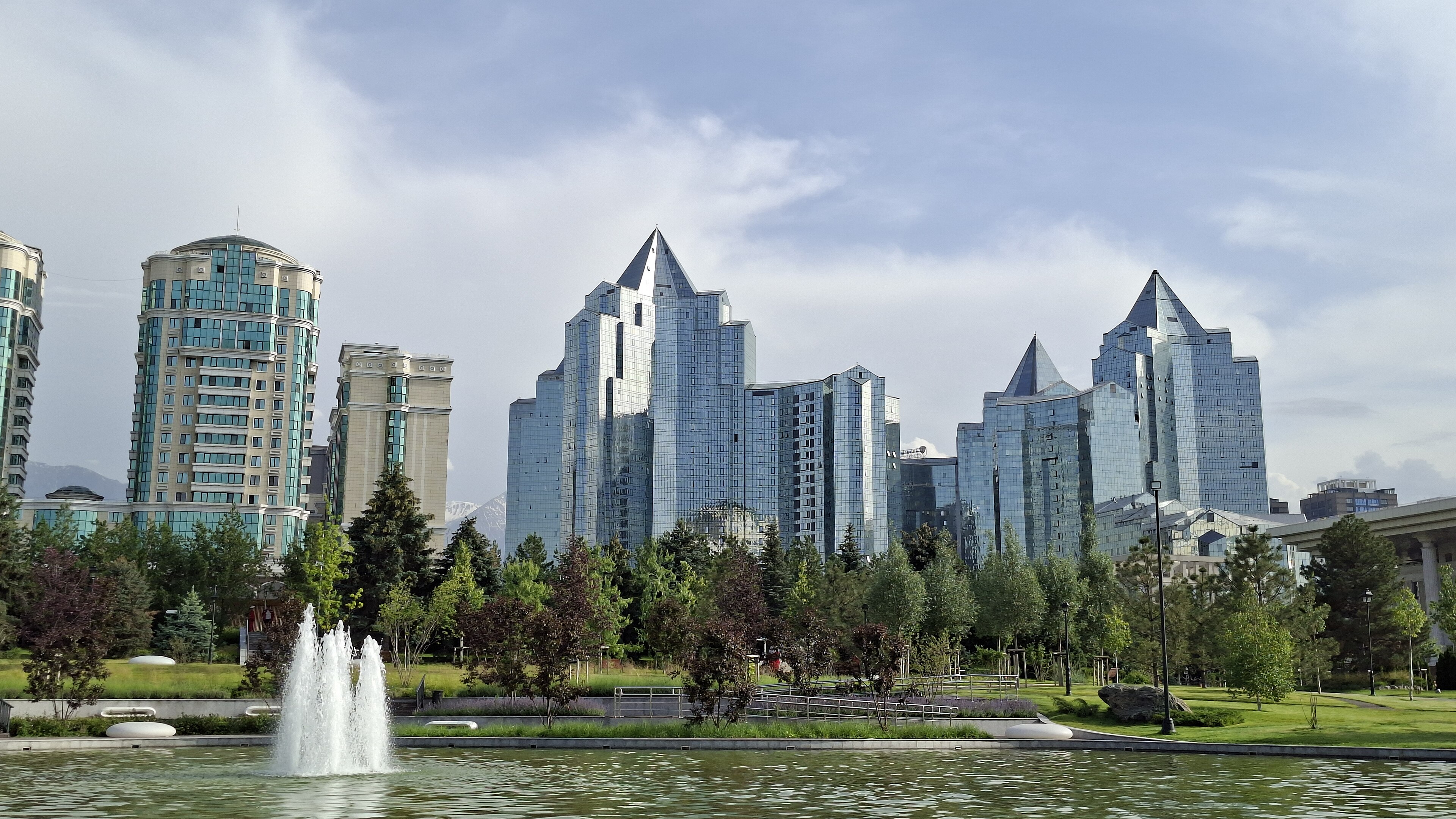
Executive Research Summary
Almaty enters the next 30 years with an unusual combination of advantages and constraints.
It is Kazakhstan’s largest economic, financial, educational and cultural centre. It has a growing population, substantial investment, a large service economy, international connections and a powerful geographical identity at the foot of the Tian Shan. At the same time, it must operate inside a mountain basin affected by air stagnation, seismic risk, pressure on water and utilities, rapid migration, traffic congestion and uneven access to social infrastructure.
The earlier Civilisation Atlas Almaty Tube established the city through six interacting foundations:
mountain water
continental and mountain climate
regional movement and trade
earthquake and hazard history
imperial and Soviet urban systems
post-Soviet metropolitan growth
Almaty must therefore be studied as a Tian Shan mountain metropolis, not merely as a collection of buildings, roads and investment projects.
This research asks one central question:
Can Almaty expand its population, economy and international role without allowing metropolitan growth to consume its environmental, infrastructural and institutional safety margins?
The answer cannot yet be known.
What can be done is to identify the systems already moving, the plans already approved, the dependencies that could break them, and the measurements that will reveal which future Almaty is actually entering.
Research conclusion at the beginning
Almaty does not primarily suffer from a shortage of plans.
Kazakhstan has a National Development Plan to 2029, an updated National Infrastructure Plan to 2029, an Almaty Development Plan for 2026–2030, an Almaty General Plan extending to 2040 and a national carbon-neutrality strategy extending to 2060.
The decisive problem is coordination.
The city must make population, housing, schools, healthcare, transport, water, wastewater, electricity, heating, air quality, seismic protection, affordability and metropolitan government move at compatible speeds.
A failure in one system can weaken the results of all the others.
A new district without sufficient schools creates long daily journeys.
A new transport line without feeder routes produces incomplete mobility.
New housing without reliable water, heating and wastewater capacity transfers construction success into utility stress.
Economic growth without affordable living conditions can increase output while reducing household security.
A digital city without public accountability can collect more information without becoming easier to repair.
The next 30 years of Almaty are therefore not one construction programme. They are a test of whether many programmes can become one functioning urban organism.
1. The official clocks of Almaty’s future
The simple structure of “five years, ten years and thirty years” is useful for research, but it is not the exact structure used by Kazakhstan’s planning system.
The official clocks overlap.
| Planning clock | Official structure | What it controls |
|---|---|---|
| 2029 | National Development Plan and National Infrastructure Plan | National economy, infrastructure, energy, transport and institutional priorities |
| 2030 | Almaty Development Plan 2026–2030 | Immediate city projects, indicators, budgets and service targets |
| 2040 | Almaty General Plan | Land use, polycentres, transport corridors, utilities and metropolitan form |
| 2060 | Kazakhstan Carbon-Neutrality Strategy | Long-run energy, buildings, transport and emissions transition |
The National Development Plan to 2029 was approved in July 2024. The National Infrastructure Plan was also approved in 2024 and was updated in December 2025.
Almaty’s 2026–2030 Development Plan was formally published in April 2026. It identifies seven city priorities:
- sustainable economic growth;
- comprehensive transport development;
- a comfortable urban environment;
- social stability and resilience;
- Green Almaty;
- Smart City;
- a safer city.
The General Plan extends the physical planning horizon to 2040 and proposes a transition from a predominantly monocentric city toward a polycentric structure.
Kazakhstan’s carbon-neutrality strategy extends beyond this article’s 2056 endpoint to 2060. It therefore operates as a national boundary condition for Almaty’s long-term energy, mobility and building systems.
The Atlas observation windows
This research translates those official clocks into three audit points:
2031 — the five-year delivery audit
The 2026–2030 programme will have reached its formal endpoint.
The research will ask what was:
- announced;
- approved;
- funded;
- constructed;
- opened;
- maintained;
- used;
- and demonstrated to improve human life.
The one-year delay is intentional.
A project completed on paper in December 2030 has not necessarily shown that it can operate reliably, survive seasonal demand or produce the promised public benefit.
2036 — the ten-year structural test
By 2036, many short-term projects will have become part of the city’s normal operating structure.
The question will no longer be whether a road, school, station, clinic or utility line was built.
The questions will be:
Did travel behaviour change?
Did jobs decentralise?
Did infrastructure inequality decline?
Did maintenance keep pace?
Did housing remain accessible?
Did seismic vulnerability fall?
Did air quality and exposure improve?
2056 — the thirty-year civilisation test
By 2056, Almaty will be operating under conditions that cannot be described confidently from 2026.
Technology, climate conditions, population, national policy, regional trade and political priorities may all change.
The 2056 article will therefore not pretend to predict one certain city.
It will test which civilisation configuration Almaty has entered.
2. Almaty at the 2026 starting line
The population of Almaty reached approximately 2.3665 million people on 1 June 2026.
During the first five months of 2026, the city recorded natural population growth of 7,218 people and positive net migration of 11,204 people. Most of the migration balance came from internal migration within Kazakhstan.
This matters because every urban target has a denominator.
A city can build schools and still have a school shortage if the number of children rises faster.
It can extend water networks while the number of households requiring connections grows faster.
It can add buses while the number and distance of daily journeys continue increasing.
It can complete housing while prices and household formation outrun supply in the locations where people need to live.
City planning officials have stated that Almaty’s formal population could reach 2.7 million within five years and that the wider population burden, when migration is considered, could be substantially higher. The same official presentation reported that more than 650,000 vehicles place pressure on city roads each day. These figures should be treated as planning stress tests rather than precise forecasts.
The economic baseline
In the first quarter of 2026, Almaty generated approximately 22.1% of Kazakhstan’s gross regional product total reported in the regional statistics. Real city output increased by 4.6% compared with the corresponding period of 2025, with services accounting for more than four-fifths of the city’s economic structure.
The 2026–2030 Development Plan is more ambitious.
It seeks annual real economic growth of at least 6%, an increase in gross regional product to KZT70 trillion and gross regional product per person of approximately US$39,000 by 2030. It also proposes large increases in fixed investment, foreign direct investment, industrial-zone capacity and the contribution of small and medium-sized businesses.
This produces the first measurable gap in the future investigation:
Can Almaty increase economic output faster than population and living costs without weakening affordability, environmental quality or public infrastructure?
Nominal average wages increased in early 2026, but the real-wage index was 99.5%, indicating that purchasing power had not risen at the same rate during that reporting period.
Economic expansion and household improvement must therefore be measured separately.
3. The central conflict: growth against the mountain-basin limit
Almaty’s mountain setting is one of its greatest assets.
It supplies identity, recreation, tourism potential, water systems, ecological value and a strong relationship between city and landscape.
It is also a constraint system.
The city cannot expand as though its geography were empty and infinitely replaceable.
The complete future equation is:
Metropolitan growth × mountain water × basin air × seismic ground × ecological carrying capacity × institutional coordination
Each component changes the others.
More housing changes travel, water, wastewater and electricity demand.
More tourism changes mountain traffic, waste, energy use and emergency requirements.
More roads may reduce congestion at one location while encouraging additional private-vehicle use elsewhere.
More electric vehicles may reduce tailpipe emissions but increase electricity demand and do little to solve congestion or road-space consumption.
More trees can improve local comfort, but planting targets will not solve air pollution without changes in heat generation, transport, industry, construction dust and regional emissions.
A successful future must therefore avoid replacing one visible problem with several less visible dependencies.
4. What Almaty intends to build by 2030
The city’s programme is substantial.
Transport
The 2026–2030 plan proposes:
- road extensions and new connections;
- expansion of the metro;
- development of BRT and LRT;
- improved public transport;
- walking and cycling infrastructure;
- intelligent traffic management;
- stronger connections between emerging polycentres.
The official presentation described a staged LRT connection between the Barlyk transport hub and Eastern Gate, metro extensions and new metro routes toward the airport and Alatau, together with a major expansion of BRT corridors. The stated objective is to increase public-transport use substantially by 2030.
The correct measurement is not kilometres constructed.
It is:
reliable door-to-door travel
transfer quality
waiting time
affordability
accessibility
operating frequency
coverage of lower-income districts
reduction in unnecessary car journeys
Polycentric development
The General Plan proposes five main polycentres:
- Historical Centre;
- Eastern Gate;
- West;
- South-West;
- North.
The purpose is to distribute employment, services, commerce, public space and daily activities more evenly across the city.
This is one of the most important ideas in the entire future plan.
It is also one of the easiest to simulate badly.
A polycentre is not simply a cluster of new buildings.
It must contain enough employment, education, healthcare, culture, recreation and transport capacity to reduce forced movement toward the old centre.
The future test is:
Do residents gain a complete daily life closer to home, or do they merely live in new districts while continuing to travel across the city for work and essential services?
Water, heating, electricity and wastewater
The city intends to reach full centralised water coverage, modernise water and wastewater systems, renew heating networks, reconstruct substations and upgrade hundreds of kilometres of electrical networks. The plan also seeks to reduce infrastructure wear across water, heat and sewerage systems by 2030.
These are essential projects, but citywide percentages are not enough.
The investigation must record:
- service interruptions;
- water pressure;
- water quality;
- pipe age;
- emergency repair time;
- district capacity;
- network losses;
- heat reliability;
- wastewater-treatment capacity;
- reserve electricity capacity.
A household connected to a network can still experience unreliable service.
Schools and healthcare
The plan includes new kindergartens, additional preschool places, new schools, school extensions, primary-care facilities, maternity hospitals, inpatient facilities, ambulance substations and hospital modernisation.
These outputs must be compared with population growth and district distribution.
A citywide increase in school places does not guarantee that places exist where new families live.
A new clinic does not guarantee reasonable appointment times, staffing or transport access.
A hospital building does not prove a resilient medical system unless energy, water, communications, emergency routes and trained personnel remain available during crisis conditions.
Green Almaty
The city plans to modernise heat sources, expand gasification, move municipal transport toward cleaner systems, increase planting and improve irrigation. It aims to raise residents’ satisfaction with environmental living conditions by 2030.
Resident satisfaction is important, but it must be accompanied by physical measurements.
The Atlas investigation will track:
- particulate pollution;
- nitrogen dioxide;
- seasonal pollution episodes;
- exposure by district;
- heat-source emissions;
- vehicle emissions;
- construction dust;
- tree survival rather than planting alone;
- accessible green space;
- heat exposure;
- river and watershed condition.
Smart City
Almaty plans to develop a digital twin capable of modelling processes, forecasting pressure on engineering networks and reducing losses from emergencies. It also proposes intelligent transport systems, digital service integration and personalised emergency communication.
The digital twin could become a valuable city-repair instrument.
It could also become a polished representation of incomplete or poor-quality data.
The correct sequence is:
accurate sensors → verified data → visible uncertainty → accountable decision → physical repair → measured result
Not:
more data → more dashboards → assumed intelligence
Seismic and emergency resilience
The Development Plan proposes seismic strengthening for at least:
- 150 critical energy, water and heating facilities;
- 400 social facilities;
- 200 multi-storey residential buildings.
It also proposes new and modernised fire stations and additional rescue equipment.
These are high-consequence commitments.
They must be evaluated against the scale of the complete building and infrastructure stock.
The investigation must identify which facilities were selected, why they were selected, what engineering standard was used, what work was completed and what residual risk remains.
Seismic resilience cannot be represented by one completed-project total.
It is a network property.
Buildings, roads, bridges, hospitals, water, gas, electricity, communications, shelters and emergency command systems must continue working together.
5. The five-year future: Almaty in 2031
The first observation point is not intended to ask whether Almaty looks more modern.
It asks whether the 2026–2030 programme produced a more capable city.
The 2031 delivery test
The city will receive a stronger result if it can demonstrate that:
- public-transport capacity and reliability rose faster than travel demand;
- polycentres gained real employment and social services;
- school and healthcare deficits fell after population growth is included;
- water, heat, wastewater and electricity failures declined;
- seismic strengthening covered the most consequential facilities;
- air-pollution exposure fell across districts;
- new housing remained connected to complete infrastructure;
- lower-income households gained, rather than lost, access to opportunity;
- mountain tourism remained inside ecological and emergency limits;
- operating and maintenance budgets followed construction budgets.
The 2031 failure pattern
Almaty may still complete many visible projects while entering a weaker operating state.
This would occur if:
- construction expands but travel times remain high;
- new districts remain dependent on the historical centre;
- infrastructure wear falls on paper but outages remain concentrated;
- population growth absorbs new school and clinic capacity;
- housing supply rises but affordability worsens;
- green programmes count planting rather than tree survival;
- the digital twin grows while basic datasets remain incomplete;
- seismic work is distributed politically rather than by consequence.
The 2031 report will therefore separate:
project completion from system improvement
6. The ten-year future: Almaty in 2036
By 2036, the city will reveal whether its current plan was a temporary building wave or the beginning of a structural transition.
Polycentricity becomes measurable
A successful polycentric city should show:
- more jobs outside the traditional centre;
- shorter compulsory journeys;
- reduced concentration of healthcare and culture;
- local access to education and public space;
- balanced housing and employment;
- reliable cross-city transport;
- stronger links with the surrounding agglomeration.
The 2026 official presentation reported that more than 90% of cultural facilities and 82% of healthcare facilities were concentrated in the southern part of Almaty.
By 2036, this imbalance should no longer be explained as an inherited condition.
It should be measurable as either repaired or continuing.
Metropolitan government becomes unavoidable
Almaty’s functional city extends beyond its administrative boundary.
People, vehicles, goods, water, waste, air pollution, housing markets and labour journeys cross jurisdictional lines.
The 2036 test must therefore examine whether the city and surrounding authorities have developed working mechanisms for:
- regional transit;
- land-use coordination;
- watershed protection;
- utility expansion;
- waste management;
- commuter data;
- emergency response;
- affordable housing;
- industrial location.
A transport system designed only inside the city boundary cannot fully solve a metropolitan travel system.
Maintenance becomes the dominant test
New infrastructure is politically visible.
Maintenance is quieter.
By 2036, the city will have accumulated a decade of maintenance requirements from the current construction cycle.
The important questions will be:
Can the city afford to operate what it built?
Are parts and technical skills available?
Are maintenance records public?
Are failures repaired before they cascade?
Were lifecycle costs included in the original investment decisions?
A city becomes resilient not when nothing breaks, but when it can detect, isolate and repair failure without allowing everyday life to collapse.
7. The thirty-year future: Almaty in 2056
No responsible research can state exactly what Almaty will look like in 2056.
The purpose of the 30-year horizon is not to produce architectural fiction.
It is to reveal long-lived choices being made now.
Buildings, utility corridors, road layouts, rail systems, river modifications, mountain developments and land-use patterns may remain in operation for decades.
The 2056 city is therefore partly being constructed through decisions made between 2026 and 2030.
Four broad futures are visible.
Future A — The Resilient Mountain Metropolis
Almaty succeeds in coordinating growth.
Public transport becomes the easiest way to move through the city. The five polycentres develop real jobs, services and cultural life. Housing, schools, clinics and utilities expand together. Seismic strengthening is guided by transparent risk priorities. Mountain development remains within ecological limits. Air quality improves through changes in heat, transport, construction and regional emissions.
The city remains economically dominant without requiring every resident to depend on the same central districts.
Technology supports maintenance rather than replacing it.
In this future, Almaty becomes a strong model of a Central Asian mountain metropolis that learned how to grow without erasing the systems that made it habitable.
Future B — The Congested Growth Machine
The economy continues to expand.
Construction remains strong. Tourism grows. More roads, stations, towers, hotels and commercial districts appear.
However, population and vehicle demand continue rising at similar or faster rates.
Infrastructure projects relieve individual pressure points but do not change the overall pattern. Housing stretches farther outward. Journeys remain long. Air pollution improves slowly or unevenly. Utilities operate near capacity. Polycentres function partly as property zones rather than complete urban centres.
Almaty is richer and larger, but daily life remains expensive in time, health and household income.
Future C — The Fragmented Risk City
Some districts become highly connected, green and well serviced.
Others carry older buildings, utility wear, weak public transport, school deficits and higher environmental exposure.
Seismic risk remains unevenly repaired. Affordability pushes more households toward peripheral locations with incomplete services. Metropolitan governance remains fragmented, making regional transport, water, land and waste difficult to coordinate.
The city contains excellent infrastructure islands inside a vulnerable larger system.
A major shock exposes the difference between visible modernisation and complete resilience.
Future D — The Regenerative Tian Shan City
Almaty changes the definition of development.
Instead of maximising land consumption and vehicle movement, it prioritises watershed security, public transport, seismic repair, compact mixed neighbourhoods, accessible services and the long-term health of the mountain-city interface.
Mountain tourism is governed by carrying capacity rather than maximum volume.
Rivers and ecological corridors are treated as infrastructure.
Old buildings are repaired and adapted where appropriate rather than automatically replaced.
Economic success is measured partly through time saved, pollution avoided, risk reduced, household stability and access to education, health and culture.
This is the most demanding future because it requires Almaty to reject the idea that every increase in construction, traffic or visitor capacity is automatically progress.
8. The Full Attack warning field
The purpose of the Full Attack is not to oppose development.
It is to find the conditions under which development fails.
Warning 1 — The moving denominator
Population and migration can consume new capacity before it becomes visible as improvement.
Every project must therefore be measured per resident, per district and against actual demand.
Warning 2 — City boundary illusion
The administrative city is not the full operating metropolis.
Transport, housing, labour, air, water and waste cross boundaries.
Warning 3 — Project dependency
A school depends on roads, transport, electricity, water, heat, staff and nearby housing.
A metro depends on feeder routes, maintenance, electricity, stations, accessibility and appropriate surrounding land use.
No project should be evaluated as an isolated object.
Warning 4 — Seismic cascade
A building can survive while the systems around it fail.
The true unit of seismic resilience is the functioning network.
Warning 5 — Mountain carrying capacity
Visitor capacity, cableways and hotel rooms are not complete measures of mountain success.
Water, habitat, slope stability, waste, emergency access and seasonal pressure must remain inside safe limits.
Warning 6 — Air-quality substitution
Cleaning one emission source does not prove that total exposure has fallen.
Transport, heating, industry, construction, weather and regional flows interact.
Warning 7 — Affordability displacement
A district can become more valuable while becoming less accessible to the households who previously lived there.
Average income and aggregate output can conceal household insecurity.
Warning 8 — Digital confidence
A digital twin cannot be more reliable than its sensors, datasets, assumptions and institutional honesty.
Unknowns must remain visible.
Warning 9 — Construction without maintenance
A project that cannot be operated, inspected, repaired and eventually replaced is a deferred failure.
Warning 10 — Plan versus outcome
The future research will preserve four separate states:
planned
funded
operating
beneficial
None automatically proves the next.
9. What a successful Almaty would feel like
The success of the next 30 years should ultimately be visible at the scale of ordinary life.
A child should be able to reach school without crossing the entire city.
A family should not need to choose between housing affordability and access to work.
A hospital should remain functional during disruption.
A person with limited mobility should be able to use public transport and public space.
A resident in the north or west should not receive a structurally weaker city than a resident in the south.
A worker should gain real time when a transport project opens.
A household should receive dependable water, heat, electricity and wastewater service without needing to understand the engineering network behind it.
A mountain visitor should not damage the landscape that created the attraction.
A city official should be able to identify a weak system before it becomes an emergency.
A citizen should be able to see what was promised, what was spent, what was completed and what effect occurred.
This is the human-life control for the entire six-article investigation.
The Atlas method does not consider a system successful merely because it is large, advanced or visible.
It asks whether people can:
live
learn
work
travel
care
breathe
recover
and continue
inside it.
10. Executive verdict
Almaty possesses many of the conditions required for a strong future:
- economic concentration;
- educational and cultural depth;
- investment capacity;
- international visibility;
- a recognisable city identity;
- substantial official planning;
- an emerging polycentric strategy;
- major transport and utility programmes;
- national support for infrastructure and decarbonisation.
It also faces a tightly connected risk field:
- rapid population growth;
- high migration;
- traffic pressure;
- unequal service geography;
- ageing utilities;
- air pollution;
- seismic exposure;
- mountain ecological limits;
- affordability pressure;
- fragmented metropolitan responsibilities;
- maintenance requirements that will grow with every new project.
The decisive variable is not ambition.
It is whether Almaty can convert ambition into coordinated, maintained and equitably distributed capability.
The next 30 years should therefore be read as a race:
Can repair, infrastructure and institutional coordination grow faster than demand, exposure and accumulated system wear?
If they can, Almaty may become one of the strongest mountain-metropolitan systems in Central Asia.
If they cannot, the city may continue growing while its safety and quality-of-life margins gradually narrow.
The purpose of this research is to detect that divergence early enough for the future to remain repairable.
Article 1 research state
ATLAS.CITY.ALMATY.FUTURE.ARTICLE.01TITLE:The Next 30 Years of Almaty, 2026–2056TYPE:Executive research summaryBASELINE:4 August 2026OFFICIAL CLOCKS:2029 / 2030 / 2040 / 2060ATLAS WINDOWS:2031 / 2036 / 2056PRIMARY CONFLICT:METROPOLITAN GROWTHversusMOUNTAIN-BASIN CONSTRAINTSPRIMARY SUCCESS CONDITION:COORDINATED CAPABILITYgrows faster thanDEMAND + EXPOSURE + SYSTEM WEAREVIDENCE STATE:Current official baseline establishedForecast closure not claimedScenario field openDataset investigation required
Continue the research
Article 2:
Almaty 2026 | The Country Plans, City Baseline and System Already in Motion
Article 2 opens the complete operating system behind this summary. It separates Almaty city from the surrounding region and agglomeration, maps the national planning hierarchy, reconstructs the 2026 baseline and identifies every major project dependency that must be monitored through 2031, 2036 and 2056.
Publication record
Suggested URL
/portfolio/next-30-years-of-almaty-2026-2056/
SEO title
The Next 30 Years of Almaty, 2026–2056 | Research
Meta description
A Civilisation Atlas research study of Almaty’s next 30 years, examining population, transport, utilities, seismic risk, mountain ecology, polycentric growth and possible futures in 2031, 2036 and 2056.
Canonical Atlas object
ATLAS.CITY.ALMATY.FUTURE.2026_2056
Research rule
Current-pass completion does not mean future certainty.
Organised scenarios do not mean predictions.
Official plans do not mean completed outcomes.
Almaty 2026
The Country Plans, City Baseline and System Already in Motion
Civilisation Atlas · The Next 30 Years of Almaty · Article 2 of 6
Almaty’s future cannot be understood by studying Almaty City alone.
The legal city is only one operating shell. Its workers, vehicles, water systems, energy supply, housing market, pollution field, mountain landscape and emergency risks extend through a much larger metropolitan and national structure.
This article therefore establishes five nested Almaty objects:
the municipal city
the functional metropolis
the Almaty agglomeration
the Tian Shan mountain–water system
the Republic of Kazakhstan planning system
The distinction matters. A project can work inside one boundary while failing at another.
A city bus programme may improve municipal routes but leave regional commuters dependent on private cars. A gasification programme may reduce emissions within the city while surrounding settlements continue adding pollution to the same air basin. New housing may be approved by one administration while its roads, schools, wastewater and employment depend on another.
The inherited Almaty Tube gives the correct historical substrate: mountain water, trade and mobility, earthquakes, imperial transformation, Soviet planning and modern metropolitan growth.
shigatse-history-culture-seo-top-gateway-v2.html
The Atlas transfer rule also remains active:
analytical tools may travel between cities; local answers may not.
Almaty must generate Almaty evidence rather than inherit institutional answers from Shigatse, Lhasa, Bishkek, Singapore or another city.
shigatse-research-release-bottom-runtime-v1.html
1. Article 2 conclusion at the beginning
Almaty is already moving into its next urban form.
It is not waiting for 2030.
Population is increasing. Housing and construction are expanding. the Kalkaman metro extension is advancing, preliminary and physical work around the first LRT line has begun, the conversion of CHP-2 to gas was reported at 92% construction readiness in July 2026, polycentres are entering detailed planning, and the city is preparing digital, seismic, water and transport systems intended to operate across the coming decade.
But the complete system is not moving at one speed.
Some elements are policy intentions. Some have legal approval. Some are funded. Some are at feasibility or environmental-review stage. Some are physically under construction. Some are already operating. Only a smaller set has enough evidence to show a durable human outcome.
The first law of this article is therefore:
Almaty’s future must be measured by project state, not project vocabulary.
“Planned,” “launched,” “implemented,” “completed” and “successful” cannot be treated as synonyms.
2. What exactly is Almaty?
Shell 1 — Almaty City
The 2026–2030 Development Plan describes Almaty as Kazakhstan’s largest metropolis and the core of the Almaty agglomeration. It records a municipal area of approximately 68,300 hectares divided into eight districts:
- Alatau;
- Almaly;
- Auezov;
- Bostandyk;
- Zhetysu;
- Medeu;
- Nauryzbay;
- Turksib.
This is the legal and administrative city. Its government owns or coordinates many municipal roads, schools, utilities, public spaces, emergency systems and local development programmes.
It is not the full daily city.
Shell 2 — The functional metropolis
The functional metropolis consists of the places connected through everyday movement:
home → work
home → school
production → warehouse
airport → city
suburb → hospital
market → distribution system
mountain → tourism system
wastewater → treatment system
Its real boundary changes by time of day and by system.
The official city plan reports that approximately 400,000 private vehicles enter or leave Almaty daily. It also records more than 600 suburban buses carrying over 400,000 people per day. Those movements demonstrate that the transport city is already larger than the municipal city.
A worker living outside the boundary but commuting into Almaty remains part of its labour and transport system. A suburban household heating with a more polluting fuel remains part of the shared air basin. A development outside the boundary can still place demand on Almaty’s hospitals, universities, roads and commercial centres.
Shell 3 — The Almaty agglomeration
Kazakhstan’s 2024–2028 Comprehensive Plan for the Almaty Agglomeration describes it as a first-level agglomeration containing three cities, four districts, 31 rural districts or district-level towns and 98 settlements. Its stated territory exceeds 939,500 hectares. On 1 January 2023, its recorded population was 3.3571 million, of whom 2.1617 million lived in Almaty and 1.1954 million in the suburban zone.
This figure is not a current 2026 population estimate. It is an older planning baseline.
That gap immediately creates an Article 6 dataset requirement:
Almaty needs a regularly updated, boundary-consistent agglomeration population and commuter ledger.
The agglomeration plan itself recognises the need to synchronise housing, social infrastructure, engineering systems, transport and environmental policy between Almaty City and Almaty Region. It contains 130 organisational and implementation measures and assigns responsibilities across national ministries, the city, the region and participating organisations.
This is a crucial governance fact.
Almaty has a metropolitan system, but its components remain divided among multiple public authorities and plans.
Shell 4 — The Tian Shan mountain–water city
Almaty’s southern edge is not merely scenery.
The mountain interface influences:
- water supply;
- rivers and drainage;
- mudflow and avalanche exposure;
- slope stability;
- biodiversity;
- air circulation;
- tourism;
- emergency access;
- recreational identity;
- land value;
- settlement geometry.
The 2026–2030 plan explicitly identifies seismic, avalanche, mudflow and landslide hazards as central emergency conditions for the city.
The mountain system must therefore be treated as part of the city’s infrastructure.
A river is simultaneously water, drainage, ecology, public space and hazard route. A mountain road is simultaneously tourism infrastructure, evacuation access and an ecological disturbance. A cableway is simultaneously transport, visitor capacity and a requirement for energy, rescue, waste and maintenance.
Shell 5 — Kazakhstan
Almaty operates within Kazakhstan’s national economic, fiscal, legal, energy, transport and climate systems.
The city cannot independently determine:
- national electricity-market structure;
- national rail policy;
- airport regulation;
- national taxation;
- carbon policy;
- central infrastructure investment;
- national education and health standards;
- major emergency-response architecture.
The next 30 years must therefore be read as a country–city interaction rather than a municipal forecast.
3. An unresolved boundary discrepancy
The official 2026–2030 city plan states an Almaty area of approximately 68,300 hectares. The official explanation of the 2040 General Plan says that the city had expanded from 33,898 hectares to 70,348 hectares.
These figures are not identical.
The difference may arise from:
- different measurement dates;
- different territorial definitions;
- later boundary adjustments;
- rounding;
- land categories included in one document but not another;
- a documentation inconsistency.
The correct research response is not to silently choose one.
Article 6 must preserve both values until cadastral or legal boundary records reconcile them.
This produces the first Full Attack rule:
A mapped object cannot be considered stable until its boundary, date and authority are declared.
4. Kazakhstan’s planning hierarchy
Almaty’s future is governed through overlapping documents rather than one master instruction.
Layer A — National Development Plan to 2029
Kazakhstan’s National Development Plan to 2029 was approved by presidential decree on 30 July 2024.
Its major structure includes:
- quality of life;
- healthcare;
- education and science;
- social protection;
- a comfortable environment;
- a strong economic foundation;
- infrastructure and institutional development.
This is the strategic national layer.
It supplies the country-wide objectives against which Almaty’s economic growth, education, healthcare, productivity, environmental quality and infrastructure are expected to contribute.
A separate government action programme covers implementation of the national plan during 2025–2026 and requires responsible authorities to submit quarterly progress information.
Layer B — National Infrastructure Plan to 2029
The National Infrastructure Plan was approved in July 2024 and officially updated on 22 December 2025.
This layer is particularly important for projects whose ownership or financing extends beyond the city:
- energy;
- transport corridors;
- water;
- waste systems;
- digital infrastructure;
- major public facilities;
- national logistics.
The presence of a project inside a national infrastructure plan does not mean it has automatically received all financing, approvals or construction capacity.
Article 6 must record each project separately.
Layer C — Almaty Agglomeration Plan, 2024–2028
The agglomeration plan attempts to connect Almaty City and Almaty Region across:
- education;
- engineering infrastructure;
- transport;
- economic development;
- environmental protection;
- waste;
- regional coordination.
This plan is the most important bridge between the administrative city and the real metropolitan system.
Its formal endpoint is 2028. That creates an immediate continuity question:
What replaces or extends metropolitan coordination after 2028?
A 30-year Almaty forecast cannot rely on a metropolitan coordination instrument that ends during the first two years of the research window.
Layer D — Almaty Development Plan, 2026–2030
The current city plan was approved through an Almaty maslikhat decision dated 10 December 2025 and published through the government portal in April 2026. It is a 103-page document with seven directions:
- sustainable economic growth;
- comprehensive transport development;
- a comfortable urban environment;
- Green Almaty;
- social resilience and stability;
- a safe city;
- Smart City.
This is the principal five-year delivery object for Articles 2 and 3.
Layer E — General Plan to 2040
The General Plan controls the longer physical form of the city.
It addresses:
- land use;
- urban zoning;
- social facilities;
- engineering corridors;
- transport;
- green systems;
- restrictions;
- polycentric development;
- links with the agglomeration.
Its first implementation stage ends in 2030 and its calculated horizon extends to 2040.
This means that the 2026–2030 Development Plan should be read partly as the opening delivery phase of a longer spatial transformation.
Layer F — Carbon neutrality to 2060
Kazakhstan’s Strategy for Carbon Neutrality to 2060 was approved in February 2023.
It calls for long-term transformation of electricity, heat, transport, buildings, industry and waste. It identifies gradual reduction of coal dependence, increased electrification, renewable and alternative energy, lower network losses, climate finance and a just transition as parts of the national route.
This strategy extends four years beyond the Almaty study’s 2056 horizon.
It therefore acts as a long-range boundary condition rather than a separate future.
5. The planning stack does not yet form one clock
| Planning object | Formal horizon | Principal scale | First Full Attack question |
|---|---|---|---|
| National action programme | 2026 | Country | What was completed before the programme expired? |
| Agglomeration plan | 2028 | Metropolis | What mechanism continues coordination after 2028? |
| National development plan | 2029 | Country | How are national indicators translated into Almaty outcomes? |
| National infrastructure plan | 2029 | Country/project | Which projects are funded and physically deliverable? |
| Almaty development plan | 2030 | City | Can delivery exceed population and demand growth? |
| General Plan | 2040 | Land and infrastructure | Does physical form produce actual polycentric behaviour? |
| Carbon-neutrality strategy | 2060 | National transition | Can energy and transport transition without creating new vulnerability? |
The periods overlap, but their reporting systems, administrative owners and definitions may not.
The first task of the full dataset is therefore not forecasting.
It is crosswalking.
6. Almaty’s population baseline
The Almaty regional statistics dashboard currently displays a city population of 2.3665 million on 1 June 2026.
During January–May 2026:
- natural increase was 7,218;
- births totalled 12,018;
- deaths totalled 4,800;
- net migration was positive by 11,204;
- internal migration accounted for 9,723 of that balance.
The 2026–2030 Development Plan used an earlier baseline of 2.3419 million residents on 1 November 2025. It stated that this represented approximately 11.4% of Kazakhstan’s population.
The approximately 24,600 difference between those two observations occurred across seven months.
That does not establish a fixed long-term rate. Migration and natural increase fluctuate.
It does establish that the city plan is being implemented against a moving population base.
The population denominator attack
Every major target needs at least four versions:
- absolute capacity added;
- capacity per resident;
- capacity by district;
- capacity after population and migration growth.
Without all four, a city can report successful construction while residents continue experiencing shortages.
7. The economic city
The official city plan records 2024 gross regional product of KZT31.3 trillion and describes Almaty as generating roughly 23% of Kazakhstan’s GDP and 26% of national tax receipts. It identifies trade, finance and real estate as major parts of its service-oriented economy.
For January–March 2026, the statistical bureau reported:
- gross regional product of approximately KZT7.543 trillion;
- 22.1% of the national regional-product total;
- real growth of 4.6%;
- services contributing 81.2% of city output;
- goods production contributing 8.3%.
The city plan seeks real growth of at least 6% annually and gross regional product per person of approximately US$39,000 by 2030. It explicitly states that economic growth must exceed population growth.
That is the correct national-economic ambition, but it is not yet a human-life measure.
Wages and household reality
Average nominal monthly wages were reported at KZT574,162 during the first quarter of 2026, 10.7% higher than a year earlier. The real-wage index was 99.5%, meaning the measured purchasing power of those wages was slightly lower than in the corresponding period. Unemployment was reported at 4.4%.
The correct economic equation is therefore:
output growth − population growth − inflation − housing burden − travel cost − household risk
A richer city does not automatically create richer households.
Construction and housing
During January–June 2026:
- construction activity reached approximately KZT436.2 billion, 22.5% above the previous-year period in volume terms;
- 1.4039 million square metres of housing were commissioned;
- total housing commissioning increased 4.6%;
- fixed-capital investment reached approximately KZT1.0215 trillion, 4.6% above the corresponding period.
These figures demonstrate strong physical activity.
They do not yet answer:
- where the housing was built;
- its price;
- whether it is occupied;
- whether schools and utilities were delivered with it;
- whether residents gained shorter or longer journeys;
- whether the new stock is seismically and thermally resilient.
8. Education: growth is consuming capacity
Almaty’s city-plan passport records 35 universities with approximately 211,000 students, including about 12,000 international students. It also records 88 colleges with more than 85,000 students.
This makes education a major part of Almaty’s economy, migration system and future human-capital base.
The school system faces a different problem.
For the 2024–2025 academic year, the plan recorded:
- 348 schools;
- approximately 340,000 pupils;
- 216 public schools;
- 132 private schools;
- annual pupil growth of approximately 10,000–14,000;
- a shortage exceeding 34,000 school places.
The city has been adding schools and extensions. The national Future Schools programme included 21 new schools with 34,800 places, while other acquisition and renovation programmes were also under way.
The school-deficit collision
The plan’s indicator table appears to show the “historically accumulated deficit” moving from 20,000 places in 2026 to 32,000 in 2027 and 37,000 by 2029–2030.
This requires verification.
Several explanations are possible:
- the figures represent a moving demand forecast;
- the target label and values are misaligned;
- new migration overwhelms planned construction;
- different definitions of deficit are being used;
- the parsed table has lost formatting;
- planned capacity has not been incorporated consistently.
The Atlas should not repair this inconsistency through guesswork.
Article 6 will preserve it as:
ALMATY.EDUCATION.COLLISION.001STATUS = UNRESOLVEDQUESTION = Why does the school-place deficit indicator rise while the objective states that the historical deficit will be eliminated?
This may become one of the most important early warnings in the complete investigation.
9. Healthcare and classification
The development-plan passport states that Almaty’s healthcare system includes 210 public and private medical organisations.
The situation-analysis section separately lists:
- 77 outpatient and polyclinic organisations;
- 122 inpatient organisations.
Those values sum to 199, not 210.
This does not necessarily mean one figure is wrong. The two sections may use different institutional definitions, dates or categories. Some facilities may sit outside the outpatient/inpatient classification.
But it creates another evidence collision.
Article 6 must identify:
- organisation ID;
- type;
- ownership;
- district;
- bed or appointment capacity;
- staffing;
- emergency role;
- date of count;
- whether one organisation operates multiple facilities.
The human test is not the number of registered organisations.
It is whether residents can receive appropriate care at the necessary time and whether critical facilities continue operating during energy, water, transport or seismic disruption.
10. Transport: the city’s most visible coordination problem
The city plan describes a system carrying more than one million vehicle movements and approximately two million passenger journeys each day. It reports average peak-hour road speed of about 19 kilometres per hour.
Public-transport journeys increased from approximately 1.2 million per day in 2022 to 1.6 million in 2024. The 2030 target is two million daily public-transport transactions.
The word transaction is important.
A boarding transaction may not equal:
- one unique passenger;
- one complete journey;
- a transfer-free trip;
- a reliable trip;
- a trip that replaced a car journey.
Article 6 must therefore distinguish passenger, boarding, transfer, journey and payment transaction.
The metropolitan transport leak
Approximately 400,000 private vehicles are reported to enter or leave Almaty daily, while suburban buses carry more than 400,000 people.
This means municipal transport improvements alone cannot solve the system.
The city needs:
- regional routes;
- integrated fares;
- transport hubs;
- reliable transfers;
- park-and-ride where appropriate;
- employment decentralisation;
- coordinated road and land-use policy;
- current origin–destination data.
Metro
Official 2026 updates reported that tunnel construction toward Kalkaman had been completed and that station structural, finishing and engineering work was advancing. The city expected commissioning work to follow the construction phase.
The project state should therefore be recorded by component:
TUNNEL = substantially completedSTATION_STRUCTURE = advancedSYSTEMS_AND_FITOUT = activeCOMMISSIONING = subsequent stagePASSENGER_OPERATION = not proven by construction report
LRT
Almaty has moved beyond a purely conceptual LRT discussion, but the project is not one uniform construction object.
An environmental-impact public hearing for the feasibility study of the first phase was scheduled for June 2026. In July, the city reported removal and replacement of old supports and utilities along Tole Bi Street as part of first-line works.
This demonstrates why project-state precision matters.
Different sections may simultaneously be at:
- feasibility;
- environmental assessment;
- utility relocation;
- preparatory works;
- procurement;
- detailed design.
Calling the entire line simply “started” loses important information.
11. Polycentric Almaty
The 2040 General Plan proposes a shift from a predominantly monocentric structure toward five polycentres:
- Historical Centre;
- Eastern Gate;
- North;
- South-West;
- West.
The city plan says that each polycentre should contain employment, housing, social facilities, public space, transport and engineering infrastructure.
This is more than a property strategy.
Properly executed, polycentricity could reduce:
- compulsory cross-city travel;
- overconcentration of employment;
- unequal access to healthcare and culture;
- infrastructure pressure in central districts;
- the difference between peripheral housing and complete urban life.
Improperly executed, it could produce new housing and commercial floor area without creating a complete daily system.
The polycentre test
A functioning polycentre needs to demonstrate:
| Field | Required outcome |
|---|---|
| Employment | Residents can reach diverse jobs without crossing the city |
| Education | Schools and preschool places grow with households |
| Health | Primary and urgent care are locally accessible |
| Mobility | High-capacity transport arrives before or with development |
| Utilities | Water, wastewater, heat and power have reserve capacity |
| Public life | Culture, recreation and civic spaces are present |
| Affordability | Lower- and middle-income households are not excluded |
| Ecology | Development remains within water, air and green-system limits |
The number of buildings is not the polycentricity score.
The score is the reduction in forced dependence on the old centre.
12. Water: coverage is not security
The city plan reports centralised water coverage for more than 2.2 million residents but estimates unaccounted-for water losses at approximately 31%, exceeding 81 million cubic metres per year. It states that these losses increase financial and resource pressure and weaken long-term reliability as the city grows.
The 2030 indicator targets are:
- 100% access to centralised water;
- at least 95% access to centralised wastewater.
These are important but incomplete measurements.
A household can be connected while experiencing:
- low pressure;
- intermittent supply;
- local contamination;
- seasonal disruption;
- weak drainage;
- repeated pipe failures;
- inadequate wastewater capacity.
The city has also developed a water-management master plan with recommendations extending to 2050.
The complete water ledger must therefore include:
source → treatment → transmission → district network → household → wastewater → treatment → river or reuse
A failure anywhere in this chain changes the value of the coverage percentage.
13. Air: source reduction is not yet exposure reduction
The city plan states that Almaty has remained among Kazakhstan’s more polluted cities and attributes the problem to concentrated human emissions, unfavourable meteorological conditions and the city’s foothill-basin position, which restricts air circulation.
Its February 2025 inventory estimated approximately 189,012 tonnes of pollutant emissions:
- road transport: about 60%;
- industrial stationary sources: about 27.5%;
- private housing and bathhouses: about 11%;
- small-business stationary sources and construction: smaller shares.
These are emissions estimates, not direct measurements of human exposure.
Exposure depends on:
- pollutant type;
- emission height;
- location;
- wind;
- temperature inversion;
- season;
- distance from roads or sources;
- time spent outdoors and indoors.
CHP-2
The city plan expects conversion of CHP-2 from coal to natural gas to reduce annual pollutant emissions from approximately 37,000 tonnes to 2,700 tonnes. In July 2026, the Ministry of Energy reported that construction readiness had reached 92%.
This is potentially a major air-quality intervention.
Its eventual evaluation must still separate:
- construction completion;
- successful commissioning;
- stable gas supply;
- actual measured stack emissions;
- changes in citywide ambient concentration;
- changes in population exposure and health.
The project may be successful at its own source while road transport remains the larger aggregate emissions field.
14. Energy and heat
The national carbon strategy expects a gradual reduction in coal dependence, greater electrification and transformation of electricity and heat systems. It also identifies reduction of transmission and generation losses as a key requirement.
Almaty’s plan targets:
- conversion of CHP-2;
- modernisation of CHP-3;
- development of a unified heat-supply scheme;
- reductions in electricity-network losses;
- expansion and reconstruction of power infrastructure.
The energy transition creates its own dependency field.
Electrified transport, digital systems, cooling, new housing and economic activity may increase electricity demand even while direct fossil-fuel use falls.
The correct question is not only:
How clean is each unit of energy?
It is also:
Is sufficient, reliable and affordable low-carbon capacity available at the place and time it is needed?
15. Waste and agglomeration
The city plan reports that Almaty produces more than 595,000 tonnes of municipal waste annually. It also notes that suburban collection and processing coverage is lower and that weaknesses remain in private-sector collection infrastructure.
Waste does not recognise the municipal border.
Land availability, treatment sites, collection routes, illegal dumping and recycling markets operate through the agglomeration.
This creates a classic metropolitan problem:
one jurisdiction produces waste; another may host the infrastructure or receive the consequences.
The agglomeration plan therefore needs a shared material-flow ledger rather than separate city and regional totals.
16. Seismic Almaty
Seismic risk is the highest-consequence system in the research.
The 2026–2030 plan proposes:
- rapid screening of 200,000 urban objects;
- seismic passports;
- a unified digital building register;
- a register and diagnostic programme for strategic life-support objects;
- strengthening of at least 150 energy, water and heating facilities;
- detailed investigation and strengthening of at least 400 social facilities;
- strengthening of at least 200 apartment buildings;
- grants for 3,500 vulnerable households;
- repeated citywide training and ShakeOut exercises.
The 2040 General Plan also restricts buildings in the highest specified seismic zones and calls for updated risk mapping and seismic auditing.
These are significant programmes.
They are still only the beginning of a complete resilience model.
The seismic network
A hospital may be structurally strengthened but remain unusable if:
- water fails;
- electricity fails;
- staff cannot reach it;
- roads are blocked;
- communications collapse;
- oxygen or medicines are unavailable.
An apartment block may survive while residents lack:
- emergency water;
- safe stairs;
- information;
- shelter;
- sanitation;
- family-reunification systems.
The unit of seismic success is therefore not the individual building.
It is the continuing life-support network.
17. Digital Almaty
The city intends to create a digital twin by 2028.
The plan describes it as a virtual representation capable of integrating infrastructure information, modelling city processes, forecasting engineering demand and reducing planning and operating costs. It proposes integration of transport, environmental, construction and economic data alongside artificial-intelligence tools and a municipal data centre.
This has strong potential.
It also creates five risks:
- incomplete source data;
- incompatible agency definitions;
- models that conceal uncertainty;
- surveillance expansion without equivalent accountability;
- dashboards replacing physical repair.
The digital twin should not become an image of an ideal city.
It should become a map of:
- known assets;
- uncertain assets;
- system condition;
- active failures;
- repair ownership;
- dependency;
- observed outcomes.
The correct digital-city equation is:
visibility + accountability + repair capacity
Data alone is not municipal intelligence.
18. Mountain tourism and airport expansion
The city plan proposes major expansion of the Almaty mountain cluster:
- cableways increasing from 16 to 62;
- ski-route length increasing to 252 kilometres;
- visitor capacity increasing to 40,000 people per day.
It also records an airport-development route intended to increase capacity:
- from 14 million to 19 million passengers by 2030;
- 26 million by 2040;
- 40 million by 2050.
Together, these projects could increase tourism, business travel, logistics and Almaty’s international role.
They also combine into one carrying-capacity problem.
The dataset must monitor:
- airport surface access;
- noise;
- air emissions;
- water and energy demand;
- mountain traffic;
- emergency rescue;
- waste;
- wastewater;
- habitat disturbance;
- seasonal crowding;
- worker housing;
- visitor expenditure retained locally.
Visitor capacity is not the same as ecological or social capacity.
19. The system already in motion
As of the Article 2 evidence freeze, Almaty’s projects occupy different states.
| System | Observed state | What is not yet proven |
|---|---|---|
| CHP-2 gas conversion | 92% construction readiness reported in July 2026 | commissioning, stable operation and measured exposure reduction |
| Kalkaman metro | tunnels completed; station and engineering work advancing | opening date, service reliability and ridership outcome |
| First LRT line | feasibility/environmental process plus preparatory utility and support works | complete financing, construction sequence and passenger operation |
| Polycentres | General Plan and detailed-planning framework adopted | actual jobs–housing balance and reduced central dependence |
| Digital twin | planned for 2028; digital infrastructure programmes active | data completeness, public accountability and repair effect |
| Seismic programme | screening and strengthening programme defined | asset-level completion and network-level resilience |
| Water programme | high connection coverage and master plan present | reduction of 31% unaccounted losses and district reliability |
| Education programme | schools built and planned | ability to outrun 10,000–14,000 additional pupils per year |
The table deliberately avoids the single label “underway.”
That word is too imprecise for a 30-year investigation.
20. The initial dependency map
POPULATION → housing → school demand → clinic demand → water demand → wastewater demand → transport demand → waste volumeHOUSING → land → seismic standard → electricity → heat → water → roads and transit → affordabilityPOLYCENTRES → jobs → social facilities → utilities → rapid transit → public space → governance coordinationTRANSPORT ELECTRIFICATION → power capacity → charging infrastructure → network resilience → fleet maintenance → fare affordabilityMOUNTAIN TOURISM → airport and roads → water and energy → waste and wastewater → rescue capacity → watershed protection → ecological carrying capacitySEISMIC RESILIENCE → buildings → bridges and roads → hospitals → utilities → communications → emergency shelter → public training
The dependency map is the real beginning of the forecast.
A project that ignores its upstream and downstream systems is not a complete project.
21. First evidence collisions
Article 2 has already located six points requiring investigation.
Collision 001 — Municipal land area
- 68,300 hectares in the 2026–2030 plan;
- 70,348 hectares in the General Plan explanation.
State: unresolved boundary or measurement difference.
Collision 002 — Healthcare organisations
- 210 organisations in the plan passport;
- 77 outpatient plus 122 inpatient organisations in the situation analysis.
State: likely classification or date difference; registry required.
Collision 003 — School deficit
- more than 34,000 places in the situation analysis;
- target table apparently falls to 20,000 and then rises to 37,000.
State: possible moving denominator, table inconsistency or definition change.
Collision 004 — Public-transport measurement
- passenger journeys;
- boarding transactions;
- unique passengers;
- transfers.
State: metrics must be separated.
Collision 005 — Agglomeration population
- 3.3571 million recorded for January 2023;
- no equivalent current 2026 figure established in this pass.
State: stale metropolitan denominator.
Collision 006 — Project status
LRT components are simultaneously described through feasibility, environmental assessment, utility relocation and construction language.
State: component-level project ledger required.
These collisions are not flaws to hide from publication.
They are the research.
22. Almaty 2026 system state
| Civilisation field | Current reading |
|---|---|
| Economic capacity | Strong but service-concentrated |
| Population pressure | High and increasing |
| Construction capacity | Strong |
| Metropolitan coordination | Formally recognised, operationally fragmented |
| Public transport | Growing but still under severe demand pressure |
| Water coverage | High |
| Water efficiency | Weak because of large unaccounted losses |
| Education capacity | Expanding but chased by demographic growth |
| Healthcare capacity | Large but requires classification and district audit |
| Air quality | Major unresolved burden |
| Energy transition | Physically advancing |
| Seismic programme | Large programme defined; delivery evidence incomplete |
| Polycentric transition | Strategically installed; outcome unproven |
| Digital capability | Expanding; governance test remains open |
| Mountain carrying capacity | Under increasing development pressure |
This is not a score of whether Almaty is “good” or “bad.”
It is an operating diagnosis.
23. The 2026 Full Attack verdict
Almaty begins the 30-year window with substantial capability.
It has a large economy, a strong education and service base, active public investment, significant construction capacity, multiple planning instruments and visible projects in transport, heat, utilities, urban development and resilience.
Its principal weakness is not absence.
It is asynchronous development.
Different systems are growing on different clocks:
- population can increase monthly;
- housing can be built in two or three years;
- schools require land, finance and teachers;
- rail projects take many years;
- utility replacement may take decades;
- ecological damage may accumulate gradually;
- seismic failure can arrive suddenly;
- governance coordination may remain unresolved indefinitely.
This produces the central finding of Article 2:
Almaty’s future risk lies in the gaps between systems, not only inside each system.
A city can have a transport plan and still suffer because housing expanded first.
It can have water coverage and still lose almost one-third of supplied water.
It can build schools and still report a growing deficit.
It can convert a power station and still experience severe road-transport pollution.
It can create five polycentres on a map without creating five complete places to live.
The next article must therefore stop reading plans as prose and begin testing delivery.
Article 2 research record
ATLAS.CITY.ALMATY.FUTURE.ARTICLE.02TITLE:Almaty 2026The Country Plans, City Baseline and System Already in MotionEVIDENCE_FREEZE:2026-08-04OBJECT_SHELLS:01 MUNICIPAL_CITY02 FUNCTIONAL_METROPOLIS03 ALMATY_AGGLOMERATION04 TIAN_SHAN_MOUNTAIN_WATER_SYSTEM05 KAZAKHSTAN_NATIONAL_SYSTEMOFFICIAL_CLOCKS:2026 GOVERNMENT_ACTION_PROGRAMME2028 AGGLOMERATION_PLAN2029 NATIONAL_DEVELOPMENT_AND_INFRASTRUCTURE2030 ALMATY_DEVELOPMENT_PLAN2040 GENERAL_PLAN2060 CARBON_NEUTRALITYPRIMARY_BASELINE:POPULATION = 2.3665M @ 2026-06-01MIGRATION_BALANCE = +11,204 @ JAN-MAY_2026Q1_REAL_GRP_GROWTH = 4.6%SERVICE_SHARE = 81.2%REAL_WAGE_INDEX = 99.5%PRIMARY_SYSTEM_WARNING:SYSTEM_CLOCKS_NOT_SYNCHRONISEDPRIMARY_EVIDENCE_COLLISIONS:BOUNDARY_AREAHEALTH_REGISTRYSCHOOL_DEFICITTRANSPORT_METRICSAGGLOMERATION_POPULATIONPROJECT_STATUSRELEASE_STATE:BASELINE ESTABLISHEDCOLLISIONS PRESERVEDDELIVERY AUDIT NOT YET COMPLETED
Next article
Article 3
Almaty 2031 | Five-Year Delivery Audit
Article 3 will dismantle the 2026–2030 plan into a project and outcome ledger.
Every major promise will pass through:
announced → authorised → funded → procured → constructed → commissioned → maintained → used → beneficial
It will also run the first complete adversarial attack against transport, polycentres, utilities, schools, healthcare, air, seismic resilience, digital systems, mountain development and metropolitan governance.
<p><strong>Civilisation Atlas · The Next 30 Years of Almaty · Article 3 of 6</strong></p>
Almaty 2031
Five-Year Delivery Audit
The year 2031 is not being used here as a prediction.
It is being installed as an audit point.
Kazakhstan’s principal city programme ends in 2030. Waiting until 2031 creates enough distance to distinguish a project that was declared complete from a system that has actually entered stable operation.
A station may open in December 2030 but require months before its passenger flows, transfers, reliability and maintenance can be evaluated.
A school may admit pupils but remain overcrowded because population growth has already consumed its new capacity.
A heating project may be commissioned but not yet have survived a full winter.
A digital platform may launch but not yet demonstrate that it can improve repair times, public access or emergency response.
The central question of this article is therefore:
By 2031, did Almaty merely complete projects, or did it acquire stronger and more evenly distributed urban capabilities?
This article does not score results that have not yet occurred. It establishes the audit contract by which the 2026–2030 programme must later be judged.
1. The audit begins before the plan ends
The 2031 audit starts with a locked 2026 evidence state.
On 1 June 2026, Almaty’s official population stood at approximately 2.3665 million. During January–May, natural increase added 7,218 people and net migration added 11,204, including 9,723 through internal migration. (Kazakhstan Stats Bureau)
At the end of the 2025–2026 school year, 357,225 children were enrolled across 360 schools, while the city reported a shortage of 29,735 pupil places. During that school year, 17,847 pupils transferred into Almaty schools from other parts of Kazakhstan, with almost half arriving from Almaty Region. (Government of Kazakhstan)
Major infrastructure systems were already moving, but at different stages:
- construction readiness at CHP-2 was reported at 92% in July 2026;
- CHP-3 was reported at approximately 26% readiness and materially behind schedule;
- the left metro tunnel toward Kalkaman had been completed, while the right tunnel and station systems remained under construction;
- Almaty’s first LRT phase was passing through environmental, feasibility and preparatory-construction processes;
- the first low-emission zone was operating only as a technical pilot, without access restrictions, charges or fines. (Government of Kazakhstan)
These conditions form the 2026 time capsule.
All later claims of success must be compared with this baseline rather than with an undefined past.
2. Why 2031 instead of 2030?
Government plans usually measure the formal delivery year.
Civilisation Atlas measures the returned consequence.
A project moves through several different states:
P0 — ANNOUNCEDP1 — AUTHORISEDP2 — FUNDEDP3 — PROCUREDP4 — PHYSICALLY CONSTRUCTEDP5 — COMMISSIONEDP6 — OPERATINGP7 — RELIABLE AND MAINTAINEDP8 — PRODUCING DISTRIBUTED HUMAN BENEFIT
Each state must be independently evidenced.
A project can reach P4 and fail at P5 because testing, permits or utility connections are incomplete.
It can reach P6 and fail at P7 because staffing, spare parts, maintenance finance or operating procedures are insufficient.
It can reach P7 and fail at P8 because the benefit reaches only some districts or because rising demand absorbs the additional capacity.
The 2031 audit therefore applies four laws:
construction ≠ operation
operation ≠ reliability
reliability ≠ equal access
equal access ≠ complete human benefit
The audit will not reward vocabulary.
It will inspect the system.
3. What the official plan promises
Almaty’s 2026–2030 Development Plan contains seven principal directions:
- sustainable economic growth;
- comprehensive transport development;
- a comfortable urban environment;
- Green Almaty;
- social resilience and stability;
- a safe city;
- Smart City. (Government of Kazakhstan)
The public presentation of the plan sets a wide range of ambitions for 2030, including:
- annual real economic growth of at least 6%;
- gross regional product of KZT70 trillion;
- gross regional product per person of about US$39,000;
- KZT7 trillion in annual fixed-capital investment;
- expansion of industrial and innovation districts;
- major metro, LRT and BRT programmes;
- development of five polycentres;
- full centralised water access;
- reduced utility-network wear;
- new schools, kindergartens and medical facilities;
- lower-emission heating and transport;
- a digital twin;
- seismic strengthening of critical infrastructure, social buildings and apartment blocks. (Government of Kazakhstan)
The 2031 audit will not ask only whether these numbers were reported.
It will ask whether the underlying urban conditions changed.
4. The moving-denominator test
The most important attack on every 2030 target is population growth.
Suppose Almaty builds 20,000 school places.
That appears to be a major delivery.
But the result depends on:
- how many pupils entered the system during the same period;
- where those pupils live;
- whether the new places are in the districts with shortages;
- whether the buildings operate in one or multiple shifts;
- whether teachers and support staff are available;
- whether transport to those schools is safe and practical.
The same applies to hospitals, buses, water, housing and public spaces.
Every 2031 result must therefore be published in three forms:
ABSOLUTE CHANGECHANGE PER RESIDENTCHANGE BY DISTRICT
A fourth measure is required where migration strongly affects demand:
CHANGE AFTER POPULATION AND MIGRATION GROWTH
A citywide average must not be allowed to hide a district-level shortage.
5. Audit Field 1 — Economy and household capability
The official promise
The city seeks real economic growth of at least 6% per year, gross regional product of KZT70 trillion and output per person of approximately US$39,000 by 2030. The plan presentation also sets large targets for investment, foreign capital, small and medium-sized enterprises, industrial expansion, exports and tourism. (Government of Kazakhstan)
What the 2031 audit must measure
Aggregate output is the beginning of the test, not the end.
The audit must separate:
- nominal growth from real growth;
- total output from output per resident;
- output per resident from median household income;
- wage growth from purchasing power;
- job creation from job quality;
- investment announcements from completed productive assets;
- company registration from durable business survival;
- tourism spending from local value retention.
The decisive household equation is:
income − housing − transport − utilities − food − healthcare − education − debt − exposure to disruption
A city can report rapid economic expansion while households lose time, purchasing power or security.
Success condition
By 2031, economic growth should have produced:
- higher real household income;
- stronger productivity;
- a broader economic base;
- better employment access outside the old centre;
- lower vulnerability to a single sector;
- improved opportunities for young people and residents with disabilities;
- greater capacity to finance maintenance and public services.
Failure signature
The economy may reach its headline output target while:
- housing costs rise faster than wages;
- lower-income workers move farther from employment;
- commute times increase;
- new investment remains concentrated in land and property;
- employment grows mainly in low-security work;
- public infrastructure costs accelerate faster than city revenue.
This would be economic growth without equivalent civilisation capability.
6. Audit Field 2 — Transport
Transport contains the first major documentary collision.
The official presentation of the 2026–2030 plan states that public transport will reach three million daily journeys by 2030. (Government of Kazakhstan)
The indicator table inside the official 103-page plan gives a sequence rising from 1.6 million daily transactions in 2024 to two million in 2030. (Government of Kazakhstan)
These are not the same target.
Several explanations are possible:
- the presentation uses passenger journeys while the table uses payment transactions;
- one target was revised after the other;
- one includes suburban services or transfers;
- one is a publication error;
- the PDF table has been rendered or parsed incorrectly.
The Atlas must not silently choose the more convenient number.
ALMATY.TRANSPORT.COLLISION.001SOURCE_A = 3.0M daily journeys by 2030SOURCE_B = 2.0M daily transactions by 2030STATUS = UNRESOLVEDREQUIRED = visual table confirmation + metric definition + version history
The transport ladder
Each rail or BRT project must be divided into:
ROUTE AUTHORISEDLAND ACQUIREDDESIGN COMPLETEENVIRONMENTAL REVIEW COMPLETEFINANCE CLOSEDUTILITIES RELOCATEDCIVIL WORKS COMPLETESYSTEMS INSTALLEDROLLING STOCK AVAILABLESAFETY CERTIFIEDPASSENGER SERVICE OPENFEEDER NETWORK OPERATINGRIDERSHIP STABILISEDMAINTENANCE FUNDED
One label such as “construction started” cannot represent all these states.
Metro audit
The 2031 audit must establish:
- which stations opened;
- actual opening dates;
- service frequency;
- reliability;
- station accessibility;
- passenger volume;
- transfer quality;
- journey-time savings;
- surrounding housing and employment effects;
- maintenance interruptions;
- operating subsidy and cost.
In early 2026, the left tunnel toward Kalkaman was complete, while the right tunnel had reached 1,390 of 1,590 metres and station engineering and finishing work continued. (Government of Kazakhstan)
This baseline means that “Kalkaman completed” cannot later be proven merely by repeating that tunnelling was largely complete.
LRT audit
The first LRT phase is reported as an 18.3-kilometre route through Momyshuly Street, Tole Bi Street and Abai Khan Avenue toward Almaty-2 railway station. In 2026, official records showed both an environmental-assessment process and preparatory or physical works affecting roads, supports and utilities. (Government of Kazakhstan)
By 2031, the audit must ask:
- Is the complete first phase open?
- Which parts are operating?
- Is the service integrated with metro, BRT, buses and suburban routes?
- Is one fare valid across modes?
- Are transfers protected from weather and traffic?
- Is service accessible to residents with mobility, visual or hearing impairments?
- Did the line reduce private-car demand or merely add another mode?
BRT audit
The public plan presentation proposes 42 BRT corridors, while the formal audit must verify:
- whether all 42 are full BRT or a mixture of bus-priority treatments;
- corridor length;
- physical separation;
- enforcement;
- signal priority;
- average and peak travel time;
- reliability;
- passenger capacity;
- transfer performance.
A painted bus lane and a high-capacity rapid-transit corridor are not equivalent.
The human transport test
The final measurement is not infrastructure length.
It is:
How much dependable life-time did residents recover?
7. Audit Field 3 — Polycentric development
Almaty’s General Plan proposes five polycentres:
- Historical Centre;
- Eastern Gate;
- West;
- North;
- South-West.
The development plan gives immediate priority to Eastern Gate and West and describes polycentres as locations combining housing, employment, social facilities, public space, utilities and transport. (Government of Kazakhstan)
The false-polycentre risk
A new district is not automatically a polycentre.
A property cluster may contain:
- apartments;
- offices;
- shopping centres;
- roads;
- decorative public space.
But residents may still need to travel elsewhere for:
- specialist healthcare;
- secondary schools;
- universities;
- cultural institutions;
- secure employment;
- government services;
- major recreation;
- transport connections.
The 2031 polycentre score must therefore include:
LOCAL_JOB_SHAREJOBS_TO_HOUSING_BALANCESCHOOL_PLACES_PER_CHILDPRIMARY_CARE_ACCESSCULTURE_AND_RECREATION_ACCESSPUBLIC_TRANSPORT_FREQUENCYAVERAGE_FORCED_CROSS_CITY_TRIPSUTILITY_RESERVE_CAPACITYAFFORDABLE_HOUSING_SHAREPUBLIC_SPACE_ACCESS
Success condition
A polycentre succeeds when it reduces compulsory dependence on the historical centre without isolating residents from the rest of the metropolis.
Failure signature
A polycentre fails when it becomes:
housing first
roads second
social infrastructure later
rapid transit delayed
employment elsewhere
This produces a larger city without producing a more complete city.
8. Audit Field 4 — Water, wastewater, heat and electricity
Water and wastewater promises
The formal plan table targets:
- 100% access to centralised water from 2026 onward;
- at least 95% access to centralised wastewater;
- reduction of network wear over the five-year period. (Government of Kazakhstan)
The city reported in 2026 that water-network wear was expected to fall to 49% and wastewater-network wear to 48% during that year as hundreds of kilometres of engineering infrastructure were modernised. (Government of Kazakhstan)
Connection is not reliability
The 2031 audit must distinguish:
HOUSEHOLD CONNECTIONSERVICE CONTINUITYPRESSUREWATER QUALITYNETWORK LOSSFAILURE FREQUENCYREPAIR TIMEWASTEWATER CAPACITYFLOOD AND DRAINAGE PERFORMANCE
A network can report 100% connection while parts of the city experience weak pressure, repeated failure or insufficient wastewater capacity.
Heat
The plan presentation proposes annual renewal of at least 39 kilometres of heat networks and a reduction in heat-network wear from 56% to 39% by 2030. (Government of Kazakhstan)
The 2031 audit must examine:
- heat outages;
- outage duration;
- winter reliability;
- network loss;
- emergency reserve;
- tariff burden;
- building thermal efficiency;
- district inequality;
- availability of repair teams and components.
Electricity
The plan includes reconstruction of substations, renewal of more than 300 kilometres of electrical networks and gradual reduction of distribution losses. (Government of Kazakhstan)
The audit must also include new demand created by:
- electric buses and vehicles;
- metro and LRT;
- digital infrastructure;
- data centres;
- cooling during hotter periods;
- new housing;
- industrial expansion;
- electrified heating or appliances.
A cleaner city may become more electricity-dependent.
Therefore:
decarbonisation without grid resilience creates a new concentration of risk.
9. Audit Field 5 — Education
Education produces the second major documentary collision.
The plan presentation says that Almaty intends to build:
- 16 schools;
- eight school extensions. (Government of Kazakhstan)
The narrative section of the official plan says:
- 16 schools providing approximately 17,000 places;
- seven extensions;
- seismic strengthening and major repair of ten schools. (Government of Kazakhstan)
This creates:
ALMATY.EDUCATION.COLLISION.002SCHOOLS = 16 in both sourcesEXTENSIONS_SOURCE_A = 8EXTENSIONS_SOURCE_B = 7STATUS = UNRESOLVED
A more serious problem appears in the formal indicator table.
The indicator is labelled as elimination of the historically accumulated shortage of pupil places, but the displayed sequence appears to move from a 20,000-place shortage in 2026 to 32,000 in 2027, 35,000 in 2028 and 37,000 in 2029–2030. (Government of Kazakhstan)
At the same time, the city’s July 2026 update placed the current shortage at 29,735 places. (Government of Kazakhstan)
The direction of the table therefore conflicts with the label “elimination.”
The possible explanations include:
- a moving forecast of total demand;
- an incorrectly titled indicator;
- displaced columns in the parsed PDF;
- planned deficits before other projects are counted;
- an underlying admission that migration will outrun construction;
- a publication error.
Article 6 must visually verify the original table and obtain a definition from the responsible authority before treating it as a valid performance series.
The real education audit
The 2031 education report must include:
- total pupils;
- annual new enrolment;
- migration into schools;
- nominal school capacity;
- actual shift pattern;
- class size;
- teacher vacancies;
- district-level shortage;
- journey distance;
- school-bus dependence;
- seismic condition;
- accessibility;
- learning outcomes;
- student wellbeing.
A school-place audit must not count a theoretical seat twice because a building operates in two or three shifts.
The eduKateSG human control
The student is not a unit of infrastructure.
The final questions are:
Did children receive more instructional time?
Did overcrowding fall?
Did teachers gain manageable workloads?
Did journey time fall?
Did learning quality improve?
Did weak districts catch up?
A building programme that does not improve these conditions remains incomplete.
10. Audit Field 6 — Healthcare
The public presentation proposes:
- 11 primary healthcare facilities serving approximately 470,000 residents;
- three maternity hospitals;
- two modern inpatient facilities;
- major upgrading of hospitals;
- additional ambulance substations. (Government of Kazakhstan)
But the underlying official materials create another counting collision.
The presentation refers to 16 new ambulance substations intended to cover 1.5 million residents. The formal indicator table appears to refer to 18 new ambulance substations together with seismic strengthening and major repair of five existing substations. (Government of Kazakhstan)
ALMATY.HEALTH.COLLISION.003NEW_AMBULANCE_SUBSTATIONS_SOURCE_A = 16NEW_AMBULANCE_SUBSTATIONS_SOURCE_B = 18EXISTING_SUBSTATIONS_FOR_REPAIR = 5STATUS = DEFINITION / VERSION CHECK REQUIRED
Healthcare delivery ladder
A medical building reaches full delivery only when it has:
- completed construction;
- water, electricity and heat;
- equipment;
- medicines and supplies;
- qualified staff;
- emergency access;
- referral integration;
- operating finance;
- infection-control systems;
- seismic and backup capability.
2031 health outcomes
The audit must measure:
- appointment waiting time;
- emergency-response time;
- district access;
- staffing vacancies;
- beds and services actually available;
- maternal and infant outcomes;
- avoidable mortality;
- life expectancy;
- patient satisfaction;
- continuity during disruptions.
A new clinic without staff is not healthcare capacity.
A hospital that cannot operate after a major earthquake is not resilient healthcare capacity.
11. Audit Field 7 — Air quality and the energy transition
Almaty’s 2026 environmental programme includes:
- conversion of major heat sources;
- private-sector gasification;
- cleaner public transport;
- emissions monitoring;
- low-emission zones;
- restrictions on solid and liquid fuel in gasified districts;
- environmental enforcement. (Government of Kazakhstan)
The first low-emission-zone pilot began on 28 April 2026. During the technical pilot, no access limits, charges or fines applied; its purpose was to test data systems and transport-flow monitoring through the end of 2026. (Government of Kazakhstan)
This means that the 2026 pilot cannot yet be counted as proven emissions regulation.
CHP-2 and CHP-3
In July 2026, CHP-2 was reported at 92% construction readiness. CHP-3 was at approximately 26% and significantly behind its approved schedule, with shortages of workers and delays in equipment delivery. (Government of Kazakhstan)
This is a powerful natural experiment for the 2031 audit.
Two related energy projects show very different delivery states.
The audit must not merge them under one headline such as “Almaty thermal plants modernised.”
The six-stage air test
SOURCE CONVERTEDSOURCE OPERATING RELIABLYACTUAL SOURCE EMISSIONS REDUCEDAMBIENT CONCENTRATIONS REDUCEDPOPULATION EXPOSURE REDUCEDHEALTH BURDEN REDUCED
A lower emissions total at one plant does not automatically demonstrate lower exposure across the city.
Traffic, construction, private heating, small businesses, industry, weather and regional emissions remain relevant.
Full Attack question
Could Almaty successfully reduce coal-related emissions while increased transport demand, construction and energy consumption prevent a comparable improvement in human exposure?
The 2031 evidence must answer this rather than assume the answer.
12. Audit Field 8 — Seismic resilience and emergency continuity
The city’s seismic-strengthening plan includes at least:
- 150 critical energy, water and heat facilities;
- 400 social facilities;
- 200 multi-storey residential buildings. (Government of Kazakhstan)
Earlier seismic-audit programmes had examined 21,441 structures across two main stages, according to a later city update. (Government of Kazakhstan)
Historical official reporting also records seismic strengthening of 239 public facilities between 2000 and 2022, including schools, kindergartens and health facilities. (Government of Kazakhstan)
The counting problem
The audit must distinguish:
- screened;
- passported;
- technically investigated;
- classified as vulnerable;
- designed for strengthening;
- funded;
- strengthened;
- independently inspected;
- operational after strengthening.
A building passport is not a retrofit.
A retrofit contract is not proven seismic performance.
Network resilience
The 2031 audit must create at least five linked networks:
LIFE_SAFETY_NETWORKWATER_AND_SANITATION_NETWORKENERGY_AND_HEAT_NETWORKHEALTH_AND_RESCUE_NETWORKCOMMUNICATION_AND_INFORMATION_NETWORK
A hospital cannot be scored independently from its road access, communications, water, electricity, backup power and staff availability.
Required shock exercise
The city must be tested against a compound scenario:
A major winter earthquake damages housing, roads, water, heat and communications while temperatures are low and hospitals face sudden mass demand.
The audit does not require a real disaster.
It requires transparent exercises, inventories, repair times and demonstrated coordination.
13. Audit Field 9 — Smart City and the digital twin
The plan states that Almaty intends to create a digital twin capable of modelling city processes, forecasting pressure on engineering systems and reducing losses from emergencies by 20%. It also proposes intelligent transport management, smarter route planning, a unified application and personalised emergency information. (Government of Kazakhstan)
The digital twin must pass four tests.
Test 1 — Representation
Does the model contain current and correctly located information about:
- buildings;
- utilities;
- roads;
- transport;
- hazards;
- population;
- public facilities;
- maintenance condition?
Test 2 — Uncertainty
Does it display missing, old and disputed data?
A confident model built on incomplete records is more dangerous than an openly incomplete map.
Test 3 — Decision effect
Can the city demonstrate that the twin changed a real decision?
Examples include:
- preventing overload;
- rerouting transport;
- identifying an unsafe building;
- reducing repair time;
- improving evacuation;
- sequencing utility replacement.
Test 4 — Public accountability
Can residents see:
- what data is collected;
- what decisions use it;
- who can access it;
- how errors are corrected;
- how privacy is protected;
- whether the physical problem was repaired?
The audit law is:
a dashboard is not an outcome.
14. Audit Field 10 — Safety, monitoring and public trust
The city plan proposes integrating 100,000 surveillance cameras and 4,500 traffic-monitoring cameras into a unified system by 2030. (Government of Kazakhstan)
The number of cameras is an output.
It is not a complete safety result.
The 2031 audit must separate:
- crime reporting;
- emergency response;
- road casualties;
- public perception;
- system uptime;
- false matches or errors;
- data retention;
- legal access;
- independent oversight;
- displacement of incidents into unmonitored areas.
More monitoring may support emergency response and investigation.
It may also increase data concentration without improving trust or prevention.
Safety must therefore be evaluated through:
lower harm + faster assistance + fair enforcement + accountable data use
15. Audit Field 11 — Mountain development and tourism
The development plan proposes a major expansion of Almaty’s mountain cluster:
- cableways increasing from 16 to 62;
- ski routes increasing to 252 kilometres;
- daily visitor capacity increasing to 40,000;
- associated expansion of tourism infrastructure and services. (Government of Kazakhstan)
The airport-development route seeks passenger capacity of:
- 19 million by 2030;
- 26 million by 2040;
- 40 million by 2050. (Government of Kazakhstan)
The 2031 audit cannot measure this system only through visitors and revenue.
The mountain carrying-capacity ledger
It must include:
- watershed condition;
- water extraction;
- wastewater treatment;
- solid waste;
- trail and habitat disturbance;
- slope stability;
- rescue incidents;
- evacuation capacity;
- vehicle traffic;
- local worker housing;
- seasonal pressure;
- maintenance costs;
- ecosystem recovery.
Attack question
Could the physical capacity to bring 40,000 people per day into the mountain zone become larger than the capacity to remove waste, protect water, rescue visitors and maintain the ecological system?
If so, tourism growth becomes a capability mismatch.
16. Audit Field 12 — Culture, language and public life
Almaty’s plan includes libraries, theatres, major cultural renovations, public events and improvement of cultural services. It also recognises the city’s role as Kazakhstan’s cultural and educational centre. (Government of Kazakhstan)
The 2031 cultural audit must not count only venues and attendance.
It must ask:
- Are cultural facilities distributed beyond the south and historical centre?
- Are Kazakh-language cultural systems strengthened without flattening Almaty’s multilingual history?
- Are independent and community cultural organisations able to survive?
- Can lower-income residents participate?
- Are historic buildings repaired responsibly?
- Are displaced neighbourhood histories recorded?
- Are young people able to create culture rather than merely consume it?
Modernisation should not cause the city to forget the systems it replaced.
17. The cross-system Full Attack
Individual sector audits are insufficient.
The most serious failures occur between sectors.
Attack A — Migration acceleration
Assume population grows faster than the principal planning forecast.
Test:
- school places;
- rental housing;
- clinics;
- transport;
- water;
- waste;
- employment;
- district services.
Attack B — Project delay
Assume a major rail or energy project is delayed by three years.
Test:
- interim transport demand;
- operating costs;
- construction disruption;
- substitute capacity;
- air-quality consequences;
- financing.
Attack C — Earthquake during winter
Assume simultaneous disruption to:
- housing;
- roads;
- heat;
- water;
- electricity;
- communications;
- hospitals.
Measure the city’s ability to preserve life and restore minimum service.
Attack D — Water disruption
Assume reduced supply or a major network failure during summer.
Test:
- household supply;
- hospitals;
- schools;
- firefighting;
- industry;
- tourism;
- wastewater;
- emergency distribution.
Attack E — Inflation and fiscal pressure
Assume construction costs, interest rates or imported-equipment prices rise.
Test which projects are:
- protected;
- reduced;
- delayed;
- cancelled;
- shifted into maintenance debt.
Attack F — Technology failure
Assume the digital twin or central monitoring system contains incomplete data or becomes unavailable during an emergency.
Test whether decentralised human procedures still work.
Attack G — Administrative boundary failure
Assume the city and region do not coordinate transport, land use, waste or water effectively.
Test whether municipal gains are cancelled by metropolitan growth outside the boundary.
18. The 2031 CivilisationOS scorecard
Each domain receives ten separate readings.
| Code | Measure | Core question |
|---|---|---|
| D | Delivery | Was the promised output completed? |
| O | Operation | Does it work under normal conditions? |
| R | Reliability | Does it continue working through time and seasonal demand? |
| H | Human benefit | Did it measurably improve life? |
| E | Equity | Is the benefit distributed across districts and groups? |
| B | Buffer | Is reserve capacity available when demand rises? |
| P | Repair | Can failure be detected, isolated and repaired? |
| A | Alignment | Do related systems support rather than obstruct one another? |
| T | Trust | Are claims, spending, results and limitations visible? |
| C | Coordination load | How difficult is it for the responsible institutions to act together? |
Each field is scored from 0 to 4:
0 = FAILURE OR NO EVIDENCE1 = PARTIAL / FRAGILE2 = FUNCTIONAL BUT BELOW REQUIRED CAPACITY3 = ROBUST AND EVIDENCED4 = ADAPTIVE, REPAIRABLE AND DISTRIBUTED
No composite total should erase a zero in a life-critical field.
A city with excellent culture, economy and digital services but a zero in seismic hospital continuity remains dangerously incomplete.
19. The 2031 phase result
The city may occupy different phases simultaneously.
Phase 0 — Capability failure
Major delivery gaps, repeated breakdowns or a shock reveal that the system cannot protect essential life functions.
Phase 1 — Recovery and catch-up
Important infrastructure has been delivered, but the city is still repairing inherited deficits and responding to growth after problems emerge.
Phase 2 — Functional delivery
Most principal systems operate, but margins remain narrow and district inequality or maintenance debt continues.
Phase 3 — Robust metropolitan operation
Population growth, infrastructure, services and maintenance are broadly aligned. Failure can be absorbed and repaired without widespread collapse.
Phase 3/4 — Adaptive mountain metropolis
The city not only maintains operation but detects future pressure early, protects ecological limits, updates decisions transparently and preserves human continuity through shocks.
Almaty will not receive one universal phase label.
The audit will map:
P3 islands
P2 operating systems
P1 recovery corridors
P0 failure pockets
This prevents a highly visible successful district from concealing a weaker larger system.
20. The minimum 2031 evidence release
A credible audit requires more than a narrative report.
Article 6 will prepare the following dataset structure for the 2031 release.
PROJECT_IDPROJECT_NAMEPLAN_SOURCERESPONSIBLE_AUTHORITYDISTRICTFUNCTIONAL_METROPOLITAN_AREABASELINE_DATEANNOUNCED_DATEAUTHORISATION_DATEBUDGET_APPROVEDPROCUREMENT_STATECONSTRUCTION_STARTPLANNED_COMPLETIONACTUAL_COMPLETIONCOMMISSIONING_DATEOPERATING_DATEMAINTENANCE_OWNERPLANNED_OUTPUTACTUAL_OUTPUTPLANNED_OUTCOMEACTUAL_OUTCOMEBENEFICIARY_COUNTDISTRICT_DISTRIBUTIONDEPENDENCIESFAILURE_EVENTSREPAIR_TIMECOST_VARIANCESOURCE_URLSOURCE_DATEEVIDENCE_GRADELAST_VERIFIED
Each project must also have an outcome record.
BEFORE_VALUEAFTER_VALUEPOPULATION_DENOMINATORDISTRICT_DENOMINATORMIGRATION_ADJUSTMENTSEASONAL_VARIATIONCONTROL_OR_COMPARISONUNCERTAINTYUNINTENDED_CONSEQUENCE
The publishing loop remains:
telemetry → declared scale → diagnosis → bounded repair → republish → observe → memory.
21. Initial 2031 red watchlist
The following systems already require enhanced monitoring.
Red 01 — School capacity
The official shortage remains large, migration into schools is substantial, and the plan’s own deficit table is internally difficult to reconcile.
Red 02 — Transport metric definition
Official materials give different 2030 public-transport targets and do not yet establish one stable distinction between passengers, journeys, boardings and transactions.
Red 03 — CHP-3 schedule
CHP-3 was materially behind schedule in July 2026, while CHP-2 was much further advanced. The two projects must not be reported as one combined completion state.
Red 04 — Metropolitan coordination
A large share of commuter, housing and environmental pressure crosses the municipal boundary.
Red 05 — Utility maintenance
High connection rates coexist with substantial network wear. Renewal must outrun both deterioration and expansion.
Red 06 — Seismic conversion
Large screening and strengthening numbers require an asset-level public ledger linking vulnerability, priority, funding and completed work.
Red 07 — Polycentre reality
Buildings, jobs, schools, healthcare and rapid transit must arrive in compatible sequences.
Red 08 — Mountain carrying capacity
Tourism expansion requires an ecological, water, waste and rescue limit that has equal authority to the visitor-capacity target.
Red 09 — Digital twin evidence
The promised 20% reduction in emergency losses requires a declared baseline and causal method.
Red 10 — Maintenance finance
Every major 2026–2030 asset will begin accumulating operating and replacement costs before the 2031 audit.
22. The 2031 audit verdict in advance
No final verdict can be issued in 2026.
But the release conditions can be locked now.
Almaty passes the five-year audit when:
- the plan’s principal outputs are physically and operationally complete;
- population growth has not recreated the same shortages;
- services are more evenly distributed;
- maintenance is funded and performed;
- air-quality improvement appears in exposure data;
- rail and BRT systems operate as one network;
- polycentres reduce compulsory travel;
- school and health capacity improve after migration is counted;
- seismic work follows consequence-based priorities;
- mountain development remains inside measurable ecological limits;
- source conflicts and missed targets are disclosed rather than hidden.
Almaty fails the audit when:
- project totals replace operating evidence;
- citywide averages conceal district deterioration;
- official definitions shift to preserve success;
- infrastructure opens without staff, maintenance or feeder systems;
- population growth is used as a permanent excuse rather than a planned variable;
- environmental gains are declared from source conversion alone;
- digital visibility replaces physical repair;
- the city produces more assets but less buffer.
The central verdict rule is:
Almaty succeeds in 2031 only when its usable, repairable and equitably distributed capability has grown faster than population demand, system wear and accumulated exposure.
Article 3 research record
ATLAS.CITY.ALMATY.FUTURE.ARTICLE.03TITLE:Almaty 2031Five-Year Delivery AuditBASELINE_FREEZE:2026-08-04AUDIT_DATE:2031PLAN_ENDPOINT:2030PRIMARY_OPERATION:PLAN → DELIVERY → OPERATION → RELIABILITY → HUMAN BENEFITAUDIT_DOMAINS:ECONOMYTRANSPORTPOLYCENTRESUTILITIESEDUCATIONHEALTHAIR_AND_ENERGYSEISMIC_RESILIENCEDIGITAL_CITYSAFETY_AND_TRUSTMOUNTAIN_TOURISMCULTURECURRENT_COLLISIONS:TRANSPORT_TARGET_2M_VS_3MSCHOOL_EXTENSIONS_7_VS_8SCHOOL_DEFICIT_DIRECTIONAMBULANCE_SUBSTATIONS_16_VS_18PRIMARY_ATTACK:CAN CAPABILITY GROW FASTER THANPOPULATION + DEMAND + EXPOSURE + SYSTEM WEAR?RELEASE_RULE:NO OUTPUT COUNTS AS SUCCESSUNTIL ITS OPERATING AND HUMAN CONSEQUENCE IS OBSERVED
Next article
Article 4
Almaty 2036 | Ten-Year Metropolitan and Infrastructure Test
Article 4 will move beyond project delivery.
It will examine what becomes structurally locked into Almaty after ten years:
- whether polycentricity changed daily behaviour;
- whether metropolitan coordination became real;
- whether maintenance replaced construction as the dominant challenge;
- whether water, energy and transport gained sufficient buffers;
- whether housing and opportunity remained accessible;
- whether the city’s mountain and seismic constraints were integrated into its normal operating system.
Research caution
The official plan PDF contains table rows whose parsed formatting is ambiguous, especially the public-transport target and education-deficit sequence. The PDF page-image renderer was unavailable during this pass despite repeated attempts. These values remain evidence collisions requiring visual confirmation against the original tables before the Article 6 dataset is frozen.
Almaty 2036
Ten-Year Metropolitan and Infrastructure Test
Civilisation Atlas · The Next 30 Years of Almaty · Article 4 of 6
The year 2036 is the point at which Almaty’s current building programme becomes a permanent urban structure.
By then, the immediate 2026–2030 plan will have ended. New roads, rail lines, housing districts, utility networks, schools, hospitals and polycentres will no longer be recent projects. They will have entered their first cycle of ordinary use, maintenance, repair and institutional memory.
The 2031 audit asks:
Was the project delivered, and did it work?
The 2036 test asks a harder question:
What kind of metropolitan system did those projects lock Almaty into?
A transport corridor can operate successfully but encourage development that creates even more travel.
A new residential district can fill with residents while remaining structurally dependent on distant employment, schools and hospitals.
A utility network can work for several years before maintenance debt begins appearing.
A polycentre can have buildings without becoming a complete centre of daily life.
A digital system can become permanent without becoming accountable.
By 2036, these differences should be visible.
1. The conclusion at the beginning
Almaty’s ten-year result will depend less on how many individual projects it completed than on whether the projects formed one coordinated metropolitan geometry.
The decisive systems are:
land use
housing
employment
transport
water
wastewater
electricity
heat
education
healthcare
seismic resilience
mountain ecology
metropolitan governance
If these systems align, Almaty may enter 2036 as a functioning polycentric mountain metropolis.
If they remain asynchronous, Almaty may become larger and more technologically advanced while retaining the same underlying pattern:
housing expands outward
employment remains concentrated
compulsory travel increases
infrastructure follows late
maintenance is postponed
environmental pressure accumulates
The central 2036 test is therefore:
Did Almaty change its operating structure, or did it merely enlarge its inherited one?
2. Why 2036 is the structural test
Five years are sufficient to observe construction and early operation.
Ten years are necessary to observe lock-in.
Lock-in occurs when a decision becomes difficult or expensive to reverse.
Examples include:
- housing constructed far from employment;
- roads that encourage permanent car dependence;
- utility networks installed without accessible repair corridors;
- high-rise districts built before school and clinic capacity;
- rivers confined in ways that reduce ecological or drainage function;
- mountain tourism expanded beyond waste and rescue capacity;
- surveillance systems normalised without strong accountability;
- public transport built without coordinated land use.
A poorly located school can be supplemented later.
A metropolitan settlement pattern involving hundreds of thousands of households is much harder to repair.
The 2036 analysis therefore follows this sequence:
PROJECT→ OPERATING PATTERN→ LAND-USE RESPONSE→ HOUSEHOLD BEHAVIOUR→ MAINTENANCE BURDEN→ LONG-TERM DEPENDENCY
The object of study is no longer the project.
It is the behaviour that formed around it.
3. The planning geometry inherited by 2036
Almaty’s General Plan extends to 2040 and was designed around a shift from monocentric development toward five polycentres:
- Historical Centre;
- Eastern Gate;
- West;
- North;
- South-West.
Official planning documents describe these as self-sufficient areas intended to combine housing, employment, social services, engineering infrastructure, transport, commerce, recreation and public activity. Detailed planning projects reserve land for social, cultural and municipal facilities, streets, engineering lines, landscaping and green space.
The General Plan also anticipates large physical additions through 2040, including housing, schools, clinics, utility networks and major public-transport infrastructure. Its published indicators envisage approximately 45.6 million square metres of new housing during 2020–2040, while planning discussions used a population assumption of about three million residents by 2040.
These figures are planning assumptions, not guaranteed outcomes.
The 2036 test must determine whether the physical geometry created a better distribution of capability or simply distributed more buildings across a wider territory.
4. Structural Test 1 — Did polycentricity become real?
Polycentricity is the central urban hypothesis of the General Plan.
The theory is straightforward:
When employment, schools, healthcare, culture, services and high-capacity transport are distributed among several centres, residents should no longer need to travel repeatedly into one historical core.
But a polycentre cannot be proved through zoning or construction volume.
It must be demonstrated through behaviour.
The 2036 polycentre audit
Each of the five centres must be tested using the same fields:
| Field | Structural question |
|---|---|
| Population | How many residents live within the centre’s operating catchment? |
| Employment | How many residents can find suitable work locally? |
| Education | Are preschool, school, college and training capacities sufficient? |
| Healthcare | Can residents obtain primary and urgent care nearby? |
| Culture | Are cultural and civic functions distributed beyond the old centre? |
| Transport | Can residents reach other centres without passing through the historical core? |
| Utilities | Is reserve capacity available for further growth? |
| Housing | Is the centre accessible across income groups? |
| Public realm | Can ordinary daily life occur without dependence on private enclosed spaces? |
| Environment | Are air, water, heat and green-space conditions improving? |
The strongest behavioural indicator
The most important polycentricity measurement is not building area.
It is:
the proportion of compulsory journeys that residents can complete within their own centre or directly between centres.
A functioning polycentre should reduce:
- long school journeys;
- forced travel for routine healthcare;
- dependence on central employment;
- cross-city shopping trips;
- private-car necessity;
- peak pressure on the historical centre.
False polycentricity
Almaty should be classified as falsely polycentric when several centres appear on maps but continue to function primarily as:
- housing zones;
- shopping clusters;
- industrial estates;
- logistics zones;
- administrative labels.
A true centre must contain a sufficiently complete life-support system.
The official purpose of the five-centre strategy is to redistribute activity and reduce pressure on central districts. By 2036, that claim must be tested through origin–destination data, local employment rates and access to services rather than repeated as a planning intention.
5. Structural Test 2 — Did the agglomeration gain a permanent government?
The Almaty metropolitan system crosses the municipal boundary.
Its commuting, housing, labour, water, waste, logistics and environmental systems involve Almaty City, surrounding districts, nearby towns and the wider Almaty Region.
Kazakhstan’s Comprehensive Plan for the Almaty Agglomeration covers 2024–2028. It formally connects the city with a wider settlement system that includes cities and districts such as Qonaev, Talgar, Kaskelen, Esik and numerous suburban settlements.
The plan’s 2028 endpoint creates a major continuity problem.
By 2036, the research must establish what replaced it.
Four possible governance outcomes
Outcome A — Permanent metropolitan authority
A continuing body coordinates transport, land use, water, waste, housing and emergency planning across administrative boundaries.
Outcome B — Formal intergovernmental compact
The city and region remain separate but operate shared systems with binding standards, budgets, datasets and accountability.
Outcome C — Project-by-project coordination
Agencies cooperate on individual roads, utilities or developments without maintaining an integrated metropolitan operating system.
Outcome D — Administrative fragmentation
Each jurisdiction optimises its own territory while transferring traffic, pollution, waste or service demand to neighbouring jurisdictions.
Only A and B are likely to support strong polycentric metropolitan development.
The 2036 governance ledger
The audit should identify:
METROPOLITAN_BODYLEGAL_AUTHORITYPARTICIPATING_JURISDICTIONSSHARED_BUDGETSHARED_TRANSPORT_PLANSHARED_LAND_USE_MODELSHARED_WATER_LEDGERSHARED_WASTE_LEDGERSHARED_AIR_BASIN_MODELSHARED_EMERGENCY_PROTOCOLPUBLIC_REPORTING_SYSTEMDISPUTE_RESOLUTION
Metropolitan government does not necessarily require the abolition of municipal boundaries.
It requires the systems crossing those boundaries to acquire recognised owners.
6. Structural Test 3 — Did transport change the city, or did the city consume the transport?
The General Plan envisages substantial expansion of metro, LRT, BRT and bus infrastructure through 2040. Its published technical indicators describe a large increase in the total passenger-transport network and stronger links among the five polycentres.
By 2036, most of the useful questions will no longer concern construction.
They will concern behaviour.
The transport transformation test
The network succeeds structurally when:
- high-capacity lines connect major residential and employment zones;
- transfers are reliable and physically easy;
- one fare system operates across modes and jurisdictions;
- feeder services arrive with the main corridor;
- residents with disabilities can use the whole journey;
- public transport is competitive in total door-to-door time;
- station areas contain mixed housing, services and employment;
- traffic growth slows despite population growth.
The capacity-consumption trap
New transit capacity can be consumed in three ways:
- population increases;
- development intensifies around the line;
- other parts of the system remain disconnected.
A metro extension may carry many passengers while citywide congestion remains unchanged.
This is not necessarily failure. It may mean the line prevented a worse outcome.
The audit must therefore compare actual conditions with a credible counterfactual:
What would travel times, congestion and emissions have been without the new capacity?
The road lock-in test
Road construction must be evaluated alongside rail and bus investment.
A new road can produce immediate relief but encourage:
- longer-distance settlement;
- additional car ownership;
- dispersed employment;
- more parking demand;
- increased traffic after an initial improvement.
The 2036 transport model should distinguish:
CONGESTION RELIEFfromTRAVEL DEMAND CREATION
The correct final outcome
The transport system should be judged through:
access to opportunity per unit of time
not merely:
kilometres travelled per day
A successful city reduces the distance and difficulty required to reach ordinary life.
7. Structural Test 4 — Housing, land and affordability
The General Plan assumes extensive housing construction through 2040. Most of the projected new stock is expected to be in multi-storey apartment buildings rather than detached housing.
This creates a major opportunity.
Compact housing can support:
- efficient public transport;
- shorter utility networks;
- local schools and clinics;
- walkable neighbourhoods;
- lower land consumption.
It also creates risks.
High-density construction can intensify:
- school shortages;
- water and wastewater demand;
- electricity demand;
- traffic at poorly connected sites;
- heat exposure;
- emergency evacuation difficulty;
- affordability pressure;
- speculative vacancy.
The 2036 housing test
The city must publish:
- completed units;
- occupied units;
- housing cost by district;
- rent-to-income ratio;
- mortgage burden;
- unit size;
- construction quality;
- seismic standard;
- utility connection;
- distance to employment;
- school and clinic capacity;
- public-transport frequency;
- accessibility;
- energy performance.
Housing is not complete at handover
A dwelling becomes part of a functioning neighbourhood only when the household can access:
water
sanitation
heat
electricity
school
healthcare
food
work
transport
public space
emergency protection
The key 2036 question is:
Did housing growth create complete neighbourhoods, or did it export infrastructure deficits into the future?
Affordability displacement
A new transport station or public-space programme may increase surrounding land values.
That may strengthen investment and improve the neighbourhood.
It may also displace households that were intended to benefit from the improvement.
The audit should therefore examine:
- who lived there before;
- who lives there afterward;
- changes in rent and ownership;
- involuntary relocation;
- public or affordable-housing provision;
- household transport savings;
- changes in local business survival.
An urban improvement that removes the original residents from access to its benefits produces a distribution failure.
8. Structural Test 5 — Did utility planning become maintainable?
Almaty’s General Plan envisages extensive water, wastewater and heating-network construction. Its published programme includes approximately 2,400 kilometres of water networks, 1,100 kilometres of wastewater networks and 161 kilometres of heat networks across the longer planning horizon.
Detailed planning projects also propose accessible engineering channels for major utility lines in new polycentre areas. These channels can make inspection and repair easier than repeatedly excavating streets, provided the system is actually built, mapped and maintained.
The ten-year utility transition
During the first years, infrastructure programmes are judged through:
- kilometres built;
- kilometres reconstructed;
- connections added;
- percentage wear reduced.
By 2036, those measures are insufficient.
The city must know:
- failure rate;
- leakage;
- service interruption;
- repair time;
- component age;
- reserve capacity;
- maintenance expenditure;
- replacement backlog;
- skilled-worker capacity;
- spare-part availability.
The maintenance inversion
At the beginning of a construction programme:
capital spending dominates.
After ten years:
operating and maintenance spending should dominate.
If the city remains politically and financially organised around opening projects rather than caring for assets, the 2026–2030 construction wave will begin forming a new maintenance deficit.
Accessible networks as a civilisation upgrade
Passable engineering corridors are important because they may convert utility repair from a disruptive emergency into a normal maintenance activity.
The structural test is not whether such corridors appeared in planning documents.
It is whether, by 2036:
- they were built;
- they contain accurate asset maps;
- operators can access them safely;
- multiple utilities coordinate work;
- failures are detected early;
- streets remain open during repair;
- maintenance costs fall over the asset lifecycle.
9. Structural Test 6 — Water security became more than water coverage
Almaty completed a master plan for integrated and rational water management, including recommendations for stronger coordination among agencies, improved information systems and the possible creation of a unified water operator.
This is a significant governance direction because Almaty’s water system contains more than household pipes.
It includes:
- mountain catchments;
- rivers;
- reservoirs;
- groundwater;
- treatment;
- transmission;
- local networks;
- irrigation;
- wastewater;
- drainage;
- mudflow and flood safety;
- ecological flows.
The 2036 water test
A strong system should demonstrate:
- low and declining physical losses;
- secure dry-season supply;
- protected source water;
- district-level pressure reliability;
- wastewater capacity ahead of development;
- integrated stormwater and river management;
- public reporting of water quality;
- emergency distribution plans;
- coordinated mountain and urban data;
- reuse where safe and appropriate.
The denominator problem returns
A reduction in network-loss percentage does not automatically mean total water loss fell if the total volume supplied increased substantially.
The audit must publish:
TOTAL WATER WITHDRAWALTOTAL TREATED WATERTOTAL NETWORK INPUTPHYSICAL LOSS VOLUMECOMMERCIAL OR METERING LOSSHOUSEHOLD CONSUMPTIONINDUSTRIAL CONSUMPTIONIRRIGATION CONSUMPTIONWASTEWATER TREATEDWATER RETURNED OR REUSED
Water and urban form
Dispersed development generally requires longer networks, more pumping and more points of possible failure.
Compact polycentres can improve water efficiency only when their density is matched by adequate source, treatment and wastewater capacity.
The city must avoid assuming:
higher density automatically equals sustainability.
Density becomes efficient only when the support systems are correctly sized and maintained.
10. Structural Test 7 — Energy transition and electrical dependence
Almaty has developed an electricity-network plan to 2030 with a development perspective extending to 2040. Its stated purpose is to improve reliability, power quality and the capacity of the city’s energy infrastructure.
By 2036, electricity will probably support more urban functions than it did in 2026:
- metro and LRT;
- electric buses and vehicles;
- digital infrastructure;
- communications;
- pumps;
- cooling;
- buildings;
- businesses;
- emergency monitoring.
This can reduce direct fossil-fuel use and local emissions.
It can also concentrate dependence.
The electricity-concentration attack
The 2036 test must ask what happens when a major electrical failure affects:
- transport;
- traffic signals;
- water pumping;
- communications;
- hospitals;
- residential lifts;
- digital payment;
- heating controls;
- emergency information.
The solution is not to reject electrification.
It is to build:
- grid redundancy;
- distributed backup;
- islandable critical systems;
- protected substations;
- reserve generation;
- demand management;
- manual emergency procedures.
The clean-energy integrity test
The city must distinguish:
- cleaner local operation;
- total electricity demand;
- generation source;
- imported electricity;
- network losses;
- cost to households;
- resilience during extreme conditions.
A quiet electric vehicle still occupies road space.
An electric heating system still fails when electricity is unavailable.
Every transition removes some risks and creates others.
11. Structural Test 8 — Seismic resilience became a renewal cycle
Almaty’s seismic problem cannot be solved through a one-time programme.
Buildings age. Uses change. New structures are added. Ground and hazard models improve. Utilities are rerouted. Maintenance conditions vary.
By 2036, the city should have moved from a temporary retrofit campaign into a permanent seismic renewal cycle.
Required renewal loop
SCREEN→ PRIORITISE→ INVESTIGATE→ DESIGN→ FUND→ RETROFIT OR REPLACE→ INSPECT→ EXERCISE→ UPDATE RISK MODEL→ REPEAT
Consequence-based priority
The first buildings repaired should not necessarily be those that are easiest to repair.
Priority should include:
- probability of severe failure;
- number of occupants;
- presence of children or patients;
- emergency role;
- dependency of surrounding systems;
- absence of alternatives;
- difficulty of evacuation;
- district vulnerability.
The 2036 network test
Seismic capability is demonstrated when the city can answer:
- Which hospitals remain operational?
- Which water corridors have redundancy?
- Which bridges and roads remain usable?
- Where are emergency shelters?
- How will residents receive trusted information?
- Which districts may become isolated?
- How quickly can essential heat and sanitation return?
- How are people with disabilities evacuated?
- What happens during winter?
A structurally strengthened building inside a failed urban network remains only partially resilient.
12. Structural Test 9 — Social infrastructure moved with population
The General Plan’s long-range programme includes substantial numbers of new schools, clinics and hospital upgrades. It presents these as part of the infrastructure required for the city’s projected population and polycentric transformation.
By 2036, the city should no longer describe school and health shortages simply as inherited problems.
The location and sequence of new development will have had a decade to produce measurable results.
Education test
The audit should examine:
- places per school-age resident;
- shift use;
- class size;
- teacher retention;
- journey time;
- district inequality;
- learning outcomes;
- seismic condition;
- accessibility.
Healthcare test
The audit should examine:
- primary-care coverage;
- appointment waiting time;
- emergency response;
- hospital occupancy;
- staff shortages;
- district access;
- backup utilities;
- continuity during shocks.
The infrastructure-timing rule
Social infrastructure should arrive:
before or alongside population
not:
after overcrowding becomes politically unavoidable.
The ten-year test should reconstruct the sequence for every large development area:
HOUSING OCCUPATION DATESCHOOL OPENING DATECLINIC OPENING DATETRANSIT OPENING DATEFULL UTILITY DATE
The interval between these dates is a direct measurement of planning quality.
13. Structural Test 10 — The digital twin became an operating memory
By 2036, Almaty’s digital twin should no longer be treated as a new technology programme.
It should have become a long-term municipal memory system.
A useful city twin should record:
- what exists;
- where it exists;
- who owns it;
- its condition;
- its dependencies;
- when it failed;
- how it was repaired;
- when it must be replaced.
The memory test
The system fails when it holds attractive visual models but loses:
- asset history;
- inspection records;
- data uncertainty;
- local knowledge;
- maintenance decisions;
- reasons for prior failures.
The twin succeeds when a new official or engineer can understand why the city made an earlier decision and what happened afterward.
Centralisation risk
A highly integrated digital platform may create a single point of failure.
The 2036 attack must therefore test:
- cyber disruption;
- power interruption;
- sensor failure;
- incorrect data;
- incompatible agency records;
- loss of network access;
- manual fallback.
A smart city must remain operational when its smartest systems are unavailable.
14. Structural Test 11 — The historical city survived the future city
The General Plan includes protection and revitalisation of the historical centre and Soviet-period residential districts while expanding new polycentres.
This creates a cultural and social test.
Almaty should not be preserved as a frozen museum.
Nor should redevelopment erase the human and architectural memory that distinguishes it from a generic global metropolis.
The 2036 heritage test
The city should document:
- protected buildings;
- adapted historic buildings;
- demolished buildings;
- displaced residents and businesses;
- retained street patterns;
- public access;
- cultural uses;
- tree and landscape continuity;
- Soviet-era housing renewal;
- local-language and community histories.
Revitalisation versus replacement
Revitalisation repairs capability while retaining useful memory.
Replacement removes the old object and installs another.
Both may sometimes be justified.
The research requires them to be named correctly.
A reconstructed appearance is not an original building.
A luxury redevelopment is not automatically public revitalisation.
A preserved façade does not prove preservation of the neighbourhood’s social life.
15. Structural Test 12 — The mountain edge remained inside carrying capacity
The mountains are one of Almaty’s core identity systems.
They are also a water, habitat, hazard and climate-regulation system.
The 2036 test must determine whether tourism and construction respected the mountain edge as infrastructure rather than treating it as unused development land.
The carrying-capacity matrix
| System | Limit to be measured |
|---|---|
| Water | Sustainable withdrawal and source protection |
| Wastewater | Treatment capacity under peak visitation |
| Solid waste | Collection and removal during busy periods |
| Access | Road, transit and emergency-route capacity |
| Rescue | Response time and simultaneous incident capacity |
| Ecology | Habitat disturbance and recovery |
| Slope | Stability under construction and heavy use |
| Fire | Prevention, access and suppression capability |
| Community | Worker housing and local livelihood effects |
| Climate | Snow reliability, heat and extreme-weather exposure |
The peak-day trap
Infrastructure designed for average use may fail during peak days.
A visitor system must therefore be tested against:
- peak weekends;
- holiday periods;
- extreme weather;
- transport interruption;
- evacuation;
- simultaneous medical incidents.
A mountain system is not safe merely because it operates normally most days.
16. The 2036 Full Attack
Attack 1 — False polycentricity
Scenario: Five centres exist physically, but high-value employment, specialist healthcare and culture remain concentrated.
Result: More residents live farther from the functions they require.
Falsifier: Local employment, service use and travel data show strong daily completeness in each centre.
Attack 2 — Metropolitan fracture
Scenario: Almaty City improves public transport and utilities while surrounding settlements expand through car-dependent development.
Result: Municipal improvement is consumed by regional demand.
Falsifier: Binding city–region transport, land, water and environmental systems operate with shared data and budgets.
Attack 3 — Maintenance debt
Scenario: New assets receive funding, but inspection and maintenance budgets remain weak.
Result: The construction wave produces a future failure wave.
Falsifier: Lifecycle expenditure, asset condition and repair times remain stable or improve.
Attack 4 — Affordability displacement
Scenario: Transport and public-space improvements raise property values faster than household incomes.
Result: Original residents lose access to the improvements.
Falsifier: Rent burden, ownership stability and affordable-housing access improve across affected districts.
Attack 5 — Utility capacity lag
Scenario: Housing and commercial growth outrun water, wastewater, electricity and heating reserves.
Result: High connection rates coexist with fragile service.
Falsifier: Peak-demand reserve, outage and repair indicators remain within declared standards.
Attack 6 — Electrical concentration
Scenario: Transport, water, communications and buildings increasingly depend on electricity without equivalent redundancy.
Result: One energy failure cascades through multiple systems.
Falsifier: Critical systems demonstrate independent backup and recovery during compound exercises.
Attack 7 — Mountain overrun
Scenario: Visitor and development capacity grows faster than water, waste, rescue and ecological management.
Result: The landscape supporting Almaty’s identity and water security is gradually weakened.
Falsifier: Ecological indicators remain stable while peak visitor pressure is safely managed.
Attack 8 — Digital blindness
Scenario: The digital twin becomes authoritative despite missing or inconsistent source data.
Result: The city makes faster but incorrect decisions.
Falsifier: Uncertainty is visible, external audits occur, and model decisions are compared with observed outcomes.
17. The 2036 lock-in ledger
Every major system should be classified using one of six lock-in states.
L0 — REVERSIBLE PILOTL1 — OPERATING BUT ADJUSTABLEL2 — CAPITAL ASSET INSTALLEDL3 — LAND-USE PATTERN FORMEDL4 — HOUSEHOLD BEHAVIOUR DEPENDENTL5 — MULTI-GENERATIONAL STRUCTURE
Examples:
- a temporary bus lane may be L0 or L1;
- a metro line is normally at least L2;
- dense housing around the line may produce L3;
- households choosing homes and jobs around it may produce L4;
- a permanent metropolitan settlement pattern may become L5.
The higher the lock-in state, the stronger the evidence required before expansion.
18. The 2036 CivilisationOS scorecard
| Code | Domain | 2036 question |
|---|---|---|
| M | Metropolitan integration | Do the city and region operate shared systems? |
| P | Polycentricity | Are daily functions genuinely distributed? |
| A | Accessibility | Can residents reach opportunity in reasonable time? |
| F | Affordability | Can households remain inside improving districts? |
| U | Utility resilience | Is capacity reliable, repairable and sufficient? |
| S | Seismic continuity | Can life-support networks survive disruption? |
| E | Ecological alignment | Is growth inside water, air and mountain limits? |
| R | Repair maturity | Does maintenance prevent failure accumulation? |
| D | Digital integrity | Is data accurate, accountable and survivable? |
| T | Trust | Are outcomes and failures publicly visible? |
Each field receives both:
CURRENT_STATE = 0–4DRIFT_DIRECTION = IMPROVING / STABLE / WEAKENING
A stable score is not necessarily success.
A system can remain functional while demand grows toward its limit.
The score must therefore include its remaining buffer.
19. Four possible Almatys in 2036
2036-A — Coordinated polycentric transition
The five centres contain real services and employment. Transit links them effectively. Metropolitan governance operates beyond the old plan period. Infrastructure maintenance is normalised. Growth pressure remains high but manageable.
Civilisation state: strong Phase 2 moving toward Phase 3.
2036-B — Built but still monocentric
Large projects are complete, but the historical centre retains most high-value functions. Residents use expanded transport mainly to travel farther into the same central structure.
Civilisation state: Phase 2 infrastructure with Phase 1 spatial behaviour.
2036-C — Fragmented metropolitan expansion
Strong districts and transport corridors coexist with peripheral housing, weak services and cross-border car dependency. Maintenance and coordination lag.
Civilisation state: Phase 3 islands within a Phase 1/2 metropolis.
2036-D — Constraint collision
Population, utility demand, affordability, air pollution and ecological pressure converge. Major assets exist, but buffers are too small to absorb disruption.
Civilisation state: nominal Phase 2 with emerging Phase 0 failure pockets.
20. The ten-year verdict
Almaty passes the 2036 structural test when the city can demonstrate that:
- five polycentres function as complete daily-life systems;
- employment and services are measurably less concentrated;
- metropolitan coordination continued after the 2024–2028 plan;
- public transport changed access and settlement behaviour;
- housing arrived with social and engineering infrastructure;
- maintenance budgets followed construction budgets;
- water management connects mountains, rivers, networks and wastewater;
- electricity dependence is matched by redundancy;
- seismic resilience operates as a permanent renewal cycle;
- digital systems preserve uncertainty and institutional memory;
- lower-income residents share in urban improvement;
- mountain development remains inside demonstrated carrying capacity.
Almaty fails the structural test when:
- new centres remain dependent suburbs;
- city–region fragmentation continues;
- infrastructure kilometres rise while repair performance weakens;
- housing quantity conceals affordability and service deficits;
- cleaner technology creates concentrated system dependence;
- central averages hide district failure;
- mountain use exceeds water, waste or rescue capacity;
- digital confidence exceeds data quality.
The final 2036 rule is:
A project succeeds only when the urban pattern formed around it remains affordable, maintainable, resilient and repairable.
Article 4 research record
ATLAS.CITY.ALMATY.FUTURE.ARTICLE.04TITLE:Almaty 2036Ten-Year Metropolitan and Infrastructure TestBASELINE:2026DELIVERY_AUDIT:2031STRUCTURAL_TEST:2036GENERAL_PLAN_HORIZON:2040PRIMARY_OBJECT:METROPOLITAN_LOCK_INLOCK_IN_SEQUENCE:PROJECT→ OPERATION→ LAND_USE→ HOUSEHOLD_BEHAVIOUR→ MAINTENANCE→ LONG_TERM_DEPENDENCYPRIMARY_TESTS:POLYCENTRICITYMETROPOLITAN_GOVERNANCEMOBILITY_BEHAVIOURHOUSING_AND_AFFORDABILITYUTILITY_MAINTENANCEWATER_SECURITYENERGY_REDUNDANCYSEISMIC_RENEWALSOCIAL_INFRASTRUCTUREDIGITAL_MEMORYCULTURAL_CONTINUITYMOUNTAIN_CARRYING_CAPACITYPRIMARY_WARNING:A LARGER INFRASTRUCTURE SYSTEMCAN CREATE A LARGER MAINTENANCE AND DEPENDENCY SYSTEMSUCCESS_CONDITION:CAPABILITY DISTRIBUTION+METROPOLITAN COORDINATION+REPAIR MATURITY+ECOLOGICAL ALIGNMENTRELEASE_STATE:STRUCTURAL TEST INSTALLED2036 RESULT OPEN
Next Article
Article 5
Almaty 2056 | Thirty-Year Futures of a Mountain Metropolis
Article 5 moves beyond the current official plans.
It will examine the long consequences of choices made between 2026 and 2036 through four complete future Almatys:
- the Resilient Mountain Metropolis;
- the Congested Growth Machine;
- the Fragmented Risk City;
- the Regenerative Tian Shan City.
Each future will include population, climate, water, transport, energy, housing, education, culture, technology, geopolitical position, daily human life, shock behaviour and the decision path that could create or prevent it.
Almaty 2056
Thirty-Year Futures of a Mountain Metropolis
Civilisation Atlas · The Next 30 Years of Almaty · Article 5 of 6
Almaty in 2056 cannot be forecast as a single finished city.
The horizon lies sixteen years beyond the 2040 General Plan and four years before Kazakhstan’s national carbon-neutrality target for 2060. The existing plans reveal the direction of travel, but they cannot determine the final destination.
The correct question is therefore not:
What will Almaty look like in 2056?
It is:
Which operating system will Almaty have created by 2056—and what will happen when that system is placed under stress?
This article constructs four bounded futures:
- The Resilient Mountain Metropolis
- The Congested Growth Machine
- The Fragmented Risk City
- The Regenerative Tian Shan City
They are not predictions.
They are complete system configurations generated from different combinations of decisions, delays, shocks, repairs and institutional behaviour.
Almaty may contain elements of all four at the same time. A strong southern corridor may coexist with a vulnerable peripheral district. A successful metro network may operate beside an unaffordable housing system. A cleaner energy supply may coexist with high transport demand. The city’s final condition will therefore be mapped as a field, not reduced to one label.
1. The conclusion at the beginning
Almaty’s strongest 2056 future will not be produced by maximum construction.
It will be produced by the best coordination between:
settlement
population
mobility
water
energy
air
mountain ecology
seismic safety
education
healthcare
culture
affordability
metropolitan government
The central conflict remains:
metropolitan growth versus mountain-basin limits
But this is not a battle in which growth must lose and nature must remain unchanged.
The real task is to transform growth so that the city’s expanding capabilities do not destroy the physical and social systems on which those capabilities depend.
The decisive 30-year test is:
Can Almaty increase human opportunity while reducing the amount of land, energy, water, travel time, pollution and systemic risk required to produce it?
2. What can and cannot be known from 2026
Some elements of Almaty’s 2056 future are already partly locked in.
Rail corridors, utility routes, housing districts and land-use decisions made during the next decade may continue shaping the city for generations.
Other elements remain deeply uncertain:
- total population;
- national migration patterns;
- regional political relationships;
- the future of global trade corridors;
- the speed and cost of energy transition;
- glacier and snow behaviour;
- water availability;
- artificial intelligence and automation;
- construction technologies;
- national fiscal capacity;
- the timing and severity of earthquakes;
- public expectations of government.
The 2040 General Plan formally commits Almaty to a five-polycentre structure, major expansion of social and engineering infrastructure, integrated rapid transit, green-space expansion and further seismic assessment. It therefore supplies a physical direction, but not proof that these systems will operate successfully.
Kazakhstan’s carbon-neutrality strategy requires transformation of energy, heat, transport, buildings, industry and consumption. It anticipates greater electrification, reduced coal dependence, alternative and renewable energy, lower network losses and a just transition. Those national changes will materially shape Almaty’s operating costs and infrastructure dependencies through 2056.
The scenario method separates three classes of statement:
C1 — ALREADY OBSERVED OR FORMALLY PLANNEDC2 — REASONABLE STRUCTURAL INFERENCEC3 — OPEN SCENARIO POSSIBILITY
No C3 possibility should be published as a C1 fact.
3. The six forces that construct Almaty 2056
Force 1 — Metropolitan population and settlement
Population growth does not merely add residents.
It changes:
- household formation;
- land prices;
- school demand;
- housing demand;
- water consumption;
- wastewater;
- transport;
- healthcare;
- waste;
- electricity;
- public-space pressure.
The 2040 General Plan was created partly because Almaty’s territory and population had expanded beyond the assumptions of the previous plan, creating unequal provision of transport, engineering and social infrastructure. It attempts to replace the inherited monocentric structure with five more self-contained centres.
By 2056, the important question will not be the city’s exact population alone.
It will be:
Where did population settle, and what complete systems arrived with it?
Force 2 — Climate, glaciers and mountain water
The Tian Shan is a slow infrastructure system.
Snow, glaciers, groundwater, rivers, vegetation, slopes and seasonal weather connect the mountain to the city.
The IPCC finds that glacier loss, declining snow cover and changing runoff will continue across mountain regions, with particularly serious future implications for Central and Western Asia. Changes in the cryosphere can alter water availability, floods, landslides and the timing of river flow.
This does not provide one precise Almaty water forecast for 2056.
It establishes that the historical water regime cannot safely be assumed to remain constant.
Kazakhstan’s new Water Code responds to this wider risk by formally introducing water security, ecological flow, glacier protection, integrated surface and groundwater management, basin plans, public reporting and climate adaptation.
By 2056, Almaty will either have learned to operate within a changing mountain-water system or will remain dependent on an obsolete assumption of stable supply.
Force 3 — Energy and electrification
Decarbonisation will likely make Almaty more dependent on electricity.
Transport, buildings, data centres, water pumps, cooling, communications and public services may increasingly run through the electrical system.
Kazakhstan’s 2060 strategy explicitly anticipates replacing direct fossil-fuel consumption through electrification where possible, increasing renewable and alternative energy, reducing coal dependence and improving electricity and heat efficiency.
This can reduce pollution and greenhouse-gas emissions.
It also creates a concentration problem:
When more systems depend on electricity, grid failure carries more consequences.
The strongest future therefore requires both clean energy and distributed resilience.
Force 4 — Eurasian connectivity
Kazakhstan’s transport and logistics strategy seeks to strengthen the country as a regional transit hub, expand multimodal transport and increase the capacity of routes connecting East and West. It also recognises geopolitical and economic turbulence as a continuing condition rather than a temporary exception.
Almaty is not the sole owner of these corridors.
But its airport, universities, financial services, logistics, technology firms and proximity to routes toward China and the rest of Central Asia may allow it to convert national connectivity into knowledge, trade and service capability.
That result is not automatic.
A transit economy can pass through a country without creating strong local industries. Almaty’s 2056 position depends on whether it becomes:
- a place where goods merely pass;
- a place where transactions are administered;
- or a place where knowledge, design, finance, technology and regional services are created.
Force 5 — Digital government and artificial intelligence
By 2056, the term “smart city” may sound as ordinary as electricity or telecommunications.
The question will no longer be whether Almaty uses artificial intelligence.
It will be:
Who controls it?
What evidence trains it?
Can its decisions be challenged?
Does it improve repair?
What happens when it fails?
Kazakhstan is already building national water-information systems intended to combine surface water, groundwater, infrastructure, demand and monitoring data.
The strongest Almaty future uses digital systems as a common operating memory.
The weakest allows dashboards and automated decisions to become more authoritative than the physical reality they are intended to represent.
Force 6 — Institutional trust and human capability
Infrastructure cannot compensate indefinitely for weak coordination.
A strong 2056 city requires institutions capable of:
- sharing information;
- preserving long-term records;
- disclosing failure;
- maintaining assets;
- correcting bad decisions;
- working across city and regional boundaries;
- retaining skilled workers;
- communicating during emergencies;
- protecting people without excessive control.
The final variable is therefore not technology or finance alone.
It is whether Almaty’s institutions become more capable of learning.
4. Scenario A — The Resilient Mountain Metropolis
Core state
Almaty becomes a large but manageable polycentric metropolis.
The five centres develop distinct economic and cultural roles while remaining connected through reliable high-capacity public transport. New housing is concentrated around complete neighbourhood systems rather than extended along car-dependent edges.
The historical centre remains important, but it is no longer the compulsory destination for most high-value jobs, specialist services and cultural life.
The city still faces earthquakes, air inversions, water uncertainty, migration and economic shocks.
Its distinction is not the absence of stress.
It is the ability to absorb, isolate and repair stress without widespread collapse.
Urban form
The five planned polycentres mature into real centres of daily life.
Each contains:
- mixed-income housing;
- employment;
- schools;
- healthcare;
- public space;
- culture;
- rapid transport;
- utility reserve;
- local government access.
The 2040 General Plan’s intended transition from a monocentric city to five self-sufficient centres has therefore become behavioural rather than remaining only spatial.
Cross-city travel remains possible, but fewer people are forced to make it every day.
The city is denser around transport and services, while high-risk slopes, river corridors and ecological areas are protected from inappropriate development.
Movement
Metro, LRT, BRT, regional rail and buses operate as one network.
The passenger experiences:
- one account or fare;
- coordinated schedules;
- protected transfers;
- accessible stations;
- reliable information;
- rapid recovery after disruption.
Roads remain important for freight, emergency access and journeys unsuitable for transit, but private cars no longer determine the geometry of every new district.
The main transport indicator becomes:
opportunity reachable within 30, 45 and 60 minutes
rather than:
traffic speed on individual roads.
Water and climate
Almaty operates a complete mountain-to-household water ledger.
The system follows:
SNOW AND GLACIER→ RIVER AND GROUNDWATER→ ECOLOGICAL FLOW→ STORAGE→ TREATMENT→ DISTRIBUTION→ HOUSEHOLD AND ECONOMY→ WASTEWATER→ TREATMENT→ REUSE OR SAFE RETURN
Leakage and unaccounted water are low. New development cannot proceed without demonstrated water and wastewater capacity.
Mountain and urban data are integrated, and uncertainty in snow, glacier and runoff forecasts is openly published. This implements the logic of Kazakhstan’s water-security and basin-planning reforms rather than treating them as temporary programmes.
Water-sensitive public space, rivers and drainage corridors also reduce flood and heat pressure.
Energy and air
Most urban transport and many buildings are electrified.
Critical systems have distributed backup:
- hospitals;
- water pumps;
- emergency centres;
- communications;
- shelters;
- transport-control systems.
Clean electricity, efficient buildings, low-loss heat systems and reduced combustion have improved air quality.
The city still experiences meteorological conditions that can trap pollution, but the total emission load is low enough that inversion episodes produce less severe exposure.
Energy transition has not been treated as source substitution alone.
It includes:
- demand reduction;
- building efficiency;
- grid redundancy;
- local storage;
- fair tariffs;
- repair capacity.
Economy and geopolitical position
Almaty becomes a high-capability regional service city.
It participates in Eurasian connectivity through:
- finance;
- logistics management;
- education;
- medicine;
- engineering;
- digital services;
- research;
- cultural production;
- regional headquarters.
Kazakhstan’s national transit strategy provides connectivity, but Almaty converts that connectivity into local knowledge and higher-value work rather than depending mainly on cargo throughput. This is an inference from the national logistics direction, not an official 2056 forecast.
Economic strength is distributed more widely across districts and skill levels.
Education and culture
Schools no longer operate as emergency capacity projects.
They form a continuous learning system connected to:
- early childhood;
- universities;
- vocational education;
- adult retraining;
- culture;
- local employment.
Universities help operate the city’s water, seismic, medical, ecological and digital research systems.
Almaty’s Kazakh identity is strong without requiring the erasure of its multilingual, imperial, Soviet, migrant and regional histories.
The city understands that cultural continuity is infrastructure.
Digital government
The digital twin has matured into a public operating memory.
It records:
- assets;
- condition;
- inspections;
- failures;
- expenditure;
- ownership;
- dependencies;
- repair;
- uncertainty.
Artificial intelligence recommends decisions but does not conceal the assumptions beneath them.
Residents can see why a project was prioritised and whether it produced the promised outcome.
Manual fallback remains available during power, communications or cyber disruption.
Shock behaviour
Winter earthquake
Some buildings and utility sections fail.
But:
- hospitals retain power and water;
- emergency routes remain available;
- district shelters activate;
- local communication works;
- damaged utility sections are isolated;
- repair priorities are pre-declared;
- public information remains trusted.
The city suffers, but its essential organism remains alive.
Multi-year water stress
Demand restrictions begin before emergency conditions.
Non-essential use falls first. Leakage repair accelerates. Reuse and reserve systems activate. Ecological flow remains protected rather than being treated as optional.
Regional trade disruption
The economy slows, but diversified local services and regional demand prevent complete collapse.
A day in Almaty, 2056-A
A family lives in the West polycentre.
One parent travels fifteen minutes by tram to a medical-technology workplace. The other works partly from a local university centre. Their child walks to school through a shaded public corridor.
The historical centre remains easily reachable, but the family does not need to enter it for ordinary work, healthcare or education.
Water and energy use are visible through household systems, but residents do not need to manage failing infrastructure themselves.
The city is not frictionless.
It is dependable.
Route into Scenario A
2026–2031:deliver essential projects and expose data gaps2031–2036:create permanent metropolitan coordinationand complete polycentre life systems2036–2045:move from construction to maintenance,retrofit and climate adaptation2045–2056:operate adaptive systems with strong buffersand public institutional memory
5. Scenario B — The Congested Growth Machine
Core state
Almaty becomes significantly larger and wealthier.
Construction, tourism, commerce, finance and services continue expanding.
Many projects are completed.
But population, land development and travel demand grow at similar or greater speed.
The city’s economy succeeds more clearly than its daily operating system.
Urban form
The five polycentres exist physically but remain incomplete.
They contain housing, offices and shopping, while specialist medicine, high-status employment, universities, government and culture remain heavily concentrated.
The city therefore appears polycentric on a map but behaves monocentrically.
Housing growth extends across the metropolitan edge. Infrastructure frequently arrives after occupancy.
Movement
Metro, LRT and BRT carry large passenger volumes.
Yet congestion remains severe because:
- more people travel;
- journeys become longer;
- regional car-dependent settlements expand;
- transfers remain inconvenient;
- parking and road expansion continue encouraging driving.
New transport capacity prevents conditions from becoming worse, but it does not produce a clear reduction in compulsory travel.
The system is busy rather than efficient.
Water and climate
Water networks are expanded, but total demand rises.
Connection rates remain high while:
- leakage persists;
- summer pressure falls in some districts;
- mountain visitor use increases;
- wastewater capacity periodically approaches its limit;
- stormwater and river systems remain fragmented.
Water problems are repeatedly solved through additional supply and infrastructure rather than reducing demand and protecting the complete basin.
Changing glacier, snow and runoff conditions therefore create recurrent planning surprises. The wider scientific risk of continued cryosphere change is known, but adaptation remains slower than exposure.
Energy and air
Major heat sources become cleaner and more transport is electrified.
However:
- electricity demand rises quickly;
- private vehicles remain numerous;
- construction dust remains high;
- cooling demand increases;
- peripheral combustion sources continue;
- grid upgrades chase demand.
Air quality improves compared with 2026 but remains a major public complaint during inversion periods.
The city has cleaner machines but not a low-demand urban form.
Economy
Almaty remains Kazakhstan’s dominant commercial and financial city.
Its regional links grow with national transport and logistics development.
But the economy carries high hidden costs:
- long commuting time;
- expensive housing;
- infrastructure congestion;
- unequal access;
- pollution exposure;
- repeated construction disruption.
Aggregate output rises while many households experience limited real improvement.
Education and healthcare
New schools and clinics continue opening.
Capacity remains tight because population and migration consume it.
Some districts receive high-quality facilities. Others experience:
- large classes;
- staff shortages;
- long travel;
- delayed appointments;
- dependence on private services.
The city remains permanently in catch-up mode.
Digital government
The city operates sophisticated dashboards and automated systems.
Data is plentiful but divided between agencies and contractors.
Success is frequently communicated through project volume, app adoption and camera coverage rather than through repair, affordability and human outcomes.
The digital twin describes the congestion more accurately but does not fundamentally reduce it.
Shock behaviour
Winter earthquake
The strongest modern districts perform reasonably well.
But widespread road obstruction, utility damage and unequal building resilience overload central emergency systems.
Water stress
Restrictions arrive late because demand and political expectations have been allowed to grow without strong limits.
Economic slowdown
Construction and property activity decline, exposing dependence on continued investment and land appreciation.
A day in Almaty, 2056-B
A resident lives in a large new northern development.
The apartment is modern, but the preferred school, medical specialist and workplace remain elsewhere.
The journey requires a bus, a rail transfer and a final walk—or a long drive through congestion.
The city offers more opportunities than it did in 2026.
Accessing them requires more time.
Route into Scenario B
PROJECT DELIVERY = HIGHPOPULATION GROWTH = HIGHLAND EXPANSION = HIGHMETROPOLITAN COORDINATION = MEDIUMMAINTENANCE = MEDIUMDEMAND REDUCTION = LOW
The city grows successfully but never escapes its infrastructure race.
6. Scenario C — The Fragmented Risk City
Core state
Almaty becomes a city of strong islands and weak corridors.
Some districts possess excellent transport, resilient buildings, clean public spaces, strong schools and dependable utilities.
Other districts carry:
- older vulnerable buildings;
- incomplete infrastructure;
- overcrowded services;
- longer journeys;
- environmental exposure;
- weak emergency access.
The average city appears functional.
The distribution is dangerous.
Urban form
Development quality follows land value and institutional influence.
High-investment corridors receive complete systems.
Lower-income households and new migrants are pushed toward cheaper peripheral locations where social and engineering infrastructure remains incomplete.
The five polycentres develop unevenly. One or two function strongly; others remain dependent satellites.
Movement
High-quality transport serves principal corridors.
Outside them, residents depend on:
- informal transfers;
- infrequent feeder buses;
- private cars;
- long walks;
- expensive taxis.
A person’s access to opportunity is strongly determined by address.
The municipal city may improve while surrounding settlements continue producing regional traffic and service demand.
Water and utilities
System averages conceal local fragility.
Some districts receive dependable water, electricity and heat. Others experience:
- pressure loss;
- outages;
- overloaded wastewater;
- emergency repairs;
- long restoration times.
Asset information is incomplete in older or rapidly developed areas.
The national and city digital systems contain many objects but not all informal, old or modified connections.
Energy and climate
Cleaner technology reaches formal, high-investment districts first.
Vulnerable households remain exposed to inefficient buildings, higher energy burdens and weaker cooling or heating security.
Climate adaptation becomes a private commodity:
- better insulation;
- air filtration;
- backup power;
- secure water;
- private transport.
People with greater income buy buffers that the shared city failed to provide.
Economy
Almaty remains prosperous in aggregate.
A high-skill knowledge economy coexists with insecure service work and expensive housing.
Automation and artificial intelligence increase productivity but divide the labour market between:
- people who design and control systems;
- people whose work is directed by them;
- people whose work has disappeared.
Education access determines which side of the division a household enters.
Education and culture
Prestigious institutions remain strong.
District differences widen.
High-capability families navigate admissions, transport, digital systems and private alternatives. Others face crowded schools and limited time.
Culture becomes highly visible in flagship districts but local histories disappear under redevelopment elsewhere.
Governance and surveillance
Digital systems are powerful but unevenly accountable.
Residents in weak districts are highly visible to monitoring systems while their infrastructure problems remain poorly visible to repair systems.
This produces a dangerous inversion:
the citizen is legible to the city
but the city is not legible to the citizen
Trust declines.
Shock behaviour
Winter earthquake
Modern resilient islands continue functioning.
Older districts experience disproportionate collapse, fire, utility failure and displacement.
Transport bottlenecks prevent resources moving quickly between strong and weak zones.
Water disruption
Priority users and stronger districts retain supply. Peripheral communities experience longer outages.
Economic shock
Households with savings and secure housing absorb the disruption. Renters and informal workers face displacement.
A day in Almaty, 2056-C
Two children live twelve kilometres apart.
One walks to a well-equipped school connected to parks, clinics and rapid transit.
The other spends more than an hour travelling from a peripheral settlement to an overcrowded school because local places remain insufficient.
Both are counted as residents of the same successful metropolitan economy.
They do not inhabit the same civilisation phase.
Route into Scenario C
INVESTMENT = HIGH BUT SELECTIVEGOVERNANCE = FRAGMENTEDAFFORDABILITY = WEAKDISTRICT DATA = INCOMPLETEPUBLIC BUFFER = LOWPRIVATE BUFFER = HIGH FOR SOME
This scenario is especially dangerous because strong city averages can conceal it for years.
7. Scenario D — The Regenerative Tian Shan City
Core state
Almaty changes the definition of development.
The city stops measuring success primarily through:
- floor area;
- vehicle throughput;
- visitor capacity;
- construction volume;
- aggregate output.
It increasingly measures:
- time returned to residents;
- water preserved;
- pollution avoided;
- risk reduced;
- habitats restored;
- household stability;
- learning capacity;
- repair speed;
- cultural continuity.
This future does not require Almaty to become small or economically inactive.
It requires the city to increase capability while reducing resource intensity and accumulated exposure.
Urban form
Growth is concentrated inside existing and planned urban centres.
Development rights are linked to complete infrastructure capacity.
River corridors, drainage systems, mountain interfaces and high-risk seismic or slope zones receive strong protection.
Older neighbourhoods are repaired and adapted where possible rather than systematically replaced.
Buildings are treated as material banks:
- structures are reused;
- components are recovered;
- construction waste is reduced;
- thermal and seismic performance is upgraded.
Movement
Many daily needs are available locally.
Walking, cycling and public transport become the default because they are the easiest options, not because private driving is simply prohibited.
Freight and service movement are reorganised to reduce unnecessary trips and peak congestion.
Digital access reduces some journeys, but physical public services remain available to people who cannot or do not wish to use automated systems.
The city measures avoided travel as an infrastructure benefit.
Water and landscape
Almaty treats the mountain watershed as its most important upstream public utility.
The Water Code’s principles of water security, ecological flow, glacier protection, public participation and integrated basin planning become embedded in metropolitan land-use decisions.
Rivers are restored where feasible as ecological, drainage and public-space systems.
Rain, snowmelt and treated wastewater are managed as separate resources.
The city plans for variable supply rather than waiting for shortages to prove the need.
Mountain tourism
The mountain cluster operates through declared carrying capacities.
Visitor access is managed according to:
- water;
- waste;
- ecosystem condition;
- weather;
- evacuation;
- rescue availability.
High-capacity public transport reaches principal mountain destinations, reducing private-car pressure.
Some areas are seasonally closed for recovery.
The mountain is not treated as a theme park attached to the city.
It remains a living system with limits.
Energy and materials
Buildings use less energy before the city adds more generation.
District systems exchange heat and recover waste energy where technically appropriate.
Local storage and microgrids protect critical facilities.
Energy poverty is treated as a system failure, not merely a household budgeting problem.
Material and carbon accounting influence public procurement.
Kazakhstan’s national decarbonisation strategy becomes a platform for industrial and technical capability rather than only a compliance obligation.
Economy
Almaty develops industries that repair the systems it depends on:
- water science;
- seismic engineering;
- building renewal;
- clean heat;
- grid technology;
- mountain ecology;
- public-health analytics;
- education technology;
- climate finance;
- cultural production.
The city exports solutions developed from its own constraints.
Its mountain and seismic risks become sources of scientific capability rather than permanent excuses for vulnerability.
Education
Schools participate in real city operation.
Students study:
- local water;
- air;
- energy;
- biodiversity;
- earthquakes;
- neighbourhood history;
- transport;
- public data.
Universities and vocational institutions maintain living laboratories across districts.
Education becomes part of the city’s sensing and repair system.
The child is not trained merely to compete inside Almaty.
The child learns how Almaty works and how to keep it working.
Culture
Kazakh language, local memory and civic identity deepen.
But the city does not freeze culture into one official representation.
It recognises overlapping histories:
- mobile and settled;
- Kazakh and multilingual;
- imperial and anti-imperial;
- Soviet and post-Soviet;
- regional and international;
- inherited and newly arrived.
Redevelopment records what is removed and who is affected.
Culture participates in planning rather than decorating projects after completion.
Digital government
Digital systems are designed around public agency.
Residents can:
- inspect project status;
- report data errors;
- understand model assumptions;
- follow repairs;
- see district inequality;
- challenge automated decisions.
Some datasets remain protected for privacy and security, but secrecy is not used to conceal ordinary performance.
AI assists the city without becoming its unchallengeable governor.
Shock behaviour
Winter earthquake
The city’s compact centres, distributed energy, local shelters, repair inventories and community training reduce cascading failure.
Water stress
Ecological and household minimums are protected first. Demand has already been lowered, so restrictions do not begin from crisis levels.
Economic disruption
Repair, education, healthcare and local technical capability provide stabilising employment.
Digital failure
Local institutions retain human procedures and offline records.
A day in Almaty, 2056-D
A student begins the day by checking a neighbourhood air and water panel maintained jointly by the school and municipal system.
The school building also functions as a cooling centre, emergency shelter and community-learning space.
After lessons, the student travels by rapid transit to a university mountain-water laboratory.
The journey crosses restored river space and older neighbourhoods that have been strengthened rather than erased.
The city is technologically advanced.
But its intelligence is visible mainly in what it no longer wastes.
Route into Scenario D
RESOURCE LIMITS BECOME PLANNING INPUTSBEFORELAND AND CONSTRUCTION APPROVALMAINTENANCE BECOMES PRESTIGIOUSREPAIR BECOMES MEASURABLEPUBLIC DATA SHOWS UNCERTAINTYEDUCATION CONNECTS TO CITY OPERATIONECOLOGICAL FLOW RECEIVES LEGAL AND PRACTICAL FORCE
8. Four-future comparison
| System | Resilient Metropolis | Congested Machine | Fragmented City | Regenerative City |
|---|---|---|---|---|
| Urban form | Complete polycentres | Built polycentres, central dependence | Strong islands and weak edges | Compact centres within ecological limits |
| Transport | Integrated and reliable | High capacity but overloaded | Unequal by corridor | Less compulsory travel |
| Water | Managed basin-to-household | Supply expansion chases demand | Reliable for some, fragile for others | Demand, reuse and ecological flow integrated |
| Energy | Clean and redundant | Cleaner but highly stressed | Unequal access to buffers | Efficient, distributed and low-demand |
| Housing | Mixed and connected | Large supply, high burden | Segregated by income and infrastructure | Complete neighbourhoods and adaptive reuse |
| Economy | Diversified regional service hub | Strong output, high hidden cost | Prosperous but divided | Repair and knowledge economy |
| Digital system | Accountable operating memory | Extensive dashboards | Powerful but asymmetric | Public, challengeable and repair-oriented |
| Mountain relation | Protected and managed | Heavily used | Privatised access and unequal risk | Regenerative carrying-capacity system |
| Shock response | Absorbs and repairs | Recovers slowly | Unequal cascade | Distributed adaptation |
| Human condition | Dependable | Opportunity with high friction | Address determines capability | Capability with lower resource intensity |
9. The branch points
The four futures do not begin in 2056.
They branch through decisions made much earlier.
Branch 1 — 2026 to 2031
Delivery integrity
Questions:
- Are projects truly operational?
- Are definitions stable?
- Is population growth included?
- Are school and clinic deficits falling?
- Are maintenance owners declared?
- Are environmental results measured physically?
Failure here pushes the city toward the Congested or Fragmented futures.
Branch 2 — 2031 to 2036
Structural lock-in
Questions:
- Did polycentres become complete?
- Did housing and employment align?
- Did a permanent metropolitan coordination mechanism emerge?
- Did maintenance follow construction?
- Did public transport change settlement behaviour?
Failure here makes later repair much more expensive.
Branch 3 — 2036 to 2045
Renewal or accumulation
By this period, the opening construction cycle begins ageing.
The city chooses whether to:
- inspect and renew;
- retrofit and adapt;
- or continue opening new assets while older ones deteriorate.
This is the main branch between Resilient and Congested Almaty.
Branch 4 — 2045 to 2056
Adaptation under changed conditions
Climate, energy, demographics and technology may differ significantly from the 2026 assumptions.
The city must decide whether inherited plans remain authoritative or become evidence to be revised.
A city unable to retire an obsolete plan becomes trapped by its own foresight.
10. The Moriarty attack
The strongest attack on the complete article is:
What if all four scenarios are too orderly?
Real history does not move through clean packages.
Almaty may experience:
- a major earthquake that restructures priorities;
- a national energy breakthrough;
- prolonged fiscal constraint;
- rapid migration;
- a regional political realignment;
- an unexpected water intervention;
- a transformative transport technology;
- institutional breakdown;
- a generation demanding a different city.
The response is not to add unlimited scenarios.
It is to preserve a runtime capable of recombination.
Each future is built from modules:
POPULATIONLAND USETRANSPORTWATERENERGYECONOMYGOVERNANCEEQUITYECOLOGYSHOCK RESPONSE
An actual 2056 Almaty can be reconstructed by selecting the observed state of each module.
11. Thirty-year red lines
Regardless of scenario, the following conditions should be treated as unacceptable.
Red line 1 — Essential water insecurity
Regular inability to provide safe minimum household, hospital and emergency water.
Red line 2 — Known seismic vulnerability without a repair route
A critical facility is identified as unsafe but remains without funding, timetable or alternative.
Red line 3 — Permanent school catch-up
New school capacity is repeatedly absorbed without reducing overcrowding or travel.
Red line 4 — Metropolitan problems without metropolitan owners
Traffic, waste, water and housing cross boundaries while no institution has authority over the full system.
Red line 5 — Infrastructure without maintenance
New projects open while existing life-support systems accumulate unmeasured deterioration.
Red line 6 — Ecological flow treated as surplus
Rivers and mountain systems receive protection only after urban and commercial demand is satisfied.
Red line 7 — District-level Phase 0 hidden by city averages
A strong metropolitan mean conceals communities experiencing repeated utility, safety or access failure.
Red line 8 — Automated authority without appeal
A consequential digital decision cannot be inspected, challenged or corrected.
12. No-regret decisions
Several actions improve all four futures even if long-range assumptions prove wrong.
Maintain accurate asset registers
Every pipe, bridge, hospital, school, shelter, station and critical building should have a known owner, condition and renewal date.
Protect corridors before development
Future rail, water, drainage, ecological and emergency corridors are difficult to recover after land is fragmented.
Build social infrastructure with housing
Schools, clinics and transport should be synchronised with occupancy.
Reduce leakage and demand
Water not lost or wasted does not require a new source.
Retrofit before avoidable replacement
This preserves materials, memory and often affordability.
Distribute critical systems
Hospitals, water, energy, communications and emergency command should not depend on one point.
Preserve human fallback
Every digital system needs a procedure for functioning without it.
Publish district data
City averages must not hide unequal risk.
Train local capability
Engineers, teachers, health workers, technicians, emergency workers and researchers are infrastructure.
13. The 2056 Civilisation Atlas scorecard
Almaty’s final state should be evaluated through twelve fields.
| Code | Field | 2056 question |
|---|---|---|
| H | Human continuity | Can ordinary life continue through disruption? |
| W | Water security | Is the complete basin managed within safe limits? |
| S | Seismic continuity | Can life-support networks survive and recover? |
| M | Metropolitan alignment | Do city and regional systems share owners and data? |
| P | Polycentric completeness | Can daily life occur across several centres? |
| A | Access | Can residents reach opportunity without excessive time or cost? |
| E | Energy resilience | Is the system clean, affordable and redundant? |
| R | Repair maturity | Does maintenance prevent accumulated failure? |
| Q | Equity | Are buffers and services distributed? |
| C | Cultural continuity | Can the city change without forgetting itself? |
| D | Digital integrity | Are models accurate, accountable and challengeable? |
| G | Ecological alignment | Does the city remain inside mountain and basin limits? |
Each receives:
STATE = 0–4BUFFER = 0–4DRIFT = IMPROVING / STABLE / WEAKENINGCONFIDENCE = LOW / MEDIUM / HIGH
No average score may cancel a zero in water, seismic safety or human continuity.
14. The final 2056 verdict
Almaty’s future is not a choice between development and no development.
It is a choice between different forms of development.
The Congested Growth Machine builds faster than it reorganises.
The Fragmented Risk City distributes protection according to wealth and location.
The Resilient Mountain Metropolis coordinates growth and builds enough buffer to survive shocks.
The Regenerative Tian Shan City goes further: it reduces the resource and risk cost of producing urban opportunity.
The strongest realistic route may combine the last two.
Almaty first needs resilience:
- reliable infrastructure;
- seismic repair;
- water security;
- complete polycentres;
- metropolitan government.
It can then become regenerative:
- lower demand;
- restored ecological systems;
- circular materials;
- adaptive reuse;
- education integrated with city operation.
The final conclusion is therefore:
Almaty succeeds in 2056 when it no longer needs permanent emergency expansion to remain functional.
A mature metropolis does not merely add capacity.
It understands demand, preserves buffer, repairs early, distributes capability and knows where not to build.
Article 5 research record
ATLAS.CITY.ALMATY.FUTURE.ARTICLE.05TITLE:Almaty 2056Thirty-Year Futures of a Mountain MetropolisBASELINE:2026SCENARIO_HORIZON:2056OFFICIAL_BOUNDARIES:GENERAL_PLAN = 2040CARBON_NEUTRALITY = 2060PRIMARY_SCENARIOS:S1 RESILIENT_MOUNTAIN_METROPOLISS2 CONGESTED_GROWTH_MACHINES3 FRAGMENTED_RISK_CITYS4 REGENERATIVE_TIAN_SHAN_CITYPRIMARY_DRIVERS:POPULATION_AND_SETTLEMENTCLIMATE_AND_CRYOSPHEREWATER_SECURITYENERGY_TRANSITIONEURASIAN_CONNECTIVITYDIGITAL_GOVERNANCEHUMAN_CAPABILITYPRIMARY_BRANCHES:2026_2031 DELIVERY2031_2036 LOCK_IN2036_2045 RENEWAL2045_2056 ADAPTATIONPRIMARY_SUCCESS_CONDITION:HUMAN CAPABILITY INCREASESWHILERESOURCE INTENSITYEXPOSUREAND SYSTEMIC RISKDECLINEPRIMARY_WARNING:A FUTURE SCENARIO IS NOT A PREDICTIONRELEASE_STATE:FOUR FUTURES INSTALLEDFINAL OUTCOME OPENDATASET AND FULLCODE REQUIRED
Next article
Article 6
FULLCODE.ATLAS.CITY.ALMATY.FUTURE.2056
Investigation Datasets, Evidence Ledger, Hyperlinked Sources and AI Continuation Runtime
The final article will contain:
- canonical object registry;
- source and hyperlink library;
- project ledger;
- district dataset;
- planning-document crosswalk;
- evidence ladder;
- contradiction register;
- scenario indicators;
- falsifiers;
- update schedule;
- machine-readable Full Code;
- AI handoff instructions;
- links to Articles 1–5 and the earlier Almaty Tube.
Civilisation Atlas · The Next 30 Years of Almaty · Article 6 of 6
FULLCODE.ATLAS.CITY.ALMATY.FUTURE.2056
Investigation Datasets, Evidence Ledger, Hyperlinked Sources and AI Continuation Runtime
This final article converts the five preceding Almaty future studies into a research object that another researcher, institution or AI can inspect, challenge and continue.
Articles 1–5 established:
- the 2026 operating baseline;
- Kazakhstan’s overlapping planning horizons;
- the 2031 delivery audit;
- the 2036 structural-lock-in test;
- four bounded futures for 2056.
Article 6 does not add a fifth narrative future.
It installs the machinery required to determine which future Almaty is actually entering.
The operating sequence is:
source → claim → project → operating result → human consequence → contradiction → repair → update
The article is complete only in an architectural sense. Almaty’s future remains open.
1. Release state
OBJECT:FULLCODE.ATLAS.CITY.ALMATY.FUTURE.2026_2056RELEASE:v1.0EVIDENCE_FREEZE:2026-08-04TIME WINDOWS:BASELINE = 2026DELIVERY AUDIT = 2031STRUCTURAL TEST = 2036CIVILISATION TEST = 2056OFFICIAL PLANNING CLOCKS:2028 = ALMATY AGGLOMERATION PLAN2029 = NATIONAL DEVELOPMENT + INFRASTRUCTURE2030 = ALMATY DEVELOPMENT PLAN2040 = ALMATY GENERAL PLAN2060 = KAZAKHSTAN CARBON NEUTRALITYRESEARCH STATE:ARCHITECTURE COMPLETELIVE DATA COLLECTION OPENCONTRADICTIONS PRESERVEDSCENARIO OUTCOME UNRESOLVED
Kazakhstan’s National Development Plan runs to 2029 and contains 17 directions grouped into four blocks. The National Infrastructure Plan also extends to 2029 and was updated in December 2025. Almaty’s present city plan covers 2026–2030, while the General Plan governs longer physical development through 2040. The Almaty Agglomeration Plan ends in 2028, creating an explicit continuity question for metropolitan governance. (adilet.zan.kz)
Kazakhstan’s carbon-neutrality strategy extends to 2060 and anticipates major changes in electricity, heat, transport, buildings and the wider economy. It therefore remains an external boundary condition four years beyond the final Atlas observation point. (adilet.zan.kz)
2. Six-article internal research graph
The following are the proposed canonical links. Existing published URLs should retain their established slugs and redirects rather than being replaced merely to match this draft.
| Article | Dominant purpose | Proposed internal link |
|---|---|---|
| 1. The Next 30 Years of Almaty | Executive thesis and warning field | Open Article 1 |
| 2. Almaty 2026 | Country plans and operating baseline | Open Article 2 |
| 3. Almaty 2031 | Five-year delivery audit | Open Article 3 |
| 4. Almaty 2036 | Metropolitan and infrastructure lock-in | Open Article 4 |
| 5. Almaty 2056 | Four thirty-year futures | Open Article 5 |
| 6. Full Code and datasets | Evidence, investigation and continuation runtime | Current Article |
Upstream Almaty objects
- History and Culture of Almaty | Full Timeline
- The Current System of Almaty
- Unknowns and Unresolved Questions of Almaty
- Almaty Connected to the World
- The Best and Worst Operating Windows of Almaty
The inherited Almaty object is a Tian Shan city examined through mountain water, movement and trade, earthquakes, imperial history, Soviet planning and modern metropolitan growth.
The transfer rule remains unchanged:
Import the analytical operation, never another city’s local answer.
Almaty can receive evidence controls and research questions from the Four Tubes or Atlas60, but only Almaty evidence may install an Almaty conclusion.
3. Canonical object registry
Almaty must not be represented as one boundary.
Object A — Municipal city
OBJECT_ID:ATLAS.PLACE.KZ.ALMATY_CITYTYPE:LEGAL_ADMINISTRATIVE_CITYOWNER:AKIMAT_OF_ALMATYREQUIRED GEOMETRY:OFFICIAL MUNICIPAL BOUNDARYDISTRICT BOUNDARIESCADASTRAL VERSIONEFFECTIVE DATE
Object B — Functional metropolis
OBJECT_ID:ATLAS.FUNCTIONAL_REGION.ALMATY_METROPOLISTYPE:OBSERVED_DAILY_SYSTEMDERIVED FROM:COMMUTINGSCHOOL JOURNEYSHEALTHCARE CATCHMENTSFREIGHTHOUSING MARKETUTILITY SYSTEMSAIR BASINWASTE FLOWS
This boundary must be calculated from actual interaction rather than declared once and permanently frozen.
Object C — Almaty agglomeration
OBJECT_ID:ATLAS.PLANNING_REGION.ALMATY_AGGLOMERATIONTYPE:STATUTORY_PLANNING_AGGLOMERATIONOFFICIAL PLAN:2024–2028MEMBERSHIP:3 CITIES4 DISTRICTS31 RURAL DISTRICTS OR DISTRICT-LEVEL TOWNS98 SETTLEMENTS
The official agglomeration plan identifies Almaty as a first-level agglomeration and explicitly requires synchronisation of housing, social infrastructure, engineering systems, transport and environmental policy between the city and region. (adilet.zan.kz)
Object D — Mountain–water interface
OBJECT_ID:ATLAS.ECOREGION.TIAN_SHAN_ALMATY_INTERFACETYPE:UPSTREAM_ECOLOGICAL_AND_HAZARD_SYSTEMCOMPONENTS:GLACIERSSNOWRIVERSGROUNDWATERSLOPESMUDFLOW CORRIDORSAVALANCHE SYSTEMSFOREST AND HABITATMOUNTAIN TOURISM
Object E — National shell
OBJECT_ID:ATLAS.STATE.KAZAKHSTANTYPE:SOVEREIGN_POLICY_AND_INFRASTRUCTURE_SYSTEMCONTROLS:NATIONAL LAWENERGY MARKETTRANSPORT CORRIDORSFISCAL TRANSFERSEDUCATION STANDARDSHEALTH STANDARDSCARBON POLICYWATER LAW
Boundary firewall
ALMATY CITY != ALMATY REGIONALMATY CITY != ALMATY AGGLOMERATIONADMINISTRATIVE POPULATION != FUNCTIONAL POPULATIONLEGAL BOUNDARY != AIR BASINMUNICIPAL NETWORK != COMPLETE WATER SYSTEMMOUNTAIN TOURISM ZONE != EMPTY DEVELOPMENT LAND
4. Source hierarchy
Not every source performs the same job.
A press statement may establish that an official announced a target. It does not prove that construction occurred.
A procurement record may prove that a contract was awarded. It does not prove that the contractor delivered the asset.
A commissioning document may prove that an asset entered formal operation. It does not prove that residents gained the expected benefit.
Source priority
S0 — PHYSICAL OR DIRECT MEASUREMENTS1 — LEGAL OR REGULATORY RECORDS2 — OFFICIAL ADMINISTRATIVE DATAS3 — AUDIT, PROCUREMENT OR FINANCIAL RECORDS4 — PEER-REVIEWED OR AUTHORITATIVE SCIENTIFIC SOURCES5 — OFFICIAL ANNOUNCEMENT OR PRESENTATIONS6 — INDEPENDENT REPORTINGS7 — COMMUNITY OR WITNESS EVIDENCES8 — MODELLED OR COMPARATIVE EVIDENCE
The order is not an automatic truth ranking.
A community report may reveal a service failure absent from official averages. A legal document may prove authority while saying nothing about implementation. Source type must therefore remain separate from claim confidence.
5. Official source connector registry
Connector 01 — Adilet legal-information system
Use for:
- decrees;
- government resolutions;
- legal plan versions;
- effective dates;
- amendment history;
- responsible authorities;
- formal reporting obligations.
The National Development Plan, National Infrastructure Plan, Agglomeration Plan and carbon-neutrality strategy are maintained through the Adilet legal-information system, which also exposes document histories and downloadable versions. (adilet.zan.kz)
ADAPTER:SOURCE.ADILET.KZCAPTURE:DOCUMENT_NUMBERTITLEADOPTING_BODYADOPTION_DATEEFFECTIVE_DATESTATUSVERSION_DATELANGUAGEFULL_TEXTATTACHMENTSAMENDMENTSSUPERSEDED_STATE
Connector 02 — Almaty city government
Use for:
- Almaty Development Plan;
- General Plan;
- city-budget decisions;
- project announcements;
- implementation reports;
- district and sector updates;
- detailed planning projects.
The formal 2026–2030 Development Plan was published in April 2026. The city’s presentation of the plan contains its principal public promises, including five polycentres, major transport construction, 16 schools and a stated target of three million daily public-transport journeys by 2030. (Government of Kazakhstan)
ADAPTER:SOURCE.GOV_KZ.ALMATYCAPTURE:PUBLISHING_DEPARTMENTDOCUMENT_TYPEPROJECT_NAMEDISTRICTPUBLICATION_DATEUPDATE_DATECLAIMED_STAGECLAIMED_BUDGETCLAIMED_DEADLINEATTACHMENT_URLCONTACT_OWNER
Connector 03 — Bureau of National Statistics
Use for:
- population;
- migration;
- births and deaths;
- labour;
- wages;
- output;
- construction;
- housing;
- investment;
- prices.
The Bureau of National Statistics reported Almaty’s population at 2.3665 million on 1 June 2026, with positive net migration of 11,204 during January–May. (stat.gov.kz)
ADAPTER:SOURCE.BNS.KZCAPTURE:INDICATOR_IDINDICATOR_NAMEGEOGRAPHYPERIODUNITVALUEREVISION_STATUSDENOMINATORMETHODOLOGYRELEASE_DATENEXT_EXPECTED_RELEASE
Connector 04 — Kazakhstan Open Data
The national Open Data portal is part of Kazakhstan’s Open Government system and provides dataset descriptions, ownership information, update dates and, where available, API access. (data.egov.kz)
ADAPTER:SOURCE.DATA_EGOV_KZUSES:ASSET REGISTRIESPUBLIC ORGANISATIONSROUTESLANDENVIRONMENTEDUCATIONHEALTHBUSINESSADMINISTRATIVE LISTSREQUIRED CHECK:DO NOT ASSUME LISTED DATASET IS CURRENTVERIFY LAST_UPDATE_DATEVERIFY FIELD DEFINITIONSVERIFY GEOGRAPHIC COVERAGE
Connector 05 — Procurement
Kazakhstan’s public-procurement portal exposes announcements, organisers, procurement methods, values, dates and contract states. It must be searched by project, customer, supplier, financial year and procurement number. (Goszakup)
ADAPTER:SOURCE.GOSZAKUP.KZCAPTURE:PROCUREMENT_IDPROJECT_IDCUSTOMER_BINCUSTOMER_NAMESUPPLIER_BINSUPPLIER_NAMEMETHODANNOUNCEMENT_DATECONTRACT_DATECONTRACT_VALUEAMENDMENTSSTATUSCOMPLETION_RECORDDISPUTE
Procurement evidence establishes a commercial process. It must never be automatically converted into construction completion.
Connector 06 — Budgets and public finance
The Ministry of Finance publishes consolidated budget-execution reports and directs users to budget materials and the Open Budgets system. Almaty also publishes local budget decisions and revisions. (Government of Kazakhstan)
ADAPTER:SOURCE.BUDGET.KZCAPTURE:BUDGET_PROGRAMMEADMINISTRATORORIGINAL_APPROPRIATIONREVISED_APPROPRIATIONACTUAL_EXPENDITURECOMMITMENTUNSPENT_BALANCETRANSFER_SOURCEPROJECT_LINKREPORT_DATE
Connector 07 — Air and environmental monitoring
Almaty states that official ambient-air assessment is based on Kazhydromet monitoring. The city reported 16 stationary observation posts. Separate sanitary monitoring provides sample-based evidence at high-traffic roads and residential areas affected by industrial sources. (Government of Kazakhstan)
ADAPTER:SOURCE.AIR.ALMATYSPLIT INTO:AMBIENT_MONITORINGSANITARY_SAMPLINGSOURCE_EMISSIONSMODELLED_EXPOSUREHEALTH_OUTCOMESDO NOT MERGE:EMISSIONS != CONCENTRATIONCONCENTRATION != EXPOSUREEXPOSURE != HEALTH BURDEN
Connector 08 — Water
Kazakhstan’s new Water Code entered into force in 2025 and introduced water security and ecological flow while strengthening integrated surface-water and groundwater management, climate adaptation and protection of smaller water bodies. (Government of Kazakhstan)
ADAPTER:SOURCE.WATER.KZCAPTURE:SOURCE_WATERRIVER_FLOWGROUNDWATERSTORAGETREATMENTNETWORK_INPUTLOSSESHOUSEHOLD_USECOMMERCIAL_USEWASTEWATERREUSEECOLOGICAL_FLOWWATER_QUALITYHAZARD_STATE
Connector 09 — Seismic and emergency systems
Almaty reported that seismic passporting had covered 21,441 objects across audit stages conducted in 2017–2018 and 2023–2024. Earlier official reporting also records microzonation, strengthening of public facilities and citywide warning infrastructure. (Government of Kazakhstan)
ADAPTER:SOURCE.SEISMIC.ALMATYCAPTURE:BUILDING_IDSTRUCTURAL_TYPEYEAR_BUILTCURRENT_USEOCCUPANCYMICROZONESCREENING_DATEINVESTIGATION_LEVELVULNERABILITY_CLASSRETROFIT_REQUIREDRETROFIT_DESIGNFUNDINGWORK_STATUSINSPECTIONDEPENDENT_SYSTEMS
Connector 10 — Climate and cryosphere
The IPCC identifies Central Asia as a mountain-water scarcity hotspot and projects continued glacier and snow changes with consequences for runoff, floods, landslides and water security. These findings establish a regional risk direction, not a precise local forecast for Almaty. (IPCC)
ADAPTER:SOURCE.CLIMATE.CRYOSPHERESOURCE_PRIORITY:LOCAL OBSERVATIONSNATIONAL HYDROMETEOROLOGYWMOIPCCPEER_REVIEWED MODELSREQUIRED LABELS:OBSERVEDMODELLEDSCENARIODOWNSCALEDLOCAL_VALIDATIONUNCERTAINTY
6. Source adapter schema
Every source entering the Warehouse receives the following wrapper:
SOURCE_IDSOURCE_CLASSTITLEPUBLISHERAUTHOR_OR_RESPONSIBLE_BODYORIGINAL_LANGUAGETRANSLATED_LANGUAGEPUBLICATION_DATEEFFECTIVE_DATELAST_MODIFIEDRETRIEVAL_DATEDOCUMENT_VERSIONLEGAL_STATUSGEOGRAPHIC_SCOPETIME_SCOPEDATASET_PERIODUNITDENOMINATORMETHODOLOGYDOWNLOAD_STATEARCHIVE_COPYCHECKSUMLICENSESOURCE_CONFIDENCEKNOWN_LIMITATIONS
Version law
NEWER SOURCE != AUTOMATICALLY BETTER SOURCELATEST PRESS RELEASE != LATEST LEGAL PLANUPDATED WEB PAGE != REVISED DATASETSAME TITLE != SAME VERSION
Every legal or statistical source must retain its version date.
7. Claim ledger
Every publishable factual claim becomes a separate object.
CLAIM_IDCLAIM_TEXTCLAIM_TYPESUBJECT_IDGEOGRAPHYSTART_DATEEND_DATEVALUEUNITDENOMINATORSOURCE_IDSOURCE_LOCATIONEVIDENCE_GRADECONFIDENCECONTRADICTION_IDLAST_VERIFIEDEXPIRY_DATEOWNERPUBLICATION_ARTICLES
Claim types
LEGALOBSERVEDADMINISTRATIVEFINANCIALPROJECT_STATUSSCIENTIFICMODELLEDSCENARIOCOMPARATIVEOPEN_QUESTION
Claim lifecycle
LEAD→ LOCATED→ EXTRACTED→ NORMALISED→ VERIFIED→ CORROBORATED→ PUBLISHED→ MONITORED→ REVISED OR RETIRED
No old claim should disappear silently. A revised claim retains the previous value and records why it changed.
8. Evidence ladder
E0 — Unprocessed lead
A potentially relevant statement, dataset or document has been found but not yet inspected.
E1 — Direct source claim
One identifiable source supports the statement.
E2 — Supported conclusion
Independent sources, measurements or records support the same bounded conclusion.
E3 — Necessary operating system
The evidence establishes a dependency or capability that must exist for the reported system to function, even where ownership or exact historical detail remains incomplete.
E4 — Bounded reconstruction or scenario
The conclusion is logically assembled from declared evidence and assumptions but remains open to revision.
E5 — Comparative evidence
Evidence from another city, region or scientific model generates a question for Almaty but cannot install an Almaty answer.
E6 — Open question
The current evidence cannot responsibly distinguish among competing explanations.
The non-occurrence safeguard remains active:
Failure to locate an asset, event or capability in the current dataset is not proof that it does not exist.
The Atlas also retains the plugin-prison test: Almaty’s local evidence may revise or reject a shared Atlas category that does not fit the city.
9. Project ledger
PROJECT_IDCANONICAL_NAMEALTERNATE_NAMESSYSTEMSUBSYSTEMPLAN_DOCUMENTPLAN_ITEMRESPONSIBLE_AUTHORITYASSET_OWNEROPERATORDISTRICTAGGLOMERATION_AREALATITUDELONGITUDEGEOMETRYANNOUNCED_DATEAUTHORISED_DATEDESIGN_DATEENVIRONMENTAL_REVIEWLAND_ACQUISITIONBUDGET_APPROVALPROCUREMENT_IDSCONTRACTORSCONTRACT_VALUEREVISED_VALUECONSTRUCTION_STARTPLANNED_COMPLETIONREVISED_COMPLETIONPHYSICAL_COMPLETIONCOMMISSIONINGOPERATING_DATEMAINTENANCE_OWNEREXPECTED_LIFEREPLACEMENT_DATEOUTPUT_TARGETOUTPUT_ACTUALOUTCOME_TARGETOUTCOME_ACTUALBENEFICIARIESDEPENDENCIESFAILURE_EVENTSREPAIR_TIMEEVIDENCE_GRADELAST_CHECKED
Project stage code
P0 = ANNOUNCEDP1 = AUTHORISEDP2 = DESIGNEDP3 = FUNDEDP4 = PROCUREDP5 = SITE WORK ACTIVEP6 = PHYSICALLY COMPLETEP7 = COMMISSIONEDP8 = OPERATINGP9 = RELIABLE THROUGH SEASONAL CYCLEP10 = MEASURED HUMAN BENEFITP11 = MAINTENANCE AND RENEWAL SECURED
A metro tunnel, station, power supply, signalling system and passenger operation can occupy different stages simultaneously.
10. District civilisation dataset
Every citywide indicator should be disaggregated across Almaty’s districts wherever data protection and statistical validity permit.
DISTRICT_IDYEARPOPULATIONAGE_STRUCTUREBIRTHSDEATHSINTERNAL_MIGRATIONEXTERNAL_MIGRATIONHOUSEHOLDSEMPLOYMENTUNEMPLOYMENTMEDIAN_INCOMEREAL_WAGEHOUSING_COMPLETIONSHOUSING_PRICERENTHOUSING_BURDENSCHOOL_AGE_POPULATIONSCHOOL_CAPACITYACTUAL_ENROLMENTSHIFT_USECLASS_SIZETEACHER_VACANCIESPRESCHOOL_CAPACITYPRIMARY_CARE_ACCESSAPPOINTMENT_WAITAMBULANCE_RESPONSEWATER_CONNECTIONWATER_RELIABILITYWATER_PRESSUREWASTEWATER_CONNECTIONUTILITY_FAILURESHEAT_OUTAGESELECTRICITY_OUTAGESPUBLIC_TRANSPORT_ACCESSPUBLIC_TRANSPORT_FREQUENCYAVERAGE_COMMUTECAR_OWNERSHIPAIR_CONCENTRATIONAIR_EXPOSUREGREEN_SPACE_ACCESSTREE_SURVIVALSEISMIC_VULNERABILITYRETROFIT_STATEEMERGENCY_SHELTERDIGITAL_ACCESSDISABILITY_ACCESSCULTURAL_ACCESSPUBLIC_TRUST
Privacy firewall
NO INDIVIDUAL IDENTIFICATIONNO PUBLICATION OF SENSITIVE HOUSEHOLD RECORDSNO SMALL-CELL RELEASE THAT ENABLES RE-IDENTIFICATIONNO SURVEILLANCE DATA REPURPOSING WITHOUT LEGAL BASIS
11. Transport dataset
ROUTE_IDMODEOPERATORORIGINDESTINATIONLENGTHSTATIONSSERVICE_STARTFREQUENCY_PEAKFREQUENCY_OFFPEAKOPERATING_HOURSCAPACITYDAILY_BOARDINGSUNIQUE_PASSENGERSTRANSFERSPASSENGER_KMON_TIME_PERFORMANCECANCELLATIONSAVERAGE_SPEEDDOOR_TO_DOOR_TIMEFARETRANSFER_FAREACCESSIBILITYFEEDER_COVERAGEMAINTENANCE_EVENTSENERGY_USEEMISSIONS
Measurement firewall
PASSENGER != JOURNEYJOURNEY != BOARDINGBOARDING != PAYMENT TRANSACTIONTRANSACTION != UNIQUE USERRIDERSHIP GROWTH != CAR TRIP REDUCTION
The source register must preserve the current transport collision: Almaty’s public presentation uses a target of three million daily public-transport journeys, while other plan tables and earlier planning documents use different figures and definitions. (Government of Kazakhstan)
12. Education dataset
SCHOOL_IDNAMETYPEOWNERSHIPDISTRICTCOORDINATESDESIGN_CAPACITYOPERATIONAL_CAPACITYACTUAL_ENROLMENTSHIFT_COUNTCLASS_SIZETEACHERSTEACHER_VACANCIESSUPPORT_STAFFYEAR_BUILTSEISMIC_STATERETROFIT_STATEACCESSIBILITYCATCHMENTAVERAGE_TRAVEL_TIMEMIGRANT_ENROLMENTLEARNING_OUTCOMESWELLBEINGOPENING_DATECONSTRUCTION_COSTMAINTENANCE_STATE
School-place law
DESIGN SEAT != USABLE SEATUSABLE SEAT != ONE-SHIFT CAPACITYBUILDING CAPACITY != TEACHING CAPACITYCITYWIDE SURPLUS != DISTRICT ACCESS
The source ledger must retain the discrepancy between city statements describing seven and eight school extensions and must record the plan version, publication date and definition attached to each number. (Government of Kazakhstan)
13. Healthcare dataset
FACILITY_IDNAMETYPEOWNERSHIPDISTRICTCOORDINATESSERVICE_AREAPATIENT_CAPACITYBEDSACTUAL_ACTIVE_BEDSSTAFFVACANCIESSPECIALTIESAPPOINTMENT_WAITEMERGENCY_ROLEAMBULANCE_CATCHMENTYEAR_BUILTSEISMIC_STATEBACKUP_POWERBACKUP_WATERCOMMUNICATION_REDUNDANCYACCESS_ROUTESOPERATING_DATEMAINTENANCE_STATE
Healthcare firewall
REGISTERED ORGANISATION != PHYSICAL FACILITYPHYSICAL FACILITY != ACTIVE SERVICEBED COUNT != STAFFED BEDNEW BUILDING != RESILIENT HEALTH CAPACITY
14. Water and wastewater dataset
WATER_SOURCE_IDSOURCE_TYPECATCHMENTLEGAL_PROTECTIONMEASURED_FLOWSTORAGETREATMENT_CAPACITYNETWORK_INPUTMETERED_CONSUMPTIONPHYSICAL_LOSSCOMMERCIAL_LOSSDISTRICT_PRESSUREOUTAGE_EVENTSQUALITY_RESULTSREPAIR_TIMEWASTEWATER_INPUTTREATMENT_VOLUMETREATMENT_STANDARDREUSE_VOLUMESAFE_RETURNECOLOGICAL_FLOWCLIMATE_SCENARIOUNCERTAINTY
The scientific connector must keep regional climate evidence separate from local measurements. IPCC findings indicate continuing cryosphere change and water-security risks across Central Asian mountain systems, but a specific Almaty supply forecast requires local hydrological and demand data. (IPCC)
15. Air and health dataset
MONITOR_IDMONITOR_TYPELOCATIONELEVATIONPOLLUTANTAVERAGING_PERIODCONCENTRATIONSTANDARDEXCEEDANCEQUALITY_CONTROLWEATHERTRAFFICHEAT_SOURCE_STATECONSTRUCTION_ACTIVITYPOPULATION_EXPOSUREHOSPITAL_ADMISSIONSRESPIRATORY_OUTCOMESCARDIOVASCULAR_OUTCOMESSOURCE_DATE
Air-quality causal chain
SOURCE ACTIVITY→ EMISSION→ DISPERSION→ AMBIENT CONCENTRATION→ PERSONAL EXPOSURE→ BIOLOGICAL EFFECT→ HEALTH OUTCOME
No stage can be skipped merely because the previous one improved.
16. Energy and heat dataset
ASSET_IDGENERATION_TYPEFUELCAPACITYACTUAL_OUTPUTEMISSION_INTENSITYAVAILABILITYOUTAGEFUEL_SECURITYNETWORK_LOSSSUBSTATION_CAPACITYDISTRICT_PEAK_LOADHEAT_NETWORK_LOSSBUILDING_EFFICIENCYBACKUP_CAPACITYCRITICAL_FACILITIES_SUPPORTEDRENEWAL_DATE
Kazakhstan’s 2060 strategy anticipates reduced coal dependence, greater renewable and alternative energy, electrification and lower electricity and heat losses. The Almaty runtime must therefore track both emissions reduction and the increased concentration of urban systems on electricity. (adilet.zan.kz)
17. Seismic continuity dataset
ASSET_IDASSET_TYPEOCCUPANCYCRITICALITYMICROZONESTRUCTURAL_SYSTEMCONSTRUCTION_YEARMODIFICATIONSSCREENINGDETAILED_INVESTIGATIONVULNERABILITYEXPECTED_DAMAGERETROFIT_PRIORITYRETROFIT_STATUSINDEPENDENT_INSPECTIONUTILITY_DEPENDENCIESROAD_ACCESSEVACUATIONBACKUP_POWERBACKUP_WATERCOMMUNICATIONRECOVERY_TIME
Seismic score
S0 = UNKNOWNS1 = SCREENEDS2 = INVESTIGATEDS3 = VULNERABILITY DECLAREDS4 = REPAIR DESIGNEDS5 = FUNDEDS6 = RETROFITTEDS7 = INSPECTEDS8 = EXERCISED WITH DEPENDENT SYSTEMSS9 = RENEWAL CYCLE INSTALLED
A building passport must not be counted as a retrofit.
18. Mountain carrying-capacity dataset
ZONE_IDLAND_STATUSWATERSHEDHABITATVISITOR_CAPACITYACTUAL_VISITORSPEAK_DAYTRANSPORT_MODEPARKINGWATER_USEWASTEWATERSOLID_WASTEENERGYRESCUE_INCIDENTSRESPONSE_TIMEEVACUATION_LIMITSLOPE_STATEEROSIONFIRE_RISKSNOW_STATESEASONAL_CLOSUREECOLOGICAL_RECOVERYLOCAL_EMPLOYMENTWORKER_HOUSING
Carrying-capacity law
CABLEWAY CAPACITY!=WATERSHED CAPACITYVISITOR CAPACITY!=RESCUE CAPACITYHOTEL CAPACITY!=WASTEWATER CAPACITYAVERAGE DAY!=PEAK EMERGENCY DAY
19. Contradiction register
Contradictions remain public until resolved.
| ID | Working conflict | Required resolution |
|---|---|---|
| C001 | Different municipal land-area values in planning materials | Legal boundary and cadastral version |
| C002 | Different counts or classifications of healthcare organisations | Facility-level registry with reporting date |
| C003 | School-deficit series appears inconsistent with the stated goal of eliminating the deficit | Original table image, metadata and authority definition |
| C004 | Seven versus eight planned school extensions | Plan-version comparison |
| C005 | Two million versus three million daily public-transport units | Definition of transaction, boarding and journey |
| C006 | Different numbers of ambulance substations in programme materials | Separate new construction from repair and phase |
| C007 | LRT sections occupy feasibility, environmental-review, utility-relocation and construction states simultaneously | Component-level project breakdown |
| C008 | Agglomeration population baseline is older than the city baseline | Current boundary-consistent estimate |
| C009 | General Plan assumptions and later population or infrastructure revisions may use different baselines | Versioned General Plan crosswalk |
| C010 | Project completion is sometimes reported at whole-project level despite unfinished subsystems | Asset and subsystem commissioning records |
The transport and education discrepancies can already be seen across official presentations and sector announcements. They should be treated as version or definition questions rather than evidence of wrongdoing unless further evidence establishes that conclusion. (Government of Kazakhstan)
20. Contradiction object
CONTRADICTION_IDSUBJECTCLAIM_A_IDCLAIM_B_IDCONFLICT_TYPEPOSSIBLE_CAUSESMATERIALITYHUMAN_CONSEQUENCERESOLUTION_OWNEREVIDENCE_REQUIREDSTATUSOPENED_DATELAST_CHECKEDRESOLUTION
Conflict types
VERSIONDATEBOUNDARYUNITDENOMINATORCLASSIFICATIONTRANSLATIONPARSE_ERRORPLANNED_VS_ACTUALWHOLE_VS_COMPONENTSOURCE_DISAGREEMENTUNKNOWN
21. Scenario indicator registry
The four Article 5 futures become measurable indicator bundles.
S1 — Resilient Mountain Metropolis
POLYCENTRE_COMPLETENESS = HIGHPUBLIC_TRANSPORT_ACCESS = HIGHMETROPOLITAN_COORDINATION = STRONGUTILITY_BUFFER = STRONGSEISMIC_RENEWAL = ACTIVEDISTRICT_INEQUALITY = DECLININGMOUNTAIN_PRESSURE = CONTROLLEDREPAIR_TIME = DECLINING
S2 — Congested Growth Machine
ECONOMIC_OUTPUT = HIGHCONSTRUCTION = HIGHTRAVEL_DEMAND = HIGHCOMMUTE_TIME = STABLE_OR_RISINGUTILITY_BUFFER = NARROWHOUSING_BURDEN = HIGHPROJECT_DELIVERY = HIGHSYSTEM_REORGANISATION = LOW
S3 — Fragmented Risk City
CITY_AVERAGE = FUNCTIONALDISTRICT_VARIANCE = HIGHPRIVATE_BUFFER = HIGH_FOR_SOMEPUBLIC_BUFFER = LOWSEISMIC_RISK = UNEQUALSERVICE_ACCESS = ADDRESS_DEPENDENTTRUST = DECLINING
S4 — Regenerative Tian Shan City
RESOURCE_USE_PER_CAPABILITY = DECLININGAVOIDED_TRAVEL = RISINGWATER_LOSS = LOWECOLOGICAL_FLOW = PROTECTEDADAPTIVE_REUSE = HIGHREPAIR_ECONOMY = STRONGMOUNTAIN_CARRYING_CAPACITY = ENFORCEDPUBLIC_DATA_ACCOUNTABILITY = HIGH
Scenario mixture law
ALMATY_2056 =WEIGHT(S1) +WEIGHT(S2) +WEIGHT(S3) +WEIGHT(S4)SUM OF WEIGHTS = 1.00
The city is not forced into one label.
Each district and system can occupy a different mixture.
22. Threshold and warning system
Yellow warning
A system remains operational but its buffer is shrinking.
DEMAND GROWTH > CAPACITY GROWTHFOR 2 CONSECUTIVE PERIODS
Orange warning
Residents experience recurring service degradation.
FAILURE FREQUENCY RISINGORREPAIR TIME RISINGORDISTRICT INEQUALITY RISING
Red warning
An essential system lacks a credible continuity route.
CRITICAL ASSET VULNERABLEANDNO FUNDED REPAIRANDNO OPERATING ALTERNATIVE
Black warning
A cross-system cascade has begun.
FAILURE IN ONE SYSTEMCAUSESFAILURE IN 2 OR MORE ESSENTIAL SYSTEMS
23. Full Attack and falsifier registry
F01 — Moving denominator attack
Claim attacked: New capacity reduced the shortage.
Falsifier: Capacity per resident and district access improved after migration and demographic change were included.
F02 — Completion attack
Claim attacked: A project is complete.
Falsifier: All critical subsystems are commissioned, operating and maintained.
F03 — Polycentre attack
Claim attacked: A new polycentre is self-sufficient.
Falsifier: Residents complete a high proportion of ordinary work, school, healthcare and service journeys locally.
F04 — Transport attack
Claim attacked: Ridership growth proves mobility improvement.
Falsifier: Door-to-door access improved and compulsory car travel fell or grew more slowly than the credible counterfactual.
F05 — Air attack
Claim attacked: Cleaner power generation solved air pollution.
Falsifier: Ambient concentrations, population exposure and health burden improved across districts.
F06 — Water attack
Claim attacked: Full connection proves water security.
Falsifier: Reliability, pressure, quality, loss, wastewater and emergency supply all meet declared standards.
F07 — Seismic attack
Claim attacked: Audited buildings are resilient.
Falsifier: Investigated assets were prioritised, strengthened, independently inspected and exercised with dependent systems.
F08 — Digital-twin attack
Claim attacked: Better modelling produced better government.
Falsifier: Model-supported decisions produced observable repairs or loss reductions, and material errors remained challengeable.
F09 — Equity attack
Claim attacked: Citywide improvement benefited residents generally.
Falsifier: District and income-group gaps narrowed without displacement of the intended beneficiaries.
F10 — Mountain attack
Claim attacked: Tourism capacity increased sustainably.
Falsifier: Peak visitor use remained inside water, waste, ecological, transport and rescue limits.
F11 — Maintenance attack
Claim attacked: New infrastructure increased long-term capability.
Falsifier: Lifecycle maintenance, staffing, spare parts and replacement finance were secured.
F12 — Moriarty attack
Claim attacked: The entire scenario architecture is adequate.
Falsifier: A material shock or mechanism appears that none of the registered modules can represent.
When F12 fires, the runtime must add or revise a module rather than forcing reality into the existing four scenarios.
24. Update schedule
| Data class | Minimum review |
|---|---|
| Population, migration, prices and labour | Monthly or quarterly |
| Economic output | Quarterly |
| City and national budgets | Quarterly and annual |
| Procurement | Monthly for priority projects |
| Project construction state | Monthly or milestone-based |
| Public transport | Monthly |
| Schools and health facilities | Termly or quarterly |
| Water reliability and losses | Monthly or quarterly |
| Air quality | Daily ingestion, monthly synthesis |
| Energy and heat | Monthly, with winter audit |
| Seismic assets | Event-driven and annual |
| Mountain carrying capacity | Seasonal and peak-event |
| Legal plans | Event-driven version check |
| Scenario state | Annual |
| Full 2031 audit | 2031 |
| Structural audit | 2036 |
| Thirty-year release | 2056 |
High-consequence refresh priority
1. WATER2. SEISMIC CONTINUITY3. HOSPITAL AND EMERGENCY SYSTEMS4. HEAT AND ELECTRICITY5. SCHOOL CAPACITY6. TRANSPORT AND ACCESS7. AIR EXPOSURE8. HOUSING AND AFFORDABILITY9. MOUNTAIN CARRYING CAPACITY10. ECONOMIC AGGREGATES
25. Publication protocol
The eduKateSG Phase 4 publishing runtime requires each URL to solve one dominant reader job, own or validly project one Atlas object and route the reader to the next correct state.
For this six-article stack:
ARTICLE 1:UNDERSTAND THE COMPLETE QUESTIONARTICLE 2:UNDERSTAND THE 2026 SYSTEMARTICLE 3:AUDIT DELIVERY IN 2031ARTICLE 4:AUDIT STRUCTURAL LOCK-IN IN 2036ARTICLE 5:COMPARE 2056 FUTURESARTICLE 6:INSPECT AND CONTINUE THE EVIDENCE
Publication firewall
Do not publish:
- raw internal prompts;
- unsupported certainty;
- undocumented number changes;
- false precision;
- expired project states;
- city averages without material district differences;
- an official target as though it were an observed outcome;
- scenario text as though it were a prediction.
The operating publication loop remains:
telemetry → declared zoom → diagnosis → bounded repair → republish → observe → memory.
26. AI continuation instructions
AI_ROLE:ALMATY_FUTURE_RESEARCH_RUNTIMEMISSION:Maintain a correctable, source-linked and human-centred modelof Almaty from the 2026 baseline through 2056.DO NOT:predict one certain futuremerge city and agglomerationconvert plans into outcomeshide contradictionsflatten district differencesinfer local facts from another Atlas citytreat absence from data as absence from realityoptimise narrative coherence over evidenceALWAYS:declare timedeclare geographydeclare denominatordeclare project stageseparate output from outcomepreserve source versionsrecord contradictionstest dependenciesreturn to human life
AI query process
STEP 01:Identify requested time:2026 / 2031 / 2036 / 2056 / LIVESTEP 02:Identify requested object:CITY / DISTRICT / AGGLOMERATION /MOUNTAIN_INTERFACE / NATIONAL_SHELLSTEP 03:Load latest legal and statistical sources.STEP 04:Load prior claim and contradiction registers.STEP 05:Run HYDRA decomposition by system.STEP 06:Run Reverse HYDRA:What upstream capability must exist?What downstream consequence should be visible?STEP 07:Run Full Attack and falsifiers.STEP 08:Assign evidence grade and confidence.STEP 09:Publish bounded answer.STEP 10:Write new evidence, revision and expiry date to memory.
Human-life return
Every system analysis ends with:
WHO GAINS?WHO WAITS?WHO TRAVELS?WHO PAYS?WHO IS EXPOSED?WHO CAN REPAIR?WHO IS LEFT WITHOUT AN ALTERNATIVE?
27. Compact Full Code
FULLCODE.ATLAS.CITY.ALMATY.FUTURE.2056.v1.0IDENTITY: CITY = ALMATY STATE = KAZAKHSTAN INTERFACE = TIAN_SHAN_MOUNTAIN_METROPOLIS BASELINE = 2026-08-04TIME: OFFICIAL = [2028, 2029, 2030, 2040, 2060] ATLAS = [2031, 2036, 2056]OBJECTS: MUNICIPAL_CITY FUNCTIONAL_METROPOLIS LEGAL_AGGLOMERATION MOUNTAIN_WATER_INTERFACE NATIONAL_POLICY_SHELLPRIMARY_CONFLICT: METROPOLITAN_GROWTH VS MOUNTAIN_BASIN_LIMITSPRIMARY_SUCCESS: DISTRIBUTED_CAPABILITY_GROWTH > DEMAND + EXPOSURE + SYSTEM_WEARSYSTEMS: POPULATION ECONOMY HOUSING EDUCATION HEALTH TRANSPORT WATER WASTEWATER HEAT ELECTRICITY AIR SEISMIC DIGITAL CULTURE MOUNTAIN_ECOLOGY GOVERNANCESOURCE_CLASSES: LEGAL OFFICIAL_DATA ADMINISTRATIVE PROCUREMENT FINANCE SCIENCE MEASUREMENT COMMUNITY COMPARATIVEEVIDENCE: E0_LEAD E1_DIRECT E2_SUPPORTED E3_REQUIRED_SYSTEM E4_RECONSTRUCTION E5_COMPARATIVE E6_OPENPROJECT_STATES: P0_ANNOUNCED P1_AUTHORISED P2_DESIGNED P3_FUNDED P4_PROCURED P5_CONSTRUCTING P6_PHYSICALLY_COMPLETE P7_COMMISSIONED P8_OPERATING P9_RELIABLE P10_HUMAN_BENEFIT P11_RENEWAL_SECUREDSCENARIOS: S1_RESILIENT_MOUNTAIN_METROPOLIS S2_CONGESTED_GROWTH_MACHINE S3_FRAGMENTED_RISK_CITY S4_REGENERATIVE_TIAN_SHAN_CITYWARNINGS: YELLOW_BUFFER_DECLINE ORANGE_RECURRING_DEGRADATION RED_NO_CONTINUITY_ROUTE BLACK_CROSS_SYSTEM_CASCADEINVARIANTS: PLAN != DELIVERY DELIVERY != OPERATION OPERATION != RELIABILITY RELIABILITY != EQUITY CONNECTION != SECURITY RIDERSHIP != ACCESS AUDIT != RETROFIT DATA != INTELLIGENCE SCENARIO != PREDICTION CITY_AVERAGE != DISTRICT_REALITY ABSENCE_FROM_DATA != ABSENCE_FROM_REALITYOUTPUTS: ARTICLE_01_SUMMARY ARTICLE_02_BASELINE ARTICLE_03_2031_AUDIT ARTICLE_04_2036_TEST ARTICLE_05_2056_FUTURES ARTICLE_06_DATA_RUNTIMERELEASE: ARCHITECTURE_COMPLETE = TRUE EVIDENCE_CLOSED = FALSE FUTURE_DETERMINED = FALSE CONTINUATION_READY = TRUE
28. Final research verdict
The Almaty future stack is now complete enough to operate as a continuing research organism.
It can:
- receive official plans;
- separate city and metropolitan boundaries;
- track projects by stage;
- compare budgets with delivery;
- preserve contradictory numbers;
- monitor district inequality;
- run shock tests;
- distinguish infrastructure from human benefit;
- recompute the 2056 scenario mixture as evidence changes.
Its principal conclusion remains deliberately simple:
The next 30 years of Almaty will be determined by whether coordinated, maintained and fairly distributed capability grows faster than population demand, environmental exposure and accumulated system wear.
The city’s greatest danger is not the absence of development.
It is the possibility that each system develops rationally on its own while the complete metropolis becomes increasingly difficult to operate.
The function of this Full Code is to detect that divergence early.
RESEARCH COMPLETION != FUTURE COMPLETIONORGANISED UNKNOWN != SOLVED UNKNOWNOFFICIAL PLAN != OBSERVED CITYTHE NEXT RESEARCHER DOES NOT BEGIN FROM ZERO
Six-article release state
Articles 1–6: complete.
Almaty 2026 evidence freeze: installed.
2031 audit: ready for future data.
2036 structural test: ready.
2056 futures: open and measurable.