
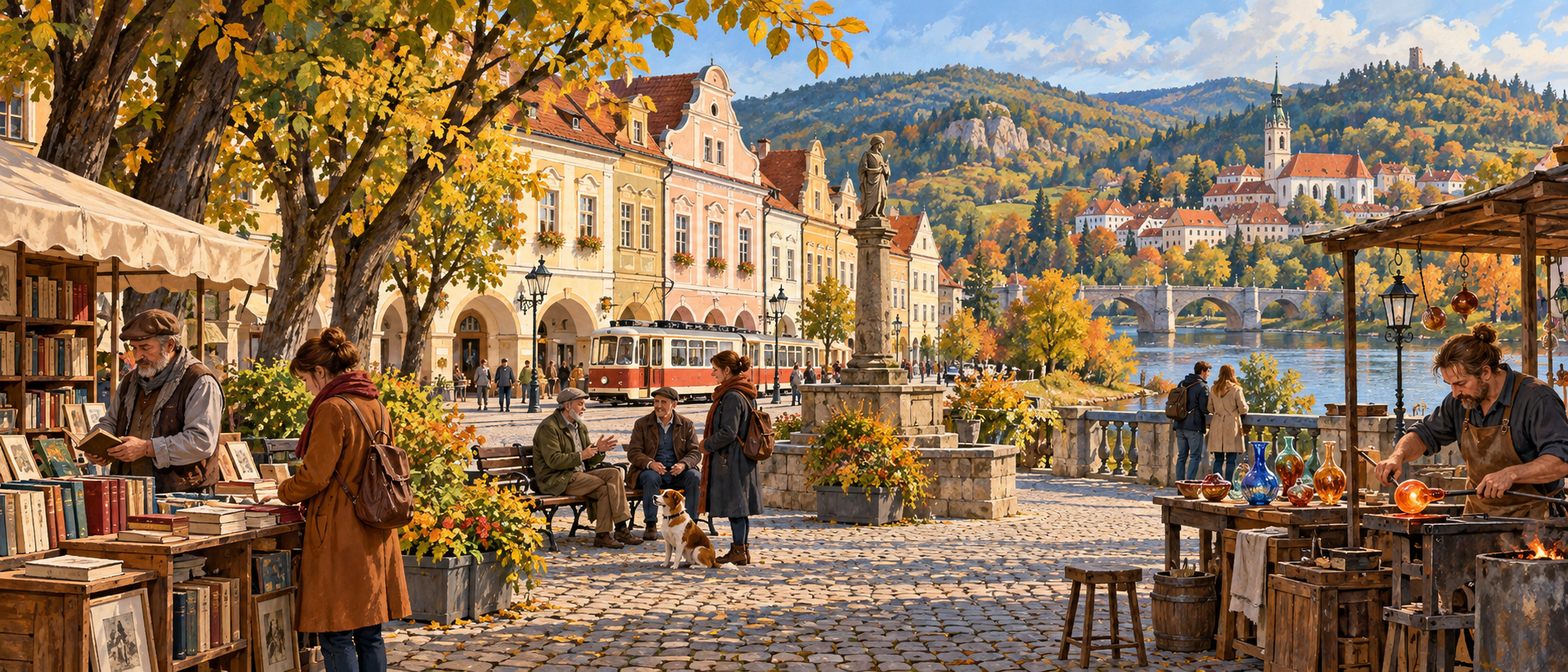
Czechia Children Vocabulary | Words for Character and Nation Building. This independent English vocabulary guide teaches twenty words through four country-based chapters, a source-grounded fictional story and worked learning tasks. A glass bead might look tiny, yet making it takes several specialist steps. A puppet needs people who write, carve and perform. Prague’s old buildings record more than one historical century, and its gardens show why a heritage city is not only stone. Czechia offers children vocabulary about skilled makers, communication, responsible conservation and careful use of evidence.
Written for international children around eight to twelve, with parents and educators assisting. This is not an official Czech curriculum, a practical guide to heating glass, a licence to copy copyrighted puppet designs or an invitation to restore old buildings. Every classroom pupil and story here is fictional, and no living community is required to share an identical artistic or religious preference.
Country-specific facts: UNESCO recognised Czechia’s handmade blown-glass-bead Christmas ornaments in 2020 and the joint Czechia–Slovakia puppetry element in 2016. It inscribed the Historic Centre of Prague in 1992, and its current serial World Heritage property also includes Průhonice Park. These heritage recognitions concern specific people and places; they do not establish every Czech household’s customs or the condition of every building today.
Learning purpose: In this guide, character and nation building means accurate attribution, respect for skilled work, thoughtful dialogue, honesty about what history shows and achievable care for shared places. It is not political loyalty or a demand that children perform skilled trades or historic ceremonies.
Quick answer: what can children learn?
| Learning section | What to practise | Common misunderstanding |
|---|---|---|
| 20 vocabulary entries | Define, distinguish and use words accurately | Memorising a word is the same as understanding it |
| Four country-grounded chapters | Compare a source fact with an inference and choose a safe transfer task | One heritage example represents everyone in the country |
| One invented school story and six checks | Explain and repair a misleading claim | A fictional pupil is an actual source |
| Seven-day retrieval plan | Notice, speak, verify, decide, write and transfer words | Children should undertake adult heritage, safety or legal responsibilities |
Jump to 20-word bank · four reading chapters · fictional learning story · worked checks · seven-day plan · teaching notes · FAQs · sources and country links.
20 English vocabulary words for children: definitions and original sentences
Each word is defined with an important distinction and an original learning sentence. Culture-specific terms belong to the community or place named, not automatically every person in the country. Example sentences and classmates are invented for teaching.
1. Blown glass beads: materials, steps and specialist care
| Word | Meaning and boundary | Original model sentence |
|---|---|---|
| Poniklá | A village in northern Czechia strongly associated with traditional blown-glass-bead ornaments; not the origin of every glass product. | The class located Poniklá on a map of Czechia. |
| glass bead | A small formed piece of glass used for decoration; not a plastic pearl. | The ornament was assembled from blown glass beads. |
| mould | A shaped form used to give material a particular outline; not a finished ornament. | The worker placed heated glass into a mould. |
| silvering | Applying a reflective silver-coloured interior or coating through a specialist process; not ordinary colouring with crayons. | Silvering helped make the glass bead reflective. |
| craftsmanship | Skill gained through practice and judgement in making objects; not just how pretty the result looks. | The display credited the craftsperson’s craftsmanship. |
2. Puppetry in Czechia and Slovakia: makers, stories and listening
| Word | Meaning and boundary | Original model sentence |
|---|---|---|
| puppetry | The art of using controlled figures in performance; not merely placing a toy on a shelf. | UNESCO recognises puppetry in Slovakia and Czechia. |
| marionette | A puppet moved through strings or other controls; not every wooden figure. | A marionette needed a puppeteer’s careful movements. |
| stagecraft | The skills used to prepare scenery, lighting and performance effects; not simply reading dialogue. | Stagecraft contributed to the theatre show. |
| repertoire | A set of pieces or performances a group knows and can present; not one single sentence. | The troupe’s repertoire included several stories. |
| attribution | Naming the real maker, performer or source; not claiming someone else’s art as one’s own. | The programme included attribution for the puppeteer. |
3. Historic Prague: layered architecture and urban responsibility
| Word | Meaning and boundary | Original model sentence |
|---|---|---|
| Prague | The capital of Czechia and a city with UNESCO-listed historical areas; not the whole country. | The map placed Prague on the Vltava River. |
| urban fabric | The connected layout of streets, houses and public spaces; not actual cloth. | The project studied Prague’s urban fabric. |
| Gothic | A historical architectural style; not simply anything old or dark. | The source identifies Gothic buildings in Prague. |
| Baroque | A later artistic and architectural period, not a word for every old church. | The class distinguished Baroque from Gothic features. |
| chronology | The order of historical events or building phases, not a random list of dates. | Chronology helped the learner order several building periods. |
4. Průhonice Park: landscape design, evidence and suitable stewardship
| Word | Meaning and boundary | Original model sentence |
|---|---|---|
| Průhonice | A landscape park southeast of Prague included in the serial UNESCO property; not just another Prague street. | The class added Průhonice to its heritage map. |
| landscape design | Planning spaces with landforms, paths and vegetation; not proof that every tree was planted at once. | Průhonice illustrates historic landscape design. |
| native species | Plants or animals naturally belonging to a region; not every species grown in a botanical garden. | The landscape includes native species alongside introduced ones. |
| monitoring | Systematic checks repeated across time; not the conclusion of one undated picture. | Monitoring helped evaluate changes in the park. |
| stewardship | Responsible care of a place under appropriate rules and knowledge; not permission to alter a protected garden. | The child’s stewardship task was a careful information sign. |
Four chapters: verified context, precise words and a child-safe action
Each chapter offers a sustained, country-specific explanation, a tempting incorrect claim to correct and a paper-based or supervised classroom task. A heritage inscription is not a licence to reproduce dangerous techniques, restricted ceremonies or professional conservation work.
1. Poniklá’s blown-glass-bead ornaments show how a small object involves large skills
Five focus terms: Poniklá · glass bead · mould · silvering · craftsmanship.
UNESCO recognised the handmade production of Christmas tree decorations from blown glass beads in Czechia in 2020. It describes specialist work historically associated with North Bohemia, particularly the Giant and Jizera Mountain regions. Poniklá is an important centre of the surviving practice. Children should not assume a decoration is automatically handmade merely because it looks old-fashioned or because a shop describes it as ‘traditional’. A photograph of the finished piece cannot establish its exact workshop, age or maker without a reliable record.
The traditional process begins with a heated glass tube shaped in a brass mould. This helps produce a string of small hollow beads, which are then treated through processes including silvering and colouring. The beads can be separated and assembled into ornaments of varied shapes. These are distinct jobs with different materials and technical needs. A mould is not the finished item, silvering is not simply using a silver pencil, and the final ornament does not show every physical choice that went into its making.
UNESCO notes that the craft is technically demanding, passed within families over generations, and associated with workshops that have faced difficult economic changes. The Kulhavý family’s continued work has been important to safeguarding the practice. This provides a useful way to explain the word craftsmanship: it refers to the trained ability to select materials and work consistently, not the mere appearance of a shiny object. A child who sees an ornament on a tree can admire it while remembering that an experienced maker had to manage many stages.
Heating glass, treating its surface and cutting beads involve hazards and specialist equipment. Children must not be asked to heat tubes over a flame, handle chemicals used for silvering, cut glass or reproduce a craft procedure at home. A classroom can safely draw a four-box flowchart labelled ‘shape’, ‘finish’, ‘colour’ and ‘assemble’, identifying the order of the tasks without describing an unsupervised technical recipe. Care includes knowing when not to imitate.
The inscription is linked to Christmas ornament traditions, but learning about it does not require every child to observe Christmas or adopt Christian beliefs. Children may study an artistic practice, the materials and its historical use while respecting different family traditions. Likewise, recognition for Czechia does not prove that every Czech family owns these ornaments. A named heritage element can be culturally significant without functioning as a universal personal identity.
UNESCO’s source shows how makers have transmitted knowledge in families and through museums or workshops. A museum teaching event can introduce the public to the craft, but one visit does not turn a beginner into an authorised specialist. A child who writes ‘I saw a video, so I know every stage and can safely perform it’ overstates both their knowledge and what the source allows. A more responsible statement is that the video demonstrated selected parts of the work and the rest requires training.
A specific ornament could involve several people, yet a public image may identify only the photographer. A useful exhibition label distinguishes maker, workshop, photographer and collecting institution when records are available. If the exact maker is not named, state the limitation instead of inventing one. Saying ‘the UNESCO element concerns blown-glass-bead ornament production’ is not proof that a particular piece pictured online was made in Poniklá.
Imagine a school display stating ‘UNESCO invented Czech glass decorations in 2020 and a single machine produces each one instantly’. The date confuses formal recognition with an existing tradition, and the process description removes its skilled practitioners. After checking the UNESCO account, the group changes it to explain older handmade techniques with distinct preparation, colouring and assembly stages. Their revision is a form of fairness: the makers become visible in the explanation.
An original school paper model can use drawn circles and labelled arrows to represent parts being assembled into a star. The class should call it an invented educational diagram, not an actual handmade glass ornament. A teacher can ask which part is an observed design feature and which detail about manufacture comes from the UNESCO source. This strengthens reasoning as well as technical vocabulary. It is not necessary to handle fragile real beads.
There is also a lesson about change. An item may be made in a traditional way but sold into a modern global market. Heritage knowledge may continue while makers respond to new designs, materials or opportunities. Children should avoid claiming that every present workshop operates exactly as it did in the eighteenth century. The UNESCO description offers historic context and present safeguarding concerns, but an individual business requires its own verified information.
The concluding sentence should be specific: ‘Blown-glass-bead ornament making in North Bohemia combines skilled moulding, surface treatment and assembly, with knowledge safeguarded by practising makers’. This tells a reader why the tradition matters without demanding any particular festival observance or exaggerating a child’s competence.
Meaning repair: Incorrect: ‘UNESCO invented glass ornaments in 2020 and a child can safely make them after watching one video.’ Repair: ‘The craft predates recognition, involves several trained technical stages and is not an unsupervised classroom experiment.’
Safe transfer exercise: Create a four-stage paper flowchart and list the people and skills behind the ornament. Explain why your drawing is an analogy, not instructions to work heated glass.
2. Czech and Slovak puppetry shows why good stories need more than the visible puppet
Five focus terms: puppetry · marionette · stagecraft · repertoire · attribution.
UNESCO inscribed puppetry in Slovakia and Czechia in 2016. It is a shared nomination, and the Czechian connection should not erase the Slovak one. The UNESCO description identifies theatre as a cultural practice used to entertain and to explore social or moral themes. A wooden figure alone is not a complete performance: authors, puppeteers, makers, musicians, set designers and audiences may all shape what happens. The name of the practice refers to those human skills and relationships as well as to the object on a stage.
A marionette is a puppet moved through controls, often strings. Other kinds of puppets use different mechanisms. Children should not call every carved toy a marionette or treat a photograph of a puppet as evidence it was actually performed. A puppet’s physical construction and a theatre troupe’s use of it are two different things. A credible museum label can identify a maker or performance history when the institution has records.
Stagecraft includes the work involved in creating an effective performance environment: scenery, lighting, sound, movement and practical preparation. The puppeteer may be visible in a workshop image while the stage designer remains unnamed. A child who says the actor invented every puppet and designed the entire performance from nothing has probably overlooked contributors. Good cultural writing begins by asking who actually did each job and crediting only what can be verified.
UNESCO notes a history of travelling families who performed puppet theatre and later adapted repertoire to local languages and themes. The word repertoire names the plays or pieces known by a performer or troupe. It does not mean that every historical show was repeated word for word or that all families presented identical characters. Living theatre changes as people adjust humour, stories, venues and performance choices while retaining relevant traditions.
The educational importance of puppetry does not mean that every show teaches the same moral or that the lesson must be dictated by a government. A story can prompt a question about honesty, fairness or cooperation and allow different audience interpretations. Children should be free to discuss what a character did and whether the outcome was sensible. Learning a language through stories involves explaining and comparing, not just agreeing with a speaker.
The UNESCO entry documents various routes for transmission, including family practice, workshops, arts schools and community programmes. Students should recognise that a performance relies on repeated practice and feedback. A short video might show an outcome, but cannot provide all the skills of carving, costuming or directing. A child who makes one paper figure has practised an elementary principle but has not reproduced a particular troupe’s historical production.
Attribution matters when the class uses an image of a known character or stage. The puppet’s maker may differ from the playwright and performer. Some scripts and designs remain protected by copyright, even if a theatre tradition has a long history. A classroom should make original characters or use properly licensed sources. If the maker is unknown, the honest caption should say so instead of assigning the work to a famous puppeteer merely because it resembles their style.
Consider a fictional school article stating ‘Czech puppetry is a modern toy created in 2016 and Slovakia has no connection’. Both assertions conflict with UNESCO’s description. A revised sentence says that UNESCO recognised a longstanding shared Czech and Slovak performance practice in 2016. The recognition date must not be substituted for the practice’s historical beginning. A multinational element must name its participating communities rather than treating national history as a competition.
A safe class project can make a small original paper puppet using age-appropriate stationery. A writer prepares a simple three-line story, another learner moves the puppet, and a third checks whether the intended audience understands the message. Label the activity ‘our classroom puppet story’, not an authentic production from a particular heritage troupe. It illustrates the general relationship among story, object and performance while respecting the real practitioners.
A teacher could ask children what makes a performance inclusive. A welcome sign is not sufficient if younger pupils cannot hear the speech or read the programme. Clear diction, a short printed summary or a second explanation might help. Pupils can test whether a partner understood the story, then revise a confusing line. That is a small but real contribution to communication; it is not a claim that all theatre accessibility barriers have been solved.
The chapter closes with the idea that people can cooperate without performing identical roles. Puppeteers, woodworkers and writers bring different skills to a shared production. A national heritage element can honour that work, but the child’s best act of respect is a source-supported caption naming the particular makers where known. The word puppetry becomes useful when it directs attention beyond the toy and toward human creativity.
Meaning repair: Incorrect: ‘Every Czech puppet is a toy created in 2016 and the tradition has no connection to Slovakia.’ Repair: ‘UNESCO recognised an existing shared Czech–Slovak performing-art practice with many contributor roles.’
Safe transfer exercise: Write an original three-line puppet story and a separate source-backed caption about the actual Czech–Slovak tradition. Include a field for maker attribution rather than inventing one.
3. Historic Prague is a city built across many periods, not a single frozen century
Five focus terms: Prague · urban fabric · Gothic · Baroque · chronology.
UNESCO inscribed the Historic Centre of Prague in 1992. Its World Heritage property currently has two components, the historic city centre and Průhonice Park nearby. Prague developed along the Vltava River and contains several distinct historical areas, including Old Town, Lesser Town and New Town. The word urban fabric describes how streets, buildings, squares and other spaces fit together. It is not simply the material in an old curtain.
UNESCO describes important Gothic architecture associated with medieval Prague, including Charles Bridge and religious buildings, while many later structures show Baroque and other architectural influences. These terms identify historic styles rather than degrees of beauty or darkness. A picture containing a church, bridge and houses cannot prove they were all constructed at the same moment. Historic towns can preserve buildings with older cores that were altered in later periods.
The city was a significant cultural and political centre during the reign of Emperor Charles IV. UNESCO connects Prague’s historical influence with urban planning, architecture and scholarship. This does not make one ruler the personal builder of every surviving street. Historians also consider architects, craftspeople, scholars, communities and the many residents whose work and lives shaped the city. A grand building is evidence of a period’s priorities, not a complete diary of every person who lived there.
Chronology is the order of events through time. Prague’s history includes medieval development, later Baroque construction and changes into the modern era. A child might see a medieval plan beside a contemporary photograph and assume that no building was ever changed. That is not supported. UNESCO notes continuing use, adaptation and carefully managed conservation of historic structures. An inscription date in 1992 should not be confused with the construction date of Prague Castle or Charles Bridge.
Prague’s Jewish Quarter and its Old-New Synagogue are part of the UNESCO-described historic city. These landmarks matter to the diverse religious and cultural histories of the city. A child can study their importance without being asked to adopt a particular faith or assume all people living nearby shared one religion. Respectful history describes communities as specific groups with their own traditions rather than treating an architectural style as evidence about every resident’s beliefs.
The city’s heritage also faces urban challenges. UNESCO documents pressures from development, building height, visual changes and continued use. A famous city does not remain safe merely because international recognition has been granted. Heritage managers must balance historic character with housing, transport, services and residents’ lives. Children should not propose repairing protected buildings on their own or assume that every interior is open to visitors.
An attractive postcard may show the bridge and river at sunrise, but cannot tell a researcher the condition of every building or the current experiences of all residents. A map may show a series of squares; it does not establish which street is safe or accessible on a given date. An English learner should avoid confusing a source-supported historical description with present-day visitor guidance. Each has different requirements for evidence and dates.
Imagine a fictional display labelled ‘Prague is a Gothic town built entirely in 1992’. A source checker sees two mistakes: 1992 was UNESCO’s inscription year, and the city contains architecture from multiple periods. The class revises it to say that Prague’s historic centre preserves a layered urban landscape with medieval, Baroque and later features. This short change gives a reader a much better understanding of how a city grows.
A safe classroom analogy can show a fictional street with three buildings: one labelled medieval, a second Baroque and a third modern. Add a note that the dates and shapes are imagined, not a surveyed Prague map. Pupils can practise placing the buildings in chronological order and explaining why one street can contain different periods. For actual Prague dates and architectural descriptions, they must consult UNESCO or another authoritative heritage resource.
There is a further lesson in not treating city centres as empty museum sets. People live, study, work and travel through places that tourists photograph. A heritage property’s value does not remove those people’s needs or rights. The learner can ask what a maintenance decision might affect and who should be consulted, while leaving real decisions to responsible institutions. This makes historical curiosity more considerate.
At the end, children can say: ‘Prague’s UNESCO historic centre has an urban fabric shaped by several architectural periods, including Gothic and Baroque, and requires continuing conservation’. The statement is both more precise and more humane than ‘everything old belongs to one century’. Its accuracy reflects a useful habit: tell a story of change without inventing a simple beginning and ending for a living city.
Meaning repair: Incorrect: ‘Every Prague monument was built in the Gothic era and the city became historic in 1992.’ Repair: ‘UNESCO recognised an existing multi-period urban landscape in 1992; its buildings have varied older histories.’
Safe transfer exercise: Create an imaginary three-period street drawing. Write a separate Prague caption distinguishing architecture, inscription date and real conservation responsibilities.
4. Průhonice Park adds plant variety and landscape design to Prague’s World Heritage story
Five focus terms: Průhonice · landscape design · native species · monitoring · stewardship.
The same UNESCO World Heritage property that includes the Historic Centre of Prague also includes Průhonice Park, southeast of the capital. UNESCO describes its development beginning in the late nineteenth century under Count Arnošt Emanuel Silva-Tarouca, who combined an existing valley landscape with vegetation, paths and garden arrangements. The park demonstrates why World Heritage need not consist only of ancient stone buildings. A designed landscape can have historical value through its composition, plants, water and the knowledge of the people who created and maintained it.
Landscape design involves shaping or arranging landforms, paths, vegetation and built features for particular purposes. UNESCO highlights how Průhonice uses the Botič Stream’s valley setting and a combination of species. A photograph of a flowering tree may look natural, but cannot show whether that exact plant was original, planted later, pruned or replaced. A landscape changes as plants grow, so historic garden design and living ecological processes interact over time.
UNESCO’s account discusses native species and introduced species in the park’s historical collections. Native means naturally associated with the region, while introduced means brought from elsewhere through human activity. An introduced plant is not automatically invasive or harmful; that would require more specific ecological evidence. Similarly, native plants may need appropriate care in a particular garden. A student should learn the definitions without declaring every non-native tree dangerous based solely on its appearance.
The park’s historical character includes its design decisions and the ongoing work of specialists. A mature tree visible today may not be the exact specimen present at the park’s founding. Yet the intended relationships among paths, valleys, water and plant groups may remain important to conservation. The word ‘authentic’ does not necessarily mean every leaf and branch has survived for 150 years. Living landscapes require more nuanced interpretation than objects made from stone or metal.
Monitoring is the systematic observation of conditions over time. In a landscape park, managers may need information about plant health, heritage features, visitor pressure and the surrounding environment. One beautiful spring photograph cannot establish that all the trees are healthy or that the historic design is preserved without alteration. A trustworthy claim about change needs dates, records and a relevant method. UNESCO’s description establishes historical significance, not a daily health report for each tree.
Stewardship means responsible care that respects specialist knowledge, rules and the people affected. The park is managed by a scientific institution according to UNESCO’s account. A child should not plant unknown species, cut branches or collect protected material in order to show enthusiasm. An age-appropriate contribution might be learning the names of plants from an approved sign, writing a clear educational caption and following current visitor guidance under adult supervision.
It is useful to distinguish a protected landscape from an ordinary empty field. Garden design can contain deliberate vistas, pathways and relationships to architecture. An uninformed change might damage those relationships even when the new plant appears healthy. This is why conservation requires evidence of the park’s history, not only the preference of one visitor. A class should not claim that removing all introduced trees would automatically restore the historic design; many were part of the documented plan.
Imagine a school poster saying ‘The Prague World Heritage property is only city buildings, and Průhonice contains nothing but untouched nature’. Both statements conflict with UNESCO’s description. A corrected caption explains that the current serial property includes a historic city and a deliberately designed landscape park, each with distinct significance and responsibilities. The correction demonstrates how reading the source can prevent an entire component from disappearing from the story.
For a paper activity, design an imaginary park with a stream, two paths, native and introduced plant symbols, and one protected heritage feature. Label every tree and location as invented. Ask what a real park manager would need to know before moving a path or selecting a plant. Children do not need to operate garden tools or advise actual Průhonice staff. The task shows the concept of informed decision-making at a safe scale.
A landscape park can also offer a lesson in time. A building may have a documented construction year, while a tree grows through decades and a garden changes across seasons. One photograph cannot prove what the park looked like at every stage. Historical plans and modern observations serve different roles. Pupils can write ‘the park was established as a historic designed landscape’ without guessing the age of a specific tree in an unlabeled photo.
When discussing access, remember that a public garden is not simply a space where every activity is permitted. A path may have restrictions to protect plants or visitor safety, and current hours or entrance rules require up-to-date official information. The article cannot replace such guidance. Children can learn why rules exist without being asked to invent regulations or treat private horticultural work as a class duty.
The final link between the four chapters is human effort. Glass beads depend on craftsperson skill, puppetry depends on performers and makers, Prague depends on many generations of builders and residents, and Průhonice depends on landscape designers and caretakers. A child who uses stewardship, attribution and chronology carefully has learned how different forms of work contribute to shared life. Those words are more meaningful than a vague declaration that every part of Czechia is the same.
Meaning repair: Incorrect: ‘Průhonice is untouched wilderness outside the UNESCO property, and any child may replace trees for conservation.’ Repair: ‘It is a designed component of Prague’s heritage property requiring informed and authorised care.’
Safe transfer exercise: Draw a clearly fictional park plan with stream, paths, plant groups and one heritage feature. Write a UNESCO-based sentence on Průhonice and one monitoring question still needing evidence.
Fictional school story: source checking improves an explanation
At an imaginary school museum, Jakub says Czech glass ornaments were invented when UNESCO recognised them in 2020. A source-checker adds the older North Bohemian production history and distinct making stages. Lenka writes that puppetry belongs only to Czechia; the class corrects the caption to include Slovakia and the makers, writers and performers. Filip treats Prague’s medieval buildings as if all were constructed in 1992; the timeline shows Gothic, Baroque and later periods. Finally, Eva omits Průhonice Park from a map of the World Heritage property; she checks UNESCO and adds the garden landscape. All pupils and events are fictional. The UNESCO information is sourced below.
Four comprehension questions
- 1. What changed in Jakub’s explanation of the glass-bead ornaments?
- 2. Why did Lenka’s puppet programme need a second country and individual credits?
- 3. How did chronology correct Filip’s Prague caption?
- 4. Which component was missing from Eva’s first UNESCO map?
For each question, explain which action in the fictional story supports the answer. Then identify which official source supports any fact about the real country. The invented children are not witnesses to historical or contemporary events.
Six vocabulary checks with worked answers
Check 1: When were Czech blown-glass-bead ornaments formally inscribed by UNESCO?
Worked answer: In 2020, recognising a much older specialist craft.
Explain what the source supports, name one tempting alternative that would be wrong and use the term in a different original English sentence. Demonstrated reasoning is more useful than copying a line from the table.
Check 2: Which countries jointly hold the 2016 puppetry heritage inscription?
Worked answer: Czechia and Slovakia.
Explain what the source supports, name one tempting alternative that would be wrong and use the term in a different original English sentence. Demonstrated reasoning is more useful than copying a line from the table.
Check 3: Are marionette-making, performance and stagecraft exactly the same job?
Worked answer: No. They are different contributing roles that may involve different people.
Explain what the source supports, name one tempting alternative that would be wrong and use the term in a different original English sentence. Demonstrated reasoning is more useful than copying a line from the table.
Check 4: When did UNESCO inscribe the Historic Centre of Prague?
Worked answer: In 1992. The city and its buildings existed long before recognition.
Explain what the source supports, name one tempting alternative that would be wrong and use the term in a different original English sentence. Demonstrated reasoning is more useful than copying a line from the table.
Check 5: Is Prague’s heritage architecture entirely one Gothic period?
Worked answer: No. UNESCO describes Gothic, Baroque and other architectural periods.
Explain what the source supports, name one tempting alternative that would be wrong and use the term in a different original English sentence. Demonstrated reasoning is more useful than copying a line from the table.
Check 6: What second component belongs to the serial Prague World Heritage property?
Worked answer: Průhonice Park, a historic designed landscape southeast of Prague.
Explain what the source supports, name one tempting alternative that would be wrong and use the term in a different original English sentence. Demonstrated reasoning is more useful than copying a line from the table.
Seven-day plan: vocabulary that children can use independently
| Day | Practice | Evidence |
|---|---|---|
| Day 1 — Notice | Read words 1–5 and explain each without copying, then identify one misuse. | Precise definition and non-example |
| Day 2 — Speak | Use words 6–10 in safe family or classroom examples. | Original spoken sentences with correct meaning |
| Day 3 — Source | Read a short, age-appropriate part of an institutional source with an adult. | One verifiable fact and one unanswered question |
| Day 4 — Compare | Study words 11–15 and sort statements into observation, source fact, inference or fiction. | No imaginary map or story presented as evidence |
| Day 5 — Decide | Study words 16–20 in a supervised fictional group problem. | One suitable responsibility and way to check success |
| Day 6 — Write | Write 80–120 words using three focus terms and naming a real source. | Clear, respectful, accurate paragraph |
| Day 7 — Transfer | Apply three general terms to a different country or everyday situation. | Correct new use without a transplanted stereotype |
A low-pressure assessment
Ask the learner for the meaning of the word in their own words, a plausible but wrong example, and one new correct sentence. Record ‘not yet’, ‘with guidance’ or ‘independently’. Revisit after several days. When a child corrects an answer after consulting a source, that is academic progress, not failure.
When checking a paragraph, look for clear subjects and verbs, correct selection of terms, evidence for real-world statements, proper attribution and an action within the child’s competence. A brief, precise account is stronger than a sweeping or flattering national claim that the source does not support.
Parents and teachers: character through evidence and dignity
- Name the correct country and community. Similar names and shared regional traditions can create misleading claims unless the state, people and source are explicit.
- Credit workers and knowledge holders. Makers, performers, guides, researchers and community members can have different contributions.
- Respect religious, cultural and personal choices. A child may study a tradition without copying restricted elements or speaking for an entire community.
- Keep heritage, science and law distinct. A World Heritage inscription, a wildlife population estimate and an official-language rule answer different questions.
- Leave hazardous work to trained adults. Heated glass, active volcanoes, dangerous wildlife and conservation fieldwork do not belong in a child’s homework.
- Include people in landscape discussions. A protected garden or rainforest is not necessarily an empty place without residents or cultural connections.
- Test practical comprehension. A polite invitation is incomplete if the intended reader cannot understand its requirements.
- Reward source-backed correction. Revising an attractive but inaccurate museum label is a concrete contribution to shared learning.
Frequently asked questions
Are blown-glass-bead ornaments safe for children to manufacture at home?
No. The craft uses heated glass and specialist techniques. Paper diagrams are an appropriate English-learning substitute.
Does Czechia hold the puppetry inscription alone?
No. It is a joint living-heritage element with Slovakia.
Are all historic Prague buildings from one century?
No. The city contains architecture from many periods and continued to change over time.
Why is Průhonice included in a Prague World Heritage guide?
It is a separately located component of the serial property, valued for its historic landscape and plant composition.
Do introduced trees automatically mean a garden is damaged?
No. Průhonice’s design historically incorporated native and introduced species; actual impacts require context.
What is a child-sized act of cultural stewardship?
Proper attribution, respectful questions, a corrected caption and following site guidance under adult supervision.
Institutional sources, country reading and linked vocabulary hubs
Country-specific factual anchors above are based on the named UNESCO, constitutional and other institutional resources below, reviewed in October 2026. Fictional dialogue, pupil examples, diagrams and assignments are independent editorial English-learning material, not official national curricula or reports of actual school events. Real access and safety decisions require current relevant authority guidance.
- UNESCO | Handmade production of blown-glass-bead decorations
- UNESCO | Puppetry in Slovakia and Czechia
- UNESCO World Heritage | Historic Centre of Prague and Průhonice Park
- UNESCO | Czechia heritage elements list
- UNICEF | Convention on the Rights of the Child
Explore this country through eduKateSG
- Everything About Czechia
- Top 100 Poniklá Bead Ornaments Vocabulary Words
- How Education System of Czechia Works
- Top 10 Places to Visit When Touring Czechia
Continue the A–K Children Vocabulary branch
Cyprus Children Vocabulary · Czechia (this article) · Democratic Republic of the Congo Children Vocabulary · Denmark Children Vocabulary · Djibouti Children Vocabulary
Vocabulary and world-learning hubs
- Vocabulary Learning Hub
- Vocabulary by Age and Purpose
- How Countries Work | A–Z
- Top 20 Unique Country Vocabulary Index
A child completing this Czechia guide should be able to define twenty words, recognise what the actual source establishes, name the people and places involved and make one safe, appropriate correction. Accuracy, humility and thoughtful action make vocabulary valuable.