
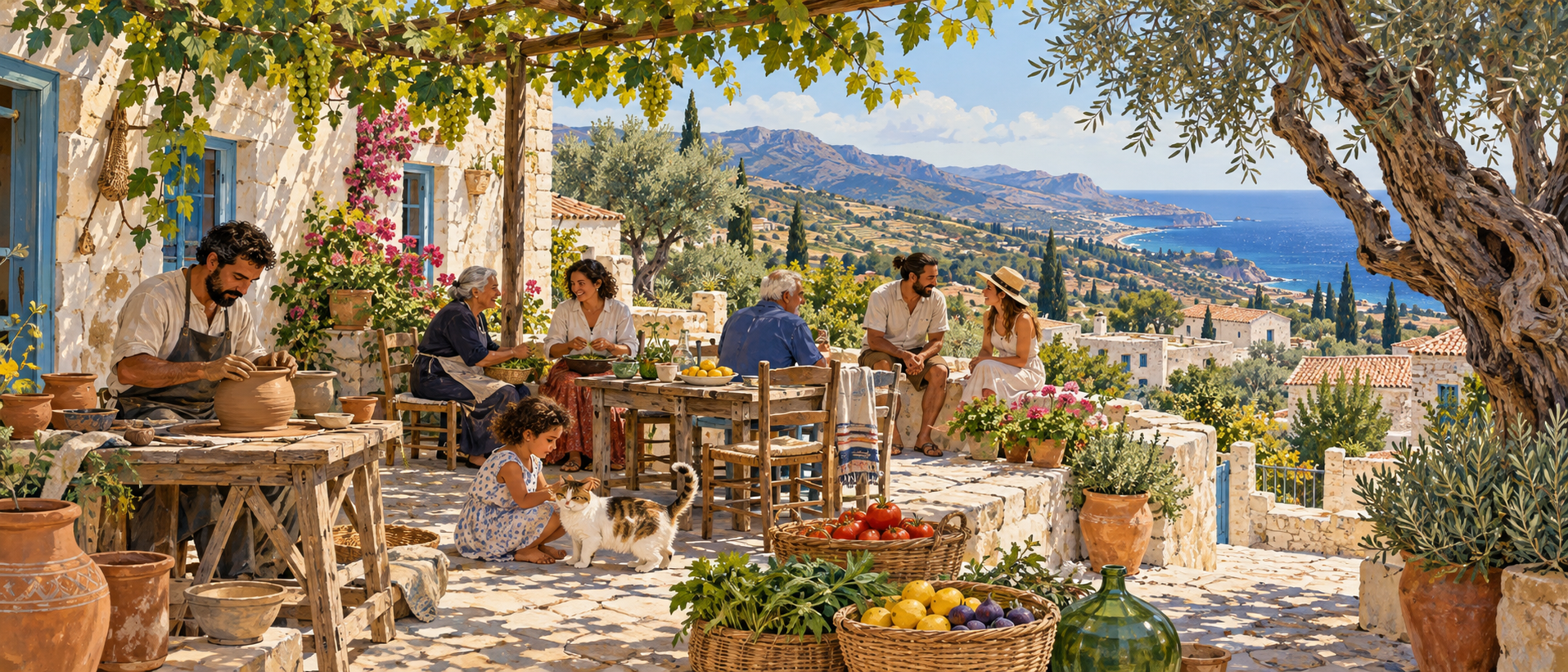
Cyprus Children Vocabulary | Words for Character and Nation Building. Learn twenty English words through four careful cultural, historical and community examples, followed by an original story and worked learning tasks. A delicate lace hem combines several stitches. A poetic exchange depends on listening as well as quick language. Mountain churches preserve paintings and varied historical techniques, while a Neolithic settlement offers clues about lives long before writing. Cyprus gives children English words for craftsmanship, dialogue, historical evidence and responsible care.
For international learners about eight to twelve years old, with adults assisting on religious and historical context. This is an independent English guide, not an official Cyprus syllabus, religious instruction, a request to imitate particular ceremonial customs or permission to handle protected archaeological objects. Cyprus has diverse people and experiences, and the selected examples do not describe every household on the island.
UNESCO-backed country context: UNESCO recognised Lefkara laces, also called Lefkaritika, in 2009 and Tsiattista poetic duelling in 2011. The Painted Churches in the Troodos Region were first inscribed as World Heritage in 1985, with an extension in 2001 producing a serial property of ten churches. The Neolithic site of Choirokoitia was inscribed in 1998. Each source illustrates a different relationship between skill, people and evidence.
Character and nation-building learning goal: Here character and nation building means respectful cultural attribution, careful speech, honest archaeological uncertainty and care for shared places. Children are not expected to choose a political position, adopt a faith or take on conservation tasks that belong to specialists.
Quick answer: learning outcomes and boundaries
| Learning feature | What a child should be able to do | Common error to avoid |
|---|---|---|
| 20 defined English terms | Explain meaning and a non-example, then use the word in a fresh sentence | Recognition alone is word mastery |
| Four source-grounded chapters | Distinguish a cultural or historic source fact from a guess | A particular tradition represents everybody |
| Fictional story and six worked checks | Repair misleading information and explain why it needed revision | Imaginary dialogue constitutes historical testimony |
| Seven-day practice guide | Read, speak, compare, write and transfer vocabulary independently | Children must do adult cultural or conservation work |
Go to 20-word bank · four chapters · model story · six checks · seven-day plan · teaching notes · FAQs · verified sources and hubs.
20 children’s vocabulary words: meanings, distinctions and original sentences
Every definition explains a meaning and excludes a tempting misconception. Example sentences are original English-learning material, never an invented quotation attributed to a real child or heritage practitioner.
1. Lefkara lace: fine stitches and the skills of named makers
| Word | Meaning and important distinction | Original example sentence |
|---|---|---|
| Lefkara | A village in Cyprus associated with a named hand-lace tradition; not a generic word for all island textiles. | The class located Lefkara on its map. |
| hemstitch | A type of needlework that draws or secures threads to form a decorative edge or openwork; not a machine print. | The sample diagram showed a hemstitch. |
| cutwork | Decorative needlework involving carefully made openings in fabric; not permission for unsupervised children to cut historic textiles. | The lace-making glossary defined cutwork. |
| satin stitch | A decorative embroidery stitch using closely spaced thread to cover a shape; not a paint fill. | The original model used the idea of satin-stitch filling. |
| transmission | Passing knowledge or methods from experienced people to others; not only showing the finished item. | Training supports transmission of lace skills. |
2. Tsiattista: a living tradition of responsive poetic exchange
| Word | Meaning and important distinction | Original example sentence |
|---|---|---|
| Tsiattista | A Cypriot tradition of improvised, often competitive verse exchange; not every playful argument. | The music article described Tsiattista. |
| couplet | Two successive lines of verse forming a unit, often rhyming; not a four-line stanza. | The child wrote an original rhyming couplet. |
| improvisation | Creating or adapting during performance using learned knowledge; not acting with no preparation. | Improvisation challenged the poet to respond quickly. |
| iambic | A rhythm pattern in poetry often associated with a light-strong beat sequence; not necessarily the rhythm of every language. | The teacher explained an iambic verse pattern. |
| dialogue | A two-way exchange that involves listening and responding; not simply competing to speak the longest. | The pupils used dialogue to revise their example. |
3. Troodos painted churches: murals, chronology and historic responsibilities
| Word | Meaning and important distinction | Original example sentence |
|---|---|---|
| Troodos | A mountain region of Cyprus containing UNESCO-listed painted churches; not a name for every church on the island. | The heritage map marked the Troodos region. |
| mural | An artwork painted on a wall or another large permanent surface; not simply an image printed on a notebook. | The church contains historic murals. |
| Byzantine | Relating to the historical Byzantine Empire and associated cultures; not a synonym for everything old. | The source described Byzantine artistic traditions. |
| serial property | A World Heritage listing made up of separate component sites connected by overall significance; not one huge building. | The Troodos inscription is a serial property. |
| conservation | Informed care protecting a monument or its cultural setting; not unauthorised repainting by visitors. | Conservation specialists study the murals before intervention. |
4. Choirokoitia: Neolithic settlement, excavation and what evidence can establish
| Word | Meaning and important distinction | Original example sentence |
|---|---|---|
| Choirokoitia | A Neolithic archaeological settlement in Cyprus inscribed by UNESCO in 1998; not a modern city district. | The class located Choirokoitia on a map. |
| Neolithic | Relating to a later prehistoric period associated with farming and settled life in many regions; not the same calendar dates everywhere. | The site preserves Neolithic settlement evidence. |
| settlement | A place where people live or lived as an organised community; not necessarily a city. | The archaeological plan revealed a settlement. |
| reconstruction | A model or rebuilt representation based on evidence; not automatically the untouched original. | The visitor centre showed an educational reconstruction. |
| provenance | Recorded information about where an artefact originated or was found; not a guess from the object’s shape. | The museum used provenance to check its label. |
Four substantial learning chapters: words connected with genuine sources
Read each chapter as an investigation: what is the actual place or practice, which people contribute, what does the source establish, which attractive conclusion is unsupported, and what can a child practise safely? General classroom analogies must never be mistaken for an authentic cultural performance or a professional field task.
1. Lefkaritika is the work of skilled people, not simply a lace pattern
Five focus words: Lefkara · hemstitch · cutwork · satin stitch · transmission.
UNESCO inscribed Lefkara laces or Lefkaritika as intangible cultural heritage of Cyprus in 2009. The practice is associated with the village of Lefkara and has a history reaching back several centuries. UNESCO describes embroidery and lace-making skills that developed through local experience and interaction with wider artistic influences. It is not a claim that every textile made on the island is Lefkaritika or that all Cypriot families practise the same craft.
The UNESCO description identifies four basic elements used in the work: hemstitch, cutwork, satin-stitch fillings and needlepoint edging. A student who looks at a finished tablecloth may see geometric patterns without realising how the openings, stitch surfaces and borders were made. These terms give language to different techniques rather than treating the work as a printed design. A photograph can show shape and colour, but cannot automatically identify the maker of that particular cloth.
A hemstitch works with fabric threads to create a decorative area or edge. Cutwork can involve making openings within fabric as part of a controlled design. A satin stitch produces closely spaced thread coverage over a shaped area. The definitions explain general concepts, not instructions for children to take sharp scissors to historic lace or use specialist tools without supervision. The actual techniques require practice, suitable materials and trained guidance.
UNESCO’s account notes influences associated with Venetian embroidery and earlier regional geometric designs. These connections should not be simplified into the claim that no local maker had creativity or expertise. A living tradition can be shaped by exchange while being sustained through the skill and choices of people in Lefkara. The best caption recognises both historical interactions and the personal contribution of the people who make the work.
Transmission is essential because the knowledge is learned through observation, guided practice and experience. UNESCO describes women teaching younger family members and others in the community. This documents how the practice has commonly been passed down, not a rule that every girl must learn it or that people may not choose other work. International children should not be pressured to represent the culture of their country of birth by demonstrating a craft at school.
A maker may choose or adapt patterns with experience. UNESCO highlights a balance of inherited features and individual imagination. The word tradition does not mean that every tablecloth must look identical forever. A pupil who describes all lace as unchanged since medieval times is probably overstating the evidence. The object in the photograph may have been made recently even when the technique has a much older history. Recognition in 2009 is a separate date from the craft’s origins.
The work also has social importance. UNESCO describes makers working and conversing together in streets or sheltered patios and producing tablecloths, napkins and other objects. A picture of a piece of lace does not show these relationships or the economic and personal experiences of the maker. A careful article gives attention to the people involved, while avoiding unsupported claims that every practitioner earns a particular income or lives in an identical household.
Attribution matters because a photographed textile may belong to a private collection, a museum or the maker. The correct label can name the technique and town without inventing the individual creator’s name. If the original designer is known, the source should be cited. Copying a modern maker’s design onto commercial goods is not authorised merely because the technique is described in a UNESCO document. Appreciation and ownership are different concepts.
Imagine a fictional museum caption: ‘This Lefkara lace was produced by a printer in one minute; no skill was involved’. A classmate compares it with UNESCO’s description of four stitch elements and revises the caption to explain handwork, artistic decisions and trained makers. The revised explanation names what the viewer cannot see in a static image. It is a practical lesson in recognising labour behind a beautiful finished product.
For a safe school exercise, draw different border patterns with pencil on paper. Label them original diagrams inspired by learning the words hemstitch and cutwork, not authentic lace or a reproduction of a particular maker’s design. Students can compare the terms, explain how each relates to textile construction and ask which information would require a practitioner to answer properly. The exercise develops English without pretending to teach specialised heritage.
Finish with a source-backed sentence: ‘Lefkaritika is a Cypriot hand-lace practice with several stitch methods carried by experienced makers through teaching and social practice’. A pupil who can explain each word will have understood more than the place name. They will have learnt to respect skilled craftsmanship without treating another community’s work as a decorative object available for anyone to claim.
Repair the misleading claim: Misleading: ‘Lefkara lace is identical to any machine-printed pattern and needs no trained makers.’ Repair: ‘UNESCO recognises specialised handwork using particular stitches and living knowledge transmission.’
Safe transfer activity: Design an original paper border and label hemstitch, cutwork and satin stitch as terms to research. Describe the difference between your drawing and authentic Lefkaritika.
2. Tsiattista teaches quick language with careful listening, not personal insults
Five focus words: Tsiattista · couplet · improvisation · iambic · dialogue.
UNESCO inscribed Tsiattista poetic duelling in Cyprus in 2011. This is a living oral poetry form in which poet-singers may exchange rhyming verses at celebrations and other gatherings. The word duelling is metaphorical here: the source describes competing poetic wit and performance, not a physical fight. A child should not read the title and assume performers attack one another. The artistic challenge is to respond in verse with knowledge of tradition, timing and language.
A couplet consists of two lines of verse, often with a rhyme relationship. UNESCO identifies rhyming couplets as typical of Tsiattista and notes a traditional preference for fifteen-syllable iambic verse, with other lengths also used. The word iambic concerns rhythmic structure, not proof that every poem in Cyprus follows the same form. Children can understand the general idea of a two-line reply without needing to master the Greek Cypriot language or exact traditional metre.
Improvisation means creating or adapting material during performance. UNESCO’s description emphasises that experienced poet-singers need wit, a rich vocabulary and familiarity with older verse to respond quickly. A learner might mistake improvisation for a lack of preparation. In fact, spontaneous creation can rely on years of listening and practice. The best school analogy is a simple English word challenge, not a claim that two sentences equal the full poetic tradition.
The poets historically performed in social settings where audiences could respond and encourage participants. Dialogue is essential because an exchange requires listening to the other person’s verse before answering it. A participant who simply repeats a memorised speech without considering the reply has missed a central part of the interaction. The child-friendly lesson is the habit of answering what was actually said instead of waiting impatiently to deliver a prepared response.
UNESCO describes changing participation over time, including younger practitioners and female poets joining a form long associated with particular male performers. This shows why a living tradition should not be presented as frozen. Historical patterns of participation do not impose a rule that contemporary children of one gender may or may not learn poetry. A source can describe past arrangements while learners practise voluntary, respectful inclusion today.
The Greek Cypriot language context is important. A student writing two rhyming English lines has created an English exercise, not necessarily an authentic Tsiattista performance. Rhyme and quick replies can illustrate parts of the concept, but the living form includes language, timing, music and cultural knowledge known to practitioners. The classroom should not translate or invent traditional verses and present them as verified unless a qualified source confirms them.
A good poetic exchange does not require humiliation. Children should never be pressured to make fun of classmates’ identities, disabilities or family circumstances under the excuse of ‘duelling’. A safe creative challenge can ask one learner to write a friendly couplet about a garden and another to reply with a gentle image of rain. Both should be able to say no to performing publicly. The lesson’s character value is fair expression and listening, not winning at the expense of dignity.
The term couplet can also be distinguished from quatrain, a four-line stanza. A child who identifies a four-line paragraph as one couplet may have confused the basic unit. Two consecutive couplets can form four lines, but the structure should be described accurately. Such distinctions are useful for other English poetry study as well, where students must identify the form before discussing a poem’s theme.
Imagine an exhibition caption saying, ‘Tsiattista is a physical sword fight where nobody listens’. A pupil checks UNESCO and corrects it to ‘Tsiattista is an improvised poetic exchange in which performers respond with verses and musical or social support’. The correction replaces literal misuse of the word duel with a proper explanation of artistic competition. It also shows how familiar English words can acquire special meanings in a cultural context.
For a classroom task, have two volunteers write original rhyming couplets about a harmless topic such as lending books. Each listens to the previous line before replying. The teacher can ask what makes the answer relevant, whether the rhymes work and what respectful feedback would help. Label the exercise ‘English dialogue poetry’ rather than ‘traditional Tsiattista’ and do not grade children on their willingness to perform for others.
The final question is why a vocabulary lesson should include an oral art. It demonstrates that language is not merely a list of words: meaning is shaped by timing, context and listening. A learner who can explain improvisation, couplet and dialogue separately can practise these skills in normal classroom conversation. The tradition’s cultural specificity remains respected while its general language concepts become useful.
Repair the misleading claim: Misleading: ‘Tsiattista is an angry fight, and improvising means the performer has learnt nothing.’ Repair: ‘It is a skilled responsive poetry tradition using rhyme, metre and informed spontaneous creation.’
Safe transfer activity: Write two original, respectful English couplets on a school topic, then explain why the exercise is a general analogy rather than an authentic Greek Cypriot Tsiattista performance.
3. The painted churches of Troodos preserve many artistic periods and living responsibilities
Five focus words: Troodos · mural · Byzantine · serial property · conservation.
UNESCO first inscribed the Painted Churches in the Troodos Region in 1985 and extended the property in 2001, bringing the selected group to ten monuments. The property is a serial property: separate components linked by their shared significance rather than one giant building. Children should not call every church in the mountain region part of the inscription or claim that all ten were built and decorated in the same year. A good map identifies the relevant sites and recognises their distinct histories.
The Troodos region includes churches and monasteries preserving remarkable murals. A mural is painting made on a wall or other large architectural surface. UNESCO’s description connects the decorations with Byzantine and post-Byzantine artistic traditions, among others. These terms refer to historical periods and cultural contexts, not just an adjective meaning ‘very old’. A pupil can describe a visible painting without pretending that one photograph reveals the artist’s personal thoughts.
UNESCO explains that the ten monuments collectively document different artistic influences over hundreds of years. The structures may be modest in size while their decoration is intricate and important. That contrast challenges the idea that the largest building must contain the most significant art. The paintings’ value is connected to the skill of creators, historical continuity and surviving evidence, not only to the physical size of a church.
Some Troodos churches have distinctive steep timber roofs and other adaptations connected with geography and climate. A child who sees one roof may draw a useful sketch but cannot assign all roofs to one exact construction year from appearance alone. Dating requires architectural study and historical records. UNESCO’s listing may support the general feature while a claim about a particular roof requires the appropriate component description.
These are Christian religious places, and some have continuing religious functions. A lesson can describe their cultural and artistic history without requiring children of different beliefs to adopt the faith or participate in worship. Respect includes appropriate behaviour in an active religious setting and care when photographing sacred images or spaces. The World Heritage status does not remove the rights or responsibilities of the people who own and use the buildings.
Conservation means informed care and maintenance of valued heritage. UNESCO discusses protective measures such as monitoring, fire or theft precautions and heritage-management plans. A visitor should not touch, repaint or trace fragile murals to improve the display. Professional knowledge is necessary for decisions about cleaning pigments, repairing plaster or protecting buildings from weather. A child’s safe responsibility is to read the rules and make accurate informational material.
An inscription date is not necessarily the date a building was constructed. The UNESCO property began with a group recognised in 1985; the final church was added in 2001. The actual historical origins of the monuments are much older. A child who says ‘the churches were painted in 2001’ has mistaken the extension of an official list for the time of the art’s creation. This is the same reasoning used in other country chapters when distinguishing formal recognition from origins.
A fictional school poster might claim, ‘Troodos has one painted church whose murals were all made by a single artist’. A student checks UNESCO and learns it is a serial group of ten monuments reflecting different eras. The caption changes to ‘UNESCO protects ten selected painted churches in the Troodos region whose murals document artistic change over centuries’. The revised sentence retains the heritage’s importance while reducing the risk of misrepresentation.
A useful classroom project is to draw an imaginary small church and a separate mural panel. Label it original artwork, not a reproduction of an actual protected painting. Pupils can then create a three-column table for ‘building’, ‘wall painting’ and ‘preservation rule’. Ask which facts are visible in their drawing, which come from UNESCO and which remain unknown. The task can teach visual literacy without copying sacred imagery.
The serial listing also provides a geography lesson. Each component occupies its own place, even though the World Heritage name groups them together. A detailed question about visitor access or services must be directed to responsible authorities rather than inferred from the shared listing. A map with one large dot labelled ‘all ten churches’ may introduce the region but cannot identify every component precisely. A source-backed map makes the spatial distinction clear.
Finally, children should recognise the role of current communities in the survival of historical art. UNESCO notes the involvement of local church authorities and heritage specialists in management. The people who maintain access and protect buildings are part of the story. A child can express respect by asking what a place needs, following instructions and resisting the temptation to handle a delicate surface. That is character in practice, not a slogan about culture.
Repair the misleading claim: Misleading: ‘Troodos is one church painted at the moment UNESCO recognised it.’ Repair: ‘The inscription groups ten distinct monuments with murals and building histories spanning earlier centuries.’
Safe transfer activity: Create a fictional three-site map and a table distinguishing UNESCO inscription date, an unknown construction date and a preservation rule. Do not reproduce protected murals as if your drawing were authentic.
4. Choirokoitia shows how archaeologists distinguish an ancient settlement from a reconstruction
Five focus words: Choirokoitia · Neolithic · settlement · reconstruction · provenance.
UNESCO inscribed Choirokoitia on its World Heritage List in 1998. It is an important Neolithic archaeological site on Cyprus, providing evidence of people who lived and organised a settled community long before written historical records of the island. The Neolithic is a broad prehistoric period, associated with changes such as settled life and agriculture in many regions. It does not have the same starting and ending dates everywhere in the world. A good student uses the term for a specific archaeological context rather than calling every ancient object Neolithic.
A settlement is a place where people live or lived together. UNESCO documents Choirokoitia’s distinctive domestic buildings, including circular structures and associated remains. Excavation helps archaeologists explore how these buildings were arranged and used. The site is not a perfectly preserved modern village whose streets and households can be directly observed exactly as they once were. What survives is physical evidence requiring study and careful interpretation.
Provenance concerns where an object came from and how its archaeological context is documented. A pottery fragment found in a particular layer can tell researchers more if the location and associated materials are recorded. Removing a stone from the site to take home could destroy useful information. A pupil should never dig, scrape or collect protected artefacts. A photograph of one item does not automatically reveal the age of every nearby building or the identity of its owner.
UNESCO identifies Choirokoitia as a significant record for the spread of early settled life across the eastern Mediterranean. This is a broad historical conclusion grounded in multiple studies, not the claim that one stone house invented every later Mediterranean city. The site can show connections and changes without proving that all ancient people travelled on the same route or lived in exactly the same manner. A careful reader pays attention to the source’s language about what the evidence demonstrates.
A reconstruction is a model or rebuilt representation of how something may have looked, created using available evidence and interpretation. Choirokoitia has educational reconstructions to help visitors visualise ancient buildings. The presence of a reconstructed house should not be used to tell children that every roof, doorway or household object is an untouched original. Models are useful when their assumptions and limits are identified. A model can communicate archaeological reasoning without replacing the material remains.
Students might see a round reconstructed building and conclude that every household in the settlement contained the same number of people. The building’s shape alone cannot prove that. Such questions require archaeological evidence about occupation, objects, burial practices and site history. UNESCO’s description offers broad understanding while specialists investigate finer details. A child who asks a justified question is thinking more critically than one who invents a complete prehistoric diary.
Historical study should treat human remains and associated material with care. Neolithic archaeology involves real people whose dignity does not disappear because they lived thousands of years ago. Students need not perform a dramatic pretend burial or handle replicas of human remains to learn the terms. A map of building shapes and a short source-backed paragraph are enough. When teachers discuss archaeological interpretations, they should distinguish the source’s claim from fictional narratives created only for reading practice.
The World Heritage listing also requires conservation and management. UNESCO identifies the work of the Department of Antiquities and programmes for site preservation. A visitor should follow official paths, respect boundaries and avoid making unauthorised changes. The existence of a visitor reconstruction does not mean that students may climb on all structures or copy the design into a real building without technical guidance. Preservation belongs to trained adults and appropriate institutions.
Imagine a school caption saying, ‘Every building in this photo is an untouched Neolithic home whose residents left written diaries’. A source checker finds that the site predates the relevant written records and that some illustrative buildings are reconstructed. The revised caption reads, ‘Choirokoitia preserves archaeological evidence of Neolithic settlement; reconstructions help visitors imagine possible building forms’. The second is more trustworthy because it separates an actual find from an educational model.
For a paper activity, draw three fictional round structures with a path between them. Label the plan an imaginary settlement and write ‘not to scale’. Place a separate diagram of a pottery sherd next to one building and explain that its provenance is unknown because the object is invented. Ask pupils what a real archaeologist would need to document before relating an artefact to a particular occupation level. This teaches the value of context rather than the thrill of discovery alone.
A further comparison can distinguish archaeology from a storybook. Fiction may invent a Neolithic child and their family for literacy practice. That is acceptable if plainly labelled as fiction. It becomes misleading if the child’s name and words are presented as historical evidence. The absence of written diaries is itself a useful source limitation. Children can enjoy imaginative learning while recognising what is known, inferred or invented.
Finish by writing an accurate three-sentence explanation: ‘Choirokoitia is a Neolithic settlement site on Cyprus’; ‘archaeologists use provenanced remains to study its past’; and ‘reconstructions illustrate interpretations rather than untouched original buildings’. The learner who can state all three has acquired valuable historical vocabulary and the habit of respecting evidence.
Repair the misleading claim: Misleading: ‘Every reconstructed Choirokoitia house is an untouched original with a known family’s written diary.’ Repair: ‘The site preserves prehistoric archaeological remains, while reconstructions are evidence-based learning models.’
Safe transfer activity: Make an original fictional Neolithic settlement plan and a two-column chart separating archaeological evidence from imagined reconstruction details. Explain why provenance matters.
Fictional school story: better explanations after checking evidence
At a fictional school heritage fair, Elena describes Lefkara lace as a printed pattern, but another learner reads UNESCO and adds hand stitches and experienced makers. Andreas says Tsiattista is an angry fight and writes an insulting poem; his group explains that it is a skilled, responsive verbal tradition and chooses a respectful English couplet instead. Maria shows a Troodos church and claims the whole World Heritage property was painted in 2001; a teacher points to the ten component sites and earlier history. Finally, Christos presents a reconstructed Choirokoitia house as an untouched Neolithic original; a classmate adds a label distinguishing archaeology from educational reconstruction. The pupils and dialogue are invented, while UNESCO facts are cited below.
Four comprehension questions
- 1. How did the source change Elena’s explanation of lace-making?
- 2. Why is a respectful reply a better teaching model for Tsiattista than a personal insult?
- 3. What was wrong with Maria’s use of the 2001 extension date?
- 4. How did Christos distinguish historical evidence from a reconstructed display?
Each answer should identify a supporting detail from the invented story. Use UNESCO or another named institutional source for actual country history, rather than treating school fiction as eyewitness evidence.
Six vocabulary checks with worked answers
Check 1: When was Lefkaritika inscribed on UNESCO’s intangible-heritage list?
Worked answer: 2009.
For full understanding, explain which fact the answer fits, identify a tempting but inaccurate alternative, and use the relevant word in a new school or family example. Accurate reasons matter more than simply repeating the glossary.
Check 2: Is every four-line poem automatically a traditional Tsiattista performance?
Worked answer: No. Tsiattista is a specific skilled Greek Cypriot poetic-exchange tradition, often using rhyming couplets.
For full understanding, explain which fact the answer fits, identify a tempting but inaccurate alternative, and use the relevant word in a new school or family example. Accurate reasons matter more than simply repeating the glossary.
Check 3: How many components are in the Troodos painted churches World Heritage property?
Worked answer: Ten churches or monasteries, following the 2001 extension to the earlier 1985 listing.
For full understanding, explain which fact the answer fits, identify a tempting but inaccurate alternative, and use the relevant word in a new school or family example. Accurate reasons matter more than simply repeating the glossary.
Check 4: Does a heritage inscription date mean all buildings were constructed that year?
Worked answer: No. It marks international recognition, not the original time of building or painting.
For full understanding, explain which fact the answer fits, identify a tempting but inaccurate alternative, and use the relevant word in a new school or family example. Accurate reasons matter more than simply repeating the glossary.
Check 5: When was Choirokoitia inscribed by UNESCO?
Worked answer: 1998, recognising an important Neolithic archaeological settlement.
For full understanding, explain which fact the answer fits, identify a tempting but inaccurate alternative, and use the relevant word in a new school or family example. Accurate reasons matter more than simply repeating the glossary.
Check 6: Why does a reconstruction need to be labelled?
Worked answer: Because a modern evidence-based model is not the same thing as untouched original remains.
For full understanding, explain which fact the answer fits, identify a tempting but inaccurate alternative, and use the relevant word in a new school or family example. Accurate reasons matter more than simply repeating the glossary.
Seven-day learning plan: practise words until they are usable
| Day | Child-friendly activity | Evidence of understanding |
|---|---|---|
| Day 1 — Notice | Read words 1–5 and explain each without copying. Give one near-miss. | Meaning and distinction are accurate |
| Day 2 — Speak | Use words 6–10 in two supervised ordinary conversations. | Original clear oral sentences |
| Day 3 — Source | Read an age-appropriate excerpt from an official source with an adult. | One verified fact and one unresolved question |
| Day 4 — Compare | Study words 11–15. Sort claims as direct observation, sourced fact, inference or fiction. | Invented details never become unlabelled history |
| Day 5 — Decide | Use words 16–20 in a small fictional group planning problem. | One age-appropriate task and a test of success |
| Day 6 — Write | Write 80–120 original words using at least three terms and naming the evidence. | Coherent, respectful explanation |
| Day 7 — Transfer | Apply three general-purpose terms to a different school, place or community. | Correct meaning outside the source example |
A practical check for parents and teachers
Ask the learner to define a word without quoting the table, correct a convincing misuse, and make an original sentence in a new situation. Record ‘not yet’, ‘with support’ or ‘independently’. Revisit the same terms several days later. Reward the learner who revises a false claim after checking evidence; correction is a sign of progress.
In writing, check clear subjects and verbs, words that contribute necessary meaning, source attribution, sensitivity toward real people and an explicit distinction between actual heritage and classroom fiction. A precise short answer is stronger than a confident stereotype.
Guidance for parents and teachers: practical character, not slogans
- Connect each fact to its source. UNESCO inscribes particular practices or properties; a listing is not a description of every person’s identity.
- Credit the makers and community bearers. Performers, artisans and conservators deserve recognition rather than an anonymous country label.
- Respect belief and choice. A religious or culturally specialised practice can be described without requiring a child to adopt or perform it.
- Protect historic and archaeological sites. A child can study an authorised image but should not remove objects, touch murals or alter protected buildings.
- Distinguish an object, a model and an interpretation. Reconstructed houses and fictional diagrams are useful but are not untouched originals.
- Keep hazardous work with trained adults. Music equipment, protected monument repair, restricted sites and high-risk industries are not unsupervised children’s tasks.
- Test real comprehension. An invitation is not inclusive if readers cannot understand the required time, place or actions.
- Make corrections visible. Responsible learning includes admitting the original wording was too broad and explaining why the revised wording is better.
Frequently asked questions
What is Lefkaritika?
A traditional hand-lace practice associated with Lefkara, involving several stitch techniques and experienced makers.
Is Tsiattista a physical duel?
No. UNESCO describes poetic competition using improvised rhyming verse and responsive performance.
Are the Painted Churches in Troodos one building?
No. The serial World Heritage property has ten separate components from different historical periods.
Are the Troodos churches a requirement to share one religion?
No. Children can study the sites’ Byzantine artistic and historical significance while respecting different personal beliefs.
What makes Choirokoitia archaeologically important?
Its Neolithic settlement remains offer evidence about early communities in the eastern Mediterranean.
Can children collect original artefacts or repaint protected murals?
No. Such sites require authorised conservation work and respect for archaeological context.
Verified sources and connected eduKateSG learning
Country details and inscription years are based on the official sources linked below, reviewed in October 2026. School characters, invented examples, questions and exercises are independent English-teaching material, not official national syllabuses or eyewitness records. Check current rules with responsible heritage authorities before any real visit.
- UNESCO Intangible Heritage | Lefkara laces or Lefkaritika
- UNESCO Intangible Heritage | Tsiattista poetic duelling
- UNESCO World Heritage | Painted Churches in the Troodos Region
- UNESCO World Heritage | Choirokoitia
- UNESCO World Heritage Committee | Troodos extension in 2001
- UNICEF | Convention on the Rights of the Child
Further learning about this country
- Everything About Cyprus
- Top 100 Lefkara Lace Making Vocabulary Words
- Top 20 Unique Visiting Vocabulary | Cyprus
- Primary Education Around the World | Cyprus
Continue the A–K Children Vocabulary country sequence
Côte d’Ivoire Children Vocabulary · Croatia Children Vocabulary · Cuba Children Vocabulary · Cyprus (this article) · Czechia Children Vocabulary
Main vocabulary and world-learning hubs
- Vocabulary Learning Hub
- Vocabulary by Age and Purpose
- How Countries Work | A–Z
- World Country Vocabulary Index
Children completing this Cyprus article should be able to use twenty English words accurately, recognise whose knowledge a source describes, separate evidence from a guess and make one small safe contribution to shared learning. Responsible words make respect practical.