
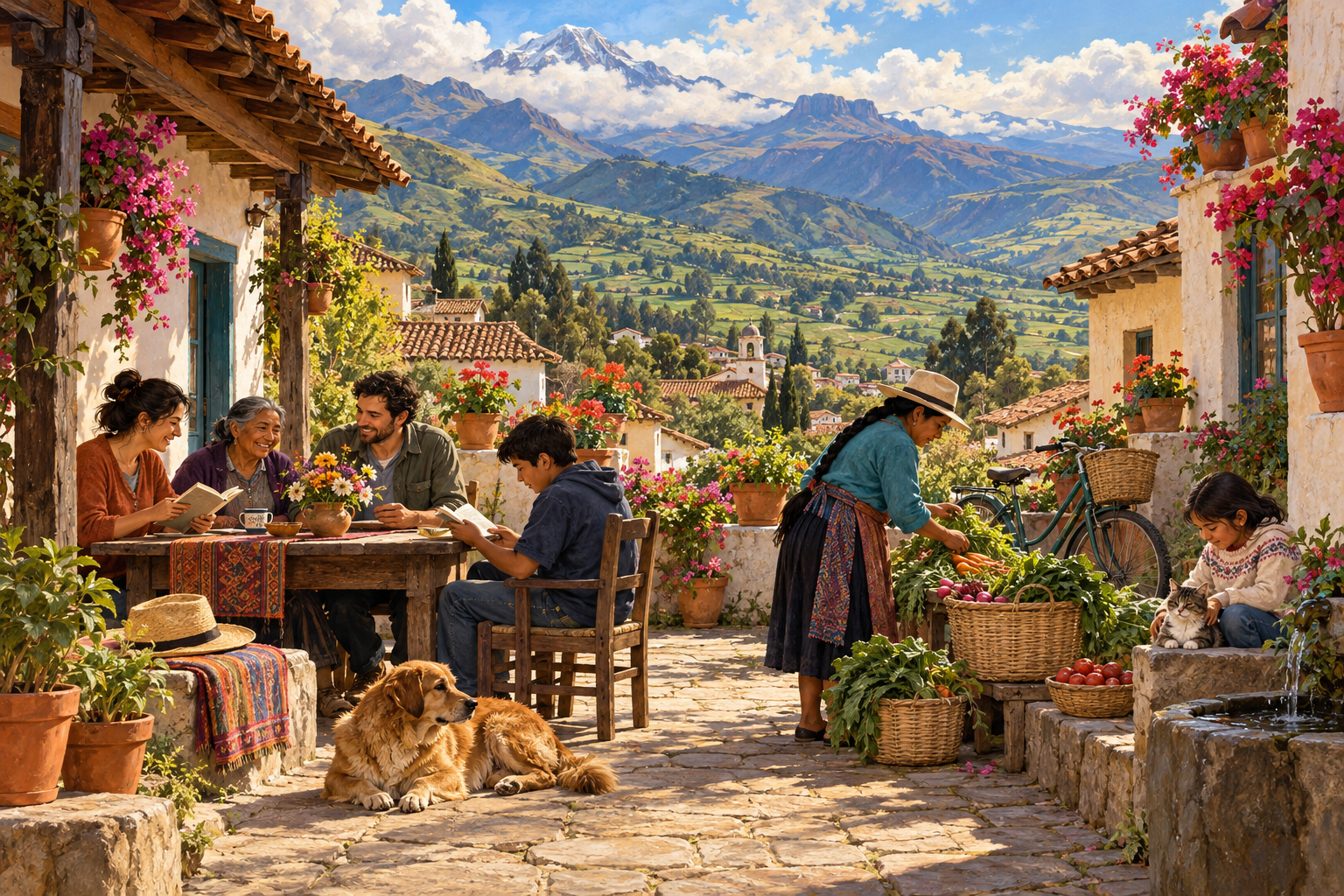
Ecuador Children Vocabulary | Words for Character and Nation Building. This source-grounded English guide connects twenty explained words with four substantial chapters, an original story, worked checks and a seven-day plan. Did you know? An Ecuadorian craft that many shoppers associate with another country’s name depends on coastal fibre growers and skilled weavers. Quito’s historic centre records Indigenous and European artistic work. The Galápagos Islands offer evidence of evolution, while Ecuador’s Constitution recognises a diverse language heritage. These examples give children words for accurate credit, history, biology and inclusion.
For international children approximately eight to twelve and adults helping them. This original English guide is not an official Ecuadorian syllabus, a chemical fibre-processing lesson, advice about visiting volcanic islands or an instruction to represent Indigenous communities. The school pupils and learning scenes are fictional. Cultural and biological facts are attributed to institutions.
Country evidence: UNESCO inscribed the traditional weaving of the Ecuadorian toquilla straw hat in 2012, listed the City of Quito as World Heritage in 1978 and recognised the Galápagos Islands in 1978 (with an important marine boundary modification in 2001). Article 2 of Ecuador’s Constitution names Spanish official; Spanish, Kichwa and Shuar are official languages for intercultural relations, while other ancestral languages have defined roles in their communities.
Character-learning purpose: Here nation building means accurately crediting craftspeople, remembering the people and histories behind a city, caring for habitats with scientific evidence and making messages understandable for different learners. It is not a request for political conformity or dangerous fieldwork.
Quick answer: the words become useful when we can explain them
| Learning section | Child’s skill | Error to avoid |
|---|---|---|
| Twenty defined words | Define a word in original language, spot an incorrect near-example and make a new sentence | Confusing a familiar spelling with complete understanding |
| Four country-based reading chapters | Identify what a source supports and what it leaves uncertain | Describing one cultural practice or habitat as every resident’s life |
| Fictional story with six answered checks | Explain and correct a misleading claim without humiliation | Treating imagined pupils as real witnesses |
| Seven-day practice schedule | Read, say, compare, write and transfer ideas to new contexts | Assigning hazardous or professional responsibilities to children |
Go to 20-word bank · four reading chapters · fictional story · worked checks · seven-day plan · parent and teacher notes · frequently asked questions · sources and hubs.
20 English vocabulary words for children: meanings and original sentences
Each definition includes a useful boundary against common misuse. All original sample sentences are editorial learning material. Names for specific heritage practices remain attached to the actual communities and places identified by the source.
1. Toquilla straw hats: coastal farmers, skilled weavers and correct attribution
| Word | Meaning and important distinction | Original learning sentence |
|---|---|---|
| toquilla | Fibre from the toquilla plant used in a named Ecuadorian hat-weaving tradition; not any commercial straw or a Panama-origin plant. | The maker prepared toquilla fibres for weaving. |
| Pile | An Ecuadorian coastal community associated with particularly fine hat weaving; not the name of every town in the craft. | The source identifies specialist weavers in Pile. |
| crown | The top part of a hat that fits over the head; not the hat’s whole shape. | The weaver began forming the crown. |
| brim | The part of a hat extending outward beyond the crown; not the same as a band. | The fine brim was woven with care. |
| transmission | Passing knowledge to new practitioners over time; not merely posting a product photo. | Family teaching supports transmission of weaving skills. |
2. Quito: architectural layers and the people behind its historic centre
| Word | Meaning and important distinction | Original learning sentence |
|---|---|---|
| Quito | The capital of Ecuador with a UNESCO-listed historic centre in the Andes; not the country’s whole territory. | The class marked Quito on its map. |
| Baroque | An artistic and architectural style from a particular historical period; not simply any colourful old facade. | The UNESCO source describes Quito’s Baroque school. |
| urban fabric | The connected layout of streets, buildings and spaces in a settlement, rather than textile cloth. | The class studied Quito’s urban fabric. |
| chronology | The order of events or building phases in time; not a random series of dates. | The poster set the city’s histories in chronology. |
| restoration | Informed work to repair or recover valued historic features; not proof everything is unchanged. | Restoration plans need trained specialists. |
3. Galápagos: island life, evolution and careful biosecurity
| Word | Meaning and important distinction | Original learning sentence |
|---|---|---|
| Galápagos | An Ecuadorian archipelago in the Pacific with extraordinary land and marine ecology; not the entire Ecuadorian mainland. | The diagram located the Galápagos Islands west of Ecuador. |
| endemic | Naturally restricted to a particular geographical range; not another word for common or safe. | An endemic species may have a small home range. |
| adaptive radiation | Evolutionary diversification from an ancestral group into forms adapted to different conditions; not a process visible in one animal’s lifetime. | The finch example helped introduce adaptive radiation. |
| marine reserve | A sea area managed for ecological conservation; not necessarily a public swimming pool. | The Galápagos marine reserve has defined management rules. |
| biosecurity | Procedures designed to prevent harmful organisms or biological risks from spreading; not simply a sign saying welcome. | Biosecurity helps protect island habitats from invasive species. |
4. Kichwa, Shuar and Spanish: legal language distinctions and practical inclusion
| Word | Meaning and important distinction | Original learning sentence |
|---|---|---|
| Spanish | Ecuador’s official language under Article 2, also an intercultural-relations language; not the only language residents speak. | The constitutional chart listed Spanish. |
| Kichwa | An Indigenous language recognised for intercultural relations in Ecuador; not the same language as Shuar. | The pupil treated Kichwa as a distinct language. |
| Shuar | An Indigenous language separately recognised for intercultural relations; not a dialect of Spanish. | The class included Shuar in its source-backed chart. |
| intercultural | Involving relationships and communication among different cultural groups; not requiring everyone to abandon a heritage. | The project used intercultural language learning respectfully. |
| inclusion | Making real participation possible for people with differing needs; not only printing ‘everyone welcome’. | A clearer bilingual notice improved inclusion. |
Four chapters: real country facts, meaningful English and a safe activity
Each chapter introduces five focus words, explains a source-grounded cultural, historical or scientific relationship and identifies a tempting overstatement for pupils to correct. The child-friendly task is an educational analogy, not protected-site access or specialist practical instruction.
1. The Ecuadorian toquilla hat is a weaving heritage, not a mistaken country label
Five focus words: toquilla · Pile · crown · brim · transmission.
UNESCO inscribed traditional weaving of the Ecuadorian toquilla straw hat in 2012. The craft is made from fibres associated with the Ecuadorian coast, and the official element belongs to communities and practitioners in Ecuador. The hats are sometimes widely known in international commerce as ‘Panama hats’, but that trade name should not be used to erase the Ecuadorian fibre growers and weavers. A careful child writer distinguishes the marketing name of a product from the documented place and people who make it.
The term toquilla identifies the plant-derived weaving material used in this practice. UNESCO explains that farmers cultivate and harvest plant stems before preparing the fibres. This is skilled agricultural and material work, not simply buying a bundle of finished thread. A product photograph may show the beautiful woven surface but not the farmers who made the material available. A good explanation recognises the work at the start as well as the weaver whose hands form the final object.
A hat has a crown, the part placed over the head, and a brim, the part extending outwards. UNESCO’s description discusses weaving both sections with careful attention to the material and desired fineness. Children often learn ‘hat’ as a single word but have difficulty describing its parts. These two terms help them write accurately about what is being made. They also illustrate how specialised vocabulary can make a complex process understandable without offering hazardous practical instructions.
UNESCO describes processing stages that can involve boiling fibres, drying and bleaching using substances or fumes that should not be handled by children without professional safeguards. It is therefore unsafe to turn the heritage description into a kitchen or garden recipe. Learning the term fibre preparation does not give a pupil the training to process plant material with heat or chemicals. A paper illustration or diagram is sufficient to learn the English vocabulary while respecting specialists’ work.
The town of Pile, in Manabí, is associated with particularly fine toquilla weaving. UNESCO explains that high-quality examples can demand specific conditions and extremely careful placement of points or rows. The time required to make a hat varies considerably with fineness and technique. A child should not assume that every hat has an identical number of stitches, every weaver earns equal pay or every product takes the same number of hours. Those claims would need documentation about the particular item.
Transmission describes how skills are passed to learners. UNESCO notes learning within families through observation and practice. This is a record of community heritage, not a school requirement that every Ecuadorian child must become a hat weaver. Some people may continue the practice, while others choose different work and lifestyles. The value of heritage does not depend on forcing people into one occupation. It is also important to recognise how individual weavers adapt skills while maintaining a distinctive tradition.
The hat’s trade connections create an additional lesson in attribution. A shop may sell a finished product under an international label that does not explain where its fibres were grown or who wove it. A school should not assert that a specific unknown hat was made in Pile simply because its weave looks fine. It can write ‘UNESCO documents toquilla hat weaving in Ecuador’ as a general fact, while a particular item’s origin requires supplier or maker records. A general heritage source is not the provenance record for every retail object.
Imagine a fictional exhibit titled ‘A Panama hat was invented in 2012 and is woven by a machine in another country’. UNESCO’s entry directly corrects the origin and the date. The inscription year is when UNESCO recognised an older Ecuadorian practice, not when the hats were created. A more precise label would identify the Ecuadorian toquilla tradition and the farmers and weavers who sustain it. The correction helps actual makers receive accurate recognition.
For a safe classroom activity, students can draw an original hat with labels for crown, brim and fibre. Use arrows to show a general supply chain: grower, fibre preparer, weaver, finisher and buyer. Clearly mark the drawing as a model, not a reproduction of a particular maker’s proprietary techniques. The activity teaches the difference between stages without using hot water, dyes, bleaching chemicals or sharp tools.
A learner may also ask why a traditional craft belongs in a lesson about character. One answer is fairness of credit. The finished product may be famous, but the people behind it can be overlooked. A writer who names where skills originate, checks the maker when records are available and refuses an incorrect attribution is acting responsibly. Another answer is patience: skilled weaving may require lengthy practice, not a quick set of printed instructions.
Historical exchange and commercial naming can be complicated. A child should not conclude that every person who uses the words ‘Panama hat’ is deliberately lying. The label developed in international commerce, while UNESCO identifies the cultural practice as Ecuadorian. The educational task is to explain that difference with evidence rather than humiliate readers or demand that everyone already knows the history.
End with a clear sentence: ‘Ecuadorian toquilla hat weaving involves coastal fibre knowledge, careful formation of crown and brim, and skills transmitted among practising communities’. The sentence makes the product interesting because it reveals the humans and processes behind it. That is a useful improvement over a description that mentions only an attractive hat in a tourist shop.
Meaning correction: Misleading: ‘The famous hat is a newly invented Panamanian craft with no Ecuadorian practitioners behind it.’ Repair: ‘UNESCO recognises a longstanding Ecuadorian toquilla fibre-weaving tradition with specific growers and makers.’
Safe transfer: Draw an original paper hat, label crown and brim, and make a five-stage supply-chain caption crediting growers and weavers without attempting chemical preparation.
2. Quito’s historic centre is a layered city with Indigenous and European artistic contributions
Five focus words: Quito · Baroque · urban fabric · chronology · restoration.
UNESCO inscribed the City of Quito on the World Heritage List in 1978. Its historic centre lies high in the Andes and has important buildings and streets dating from several centuries. UNESCO explains that the Spanish founded colonial Quito in the sixteenth century over the remains of an earlier Inca city. It is therefore inaccurate to describe the area as an empty hillside on which Europeans created everything from nothing. The historical city had earlier Indigenous contexts and later forms of political, artistic and community development.
Quito is the capital of Ecuador, but its World Heritage property is a defined historic area rather than the whole national territory or every building in the modern city. A photograph of a plaza may show one place at one moment. A source-backed map is needed to understand the area included in the listing. The property contains churches, streets, former religious buildings and other historic structures, all with distinct historical contexts. A child should avoid giving every structure the same construction date.
UNESCO identifies the Baroque school of Quito as a notable fusion of artistic influences, including Indigenous and European traditions. Buildings such as San Francisco, Santo Domingo and La Compañía are important examples. The word Baroque names an artistic and architectural style, not a generic adjective meaning every old building looks grand. A precise caption recognises who made and influenced the art rather than crediting only one empire or one architect without evidence.
The phrase urban fabric means the connected pattern of streets, buildings, public spaces and their uses. It does not refer to woven fabric. A city develops through people moving, trading, governing, worshipping and maintaining infrastructure. The UNESCO description notes the city’s striking historic integrity and conservation needs. The way buildings relate to streets and public squares can be as significant as the decoration of one facade.
Chronology is the order of events and building phases. The presence of Indigenous traditions, Spanish colonial settlement, later Baroque art and modern life means Quito cannot be explained in a single historical date. 1978 records UNESCO recognition, not the founding of the city, the construction of a monastery or the completion of every painting. A child can learn to make a three- or four-stage timeline rather than attaching the inscription year to all historic objects.
The history of colonial art also requires care. Cultural exchange did not always take place under equal conditions. The fusion of traditions does not erase Indigenous labour or the power exercised by colonial institutions. A beautiful church can be important artistic evidence while the wider historical setting includes different social experiences and inequalities. An article should make room for that complexity without demanding a judgement about every individual or inventing testimony from an unnamed worker.
Restoration involves informed work to repair or preserve valued historic features. It is not identical to rebuilding something without records, and it does not prove every stone is original. UNESCO’s management descriptions identify challenges from urban development, traffic, environmental pressures and the needs of people using the historic centre. A living city requires housing, movement and services as well as conservation. Children cannot responsibly propose painting old walls or repairing monuments themselves.
Imagine a fictional school poster saying ‘Quito was built by one person in 1978 and has only one European art style’. A source-checker uses UNESCO to identify earlier Inca context, the colonial founding period and the artistic mixture described by the Baroque school of Quito. The revised caption explains the UNESCO inscription date separately. This correction recognises chronology and Indigenous contribution rather than replacing them with an oversimplified history.
A child can make a paper map containing a central plaza, lanes and imagined buildings in three different periods. The drawing should be labelled a fictional learning model, not a surveyed map of the historic centre. Then write one verified UNESCO fact about Quito’s architectural importance. Ask which actual buildings need further documentation before assigning an exact year, artist or conservation status. The exercise encourages good source use without risking fragile heritage.
An official World Heritage listing does not mean every resident in the city has the same religion. Quito’s historic churches record the history of particular Christian institutions and communities; they do not speak for all Ecuadorians’ personal beliefs. A respectful child can learn about religious architecture without being required to practise the associated faith. Historical description and religious commitment are different things.
There is a useful connection between the toquilla chapter and this urban-history chapter. Both involve skilled people whose labour can disappear behind a famous finished product: an intricately woven hat or a celebrated building. A strong writer asks who made it, who holds the knowledge and which source supports the credit. The tools and timescale differ, but the character habit of fair attribution transfers.
End with a factual sentence: ‘Quito’s UNESCO-listed historic centre preserves an urban landscape with Indigenous and European influences, including distinctive Baroque art, while its conservation requires evidence and consideration of present residents’. Each term names a meaningful part of the story. The sentence is stronger than calling Quito a beautiful old city and stopping there.
Meaning correction: Misleading: ‘Quito was created from nothing in 1978 and its architecture comes from one European source alone.’ Repair: ‘UNESCO recognised a much older multi-period city with Indigenous and European artistic contributions in 1978.’
Safe transfer: Create a fictional Quito-inspired street map with three time periods and a distinct source-backed label for real UNESCO heritage. Explain why a photograph alone cannot date every building.
3. The Galápagos Islands teach evolution, endemism and why visiting requires biosecurity
Five focus words: Galápagos · endemic · adaptive radiation · marine reserve · biosecurity.
UNESCO inscribed the Galápagos Islands in 1978, among the first World Heritage properties. The Ecuadorian archipelago lies in the Pacific Ocean well west of the mainland and includes volcanic islands and surrounding marine environments. A significant boundary modification in 2001 expanded the property to include the marine reserve. These dates identify different heritage decisions; they do not mean the islands or their life forms first appeared in 1978 or 2001. A child’s geography map should show the archipelago separately from the Andes.
The islands’ isolation and connections among ocean currents helped shape unusual ecosystems. UNESCO mentions giant tortoises, land iguanas, finches and diverse marine life as examples that helped make the region important to evolutionary science. A species found on one island may differ from a related species elsewhere. Yet a photograph of two birds with different beaks does not prove their exact ancestry without research. Evolution is studied through many kinds of evidence, not guessed from visual novelty alone.
The word endemic means that a species occurs naturally in a restricted geographic area. It does not mean that the animal is automatically numerous or safe from extinction. Some island organisms are vulnerable because they have limited ranges or specialised ecological needs. Another species may visit the islands yet also occur elsewhere and therefore not be endemic. A careful article must identify the species and its documented distribution before applying the word.
Adaptive radiation describes diversification from an ancestral lineage into different forms adapted to various environments or ecological roles. Darwin’s finches are often used to explain the concept. The fact that some related finches have different beak forms can help learners ask how diet and habitat relate to evolution. But adaptive radiation unfolds across generations and evolutionary timescales; it is not one individual bird deciding to change its beak during a school day. A diagram can illustrate a branching lineage while remaining a simplification.
UNESCO notes that Charles Darwin visited the Galápagos in 1835 and that observations from the islands contributed to his later thinking about evolution by natural selection. That does not mean Darwin was the only person ever to observe the islands or that he completed the entire theory during one afternoon ashore. A historical timeline should separate the visit from later research, writing and publication. Students should give scientific claims their real chronology rather than turning the story into a sudden magical discovery.
A marine reserve protects or manages ocean environments under particular rules. The UNESCO property includes important marine habitat, but it is not the same as a public swimming pool. Marine organisms may depend on coral, rocky coasts, open water or other conditions, and management zones can differ. A child should not assume all waters are accessible or safe for diving or boat travel. Real visitor decisions require current authorised guidance and trained adults.
Biosecurity is relevant to island ecosystems because organisms brought accidentally or deliberately from elsewhere may harm native species. Seeds, insects, animals or pathogens can spread through transport and goods. The official Galápagos conservation framework addresses invasive alien species and the need for controls. A child who sees a cute animal from another region should not suggest releasing it on the islands as an act of kindness. Introducing an unfamiliar species may harm the habitats the learner hoped to protect.
World Heritage recognition does not mean every island is uninhabited or that all ecological pressures have disappeared. UNESCO discusses resident communities, visitor impacts, fishing pressures and the continuing needs of conservation institutions. The property was on the List of World Heritage in Danger from 2007 to 2010, a period distinct from the original 1978 inscription. The later removal was a management milestone, not an eternal guarantee of perfect ecological conditions.
Imagine a fictional brochure saying ‘Every Galápagos animal is endemic and anyone can bring a pet to help biodiversity’. Both claims are wrong. A source checker could revise it to explain that Galápagos has many remarkable endemic species and requires biosecurity to protect ecosystems. Such a caption does not invent the rules for a specific visitor or port. It teaches a principle and directs real decisions to the responsible authorities.
A safe classroom activity uses a fictional branching diagram with an imaginary ancestral bird and three descendant types. Label it an explanatory model rather than a reconstruction of actual finch evolutionary history. Then create a separate island-habitat map with a note that current management zones and access must be checked officially. The exercise links vocabulary about evolution with the practical need to avoid ecological harm.
It is also important to distinguish the Galápagos Islands from the rest of Ecuador. A country with Pacific islands, Andean cities and coastal craft communities does not have one uniform environment or livelihood. An island bird cannot stand for all Ecuadorian people or wildlife, just as a traditional hat does not define every household. Good national vocabulary includes the skill of naming a specific place rather than stretching one example across a country.
The final sentence should use the focus words coherently: ‘The Galápagos are Ecuadorian islands of outstanding evolutionary importance, with endemic species and marine habitats whose protection requires scientific management and biosecurity’. A pupil who can explain why an endemic animal differs from an introduced one has acquired a useful environmental distinction without needing to touch or approach protected wildlife.
Meaning correction: Misleading: ‘Every animal in the Galápagos is endemic, and releasing new pets is a safe way to add biodiversity.’ Repair: ‘The islands host distinctive native life, and biosecurity limits harmful species introductions.’
Safe transfer: Draw a fictional island food-web or evolutionary branching model, clearly marked imaginary, then write one UNESCO-supported fact and one reason to follow biosecurity rules.
4. Spanish, Kichwa and Shuar show why official labels do not tell us every family’s story
Five focus words: Spanish · Kichwa · Shuar · intercultural · inclusion.
Article 2 of Ecuador’s Constitution states that Spanish is the official language. It also identifies Spanish, Kichwa and Shuar as official languages for intercultural relations. Other ancestral languages have defined official use for Indigenous peoples in the territories where they live, according to law, and the state is directed to respect and encourage their preservation and use. The legal wording is more precise than simply saying Ecuador has one language or that every language has identical administrative use everywhere.
The term Kichwa names a language with its own history and communities; Shuar names a distinct language. Neither is an inferior form of Spanish or a synonym for the other. A child should not confuse cultural differences with mistakes in language learning. Individual speakers may also use Spanish, English or other languages in various situations. An article about the Constitution cannot establish the language that every particular child first learned at home.
Intercultural means involving communication and relations among different cultural groups. It does not mean everyone must lose their own traditions and adopt one uniform identity. The constitutional language category is a formal expression of recognition, while successful intercultural communication requires practical understanding and respect. If a public message is incomprehensible to an intended reader, the fact that several languages are officially named does not automatically solve the problem.
Imagine a school poster containing Spanish, Kichwa and Shuar headings but giving the wrong room number in one version. The translation has failed to preserve an essential instruction. A child who cannot write in one of those languages should not invent its words and claim they are accurate. The responsible approach is to use a verified source or ask a qualified speaker to check the translation. Respect for a language includes taking the accuracy of its grammar and meaning seriously.
Inclusion means giving people a real opportunity to take part. A notice can welcome everybody but still be too long, too small or too complicated for younger children to understand. Large-print headings, clear diagrams and careful explanation may help. Teachers should ask intended readers whether they can identify the date and action, rather than judging success solely by the number of languages on the page. Actual comprehension is an outcome, not a decoration.
The constitutional wording also makes clear that ancestral languages beyond Kichwa and Shuar exist and have meaning in their communities. An article that names only two Indigenous languages as if they were every Indigenous tongue in Ecuador would erase others. Where a particular community language is relevant, name it from an authoritative source and keep the community’s own voice in view. A country article is an introduction, not a full census of families and dialects.
A child should not be appointed as a spokesperson for an entire Indigenous population because they have a name, appearance or ancestry that classmates find interesting. Students can choose to share their own language experiences voluntarily. The teacher can use published cultural and legal material instead of requiring personal disclosure. Inclusion works better when people are respected as individuals rather than presented as living demonstrations of a textbook category.
The earlier three chapters each show why categories have different scopes. UNESCO’s toquilla listing concerns a specific craft, Quito concerns a particular historic city, and Galápagos concerns a particular ecological property. Article 2 concerns constitutional language status. None of these sources alone tells us what a named family in Ecuador believes, earns or says at home. A careful writer should choose the type of source that answers the actual question being asked.
Another useful school exercise is to classify three statements. ‘Spanish is Ecuador’s official language’ is a legal fact. ‘I prefer to read this story in Kichwa’ would be one individual’s voluntary preference. ‘Our class made an announcement clearer’ is a recorded action. A pupil who mixes these types may make a national stereotype or claim a result that was not tested. Naming the evidence type helps to prevent that error.
In a fictional classroom, the organiser of a cultural exhibition first uses a complicated English instruction and claims everybody should understand it. After two readers misinterpret the time, the organiser simplifies the wording and asks them again. The pupils do not need to know a second language to understand this general lesson: a message must carry the same important meaning to the intended reader. If a real translation is required, qualified help is necessary.
It is also reasonable to ask what character means here. A child might practise patience when a classmate needs a second explanation, fair attribution when an Indigenous word is used, and honesty when they do not know a translation. These are real actions. They do not require agreement with a political party or a claim that national language issues are fully resolved. A school can start with a small improvement within its own responsibility.
Finish with a sentence that keeps legal and individual meanings distinct: ‘Ecuador’s Constitution recognises Spanish for official use and Spanish, Kichwa and Shuar for intercultural relations, while children’s actual language experiences vary and their understanding should be checked respectfully’. That statement helps a young learner become more precise and considerate when discussing multilingual countries anywhere in the world.
Meaning correction: Misleading: ‘Ecuador officially uses only Spanish, so Kichwa and Shuar are mistakes and every family speaks the same language.’ Repair: ‘Article 2 gives several named languages different formal roles and protects other ancestral languages, while individual use varies.’
Safe transfer: Make a source-backed three-language status chart without inventing translations, then simplify a fictional English school notice and check a partner’s comprehension.
Original fictional classroom story: a better answer after a source check
At a fictional learning exhibition on Ecuador, Natalia labels a toquilla hat as a craft created in Panama in 2012. After studying UNESCO, she corrects the Ecuadorian weaving heritage and separates the date of listing from the much older practice. Javier calls every historic Quito building one European style built in 1978, and his group adds Indigenous contributions and a chronological timeline. Carmen sees one Galápagos tortoise and claims all island organisms are endemic and fully protected, so classmates explain species ranges and biosecurity. Finally, Luis writes that Spanish is Ecuador’s only meaningful language; he checks the constitutional text and recognises Kichwa, Shuar and the importance of comprehension. These students and activities are fictional; facts are attributed below.
Four comprehension questions
- 1. Why was Natalia’s hat history misleading about both place and date?
- 2. Which people and time periods did Javier overlook in his Quito description?
- 3. Why do one tortoise sighting and a heritage listing not establish the health of every island species?
- 4. What legal distinction and teaching action improved Luis’s language paragraph?
Answers should cite an action in the invented story, then use the actual institutional reference for any claim about the country. Fictional dialogue cannot serve as eyewitness history or scientific data.
Six vocabulary and reasoning self-checks with worked answers
Check 1: In which country is the UNESCO-listed toquilla straw hat-weaving tradition based?
Worked answer: Ecuador, with craft communities including specialist makers in Pile.
Explain which particular source fact or definition supports the answer, rule out a tempting alternative that changes the meaning and make one fresh sentence outside this country’s setting. Clear reasoning is more valuable than copying the bolded words.
Check 2: What parts of a hat are the crown and brim?
Worked answer: The crown fits over the head; the brim extends outward.
Explain which particular source fact or definition supports the answer, rule out a tempting alternative that changes the meaning and make one fresh sentence outside this country’s setting. Clear reasoning is more valuable than copying the bolded words.
Check 3: When did UNESCO first recognise Quito’s historic centre?
Worked answer: 1978, long after the city’s Indigenous and colonial historical development.
Explain which particular source fact or definition supports the answer, rule out a tempting alternative that changes the meaning and make one fresh sentence outside this country’s setting. Clear reasoning is more valuable than copying the bolded words.
Check 4: What does endemic mean for Galápagos wildlife?
Worked answer: Naturally limited to a particular geographic area, not necessarily abundant or safe.
Explain which particular source fact or definition supports the answer, rule out a tempting alternative that changes the meaning and make one fresh sentence outside this country’s setting. Clear reasoning is more valuable than copying the bolded words.
Check 5: Why is biosecurity particularly important on remote islands?
Worked answer: It helps reduce harm from unwanted organisms and biological threats introduced to vulnerable habitats.
Explain which particular source fact or definition supports the answer, rule out a tempting alternative that changes the meaning and make one fresh sentence outside this country’s setting. Clear reasoning is more valuable than copying the bolded words.
Check 6: How does Article 2 of Ecuador’s Constitution distinguish its languages?
Worked answer: Spanish is official, and Spanish, Kichwa and Shuar have official status for intercultural relations, with provisions for other ancestral languages.
Explain which particular source fact or definition supports the answer, rule out a tempting alternative that changes the meaning and make one fresh sentence outside this country’s setting. Clear reasoning is more valuable than copying the bolded words.
Seven-day practice plan: remember, explain and transfer
| Day | Suitable activity | Evidence of understanding |
|---|---|---|
| 1 — Notice | Read words 1–5 and give a correct definition and misleading non-example. | Independent explanation of precise meaning |
| 2 — Speak | Use words 6–10 aloud in imaginary home or school situations. | Two original sentences with the intended sense |
| 3 — Source | With adult support read an age-appropriate paragraph from one linked institution. | One sourced fact and one unanswered question |
| 4 — Compare | Study words 11–15 and distinguish observation, verified fact, interpretation and fiction. | No invented story passed off as real evidence |
| 5 — Decide | Use words 16–20 in a supervised mock information project. | One achievable responsibility and way to check it |
| 6 — Write | Write an original 80–120-word explanation with three precise words and an attributed source. | Coherent respectful prose with evidence |
| 7 — Transfer | Apply three general words to a different school, place or research problem. | Accurate new usage without stereotyping people |
A low-pressure word mastery check
Ask the child to define a term in their own words, repair a plausible wrong use, then make a fresh sentence in a different situation. Record each as ‘not yet’, ‘with guidance’ or ‘independently’. Return to the same words several days later. A child who revises an answer after reading a reliable source has gained skill; there is no need to shame them for the first guess.
Assess writing for a clear subject and verb, a word used where it genuinely adds meaning, verifiable facts about real people and places, proper attribution, and a task within a child’s abilities. Avoid rewarding exaggerated claims merely because they sound positive. An honest uncertainty is better than a fictional date or personal biography.
Parent and teacher notes: character through evidence, fairness and care
- Use an authoritative source. A heritage inscription, constitutional article or scientific report establishes a defined fact, not every person’s experience.
- Name the community or geographic property. National labels are useful for location but should not erase the makers, residents or different ecosystems involved.
- Give specialised workers due credit. Craftspeople, conservators, researchers and community knowledge holders undertake distinct tasks.
- Keep historical complexity visible. A celebrated old city can include Indigenous contributions and unequal colonial relationships.
- Separate model from evidence. A paper evolutionary tree or imagined street plan must not be presented as a measured map.
- Respect visitor rules and specialist safety. Protected wildlife, chemicals, archaeological objects and historic repairs are adult responsibilities.
- Recognise lived language differences. Legal categories do not reveal what every child understands or uses at home.
- Celebrate reasoned revisions. Correcting a caption after a source check makes shared information more reliable.
Frequently asked questions
Is the traditional toquilla hat originally a Panama craft?
UNESCO’s inscription identifies the weaving tradition as Ecuadorian, involving specific coastal fibres, farmers and weavers.
Did Quito’s historic buildings originate when UNESCO inscribed the city in 1978?
No. The city has Indigenous, colonial and later historical layers much older than the inscription.
Are all Galápagos animals endemic and safe from ecological threats?
No. Species ranges differ, and conservation requires biosecurity, research and appropriate management.
Why did Darwin’s 1835 Galápagos visit matter?
Observations from the islands contributed to his later work on evolution by natural selection, but the theory was not completed in one day.
Does Ecuador’s Constitution name only Spanish?
No. Article 2 also names Kichwa and Shuar for intercultural relations and protects other ancestral language use.
What is a suitable child-sized contribution?
A properly attributed craft caption, clear historical timeline, careful conservation diagram or a comprehensible school notice.
Institutional sources and linked country learning ecosystem
Real-world facts are based on the named UNESCO, heritage and legal sources below, consulted in October 2026. Fictional pupil names, class conversations, sample sentences and paper activities are original educational content, not national curriculum or eyewitness accounts. Confirm current access and safety rules with relevant authorities.
- UNESCO | Traditional weaving of the Ecuadorian toquilla straw hat
- Ecuador National Cultural Heritage Institute | Toquilla weaving
- UNESCO World Heritage | City of Quito
- UNESCO World Heritage | Galápagos Islands
- Ecuador Constitution | Article 2, consolidated English text
- UNICEF | Convention on the Rights of the Child
Learn more about this country on eduKateSG
- Everything About Ecuador
- How Ecuador Works | Government and Galápagos
- Top 100 Toquilla Straw Weaving Vocabulary Words
- Top 100 Island Evolution Vocabulary Words
- Top 100 Tagua Carving Vocabulary Words
Continue the A–K Children Vocabulary country series
Djibouti Children Vocabulary · Dominica Children Vocabulary · Dominican Republic Children Vocabulary · Ecuador (this article) · Egypt Children Vocabulary
Core vocabulary and world-learning hubs
- Vocabulary Learning Hub
- Vocabulary by Age and Purpose
- How Countries Work | A–Z
- Country Vocabulary Index
Children who finish this Ecuador guide should be able to explain twenty words accurately, recognise the limits of the evidence, give credit to real people and make one age-appropriate improvement in their writing or classroom. Character learning is meaningful when careful language leads to thoughtful action.