
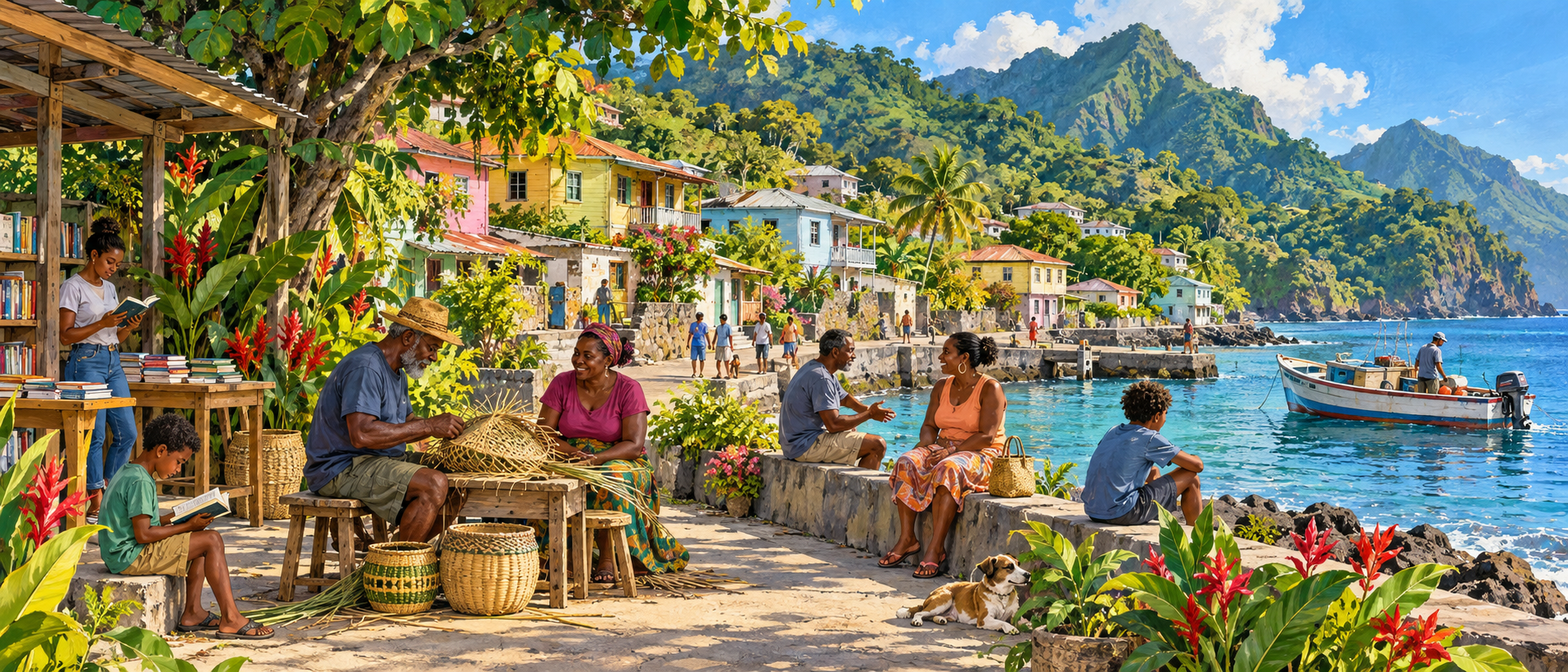
Dominica Children Vocabulary | Words for Character and Nation Building. Twenty meaningful English terms, four substantial country examples, an original fictional story and worked learning checks. Did you know? Dominica is not the Dominican Republic. Its Kalinago people have living communities, its mountains contain a remarkable volcanic World Heritage park, and the island’s cultural and emergency-management institutions remind families that clear communication and preparation matter. Children can learn English through four real examples without pretending one tradition describes every person on the island.
This international English resource suits readers around eight to twelve years old, supported by adults. It is not Dominica’s national syllabus, an introduction granting authority to perform Indigenous traditions, a volcanic hiking guide or real-time emergency instructions. Every classroom child and scenario is fictional. Kalinago voices, Indigenous identity and families’ privacy deserve respect.
Verified country context: The Government of Dominica identifies Roseau as the capital of the Commonwealth of Dominica. Its Division of Culture documents the Kalinago Territory, basket work and canoe-related knowledge; a July 2026 government notice details training in Kalinago costume-making. UNESCO inscribed Morne Trois Pitons National Park in 1997. The Division of Culture also documents Kwéyòl, and the Office of Disaster Management publishes disaster-preparedness, shelter and emergency-communication guidance.
Practical meaning of the title: In this guide character and nation building means truthful attribution, consent before using others’ cultural work, careful scientific observation, practical inclusion and family emergency readiness under adult guidance. It is not a demand for political loyalty or a claim that children can do the jobs of park rangers and emergency managers.
Quick answer: meaningful words and responsible learning
| Learning material | What the child demonstrates | Misleading shortcut to reject |
|---|---|---|
| Twenty defined words | Explain meaning, reject a non-example and make a new sentence | Pronouncing a word proves full comprehension |
| Four country chapters | Identify a source-backed fact and its scope | One protected site or tradition represents everyone |
| Original story and six worked checks | Find and repair an inaccurate sentence | Fictional school scenes are actual historical testimony |
| Seven-day practice programme | Read, speak, research, compare, write and transfer vocabulary | Children are responsible for hazardous work or national policies |
Read the word bank · four chapters · fictional story · worked checks · seven-day learning · parent and teacher guidance · FAQs · verified sources.
20 children’s English words: meanings and original sentences
Read five linked words at a time. Each definition explains both its useful meaning and a common inaccurate use. Every sample sentence is an editorial teaching example, not the speech of an actual named pupil.
1. Kalinago communities: skilled craft and living self-representation
| Word | Meaning and important distinction | Child-friendly model sentence |
|---|---|---|
| Kalinago | An Indigenous people of the Eastern Caribbean, with a named Territory in Dominica; not a historical identity that has disappeared. | The exhibit credited Kalinago community members as living practitioners. |
| territory | A defined area of land with geographical and administrative meaning; not evidence everyone there has identical customs. | The map marked the Kalinago Territory in eastern Dominica. |
| basketry | The skilled making of baskets by interweaving suitable materials; not ordinary paper printing. | The museum described Kalinago basketry. |
| canoe | A relatively narrow boat used for transport or other purposes; not something children should build or navigate without trained adults. | The cultural account mentioned traditional canoe-making skills. |
| consent | An informed, voluntary agreement to a particular activity, photograph or use of information; not assumed from silence. | The group requested consent before publishing an interview. |
2. Morne Trois Pitons: water, geothermal activity and biodiversity
| Word | Meaning and important distinction | Child-friendly model sentence |
|---|---|---|
| Morne Trois Pitons | A UNESCO-listed volcanic national park in Dominica; not every mountain or geothermal site on the island. | The map located Morne Trois Pitons National Park. |
| fumarole | An opening that releases volcanic steam or gases, not simply a harmless hole with mist. | The class researched fumaroles rather than approaching them. |
| geothermal | Relating to heat within Earth; not the same thing as ordinary sunlight warming pavement. | Geothermal activity contributes to hot springs and volcanic features. |
| endemic | Naturally restricted to a particular geographical area; not another word for plentiful. | Dominica has bird species endemic to the island. |
| watershed | Land that drains toward a stream, river or other common water body; not only a lake’s surface. | The mountain watershed provides headwaters for rivers. |
3. English and Kwéyòl: language history and practical understanding
| Word | Meaning and important distinction | Child-friendly model sentence |
|---|---|---|
| Kwéyòl | A Caribbean French-lexifier Creole language documented in Dominica; not inferior or careless French. | The class described Kwéyòl as a living community language. |
| official language | A language with formal public or legal status; not every citizen’s sole home language. | English is Dominica’s official language. |
| creole language | A historically developed language with its own patterns, often arising from language contact; not a collection of random errors. | A creole language can be used for complex ideas and storytelling. |
| paraphrase | Express the meaning again in different words while preserving the facts; not an inaccurate translation. | A pupil paraphrased the notice without changing the deadline. |
| inclusion | Removing barriers so people can really understand or participate; not simply saying ‘all welcome’. | An easier-to-read notice improved inclusion. |
4. Hurricane preparedness: how families and schools share responsibilities
| Word | Meaning and important distinction | Child-friendly model sentence |
|---|---|---|
| hurricane | An intense tropical cyclone with strong sustained winds; not just an ordinary rainy afternoon. | The family reviewed hurricane-preparedness information. |
| early warning | An authoritative advance alert about a possible hazard; not a rumour in a chat group. | The teacher checked the official early warning. |
| emergency shelter | A place designated or used to provide temporary refuge in emergencies; not automatically open at all times. | An adult consulted the current emergency shelter guidance. |
| resilience | The capacity to prepare for, cope with and recover from difficulties; not the claim that harm cannot occur. | Community resilience depends on preparation and support. |
| preparedness | Steps taken before a possible emergency, within suitable roles and professional guidance. | Preparedness included updating a family contact plan. |
Four substantial chapters: real people, evidence and small actions
Each chapter connects five terms with reliable country facts, then shows a misleading claim and a safe way to practise the meaning. These exercises are not permission to use dangerous tools, enter restricted areas or imitate community rituals.
1. The Kalinago Territory shows why living communities are not museum displays
Focus vocabulary: Kalinago · territory · basketry · canoe · consent.
Dominica’s Division of Culture identifies the Kalinago Territory on the island’s eastern Atlantic coast as home to living Kalinago communities. Children studying Indigenous history sometimes see photographs of older tools and mistakenly conclude that the people who made them disappeared long ago. That would be especially misleading here. Kalinago people live, work, study, make choices and sustain knowledge today. A historic craft and a contemporary resident can belong to the same community without every resident practising the exact same trade.
The word territory identifies land with particular historical and administrative arrangements. The government cultural division discusses the Territory’s chief and council, and its accounts of cultural history address the consequences of colonisation. A territory is not the same as a private tourist workshop. Some spaces are homes, schools, working areas or community places with their own rules and responsibilities. A school map should locate the general area without inventing a visitor’s right to enter any household or sacred setting.
Basketry is one skill for which Kalinago knowledge is known. Basket-making involves materials, preparation, patterns and handwork that require practice. A photo can reveal woven shapes but not automatically show the maker’s name, the purpose of a basket or how the material was selected. The correct exhibition label can identify the community and method where the source supports it; details about an individual piece need a workshop or museum record. A child should not confidently assign all baskets in the Caribbean to the same maker or heritage tradition.
Dominica’s cultural information also discusses traditional canoe-making, which connects practical craft knowledge with travel and fishing history. Skilled work on a canoe involves materials and technical choices with consequences for safety. Reading about a canoe does not qualify children to cut a tree, carve timber or launch a vessel. A drawing can illustrate the meaning of canoe without being an engineering plan. The fact that a craft has cultural significance is not permission to undertake hazardous stages without the community’s guidance and properly trained adults.
The cultural institution Kalinago Barana Autê has described traditional craft demonstrations and community-related learning. However, attending a public presentation does not mean everything in a private community is available for copying. Consent means informed, voluntary agreement to a specific use. Permission to view an exhibition does not automatically include permission to interview residents, photograph children, reproduce designs for sale or publish recordings. A young writer should learn that ‘the person said yes to this’ is different from ‘the entire community agreed to everything’.
A recent example gives the issue a present-day dimension. In July 2026 Dominica’s government announced a training appointment connected with Kalinago costume-making through its biodiversity and community-related tourism project. The notice described knowledge transfer and cultural preservation as the work’s purpose. This is evidence that practitioners and institutions are working on living skills today, not merely showing old objects. But a contract announcement is not proof that every local young person has completed training or that the programme has solved every challenge.
Indigenous peoples have experienced major losses and changes through colonial history. The government Division of Culture describes parts of the older Kalinago way of life that were disrupted and records surviving craft practices. A child should not turn that into a story that living Kalinago families are ‘people from the past’ who must live without modern technology. Such language would deny their present agency. A community can preserve important heritage while choosing contemporary education, services and livelihoods.
Imagine an imaginary school label: ‘The Kalinago lived in Dominica long ago, so every present resident makes a canoe and welcomes visitors into their home’. The source directly challenges both parts. A more respectful caption says that the Kalinago are a living Indigenous people with a recognised Territory and forms of craft knowledge sustained by practitioners. Specific interviews, demonstrations and access must follow community choices. This narrower statement is more informative and less intrusive.
A safe classroom project can create an original interlacing exercise using plain paper strips. Explain that it demonstrates the general idea of weaving, not an authentic Kalinago basket pattern. Another group can draw a fictional canoe and name the kinds of specialist questions a boatbuilder would answer, without attempting to carve or test the design. The exercise becomes successful when the children understand both a useful word and the boundary between analogy and a real community practice.
One lesson in community responsibility is giving workers credit. An attractive craft stall involves people who select materials, develop skills, make items, explain cultural context and run the business. A national label such as ‘Dominica made this’ can hide those people. When names are available and shared with permission, use them. When they are unknown, do not invent them. Accurate attribution makes an article about culture an act of practical respect rather than anonymous tourism advertising.
The guide also should not ask a Kalinago classmate to perform heritage or explain family history simply because other students are curious. A child can choose to share or not share. A teacher can use the Division of Culture’s published information to support factual learning without turning one young person into a spokesperson for all their relatives. Consent and individual choice are as important as recognising the community’s history.
End with an English sentence that uses the focus words meaningfully: ‘Kalinago basketry and canoe-making are skilled practices connected with a living Indigenous territory, and learning about them requires respectful attribution and consent’. A pupil who can explain why ‘living’ matters has understood more than a fact about an island. They have learned not to erase people behind the object.
Common error and repair: Misleading: ‘Kalinago people belong only to the distant past, so visitors can copy any craft and enter every home.’ Repair: ‘They are living communities with particular cultural skills, individual choices and rights to consent.’
Child-safe transfer: Make an original paper-weaving model and write a five-line Kalinago heritage caption. Mark the model as an English exercise, not a traditional basket, and name one permission you would request before using a real photograph.
2. Morne Trois Pitons combines deep-forest habitats with dangerous volcanic features
Focus vocabulary: Morne Trois Pitons · fumarole · geothermal · endemic · watershed.
UNESCO inscribed Morne Trois Pitons National Park as World Heritage in 1997. Its official description places a rich tropical-forest landscape around several volcanic centres, hot springs, freshwater lakes, deep valleys and distinctive geothermal features. Dominica should not be confused with the Dominican Republic when locating this park. A student must use the island’s own map and the UNESCO entry, not borrow photographs of another Caribbean country’s mountains simply because the names sound similar.
A fumarole is an opening where steam or volcanic gases emerge. It is not an ordinary misty puddle that a child can approach safely to test temperature. Geothermal means relating to heat from Earth’s interior. Volcanoes, hot springs and gas vents reflect underlying geological conditions, while their exact hazards vary by location and time. A photograph of rising steam cannot tell whether the gas is safe or what the ground temperature is. This is why the lesson uses descriptions and drawings rather than field experiments.
UNESCO lists Dominica’s famous Boiling Lake and the Valley of Desolation among the park’s noteworthy volcanic and hydrological features. The names may sound exciting, but they are not invitations for unsupervised exploration. Such settings may involve heat, unstable terrain, fumes and rapidly changing conditions. Children should never be tasked with entering hot springs, collecting water or following an undated route to the Boiling Lake. A heritage article is not current access guidance; only qualified adults and responsible authorities can evaluate such visits.
The park also protects an unusually rich range of forest types. UNESCO mentions moist forests, montane forests and high-elevation cloud or elfin forests. These conditions differ with height and local climate. One image of dense green trees cannot represent every habitat in the property. The distinction between vegetation types helps students see why an island of modest size can still contain impressive ecological variety. A scientific description uses locations and measurements rather than relying on the colour of a tourist picture.
The word endemic describes an organism naturally restricted to a particular area. UNESCO mentions the Imperial Parrot, or Sisserou, and the Red-necked Parrot as birds endemic to Dominica. That does not mean every bird seen in the park is endemic or that the presence of one bird proves all populations are thriving. A species can be unique to a region and still require careful conservation. The word endemic also should not be confused with endangered, which describes a different kind of ecological status.
A watershed is land that drains water toward a connected river or other receiving system. UNESCO explains that the park protects important freshwater resources, including headwaters for rivers in southern Dominica. That is more informative than describing the area simply as pretty mountains. Mountain slopes, rainfall and vegetation can affect water movement. A classroom diagram may show water flowing downhill, but it must not pretend to model exact local groundwater conditions or current water quality.
UNESCO’s conservation discussion mentions competing interests involving freshwater, hydropower and geothermal energy. This demonstrates that protecting a park is not only a choice between admiring nature and ignoring people. Communities may depend on electricity and drinking water, while habitats require careful protection. Managers need research, law, consultation and specialist judgement to weigh proposals. A child can ask which interests must be considered without claiming to decide a real energy project.
The heritage entry also discusses challenges such as invasive species, storms, staff resources and tourism pressures. World Heritage recognition does not mean all problems have vanished since 1997. A listing documents outstanding value, not an eternal guarantee about every species and tree. If a student wishes to report the current state of one parrot population, they need recent survey data rather than an old photo. A claim about conservation success must keep its source date and measurement method attached.
Imagine a fictional poster: ‘Every hot pool in Morne Trois Pitons is safe to swim in and every green bird is the Sisserou’. The two claims could mislead or endanger readers. A safer, accurate caption describes a UNESCO-listed volcanic landscape with specialised habitats and endemic wildlife whose observation and protection require informed guidance. The goal is curiosity matched with restraint, not a dramatic challenge to visit every geyser.
For an original paper model, draw a volcano, a steam vent, a high-altitude forest and a stream descending through a watershed. Label it a general conceptual diagram and give no actual hiking directions. Next, use the UNESCO entry to write one verified fact, such as the 1997 inscription and the park’s combination of volcanic and tropical ecological features. Ask which current conditions the entry alone cannot confirm.
The park’s natural setting also shows why a country cannot be reduced to one landscape. The Kalinago Territory, Roseau and many other communities are separate places with their own lives and roles. A volcanic image cannot tell us what every Dominican child learns or how all households earn a living. Precise geography protects against the temptation to make one striking visual stand for the people of an entire nation.
A strong concluding sentence might say: ‘Morne Trois Pitons National Park in Dominica preserves geothermal landforms, forests, endemic wildlife and important headwaters, while stewardship requires scientific evidence and safe management’. Each word has a role. A child who can explain the difference between a fumarole and a harmless cloud has acquired useful science literacy and respect for boundaries.
Common error and repair: Misleading: ‘A UNESCO volcanic park is a safe natural playground and any one bird sighting proves full ecological health.’ Repair: ‘The site has potentially hazardous geothermal features and varied habitats needing professional conservation.’
Child-safe transfer: Create a fictional volcano-to-river diagram with fumarole, forest, endemic bird label and watershed. Explain why no temperature or access claim can be inferred from the drawing.
3. English and Kwéyòl demonstrate the value of home languages and accurate paraphrase
Focus vocabulary: Kwéyòl · official language · creole language · paraphrase · inclusion.
The Government of Dominica lists English and French Patois, also commonly called Kwéyòl, among languages associated with the island. English is the country’s official language for public administration, while Kwéyòl is a significant community language and part of living cultural expression. These are different categories. A legal language’s status does not mean every family speaks only that language at home or uses identical vocabulary in conversation.
Dominica’s Division of Culture explains that Kwéyòl developed through the history of French-language contact and African people brought to the Caribbean through enslavement. The fact that a language emerged in unequal colonial conditions must not be transformed into a cheerful claim that everyone involved could choose freely. Children can acknowledge that historical injustice and still respect Kwéyòl as a complete, meaningful language used by communities today. The dignity of modern speakers does not depend on the circumstances of a language’s origin.
A creole language has developed linguistic structures and conventions. It is not simply a collection of mistakes made by people who cannot learn another language. The Division of Culture provides information on Kwéyòl writing and vocabulary, illustrating that it can be documented and taught. Pupils need not become fluent in one chapter, nor should they invent Kwéyòl translations from English words they have never studied. Language learning includes knowing when to ask a competent speaker.
The term official language describes a formal role of a language, not an intelligence test or a statement about home life. A child might confidently use Kwéyòl with family and learn English at school. Another might use mostly English but recognise some cultural expressions. An international teacher should never guess someone’s language proficiency from their appearance, surname or place of birth. A respectful question concerns what explanation would help that particular person understand the activity.
A paraphrase restates meaning in different words while keeping essential information accurate. Suppose a fictional notice reads, ‘The book club meets in Room 7 at ten, but borrowed books are due at nine’. A pupil says the club and returns both happen at ten. The child may have pronounced the sentence correctly, but the paraphrase has changed the action and time. A teacher can simplify the sentence or use a table to make the two events clear.
Inclusion asks whether learners can truly participate. A sign reading ‘Welcome’ may still be confusing if it has tiny type, an unexplained word or unclear conditions. Providing an accurate language option, diagram or plain-English version can help. Yet a second language version that gives the wrong date can create a new barrier. A qualified translator should verify unfamiliar language text before it is presented as official or educationally reliable.
The history of Kwéyòl also involves stories, songs and opportunities for community expression. A child can study how a living language connects people without assuming that all Dominicans share the same tastes or opinions. A classmate from Dominica should not be appointed as the spokesperson for every Kwéyòl speaker. The teacher can use official cultural resources and allow voluntary contributions without turning anyone’s family background into a public assessment.
Another language term useful here is bilingualism, though it is not one of the five core words. It can describe people or institutions using two languages. That does not mean every individual has equal reading, writing, listening and speaking skill in both. A school can improve comprehension without requiring perfect fluency. The goal is usable communication and opportunity to learn, not humiliating a young learner for needing a clearer explanation.
Imagine a school exhibit saying, ‘Kwéyòl is broken French, so only English is a real language’. The Division of Culture’s documentation directly refutes the dismissive approach. A more accurate caption says that English has official status while Kwéyòl is a historically developed Caribbean Creole language with community uses and writing conventions. The revised wording helps readers distinguish legal designation from linguistic validity. It treats speakers fairly.
A safe classroom task can create two English versions of a fictional library message: one long and complicated, another shorter and clearly structured. Ask a younger pupil to identify the room, date and deadline in each. If the shorter version helps, record that result honestly, but do not extrapolate to every reader in Dominica. A test with one or two classmates is useful as feedback, not as a national survey.
A pupil can also learn to separate three kinds of statement. ‘English is Dominica’s official language’ describes legal or public status. ‘My grandmother prefers Kwéyòl at home’ would be one family’s possible experience, requiring that person’s account. ‘Our class made its notice clearer’ describes an action the group can verify. Each kind requires different evidence. Mixing them often produces stereotypes or unreliable communication.
The chapter ends with this idea: words can include or exclude people depending on how they are used. Precise definitions, correct paraphrase and respect for speakers help a community share practical information. A learner does not need to solve every language barrier to demonstrate character; they can begin by checking whether one person truly understood a message.
Common error and repair: Misleading: ‘Kwéyòl is merely incorrect French, and English’s official status proves every family has the same home language.’ Repair: ‘Kwéyòl is a legitimate living Creole language, and official status is distinct from household speech.’
Child-safe transfer: Rewrite an invented library message into simple English, test the dates with a partner and explain why an unverified Kwéyòl translation should not be published.
4. Hurricane preparedness is practical care, not a guarantee that storms cannot hurt people
Focus vocabulary: hurricane · early warning · emergency shelter · resilience · preparedness.
Dominica lies in a Caribbean region that can experience powerful tropical storms and hurricanes. The country’s Office of Disaster Management (ODM) documents major events, including Hurricane Maria in September 2017. That storm disrupted schools, homes, infrastructure and everyday life, as contemporaneous UNICEF reports describe. Children can be told clearly that disasters harm people and create serious challenges, without being shown distressing photographs or asked to relive traumatic experiences. The lesson should focus on calm, practical understanding of who helps and what the official advice means.
A hurricane is a strong tropical cyclone with sustained winds meeting the established hurricane threshold. It is not simply a rainy afternoon, although very heavy rain can be dangerous in its own right. Winds, flooding, landslides and sea conditions may create different hazards depending on the location. A child cannot use a general vocabulary definition to decide whether their own home or road is safe. Actual hazard decisions require current official information and adults responsible for safety.
Early warning means an alert or information issued ahead of a possible hazard by an appropriate authority. The Office of Disaster Management coordinates emergency work and describes the roles of official sources. It is unsafe to rely on an undated viral message or a classmate’s guess about the path of a storm. An educational exercise may teach students where official warnings originate but should never generate imaginary alerts presented as current facts. Children should tell trusted adults about worrying messages rather than independently interpreting severe weather.
An emergency shelter can provide temporary refuge under designated arrangements. The ODM publishes shelter information and a manual, but a building listed in older material may not be operational at every time. Real shelter status, opening and suitability must be confirmed from current authorities, not inferred from a school article. Children should not travel alone to an unknown location because they read the word shelter in a glossary. Adults should establish family plans using official sources.
Preparedness means appropriate steps taken before a possible emergency. ODM guidance discusses family communication plans, emergency kits, important documents and knowing local hazards. A young learner can help by learning a family contact plan or identifying which adult to ask, but should not be made responsible for securing a roof, using dangerous tools or deciding when to evacuate. The work is shared according to ability, with adults and public institutions carrying the more serious duties.
Resilience is the capacity to prepare, cope and recover, not a declaration that a person or community will never be hurt. A hurricane may damage buildings despite reasonable preparation. A family needing help is not evidence of low character or personal failure. Resilience includes community resources, safe structures, government services, social support and the recovery of schools. A child-level act such as maintaining a clear contact list matters, but cannot replace public infrastructure or emergency response.
UNICEF’s reporting on Dominica after Hurricane Maria described school closures and children’s concern about returning to learning. More recent examples, such as the refurbishment of Salybia Primary School’s kitchen with UNICEF and local support, show why recovery includes ordinary services children rely on. This is not a story in which every problem vanished at one reopening ceremony. Recovery is a process involving facilities, people, resources and ongoing maintenance. A factual caption should identify what was repaired and when, rather than claim the whole island was permanently made storm-proof.
The ODM’s website offers downloadable family and children’s checklists. These are appropriate source materials for adult-led learning. However, the checklist is not a substitute for evaluating an individual family’s needs, nor a reason to force children to prepare hazardous equipment. For an international English class, a safe task is to make a fictional communication chart with spaces for adult contacts, an official alert source and a reminder to follow the family’s actual plan.
Imagine a poster that says, ‘Resilient families never suffer during hurricanes and every school is automatically a shelter’. Both statements could mislead. The corrected explanation says that preparedness and resilient systems reduce risk and support recovery, while actual shelters and warnings must be verified through responsible authorities. The distinction is ethically important because it avoids blaming people who have experienced serious losses and prevents unsafe assumptions.
A school can also practise clear messages without simulating a disaster. One group writes ‘Meet the teacher in Room 4 at 10 a.m. if the activity changes’, and another checks which room and time were understood. It is a comprehension exercise, not a real evacuation order. Do not sound alarms, spread rumours or make children believe an emergency is occurring. Learning can remain calm and supportive while teaching the purpose of precise instructions.
Parents may wish to use the article as a conversation starter. They can ask children whom they would contact in a real emergency, and then refer to their own official family plan. If the family has no current plan, the responsible adult can consult the ODM’s documents and relevant local guidance. The child can assist in age-appropriate ways such as remembering a trusted contact, while decisions about weather, travel and safety remain with adults and authorities.
The final lesson is that character education should name actions rather than promise perfect outcomes. The student can say, ‘Preparedness includes listening to official early warnings and understanding a family communication plan; resilience also requires support and resources’. That sentence is both more truthful and more useful than a boast that nothing bad can happen.
Common error and repair: Misleading: ‘Being resilient guarantees safety from every hurricane, and any school is always open as an emergency shelter.’ Repair: ‘Preparedness helps reduce risk, while shelter status, warnings and decisions require current official guidance.’
Child-safe transfer: Use an original fictional family-communication worksheet to learn the terms, then ask a caregiver where the real household plan and current official alerts are found. Do not issue or simulate real emergency instructions.
Fictional school story: a source check improves the explanation
At an imaginary Caribbean learning fair, Elise labels the Kalinago as people who no longer live in Dominica, but a source-checker uses the Division of Culture to show that Kalinago communities exist today. Daniel labels steam at Morne Trois Pitons ‘harmless mist’ and suggests touching it; his group explains what fumaroles and geothermal hazards mean. Renée says Kwéyòl is just incorrect French and makes an unclear school notice; she revises the caption and checks comprehension. Finally, Simon claims that resilience means a family never needs emergency help. After reading ODM guidance and UNICEF recovery accounts, the group explains preparedness without blaming people for losses. The children and fair are invented; institutional facts are linked below.
Four comprehension questions
- 1. What source helped Elise recognise living Kalinago communities?
- 2. Why was Daniel’s interpretation of volcanic steam unsafe?
- 3. What linguistic difference made Renée’s first label disrespectful?
- 4. How did the class distinguish preparedness from a promise that no harm can occur?
Explain the detail supporting each answer in the imaginary story. For an actual country claim, use the named institutional source, not the invented classroom dialogue.
Six self-check questions with worked answers
Check 1: Which independent Caribbean country is this article about?
Worked answer: The Commonwealth of Dominica, capital Roseau—not the separate Dominican Republic.
Give a reason why the evidence supports this answer, identify a tempting but inaccurate alternative, and use the same vocabulary concept in one independent sentence about a different situation. This checks understanding rather than recital.
Check 2: What does the word Kalinago identify?
Worked answer: A living Indigenous people with a recognised Territory and community practices in Dominica.
Give a reason why the evidence supports this answer, identify a tempting but inaccurate alternative, and use the same vocabulary concept in one independent sentence about a different situation. This checks understanding rather than recital.
Check 3: What World Heritage park was inscribed in Dominica in 1997?
Worked answer: Morne Trois Pitons National Park, known for volcanic features and rich forest habitats.
Give a reason why the evidence supports this answer, identify a tempting but inaccurate alternative, and use the same vocabulary concept in one independent sentence about a different situation. This checks understanding rather than recital.
Check 4: Does a photo of volcanic steam establish that the ground is safe?
Worked answer: No. Fumaroles and geothermal activity may be hazardous and require specialist assessment.
Give a reason why the evidence supports this answer, identify a tempting but inaccurate alternative, and use the same vocabulary concept in one independent sentence about a different situation. This checks understanding rather than recital.
Check 5: Is Kwéyòl merely incorrect French?
Worked answer: No. Dominica’s cultural institutions document it as a historically developed Creole language.
Give a reason why the evidence supports this answer, identify a tempting but inaccurate alternative, and use the same vocabulary concept in one independent sentence about a different situation. This checks understanding rather than recital.
Check 6: Does preparedness eliminate all harm from hurricanes?
Worked answer: No. It supports risk reduction and response; real warnings and shelters require current official guidance.
Give a reason why the evidence supports this answer, identify a tempting but inaccurate alternative, and use the same vocabulary concept in one independent sentence about a different situation. This checks understanding rather than recital.
Seven-day plan to use words independently
| Session | Age-appropriate practice | What shows the learner understands |
|---|---|---|
| Day 1 — Notice | Study words 1–5 and give a definition and contrasting mistake in your own words. | Accurate meaning rather than copying |
| Day 2 — Say | Use words 6–10 in two supervised imaginary home or school scenarios. | Clear original spoken examples |
| Day 3 — Source | Read a short age-suitable extract from a named official source with adult support. | One supported fact and an open question |
| Day 4 — Compare | Learn words 11–15; sort claims into observation, source-backed fact, inference and fiction. | No imaginary model presented as history or field data |
| Day 5 — Decide | Use words 16–20 to make a small fair decision about a fictional information display. | A safe role and a way to check the result |
| Day 6 — Write | Write an 80–120-word paragraph including three precise words and an attributed fact. | Original writing with useful word choices |
| Day 7 — Transfer | Apply three general-purpose words to a new school or community scenario. | Correct use beyond the country example |
How to assess real vocabulary learning
Ask a child for a definition without copying the table, a near-miss they can correct and an original sentence in a different context. Mark ‘not yet’, ‘with support’ or ‘independently’. Repeat several days later. An accurate correction after consulting a source is progress, not a reason to embarrass the learner.
Check writing for clear subjects and verbs, correct factual scope, distinction between history and fiction, appropriate attribution and realistic child-scale action. Short accurate sentences are more valuable than confident stereotypes. A child who honestly says a detail is unknown demonstrates sound judgement.
Parents and teachers: useful character habits instead of slogans
- Name the correct country and community. Dominica and the Dominican Republic are different states; national heritage examples do not describe every household.
- Credit practitioners and workers. Indigenous craftspeople, musicians, historians and emergency workers have real, different contributions.
- Distinguish a designation from an outcome. UNESCO listing, legal language status and preparedness documents have defined meanings, not promises of perfection.
- Teach difficult history without euphemisms. Enslavement and colonial coercion must not be rewritten as voluntary opportunities.
- Use reliable safety sources. Protected parks, volcanic terrain and emergency operations require current adult and institutional guidance.
- Respect cultural consent. A public description is not permission to copy restricted or private community knowledge.
- Check practical comprehension. A welcoming sign needs to be readable and understandable to its intended audience.
- Welcome factual revision. Corrected captions, honest progress reporting and appropriate uncertainty are forms of responsible contribution.
Frequently asked questions
Is Dominica the Dominican Republic?
No. The Commonwealth of Dominica is a separate Caribbean island country with capital Roseau.
Is Kalinago heritage only something from the past?
No. Living Kalinago communities maintain their own lives and choices, including crafts and training.
Why are fumaroles and Boiling Lake taught without a hiking activity?
They are geothermal features whose conditions can be hazardous. Classroom diagrams and official descriptions are suitable for children.
Are English and Kwéyòl the same kind of language designation?
No. English is official; Kwéyòl is a community Creole language documented by the cultural authorities.
Can an old list confirm which emergency shelter is open now?
No. Current shelter operations and warnings need direct, up-to-date official verification.
What does a child-sized form of resilience look like?
Understanding a family plan with a trusted adult, using clear communication and recognising when trained help is needed.
Source library, related country articles and vocabulary hubs
Country-specific facts and dates use the named official and institutional references, reviewed in October 2026. Children, model stories, sentences and paper activities are independent editorial English-learning content, not official national curricula or eyewitness accounts. Real-time weather, emergency and visitor decisions must be based on current relevant authorities.
- Government of Dominica | Country profile and languages
- Dominica Division of Culture | The Kalinago Territory
- Dominica Division of Culture | Kalinago Barana Autê
- Government of Dominica | Kalinago craft training contract, 2026
- UNESCO World Heritage | Morne Trois Pitons National Park
- Dominica Division of Culture | Kwéyòl
- Dominica Office of Disaster Management | Preparedness documents
- Dominica Office of Disaster Management | Hurricane information
- UNICEF | Salybia school kitchen restoration in Dominica
- UNICEF | Convention on the Rights of the Child
Explore this country in eduKateSG
- Everything About Dominica
- How Dominica Works | Government, Volcanic Hazards, Hurricanes
- Dominica Education System
- Top 100 Geothermal Energy Vocabulary Words | Dominica
- Top 20 Unique Visiting Vocabulary | Dominica
Continue the A–K Children Vocabulary branch
Djibouti Children Vocabulary · Dominica (this article) · Dominican Republic Children Vocabulary · Ecuador Children Vocabulary · Egypt Children Vocabulary
World vocabulary learning hubs
- Vocabulary Learning Hub
- Vocabulary by Age and Purpose
- How Countries Work | World Index
- World Country Vocabulary Index
The Dominica chapter aims for a child who can define twenty English terms, name the real people or places involved, identify the limits of evidence and make one small, safe and respectful correction. Precise words build character when they improve people’s understanding rather than repeat empty slogans.