
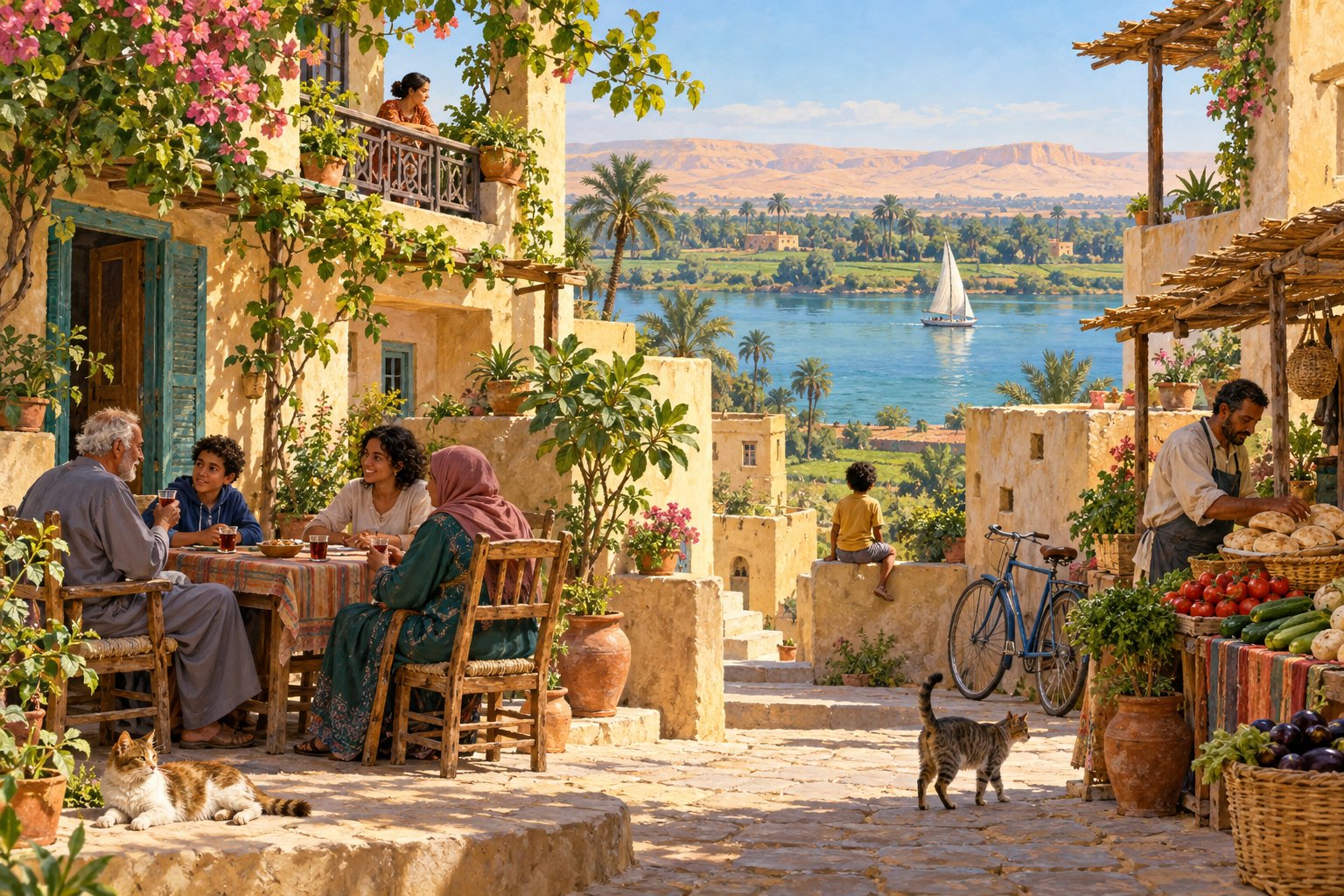
Egypt Children Vocabulary | Words for Character and Nation Building. This source-grounded English guide connects twenty explained words with four substantial chapters, an original story, worked checks and a seven-day plan. Did you know? Ancient Egyptian pyramid fields are more than one famous monument. A dry valley holds fossils of early whales, once ocean-going mammals with a land-animal ancestry. Skilled handloom weavers preserve knowledge in Upper Egypt, and Historic Cairo’s schools, markets, fountains and buildings record many centuries of urban life. These four settings help children connect English vocabulary with evidence, people and responsible care.
For international English learners around eight to twelve years old, with adults supporting history and science. This independent guide is not an official Egyptian curriculum, a religious lesson, archaeological field manual, textile production course or permission to collect fossils. The fictional student story contains no claims of eyewitness ancient history. Protected sites require current official guidance.
Country evidence: UNESCO inscribed Memphis and its Necropolis (including Giza, Saqqara and Dahshur) in 1979, Wadi Al-Hitan or Whale Valley in 2005, and Historic Cairo in 1979. It placed Handmade Weaving in Upper Egypt (Sa’eed) on the List of Intangible Cultural Heritage in Need of Urgent Safeguarding in 2020. These sources respectively concern archaeological monuments, evidence of whale evolution, living craftsmanship and a multi-period historic city.
Character-learning purpose: Here character and nation building means truthfulness about archaeological evidence, appreciation of craftspeople, fair acknowledgement of changing historical communities and responsible scientific verification. It is not a requirement to adopt ancient or modern religious beliefs or to make children responsible for professional conservation.
Quick answer: the words become useful when we can explain them
| Learning section | Child’s skill | Error to avoid |
|---|---|---|
| Twenty defined words | Define a word in original language, spot an incorrect near-example and make a new sentence | Confusing a familiar spelling with complete understanding |
| Four country-based reading chapters | Identify what a source supports and what it leaves uncertain | Describing one cultural practice or habitat as every resident’s life |
| Fictional story with six answered checks | Explain and correct a misleading claim without humiliation | Treating imagined pupils as real witnesses |
| Seven-day practice schedule | Read, say, compare, write and transfer ideas to new contexts | Assigning hazardous or professional responsibilities to children |
Go to 20-word bank · four reading chapters · fictional story · worked checks · seven-day plan · parent and teacher notes · frequently asked questions · sources and hubs.
20 English vocabulary words for children: meanings and original sentences
Each definition includes a useful boundary against common misuse. All original sample sentences are editorial learning material. Names for specific heritage practices remain attached to the actual communities and places identified by the source.
1. Memphis and the pyramids: archaeological proof and respectful remembrance
| Word | Meaning and important distinction | Original learning sentence |
|---|---|---|
| Memphis | An ancient Egyptian city associated with major royal and religious history; not the same as all modern Cairo. | UNESCO lists Memphis and its Necropolis. |
| necropolis | A large burial area with tombs and related monuments; not a modern housing estate. | The class labelled Saqqara as part of a necropolis. |
| mastaba | An early type of ancient Egyptian flat-roofed tomb structure; not a step pyramid. | The archaeology chart compared mastabas and pyramids. |
| pyramid | A monumental structure with sloping sides meeting toward a top; in this heritage context related to royal funerary architecture. | A drawing showed the Great Pyramid and its surrounding site. |
| provenance | Recorded evidence about an artefact’s origin and context; not an invented museum label. | The researcher asked about the pot’s provenance. |
2. Wadi Al-Hitan: fossils, early whales and evolutionary reasoning
| Word | Meaning and important distinction | Original learning sentence |
|---|---|---|
| Wadi Al-Hitan | Egypt’s Whale Valley World Heritage fossil site in the Western Desert; not a modern whale-watching coast. | The map located Wadi Al-Hitan in Faiyum. |
| archaeocete | A member of an extinct early whale group important for understanding whale evolution; not a living dolphin. | The fossils include archaeocete remains. |
| fossil | Preserved evidence of past life in rock or sediment; not an animal alive today. | The student recognised a fossil as ancient evidence. |
| vestigial | Reduced in form or function compared with related ancestral structures, rather than completely imaginary. | Early whale fossils show reduced hind-limb structures. |
| evolution | Change in the inherited characteristics of populations across generations; not one animal choosing to transform overnight. | The whale fossils provide evidence relevant to evolution. |
3. Upper Egypt weaving: skilled looms, apprentices and community livelihoods
| Word | Meaning and important distinction | Original learning sentence |
|---|---|---|
| Sa’eed | A cultural term referring to Upper Egypt, important in the UNESCO weaving element; not the name of every Egyptian town. | The heritage listing identifies Sa’eed weaving communities. |
| loom | A device that holds threads for weaving fabric; not merely a sewing needle. | A skilled weaver prepared the loom. |
| warp | Lengthwise threads held under tension for weaving; not the same as the crossing yarn. | The diagram marked warp threads. |
| weft | Threads interlaced across warp threads to form fabric; not an ink-printed pattern. | The weft crossed the warp. |
| safeguarding | Supporting the continued teaching and practice of heritage skills; not freezing people in one occupation. | A training programme may support safeguarding. |
4. Historic Cairo: water, learning, architecture and a lived-in city
| Word | Meaning and important distinction | Original learning sentence |
|---|---|---|
| Historic Cairo | A UNESCO-listed area with several layered neighbourhood histories; not all of metropolitan Cairo. | The source maps Historic Cairo separately. |
| madrasa | An educational institution in Islamic historical settings; not an ordinary word for every modern school. | The museum label explained a historic madrasa. |
| hammam | A bathhouse with a particular social and architectural role; not a modern public swimming pool. | The historic street included a hammam. |
| sabil | A public water-dispensing structure or fountain in Islamic architectural heritage; not a natural spring. | The guide described a sabil as a water-service building. |
| urban fabric | The relationship among streets, buildings, neighbourhoods and public spaces; not cloth used for sewing. | The class diagrammed Cairo’s urban fabric. |
Four chapters: real country facts, meaningful English and a safe activity
Each chapter introduces five focus words, explains a source-grounded cultural, historical or scientific relationship and identifies a tempting overstatement for pupils to correct. The child-friendly task is an educational analogy, not protected-site access or specialist practical instruction.
1. Memphis and its Necropolis show why pyramids are part of a much larger society
Five focus words: Memphis · necropolis · mastaba · pyramid · provenance.
UNESCO inscribed Memphis and its Necropolis – the Pyramid Fields from Giza to Dahshur on the World Heritage List in 1979. The property includes much more than the three famous pyramids of Giza. UNESCO describes areas including Saqqara, Abusir and Dahshur, together with temples, tombs and settlement remains linked to the ancient city of Memphis. A pupil who labels one picture ‘all the archaeology of Egypt’ has compressed millennia of history into a single tourist view. The proper name of the listing reveals its broader geographical and historical scope.
A necropolis is a large burial complex or cemetery with funerary structures. That does not mean the entire surrounding city was a place only for the dead. People also worked, traded, built and lived near the ancient capital. The UNESCO property includes tombs and architectural evidence, while the story of daily life requires additional materials such as settlement remains, inscriptions and artefacts. A single pyramid cannot tell us every occupation or belief of the population.
A mastaba is a type of early Egyptian tomb with a relatively flat roof and sloping sides. A pyramid has a different monumental form. UNESCO describes the development of royal funerary architecture from earlier tomb structures toward step and later pyramidal designs. The Step Pyramid of Djoser at Saqqara is an important example of this development. A child should not assume that every tomb with stone walls is a pyramid or that all pyramids were constructed at the same time.
Egypt’s monuments reflect engineering, planning, quarrying, transport, design and many workers’ labour. UNESCO records architectural achievement but does not offer a simple personal biography of every builder. Historians and archaeologists study organised work through physical evidence and surviving records. Students should not confidently assert that every individual builder was enslaved, or that all workers enjoyed the same living conditions, without sources appropriate to those specific claims. A grand monument does not establish the lives of everyone who contributed.
Provenance means documented information about where an object was found and how it relates to its archaeological setting. An ancient pot or carving can be difficult to interpret if removed without recording its position or associated layers. A photograph on a website may show a museum artefact but not its excavation context or exact date. The responsible student looks for an institutional catalogue instead of inventing a king’s name or a precise origin. Archaeology depends on records, not the appearance of mystery.
The pyramid fields also relate to ancient funerary beliefs. A child can explain that particular tombs and temples had religious or commemorative functions without being asked to adopt those beliefs. A contemporary person’s faith or view of the past may differ. Historical description concerns what evidence says ancient people practised, not a demand for the international reader to agree. Respect means explaining the context without ridicule or forced imitation.
The UNESCO inscription year, 1979, must be separated from the ancient building dates. The Great Pyramid of Khufu is far older than modern UNESCO. A child who writes ‘UNESCO built the Great Pyramid in 1979’ has confused recognition with construction. The correct timeline includes ancient phases of the city and necropolis, many later periods of research or conservation, and the modern World Heritage designation. Each date has its own meaning.
UNESCO’s conservation discussion describes pressures such as development, tourism and the need for coordinated management across component areas. An ancient monument does not become physically indestructible because it is famous. Visitors should not climb on restricted structures, move stones or remove fragments as souvenirs. Proper conservation requires trained professionals, responsible authorities and evidence about a site’s condition. A child can help by learning and following rules, not by undertaking repairs.
Imagine a fictional museum sign saying ‘All Egyptian pyramids were made at one moment and there is no other archaeology to study’. A student checks UNESCO and adds the spread of sites, earlier tomb structures and the complexity of the ancient capital. The revised sentence is more accurate because it treats the necropolis as part of a changing society, not as a single unexplained object. It also points readers toward questions historians still investigate.
A safe classroom model can use folded paper shapes to illustrate a mastaba, a step pyramid and a smooth-sided pyramid. Label each a modern educational diagram, not an original ancient construction plan. Then ask what materials or dates a real historian would need to document for a particular monument. The pupil learns the general architectural distinction without handling protected stones or trying to reconstruct dangerous building methods.
A strong writing task can ask children to name people often left out of a monument caption: workers, planners, craft specialists, maintainers and the communities whose lives surrounded the site. If a source cannot name particular individuals, the writer should not create fictional quotes and pretend they are evidence. Truthful uncertainty helps protect the dignity of real historical people whose names may not survive.
The concluding sentence can say: ‘Memphis and its Necropolis preserve evolving tomb architecture and evidence of ancient Egyptian work and beliefs, with structures such as mastabas and pyramids requiring careful archaeological provenance’. A child who can explain each part has learned more than the name of a famous monument.
Meaning correction: Misleading: ‘Egypt’s entire ancient history is one pyramid that UNESCO created in 1979, and every ancient worker had the same life.’ Repair: ‘The listed property contains many historic sites and monuments developed across periods, with different people and evidence.’
Safe transfer: Draw a fictional timeline of mastaba, step-pyramid and pyramid forms, then write one official UNESCO fact and one question requiring archaeological provenance.
2. Wadi Al-Hitan teaches whale evolution through fossils, not through invented stories
Five focus words: Wadi Al-Hitan · archaeocete · fossil · vestigial · evolution.
UNESCO inscribed Wadi Al-Hitan, or Whale Valley, in 2005. This World Heritage property lies in the Western Desert of Egypt, in the wider Faiyum area. It contains a remarkable concentration of fossils of early whales, particularly the extinct group called Archaeoceti. The name Whale Valley does not mean modern whales swim through the desert or that the site is a beach for watching living dolphins. The ancient environment and its fossils need a geological explanation.
A fossil is preserved evidence of an organism that lived long ago. It may consist of bones, shells or traces within rock or sediment. UNESCO highlights the number, quality and preservation of whale remains at Wadi Al-Hitan. Some fossil skeletons make body structures visible that help scientists study early cetaceans. A photograph can show a portion of a skeleton, but a complete species identification or geological age needs specialist evidence beyond the image.
An archaeocete is a member of an extinct early whale group. UNESCO explains that these fossils help document the transition of whale ancestors from land-based mammals toward fully aquatic life. The change did not involve one animal suddenly becoming a whale because it chose to swim. Evolution concerns inherited changes in populations across many generations. A helpful family-tree diagram can illustrate common ancestry but should not be mistaken for a photograph or complete reconstruction of every species.
The word vestigial relates to a reduced structure whose role has changed compared with ancestral forms. UNESCO describes early whale fossils with small hind limbs representing a stage in their evolutionary history. This detail can be surprising to children who know only modern ocean-going whales. A fossil skeleton does not prove the anatomy of every whale lineage at every date, but it provides important evidence about a documented group of ancient organisms. Scientists compare many specimens to build a fuller explanation.
The geological setting was once associated with a marine environment. Over very long periods, changes in Earth’s surface and climate contributed to the landscape seen today. That is why fossils of marine animals can occur in present-day desert rocks. A child should not write that whales wandered alive through today’s dry dunes last year. The fossil record concerns a distant ancient environment, and geology explains how the record came to be preserved in the place now known as Wadi Al-Hitan.
Scientific evidence includes where a fossil was found, the layers surrounding it, the anatomy visible and comparisons with other fossils. If a skeleton has been moved from its original position, scientists need records to understand its context. A child who removes a fossil bone as a souvenir may damage the information researchers need. Protected sites are not free sources of collectibles, and the UNESCO property’s management depends on controlling damaging activities and preserving research value.
UNESCO’s property description links the fossils with a globally important chapter in understanding evolution. That does not mean a single specimen from Egypt is the only evidence for whale evolution. Scientists use research from multiple locations and disciplines. An educational article can show how Wadi Al-Hitan contributes evidence without claiming it answers every question about cetacean ancestors or the complete history of life on Earth.
The distinction between observation and interpretation helps here. Observation: a fossil has a particular shape or set of bones. Interpretation: those structures indicate a relationship to earlier land mammals. The latter is a scientifically supported conclusion built from many observations. Fiction: a named ancient whale tells us what it thought when swimming. A story can be written for reading practice if clearly labelled imaginary, but it should not be cited as evidence about real prehistoric animals.
Imagine a fictional exhibition poster reading ‘Modern whales still live in Egypt’s desert, and one fossil proves an entire animal changed species overnight’. Both claims are wrong. After reading UNESCO, the class corrects the account to say that Whale Valley preserves ancient early-whale fossils important to understanding long-term evolutionary transitions. The corrected wording is clearer, more accurate and still fascinating.
A child-safe learning task uses paper drawings of a generalized terrestrial mammal, an early whale and a modern whale, labelled as simplified teaching models. Students can compare changes in limb structure without claiming the three images represent a direct three-generation family. Add a note that evolutionary lineages have branches and that actual fossil identification requires specialists. No field collection or visits to unstable desert terrain are required.
Visitors and researchers face environmental and site-protection concerns. UNESCO describes the need to manage vehicle access, excavation, tourism pressure and the preservation of exposed remains. The word protected does not mean physically unbreakable or safe for unsupervised climbing. Adults and heritage managers should make any real visitor decisions using current guidance. Children’s role is to respect boundaries and communicate scientific concepts accurately.
For a final English sentence, combine the focus terms: ‘Wadi Al-Hitan holds archaeocete fossils, including evidence of reduced hind limbs, that help scientists study whale evolution across long periods’. This conveys the most important relationship without pretending to reproduce a specialist scientific paper. It shows how careful vocabulary can turn an exciting fossil photo into a reasoned explanation.
Meaning correction: Misleading: ‘One animal chose to become a whale overnight, and live whales now swim through Whale Valley.’ Repair: ‘UNESCO documents extinct early-whale fossils that support evolutionary research across deep time.’
Safe transfer: Make an original three-stage, explicitly simplified whale-evolution diagram. Explain what fossils support and why the drawing is not an actual species genealogy.
3. Handmade weaving in Upper Egypt keeps the expert loom and its practitioners visible
Five focus words: Sa’eed · loom · warp · weft · safeguarding.
UNESCO placed Handmade weaving in Upper Egypt (Sa’eed) on its List of Intangible Cultural Heritage in Need of Urgent Safeguarding in 2020. The cultural term Sa’eed refers to Upper Egypt and its communities. The listing identifies a particular concentration of traditional handloom knowledge, not a claim that everybody in Egypt makes identical textiles. A child should not confuse this contemporary living craft with ancient pyramid construction or assume that every Egyptian family practises the trade.
A loom is a device that holds threads so they can be interlaced into cloth. The lengthwise threads are called warp, while crossing threads are called weft. These are technical English words with different roles. A drawing of a patterned textile may display colours but cannot tell us by itself how the maker controlled the loom, prepared yarn or finished the fabric. UNESCO’s account explains that these stages demand patience, precision and repeated practice.
UNESCO describes the use of materials such as linen, cotton, wool and silk in traditional weaving, while noting historical changes in the economic choices of producers. Different fibres have different properties and can require different techniques. A learner should not call every woven cloth ‘silk’ simply because it looks smooth. Nor should a glossary become an unsafe chemical-dyeing or machinery guide. The school activity should remain a paper model rather than a workshop using sharp or powered equipment.
Safeguarding means supporting the continuation of knowledge through the people who hold it. UNESCO’s urgent listing reflects concerns about economic pressures, the costs of materials, limited home space for looms and fewer opportunities for younger people to learn. An inscription should not be interpreted as proof that the craft is already secure forever, nor as an announcement that it has disappeared. It recognises a living practice facing challenges and a need for carefully designed support.
The UNESCO committee’s decision describes community knowledge passed through guided imitation and oral teaching. Men and women have contributed to making textiles and transmitting skills, with particular roles varying among families and locations. These are observations about historic and current practice, not rules that every child must enter a particular trade. Education, agency and choice matter to people who may wish to learn a craft or develop other professions. Safeguarding should support communities rather than impose outside expectations.
The source also recognises that crafts can provide livelihoods while facing competition from cheaper mass-produced materials. A customer who sees two fabrics with different prices cannot infer that one maker lacks skill or that all practitioners earn the same amount. Income, costs, market access and working conditions require appropriate economic evidence. A traditional technique can be valuable culturally even when its commercial survival is challenging. An honest educational caption leaves room for both ideas.
UNESCO’s 2020 decision described proposals for training, documentation and awareness-raising. The existence of such a plan is not proof that every goal has been completed by October 2026. For current outcomes, a writer would need the relevant subsequent monitoring and safeguarding reports. Children can learn the important difference between an intention, an activity and a measured result. A programme announcement and a verified improvement answer different questions.
Imagine a fictional museum label reading ‘Upper Egyptian weaving is instant machine printing; UNESCO invented the craft in 2020’. A student checks the heritage source and changes it to explain handloom skills, interlaced threads and knowledge transmitted by practitioners long before the inscription. The correction gives proper recognition to work that a smooth finished piece of fabric might conceal.
A safe classroom exercise uses strips of paper on a piece of cardboard. Pupils mark one set ‘warp’ and cross it with coloured ‘weft’ strips. They can explain the general mechanism without claiming they have used an authentic Sa’eed loom or learnt its full technique. No specialised equipment, fabric dyes or industrial processes are required. The exercise succeeds when children can use the two thread terms accurately and ask questions about the real makers.
There is a link with attribution here. A textile may be sold with a generic label naming Egypt but without the specific weaver or community identified. An accurate exhibit should give the maker and location where the records allow it. If details are not known, state the limit rather than invent a person’s name. Crediting the work helps avoid turning living practitioners into an anonymous part of a tourism picture.
The adjective traditional can also be misunderstood. It does not mean no practitioner may adapt material, design or teaching arrangements. UNESCO notes that weaving methods and equipment have changed over time in response to economic and practical conditions. A child should describe the practices that actually exist rather than demand that every household use a loom identical to one pictured centuries ago.
Finish with a coherent sentence: ‘Handmade weaving in Upper Egypt uses looms to interlace warp and weft, with skilled knowledge that UNESCO says needs continued safeguarding’. The sentence names a region, a process, people and an important concern. It is much more informative than a claim that Egypt has beautiful fabrics.
Meaning correction: Misleading: ‘All Egyptian weaving is machine-printed cloth invented in 2020, and UNESCO listing guarantees every maker’s livelihood.’ Repair: ‘The Upper Egypt handloom tradition predates the listing and faces real economic and transmission challenges.’
Safe transfer: Make an original paper warp-and-weft model, then write one UNESCO-supported sentence about Sa’eed weaving and an unanswered question about current safeguarding outcomes.
4. Historic Cairo’s schools, baths and public fountains tell a story beyond famous monuments
Five focus words: Historic Cairo · madrasa · hammam · sabil · urban fabric.
UNESCO inscribed Historic Cairo in 1979 as a World Heritage property. It is a defined historic part of Egypt’s capital, not the whole present-day metropolitan city and not the same property as ancient Memphis and its pyramid fields. UNESCO describes an exceptionally layered urban landscape, with histories linked to Fustat, later medieval capitals and centuries of cultural, commercial and intellectual activity. A child should not collapse all Egyptian historical periods into the age of the pyramids simply because both belong to Egypt.
The word urban fabric means the connected pattern of streets, neighbourhoods, public buildings, housing and services. UNESCO describes lanes, squares, markets and buildings from different phases, with uses that often remain connected with everyday city life. The historical city is not an empty film set where no one lives. Residents, businesses, students and visitors continue to use parts of the area, and conservation decisions affect their practical needs.
A madrasa is an educational institution in historical Islamic contexts. It should not be translated as ‘every modern school’ or treated as a building where only one subject was necessarily taught in every century. The use of an individual madrasa depends on its time and institution. UNESCO documents educational and scholarly activity in Historic Cairo, including centres associated with theology, jurisprudence, science and other forms of learning. A famous building tells part of a wider history of teaching and scholarship.
A hammam is a bathhouse associated with particular social and architectural practices. It is not the same as a public swimming pool or ordinary domestic bathroom. UNESCO lists bathhouses among Historic Cairo’s surviving urban elements. A photograph of a historic interior may show vaulted ceilings or water-related architecture, but cannot establish how every resident used it at a particular date. Good writing requires more than translating one unfamiliar word.
A sabil is a public water-dispensing structure or fountain associated with historic urban provision. It is an especially useful term because it connects a building with the everyday need for water. UNESCO describes Cairo’s cisterns, water systems and sabil structures within its historic urban fabric. A sabil is not automatically a natural spring. A child can learn that urban infrastructure includes services that may be less dramatic than palaces or fortifications but were significant to daily life.
The city contains mosques, madrasas, bathhouses, water structures, markets, residences and other buildings from different historical periods. The UNESCO account discusses Fatimid, Ayyubid, Mamluk and Ottoman influences, among others. These are not interchangeable names for one ruler or century. A good timeline identifies changing political and architectural contexts without asserting that every monument was created at the same moment or used identically.
Historic Cairo also has Christian and Jewish heritage documented in UNESCO’s longer description. A child should not treat one religious building as proof that every inhabitant shared one belief or dismiss the importance of a community because it was not the ruling institution at a particular time. Learning about faith-related architecture can be done respectfully without asking international pupils to adopt a religion. A historical description explains a setting; it is not a declaration about the personal beliefs of today’s readers.
UNESCO’s account emphasises both exceptional preservation and serious pressures, including traffic, changing land use, buildings in need of maintenance and environmental challenges. A World Heritage badge does not mean every house is safe or completely restored. Conservation includes research, planning and the involvement of responsible authorities and affected residents. A child should not attempt to repair masonry, touch protected decoration or enter restricted buildings to complete a homework assignment.
Imagine a fictional tourist poster claiming ‘Historic Cairo is just a group of untouched mosques built in 1979’. The claim is wrong in scope, chronology and description. A source checker revises it: ‘UNESCO recognised a multi-period historic city containing religious buildings, schools, markets, residences and public water structures in 1979’. The new version names the broader living urban fabric and separates the inscription year from the historical construction periods.
A safe class diagram can show an imaginary urban block with a madrasa, hammam, sabil, residential houses and a market street. Label it a fictional learning plan, not an accurate route map of Historic Cairo. Ask which building serves education, which is a bathhouse and which relates to public water. Then write a separate source-backed sentence about the real property. Children learn the role of infrastructure without inventing today’s opening hours or access permissions.
The chapter also provides a connection with responsibility. A city depends on less-visible labour to keep services functioning and valued places maintained. Builders, craftspeople, water workers, teachers, residents and conservators contribute in different ways. A good description credits those kinds of work instead of presenting the city as only the achievement of a famous ruler. Specific individuals should be named only when reliable records establish their contributions.
A final lesson in precise words asks students to distinguish Historic Cairo from Memphis, and a sabil from a madrasa. Both geographic and functional categories matter. A child who can say ‘Historic Cairo’s urban fabric includes historic education and water-service buildings developed across different periods’ has learnt an idea that transfers to other cities and public spaces. That is more informative than calling every Egyptian monument ancient and stopping there.
Meaning correction: Misleading: ‘Every Egyptian monument is a pyramid, and Historic Cairo is an empty city of identical religious buildings constructed in 1979.’ Repair: ‘Historic Cairo is a living multi-period urban property with distinct schools, baths, fountains, homes and markets.’
Safe transfer: Create an original fictional Cairo street diagram identifying madrasa, hammam and sabil separately, and make a timeline distinguishing the city’s history from UNESCO’s 1979 inscription.
Original fictional classroom story: a better answer after a source check
At a fictional school exhibition about Egypt, Dalia labels all Egyptian tombs pyramids made in 1979. A source-checker shows her UNESCO’s wider Memphis necropolis and the difference between mastabas, pyramids and listing dates. Omar finds a whale fossil photograph in the Western Desert and writes that modern whales still swim in the sand; the teacher explains early archaeocetes and evolutionary time. Mariam calls Sa’eed handloom weaving instant machine printing; classmates build a paper warp-and-weft model and credit the real artisans. Finally, Karim treats every building in Historic Cairo as a pyramid-era temple; another pupil identifies madrasas, hammams, sabils and layered city history. The students and scenes are imaginary; all real heritage facts have sources below.
Four comprehension questions
- 1. How did the evidence change Dalia’s chronology and tomb classification?
- 2. Why could Omar not infer living desert whales from ancient fossils?
- 3. Which word distinctions made Mariam’s textile explanation more accurate?
- 4. What public functions did Karim overlook in his historic-city description?
Answers should cite an action in the invented story, then use the actual institutional reference for any claim about the country. Fictional dialogue cannot serve as eyewitness history or scientific data.
Six vocabulary and reasoning self-checks with worked answers
Check 1: When did UNESCO inscribe Memphis and its Necropolis?
Worked answer: 1979, for extensive ancient sites including Giza, Saqqara and Dahshur.
Explain which particular source fact or definition supports the answer, rule out a tempting alternative that changes the meaning and make one fresh sentence outside this country’s setting. Clear reasoning is more valuable than copying the bolded words.
Check 2: What is a mastaba?
Worked answer: A type of early flat-topped ancient Egyptian tomb, distinct from a pyramid.
Explain which particular source fact or definition supports the answer, rule out a tempting alternative that changes the meaning and make one fresh sentence outside this country’s setting. Clear reasoning is more valuable than copying the bolded words.
Check 3: Why are Wadi Al-Hitan’s fossils important?
Worked answer: They document extinct early whales and evidence relevant to the transition toward ocean-going mammals.
Explain which particular source fact or definition supports the answer, rule out a tempting alternative that changes the meaning and make one fresh sentence outside this country’s setting. Clear reasoning is more valuable than copying the bolded words.
Check 4: When did UNESCO place handmade weaving in Upper Egypt on the urgent safeguarding list?
Worked answer: 2020, recognising longstanding skills facing social and economic pressures.
Explain which particular source fact or definition supports the answer, rule out a tempting alternative that changes the meaning and make one fresh sentence outside this country’s setting. Clear reasoning is more valuable than copying the bolded words.
Check 5: What are warp and weft?
Worked answer: Warp threads run lengthwise; weft threads interlace across them in weaving.
Explain which particular source fact or definition supports the answer, rule out a tempting alternative that changes the meaning and make one fresh sentence outside this country’s setting. Clear reasoning is more valuable than copying the bolded words.
Check 6: How do a madrasa, hammam and sabil differ?
Worked answer: A madrasa is a historic educational institution, a hammam a bathhouse and a sabil a water-dispensing structure.
Explain which particular source fact or definition supports the answer, rule out a tempting alternative that changes the meaning and make one fresh sentence outside this country’s setting. Clear reasoning is more valuable than copying the bolded words.
Seven-day practice plan: remember, explain and transfer
| Day | Suitable activity | Evidence of understanding |
|---|---|---|
| 1 — Notice | Read words 1–5 and give a correct definition and misleading non-example. | Independent explanation of precise meaning |
| 2 — Speak | Use words 6–10 aloud in imaginary home or school situations. | Two original sentences with the intended sense |
| 3 — Source | With adult support read an age-appropriate paragraph from one linked institution. | One sourced fact and one unanswered question |
| 4 — Compare | Study words 11–15 and distinguish observation, verified fact, interpretation and fiction. | No invented story passed off as real evidence |
| 5 — Decide | Use words 16–20 in a supervised mock information project. | One achievable responsibility and way to check it |
| 6 — Write | Write an original 80–120-word explanation with three precise words and an attributed source. | Coherent respectful prose with evidence |
| 7 — Transfer | Apply three general words to a different school, place or research problem. | Accurate new usage without stereotyping people |
A low-pressure word mastery check
Ask the child to define a term in their own words, repair a plausible wrong use, then make a fresh sentence in a different situation. Record each as ‘not yet’, ‘with guidance’ or ‘independently’. Return to the same words several days later. A child who revises an answer after reading a reliable source has gained skill; there is no need to shame them for the first guess.
Assess writing for a clear subject and verb, a word used where it genuinely adds meaning, verifiable facts about real people and places, proper attribution, and a task within a child’s abilities. Avoid rewarding exaggerated claims merely because they sound positive. An honest uncertainty is better than a fictional date or personal biography.
Parent and teacher notes: character through evidence, fairness and care
- Use an authoritative source. A heritage inscription, constitutional article or scientific report establishes a defined fact, not every person’s experience.
- Name the community or geographic property. National labels are useful for location but should not erase the makers, residents or different ecosystems involved.
- Give specialised workers due credit. Craftspeople, conservators, researchers and community knowledge holders undertake distinct tasks.
- Keep historical complexity visible. A celebrated old city can include Indigenous contributions and unequal colonial relationships.
- Separate model from evidence. A paper evolutionary tree or imagined street plan must not be presented as a measured map.
- Respect visitor rules and specialist safety. Protected wildlife, chemicals, archaeological objects and historic repairs are adult responsibilities.
- Recognise lived language differences. Legal categories do not reveal what every child understands or uses at home.
- Celebrate reasoned revisions. Correcting a caption after a source check makes shared information more reliable.
Frequently asked questions
Does Egypt’s UNESCO pyramid listing include only the three pyramids at Giza?
No. The Memphis and Necropolis property also includes Saqqara, Abusir, Dahshur and many tombs and settlements.
Why are whale fossils found in the desert?
Wadi Al-Hitan preserves evidence of ancient marine life and geological changes; no living whales swim in the present desert.
Does a fossil show an individual animal changing species overnight?
No. Evolution involves changes in populations over many generations, supported by evidence from numerous organisms and disciplines.
Is Upper Egypt handmade weaving guaranteed secure because UNESCO listed it?
No. Its 2020 urgent safeguarding status documents concerns about continued transmission and economic viability.
Are Historic Cairo and ancient Memphis the same UNESCO property?
No. They are distinct World Heritage properties with very different historical periods and features.
Does learning about an ancient religion require practising it?
No. Archaeology and architecture can be studied respectfully without requiring children to adopt a belief or participate in a ceremony.
Institutional sources and linked country learning ecosystem
Real-world facts are based on the named UNESCO, heritage and legal sources below, consulted in October 2026. Fictional pupil names, class conversations, sample sentences and paper activities are original educational content, not national curriculum or eyewitness accounts. Confirm current access and safety rules with relevant authorities.
- UNESCO World Heritage | Memphis and its Necropolis
- UNESCO World Heritage | Wadi Al-Hitan (Whale Valley)
- UNESCO | Handmade weaving in Upper Egypt (Sa’eed)
- UNESCO | Committee decision on Upper Egypt weaving safeguarding
- UNESCO World Heritage | Historic Cairo
- UNESCO World Heritage | Egypt’s listed sites
- UNICEF | Convention on the Rights of the Child
Learn more about this country on eduKateSG
- Everything About Egypt
- How Egypt Works | Government, Nile and Suez Canal
- Ancient Egypt | How the Nile Supported a Civilisation
- Top 100 Papyrus Manuscript Vocabulary Words
- Top 100 Cotton Fibre and Fabric Vocabulary Words
- Top 100 Khayamiya Appliqué Vocabulary Words
Continue the A–K Children Vocabulary country series
Djibouti Children Vocabulary · Dominica Children Vocabulary · Dominican Republic Children Vocabulary · Ecuador Children Vocabulary · Egypt (this article)
Core vocabulary and world-learning hubs
- Vocabulary Learning Hub
- Vocabulary by Age and Purpose
- How Countries Work | A–Z
- Country Vocabulary Index
Children who finish this Egypt guide should be able to explain twenty words accurately, recognise the limits of the evidence, give credit to real people and make one age-appropriate improvement in their writing or classroom. Character learning is meaningful when careful language leads to thoughtful action.