
Did you know that an examined Drama student must be able to explain how a scene might work on stage, not just memorise its lines? The 2027 SEC G3 Drama syllabus brings a written paper, two live performance tasks and a reflective Development Journal together. A confident performer can still need help analysing rehearsal choices, while a thoughtful reader may need practice communicating clearly to an audience. For Bukit Timah parents, the important distinction is that G3 Drama K352 is a performance-centred course, not the same paper as Drama studied within Literature in English.
The quick answer: SEAB lists G3 Drama K352, formerly 2299, as revised for the 2027 SEC. Paper 1 is a compulsory two-hour written examination, 80 marks, 40%, divided into unseen extract (30 marks), pre-release extract (30) and analysis of practical rehearsal with the pre-release extract (20). Paper 2 Coursework carries 120 marks and 60%: an Individual Scripted Performance of 3–5 minutes (45 marks), an original Group Devised Piece of no more than 15 minutes with 2–5 candidates (45 marks), and an individual Development Journal covering both pieces (30 marks). Coursework must be authentic and supervised; the syllabus requires a declaration that submitted work is the pupil’s own without another person’s or AI-generated contribution.
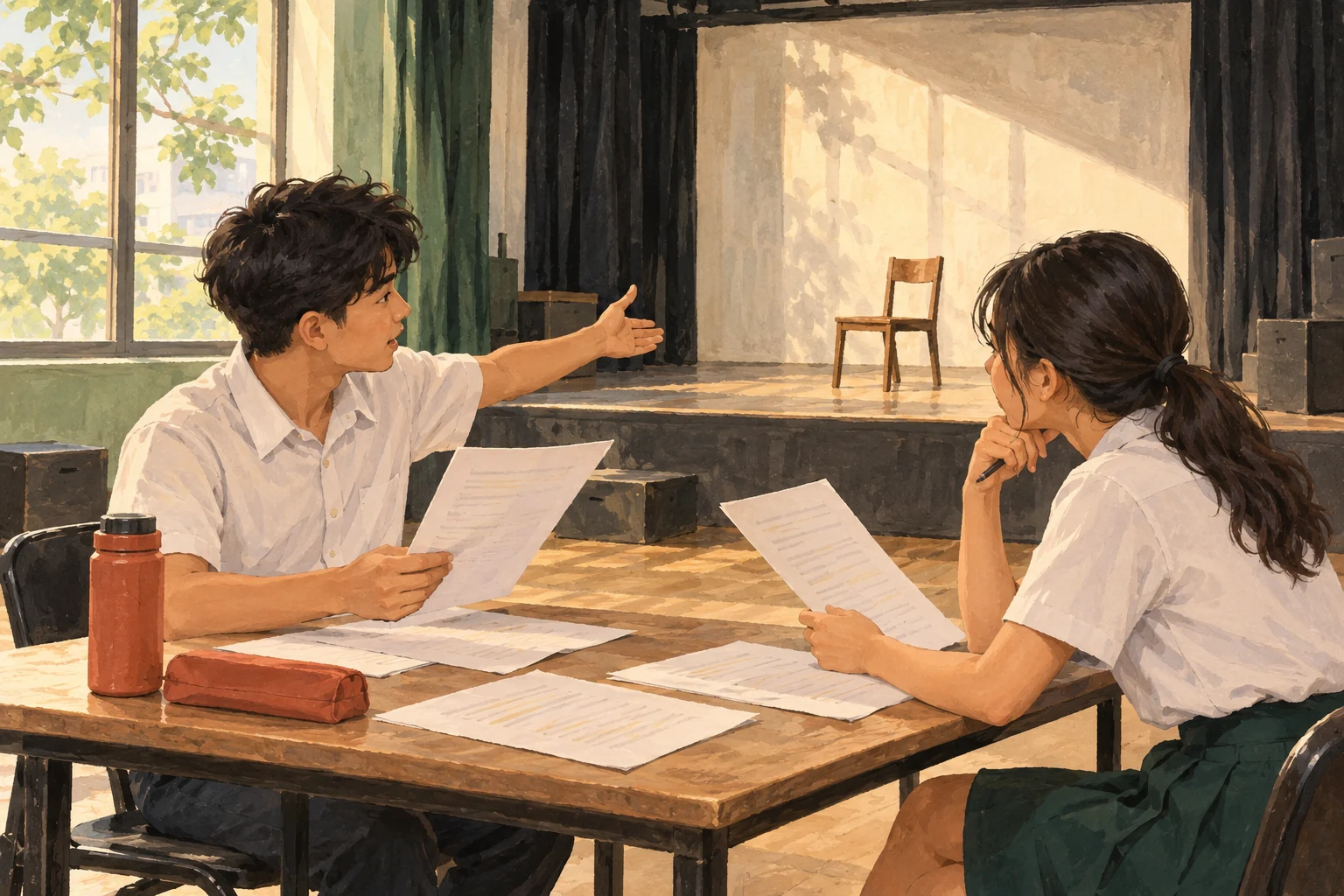
Updated 28 October 2026. The featured editorial illustration shows fictional students discussing a script near a rehearsal stage, not an official 2027 Drama performance. Original illustrative dialogues are not SEAB extracts, and authenticity rules apply to all formal coursework.
Jump to: 1. Why a Drama subject is not identical to Literature Drama · 2. A new examination year with a revised syllabus · 3. Paper 1 and Paper 2: the 40/60 structure · 4. The three assessment objectives are distinct · 5. Paper 1 Section A: three ten-mark unseen questions · 6. A performance proposal is more than a plot description · 7. Paper 1 Section B: a pre-release extract · 8. Section C: reflect on actual rehearsal · 9. The pre-release extract is not an entire prescribed play list · 10. Individual Scripted Performance: 3–5 minutes · 11. Individual staging choices need a reason · 12. Group Devised Piece: 2–5 candidates, maximum 15 minutes · 13. A group piece begins with an approved stimulus · 14. Original devising is not copying an internet scene · 15. Stage space and proxemics communicate relationships · 16. Voice: articulation, projection, pace and emphasis · 17. Physical expression should be intentional · 18. Tension and focus create dramatic momentum · 19. Audience response is a source of information · 20. The Development Journal is thirty raw marks · 21. A good journal compares intention with outcome · 22. Evaluation of an individual’s group contribution · 23. Coursework authenticity and the explicit AI rule · 24. Theatre and video recordings serve different purposes · 25. Costumes, props and sets are not a spending contest · 26. What the May pre-release timing means · 27. A safe and realistic rehearsal schedule · 28. Why Drama can support wider education · Related 2027 SEC subjects
1. Why a Drama subject is not identical to Literature Drama
Standalone G3 Drama K352 is a subject about making, interpreting, performing and evaluating theatrical work. Literature in English K331 includes a Drama paper that asks students to analyse a prescribed play as a literary text. Both involve scripts and audiences, but K352 assesses a pupil’s own performance and development process through moderated coursework as well.
Under the first 2027 SEC, subject codes identify these separate routes. K352 is the new code for former 2299; K331 remains the Literature qualification. A student who enjoys reading Shakespeare may also like theatre, but the additional practical requirements in K352 need serious consideration.
Parents should confirm whether their child’s school offers the subject, what rehearsal facilities and teacher supervision are provided, and which assessed tasks the pupil must complete. A school play or CCA appearance alone does not establish registration for the national Drama examination.
2. A new examination year with a revised syllabus
SEAB’s G3 2027 directory explicitly marks Drama as a revised subject. That distinction means families should use the current K352 syllabus rather than assume the 2026 paper structure remains unchanged. The published scheme separates written interpretation from assessed individual and group performances.
The course is designed to develop understanding of the way meaning is constructed for an audience. Students draw on observation, stories, experience and dramatic techniques to conceptualise and rehearse work. They consider voice, physical action, space and the consequences of theatrical choices.
This approach makes Drama intellectually demanding as well as expressive. A technically strong scene can communicate an unintended message; a thoughtful student should be able to explain the intended effect and evaluate whether the audience could perceive it.
3. Paper 1 and Paper 2: the 40/60 structure
The two-hour written Paper 1 has 80 raw marks and contributes 40% of the qualification. Paper 2 is 120-mark coursework contributing the remaining 60%. Both are compulsory. Paper 2 is assessed by the school and externally moderated under the official criteria.
Do not confuse the raw totals with equal percentages. A student cannot assume that getting eighty written marks means the written paper carries the same weight as the practical project. The scheme deliberately gives greater weight to the realisation of Drama as performance.
A family study plan should still maintain both written and practical skills. A performer may communicate well to a live audience but fail to articulate choices in an examination answer. Another student may write insightful analyses while needing coaching in pacing, focus and ensemble communication.
- Paper 1: 2 hours, 80 marks, 40%.
- Paper 2: authentic supervised coursework, 120 marks, 60%.
- Individual performance, group-devised piece and journal are all required.
- All work must follow the 2027 submission and integrity rules.
4. The three assessment objectives are distinct
SEAB defines AO1 as applying knowledge and understanding to explore and structure dramatic ideas. AO2 is communicating in live performance, including acting skills and effective engagement with an audience. AO3 is analysis and evaluation of one’s own work and rehearsal process.
Across the subject, AO1 accounts for 45%, AO2 for 30% and AO3 for 25%. These are objective distributions across both papers, not three separately scheduled examinations. The scheme shows that performers are assessed on intention and reflection as well as acting.
A useful question after a rehearsal is therefore not only ‘Did you remember your lines?’ Ask what the candidate was trying to communicate, what choices helped that intention, and what evidence suggests that the audience understood it.
5. Paper 1 Section A: three ten-mark unseen questions
Section A introduces an unseen play extract and asks three compulsory questions of ten marks each. Students may have to discuss how the passage could be performed or directed, using the situation, relationships, dramatic tensions and stagecraft shown in the script.
Unseen does not mean impossible to interpret. Pupils can identify who is present, what each character seems to want, where the scene changes and which theatrical possibilities follow. The proposed choice should be linked to the extract, not an unrelated imaginative stunt.
Practise using original short dialogues and teacher-approved extracts. Ask the child to state a staging choice and explain why it would affect a live audience. A clear reason matters more than choosing the most expensive possible effect.
6. A performance proposal is more than a plot description
A script may indicate that two characters disagree, but Drama analysis asks how performers communicate the conflict. Their distance, movement, pace and voice can suggest hostility, nervousness or a shifting relationship depending on the surrounding action.
Consider an original practice dialogue: ‘You told me it was safe.’ ‘I said I hoped it was.’ The second line may alter the audience’s understanding of trust and responsibility. A candidate might explain a pause or change in stance that exposes the uncertainty. The effect depends on the actual situation in the wider scene.
Students should distinguish what a script explicitly establishes from the staging decisions they propose. A defensible choice considers the playwright’s material and the intended audience rather than inventing facts about a character with no basis in the extract.
7. Paper 1 Section B: a pre-release extract
Section B is worth 30 marks and uses a pre-release extract. Candidates answer one five-mark question, one ten-mark question and one fifteen-mark question chosen from two alternatives. The pre-release material is supplied to centres in May before the examination, according to the 2027 syllabus.
This allows students to explore the performance possibilities of a text over time. It is not an invitation to memorise every published interpretation of the play. Teachers may help pupils rehearse and examine staging choices so that they understand why one action or design decision produces a particular effect.
The fifteen-mark choice should be made by reading the full alternatives and identifying which can support a coherent practical explanation. Students should avoid writing about unrelated scenes simply because they practised those scenes previously.
8. Section C: reflect on actual rehearsal
Paper 1 Section C carries 20 marks through two ten-mark questions about the candidate’s practical exploration of the pre-release extract. The syllabus recommends trying the extract in rehearsal or informal performance, even though that practical exploration is not itself directly graded as a performance in this written paper.
This is an important distinction. A student’s experience of rehearsal supplies evidence for reflective analysis. A statement such as ‘we practised often and improved’ is less useful than describing the difficulty, the chosen adjustment and why it altered communication with an audience.
Parents can encourage children to remember what genuinely happened during school work, but should not create fictional rehearsal episodes for the candidate to describe. The answer must be grounded in authentic learning and the question asked.
9. The pre-release extract is not an entire prescribed play list
Unlike Literature K331, Drama K352 does not use a stable list of four prescribed plays for its written examination. The pre-release extract is selected by Cambridge and issued to centres before the paper. Students also face an unseen extract in the examination.
Families should not purchase a bundle of assumed ‘2027 Drama set texts’ from an unverified advertisement. The school’s teacher and the formal pre-release material determine which extract is relevant. The prior-year extract may teach technique, but is not proof of the upcoming paper.
Rehearsal and study should focus on the script’s dramatic possibilities: setting, tension, role, language, subtext, movement, atmosphere, vocal expression and audience response.
10. Individual Scripted Performance: 3–5 minutes
The first coursework practical is one Individual Scripted Performance of an extract from a play, with a planned duration between three and five minutes. Its assessment includes 15 raw marks for application of knowledge and 30 for communication in performance, giving 45 marks.
A successful performance involves more than remembering lines. The candidate should understand the role, interact with any relevant stage circumstances and shape their voice and physical behaviour to communicate the scene’s intention. The audience needs to perceive a coherent dramatic journey.
Teachers supervise the selection, rehearsal and assessment conditions. Parents should not rewrite the assessed script or provide a professionally staged replacement performance for the pupil. The submitted work must genuinely represent the candidate’s own skills.
11. Individual staging choices need a reason
A performer can choose where to stand, what to focus on and how to shift emphasis, but those decisions should support the text. Moving dramatically across a stage without narrative purpose may distract rather than communicate.
Imagine an original scene in which a character considers revealing a secret. A measured pause, change in posture or shift in proximity might show internal conflict. The appropriate choice depends on the script and the intended effect, not on a universal rule that silence always implies fear.
A useful reflection describes what the candidate tried, how it worked during rehearsal and which adjustment improved clarity. This develops informed judgement rather than decorative performance.
12. Group Devised Piece: 2–5 candidates, maximum 15 minutes
The second coursework performance is an original group-devised piece for two to five candidates. Its planned duration must not exceed fifteen minutes, and each candidate should have broadly equal exposure. Like the individual piece, it contributes 45 raw marks through application and communication in performance.
Group devising creates different learning challenges from performing a given script. The participants must agree on a dramatic purpose, generate ideas, organise scenes and make coherent choices about character, movement, space and audience. One confident member should not simply dominate every decision while others become background.
Students are assessed individually within the group context. Honest contributions, communication and a justified understanding of their own role matter. The prescribed group size and performance duration must be checked against the final school and examining authority instructions.
13. A group piece begins with an approved stimulus
The official syllabus says the teacher selects a stimulus for devised coursework. Examples may include an image, music, poem, newspaper article or a suitable issue, including cultural, social or environmental themes. The group then creates its own original dramatic work under supervision.
A hypothetical stimulus about an unfamiliar visitor to a neighbourhood can inspire questions about belonging or misunderstanding. But an illustrative idea from this article is not the actual assessed task; the class teacher determines what is appropriate and authorised.
The strongest group begins by discussing what the audience should understand or feel and which dramatic form will communicate that. Only after agreeing on a purpose should the performers decide on individual scenes and stage images.
14. Original devising is not copying an internet scene
Performers may learn from plays and theatre traditions, but assessed devised work must be original and properly attributed where required. A popular online sketch may be entertaining yet unsuitable as the submitted group’s own creation.
Students can explore multiple concepts before choosing one. Perhaps a scene works better through contrasting dialogue, a repeated gesture or a shift in point of view. Documenting those choices helps explain the development process without presenting outside material as personal invention.
Academic integrity also applies to digital tools. The syllabus requires declaration that coursework contains no work created through AI or supplied or assisted by another person. Do not treat a generated script or an adult’s staging plan as the candidate’s own assessed work.
15. Stage space and proxemics communicate relationships
Proxemics concerns the use of distance and positioning among performers. A character who moves closer to another may suggest concern, confrontation or dominance, depending on context. Stage areas and sightlines also shape what the audience notices.
An imagined dialogue with two people across a table can become different when one stands while the other remains seated. The change in height or distance may affect perceived power or vulnerability. The meaning should be explained through the dramatic action, not assumed from the position alone.
School rehearsal gives pupils a safe place to explore choices and gather feedback. Families need not construct a home theatre or purchase elaborate sets to practise discussing the concepts.
16. Voice: articulation, projection, pace and emphasis
Effective vocal expression helps a live audience understand speech, character and intention. Projection is not simply shouting, and varied pacing should serve the dramatic moment. An overly rapid line may obscure meaning, while an unmotivated slow delivery can flatten a scene.
Students can practise interpreting a brief original line with different intentions, then discuss what changed. For instance, the phrase ‘I thought you knew’ could communicate surprise, disappointment or irritation depending on its circumstances and delivery.
Feedback should be specific and respectful. If a student is nervous, repeatedly criticising their accent or natural speaking style may reduce confidence. The aim is clear communication suited to the role, not imitation of an arbitrary voice.
17. Physical expression should be intentional
Gesture, posture, facial expression and movement can express a character’s objective and emotional state. But more movement does not necessarily make a scene more compelling. Some of the most meaningful actions are small when the audience understands their significance.
A pupil might begin with a tentative posture and gradually change as a character gains confidence. An appropriate physical shift can clarify development, provided it follows the text and is safe within the performance space.
Students should not rehearse stunts, falls or risky movements without qualified school direction. Physical storytelling and the wellbeing of performers are compatible.
18. Tension and focus create dramatic momentum
Dramatic tension arises when an outcome or relationship matters and remains unresolved. The performer can influence it through pacing, silence, withheld information or competing objectives. However, a scene with constant shouting is not automatically more tense than a carefully restrained exchange.
A fictional stage moment in which two people wait for an important decision can develop tension through changes in attention and brief responses. The candidate should identify which detail makes the audience anticipate an outcome.
Analysis should describe how the chosen element works within the scene, and whether it supports the intended response. A generic statement that tension ‘keeps the audience interested’ is a starting idea, not a complete evaluation.
19. Audience response is a source of information
During authorised rehearsals, pupils may present work to peers or teachers and consider their responses. Feedback can reveal whether a relationship, intention or scene transition is understandable. This does not mean performers must always follow every suggestion they hear.
The student should distinguish what the audience actually observed from the candidate’s hope that everyone felt the same emotion. A comment about unclear motivation may justify revisiting a scene; a difference in taste may call for discussion rather than immediate change.
Good evaluation explains the evidence and the action taken. Authentic response information matters more than inventing applause or claiming perfect understanding after every rehearsal.
20. The Development Journal is thirty raw marks
Paper 2 requires one individual Development Journal covering the planning, development and performance of the individual scripted piece, as well as the candidate’s own contribution to the group-devised piece. It contributes 20 raw marks for the individual work and 10 for the group contribution, totalling 30.
This is not a decorative scrapbook. The journal should explain intended effects, choices made, the rehearsal process and evaluation of outcomes. It can discuss changes in interpretation and the reasons behind them. The official rubric recognises thoughtful analysis rather than simply a list of dates or rehearsals.
Students may work on the journal using their personal learning device under the syllabus rules, but teachers must authenticate the work and ensure it is completed without external assistance. Parents must not ghostwrite reflections.
21. A good journal compares intention with outcome
Start with the question ‘What did I want the audience to understand?’ Then describe which vocal, physical or staging choices were used, what happened in rehearsal and how the result compared with the intention. The pupil should explain the evidence for any claimed improvement.
A fictional journal example might note that a first staging caused the audience to misunderstand which character was leading the scene. The student then changes positioning and tests the effect. That is more informative than writing that ‘the rehearsal went really well’.
Documentation must remain truthful. A mistake or uncertain result can be a legitimate part of learning when the candidate evaluates it and responds responsibly.
22. Evaluation of an individual’s group contribution
The ten-mark group-journal element asks the pupil to evaluate their own contribution to the devised piece and how it influenced the final outcome. It should not become a page blaming teammates or claiming that the pupil personally created everything.
Useful reflection may consider proposing an idea, helping structure a transition, responding to feedback or resolving a practical problem. The candidate can explain how the action affected group coherence or the intended audience response.
Because group performance depends on collaboration, respectful evaluation matters. The student should acknowledge others’ roles appropriately without submitting another person’s writing or private rehearsal notes as their own work.
23. Coursework authenticity and the explicit AI rule
The 2027 syllabus requires a Declaration and Submission form stating that coursework is the student’s own and contains no work published or assisted by another person or created by AI. This is unusually direct language and should be read carefully by families and tutors.
General discussion of dramatic concepts can be valuable before or outside examined work, but when creating the actual coursework the pupil must follow the teacher’s permitted guidance. An AI-written script, a family member’s revised journal or an adult-directed performance intended as the pupil’s own can compromise authenticity.
Students should ask the teacher how reference material and permitted feedback are handled. Respecting the rule protects the educational purpose: the assessment is meant to show the learner’s own choices, performance and reflection.
24. Theatre and video recordings serve different purposes
SEAB says coursework should be intended for live performance in an appropriate space. Centres video-record performances for moderation, but the pieces should not be designed as film or television works. A dramatic performance created for camera editing is not identical to one intended for an audience in the room.
Camera framing, cuts and effects can hide weaknesses or create meanings that are different from stagecraft. Drama pupils need to think about sightlines, entrances, shared space and live communication. Recordings document the performed work; they do not replace the candidate’s actual live intentions.
Parents should avoid paying for elaborate videography or digital effects in the belief that these are examined skills. The teacher can explain the centre’s official recording procedure and what students are actually assessed on.
25. Costumes, props and sets are not a spending contest
Costume and set decisions may support a character or scene, but the syllabus does not separately assess the cost or sophistication of these elements as their own coursework category. They should serve the intended dramatic effect and avoid distracting from the central performance.
A plain chair and a thoughtfully chosen gesture may communicate more clearly than a complicated set that takes all the audience’s attention. The quality of the theatrical idea matters. Students should reason about why a prop is needed rather than treat buying materials as evidence of achievement.
Families can ask the school what resources are already available and whether a proposal is safe and permitted. No parent should feel compelled to create expensive staging on behalf of an examined teenager.
26. What the May pre-release timing means
SEAB states that the pre-release extract is issued to centres in May preceding the examination. For the 2027 examination cohort, the school’s receipt and handling of the authorised text govern how candidates should study it. The published national syllabus does not reveal the text itself.
Parents should not trust websites advertising a confidential pre-release script long before official distribution. Earlier sample extracts can help practise analysis, but they do not guarantee the same genre, setting or roles.
When the real extract is issued, students can use appropriate school-guided exploration to understand its possibilities and prepare for both the written questions and reflections on rehearsal.
27. A safe and realistic rehearsal schedule
Rehearsal should account for school assignments, group availability, performance spaces, teacher supervision and rest. An illustrative cycle might use early sessions to explore the text, middle sessions to try alternative staging and later sessions to refine and evaluate the selected approach.
Students need time to understand the intended audience effect as well as practise lines and movement. A group that rehearses frequently without discussing purpose may become fluent yet remain unclear in dramatic intention.
Parents should support practical logistics rather than take over staging. Where illness, accessibility needs or group scheduling create problems, the school should advise on authorised procedures.
- Check the correct revised K352 syllabus.
- Know the 40% two-hour written and 60% coursework split.
- Practise unseen and pre-release analysis, including authentic rehearsal reflection.
- Respect 3–5-minute solo and 2–5-member group task limits.
- Maintain the individual Development Journal without external assistance.
- Use school supervision and live-performance safety rules.
28. Why Drama can support wider education
Drama develops communication, interpretation, collaboration, empathy and reflection. These skills can help a teenager explain ideas, listen to different perspectives and work constructively with peers. They remain valuable even if the student never pursues acting professionally.
The first 2027 SEC results are expected in January 2028. Post-secondary institutions have their own requirements, and a K352 grade cannot guarantee a theatre diploma or other course. Families can discuss genuine interests and access to opportunities rather than assume one examination determines the child’s future.
For a different subject, read our G3 Literature in English guide, where Drama is assessed through reading a prescribed play rather than K352’s examined personal performance.
Frequently asked questions
What is G3 Drama’s 2027 code?
K352, with old reference 2299 and a revised syllabus.
What percentage is the written examination?
40%, with eighty marks and a two-hour duration.
How is the written paper divided?
Unseen extract 30 marks, pre-release extract 30, and evaluation of rehearsal with the pre-release extract 20.
When is the pre-release material issued?
SEAB says it is issued to centres in May before the examination.
What is the coursework percentage?
60%, represented by 120 raw marks.
How long is the solo scripted performance?
Three to five minutes, with 45 raw marks.
How long is the group-devised piece?
No longer than fifteen minutes, with 45 raw marks.
How large may the group be?
Two to five candidates, with broadly equal exposure.
How many marks is the Development Journal?
Thirty: 20 for reflection on individual scripted performance and 10 for group contribution.
Is the performance intended for film?
No. It must be conceived for live performance; recordings support moderation.
Does the syllabus allow AI-generated assessed coursework?
The 2027 declaration expressly excludes submitted work created by AI or assisted by another person.
Can parents rewrite the student’s journal?
No. Authorship and teacher authentication requirements must be observed.
Are costumes and expensive sets separately graded?
The syllabus says they are not specifically assessed as independent categories; they should support dramatic intention.
Is K352 the same as Drama in Literature K331?
No. They are different subject registrations with different assessment schemes.
Who confirms exact deadlines and candidate dates?
The school’s drama teacher and examination office, using SEAB’s official rules.
Related Education at Bukit Timah SEC 2027 Guides
These guides compare different 2027 subject syllabuses and the skills that they examine. Confirm the student’s exact subject code and school registration before choosing learning materials.
- Education at Bukit Timah | G2 Literature K228 — Four Equal Answers
- Education at Bukit Timah | G3 Humanities K337 — Social Studies and Literature
- Education at Bukit Timah | G3 Electronics K353 — 32-Hour Project
2027 SEC examination calendar and preparation guide — for the wider school-year context.
Official sources and related reading
SEAB 2027 G3 school-candidate syllabuses — official syllabus or connected educational guide.
Official K352 Drama syllabus for 2027 — official syllabus or connected educational guide.
SEAB SEC overview — official syllabus or connected educational guide.
MOE SchoolFinder — official syllabus or connected educational guide.
eduKateSG G3 Literature compared — official syllabus or connected educational guide.
eduKateSG 2027 SEC examination calendar — official syllabus or connected educational guide.
Bottom line: Drama K352 tests a complete creative process: interpreting a script, developing a performance, collaborating with others and evaluating real decisions. Its revised 2027 structure gives coursework significant weight, so a pupil’s authentic choices and reflections matter every bit as much as polished delivery on stage.