
Where is Argentina, what is it famous for, and why does it matter beyond football and tango? Argentina is a large South American country stretching from subtropical northern landscapes to the cold and windy south. The Andes form much of its western edge, the Pampas support major farming areas, and the Atlantic coast connects the country to international trade. Buenos Aires is its capital, but the country includes many regional centres with different histories, industries, foods and ways of life.
Argentina is famous for football, tango, mate, literature, beef, wine, Patagonia, the Andes and Iguazú Falls. Those familiar names are useful entry points, but they do not explain everything. To understand the country, connect its landscapes with its federal institutions, population, agricultural exports, industries, schools, public services and changing economy. This guide makes those connections and gives you routes into more detailed eduKateSG reading.
Argentina at a glance
- Region: southern South America.
- Capital: the Autonomous City of Buenos Aires, which is separate from Buenos Aires Province.
- Land neighbours: Chile, Bolivia, Paraguay, Brazil and Uruguay.
- Federal units: 23 provinces and the Autonomous City of Buenos Aires.
- Main language: Spanish, alongside Indigenous languages and languages maintained by immigrant communities.
- Currency: Argentine peso, currency code ARS.
- Population: 45,892,285 in INDEC’s definitive 2022 census results. This is a dated census count, not a live 2026 total.
- Independence declaration: 9 July 1816. The May Revolution of 1810 is a different milestone.
- Government: a federal republic with a president, bicameral Congress, courts and provincial governments.
- Major landscapes: Andes, Pampas, Gran Chaco, northeastern river and wetland systems, Cuyo and Patagonia.
- Important economic activities: agriculture, food processing, manufacturing, services, energy, mining and tourism.
- Reading date: 20 October 2026 in Singapore. Each statistic and policy claim retains its own source date.
A few distinctions make the country much easier to read. Buenos Aires city is not Buenos Aires Province. Patagonia is a region shared with Chile, not another country. A fall in the inflation rate is not automatically a fall in prices. A mineral resource is not the same as operating production. Keep those distinctions in mind as you move through the chapters.
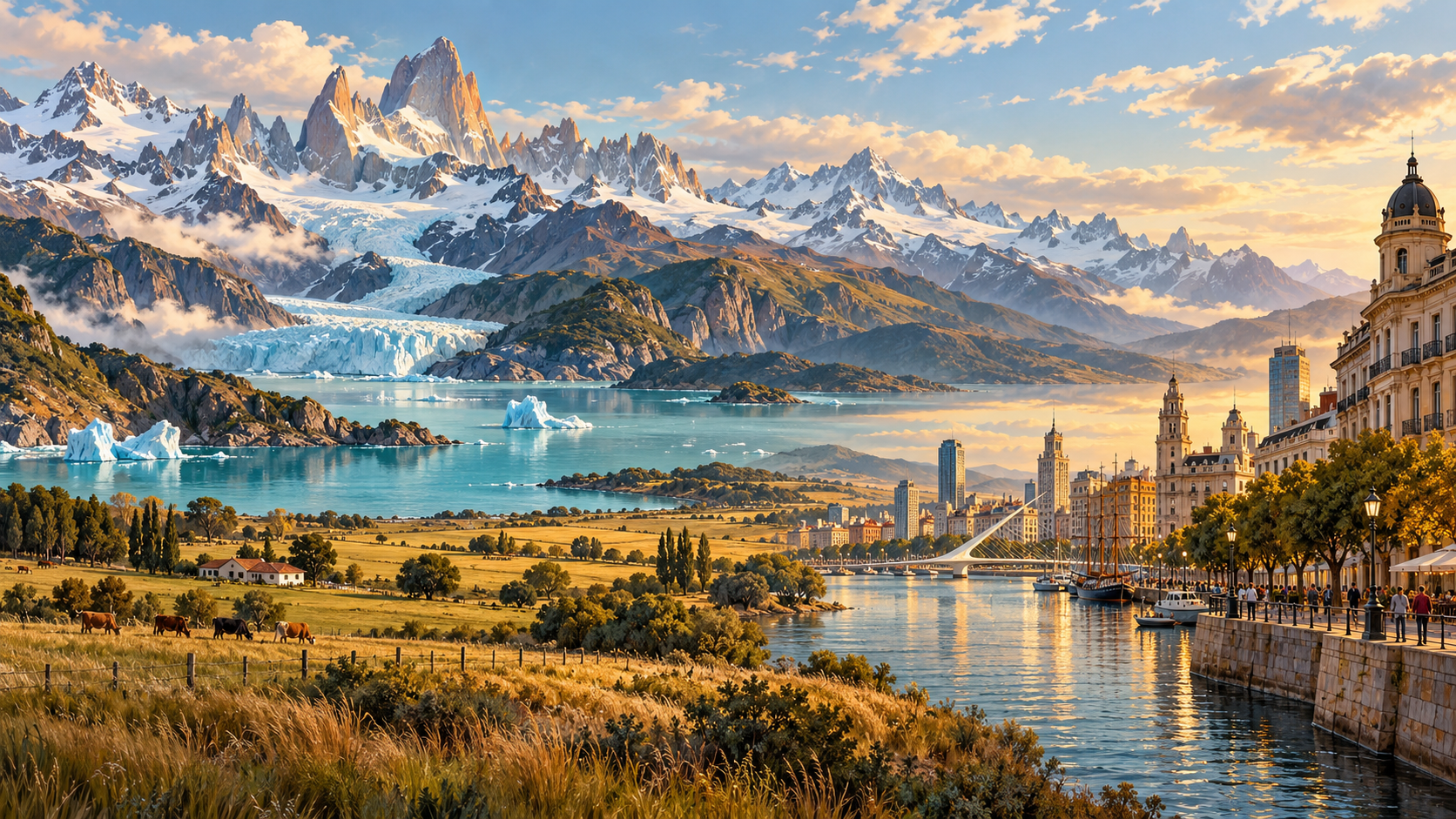
Cover illustration: an original artistic interpretation of Argentine landscapes and city life, not a literal geographic view.
Choose your route through Argentina
- 1. Where is Argentina, and how do its regions fit together?
- 2. How do the Andes, Pampas, Patagonia and rivers shape Argentina?
- 3. Who lives in Argentina, and what languages are spoken?
- 4. What happened before independence?
- 5. How did independence become a national state?
- 6. How did dictatorship and democracy shape modern Argentina?
- 7. How is Argentina governed today?
- 8. Which cities matter, and what does “Buenos Aires” mean?
- 9. How does Argentina’s economy work, and why does inflation matter?
- 10. What does Argentina produce?
- 11. Transport, Ports and the Challenge of Long Distances
- 12. Energy, Water and the Networks Behind Daily Life
- 13. Education, Federal Curricula and Universities
- 14. Health, Social Insurance and Everyday Support
- 15. Language, Literature, Tango and Regional Music
- 16. Food, Mate and Regional Traditions
- 17. Sport, Football and the Neighbourhood Club
- 18. World Heritage, Archaeology and Places of Memory
- 19. Biodiversity, Iguazú and the Glaciers of Patagonia
- 20. International Connections and Argentina’s Future
1. Where is Argentina, and how do its regions fit together?
Argentina occupies a large part of southern South America. Chile follows its western side, while Bolivia and Paraguay lie to the north and Brazil and Uruguay to the northeast and east. The South Atlantic lies beyond its eastern coast. These five neighbouring countries connect Argentina to different landscapes and trading routes: Andean passes, river crossings, agricultural plains and Atlantic ports all matter.
The country stretches across roughly 3,700 kilometres from its northern to southern extremes in the Americas. That distance is a useful first clue to its variety. A warm afternoon in the northeast says little about conditions in a high Andean settlement or a windy Patagonian town. Reading Argentina as one enormous version of Buenos Aires misses much of the country.
A practical regional map
The northwest includes high plateaux, valleys and cities such as Salta and San Salvador de Jujuy. The northeast contains major rivers, wetlands and the forested province of Misiones. Cuyo, in the central west, is closely associated with the Andes and irrigated agriculture. The Pampas and adjoining central regions contain extensive farmland and major cities. Patagonia occupies the south, with mountains, steppe, Atlantic coasts and the Argentine part of Tierra del Fuego.
Regional names are useful orientation tools, but their boundaries depend on the purpose of the map. A tourism region, an ecological region and an INDEC statistical region need not contain exactly the same provinces. When comparing figures, check the definition rather than assuming that every reference to “the north” or “Patagonia” describes an identical area.
Reading sovereignty labels carefully
Maps also need to distinguish administered territory from territorial claims. The Falkland Islands, called Islas Malvinas in Argentina, are administered by the United Kingdom and claimed by Argentina. The United Nations identifies a sovereignty dispute between the two governments. This guide uses both names when discussing that dispute.
Argentina also maintains an Antarctic territorial claim, whose treatment involves the Antarctic Treaty framework. A national map can therefore show a much larger claimed space than the land usually used in international country-area comparisons. For a school project, the important habit is to explain what a map or area figure includes. Geography becomes clearer when its labels are read as carefully as its outlines.
2. How do the Andes, Pampas, Patagonia and rivers shape Argentina?
Argentina’s landscapes are connected systems. Mountains influence rainfall and river flow; plains support farming and transport; estuaries connect the interior to overseas markets. The scenery is striking, but its everyday consequences are just as important: where water comes from, which routes remain open and what can grow in a particular place.
The Andes and the difference altitude makes
The Andes form much of the western edge. In the north and central west, great elevation brings cold conditions even at latitudes that would otherwise suggest warmth. The National Parks Administration describes the High Andes as exceptionally cold, dry and windy. Mountain settlements, roads and ecosystems must work within those conditions.
Farther south, Andean lakes, forests and glaciers contrast with the drier land to the east. The mountains help create this contrast by altering the movement of moist air. Patagonia is consequently not one continuous glacier landscape. Large areas are open steppe, and distances between settlements can be considerable.
Plains and a river network
The Pampas are associated with grasslands, cropping and cattle production, although towns, industry and transport infrastructure are also part of the landscape. Relatively gentle terrain makes movement easier than in the mountains, but it does not remove exposure to drought, flooding or soil degradation.
The Paraná, Paraguay and Uruguay rivers belong to the wider Río de la Plata system. These waters cross national boundaries and connect inland places to the Atlantic. Argentina’s transboundary water institutions show why navigation, water management and cooperation with neighbours belong in the same geographical discussion. A river is simultaneously habitat, water supply, transport route and sometimes an international boundary.
There is no single Argentine climate
The government’s climate overview emphasises the country’s large north–south range and the influence of the Andes. The northeast is generally warmer and wetter, much of the centre has temperate conditions, western areas are often dry, and the far south is colder. Elevation modifies all of those broad patterns.
Seasons are opposite to Singapore’s northern-hemisphere schoolbook examples: January falls in the southern summer and July in winter. Yet “summer” still does not mean beach weather everywhere. For agriculture, travel or a field study, the useful questions are local: which town, what elevation, which month and how exposed is the route? A national average cannot answer them.
3. Who lives in Argentina, and what languages are spoken?
Argentina’s population includes Indigenous peoples, descendants of successive migrations, Afro-Argentine communities and people whose families combine several of these histories. National identity does not require one ancestry or one appearance. The familiar story of European immigration is important, but it is only one part of a much longer and more diverse history.
Use the final census count
INDEC’s final 2022 census total is 45,892,285 people, recorded in its statistical yearbook tables. The earlier provisional release reported 46,044,703. Another number frequently found online, 46,234,830, belongs to an older population projection for 2022, not the final census count. These figures should not be used interchangeably.
The same final tables counted 3,121,707 people in the Autonomous City of Buenos Aires and 17,523,996 in Buenos Aires Province. The province therefore contained far more people than the city proper, spread across metropolitan municipalities, other cities, agricultural districts and coastal communities. A later population projection should be labelled separately from these census counts.
Spanish and living linguistic diversity
Spanish is the dominant language of public life, schooling and most everyday communication. Its sound varies across the country. Rioplatense speech, associated especially with Buenos Aires and the Río de la Plata region, is well known, but it should not be treated as the only Argentine accent.
Indigenous languages remain living means of communication. Government language resources include materials in Wichí, Qom, Quechua, Mapuche and Guaraní varieties. Their presence in educational and community work challenges the mistaken idea that Indigenous languages belong only in a historical chapter. Language knowledge can also differ across generations within the same family.
Identity, migration and daily life
INDEC’s 2022 Indigenous population publication distinguishes identifying with or descending from an Indigenous people from speaking or understanding its language. Those are related but separate questions. Someone does not cease to belong to a community because displacement, schooling or family history interrupted language transmission.
The national Indigenous peoples overview also notes that many families live in towns and cities while maintaining community connections. For a student, this is a useful correction to illustrations that place every Indigenous person in an isolated rural setting. Modern Argentine society includes metropolitan neighbourhoods, provincial cities, small towns and rural communities, each with its own combinations of work, language, culture and belonging.
4. What happened before independence?
Argentina’s history begins long before the state called Argentina existed. Different Indigenous societies inhabited the lands now inside its borders, and their ways of living reflected varied environments. It is more accurate to think of overlapping cultural regions and changing relationships than to imagine one ancient people occupying a ready-made modern country.
Deep histories in the landscape
At Cueva de las Manos in Santa Cruz, hand stencils, animal images and hunting scenes preserve evidence of early Patagonian societies. The site is not simply an attractive wall of paintings. Its relationship to the surrounding canyon and animal life helps researchers ask how people moved, hunted and expressed meaning.
In Jujuy, the Quebrada de Humahuaca was a corridor between high Andean country and lower land over thousands of years. UNESCO describes successive farming settlements, trade routes, Inca connections and later colonial layers. Together, these two sites show why one short national origin story cannot represent all of the territory’s past.
Colonial rule and an Atlantic-facing capital
Spanish colonisation established settlements, institutions and economic networks, but control developed unevenly. Colonial towns did not mean that every part of the later national territory was governed in the same way. Indigenous communities negotiated, resisted and adapted, and substantial areas remained beyond effective colonial control.
The Viceroyalty of the Río de la Plata was created in 1776, with Buenos Aires as its capital. The government’s account of the country’s name connects the region to routes carrying silver from Potosí towards Spain. Buenos Aires therefore grew within a wider South American commercial and administrative network, rather than as the capital of a country already identical to today’s Argentina.
Whose work built colonial society?
Colonial life depended on many kinds of labour, including coerced Indigenous labour and the work of enslaved Africans and their descendants, a history explored in the city government’s Buenos Aires Negra collection. A history told only through governors and explorers leaves out the people who produced food, maintained households, transported goods and kept towns functioning. Later national narratives have not always given those people equal visibility.
The old fort at Buenos Aires became a seat of vice-regal authority, as the Casa Rosada museum’s account explains. Its location helps connect the colonial waterfront to the later centre of national government. Buildings and street plans can preserve these relationships, but their survival should not make colonial rule look timeless or universally accepted. The institutions were created by people, contested by people and eventually transformed.
5. How did independence become a national state?
Two dates help organise Argentina’s independence story. The May Revolution of 1810 began a major political break in Buenos Aires. On 9 July 1816, a congress meeting in Tucumán declared independence. The official historical account places that declaration within a difficult continental war, when royalist forces still posed a serious threat.
Independence was a regional struggle
José de San Martín’s campaigns connected the struggle in the Río de la Plata with Chile and Peru. Independence was therefore not achieved by one declaration or fought entirely within present-day national borders. Armies, supplies, political alliances and local participation linked different parts of South America.
This distinction helps when reading a historical map. The Provinces United in South America did not have precisely the same territorial arrangement as the modern republic. Names used in declarations describe political ambitions and circumstances at a particular moment; they should not be silently replaced with current borders.
A constitution did not end every disagreement
After independence, leaders and provinces disagreed over authority, revenue, trade and the place of Buenos Aires. The national museum’s state-building overview describes decades of civil wars and unsuccessful political arrangements. The Constitution of 1853 was a decisive foundation, but Buenos Aires remained separate from the Confederation for part of the following period.
These disputes were practical as well as ideological. Control of a major port and its customs revenue mattered to provincial economies. A province could support independence while opposing the way national power was being organised. Argentina’s federal structure is easier to understand when those different interests are visible.
Expansion, immigration and unequal costs
During the later nineteenth century, railways, agricultural exports and immigration transformed the country. The state extended its institutions and strengthened connections between inland production and Atlantic shipping. Buenos Aires became the federal capital in 1880, while provincial and national responsibilities continued to develop.
Territorial expansion also involved violence and dispossession of Indigenous peoples. The campaigns commonly called the “Conquest of the Desert” targeted inhabited lands. The name should not be read literally as evidence that those regions were empty. The Indigenous affairs institute’s discussion of historical redress addresses the treatment of Indigenous remains and the continuing consequences of that period.
A balanced account can recognise the growth of a national economy while also examining who lost land, autonomy or security. These were simultaneous parts of state formation. Understanding both makes the history more precise and helps explain why land and recognition remain important subjects today.
6. How did dictatorship and democracy shape modern Argentina?
Argentina’s twentieth century cannot be reduced to a simple alternation between good and bad economic years. It also involved changing political participation, strong labour movements, military intervention and struggles over basic rights. Those experiences shaped institutions and family memories that remain important in contemporary life.
Participation widened unevenly
The Sáenz Peña electoral law of 1912 changed national voting arrangements, but its celebrated expansion of participation did not include women. The word “universal” therefore needs historical context. Women obtained national political rights through the 1947 suffrage law and first voted in a presidential election in 1951.
Juan Domingo Perón became president in 1946. Peronism developed into a lasting political movement, with labour, social policy and the role of the state central to its identity. Perón was overthrown in 1955, and the movement’s subsequent exclusion from elections became another source of conflict. The Casa Rosada museum places the 1955 coup within that wider breakdown of political life.
The dictatorship of 1976–1983
The military dictatorship that began in 1976 used clandestine detention, torture, enforced disappearance and killing against opponents and people identified as opponents. These were systematic human-rights violations. They affected individuals, families, workplaces and communities, with consequences extending far beyond the dictatorship itself.
The ESMA Museum and Site of Memory, inscribed on UNESCO’s World Heritage List in 2023, preserves a former clandestine detention centre in Buenos Aires. It makes this history tangible through a specific place and documented events. Visiting or studying such a site calls for care: it concerns real people’s lives, rather than a dramatic backdrop for a travel photograph.
Democratic government returned in 1983
Raúl Alfonsín took office on 10 December 1983, following elections that ended military rule. The government’s democracy history identifies that transition as a central national milestone. Subsequent governments have faced severe disagreements and economic crises, but elected constitutional government has continued.
Democracy involves more than selecting a president. Courts, legislatures, journalists, civic organisations and citizens all influence whether authority can be challenged and rights defended. Argentina’s modern history explains why public memory, accountability and the freedom to participate are prominent themes. For a country overview, the essential point is to connect institutions with the people who depend on them, without treating present-day party preferences as the only possible interpretation of the past.
7. How is Argentina governed today?
Argentina is a federal republic with an elected president, a national legislature and a judicial system. As checked on 19 October 2026, Javier Milei is president; the Office of the President provides current official activity. Names and officeholders are date-sensitive facts, while the underlying constitutional arrangement is a separate subject.
Twenty-three provinces and an autonomous city
The country has 23 provinces and the Autonomous City of Buenos Aires, making 24 first-level jurisdictions. The national province directory is useful for checking names and distinguishing those jurisdictions from geographical regions. Patagonia is a region; Neuquén is a province; the city of Neuquén is a particular urban place.
Federalism means that government is not simply one national office with local branches. Provinces have their own authorities and responsibilities. The national government deals with countrywide matters, while provincial and local institutions shape many services people encounter every day. Responsibilities can overlap, which makes coordination important.
How the main national institutions fit together
Under the national Constitution, Congress has two chambers: the Chamber of Deputies and the Senate. The presidency leads the executive branch. The judiciary includes the Supreme Court and other courts. These institutions have different jobs, rather than forming one interchangeable body called “the government”.
The distinction matters when reading news. A presidential proposal, a bill approved by Congress, a court decision and an implemented administrative measure are different stages or kinds of action. Announcing a policy does not by itself establish that every required legal or operational step is finished.
The practical meaning of a federal country
Consider a family moving between provinces. National citizenship remains the same, but the institutions handling local services, provincial administration and municipal matters can change. A business transporting goods also encounters infrastructure and rules involving several levels of government. The map of responsibility is therefore relevant to ordinary decisions, not only constitutional debates.
Natural resources, public spending and the distribution of revenue are recurring subjects in federal politics. A producing province and a large metropolitan consumer region may see the same national issue from different positions. This atlas introduces that relationship without attempting to turn a broad country guide into a legal manual. For a specific right, requirement or procedure, the relevant official authority and current rules need to be checked separately.
8. Which cities matter, and what does “Buenos Aires” mean?
Buenos Aires can mean the national capital, a surrounding metropolitan area or the much larger province bearing the same name. These are not interchangeable. A population figure, address or news report can become misleading if the geographical unit is omitted.
City, province and metropolitan area
The Autonomous City of Buenos Aires, often abbreviated CABA, is a separate jurisdiction and Argentina’s capital. Buenos Aires Province surrounds it on the landward side and extends far beyond the metropolitan suburbs. La Plata is the provincial capital. A person living in a suburban municipality can therefore be part of metropolitan Buenos Aires without living inside CABA.
The city government’s account of autonomy traces the current arrangement to the 1994 national constitutional reform and the city’s 1996 constitution. This is why the city has its own elected government rather than being an ordinary municipality within Buenos Aires Province.
Metropolitan boundaries depend on the statistical or planning purpose. When comparing Buenos Aires with another world city, use equivalent units: city proper with city proper, or metropolitan region with metropolitan region. Otherwise, the comparison may say more about boundary choices than about actual urban size.
A network beyond the capital
Córdoba is a major inland centre with education, services and manufacturing. Its surrounding province has an industrial base that includes vehicles, machinery, food processing and aerospace activities, as the official provincial profile describes. It offers an important counterweight to a capital-only picture of the country.
Rosario sits on the Paraná in Santa Fe Province, linking an urban economy with river transport and the agricultural hinterland. Mendoza connects western Argentina with irrigated farming, wine production and Andean routes. San Miguel de Tucumán and Salta are significant northern centres, while Neuquén has a prominent relationship with the energy-producing basin around it.
Cities are places of everyday life
Mar del Plata is associated with the Atlantic coast, Bariloche with the Andean lake district, and Ushuaia with Tierra del Fuego. Their recognisable images are useful starting points, but each is also a place where people need housing, schools, reliable transport and year-round work.
A sensible way to study Argentina’s cities is to ask what each connects: farmland to ports, universities to industry, mountain routes to lowlands, or energy fields to services. That approach explains their importance more effectively than memorising a ranking. It also leaves room for smaller towns whose national population share is modest but whose regional role is substantial.
9. How does Argentina’s economy work, and why does inflation matter?
Argentina has an economy combining services, farming, manufacturing, energy and mining. Agricultural exports are highly visible, but a country’s export basket is not a complete description of its jobs or daily activity. Teachers, shopkeepers, health workers, software teams, transport operators and manufacturers are also part of the economic picture.
The peso and purchasing power
The national currency is the Argentine peso. The Central Bank’s currency information is the appropriate starting point for identifying current notes and coins. A price written with a dollar sign in an Argentine context may refer to pesos; the currency should always be made explicit when comparing prices internationally.
Inflation means a rise in the general level of prices. Its practical effect depends on what happens to incomes and household expenses. A salary can increase in pesos while buying less if prices increase faster. Equally, slower inflation does not usually mean that prices have returned to an earlier level; it means that their rate of increase has slowed.
A dated 2026 statistical snapshot
INDEC’s consumer-price release dated 13 October 2026 reports that national CPI increased 1.9% in September 2026 compared with August. This is a monthly rate. It should not be described as the annual inflation rate, and it cannot be converted into a reliable annual forecast simply by multiplying by twelve.
For a separate trade snapshot, INDEC reported US$8.883 billion in goods exports and US$6.696 billion in goods imports in August 2026. The August trade release therefore shows a goods surplus of US$2.187 billion. These are monthly merchandise figures, not total GDP or the whole balance of payments.
Why one strong number is not the whole story
Export earnings help pay for imported machinery, components and other goods. Agricultural conditions, international prices and energy production can influence those earnings. Domestic living standards also depend on employment, wages, housing costs and public services, which may move differently from export values.
The geography of exports is uneven. A harvest setback can affect grain-growing districts and the river terminals that handle their output, while energy-producing areas may experience a different cycle. A large export figure also does not establish how earnings are distributed between wages, operating costs, taxes and profits. Those connections help explain why a national recovery can feel different across households and provinces.
10. What does Argentina produce?
Argentina’s productive geography is broader than the familiar combination of beef and wine. Farms supply food and industrial inputs; factories process crops and assemble equipment; mineral and energy operations connect remote producing areas with towns, ports and international markets. Each activity depends on infrastructure and skilled work as well as natural resources.
Agriculture is a chain of activities
Soybeans, maize, wheat and sunflower are among the major crops tracked in the Agriculture Secretariat’s official agricultural data. Cattle and other livestock are also important. Production involves much more than the harvest: seed development, machinery, storage, processing, veterinary services and transport connect the field to the final buyer.
Regional agriculture adds variety. Viticulture is strongly associated with western provinces, especially Mendoza and San Juan, while the yerba-mate producing landscapes of Misiones and Corrientes connect farms, drying facilities, mills and cooperatives with a drink familiar across the country. The government’s wine overview shows how this industry combines local conditions with a long history of cultivation. Irrigation and water management help explain why vineyards appear in otherwise dry landscapes.
Industry and mining
Food processing links farms to manufacturing, while vehicles, machinery and other industrial products show why Argentina should not be described solely as a raw-material exporter. Production chains need components, engineering, maintenance and dependable routes to buyers. A disruption at one stage can affect businesses far from the original problem.
Mining is geographically concentrated. The official 2025 mining export account records US$6.073 billion in exports, with gold, lithium and silver together accounting for 95.4% of the value. Lithium is important in northwestern provinces, but gold remained the largest component of that export total. This dated comparison prevents the attention surrounding battery minerals from obscuring the existing industry.
Energy connects the subsurface to daily life
Vaca Muerta is a geological formation in the Neuquén Basin, rather than one single oilfield. The government’s geological history explains its connection to shale oil and gas. Commercial output depends on drilling, processing and transport capacity, so a large resource estimate should not be confused with immediate production or export revenue.
Electricity also has several sources. Argentina’s nuclear fleet includes Atucha I, Atucha II and Embalse, identified by the nuclear regulator. Hydroelectric, thermal and renewable generation add other parts of the system. Mining and energy projects can bring employment and revenue while raising questions about water, environmental protection, infrastructure and neighbouring communities. Understanding production means examining those practical connections, not simply listing what lies underground.
11. Transport, Ports and the Challenge of Long Distances
Argentina’s transport geography has two very different scales. A commuter may combine a bus, suburban train and underground railway within Greater Buenos Aires; a journey between northern Argentina and southern Patagonia crosses a substantial part of a continent. Reading a map without considering time, terrain and connections can make the country seem much easier to cross than it is. Transport links are also the practical connection between farms, factories, universities and overseas markets.
Everyday journeys and the SUBE network
The SUBE system is a public-transport payment system used in participating Argentine localities. In Buenos Aires, the word colectivo means a city bus, while subte refers to the underground railway. Payment methods, registration requirements and transfer benefits need checking for the particular service. The official RED SUBE information distinguishes services by jurisdiction: the existence of an integrated payment card does not mean that every journey receives an identical discount.
Roads make the country’s scale visible
National Route 40 follows the western side of Argentina between Cabo Vírgenes in Santa Cruz and La Quiaca in Jujuy. A government educational account describes a route of 5,194 kilometres. That figure conveys scale; it should not be used as a promise about a specific driving itinerary. Mountain sections, changing surfaces, weather, fuel stops and side trips all affect actual travel. A road can connect places on a national map without providing the same driving conditions along its full length.
For a long-distance journey, compare the whole connection rather than only the advertised flight or bus time. Getting to the terminal, transferring between airports, waiting for an onward service and reaching the final town may change the practical choice. An itinerary linking the northwest, Buenos Aires and southern Patagonia is a sequence of major journeys, not a compact sightseeing circuit.
Rivers are working infrastructure
The Vía Navegable Troncal is a central shipping corridor for Argentine foreign trade. Its official portal provides navigation information including water levels, channel conditions and signalling. This is why a river port needs more than a quay: vessels depend on a usable channel, appropriate loading and links inland. Waterway maintenance and changing river levels connect transport policy directly to hydrology. A productive inland region still needs dependable ways to move its goods to customers.
12. Energy, Water and the Networks Behind Daily Life
Oilfields, gas reserves and renewable resources describe what Argentina can produce. Daily life depends on the next stages: moving energy, distributing electricity, treating water and maintaining the equipment that connects homes and workplaces. A country can possess abundant natural resources while a particular neighbourhood still faces a weak connection, an expensive bill or an unreliable service.
Generation is only one part of electricity supply
The national energy information system maps generating stations, high-voltage transmission, substations and distribution concessions separately. These are different jobs. A power station produces electricity; transmission carries it over long distances; distribution delivers it locally. More generating capacity does not automatically resolve a constraint on a transmission line or replace an ageing neighbourhood transformer. For the same reason, installed megawatts and electricity actually generated are different measurements.
Argentina uses a mixed electricity system. The Energy Secretariat’s second-quarter 2025 report attributes 51.7% of net generation to thermal sources, 40.5% to renewables including large hydropower, and 7.8% to nuclear power. Its renewable category therefore means more than wind and solar. These are shares for April–June 2025, rather than a full-year or current operating mix; they show the continuing importance of thermal generation alongside several other technologies.
Check the institution and its jurisdiction
As checked in October 2026, the Ente Nacional Regulador del Gas y la Electricidad, ENReGE, identifies its role as regulation and oversight of gas and electricity transport and distribution under federal jurisdiction. Older pages still carry the ENRE name. Federal jurisdiction is an important qualification: a national institution’s website should not be read as proof that it directly handles every local utility throughout the country.
Water supply is a chain of processes
AySA’s concession covers the City of Buenos Aires and 26 surrounding provincial districts, not the whole country. Its supply system combines treated river water and groundwater with underground conduits, pumping stations and distribution pipes. Major river-water plants include General San Martín in Palermo, General Belgrano in Bernal, Quilmes, and Juan Manuel de Rosas in Dique Luján, Tigre, as identified in AySA’s educational guide. This network crosses city and provincial boundaries.
Water and energy therefore belong in the same discussion. Pumping and treatment require power; households need both services to function together. Infrastructure assessment should ask whether people receive a dependable service and whether networks are maintained, rather than counting only impressive new facilities. Those questions connect engineering to public health, household costs and the ability of businesses and schools to operate.
13. Education, Federal Curricula and Universities
Education in Argentina combines national frameworks with a federal country’s regional responsibilities. A learner’s experience depends on the school, province, language setting, course and available support, as well as national policy. This makes it misleading to describe the whole system through one Buenos Aires institution or one international comparison.
Four levels, different routes through learning
The official system structure identifies four levels: initial, primary, secondary and higher education. It also recognises eight modalities, including technical-professional, artistic, special, rural, intercultural bilingual, youth-and-adult, prison-context, and home-and-hospital education. These are ways of organising education around particular learning needs and circumstances, not eight successive stages that every student passes through.
Schooling is compulsory from age four through completion of secondary education. For ordinary primary and secondary education, jurisdictions use either six years plus six years or seven plus five. Both routes total 12 years, or 14 when the two compulsory preschool years are included. Technical-professional secondary programmes can last longer. Rural and intercultural bilingual modalities address other differences: where children live and the linguistic and cultural settings in which they learn.
Shared priorities do not mean identical lessons
The national Núcleos de Aprendizaje Prioritarios, usually abbreviated NAP, set out priority learning across subjects and stages. The published materials cover areas such as language, mathematics, sciences, arts, technology and civic education. They provide a shared reference for understanding what education seeks to develop. They should not be confused with a single textbook, daily timetable or lesson script imposed identically in every classroom.
When comparing educational outcomes, separate access, attendance, completion and learning. Enrolment tells us who entered an institution; it does not by itself show who completed a qualification or mastered reading and mathematics. The government’s education data portal brings together statistical and assessment information, allowing these questions to be examined rather than compressed into one broad claim about quality.
A long university history
The Universidad Nacional de Córdoba traces its higher studies to 1613 and its Jesuit origins. Its history demonstrates that Argentine higher education predates the modern republic. Today, choosing a university requires attention to the actual qualification, recognition, entry requirements, teaching language and living arrangements. Institutional age is historically meaningful, but it is not a substitute for checking whether a particular programme meets a student’s needs.
14. Health, Social Insurance and Everyday Support
Argentina’s health system cannot be understood as one uniform national hospital service. Public establishments, social-insurance organisations and private providers coexist. The national legal framework describes the aim of coordinating these parts within a decentralised system that reflects the country’s federal structure. The resulting practical question is often not simply whether a service exists, but which institution provides it and how a person accesses it.
Different institutions have different responsibilities
The national health-insurance framework explicitly addresses the relationship between public facilities, obras sociales and private providers. Obras sociales are health-insurance organisations, not a Spanish expression for charity hospitals. The Superintendencia de Servicios de Salud identifies its oversight role for national obras sociales and prepaid medical entities. Its remit should not be assumed to cover every health institution in the same way.
The Hospital Garrahan illustrates the role of specialised public institutions. It is a national reference centre for complex paediatric care, combining treatment with teaching and research. Its services directory describes laboratory work for other public hospitals that can avoid transferring a patient to Garrahan. This shows how a referral centre can support a wider network: expertise sometimes travels through samples, professional consultation and training, as well as through a patient’s physical journey.
Ageing makes continuity of care important
PAMI describes itself as the health-insurance organisation for Argentina’s retirees and pensioners. It brings health and social support into the same institutional picture. Older people may need continuing access to primary care, medicines, specialist review and help navigating services, rather than one isolated hospital visit. Reliable transport and accessible information can be as important to using those services as the existence of a building.
Social protection reaches beyond medical treatment
ANSES administers social-security benefits, including the Asignación Universal por Hijo. Its current guidance sets out eligibility and administrative requirements. A benefit’s familiar name is not enough to determine whether a household qualifies, and a cash amount copied from an older article can quickly become misleading. The appropriate reference is the official guidance for the relevant period and household circumstances.
For a country atlas, the central connection is between health and the conditions of daily life. Clean water, education, housing, income and mobility help determine whether people can seek care early and continue treatment. Describing only famous hospitals would miss these connections. Equally, treating every province as if it had identical service access would hide the importance of distance and local capacity.
15. Language, Literature, Tango and Regional Music
Argentine culture is recognisable internationally, but its best-known symbols do not exhaust it. Tango, literary experimentation and distinctive Spanish speech belong alongside regional musical traditions and the work of communities beyond the capital. A country with such varied settlement histories cannot be reduced to one accent, dance or artistic personality.
Spanish with a familiar vos
One useful language feature is voseo: the use of vos in addressing another person informally. The RAE and ASALE dictionary identifies vos as the familiar form used in Argentina and Paraguay. This is a recognised feature of Spanish usage. A learner who knows only textbook tú will encounter different pronouns and verb forms in ordinary conversation, advertising and dialogue. Vocabulary and pronunciation also vary across regions and speakers.
Literature invites different ways of seeing
Jorge Luis Borges and Julio Cortázar offer two entry points into Argentine literature. The national culture department’s account of Borges connects his writing with Buenos Aires, reading, teaching and his work at the National Library. The city in literature is more than a setting: its margins, conversations and imagined histories can become subjects in their own right.
Cortázar’s Rayuela is famous for offering different routes through its chapters. The culture department’s 2026 remembrance highlights that experimental relationship with the reader. These authors are useful starting points, rather than an exhaustive national canon. Reading a short story closely often teaches more about a writer than memorising a list of celebrated names.
Tango is shared across the Río de la Plata
UNESCO’s 2009 tango inscription is shared by Argentina and Uruguay. It recognises a living tradition of music and dance associated with the Río de la Plata’s urban communities. Describing tango as exclusively Argentine would erase that shared history. Performance on a theatre stage is also only one setting in which the tradition lives.
Chamamé, inscribed in 2020, introduces another cultural geography, associated especially with northeastern Argentina and Corrientes. Its recognition helps counter the assumption that the capital’s best-known dance represents every province. Together, literature, speech and music show culture as something people practise and reinterpret, with local attachments and connections extending beyond national borders.
16. Food, Mate and Regional Traditions
Food provides an accessible way to explore Argentina’s regional differences. A national menu assembled only from steak and wine would overlook everyday drinks, maize-based dishes, filled pastries and the social settings in which people eat. Recipes also travel, so a dish can be strongly identified with one province without belonging to a sealed cultural territory.
Mate names both a drink and its vessel
The government’s introduction to mate explains that the word can mean the infusion made from yerba-mate leaves and the container used to drink it. A gourd is the traditional vessel many readers picture. The drink’s importance includes preparation and sociability, not simply ingredients. To understand an everyday custom, ask who prepares it, when it is offered and how people share time around it, rather than treating it only as an unfamiliar beverage.
Mate also links consumption to geography. A familiar object on a desk or at a family gathering begins with a cultivated plant, harvesting and processing. The resulting product connects agricultural work with domestic routine. This is a useful reminder that culture and economic geography meet in ordinary activities, rather than existing in separate chapters of national life.
The northwest has its own food vocabulary
The official Tucumán food guide identifies humita in its maize husk, locro, carbonada and local empanadas among provincial specialities. These names describe different preparations, not interchangeable versions of one dish. Humita foregrounds maize; an empanada encloses a filling in pastry; locro is a substantial cooked dish with a long place in regional food traditions.
In Salta, the government’s guide to peñas folklóricas connects food with live music and dance. It mentions hand-cut meat empanadas, tamales, humitas and locro alongside zambas and Andean music. The setting matters: a peña is an opportunity to encounter a social combination of performance, company and cooking, rather than a menu detached from its community.
National symbols still have local versions
The culture department describes locro as an emblem of Argentine food culture. That does not imply a single recipe used by every family. Ingredients, technique, occasion and household preference can vary. A helpful food question is therefore “How is it made here?” rather than “Which version is the only authentic one?” This approach makes room for regional pride without assuming that every Argentine person eats alike.
17. Sport, Football and the Neighbourhood Club
Football is one of Argentina’s most visible connections with the wider world. Yet sport also belongs to neighbourhood grounds, school teams, volunteers and families arranging transport to practice. Understanding those ordinary structures helps explain why a famous national result can carry so much emotional meaning.
International success and shared memory
FIFA’s Argentina association record lists the men’s World Cup titles of 1978, 1986 and 2022. These are dated achievements, not a claim about an upcoming tournament or current match result. They offer reference points for different generations: remembered teams and players become part of family conversation, media archives and public celebration. The historical record is more durable than a prediction about the next competition.
National-team support and club support are different attachments. A national side brings players together for international competition; clubs organise an ongoing local sporting life. To understand the country through football, both scales matter. A televised final may reach an enormous audience, but regular training, administration and the upkeep of a playing surface happen between the occasions that make international headlines.
A club can be a community institution
Argentina’s national register of neighbourhood and town clubs describes qualifying clubs as nonprofit civil associations providing non-professional sport and space for educational, cultural and community activities. The definition is broader than a football team. It helps explain why discussions about club buildings, utility costs or equipment can also become discussions about inclusion and local social life.
A club’s community role should not be confused with the financial structure of every professional sporting organisation. Nor does the existence of a register prove that all facilities have equal resources. The useful distinction is between the function an institution is intended to perform and its actual capacity to provide welcoming, well-maintained activities.
Look beyond one sport
Argentina’s official account of the Tokyo Olympics, held in 2021, records medals in women’s hockey, men’s rugby sevens and men’s volleyball. These concrete examples show the range hidden by a football-only portrait. The Juegos Deportivos Nacionales Evita likewise frame youth sport as education in teamwork, effort, respect and fair play. Sporting achievement and broad participation are related goals, but one medal count cannot measure both.
18. World Heritage, Archaeology and Places of Memory
Heritage in Argentina includes ancient art, cultural landscapes, colonial institutions, modern architecture, difficult recent history and natural systems. These places ask different questions of visitors. A rock-art site requires attention to preservation; a memory museum asks how evidence of state violence is kept available to later generations.
What is actually on UNESCO’s list?
As checked in October 2026, UNESCO’s Argentina record lists 12 World Heritage properties: seven cultural and five natural. Cultural entries include Cueva de las Manos, the Jesuit Block and Estancias of Córdoba, Quebrada de Humahuaca and the ESMA Museum and Site of Memory. Argentina also participates in transnational inscriptions, including Qhapaq Ñan and the architectural work of Le Corbusier.
The natural entries are Los Glaciares National Park, Iguazu National Park, Península Valdés, Ischigualasto / Talampaya Natural Parks and Los Alerces National Park. UNESCO separately lists tentative properties. A place on the Tentative List is under consideration for possible future nomination; that is not World Heritage inscription. Promotional use of the word “UNESCO” should therefore be checked against the exact programme and status.
ESMA: heritage can preserve evidence of violence
The ESMA Museum and Site of Memory was inscribed in 2023. Located in Buenos Aires in the former Navy School of Mechanics officers’ quarters, it preserves a place used for clandestine detention, torture and extermination during the dictatorship. Its significance lies in testimony, evidence and the transmission of memory, rather than celebration of the institution that operated there.
Including such a site in a country atlas changes what “heritage” means. Heritage is not confined to beautiful buildings or reassuring national stories. It can require confronting harm, recognising survivors and understanding why democratic societies preserve records of abuses. Visiting or teaching about the site calls for the same care with evidence and human experience that gives the place its importance.
Recognition does not replace stewardship
World Heritage inscription identifies international significance; it does not remove ordinary conservation responsibilities. Buildings need maintenance, landscapes need management and visitors need clear interpretation. A transnational inscription also means cooperation across borders, not exclusive ownership of an entire tradition by one country. Tango and chamamé, discussed earlier, belong to UNESCO’s intangible-heritage framework, which is distinct from the World Heritage property list. Keeping these categories clear prevents an impressive label from obscuring what is actually being protected.
19. Biodiversity, Iguazú and the Glaciers of Patagonia
Argentina’s protected landscapes span environments that should never be imagined as one continuous ecosystem. A humid forest around Iguazú and a Patagonian glacier belong to very different climatic and ecological settings. National parks help reveal that variety, while also showing why conservation must extend beyond a single scenic viewpoint.
Iguazú protects forest as well as waterfalls
The National Parks Administration’s Iguazú description emphasises the forest’s biodiversity alongside the falls. Different vegetation layers support different animals; the park records more than 450 bird species. Looking only at the water misses the surrounding habitat that gives the protected area much of its conservation importance. The forest is not simply decorative space between the entrance and the viewpoint.
Argentina’s Iguazú National Park must be distinguished from Brazilian Iguaçu National Park across the border. Shared waterfalls and adjoining ecosystems do not make them one administrative destination. Entry arrangements, transport and border requirements belong to the country and site concerned. A photograph of the falls cannot tell a traveller which side a particular walkway or service is on.
A famous glacier and a similarly named park
The Perito Moreno glacier lies in Los Glaciares National Park, with El Calafate serving its southern visitor area and El Chaltén its northern area. The park’s official activities page describes approximately 200 kilometres of paved road between those towns. That is a useful reminder that even one protected area may contain widely separated visitor bases.
Perito Moreno National Park is a different protected area in Santa Cruz. Confusing the two can produce a fundamentally wrong itinerary. Equally, describing the famous glacier as permanently stable would be an unsafe shortcut: a glacier’s condition requires dated scientific observations. Ice scenery, access information and measurements of glacier change answer different questions.
Wildlife needs connected habitat
The national yaguareté conservation plan identifies habitat loss and illegal hunting among threats to the jaguar, and combines habitat protection, population recovery and work with communities. Its existence illustrates why protecting a species requires more than drawing a park boundary. Animals move through landscapes, and conservation depends on what happens around protected areas too. Population estimates and reopening notices should be checked against their dates; an older conservation page is not a live wildlife census or proof that every visitor route is open.
20. International Connections and Argentina’s Future
Argentina’s future is connected to its neighbours and to systems extending far beyond its borders. Trade routes, shared waters, scientific information and migration all make national development an international subject. The strongest country portrait therefore ends by connecting the preceding chapters rather than predicting one inevitable outcome.
Regional membership has a precise meaning
Argentina is a founding member of MERCOSUR, alongside Brazil, Paraguay and Uruguay. Bolivia became a State Party on 7 August 2024; the subsequent period for incorporating the bloc’s rules does not mean it is merely an applicant. Venezuela remains suspended. Associated states have a different status from states parties. These distinctions matter when explaining regional trade and mobility: geographic proximity alone does not establish identical membership or operating arrangements.
Shared rivers require shared information
The Instituto Nacional del Agua describes the La Plata basin as shared by Argentina, Bolivia, Brazil, Paraguay and Uruguay. Its monitoring connects conditions upstream with consequences farther downstream. Rainfall or river changes elsewhere can matter for Argentine navigation, water supply and flood planning. This is a physical reason for cooperation, independent of whether governments agree on every political issue.
Climate evidence needs an observation date
The national meteorological service’s final report on Argentina’s climate in 2025 estimates that national mean temperature was 0.6°C above the 1991–2020 reference average, placing 2025 second-warmest in its 1961–2025 series. It also reports uneven precipitation, with excesses in some regions and deficits elsewhere. A national annual average therefore cannot describe the experience of every farm, city or watershed.
Those figures describe a completed observation period. They do not state today’s river level, tomorrow’s weather, whether a road is open or whether a park trail is operating. The INA’s hydrological alert service provides separately dated reports and forecasts. Long-term climate evidence and current operating information should inform one another without being treated as interchangeable.
The next chapter depends on connections
The practical development questions are visible throughout this guide: can productive regions reach markets, can networks deliver dependable services, can students complete useful learning, and can communities protect the landscapes and institutions they value? Resources create possibilities; outcomes depend on investment, knowledge, public decisions and everyday maintenance. Argentina is best understood through those relationships, with its cultural confidence and regional diversity held alongside the real work of making opportunity more widely accessible.
Frequently asked questions about Argentina
Where is Argentina?
In South America, extending along much of the continent’s southern portion. Chile lies to its west, while Bolivia, Paraguay, Brazil and Uruguay are its other land neighbours.
Is Argentina a Spanish-speaking country?
Spanish is the dominant language. Argentine speech includes regional accents and vocabulary, while Indigenous languages and immigrant-community languages are also part of the country. No single Buenos Aires accent represents everyone.
Is Buenos Aires a city or a province?
Both names exist, but they refer to separate jurisdictions. The Autonomous City of Buenos Aires is the national capital. Buenos Aires Province surrounds it on its landward side and has La Plata as its capital.
How many provinces does Argentina have?
Twenty-three provinces, plus the Autonomous City of Buenos Aires. Calling all 24 jurisdictions provinces loses the capital’s distinct constitutional status.
What is Argentina famous for?
Football, tango, mate, literature, regional food, wine, farming, the Andes, Patagonia, Iguazú Falls and a wide range of cultural and natural heritage. The most useful answer depends on the part of the country and the subject you want to explore.
Is all of Argentina cold?
No. Its north-to-south extent, altitude and distance from the ocean create very different climates. Conditions in a subtropical northern area, an Andean highland and southern Patagonia are not interchangeable.
Is Patagonia a separate country?
No. Patagonia is a region extending across southern Argentina and Chile. It contains varied landscapes and communities rather than one uniform wilderness.
Is the Argentine peso the same as the US dollar?
No. The Argentine peso is Argentina’s currency. Exchange-rate arrangements, access conditions and prices can change, so current transactions require current information rather than a permanent rate in a country guide.
Does lower inflation mean prices have gone back down?
Not necessarily. A lower positive inflation rate means prices are rising more slowly on the index being measured. Falling prices would be deflation for that period and measure. Household experience also depends on which goods and services it buys.
How many people live in Argentina?
INDEC’s definitive 2022 census result is 45,892,285. Earlier provisional figures and population projections differ. Label the source, reference date and statistical category instead of mixing them.
When did Argentina become independent?
The declaration of independence was adopted on 9 July 1816 in Tucumán. The May Revolution of 1810 was an earlier turning point in the process, not the same event.
What is mate?
A drink prepared from yerba mate leaves and hot water, commonly using a vessel and a filtered drinking straw called a bombilla. Practices vary, and mate also belongs to wider regional traditions beyond Argentina.
Are tango and asado the whole of Argentine culture?
No. They are important cultural references, but regional music, Indigenous traditions, literature, visual arts, community festivals and many food traditions also matter. A national stereotype leaves out substantial parts of the country.
Are Perito Moreno glacier and Perito Moreno National Park the same place?
No. The well-known glacier is in Los Glaciares National Park. Perito Moreno National Park is a separate protected area. Similar names should not be used to infer that two destinations are identical.
Can this guide settle a property, medical, investment or travel decision?
No. It provides educational context. Check current rules, local conditions and qualified advice for a consequential individual decision. Schedules, entry requirements, prices and service access can change.
Continue reading: Argentina’s specialist guides
- How Argentina Works | Federal Government, Provinces, Inflation and Trade — institutions and the practical operation of the country.
- How Education System of Argentina Works — federal school structures and education pathways.
- How Ministry of Education for Argentina Works — education governance and responsibilities.
- Schools of Argentina — primary, secondary and technical institutions.
- What Is Taught in School | Argentina — curriculum and learning.
- Tutors of Argentina — apoyo escolar, clases particulares and local schooling.
- Top 10 Places to Visit When Touring Argentina — places and landscape-focused reading.
- Top 10 Things to Eat in Argentina — food traditions and regional exploration.
Return to Everything About Countries for broad country atlases, explore How Countries Work for institutional explanations, or compare with the separate How Singapore Works | Civilisation collection. The purpose is to understand each country in its own setting, not to force different societies into one template. For the complete alphabetical country directory, use How Countries Work | A–Z Guide.
The country behind the familiar names
Argentina becomes more understandable when its regions remain visible. A vineyard in Mendoza, a school in the northwest, a port along the Paraná, a factory in Córdoba and a neighbourhood in Buenos Aires participate in one country while facing different conditions. Their connections involve transport, law, water, work, learning and cultural exchange.
The same approach helps with the headlines. A national economic figure is important, but it does not explain every household. A spectacular glacier is important, but it does not stand for every Patagonian landscape. Football and tango reveal real traditions, but neither contains all of Argentine life. Keep the national picture and the local detail together, and the country becomes richer than any single label.
Sources and further evidence
Sources were checked for this edition in October 2026. Each statistical observation, policy statement and historical record retains its own date. Government announcements describe stated programmes; they do not alone establish completed outcomes.
- five neighbouring countries
- United Nations identifies a sovereignty dispute
- High Andes
- transboundary water institutions
- climate overview
- statistical yearbook tables
- earlier provisional release
- older population projection for 2022
- language resources
- 2022 Indigenous population publication
- Indigenous peoples overview
- Cueva de las Manos in Santa Cruz
- Quebrada de Humahuaca
- account of the country’s name
- Buenos Aires Negra collection
- Casa Rosada museum’s account
- official historical account
- national museum’s state-building overview
- Indigenous affairs institute’s discussion of historical redress
- Sáenz Peña electoral law of 1912
- 1947 suffrage law
- Casa Rosada museum
- ESMA Museum and Site of Memory
- government’s democracy history
- Office of the President
- national province directory
- national Constitution
- account of autonomy
- official provincial profile
- Rosario sits on the Paraná
- Central Bank’s currency information
- consumer-price release dated 13 October 2026
- August trade release
- official agricultural data
- yerba-mate producing landscapes of Misiones and Corrientes
- wine overview
- 2025 mining export account
- government’s geological history
- nuclear regulator
- SUBE system
- RED SUBE information
- 5,194 kilometres
- Vía Navegable Troncal
- generating stations, high-voltage transmission, substations and distribution concessions
- second-quarter 2025 report
- Ente Nacional Regulador del Gas y la Electricidad, ENReGE
- City of Buenos Aires and 26 surrounding provincial districts
- supply system
- AySA’s educational guide
- system structure
- from age four through completion of secondary education
- Technical-professional secondary programmes can last longer
- Núcleos de Aprendizaje Prioritarios
- education data portal
- 1613 and its Jesuit origins
- national health-insurance framework
- Superintendencia de Servicios de Salud
- Hospital Garrahan
- services directory
- PAMI
- Asignación Universal por Hijo
- RAE and ASALE dictionary
- account of Borges
- 2026 remembrance
- 2009 tango inscription
- Chamamé, inscribed in 2020
- introduction to mate
- Tucumán food guide
- guide to peñas folklóricas
- locro as an emblem of Argentine food culture
- Argentina association record
- national register of neighbourhood and town clubs
- official account of the Tokyo Olympics, held in 2021
- Juegos Deportivos Nacionales Evita
- Argentina record
- Tentative List
- ESMA Museum and Site of Memory
- Iguazú description
- Brazilian Iguaçu National Park
- Los Glaciares National Park
- Perito Moreno National Park
- national yaguareté conservation plan
- MERCOSUR
- State Party on 7 August 2024
- La Plata basin as shared by Argentina, Bolivia, Brazil, Paraguay and Uruguay
- final report on Argentina’s climate in 2025
- hydrological alert service