
Where is Armenia, what is it famous for, and how does this mountainous country connect its ancient heritage with modern life? Armenia is a landlocked country in the South Caucasus, bordered by Georgia, Azerbaijan, Iran and Türkiye. Yerevan is its capital. Its landscapes include high plateaus, mountains, deep valleys and Lake Sevan, while its cultural history includes an ancient Christian tradition, a distinctive alphabet, monasteries, manuscripts, music and communities spread across the world.
Armenia is more than a collection of old churches or a country defined only by conflict. It is also a place of schools, universities, farms, technology businesses, neighbourhoods, healthcare reforms and changing regional relationships. This guide brings those subjects together, distinguishing the present Republic of Armenia from wider historical Armenian geographies and from Armenian communities outside its borders.
Armenia at a glance
- Region: the South Caucasus, at the meeting of commonly used European and Asian regional frames.
- Capital: Yerevan.
- Land neighbours: Georgia, Azerbaijan, Iran and Türkiye. A shared border does not mean that every crossing is open.
- Main language: Armenian, written in its own alphabet.
- Currency: Armenian dram, currency code AMD.
- Government: parliamentary republic, with a National Assembly and a government led by the prime minister.
- Administrative structure: ten provinces, or marzes, and Yerevan with its distinct municipal status.
- Population: the 2022 census recorded a permanent population of 2,932,731 and a present population of 2,689,438. These measure different categories, not contradictory versions of one total.
- Major natural features: Lake Sevan, Mount Aragats, highland plateaus, volcanic landscapes and mountain valleys.
- Important distinction: Mount Ararat has deep Armenian cultural significance but lies in present-day Türkiye.
- Modern independence: Armenia’s 1991 independence referendum and emergence from the Soviet Union belong to a much longer national history.
- Known for: monasteries and manuscripts, lavash, duduk music, khachkar stone carving, chess, diaspora connections and mountain landscapes.
- Reading date: 20 October 2026 in Singapore. Statistics and policy claims retain their own reference dates.
Three distinctions are particularly useful. Historical geography is not the same as today’s international border; permanent population is not the same as people physically present on census day; and an initialled agreement is not automatically a ratified and fully implemented settlement. These distinctions allow the country’s story to be told clearly without flattening its people or its political realities.
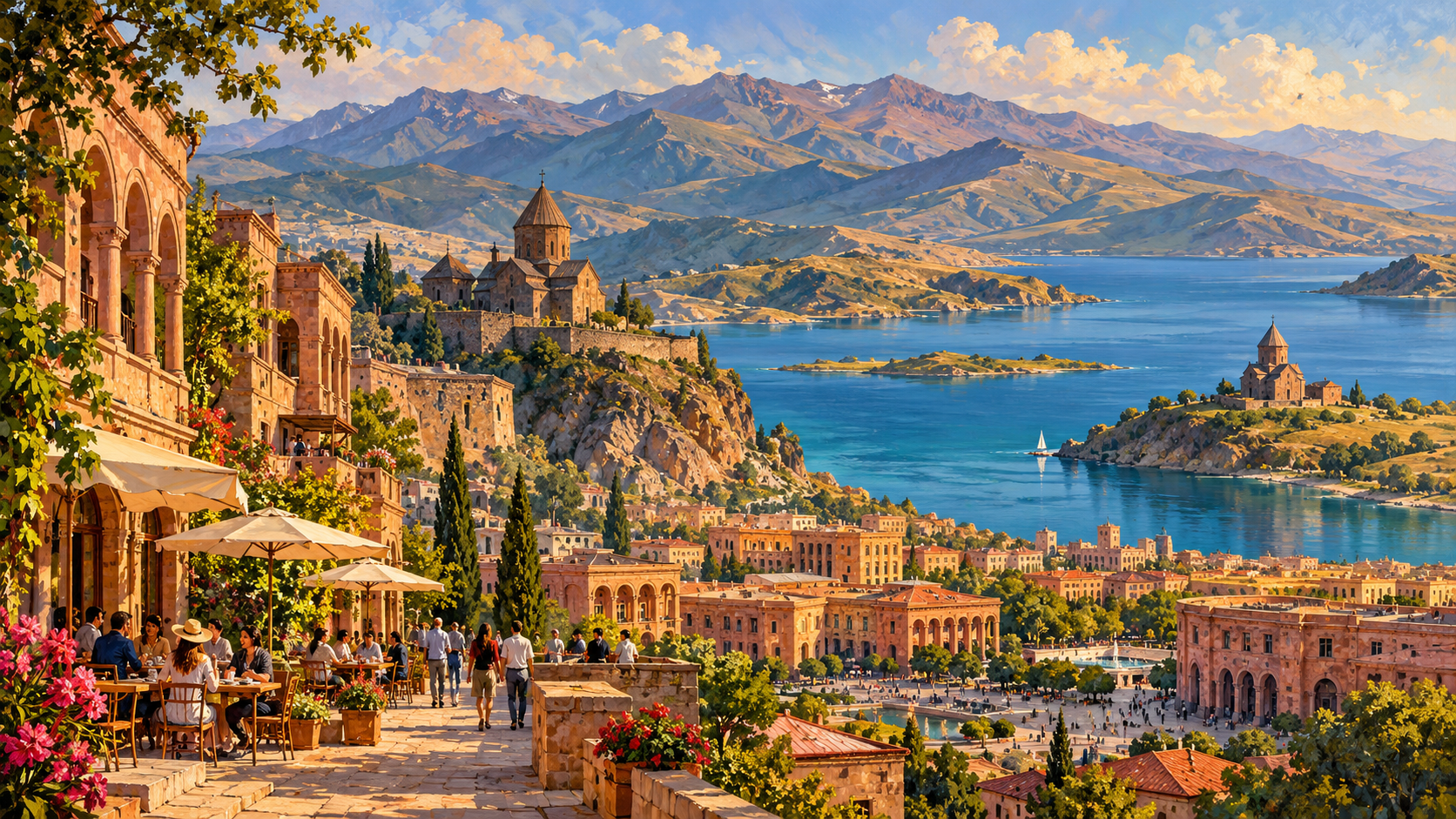
Cover illustration: an original artistic interpretation of Armenian highlands, lake landscapes and city life, not a literal geographic view.
Choose your route through Armenia
- 1. Where is Armenia? A landlocked country in the South Caucasus
- 2. Mountains, Lake Sevan, water and climate
- 3. Population, language, alphabet and diaspora
- 4. Ancient kingdoms, Christianity and medieval cultural networks
- 5. The Armenian genocide, displacement and remembrance
- 6. Soviet Armenia, independence and post-Soviet change
- 7. Government, parliament and the constitution
- 8. Regions, Yerevan and the country beyond its capital
- 9. Economy, trade, services and technology
- 10. Agriculture, mining and energy: resources with responsibilities
- 11. Transport: how a landlocked country reaches the world
- 12. Electricity, energy security and water networks
- 13. Education: schools, universities and changing classrooms
- 14. Health services and the 2026 insurance reform
- 15. Language, manuscripts, literature and music
- 16. Food: bread, seasonality and regional traditions
- 17. Everyday culture, community life and sport
- 18. Heritage: what UNESCO has actually inscribed
- 19. Nature, Lake Sevan and biodiversity
- 20. International connections, diaspora and future choices
1. Where is Armenia? A landlocked country in the South Caucasus
Armenia is a landlocked country in the South Caucasus, between the Black Sea and the Caspian Sea but with a coastline on neither. Its neighbours are Georgia to the north, Azerbaijan to the east, Iran to the south and Türkiye to the west. Azerbaijan’s Nakhchivan exclave also borders Armenia to the southwest. The government gives the country’s area as 29,743 square kilometres. This is the present Republic of Armenia: historical maps of Armenian kingdoms describe different territories and periods. Government geographical information.
Regional labels answer different questions. “South Caucasus” locates Armenia alongside Georgia and Azerbaijan south of the Greater Caucasus. The United Nations M49 statistical system places it in Western Asia. Cultural, sporting and diplomatic organisations sometimes group Armenia with Europe. These classifications need not contradict one another: a statistical region, a physical landscape and a political association are different kinds of geography. Armenia is not a member of the European Union merely because it participates in European institutions. UN regional classification.
Landlocked geography makes connections important. A producer exporting fruit needs roads, inspection facilities, refrigeration and access through another country before a shipment can reach an overseas port. A software business may send its product digitally, but still needs reliable electricity, international payments and access to skilled workers. Consequently, Armenia’s geography affects different industries in different ways. Mountain distances, freight costs and diplomatic relations can matter as much as distance measured across a map.
Borders also require political precision. Nagorno-Karabakh is internationally recognised as part of Azerbaijan; it is not an Armenian province. Decades of conflict caused displacement and suffering among both Armenian and Azerbaijani communities. Recognising the internationally accepted territorial framework does not erase individuals’ rights, homes, cultural heritage or experiences of violence. Background on the conflict and international court proceedings.
On 8 August 2025, the two foreign ministers initialed a peace agreement in Washington. The Armenian foreign ministry’s bilateral-relations page, checked for this guide on 19 October 2026, continues to describe that agreement as initialed and says diplomatic relations have not been established. Initialing a text is a significant diplomatic step, but it should not be confused with completion of ratification or every border-delimitation task. An August 2026 joint statement reported the lifting of Azerbaijani transit restrictions and close to 60,000 tonnes of goods transported to and from Armenia through Azerbaijan. That freight development does not establish general passenger access or the completion of every proposed route. Official bilateral status; August 2026 joint statement.
2. Mountains, Lake Sevan, water and climate
Armenia’s relief is one of its defining features. The government gives an average elevation of about 1,800 metres, while Mount Aragats reaches 4,090 metres. Volcanic uplands, deep valleys, mountain basins and relatively limited lowland areas create sharply different local environments. A small country on a world map can therefore contain large differences in temperature, growing season and accessibility. Official elevation figures.
Aragats and Ararat are different mountains. Aragats is Armenia’s highest summit. Mount Ararat, whose snowy outline appears in many photographs taken from Yerevan and the Ararat plain, lies in present-day Türkiye. It has profound significance in Armenian cultural memory and symbolism, but visibility and cultural importance do not establish territorial jurisdiction. The Armenian tourism authority itself explains that Ararat is outside today’s national borders. Ararat’s landscape and cultural significance.
Lake Sevan is a major freshwater store and an essential part of Armenia’s water system. Its importance reaches beyond the lakeshore: water management connects the lake with irrigation, power generation, aquatic habitats and settlements downstream. Historical extraction lowered the lake, demonstrating that using a freshwater body as a supply reservoir can transform its ecology. Water level, water quality and the health of the catchment must be considered together. A fuller lake is not automatically a clean lake if polluted runoff continues to enter it. World Bank study of Lake Sevan.
Climate changes markedly with altitude. Lower valleys can experience hot, dry summers, while high mountain areas have much colder conditions and shorter growing seasons. Armenia’s national climate reporting describes a vertical sequence from relatively warm, dry environments to severe alpine climates. Snow stored at elevation and its seasonal melting influence water availability below. The timing of water can be as important as the annual total: an orchard needs moisture during particular stages of growth. Armenia’s national climate communication.
These connections explain why water, farming and energy cannot be planned separately. Saving irrigation water may reduce pressure on a river, but the result depends on whether the saved water remains in the system or supports additional cultivation. Similarly, hydropower supplies electricity while changing flows that ecosystems also need. The World Bank’s Armenia climate-and-development assessment treats food security, water security and energy transition as connected priorities. The practical challenge is to maintain livelihoods while preparing infrastructure and land management for changing conditions. Armenia climate and development assessment.
3. Population, language, alphabet and diaspora
Armenia’s 2022 census recorded a permanent population of 2,932,731, with a reference date of 13 October 2022. Its present-population count was 2,689,438. These numbers describe different census populations, rather than two rival answers to the same question. The permanent-population measure and the population physically present cannot be interchanged without changing the meaning. The government’s report on the census confirms the permanent total; the UN demographic tables identify the present-population total. Official census presentation; UN census table.
Neither figure is a live 2026 population estimate. Between censuses, statistical estimates incorporate births, deaths and migration and may later be revised. Armstat notes that its 2012–2022 population series was recalculated using the 2022 census results. This matters particularly in Armenia, where movement across borders can substantially affect housing, employment and public-service demand. Armstat population methodology and series.
Armenian is the state language. Its alphabet is a visible link between everyday communication and a long literary tradition. UNESCO dates Mesrop Mashtots’s creation of the alphabet to 405 CE and recognises Armenian letter art as living cultural heritage. Letters appear in manuscripts, calligraphy, stone carving, textiles and contemporary design. The alphabet therefore functions both as a writing system and as material for artistic expression; it is not simply a museum object. UNESCO on Armenian letter art.
A strong Armenian majority does not mean that every resident has the same language, religion or identity. Yezidi, Assyrian, Russian, Kurdish and other minority communities form part of the country’s social fabric. Council of Europe monitoring discusses the protection and teaching of minority languages, including the challenge of turning formal recognition into accessible education. A national portrait should include these communities without treating them as decorative exceptions to an otherwise uniform society. Minority-language monitoring.
The Armenian diaspora is not included automatically in Armenia’s resident population. Communities abroad have different migration histories, citizenships and relationships with the republic. Some families trace displacement to the genocide; others moved for work, education or later political upheavals. The September 2023 arrival of over 100,000 refugees from Nagorno-Karabakh created another, distinct displacement experience. UNHCR documents the resulting need for accommodation, services and longer-term inclusion. Shared Armenian identity does not remove the practical work of rebuilding a household after losing a home. UNHCR Armenia factsheet.
4. Ancient kingdoms, Christianity and medieval cultural networks
Armenia’s history extends far beyond the borders and institutions of the present republic. Archaeology in and around Yerevan reveals successive settlements and political worlds. The Urartian fortress of Erebuni is conventionally dated to 782 BCE from an inscription associated with King Argishti I. This is an important anchor for the city’s historical identity, although a fortress foundation should not be mistaken for a complete description of every later settlement on the site. Yerevan municipality’s historical account.
Ancient Armenian kingdoms subsequently occupied an important position among larger imperial powers. Tigranes II, known as Tigranes the Great, ruled in the first century BCE; coins bearing his portrait preserve evidence of royal representation and connections with the wider Hellenistic world. A coin can reveal names, symbols, titles and economic exchange, while its discovery context adds another layer of information. Such objects are evidence for a particular period, not a map of modern political entitlement. Central Bank history of Armenian coinage.
Armenia’s adoption of Christianity is traditionally dated to 301 CE, associated with King Tiridates III and Gregory the Illuminator. The broader historical description is an early-fourth-century conversion of the kingdom; traditional anniversary dates and the chronology debated by historians should not be confused. The Metropolitan Museum’s account places the development of Armenian Christian culture within that fourth-century setting. Religious change reshaped institutions, patronage, buildings and writing over time rather than replacing every earlier practice overnight. Armenia’s traditional date; The Met’s historical framing.
Medieval monasteries were centres of scholarship as well as worship. Haghpat and Sanahin, now a UNESCO World Heritage property, demonstrate the sophistication of Armenian ecclesiastical architecture. Their churches and associated spaces belong to a wider landscape of learning, manuscript production, patronage and exchange. Stone construction, carved surfaces and carefully arranged interior space made religious ideas physically visible. UNESCO: Haghpat and Sanahin.
Armenian cultural life also flourished beyond the present country, including in Cilicia and major trading centres. The Met documents Armenian communities linking religious institutions with commerce across the Ottoman and Safavid worlds. Manuscripts, textiles and printed books moved with people and ideas. This helps explain how Armenian identity could persist across changing political boundaries: churches, schools, merchants and families sustained networks that no single state contained. A history of Armenia is therefore simultaneously a history of territory and of communities connected across territories. Armenian art, religion and trade.
5. The Armenian genocide, displacement and remembrance
The Armenian genocide is central to modern Armenian history. During the First World War, Ottoman authorities organised the deportation and mass killing of Armenian Christians and imposed conditions intended to cause widespread death. The United States Holocaust Memorial Museum identifies the central period as spring 1915 to autumn 1916 and estimates that between 664,000 and 1.2 million Armenians died. Estimates differ with the geographical and chronological scope and the evidence used; this museum’s range should not be presented as a precise census of the dead. United States Holocaust Memorial Museum overview.
The persecution targeted people as members of a community. Deportation did not simply mean changing a household’s address: removal from homes, destruction of livelihoods and exposure to killing and lethal conditions broke the structures that made ordinary life possible. The museum’s detailed account describes the arrest of Armenian leaders in Constantinople on 24 April 1915, followed by deportations and mass violence. That date became the principal day of commemoration. The wartime setting helps explain the opportunity and machinery of persecution; it does not justify it. Historical account of the genocide.
Survival and forced dispersal shaped families far beyond the Ottoman Empire. The genocide is an essential part of diaspora history, but it is not the only explanation for Armenian communities abroad: medieval trade networks and later migration also matter. A family history may combine several movements, different languages and more than one citizenship. For this reason, “Armenian diaspora” describes many communities rather than a single organisation with one political view.
Remembrance has a physical centre at Tsitsernakaberd in Yerevan. The memorial opened in 1967; the Armenian Genocide Museum-Institute opened in 1995. The complex connects public mourning with exhibitions, research and the preservation of testimony. Its annual commemoration on 24 April gives families and visitors a place to recognise loss across generations. The memorial’s date is also a reminder that public memory itself has a history, shaped by institutions and the political conditions in which people can speak. Memorial and museum history.
For students, responsible study means keeping victims visible as people who had occupations, schools, homes and relationships before persecution. It also means distinguishing historical evidence from inherited stereotypes. Responsibility for Ottoman-era policy should be explained through the institutions and perpetrators involved, without assigning collective guilt to people living today. Learning about genocide should deepen attention to human rights and evidence, rather than turn present populations into simplified enemies.
6. Soviet Armenia, independence and post-Soviet change
The first modern Armenian republic existed from 1918 to 1920. Sovietisation followed in late 1920; Armenia subsequently entered the Soviet Union through the Transcaucasian federation and became a separate Soviet republic in 1936. These changes placed Armenia within a centrally directed political and economic system. The United States Office of the Historian distinguishes this short-lived first republic from the independent state recognised after the Soviet Union’s dissolution in 1991. Historical chronology.
The Soviet period left an enduring built environment and institutional inheritance. Industrial facilities, public buildings, housing districts and educational institutions became part of the landscape that independent Armenia would later use, adapt or replace. The History Museum of Armenia presents this period through documents, photographs, personal objects and the development of the economy and culture. Such evidence supports a fuller picture than either uncritical nostalgia or the assumption that nothing valuable existed under an authoritarian system. History Museum’s Soviet Armenia collection.
Independence was a sequence of political steps. The declaration of independence was adopted on 23 August 1990. A referendum followed on 21 September 1991, the date now celebrated as Independence Day. These events belong to the wider collapse of the Soviet Union, but Armenian state-building also had its own institutions, decisions and public participation. The republic then needed to conduct foreign relations, manage its budget and establish economic rules as a sovereign state. Government independence chronology.
Economic transition was difficult. The energy crisis of the early and mid-1990s affected daily life and production, while the loss of former supply arrangements made infrastructure reliability a national priority. The International Energy Agency describes subsequent investment and restructuring that improved electricity and gas services. This history explains why debates about power generation are not abstract: households and businesses remember the consequences when basic systems fail. IEA on the post-Soviet energy transition.
Post-Soviet politics has also involved arguments about representation, accountability and the distribution of economic opportunities. The peaceful protest movement of 2018 brought Nikol Pashinyan to the premiership. Political change, however, should not be treated as a single event that automatically resolves every institutional problem. Elections, courts, budgets and the daily conduct of officials determine how constitutional promises become lived experience. Official prime-ministerial biography.
The conflict with Azerbaijan has repeatedly affected this transition. The 2023 displacement from Nagorno-Karabakh added urgent housing and integration needs to longer-term development challenges. It is important to keep that event distinct from the 1915 genocide and from earlier rounds of displacement, even when family experiences and public memory connect them. Different events require their own chronology, sources and legal analysis.
7. Government, parliament and the constitution
Armenia operates a parliamentary system. The government, led by the prime minister, carries executive responsibility; the president is head of state with constitutionally defined functions. Official websites checked on 19 October 2026 identify Nikol Pashinyan as prime minister and Vahagn Khachaturyan as president. These names are a dated snapshot, whereas the distinction between the two offices explains the system more durably. Prime Minister’s Office; President’s Office.
The constitution provides for a unicameral National Assembly, meaning a parliament with one chamber. It adopts legislation and the state budget and supervises the executive. The constitutional framework provides for at least 101 deputies, proportional elections and a five-year parliamentary term. The president is elected by the National Assembly for a seven-year term. The prime minister’s position depends on the parliamentary framework rather than a separate nationwide presidential-style election. Constitutional provisions.
These arrangements distribute different responsibilities. Parliament can debate a spending proposal, but ministries administer the programmes funded by the budget. Courts decide cases within their jurisdiction, while local self-government deals with matters closer to residents. Constitutional rights and formal procedures are essential, yet their effectiveness also depends on administrative capacity, access to remedies and officials following the rules in practice.
Armenia’s first post-independence constitution was adopted in 1995 and underwent major referendum amendments in 2005 and 2015. The 2015 changes underpin the parliamentary model. The dates matter because an older description of a powerful elected presidency may describe an earlier constitutional arrangement rather than the present one. A country can retain the same official name while changing how executive power is organised.
Foreign policy also passes through legal institutions. The peace text published in August 2025 recognises each country’s sovereignty and territorial integrity and provides for further negotiations on delimitation and demarcation. Its entry-into-force clause requires completion of domestic procedures and an exchange of notifications. The published document therefore cannot support a claim that initialing alone settled every issue. A separate Armenia–United States TRIPP framework signed in June 2026 likewise has its own domestic procedures; it is not proof that the bilateral Armenia–Azerbaijan agreement has entered into force. Published peace text; TRIPP framework announcement.
8. Regions, Yerevan and the country beyond its capital
Armenia is divided into ten marzes, or regions, plus Yerevan, which has a separate local-government framework. The regions are Aragatsotn, Ararat, Armavir, Gegharkunik, Lori, Kotayk, Shirak, Syunik, Tavush and Vayots Dzor. Regional administrations and municipalities are not identical institutions: governors implement national regional policy, while local self-government has its own responsibilities. Government regional overview.
Yerevan is the capital and a major centre of administration, education, business and cultural life. Its historical layers include archaeological sites, the planned city of the Soviet period and later redevelopment. The Erebuni Museum’s collections include material from Urartian, Achaemenid, Hellenistic and early Armenian contexts. They make the capital’s long history visible through evidence rather than relying only on anniversary slogans. Yerevan museum collections.
The regional map reveals several different Armenias within one country. Aragatsotn rises around the slopes of Aragats, while Ararat and Armavir include important agricultural parts of the Ararat plain. Gegharkunik contains Lake Sevan and its surrounding settlements. Lori includes the monastic landscapes of Haghpat and Sanahin; its valleys offer a different setting from the open uplands. These physical contrasts help explain why a policy appropriate to one locality may not suit another.
Cities outside the capital matter to national development. Gyumri in Shirak and Vanadzor in Lori are important regional urban centres. Smaller towns support surrounding villages through markets, services and administration. A family’s access to a school, hospital or employer depends on the relationship between its settlement and these centres, not simply on whether the country has such facilities somewhere. Mountain roads and winter conditions can turn a modest map distance into a substantial daily journey.
Regional development therefore involves more than distributing tourist attractions. It asks whether people can find useful work close to home, whether infrastructure is maintained and whether young adults have realistic options outside the capital. Concentrating specialised services can bring benefits, but it also creates travel costs and pressure on housing where opportunities cluster. Good public planning must weigh both effects.
Yerevan’s cultural institutions provide another way to understand the relationship between centre and regions. The Matenadaran preserves manuscripts representing many places and periods, rather than only the city where it stands. UNESCO’s description emphasises the breadth of the collection across Armenian science and culture. A national institution can therefore hold evidence of a much wider historical network, including communities located beyond today’s borders. UNESCO on the Matenadaran collection.
9. Economy, trade, services and technology
Armenia’s economy combines services, construction, manufacturing, agriculture and mining. Official reporting recorded real GDP growth of 5.9% in 2024. A June 2026 National Assembly account of the central bank’s annual report states that growth reached 7.2% in 2025. These are dated annual growth rates, not predictions for 2026 and not measures of how much every household’s income increased. 2024 official growth announcement; Central bank’s 2025 results presented to parliament.
GDP measures production across the economy. Real growth adjusts for price changes, while nominal output is measured at current prices. A rising average can coexist with uneven experiences between sectors, places and households. Construction may provide jobs in one city while a rural producer faces a poor harvest. For a useful national picture, output growth should be considered alongside employment, productivity, living costs and access to services.
Services cover a broad range of work: retail, transport, accommodation, finance, professional activity and digital products, among others. Armenia’s technology activity is important because some services can reach foreign customers without transporting a physical product across mountain borders. However, digital trade still depends on infrastructure, trained workers, contracts and payment systems. The central bank’s 2025 analysis tracks exports of productive services, including information and communication technology, illustrating the role of this part of the economy. Central bank analysis of services exports.
Merchandise trade requires another distinction: an export may be produced domestically or may be a re-export of an imported good. The central bank’s February 2025 outlook separately examines trade linked to gold and re-export activity. Large changes in gross trade values should therefore not automatically be interpreted as equivalent changes in domestic factories or mines. The value added inside Armenia is a different concept from the total customs value of goods crossing its borders. Central bank trade analysis.
For long-term prosperity, the key question is how firms become more productive and resilient. A food processor may need refrigeration and consistent packaging; a technology firm may need engineers and access to international customers. A small manufacturer may need predictable delivery times. These are different business problems, yet they share a need for reliable institutions and infrastructure. Armenia’s investment in skills and connectivity matters because a small domestic market makes access to wider markets especially valuable.
An expanding economy also creates policy choices. Governments need to finance public services without assuming that unusually strong growth will continue indefinitely. Firms need to assess whether demand reflects a durable customer base or a temporary change in regional flows. Separating growth, trade turnover and household welfare makes it easier to understand both Armenia’s opportunities and its exposure to external shocks.
10. Agriculture, mining and energy: resources with responsibilities
Agriculture connects Armenian landscapes with food, rural livelihoods and cultural traditions. Orchards, vineyards and livestock activity depend on suitable land, water and access to markets. FAO’s work in Armenia includes conserving grape and apricot genetic resources, an important reminder that agricultural diversity is a productive asset. Preserving varieties can maintain options for future breeding and adaptation, rather than treating every farm as interchangeable. FAO’s Armenian agricultural programmes.
Irrigation is particularly important in the Ararat and Armavir farming areas. Modern equipment can improve delivery, but adopting it requires investment, maintenance and appropriate management. FAO’s AgriTech Observatory describes a project supporting smallholders, higher-value crops and modern irrigation in those regions. Productivity is not simply a matter of using more water: timing, soil conditions, storage, crop choice and the price received at market all influence whether a farm is viable. Irrigation and agricultural development.
Mining provides another economic resource. Armenia produces copper, molybdenum, gold and other metals. EITI reporting supports transparency about production, revenue and company ownership, while documenting environmental obligations. A mineral deposit becomes economically useful only through extraction, processing, transport and sale; each stage brings costs and responsibilities. Tailings management, water protection, worker safety and eventual rehabilitation belong in the assessment from the beginning. Export earnings alone cannot show whether a project’s benefits and burdens are fairly distributed. EITI Armenia overview and validation.
Energy presents a different resource balance. Armenia imports the fossil fuels it uses, while electricity generation draws on gas, nuclear power, hydropower and growing renewable capacity. The IEA’s 2023 profile reports that in 2021 generation totalled 7.7 terawatt-hours: 44% came from natural gas, 30% from hydro and other renewables, and 26% from nuclear. These figures are a historical baseline, not a claim about the 2026 generation mix. IEA’s dated energy profile.
Each energy option involves a different set of requirements. Gas relies on imported fuel and produces emissions. Nuclear power provides substantial generation but requires stringent safety, fuel supply, waste management and long-term investment. Hydropower depends on water availability and appropriate river management. Solar can reduce fuel imports, but its variable output makes grid operation and complementary capacity important. Energy efficiency lowers the amount of supply needed to provide the same useful service. Armenia’s challenge is to combine these tools into a dependable system while protecting the environments and communities on which economic life depends.
11. Transport: how a landlocked country reaches the world
Armenia’s transport geography is shaped by both mountains and borders. A short straight-line distance can involve a long climb, a river valley detour or an international crossing that is unavailable. For a landlocked country, access to a foreign port also depends on roads, railways, customs procedures and relations with neighbours. Georgia supplies the main northern overland connection, including onward access to the Black Sea, while the southern road through Syunik connects with Iran. These are different gateways, with different terrain and onward markets.
Border status must be separated from diplomatic announcements. At the 19 October 2026 research check, official British travel advice continued to describe the land borders with Azerbaijan and Türkiye as closed for ordinary crossings. It separately confirmed scheduled Yerevan–Istanbul flights. Thus, an airline connection does not mean a road crossing is available. The advice also identifies restrictions near Armenia’s eastern border and on the M16/H26 section between Ijevan and Noyemberyan; a map showing a road is not evidence that it is a suitable through-route. Official border and regional travel information.
The freight-transit progress described in chapter 1 does not establish ordinary passenger-crossing access. Trade rules can change before physical crossings open. In May 2026 Armenia welcomed Türkiye’s removal of restrictions on bilateral trade, but its Foreign Ministry explicitly described opening the border and establishing diplomatic relations as further steps. This is a useful distinction for students of trade: permission to name a country as the origin or destination of goods, the route those goods physically take, and permission for people to cross a border are separate matters. Armenian Foreign Ministry trade statement.
An operating railway provides a more concrete example. South Caucasus Railway publishes a Yerevan–Tbilisi overnight timetable for 2 October 2026 to 13 June 2027, through Armavir, Gyumri, Vanadzor and the Ayrum–Sadakhlo border crossing. Its summer 2026 Yerevan–Batumi service had a separate season ending on 1 October. These timetables should not be combined into a claim that Batumi trains operate year-round. Nor do they establish passenger rail services to Iran, Türkiye or Azerbaijan. South Caucasus Railway routes. Railway summer 2026 announcement.
For air travel, Zvartnots serves Yerevan and is the country’s principal international gateway; Shirak serves Gyumri. The airport operator’s flight information links Armenia with destinations including Moscow, Tbilisi, Tehran and Abu Dhabi, although routes and frequencies change. Aviation connects tourism, business and diaspora visits with a country whose land routes remain constrained. For exporters, the practical comparison is between air freight’s speed and the cost, capacity and border reliability of surface transport. Zvartnots airport operator. Airport flight information.
12. Electricity, energy security and water networks
Armenia’s energy system illustrates the difference between generating electricity at home and being independent of imported fuel. Gas-fired stations, nuclear generation and hydropower all contribute to electricity supply. Natural gas and oil products are imported, while nuclear generation also requires an external fuel supply. Hydropower and solar use local renewable resources, but their output follows water availability and sunshine. A varied electricity mix therefore reduces some risks without removing every dependency. IEA Armenia energy policy review.
The International Energy Agency describes Russian gas reaching Armenia through Georgia and an arrangement exchanging Iranian gas for Armenian electricity. These links make cross-border infrastructure part of everyday life: a pipeline disruption affects heating and generation, while an electricity interconnector helps support exchanges. Energy security includes the reliability of imported fuel, the condition of power stations and networks, and the ability to keep supplies affordable. A generation percentage should always carry a year because maintenance and rainfall can substantially change the annual mix. IEA energy profile.
The Armenian Nuclear Power Plant near Metsamor is a particularly consequential asset. Its existing reactor provides firm generation that does not depend on a sunny afternoon or the timing of snowmelt. Extending an ageing plant and choosing replacement capacity involve different decisions: engineering inspection, safety regulation, financing, fuel arrangements and construction schedules. The IEA identifies continued nuclear operation and eventual replacement as strategic policy questions. A proposed new reactor should never be counted as generating capacity before commissioning. IEA on nuclear fuel and diversification.
Solar development offers another path, particularly where it can reduce daytime demand on imported-fuel generation. The IEA’s policy review records a 2030 ambition for much more solar capacity; that is a target, rather than proof the capacity already exists. More solar also increases the value of flexible generation, stronger networks, forecasting and demand management. Hydropower has similar system-wide connections: using river water to produce electricity must be considered alongside irrigation and ecological requirements.
Water supply is infrastructure as well as geography. In June 2025 the World Bank approved the first phase of a programme to improve drinking-water and irrigation services in rural and underserved settlements. Its focus shows why abundant mountain water does not automatically mean every household receives dependable service. Pipes, pumping, storage, leakage control and maintenance determine what reaches a home or farm. Irrigation timing matters especially when crop demand is high and river flows are under pressure. World Bank water and irrigation programme.
Earlier Asian Development Bank work repaired water and sanitation systems in Armenian towns and villages, addressing the inherited condition of networks. Electricity and water policy meet at the household scale: pumps consume power, hot water needs energy, and efficient buildings reduce winter heating demand. The useful measure of development is therefore not simply the number of dams, pipelines or treatment plants, but reliable services, sustainable water use and manageable bills. ADB water-supply and sanitation project.
13. Education: schools, universities and changing classrooms
Armenia’s twelve-year general education pathway has a 4–5–3 structure: four years of primary school (grades 1–4), five of middle school (grades 5–9), and three of high school (grades 10–12). Education Ministry school-stage guide. Primary learning, middle-school subject study and upper-secondary preparation serve different purposes: building literacy and numeracy, broadening knowledge, then preparing for further study or vocational choices. The World Bank describes the shift to twelve years beginning in the 2006–07 school year. More years in school are valuable only when pupils gain stronger knowledge and the confidence to use it, which helps explain the emphasis on curriculum reform. World Bank education assessment.
The Ministry of Education, Science, Culture and Sports describes a phased introduction of new standards, subject programmes and textbooks. Its 2025 report identifies further grades entering the new approach in the 2025–26 academic year, alongside teacher development and changes to learning conditions. Reform here means more than changing the contents page of a textbook: teachers need materials, professional support and ways to assess whether children can apply concepts. Education Ministry general-education report.
The Tavush curriculum pilot provides evidence rather than just an aspiration. A World Bank evaluation released in 2024 found gains in mathematics and science equivalent to about six months of additional learning after a two-year pilot. That finding concerns the evaluated programme and pupils; it should not be presented as a result already achieved by every Armenian school. The important lesson is that curriculum changes can be tested, measured and improved before wider implementation. World Bank curriculum-pilot findings.
Access remains as important as academic content. UNICEF’s Armenia education programme focuses on inclusive schools, support for children with disabilities and better identification of pupils at risk of dropping out. An accessible entrance alone cannot make a school inclusive: appropriate teaching, specialist support and participation with classmates also matter. Rural travel distances, family resources and displacement can influence whether a child can use an educational opportunity in practice. UNICEF Armenia education.
Higher education combines longstanding public institutions with newer international models. Yerevan State University traces its founding law to 1919 and its initial opening to Alexandropol, now Gyumri, in 1920. The American University of Armenia opened in 1991 with Armenian, diaspora and University of California support. Their histories demonstrate that Armenian universities are connected both to state-building and to educational networks beyond the country. Yerevan State University history. American University of Armenia history.
Learning also takes place outside formal school. TUMO offers teenagers free technology and design education through self-directed activities, workshops and project laboratories. Its Armenian hubs and smaller TUMO Boxes are designed to extend access beyond central Yerevan. Such provision complements school rather than replacing the foundations taught there: a programming project still depends on careful reading, mathematical reasoning, teamwork and the willingness to revise unsuccessful work. TUMO educational model.
14. Health services and the 2026 insurance reform
Armenia’s healthcare story combines clinical capacity with a difficult financing question: can people obtain care when they need it without a damaging household bill? Primary care, hospital treatment and medicines do not necessarily have the same funding arrangements. The European Observatory’s 2024 assessment described population-wide primary-care coverage within the basic benefits package, but more limited hospital and outpatient medicine coverage and substantial out-of-pocket payments. Those findings describe the pre-reform baseline, rather than the complete rules in force today. WHO European Observatory health-system assessment.
The chronology changed in 2026. On 25 December 2025 the government announced implementing decisions for the first stage of universal health insurance, effective from 1 January 2026. The decisions covered the insured package, reimbursement arrangements, contracts with medical centres and pharmacies, and creation of a Health Insurance Fund. An atlas updated in October 2026 should therefore describe a launched, phased reform, not merely a proposal for some future year. Government insurance launch decisions.
The Health Ministry’s 30 June 2026 review of the system’s first six months provides further evidence of implementation. Nevertheless, the term “universal” names the reform’s direction and should not be read as a promise that every service is immediately free for every person. Eligibility, covered services, referral requirements, provider contracts and possible co-payments determine the actual entitlement. Anyone seeking treatment needs current guidance from the fund or health authorities, rather than an assumed benefit inferred from the reform’s name. Health Ministry six-month implementation review.
Financial protection is only one part of access. The 2024 Observatory assessment also identifies health-worker shortages, especially nursing. This creates a useful distinction between an entitlement on paper and the practical capacity to deliver it. A clinic needs trained staff, suitable equipment, supplies, reliable referrals and enough consultation time. Strengthening services outside the capital can reduce the cost and disruption of travelling for routine care, while specialised treatment may still require larger hospitals.
Prevention and continuity of care are central to the next stage. WHO’s October 2026 account describes work on primary care, tobacco control, rehabilitation, immunisation, mental health and emergency preparedness. Its report also records assistance during the 2023 refugee response, including mobile services and training for doctors and nurses. The healthcare system must therefore support both long-term conditions and sudden humanitarian pressures, with attention to host communities as well as displaced people. WHO Armenia October 2026 assessment.
To judge the reform fairly, follow several outcomes together: whether people can reach care, whether treatment is clinically effective, whether medicine costs become manageable, and whether fewer households delay necessary treatment. Insurance enrolment is an important step, but patient experience and financial protection reveal whether the new arrangements deliver their intended benefit.
15. Language, manuscripts, literature and music
Armenian gives the country a distinctive written landscape, from street signs and textbooks to church inscriptions and digital screens. Its alphabet is associated with Mesrop Mashtots and the early fifth century. UNESCO’s account of Armenian letter art dates its creation to 405 and explains how letters became decorative forms as well as tools for recording language. Bird-shaped, interlaced and other ornamental letters connect writing with carving, embroidery, jewellery and contemporary design. UNESCO Armenian letter art.
This connection between script and cultural continuity is visible at the Matenadaran in Yerevan. The Mesrop Mashtots Research Institute of Ancient Manuscripts preserves manuscripts, fragments and related materials, while its specialists catalogue and study them. A manuscript repository is more than a collection of beautiful pages. Texts and marginal notes can reveal translation, scholarship, patronage, travel and the practical work of copying books before printing was widespread. Matenadaran manuscript depository. Matenadaran main catalogue.
Literature is encountered through places as well as printed texts. Hovhannes Tumanyan’s house-museum in Dsegh links a major Armenian poet and storyteller with the village landscape of Lori. Reading a story, visiting its author’s home and listening to an oral performance offer different routes into cultural memory. They help explain why a writer’s name can recur in schools, theatres and public spaces: literary figures become reference points shared across generations. Tumanyan house-museum in Dsegh.
Music has similarly varied forms. Komitas collected and transcribed folk songs, helping preserve traditions associated with village life. Aram Khachaturian brought Armenian-associated musical ideas into internationally performed concert and ballet music, while contemporary performers such as Tigran Hamasyan work across folk, jazz and other genres. Yerevan’s opera house, concert halls and clubs illustrate that national culture is continually performed and reinterpreted rather than confined to an ancient past. Armenia Tourism Committee music guide.
The duduk is the best-known Armenian wind instrument internationally, and UNESCO inscribed “Duduk and its music” on its Representative List in 2008. That designation concerns a living musical practice, not a World Heritage monument. Its expressive sound is often associated with reflective music, but reducing an entire musical culture to a single melancholy instrument misses ceremonial, dance, religious and contemporary repertoires. UNESCO duduk inscription.
The kamancha, a bowed string instrument played upright, is associated with the eighteenth-century poet-musician Sayat-Nova. It also belongs to a wider regional musical world. Armenia’s traditions are distinctive without having developed in isolation: instruments, performers and musical ideas move between neighbouring societies. The most informative listening exercise is to compare a folk-song arrangement, a duduk performance and a modern ensemble, then identify what changes in rhythm, timbre and setting. Tourism Committee traditional instruments.
16. Food: bread, seasonality and regional traditions
Armenian cooking connects grain, dairy, herbs, fruit and preserved ingredients with the rhythms of household and community life. Geography matters: a highland winter encourages storage, while summer brings fresh vegetables and greens. A national dish is best understood as a family of practices rather than a single compulsory recipe. Households adapt ingredients, religious calendars, available time and inherited regional preferences, and people who migrate carry those practices into new kitchens.
Lavash is an especially clear example. UNESCO’s 2014 inscription concerns the preparation, meaning and appearance of this traditional bread as an expression of culture in Armenia. The significance includes knowledge shared between bakers and the social uses of bread, rather than simply the finished sheet of flatbread. Recognising the Armenian practice does not erase related breads or baking traditions elsewhere in the region. UNESCO lavash cultural practice.
Tolma can involve grape leaves, cabbage leaves or vegetables wrapped or filled around a seasoned mixture. Harissa combines wheat and meat in a slowly cooked dish whose preparation can bring people together. Ghapama turns a pumpkin filled with rice, dried fruit and other additions into a festive centrepiece. The Tourism Committee’s food guide also describes khorovats, grilled food associated with gatherings, and khash, a long-simmered broth commonly eaten in cold weather. Tourism Committee Armenian dishes.
Regional detail makes the food map more interesting. The same guide associates panrkhash, built around cheese and lavash, with Shirak, and describes herb-filled zhingyalov hats in connection with Syunik and the traditions of Armenians from Nagorno-Karabakh. In the latter case, a culinary association describes people’s heritage; it is not a statement about present territorial sovereignty. Displaced families can preserve and adapt food traditions wherever they now live.
Winter cooking offers a second way to read the menu. A long-cooked grain dish, a stuffed pumpkin and a sweet pastry all use stored ingredients differently. Armenia’s winter-food guide highlights harissa, ghapama and gata, showing how substantial meals and shared preparation fit the colder season. Comparing these dishes with fresh summer herbs helps explain why preservation, drying and baking remain important even when modern supermarkets offer year-round supplies. Tourism Committee winter foods.
Food is also a useful entry point into respectful cultural comparison. Similar stuffed vegetables, grilled meats and dairy preparations occur across several neighbouring cuisines. Students can compare ingredients and techniques without turning culinary history into a contest over exclusive ownership. Within Armenia itself, the differences between a restaurant presentation, a family recipe and a village celebration are worth noticing. Asking who prepares a dish, when it is eaten and how its ingredients are obtained often teaches more than memorising a list of national foods.
17. Everyday culture, community life and sport
Everyday Armenia is lived in city neighbourhoods, regional towns and villages, not only at famous monuments. Yerevan’s museums, cafés, markets and performance venues form a public cultural landscape in which residents study, work and meet. A visitor’s experience of central Yerevan is therefore one part of the country rather than a complete portrait. Gyumri, smaller towns and agricultural communities have their own institutions, travel distances and seasonal routines. Tourism Committee Yerevan guide.
Kochari offers a concrete example of participation across generations. UNESCO describes this group dance as part of holidays, family ceremonies and other social events, transmitted through families, community groups and organised teaching. Its 2017 inscription recognises a living practice that people learn by joining others. The social meaning is found in coordinated movement and shared participation, not only in a polished performance watched from a theatre seat. UNESCO Kochari group dance.
Chess has a distinctive institutional place. FIDE records that Armenia introduced compulsory chess lessons for second-, third- and fourth-grade pupils in 2011. This makes chess familiar as a classroom activity as well as a competitive pursuit. It is important to describe the grades accurately: the policy does not mean every pupil plays chess in every school year. The teaching goal also differs from selecting future grandmasters; classroom activities can focus on observing a position, considering alternatives and explaining a choice. FIDE on Armenian school chess.
The connection between local learning and international competition remained visible in 2026, when Tsaghkadzor hosted the European stage of the World Schools Team Championship. FIDE’s account describes school teams from multiple countries gathering there. Such events place Armenia within international youth networks and show how a small country can acquire a recognisable sporting identity through sustained teaching and organisation. FIDE 2026 Tsaghkadzor school championship.
Physical sport provides another source of public recognition. Artur Aleksanyan’s gold medal in the men’s Greco-Roman wrestling competition at Rio 2016 is documented in the official Olympic results. His achievement is an example of success built around specialised coaching and individual discipline. Sporting identity, however, includes ordinary participation as well as medals: the ability of children and adults to use facilities matters alongside the performance of elite athletes. Rio 2016 official wrestling results.
Community life also includes young people making films, coding, designing and performing. TUMO’s free programme for teenagers illustrates a meeting place organised around shared interests and creative work. Reading dance, chess, sport and technology together avoids a false choice between “traditional” and “modern” Armenia. The same young person can learn a group dance, study a chess position and build a digital project, with each activity creating a different kind of connection. TUMO participation and access.
18. Heritage: what UNESCO has actually inscribed
Armenia has three properties on UNESCO’s World Heritage List, all cultural, at the October 2026 check. The count refers to listed properties, some of which contain several monuments; it is not a count of every church, building or heritage practice. Keeping this distinction clear prevents the common mistake of describing every famous Armenian monastery as a UNESCO World Heritage Site. UNESCO Armenia country listing.
The Monasteries of Haghpat and Sanahin in northern Armenia form one property. Haghpat was inscribed in 1996 and Sanahin added in 2000. UNESCO highlights the monasteries’ religious and educational roles and their architectural achievement. Their importance is therefore more than picturesque stonework: monastic complexes could bring worship, learning, manuscripts and patronage together within a larger regional society. UNESCO Haghpat and Sanahin.
The Cathedral and Churches of Echmiatsin and the Archaeological Site of Zvartnots form a second property, inscribed in 2000. This grouping connects an enduring religious centre with important stages in Armenian church architecture. The ruined remains of Zvartnots and the standing churches offer different kinds of evidence: archaeological interpretation reconstructs what no longer survives, while a functioning religious building also has present-day needs and users. UNESCO Echmiatsin and Zvartnots.
The Monastery of Geghard and the Upper Azat Valley make up the third property, also inscribed in 2000. Its architecture includes spaces cut into rock, giving the surrounding landscape a direct role in the construction and experience of the complex. Here the valley is part of the listed property’s meaning, rather than an interchangeable backdrop. Conservation consequently involves the relationship between buildings, rock, setting and visitors. UNESCO Geghard and Upper Azat Valley.
A tentative listing is a proposal stage, not World Heritage inscription. Armenia’s current tentative list includes Dvin, Yererouk, Noravank, Tatev and Tatevi Anapat, the Vishaps and Tirinkatar landscape, Garni and its basalt formation, the Urartian heritage of Yerevan, and Areni-1 Cave. The last was added in 2026. These places may be highly significant without yet holding the same formal status as the three inscribed properties. The correct wording is “on Armenia’s UNESCO Tentative List”.
Intangible heritage uses a different UNESCO convention and different lists. Lavash preparation, duduk music, Kochari and Armenian letter art concern skills, performance and transmission. They should not be added to the three World Heritage properties as though all belonged to a single category. This distinction helps explain two complementary forms of conservation: repairing a church can protect a structure, while teaching a dance or craft helps keep a practice alive. Both depend on the people who care for and use the heritage.
19. Nature, Lake Sevan and biodiversity
Armenia’s ecological variety is striking for a relatively small country. Mountain slopes, dry valleys, forests, grasslands and lakes create different habitats over short distances. Altitude and exposure affect temperatures, vegetation and the timing of seasonal change. A useful nature map therefore needs more than a single national label such as “mountainous”: it should show how water, terrain and climate produce a mosaic of living environments.
The four national parks provide clear reference points. Sevan protects the lake and surrounding areas; Dilijan is associated with forested mountain landscapes; Lake Arpi lies in the north-west; and Arevik occupies part of the southern Syunik landscape. The Tourism Committee describes Arevik’s mixture of forest, alpine meadow and semi-desert, with species including the Caucasian leopard and bezoar goat. These examples show why conservation cannot rely on protecting only the greenest-looking scenery. Tourism Committee national parks.
Sevan National Park was founded in 1978 to protect Lake Sevan and its surroundings. The park identifies endemic plants and other species of conservation concern, while the wider basin supports human settlements and economic activity. Endemic means naturally restricted to a particular area; it is not a synonym for common. A small habitat change can therefore matter greatly when a species has a limited natural range. Sevan National Park.
Lake Sevan must be understood as both an ecosystem and a managed water body. The World Bank’s climate assessment links water stress with irrigation demand and releases from the lake. Changes in rainfall, temperature, evaporation and water use interact, so protecting the lake is not just a question of choosing a desirable water level. The basin needs attention to water quality, demand, catchment conditions and the timing of inflows and withdrawals. World Bank Armenia climate assessment.
Wildlife conservation also involves places beyond national-park boundaries. Armenia’s official nature guide identifies Khosrov Forest State Reserve, mountain slopes, river valleys and wetland areas as settings for observing biodiversity. A park boundary can protect important habitat, but animals and ecological processes do not necessarily remain inside it. Responsible observation therefore includes avoiding disturbance, keeping to permitted routes and following the rules of the particular protected area. Tourism Committee nature and wildlife.
The wider climate challenge is closely tied to livelihoods. The World Bank’s Country Climate and Development Report identifies existing water stress, agricultural risks and flooding among Armenia’s adaptation concerns. Better irrigation, maintained drainage, resilient roads and healthy ecosystems serve people as well as conservation goals. In October 2026 this local-global connection gained international visibility as Yerevan hosted the Convention on Biological Diversity’s COP17, scheduled for 19–30 October. Hosting the meeting is a diplomatic role; its final decisions were not yet known at this article’s 19 October check. World Bank climate and development report. Convention on Biological Diversity COP17.
20. International connections, diaspora and future choices
Armenia’s international position is shaped by neighbourhood geography, economic partnerships and a worldwide diaspora. These connections operate at different scales. A border agreement can change transport possibilities; a university partnership can connect researchers; a family abroad can support relatives or introduce a business contact. The diaspora should not be treated as a single institution with one political view. Its practical contribution includes many separate educational, professional, cultural and family networks.
One concrete institutional example is iGorts, the government programme bringing diaspora professionals into Armenian public institutions. The Office of the High Commissioner for Diaspora Affairs also describes work on repatriation, youth engagement and professional connections. Such programmes show how cross-border links can transfer knowledge as well as funds. Their value depends on matching experience with local needs and enabling cooperation with people already living and working in Armenia. Diaspora Affairs Office programme report.
The European Union relationship provides another example of formal cooperation. The Comprehensive and Enhanced Partnership Agreement entered into force on 1 March 2021 and covers a broad range of governance, economic and social fields. The EU’s May 2026 factsheet continues to identify CEPA as the basis of the relationship. A partnership agreement is not EU membership: readers should distinguish cooperation, domestic political aspirations and the formal stages required for joining an international organisation. EU CEPA entry into force. EU Armenia 2026 factsheet.
The separate Armenia–US TRIPP framework concerns planned transport and other infrastructure under Armenian sovereignty and jurisdiction. Its text was published in May 2026, with US and Armenian signatures on 1 and 4 June respectively. A September government update still discussed draft company documents. These are development milestones, not evidence of an operational railway, highway or passenger crossing. TRIPP framework text; June signing record; September implementation update.
These distinctions matter to ordinary people. Durable normalisation could lower transport uncertainty and widen economic opportunities, but the practical tests include implemented border arrangements, safe travel, functioning infrastructure and sustained trust. At home, education, health financing, water security and dependable energy will shape how widely opportunities are shared. Armenia’s future is best understood through those connected choices, with attention both to institutional progress and to the lives of communities affected by conflict and displacement.
Frequently asked questions about Armenia
Where is Armenia?
In the South Caucasus, with Georgia to the north, Iran to the south, Türkiye to the west and Azerbaijan along its eastern side and the separate Azerbaijani territory of Nakhchivan to the southwest. Its landlocked position makes dependable regional transport connections especially important.
Is Armenia in Europe or Asia?
Different geographic, political and cultural frameworks describe the South Caucasus differently. Armenia participates in relationships associated with both Europe and Asia. Naming the South Caucasus is more precise than pretending there is one universally applied regional label.
What is the capital of Armenia?
Yerevan. It is the principal urban and national institutional centre, but cities such as Gyumri and Vanadzor and many smaller communities have their own histories and economic roles.
What language is spoken in Armenia?
Armenian is the national language and has its own alphabet. Russian and other languages also appear in different contexts. Eastern and Western Armenian are important distinctions in the wider Armenian-speaking world.
What currency does Armenia use?
The Armenian dram, coded AMD. A current conversion into another currency requires a dated exchange-rate source rather than a fixed number in a general country guide.
How many people live in Armenia?
The 2022 census reports 2,932,731 permanent residents and 2,689,438 people in its present-population measure. The categories differ, and neither should be called an exact live 2026 headcount. Later migration and displacement also matter when comparing data.
Is Mount Ararat in Armenia?
No. It lies in present-day Türkiye, although it is visible from parts of Armenia and has exceptional significance in Armenian cultural memory. Mount Aragats is a different mountain within Armenia.
Is Lake Sevan a sea?
No. It is a large high-altitude freshwater lake. Its water, biodiversity and surrounding communities matter to Armenia’s environment and economy.
Does Armenia have a coastline?
No. It is landlocked. Access to international sea trade depends on routes through other countries and on the practical operation of those connections.
Why are churches and monasteries important in Armenian history?
Christian institutions have played major roles in religious life, education, manuscripts, architecture and cultural continuity. They should be understood alongside the people who built, maintained and used them, rather than as isolated monuments.
Is every Armenian monastery a UNESCO World Heritage Site?
No. UNESCO inscriptions cover specifically named properties. Tentative-list entries and other important heritage places have different statuses. A site can be culturally significant without being inscribed.
What is lavash?
A thin traditional bread associated with Armenian food culture and wider regional bread traditions. UNESCO’s Armenian inscription concerns the preparation, meaning and appearance of lavash as an expression of culture, rather than a claim that all flatbread belongs exclusively to one country.
What is a duduk?
An Armenian double-reed woodwind instrument associated with a distinctive warm sound and musical tradition. Duduk music is recognised within UNESCO’s intangible cultural heritage framework.
Are Armenia’s borders all open?
No such general assumption is safe. Geography and current transport access are different questions. Check the particular crossing, nationality, service and date with official sources.
Does an initialled peace text mean every dispute is settled?
No. Initialling, signing, ratification, entry into force and practical implementation are different stages. The guide labels the status reported by current sources rather than treating a diplomatic announcement as proof of unrestricted movement or a completed settlement.
Is this guide travel, property, medical or legal advice?
It is an educational country atlas. Individual decisions require current official information and, where appropriate, qualified professional advice. Conditions can differ by location and change over time.
Continue reading: Armenia’s specialist guides
- How Armenia Works | Parliament, Regions, Borders and Trade Routes — the country’s institutions and practical connections.
- How Education System of Armenia Works — school stages, reform and examinations.
- How Ministry of Education for Armenia Works — governance and education responsibilities.
- Schools of Armenia — primary, secondary and institutional pathways.
- What Is Taught in School | Armenia — curriculum and learning.
- Tutors of Armenia — school support and examination preparation.
- Top 10 Places to Visit When Touring Armenia — landscape and heritage-focused reading.
- Top 10 Things to Eat in Armenia — food traditions and culinary exploration.
Explore the Everything About Countries archive for broad national overviews and How Countries Work for institutional explanations. The separate How Singapore Works | Civilisation collection provides a different national case study, with its own history and constraints. For the complete alphabetical country directory, use How Countries Work | A–Z Guide.
A country understood through its people and connections
Armenia’s mountain geography, language, history and diaspora connections are closely intertwined. So are the practical systems of everyday life: water from a catchment, electricity for a classroom, a road to a market, a qualification that opens a new opportunity and healthcare that can be reached when needed.
The country is easiest to understand when neither heritage nor current politics is allowed to stand for everything. Historic churches coexist with contemporary research and businesses. Strong cultural continuity coexists with migration and change. National institutions matter, but so do the circumstances of particular towns, villages and families. Keeping those layers together is the purpose of this Armenia guide.
Sources and further evidence
Sources were checked for this edition in October 2026. Each statistical observation, policy statement and historical record retains its own date. Government announcements describe stated programmes; they do not alone establish completed outcomes.
- Official elevation figures
- UN regional classification
- Background on the conflict and international court proceedings
- Official bilateral status
- August 2026 joint statement
- Ararat’s landscape and cultural significance
- World Bank study of Lake Sevan
- Armenia’s national climate communication
- World Bank climate and development report
- Official census presentation
- UN census table
- Armstat population methodology and series
- UNESCO on Armenian letter art
- Minority-language monitoring
- UNHCR Armenia factsheet
- Yerevan municipality’s historical account
- Central Bank history of Armenian coinage
- Armenia’s traditional date
- The Met’s historical framing
- UNESCO Haghpat and Sanahin
- Armenian art, religion and trade
- United States Holocaust Memorial Museum overview
- Historical account of the genocide
- Memorial and museum history
- Historical chronology
- History Museum’s Soviet Armenia collection
- Government independence chronology
- IEA on the post-Soviet energy transition
- Official prime-ministerial biography
- Prime Minister’s Office
- President’s Office
- Constitutional provisions
- Published peace text
- TRIPP framework announcement
- Government regional overview
- Yerevan museum collections
- UNESCO on the Matenadaran collection
- 2024 official growth announcement
- Central bank’s 2025 results presented to parliament
- Central bank analysis of services exports
- Central bank trade analysis
- FAO’s Armenian agricultural programmes
- Irrigation and agricultural development
- EITI Armenia overview and validation
- IEA energy profile
- Official border and regional travel information
- Armenian Foreign Ministry trade statement
- South Caucasus Railway routes
- Railway summer 2026 announcement
- Zvartnots airport operator
- Airport flight information
- IEA Armenia energy policy review
- IEA on nuclear fuel and diversification
- World Bank water and irrigation programme
- ADB water-supply and sanitation project
- Education Ministry school-stage guide
- World Bank education assessment
- Education Ministry general-education report
- World Bank curriculum-pilot findings
- UNICEF Armenia education
- Yerevan State University history
- American University of Armenia history
- TUMO educational model
- WHO European Observatory health-system assessment
- Government insurance launch decisions
- Health Ministry six-month implementation review
- WHO Armenia October 2026 assessment
- UNESCO Armenian letter art
- Matenadaran manuscript depository
- Matenadaran main catalogue
- Tumanyan house-museum in Dsegh
- Armenia Tourism Committee music guide
- UNESCO duduk inscription
- Tourism Committee traditional instruments
- UNESCO lavash cultural practice
- Tourism Committee Armenian dishes
- Tourism Committee winter foods
- Tourism Committee Yerevan guide
- UNESCO Kochari group dance
- FIDE on Armenian school chess
- FIDE 2026 Tsaghkadzor school championship
- Rio 2016 official wrestling results
- TUMO participation and access
- UNESCO Armenia country listing
- UNESCO Echmiatsin and Zvartnots
- UNESCO Geghard and Upper Azat Valley
- Tourism Committee national parks
- Sevan National Park
- World Bank Armenia climate assessment
- Tourism Committee nature and wildlife
- Convention on Biological Diversity COP17
- Diaspora Affairs Office programme report
- EU CEPA entry into force
- EU Armenia 2026 factsheet
- TRIPP framework text
- June signing record
- September implementation update