
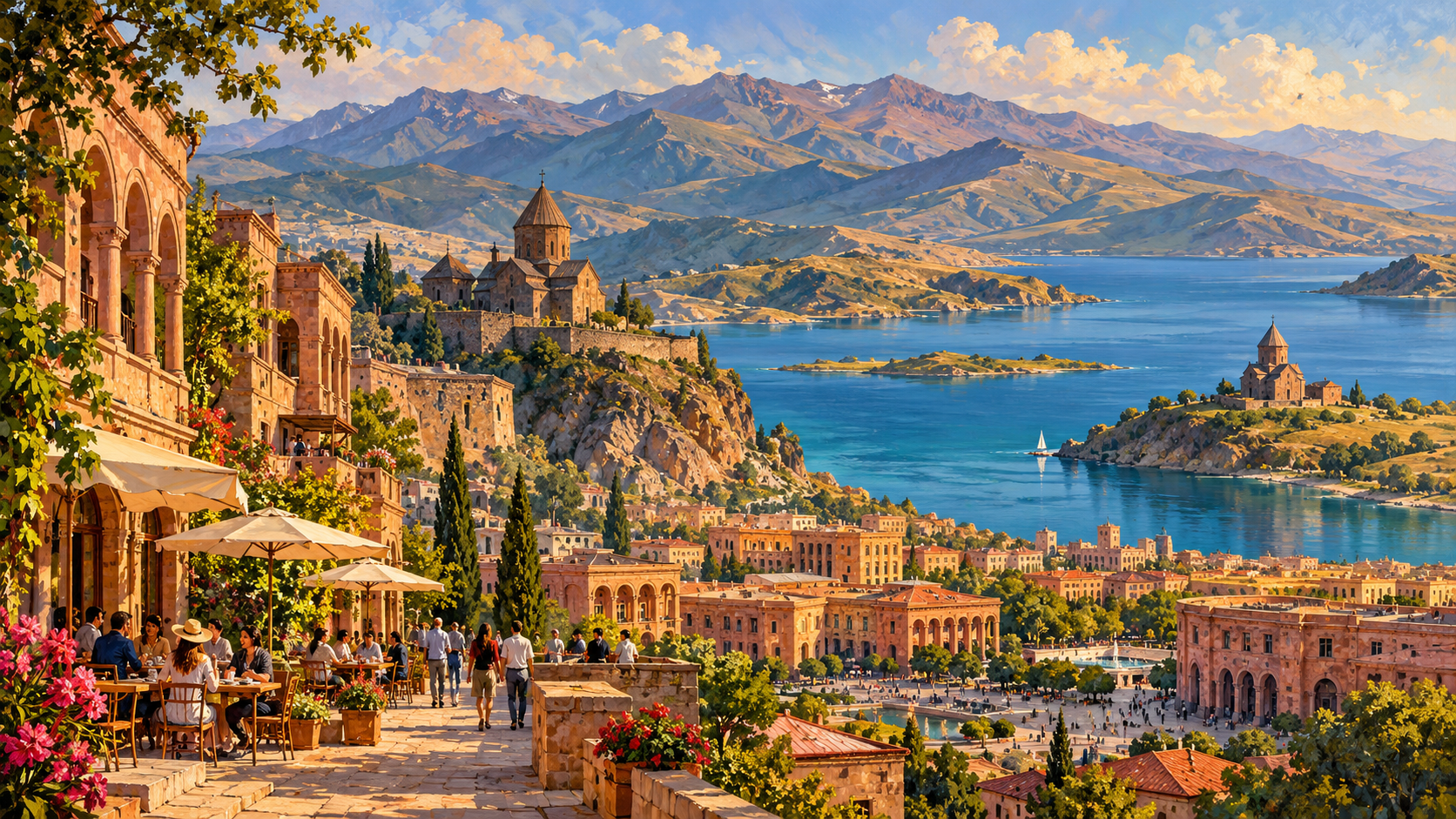
How does Armenia’s parliamentary government work, why does it have ten regions and a separate capital administration, and how do mountain roads, borders, schools and trade routes affect everyday life? Armenia is a landlocked parliamentary republic in the South Caucasus. Its prime minister heads the government, the elected National Assembly makes laws and holds the executive accountable, and the president has a distinct constitutional head-of-state role. Armenia is divided into ten marzes (regions); the capital, Yerevan, has a separate local-government status.
The easiest way to understand how Armenia works is to follow a normal need: national decision → regional or community administration → roads, power, water, schools and public services → an actual household. Mountains and closed or constrained borders can make trade routes expensive. Refugee arrivals and housing pressures add service needs. At the same time, education, skilled workers, diaspora connections, tourism and possible new regional transport links create opportunities. A country is more than its government chart; it is everything that lets people get through an ordinary Tuesday.
Armenia at a glance: the main answers
- State: a sovereign parliamentary republic governed under the Constitution, with national elections and a single-chamber National Assembly.
- Executive: the prime minister and cabinet direct government policy; the president serves a separate constitutional office.
- Territory: ten marzes and the capital city of Yerevan, which is also a self-governing community.
- Local government: community (hamaynk) authorities have local self-government functions; regional administration carries national policy.
- Geography: mountainous and landlocked, between Georgia, Azerbaijan, Iran and Türkiye.
- Economic activity: services, trade, technology, tourism, manufacturing, agriculture and household links to people abroad.
- 2026 context: a June parliamentary election, a new government programme, ongoing border and peace diplomacy, and proposals for improved regional transit.
Begin with the Constitution of Armenia and the government’s regional-administration guide. The World Bank Armenia overview explains the economic and human-development context. Statements about negotiations or proposed routes are dated to October 2026; they should never be treated as proof a future infrastructure project is already operating.
1. Who runs Armenia: the president, prime minister or parliament?
Armenia’s constitutional structure gives different institutions different functions. The National Assembly is its elected unicameral parliament. The prime minister leads the government, which the Constitution describes as the supreme body of executive power. The government directs public administration and develops domestic and foreign policy under the law. The president is head of state, with constitutional duties that differ from a strong executive presidency.
This distinction matters whenever a headline attributes an action to ‘Armenia’. Parliament may approve a law or the budget. The government may approve a programme. A minister may issue implementing decisions. A court may interpret law in a specific case. These are separate stages, not interchangeable acts.
Articles 146–150 of the Constitution describe government and prime minister appointment. The 2015 constitutional framework should be distinguished from Armenia’s earlier, more presidential political arrangements. A history textbook covering an earlier decade can be misleading when used as a 2026 directory.
2. How did the June 2026 parliamentary election affect the government?
Armenia held parliamentary elections on 7 June 2026. The governing Civil Contract party led by Nikol Pashinyan won enough support to retain a parliamentary majority. The government then set out its 2026–2031 programme. These are dated political developments, not changes to the fact that the underlying system is parliamentary.
An election can alter the distribution of seats and the government’s policy direction. It does not instantly change every law, public facility or community budget. After a vote, the steps still include formation of government, presentation of a programme, parliamentary processes, spending decisions and implementation.
For the 2026 context, read the 20 August Cabinet account and the official government-programme page. A government programme states aims and commitments; whether a road, clinic or school improves must be checked against later evidence.
3. What is the difference between a marz and a community?
A marz is one of Armenia’s ten regional administrative units. The government’s official list is Aragatsotn, Ararat, Armavir, Gegharkunik, Lori, Kotayk, Shirak, Syunik, Vayots Dzor and Tavush. Regional governors or marzpets coordinate specified state policies and institutions within their regions.
A community, or hamaynk, is the unit of local self-government, with its own local institutions and responsibilities under law. Communities may include towns, villages or merged settlements. The important point is that regional state administration and elected local self-government are not identical tiers with interchangeable budgets.
The capital Yerevan has a distinctive arrangement: it is a community with its own municipal government, rather than a normal eleventh marz. The official state-administration guide spells out these territorial categories.
4. Why doesn’t a marzpet do everything in a province?
The marz governor helps implement national government policy and coordinate regional offices within assigned competences. A community authority handles local self-government matters within the law. A ministry may retain authority over standards, staffing arrangements or sector programmes. Service companies can operate networks that cross several local boundaries.
Suppose an access road needs maintenance. The relevant authority depends on whether it is a national road, regional connection, community street or another asset. Knowing the marz is not enough to identify the road owner. Likewise, a school’s administrative subordination may depend on national education legislation rather than which regional office is nearest.
Students can draw three columns: national, regional and community. Under each, write which decisions, resources and accountability checks may belong there. Where the same topic appears twice, draw an arrow instead of pretending one institution has no role.
5. Why is Yerevan so important to Armenia’s economy and services?
Yerevan concentrates a substantial share of jobs, business services, higher education, public institutions, healthcare facilities and transport connections. The capital’s economic weight can create opportunities but also housing, transport and infrastructure pressures. People outside the capital may depend on its specialised services and markets.
A student from a smaller community might consider a university in Yerevan. A patient may travel there for specialist care. A firm may seek investors, skilled staff or administrative approvals in the city. Good national development therefore requires effective links to the capital without leaving regional communities permanently dependent on expensive journeys.
The system question is not merely whether Yerevan grows. It is whether regions can also support viable work, education, safe roads and good public services so that households have meaningful choices.
6. Why does being landlocked make trade complicated?
Armenia has no seaport. Imports and exports therefore move through land routes, air transport and the infrastructure of neighbouring states before they can reach global shipping networks. Mountain passes, border procedures, road condition, rail connectivity, security and political relationships can all influence cost and reliability.
Trade dependence is not automatically weakness: a country can build strong international relationships without owning an ocean coastline. The challenge is to maintain reliable connections and alternatives when one route experiences delay or restriction. A business that cannot predict delivery times may hold more stock or charge more to cover risk.
Original worked example: A small Armenian technology-hardware company imports components. The components arrive by air or through a land corridor, pass customs, move to a workshop, undergo assembly and testing, and are sent to customers. A delay at a border is not only a diplomatic story; it can delay production and wages.
7. What is Armenia’s Crossroads of Peace approach?
Armenia has promoted improved regional connections as part of its peace and economic strategy. The idea is that roads, rail lines and border crossings can expand regional trade if they operate with predictable rules and respect for sovereignty. The economic benefits depend on the actual construction, customs procedures, security arrangements and willingness of partners to use the routes.
A transport plan can appear simple on a map and still involve years of complex work. It requires right-of-way decisions, engineering, border facilities, land rules, financing, public communication and agreements between countries. Diplomatic progress should be distinguished from completed commercial operations.
This topic is sensitive because Armenia–Azerbaijan relations and the regional history of conflict affect trust and border policy. Readers should use precise dates and official texts rather than assuming that a preliminary declaration is the same thing as a fully implemented peace settlement.
8. What is TRIPP, and does it mean Armenia loses control of its territory?
The Trump Route for International Peace and Prosperity (TRIPP) is a proposed regional transit framework involving Armenia and the United States, associated with efforts to improve connections between Azerbaijan and its Nakhchivan exclave through Armenian territory. The governments signed a framework agreement in May 2026 after earlier diplomatic steps in 2025 and early 2026.
The Armenian Foreign Ministry’s published framework explicitly says that Armenia retains sovereignty and jurisdiction over project areas on its territory, including customs, law enforcement and border functions. It also describes proposed development and commercial arrangements, which require close legal reading.
A framework for an international route is not proof that every railway or road segment is already complete. To evaluate a claim, identify whether it concerns political commitment, a signed document, final engineering, concession rights, completed construction or actual cargo movement. That distinction avoids both over-selling a proposal and mischaracterising its legal terms.
9. How have conflict and displacement affected household services?
The South Caucasus has endured serious conflict, particularly around Nagorno-Karabakh. After Azerbaijan’s 2023 offensive, more than 100,000 ethnic Armenians fled to Armenia. The arrival of displaced people created urgent and long-term needs involving shelter, documents, employment, education, mental health and community integration.
These are human realities as well as administrative tasks. A household may need a rental home, recognition of qualifications, schooling for children and practical help entering the labour market. A community may need more classroom places or clinical services than its former population forecast assumed.
The World Bank Armenia overview discusses the refugee-related pressures on housing, jobs, social services and psychological support. Any analysis of resilience must include the people affected, not just the diplomatic or military institutions mentioned in headlines.
10. How do local authorities support displaced families?
National programmes may establish eligibility or funding for housing and social assistance, but the person still needs to understand the relevant procedure, access an office, find suitable housing and use local services. Municipal or community administrations, schools, civil society organisations and national institutions may each have different supporting functions.
Illustrative case: A displaced family relocates to a small town. A parent seeks work; a child needs a school place; a grandparent needs medical continuity; the family needs a stable rental arrangement. These concerns share income, transport and information links. A housing payment is helpful, but a home far from employment or medical services can create new costs.
The strongest delivery test is whether a family can access services consistently over time, without having to repeat its circumstances to disconnected offices. Infrastructure and administrative design can either reduce or increase that burden.
11. How do roads connect Armenia’s mountain communities?
Armenia’s mountainous geography shapes settlements, road building, maintenance and winter transport. A bridge, tunnel or pass may be essential not only to freight but also to ambulance access, teacher journeys and the sale of farm produce. A route can be short in kilometres but slow or unreliable because of terrain or weather.
A local road repair often has benefits outside transport. A farmer reaches a buyer; a child reaches a classroom; a nurse arrives on time; a family can visit a specialist. This is why road maintenance belongs in a civic-systems article alongside education and health rather than in a separate engineering silo.
Imagine a fictional mountain village where one bridge carries the school bus, milk collection vehicle and medicine deliveries. If that bridge closes, three departments may report different problems. A good response identifies the common point of failure and coordinates a safe temporary alternative.
12. Why does electricity reliability matter to Armenia?
An electricity system includes generation, transmission, substations, distribution, connections and maintenance. Armenia has a mix of nuclear, thermal, hydro and increasingly renewable electricity sources. Reliability matters to clinics, factories, schools, data systems and home life, even if nationwide access is high.
An interesting 2026 evidence example comes from the World Bank’s electricity reliability results: targeted transmission line outages fell by 57% in a supported project, while breakdowns at key substations declined substantially. Those are project-specific measures, not claims that Armenia can never experience an outage.
The key lesson is that transmission and substations can create national benefits. Building more generation is not the same as getting existing electricity to users safely and reliably. A modern power system requires capacity, engineering standards, inspections and skilled employees at several connected layers.
13. How do energy, water and agriculture support each other?
Agriculture needs dependable water, roads, labour and markets. Water systems may need electricity for pumping or treatment. Power production may in turn be affected by water availability and environmental constraints. Farms can be productive in suitable valleys, but a crop still needs storage, processing and transport to become a sale.
A drought may reduce irrigation supplies and crop yields. Heavy rain may affect mountain roads or water quality. A market-price change can affect how much equipment a farmer can afford. Looking at agriculture only as seed and soil misses much of what determines the final household income.
Worked crop example: A family grows apricots. Harvesting succeeds, but refrigeration is unreliable and the road to buyers is slow. Spoilage rises before products reach the market. Better electricity distribution and improved logistics could raise earnings even without planting more trees. This is an example of infrastructure turning a crop into a viable business.
14. Why are technology, tourism and services important to the economy?
Armenia’s economic activity includes information technology, other services, commerce, tourism, manufacturing and agriculture. These sectors use different assets but share human capital, communications, stable policy, financial services and transport. Technology workers may export services digitally; farmers or manufacturers often need physical corridors.
The World Bank reports that Armenia’s economy continued growing in the first half of 2026, supported particularly by services and consumption, while inflation, investment execution and external trade remained issues to monitor. High aggregate growth does not imply that every household’s purchasing power or employment has improved equally.
An important distinction is between income earned inside Armenia and flows such as remittances or transfers from abroad. Diaspora connections can support households, business relationships and new ideas, but they do not replace productive domestic services and resilient institutions.
15. Why does the Armenian diaspora matter?
Armenians live in communities across many countries. Connections through relatives, education, culture, business, donations and professional networks can strengthen international opportunities. Diaspora relationships may help firms find customers or investors and students explore qualifications abroad.
These networks also have limits. Family support may be uneven; outside economic changes can affect remittances; and a talented person abroad may face many obstacles before contributing to a project at home. A constructive analysis avoids assuming that every Armenian living abroad has the same circumstances or commitments.
The systems question is how institutions turn cross-border interest into transparent opportunities: reliable business rules, useful information, compatible qualifications, straightforward procedures and partnerships that benefit communities in Armenia.
16. How does Armenia’s education system work, and why was 2026 important?
Armenia’s formal general education has included a 12-year structure with primary, basic and high-school stages. Education provides the future professionals needed for medicine, engineering, agriculture, public administration, trade and digital work. But school governance can change while the overall purpose of learning remains the same.
In June 2026 the Ministry of Education, Science, Culture and Sports described amendments envisaging that schools under regional administration would come under ministry subordination from September 2026, followed by schools under Yerevan municipality from September 2027. This is a real example of institutional restructuring: the body supervising a school may change even though the pupil still attends the same classroom.
Check the 30 June 2026 ministry explanation and later implementation notices for the effective position of any particular institution. For the detailed school pathway read Schools of Armenia, How Education System of Armenia Works, and How Ministry of Education for Armenia Works.
17. Why is this school-administration change more than paperwork?
Imagine a principal needing maintenance funds, a teacher-training programme and permission for a new service arrangement. If the competent supervisory institution changes, reporting lines, budget processes, staffing decisions and records may also change. The pupil should ideally experience continuity, while the administration behind the scenes completes the transition.
A reform can improve standardisation and accountability, but it can also create temporary adjustment costs if duties are unclear or systems are not ready. The question is not merely ‘centralisation or decentralisation?’ It is how responsibility, finance, local knowledge and oversight are distributed to improve education.
A student can use the change as a critical-thinking exercise: who formerly made the decision, who is proposed to make it now, what remains the same, and how would an improvement in student learning be demonstrated? That is a stronger way to evaluate reform than repeating the ministry’s official slogan.
18. How do schools connect to future energy and infrastructure projects?
Energy systems require electrical engineers, line workers, safety specialists, software developers and project managers. Roads require surveyors, materials specialists and maintenance teams. Healthcare requires clinicians and support staff. A country can allocate a substantial infrastructure budget and still struggle to operate its facilities if skilled people are unavailable.
This makes education a form of long-term infrastructure. The technician who repairs a substation in 2036 may be a child learning algebra today. A robust training system enables a country to maintain, improve and safely expand its physical assets without depending entirely on imported expertise.
Good education policy therefore connects primary literacy to technical learning, vocational pathways, universities, professional standards and lifelong skills. Examination scores matter, but they are not the only measure of future national capability.
19. What does regional cooperation mean for an ordinary business?
Regional cooperation can make it easier to obtain goods, move exports, communicate with partners and reduce delays. It can also alter competitive pressures, administrative rules and the kinds of expertise firms need. For Armenia, the benefit of opening or improving corridors depends on stable agreements and physical reliability.
Consider a fictional manufacturer whose products currently take a long route to a customer. A new transit arrangement might shorten distance, but saving time requires reliable customs procedures, suitable roads, clear insurance and secure cargo handling. One diplomatic announcement is not enough to change a delivery timetable.
For a family, better trade arrangements may affect jobs, availability of products and prices. Those benefits are plausible mechanisms, not guaranteed outcomes. In a conflict-affected region, maintaining trust and protecting rights are part of the economic system as well as political concerns.
20. Is Armenia joining the European Union?
Armenia has pursued closer relations with the European Union through agreements, policy cooperation and discussions about European integration. This is different from being an EU member or automatically obtaining candidate status. The World Bank’s 2026 Armenia profile explicitly notes a process of closer European integration while saying Armenia is not an EU candidate country.
Terms such as partnership, strategic agenda, visa liberalisation plan, candidate status, accession negotiations and membership describe different stages. They should never be collapsed into one headline. For up-to-date legal or travel rights, consult the relevant Armenian and EU official information.
The same critical-reading principle applies to transport diplomacy: documents and frameworks can be important milestones, but a proposed future status should not be reported as a completed outcome.
21. How should we interpret a new constitution being discussed?
Armenia’s government has discussed a new constitution. In September 2026, officials said a draft was expected later in the year. A draft under preparation is not a constitution already enacted, and a political proposal is not proof of how any eventual referendum or legal process will conclude.
Armenia’s current institutional arrangements should therefore be explained from the constitutional text in force, while reform proposals are described separately and dated. This is particularly important where debates involve sovereignty, national identity or diplomacy with neighbouring states.
A careful educational explanation does not try to predict the outcome of a contentious constitutional debate. It asks what exists, what change is proposed, which process would be legally required and whose rights and responsibilities could be affected.
22. An integrated case study: one Armenian family’s journey
Illustrative family, not identifiable people. A parent in a regional community commutes to a factory, a child attends school, and a grandparent needs a periodic medical consultation in Yerevan. The factory requires imported components, stable electricity and road access. The school requires appropriate governance, teachers and safe transport. The medical visit requires a referral and affordable travel.
Now suppose a landslide temporarily closes the principal route. The factory’s deliveries are late. The child struggles to reach school, and the older relative must rearrange an appointment. A transport problem has become an education, employment and healthcare problem. Meanwhile a national minister and regional governor may each have separate responsibilities for mitigation.
The right question is which shared infrastructure link failed, what temporary alternative is available, and who is accountable for restoring access. A national strategy earns its value when it translates into a less difficult day for this kind of household.
23. What makes an institution effective rather than just visible?
- Law: clear authority, rights and a defined remedy when a decision is disputed.
- Budget: money for operating costs, replacement parts and staff, not only a new building.
- People: appropriately trained workers supported by reasonable procedures.
- Infrastructure: transport, electricity, digital networks, water and safe facilities that function together.
- Communication: understandable information in a suitable language and accessible channels.
- Outcome: shorter journeys, reliable services, genuine learning or improved health that can be checked.
- Adaptation: evidence-based changes when the original plan does not work as expected.
This framework helps compare national and local decisions without flattening their context. A regional office may have limited finance but intimate knowledge of local needs. A national ministry may have professional capacity but need community feedback. A capable system connects them and learns from the gaps.
24. How is Armenia different from Singapore?
Singapore is a maritime city-state whose port, airport and dense road network place it at the centre of global transport and trade. Armenia is a mountainous, landlocked country whose international connections rely on neighbouring corridors and diplomatic conditions. The two face very different kinds of geography-driven friction.
Yet both need functioning schools, digital services, safe electricity, trustworthy public institutions and clear long-term planning. Singapore’s infrastructure compresses distance; Armenia’s transport policy must also address terrain and international borders. The fair comparison is the journey from national ambition to real household access, not a ranking of unrelated building projects.
Read How Singapore Works and How Singapore Connects | Roads, Expressways and Junctions for a contrasting transport-and-governance case study.
A five-minute classroom exercise: draw a border-to-classroom system
On paper draw five boxes: international supplier, border or transport corridor, business warehouse, community road and school. Place one possible delay in each box. Then add an electricity substation supplying the warehouse and school. Ask whether a new international agreement automatically solves a local road problem. The answer is no, but it may create opportunities if other connections are made reliable.
Extend the diagram to an ambulance journey from a regional community to a larger medical facility. Which actors are national, regional, community or commercial? Which evidence would show improvement? The exercise teaches civic responsibility and infrastructure reasoning without requiring complex political jargon.
Frequently asked questions about how Armenia works
Is Armenia a parliamentary or presidential republic?
A parliamentary republic. The prime minister leads executive government; the National Assembly legislates, and the president has a separate head-of-state role.
How many regions does Armenia have?
Ten marzes. Yerevan is the capital city with separate community-level local-government status, rather than an ordinary eleventh marz.
What is a marzpet?
The governor or regional administrative official of a marz, charged with implementing and coordinating specified government policies in that region under the applicable law.
Why are Armenia’s borders and trade routes important?
Armenia has no coastline and depends on land and air connections through a mountainous and geopolitically complex neighbourhood. Reliable transit affects prices, jobs and business opportunities.
What is the TRIPP transit project?
A proposed multimodal regional-connectivity initiative supported by a May 2026 Armenia–US framework. The framework affirms Armenian sovereignty and jurisdiction; the final practical benefits depend on implementation.
Did the 2026 election change Armenia’s system?
It determined a new parliamentary mandate and led to a new government programme. The existing constitutional design remains the appropriate basis for explaining the system unless formal legal changes take effect.
Why do schools have changing administrative responsibilities?
Education-law reforms discussed in 2026 envisaged a change in the supervisory authority for certain regional schools, with later changes planned for Yerevan. Verify the status for a particular school through current ministry notices.
Is Armenia already an EU candidate country?
No. As described in the World Bank’s 2026 country overview, Armenia is pursuing closer European integration but does not have EU candidate status.
Follow the A-series and the international civilisation map
This article belongs to How Countries Work, a sibling collection to How Singapore Works. Compare Angola’s oil, regional administration and Lobito Corridor, Antigua and Barbuda’s island government and climate resilience, and Argentina’s federal system and economy. Use the country archive to compare how different systems solve similar human needs without pretending the solutions are interchangeable.
Sources and editorial notes
- Constitution of the Republic of Armenia — National Assembly, president, government and prime minister.
- Government of Armenia, Regions — ten marzes and Yerevan’s status.
- Government of Armenia, State administration system — local self-government and administrative units.
- Prime Minister’s Office, August 2026 government programme.
- Armenian Foreign Ministry, TRIPP Framework Agreement, May 2026 — sovereignty, proposed connectivity and implementing roles.
- World Bank Armenia overview, 2026 — economy, refugees, regional connectivity and EU relationship.
- World Bank, January 2026 electricity reliability project results.
- Ministry of Education, Science, Culture and Sports, June 2026 school-administration reform notice.
- Reviewed: 20 October 2026. Scenarios are original teaching examples, not current border, travel or safety directions.