
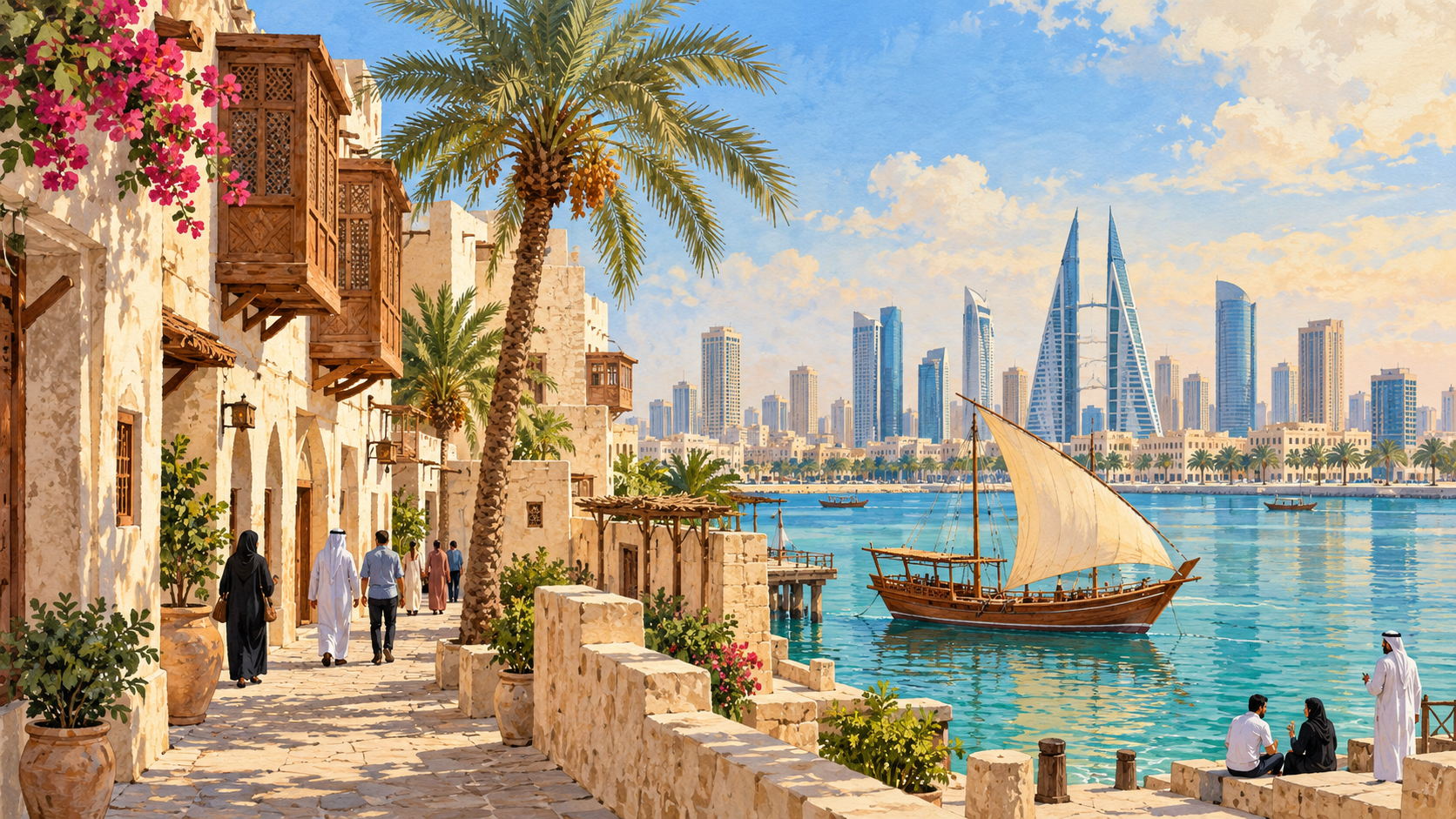
Where is Bahrain, what is it famous for, and how does this island country connect a long trading history with contemporary city life? Bahrain is an archipelago in the Gulf, near Saudi Arabia and Qatar. Manama is its capital. Its history includes Dilmun, pearling and maritime trade, while modern life also involves finance, aluminium, energy, public services and communities with many different backgrounds.
A country overview needs to look beyond a skyline or one industry. Bahrain’s compact geography brings homes, workplaces, roads, coastlines and heritage places close together, but the experiences of different households can still vary greatly. This guide explains the connections between landscape, history and institutions, distinguishing dated statistics, legal frameworks, actual services and projects that remain under development.
Current conditions: regional tensions can disrupt travel and services. The UK’s Bahrain advice, checked on 19 October 2026, notes regional security risks and possible transport disruption. This educational guide is not a guarantee of safe travel or normal operations.
Bahrain at a glance
- Official name: Kingdom of Bahrain.
- Region: the Gulf, in Western Asia.
- Capital: Manama.
- Geography: an island archipelago with coastlines altered in places by reclamation.
- Main official language: Arabic; English and other languages are used in different communities and settings.
- Currency: Bahraini dinar, code BHD.
- Government: constitutional monarchy; the guide distinguishes institutional design from evidence about political practice.
- Modern independence: 1971.
- Important land connection: the King Fahd Causeway links Bahrain and Saudi Arabia.
- Economic activities: oil and refining, finance, aluminium, logistics, tourism and other services.
- Known for: Dilmun archaeology, pearling heritage, Muharraq and Manama, maritime connections and contemporary industries.
- Reading date: 20 October 2026 in Singapore. Statistics and policy claims retain their own dates.
Three distinctions matter throughout: residents are not the same category as citizens; a proposed transport system is not an operating service; and a constitutional description does not by itself establish how institutions work in practice. Keeping these distinctions visible gives a more useful picture of Bahrain’s everyday life.
Cover illustration: an original artistic interpretation of Bahraini waterfronts, pearling heritage and contemporary city life, not a literal geographic view.
Choose your route through Bahrain
- 1. Bahrain on the Map: An Island Country in the Gulf
- 2. Land, Climate and Water: Living with an Arid Environment
- 3. Population and Languages: Citizens, Residents and a Connected Society
- 4. Dilmun and Ancient Bahrain: Trade, Towns and Archaeological Evidence
- 5. Later History and Pearling: A Society Shaped by the Sea
- 6. Twentieth-Century Transformation and Independence in 1971
- 7. Government and Institutions: Constitutional Design and Public Practice
- 8. Manama, Muharraq and the Country’s Different Places
- 9. The Economy: Oil, Finance, Aluminium and Diversification
- 10. Trade, Fisheries and Food Security: How Supplies Reach the Islands
- 11. Transport: an island connected by roads, buses and air
- 12. Electricity, water, waste and the digital state
- 13. Education: schools, pathways and informed choices
- 14. Healthcare: access, insurance and patient eligibility
- 15. Work, housing and the different realities of everyday life
- 16. Food: a record of the sea, trade and hospitality
- 17. Culture, music and sport: memory alongside public life
- 18. Heritage and UNESCO: learning to read the evidence
- 19. Ecology and climate: the value of the coast
- 20. Bahrain in the wider world: connection, influence and exposure
1. Bahrain on the Map: An Island Country in the Gulf
Location, neighbours and scale
Bahrain is an archipelago in the Persian Gulf, off the eastern side of the Arabian Peninsula. Its position is easiest to remember by locating Saudi Arabia to the west and the Qatar peninsula to the southeast. Qatar’s official geographical guide describes the narrow stretch of water separating Qatar from Bahrain. Bahrain therefore belongs to Western Asia and the wider Gulf region, while remaining a separate sovereign country. An island’s nearest mainland is useful for orientation, but proximity alone does not determine nationality, ownership or a maritime boundary. Sources: Visit Qatar: Geography.
The national government’s facts page, consulted in October 2026, lists 786.8 square kilometres of land. It separately lists territorial waters, so the much larger combined figure should not be presented as land area. Bahrain’s sea area is important to its geography, but it is not land available for settlement. This distinction matters when comparing countries or calculating population density. Sources: Bahrain National Portal: Facts & Figures.
Connections across the water
The King Fahd Causeway provides Bahrain’s road connection with Saudi Arabia. The approximately 25-kilometre crossing officially opened on 25 November 1986. It is both transport infrastructure and an international border, with immigration and customs functions. Its significance extends beyond the structure itself: the crossing links Bahrain with the much larger Saudi market and makes cross-border journeys possible by road. Passport, customs and vehicle-insurance requirements remain relevant because the causeway joins two countries. A physical connection does not remove the border between them. Sources: Bahrain National Portal: King Fahd Causeway.
Bahrain’s coast is partly a constructed landscape. NASA’s comparison of Landsat images from 1987 and 2022 shows expansion of existing islands and the creation of new land, particularly in the north. Shallow coastal waters made such projects technically possible. Reclamation can accommodate buildings, roads and infrastructure, but it changes the relationship between land and sea. The useful map-reading question is therefore not simply “Where is the coastline?” It is also “When was this coastline mapped?” Comparing two dated images reveals change that a single contemporary map cannot show. Sources: NASA Earth Observatory: Building Bahrain.
2. Land, Climate and Water: Living with an Arid Environment
Low islands and a dry interior
Bahrain’s physical landscape is generally low-lying. The main island has limestone terrain rising towards Jebel Dukhan in its interior, with much flatter coastal surroundings. The archipelago also includes Muharraq, Sitra, Umm Nasan and the Hawar group near Qatar. FAO’s 2008 physical profile contrasts the developed and cultivated north with the drier interior and southern landscapes. Its old island-area totals should not be treated as current measurements, but the broad contrast helps explain why a small country can still contain quite different settlement and land-use patterns. Sources: FAO AQUASTAT Survey 2008: Bahrain profile.
Heat and rainfall tell different parts of the climate story. Bahrain has hot, humid summers and a cooler winter season. Being surrounded by seawater does not make it a rainy country: humid air and plentiful freshwater are different things. Official visitor guidance places the hottest summer period broadly between May and September and the cooler season between October and April. These are seasonal descriptions, not guarantees for an individual day. A climate graph summarises patterns over time; a weather forecast answers the more immediate question of what conditions are expected next. Sources: Bahrain Tourism: Bahrain Basics.
Why freshwater needs infrastructure
Bahrain does not have a network of permanent rivers supplying its cities. Its groundwater belongs to a wider regional system, including the Dammam aquifer extending from Saudi Arabia. FAO’s historical assessment describes the pressure caused by abstraction and salinity. This is a useful reminder that an island’s water resources can be connected underground to the mainland. Water availability depends on geology, recharge and extraction as well as rainfall on the island itself. Groundwater should therefore be understood as a managed resource, rather than an inexhaustible reserve beneath the desert. Sources: FAO AQUASTAT Survey 2008: Bahrain profile.
Modern urban supply depends on desalination. The Electricity and Water Authority describes reverse-osmosis and thermal processes, followed by transmission pipelines, storage and distribution to consumers. Each stage matters: producing water is only the beginning of delivering it reliably. The authority’s institutional timeline records desalination beginning in 1975 and a full-reliance-on-desalinated-water milestone in 2016. These changes connect Bahrain’s environmental history with its engineering history. They also make water conservation an infrastructure issue: reducing avoidable demand can reduce the amount that must be produced, moved and stored. Sources: Electricity and Water Authority: The Water Network; Electricity and Water Authority: Our Journey.
3. Population and Languages: Citizens, Residents and a Connected Society
Reading population figures correctly
Bahrain’s official 2024 population figure was 1,588,670. Of these residents, 739,736 were Bahrainis, or 46.6%, and 848,934 were non-Bahrainis, or 53.4%. These figures describe the population living in the country, rather than a count of citizens alone. They also describe one dated statistical year. They should not be silently relabelled as a 2026 headcount. Migration, births and deaths can change both the total and its composition, so comparisons work best when they use the same definition and compatible dates. Sources: Bahrain National Portal: Facts & Figures.
Citizenship, residence and employment are three different classifications. A resident population includes children and people who are not working; an employment total counts a different group. Someone may live in Bahrain while retaining another nationality. A tourist count, meanwhile, measures visits or arrivals and cannot simply be added to the resident population. Keeping these categories separate prevents common mistakes, such as describing all non-citizen residents as short-term visitors or treating every expatriate resident as a worker. It also helps explain why population statistics and labour-market statistics may legitimately give different totals.
Language and migration
Arabic is Bahrain’s official language, while English is commonly used in business. An official language has a particular public role; it is not necessarily the only language used at home or at work. This Arabic–English combination does not imply that every resident has the same fluency. Language use varies with the person and setting, including documents, customer service and family conversation. Sources: Bahrain National Portal: About Bahrain.
The Indian community illustrates the depth and variety of migration links. India’s embassy describes merchant connections as well as workers and professionals in construction, medicine, engineering, accounting, banking and management. It also documents community associations and schools. These are different experiences within a single national-origin community, rather than one uniform “expatriate lifestyle”. The broader lesson is to avoid inferring an individual’s occupation, income or language from nationality. A country profile becomes more accurate when it recognises residents as families, colleagues and community members, alongside their role in the labour force. Sources: Embassy of India: Indian Community in Bahrain.
Labour institutions also shape how newcomers participate in the economy. In August 2024, the Labour Market Regulatory Authority announced a programme with the central bank and private sector to facilitate bank account identification numbers for incoming expatriate employees. That specific initiative shows how migration connects with payroll and financial services. It does not establish that every worker has identical conditions, or that one reform resolves every labour issue. The distinction between an announced measure, its implementation and its practical results is important when reading government programmes. Sources: LMRA: Expatriate Employee IBAN Announcement.
4. Dilmun and Ancient Bahrain: Trade, Towns and Archaeological Evidence
A harbour linking distant societies
Bahrain’s importance did not begin with oil. At Qal’at al-Bahrain, archaeological layers document settlement reaching back to about 2300 BCE. The site was a capital and harbour of Dilmun, whose commercial connections linked the Gulf with Mesopotamia and the Indus region. Excavations reveal residential, religious, commercial and defensive structures. This variety matters because a trading centre needs more than a landing place: it needs people, storage, institutions and arrangements for everyday life. The archaeological site therefore helps students imagine a functioning settlement rather than an isolated ancient monument. Sources: UNESCO: Qal’at al-Bahrain.
Qal’at al-Bahrain is a tell, a mound formed through successive periods of occupation. Its prominent later fort sits above much older layers. Reading the entire site as one building from one date would erase that long history. UNESCO inscribed it in 2005 for the combined importance of the harbour, settlement and surrounding landscape. Archaeology works through such relationships: a wall, an imported object and a harbour channel can each answer different questions about movement, construction and contact. Sources: UNESCO: Qal’at al-Bahrain.
Burial landscapes and belief
The Dilmun Burial Mounds provide another kind of evidence. The UNESCO property contains 21 archaeological components dating broadly from 2200 to 1750 BCE, including approximately 11,774 burial mounds and 17 royal mounds. Many structures began as low cylindrical towers rather than the rounded heaps visible after long weathering. Differences in size and construction help archaeologists investigate social organisation and hierarchy. The burial landscape was inscribed on the World Heritage List in 2019. It is valuable not only for spectacular individual tombs, but also for what many burials considered together reveal about a society. Sources: UNESCO: Dilmun Burial Mounds.
The Barbar Temples add a religious dimension. Three successive temples occupied the same site, and their remains include altars and a freshwater well. Bahrain’s tourism authority explains their architectural connections with ancient Mesopotamia and possible associations with beliefs about freshwater. The word “possible” matters: archaeological interpretation combines physical evidence with comparison and historical texts, and not every detail of ancient belief is certain. Together, the harbour, graves and temples support a fuller picture of Dilmun: a society organising trade, honouring its dead and investing labour in religious buildings. Sources: Bahrain Tourism: Barbar Temples.
5. Later History and Pearling: A Society Shaped by the Sea
Changing names and political connections
Bahrain’s history continued through several changing political and cultural settings after early Dilmun. In the Hellenistic era, the islands were known as Tylos, with connections to the wider world that followed Alexander’s conquests. Christian communities existed in the Gulf before the spread of Islam, which brought another enduring transformation. Much later, the Al Khalifa family established rule in Bahrain in 1783. Nineteenth-century treaties drew Bahrain into a British-protected relationship, including agreements in 1820 and 1861. These phases should be placed on a timeline, rather than compressed into a claim that the islands had one unchanged identity or political system across millennia. Sources: Bahrain Authority for Culture and Antiquities: History Timeline.
The economy behind the pearl
Pearling connected work at sea with life on land. UNESCO’s Bahrain pearling property brings together historic buildings in Muharraq, offshore oyster beds, part of the seashore and the Bu Mahir fort. Merchant houses, shops and storage spaces show where wealth and commercial activity were concentrated. The industry’s late nineteenth- and early twentieth-century prosperity had a visible effect on the built environment. Inscribed in 2012, the property is therefore an economic landscape as well as an architectural collection: the oyster beds explain the source of the product, while the town helps explain its organisation and exchange. Sources: UNESCO: Pearling, Testimony of an Island Economy.
The Pearling Path’s historical account describes a network of captains, divers, haulers, boat builders, merchants and creditors. The work was demanding, seasonal and uncertain. A poor catch could leave a crew member owing money into the following season; before reforms in the 1920s, unpaid debts could pass to relatives. These details prevent an overly romantic picture of pearl diving. Beautiful pearls and wealthy houses were only part of the story. Labour, risk and unequal bargaining power were also involved, making pearling a useful case study in how a valuable export can support livelihoods while distributing rewards unevenly. Sources: Pearling Path: History of Pearling.
Why the old industry declined
The collapse was not caused by one isolated event. The Pearling Path links it to wars, price falls, competition from cultivated pearls and the wider economic shock of the Depression. A changing global market could therefore overturn an island livelihood even when the sea still contained oysters. Sources: Pearling Path: History of Pearling.
British Library records preserved by the Qatar Digital Library show that people debated how to respond. A file covering 1934–1949 includes discussions about mechanical diving, pearl cultivation and restrictions affecting trade. Some Bahraini authorities objected to mechanised methods because of concerns about the market and environment. Such records reveal disagreement and decision-making, not simply a passive disappearance of an old occupation. They also demonstrate how historians combine buildings and objects with written correspondence to explain economic change. Sources: Qatar Digital Library/British Library: File 9/2 Pearling.
6. Twentieth-Century Transformation and Independence in 1971
Oil and a new economic direction
The Bahrain Petroleum Company was founded in 1929. Oil was discovered in 1932, exports began in 1934 and refining followed in 1936. This sequence separates three activities that are often confused: finding oil underground, selling crude abroad and processing it into usable products. Petroleum created a new basis for industrial development just as the older pearl economy was in difficulty. The first crude shipment left the Sitra terminal for Japan. The industry required trained workers, industrial facilities and transport connections, creating different forms of employment from the seasonal pearling economy. Oil extraction and refining also became lasting, separate parts of Bahrain’s economic structure. Sources: Bapco Refining: At a Glance; Bapco Refining: History.
The oil industry also created new settlement patterns. Bapco’s history traces Awali from temporary accommodation near the first well in 1933 into a dedicated township for employees and families. Its account describes training Bahrainis for industrial work as well as the arrival of qualified staff from overseas. Awali makes the economic transition visible on the map: production brought housing and amenities into an area whose role differed from the older commercial centres on the coast. Sources: Bapco Refining: History.
From protected state to independent country
In 1968 Britain announced its intention to end its treaty relationships with the Gulf sheikhdoms. Bahrain initially took part in discussions about a union involving nine states: Bahrain, Qatar and the seven sheikhdoms that later formed the United Arab Emirates. Agreement on that wider union was not reached. Bahrain instead became independent in August 1971; the US Office of the Historian dates its declaration and American recognition to 15 August. This is why Bahrain is not one of the seven emirates of the UAE, despite its participation in the earlier discussions. Sources: US Department of State, Office of the Historian: Bahrain.
United Nations records provide a second milestone. Bahrain’s declaration accepting the obligations of the UN Charter was dated 15 August 1971, and it joined the organisation on 21 September that year. Independence and membership are related but distinct events: one concerns the state’s political status, while the other concerns admission to an international organisation. Using both dates makes the chronology more precise. It also illustrates a useful historical method: diplomatic records can establish particular actions and dates without requiring every wider interpretation of the period to come from the same source. Sources: UN Treaty Series: Bahrain’s Charter Declaration.
Constitutional change after independence
The Shura Council’s institutional chronology identifies the 1973 Constitution, establishment of a consultative Shura Council in 1992, the National Action Charter in 2001 and adoption of the bicameral system in 2002. Constitutional amendments followed in 2012. These milestones show that independence did not freeze the institutional structure in its original form. A chronological account should explain which arrangement existed at a particular time. Describing a 1970s institution with the membership or powers of its twenty-first-century successor would blur the difference between historical development and present legal design. Sources: Bahrain Shura Council: Institutional Chronology.
7. Government and Institutions: Constitutional Design and Public Practice
Monarchy, cabinet and parliament
Bahrain’s Constitution defines a hereditary constitutional monarchy under the Al Khalifa ruling family. King Hamad bin Isa Al Khalifa is an active part of the governing system, rather than a purely ceremonial figure. The constitutional framework distributes functions among the King, the executive, the legislature and the courts. Its statements about rights and judicial independence describe the legal design. They need to be read alongside the powers assigned elsewhere in the text. Calling a state a constitutional monarchy does not, by itself, tell a reader how much power elected representatives exercise or how institutions work in practice. Sources: Legislation and Legal Opinion Commission: Constitution.
The King appoints the Prime Minister and ministers. The Cabinet sets general government policy and oversees its implementation through ministries. As checked in October 2026, the government’s cabinet page identifies Prince Salman bin Hamad Al Khalifa as Crown Prince and Prime Minister. Distinguishing the head of state from the head of government helps clarify responsibility: a ministry administers a particular field, while the Cabinet coordinates government policy. These roles should not be confused with the separate work of debating legislation or adjudicating disputes in court. Sources: Bahrain National Portal: Cabinet.
The National Assembly has two chambers: a forty-member appointed Shura Council and a forty-member elected Council of Representatives. Both take part in legislation; the Council of Representatives also has oversight instruments. The appointed chamber participates in lawmaking alongside the elected chamber; elections therefore select only one part of the National Assembly. Parliamentary committees and legislative debate operate within that wider framework. The relationship between appointment, election and royal authority is central to understanding the country’s political structure. Sources: Shura Council ESG Report 2025.
Why the written rules are only part of the account
Bahrain’s political history also includes serious conflict over rights and participation. The Bahrain Independent Commission of Inquiry investigated events surrounding the 2011 protests and their aftermath. Its report documented torture and other ill-treatment and recommended changes in investigation and institutional practice. This was an inquiry into a defined historical period, not a description of every subsequent year. Its importance is that it supplies documented findings that cannot be replaced by reading constitutional promises alone. Sources: Bahrain Independent Commission of Inquiry Report.
In its 2018 concluding observations, the UN Human Rights Committee raised concerns about restrictions affecting associations and opposition groups. It also recorded the government’s position that the inquiry’s recommendations had been implemented, while stating that key recommendations remained unimplemented. The disagreement should be attributed and dated. A balanced country account can explain official institutions while also reporting credible scrutiny of their operation. For any current assessment, the relevant questions remain specific: which right, which institution, what evidence, and from which period? Sources: UN Human Rights Committee: Bahrain Concluding Observations.
8. Manama, Muharraq and the Country’s Different Places
More than one urban centre
Manama is Bahrain’s capital, but its story is not limited to modern office buildings. The old souq near Bab Al Bahrain brings together shops selling items such as gold, spices and textiles, alongside cafés and restaurants. The area’s relationship with the former port explains why commercial streets developed there. Looking at a historic market is therefore a way to study movement and exchange: goods arrive, traders sort and sell them, and customers connect the port economy with ordinary household life. A city’s older trading spaces can remain important even after its waterfront moves. Sources: Bahrain Tourism: Manama Souq.
Muharraq combines historical pearling neighbourhoods with Bahrain International Airport. Its heritage streets reflect maritime livelihoods, while aviation connects it with contemporary travel networks. This combination gives Muharraq a distinct identity rather than making it simply an extension of Manama. Sources: Bahrain Airport Company: Corporate Portal; UNESCO: Pearling, Testimony of an Island Economy.
Administrative regions and local identities
Bahrain is divided into four governorates: Capital, Muharraq, Northern and Southern. A governorate is an administrative area, not necessarily the same thing as a city or island. A figure labelled “Capital Governorate” should therefore not automatically be presented as the population of Manama city. Regional statistics describe an administrative territory that may include several distinct communities. Sources: Bahrain National Portal: About Bahrain.
Riffa offers another historical focus. The culture authority describes its fort as overlooking the low desert between East and West Riffa. Built in 1812 on the remains of an older structure, it served as a residence and seat of rule for Shaikh Salman bin Ahmed Al Khalifa. Its towers, courtyards and position help explain a different aspect of settlement from the waterfront souq. Studying the fort beside Manama’s market asks a productive question: how do government, defence and trade create different kinds of urban space? Sources: Bahrain Authority for Culture and Antiquities: Our Year of Archaeology.
A’ali shows another connection between place and history. Its Early Islamic settlement, excavated west of the present village, was occupied mainly during the late eighth and early ninth centuries. Archaeologists found house remains, ovens and an installation for storing dates and making date syrup. The culture authority interprets it as a farming settlement supplying the central part of Bahrain Island. Imported ceramics from Mesopotamia and a small number of Chinese fragments also show that an inland agricultural community could participate in wider exchange. Sources: Bahrain Authority for Culture and Antiquities: A’ali Early Islamic Settlement.
Industrial geography adds another layer. Khalifa Bin Salman Port, which opened in 2009, occupies reclaimed land in Salman Industrial City and handles several forms of cargo. Its link to roads and other transport facilities shows why economic activity is not distributed evenly across the country. The port handles containers, general cargo, roll-on/roll-off traffic and passengers, with a private operator working under government supervision. It connects Bahrain’s industrial and distribution functions with maritime routes, the airport and the road connection to Saudi Arabia. Sources: Ministry of Transportation: Khalifa Bin Salman Port.
9. The Economy: Oil, Finance, Aluminium and Diversification
An economy with several major activities
Bahrain’s economy includes petroleum, manufacturing and a substantial services sector. Preliminary official estimates put real GDP growth at 2.6% in 2024. Financial and insurance activities and manufacturing were prominent contributors. “Real” growth adjusts for price changes, helping distinguish an increase in output from a rise in prices. The composition of GDP is also different from the composition of government income. A country can produce many non-oil services while its public finances remain sensitive to petroleum revenue. Those are two separate measures of diversification, and both matter. Sources: iGA: Bahrain Real GDP Growth in 2024.
Aluminium provides a concrete example of industrial diversification. Aluminium Bahrain, known as Alba, reported net finished production of 1,622,261 metric tonnes in 2024. It also reported that value-added products accounted for 72% of its shipments. The production figure establishes scale without needing an unsupported claim that the plant is the world’s largest. Manufacturing should be studied as a chain: imported inputs, energy, processing, specialised labour and overseas customers all contribute to the final product. The presence of a smelter does not imply that Bahrain has large domestic deposits of every material it uses. Sources: Alba: 2024 Annual Financial Results.
Financial services and regional connections
Finance has a long institutional history. An IMF account records the government’s October 1975 invitation for international banks to establish offshore operations. That development connected Bahrain to regional funds and business beyond its own small domestic market. It is an example of a service industry expanding through regulation, specialist knowledge and commercial relationships rather than through a large local resource deposit. The date also shows that diversification was already being pursued decades ago; it is not solely a recent response to discussions about a future beyond oil. Sources: IMF Finance & Development: Bahrain’s Offshore Banking Centre.
The central bank’s reporting distinguishes conventional and Islamic banking, and separates retail from wholesale business. These are different classifications: one concerns the banking model, while the other concerns the market and type of business served. Banking should not be used as a synonym for every financial activity, because insurance and other services are also part of the wider sector. For an economic project, identifying the actual service being provided is more informative than describing a skyline of bank offices as proof of financial success. Sources: Central Bank of Bahrain: Financial Stability Report.
Diversification still has constraints
The IMF’s January 2026 assessment praised diversification towards non-hydrocarbon activity while warning about high and rising public debt and fiscal vulnerabilities. It also emphasised productivity, human capital and digital infrastructure. These points make diversification a continuing process rather than a finished achievement. Growth in a new industry can broaden production, but it does not automatically remove exposure to energy prices, borrowing costs or regional demand. This account uses the assessment for those structural observations and does not present its then-current forecasts as later measured outcomes. Sources: IMF: 2025 Article IV Board Conclusion.
10. Trade, Fisheries and Food Security: How Supplies Reach the Islands
What trade statistics reveal
Bahrain’s 2024 non-oil merchandise figures show the importance of manufacturing and regional customers. Exports of products of national origin were valued at BD3,864 million, with Saudi Arabia receiving 23%. Unwrought aluminium alloys were the leading listed export category. Major imported industrial inputs included iron ore and aluminium oxide. These examples show why imports are not limited to consumer goods: materials brought into the country can support products later sold overseas. The figures belong to a defined merchandise series, so they should not be presented as the total value of every oil, goods and services transaction. Sources: iGA: Foreign Trade Report 2024; Tamkeen: Business Review 2025.
Re-exports are a separate category in the same report, valued at BD819 million in 2024, up 8% from 2023. The UAE was the largest destination, followed by Saudi Arabia, with Singapore third. These are goods sent onward rather than necessarily manufactured locally. Handling, storing or redistributing a product can generate business without changing its national origin. The distinction between domestic exports and re-exports helps explain Bahrain’s role as both a production base and a place through which goods move to other markets. Sources: iGA: Foreign Trade Report 2024.
Local production and international supply
Bahrain’s food-security strategy recognises that domestic production and imports must work together. The national development strategy’s food-security priority calls for improving agriculture and fisheries while maintaining international supply networks. It also identifies disruption and price volatility as concerns. Food security is therefore broader than producing everything within national borders. It involves whether food remains available and obtainable when weather, transport or market conditions change. For an island with limited land and freshwater, the practical question is which combination of local capacity and dependable external supply provides resilience. Sources: Bahrain National Development Strategy, priority 6.3, via FAOLEX.
Agriculture nevertheless has local economic and social importance. The municipalities ministry describes support through agricultural laboratories, advice to farmers and marketing opportunities, including farmers’ markets in Aali and Budaiya. These activities connect production with the point of sale. Growing a crop is only one stage: farmers also need suitable inputs, information and access to buyers. Comparing a local market with an imported-food supply chain helps students see the different distances, organisations and resources involved, without assuming that every local product or every imported product has the same advantages. Sources: Ministry of Municipalities: Agriculture and Fisheries.
Fishing and aquaculture
The sea remains a food source as well as a transport route. FAO identifies Bahrain among Near Eastern countries gradually expanding aquaculture, including marine production, to strengthen food security and reduce pressure on capture fisheries. Capture fishing harvests wild populations; aquaculture raises aquatic organisms under managed conditions. Neither should be described as unlimited production. The two systems involve different needs for habitat, feed, management and monitoring. Understanding that difference links Bahrain’s maritime heritage with a modern question: how can a country obtain food from the sea while maintaining the resources on which future production depends? Sources: FAO Near East: Aquaculture.
11. Transport: an island connected by roads, buses and air
The causeway and airport
The King Fahd Causeway links Bahrain with Saudi Arabia, making a road crossing part of the country’s international connections. Its authority was established through a bilateral agreement between the two kingdoms. The crossing is therefore both infrastructure and a border: a short journey on a map still involves the entry requirements and procedures of two different countries. For understanding Bahrain, the important point is how a physical connection can enlarge an island’s economic and social reach. Sources: King Fahd Causeway Authority: Our Foundation.
Bahrain International Airport provides the air connection. Bahrain Airport Company describes its passenger terminal as having capacity for 14 million passengers a year. Capacity is the amount an airport is designed to handle, not the number of people who actually travelled in a particular year. The distinction matters when comparing airports: passenger totals measure realised activity, while terminal capacity also reflects investment made for future demand. Sources: Bahrain Airport Company: Bahrain International Airport.
Public transport that operates, and rail that is planned
Bahrain’s red public buses are an operating network. The operator’s maps checked in October 2026 showed 140 buses across 26 routes, with revised daytime maps effective from 13 September 2026. Day and night maps should be read separately. A useful journey plan includes the walk to the stop, the transfer, and the last return service, rather than assuming that a route line guarantees frequent service at every hour. Sources: Bahrain Bus: Network Maps.
At the same check, the operator listed a GO Card single-trip fare of 275 fils and a daily cap of 700 fils; a paper ticket cost 300 fils. Its weekly package covered seven days, while the package labelled monthly covered 28 days. These are useful examples of why a transport budget should follow the operator’s actual fare rules. A familiar label such as monthly does not always mean a calendar month. Sources: Bahrain Bus: GO Card Balance and Fares.
Rail needs a different description. The transport ministry presents Bahrain Metro as a planned, phased network, with Phase 1 covering about 29 kilometres and 20 stations. Its railway page describes the proposed King Hamad Causeway and a future rail connection with Saudi Arabia. Neither project description should be turned into an available train itinerary. Tender qualification, design, construction and passenger operation are distinct stages, and each answers a different question about whether people can use a service. Sources: Ministry of Transportation: Bahrain Metro; Ministry of Transportation: Railway.
12. Electricity, water, waste and the digital state
The networks behind daily comfort
Bahrain’s water supply depends on engineering as well as natural resources. EWA describes desalination using both reverse osmosis and thermal technologies, followed by transmission, storage and distribution. Producing fresh water is only the first stage: reservoirs and pipes must deliver it to the customer. This helps explain why water security concerns maintenance and network reliability as much as the construction of another treatment plant. Sources: EWA: The Water Network.
Electricity has a comparable chain. EWA purchases power primarily from privately owned independent producers and operates the transmission network, while distribution brings electricity to customers at lower voltages. Its electricity-network page, updated in June 2025, reported production capacity of 5,044 megawatts. That is a dated capacity figure, not a measure of annual consumption. A megawatt describes a rate of power; a household electricity bill normally records energy used over time in kilowatt-hours. Sources: EWA: The Electricity Network.
Future projects must remain visible as future projects. EWA’s Hamala reverse-osmosis project page, updated in June 2026, describes a planned plant that would treat brackish groundwater. A proposal to expand supply is evidence of an intended response to demand, but it does not establish that the added capacity is already available. Reading project status carefully is especially important where water, power and new housing have to expand together. Sources: EWA: Hamala Reverse Osmosis Water Production Plant.
Waste and services beyond the physical network
Waste requires another organised chain: collection, transport, treatment where available, and final disposal. Bahrain’s municipalities ministry provides an Askar landfill-management system for registration, licensing and payment of disposal fees. This confirms an operational administrative route for landfill disposal; it does not establish a national recycling rate or show that every discarded material is recovered. For a small island, the distinction between disposing of waste and reducing the amount that needs disposal is particularly important. Sources: Municipalities Ministry: Askar Landfill Management.
Digital services add an administrative layer to everyday life. In February 2025, the Information and eGovernment Authority described the first phase of MyGov as bringing together 41 services from nine government bodies. It also introduced eKey 2.0 biometric authentication and pointed residents to Tawasul for suggestions and complaints. These are dated launch details, not a claim that the service catalogue has remained fixed. Digital access can reduce repeated visits, but keeping identity and address information accurate remains essential to using services successfully. Sources: iGA: MyGov and eKey 2.0 launch services.
13. Education: schools, pathways and informed choices
Understanding the school sequence
Bahrain’s education law defines compulsory schooling as beginning at age six and ending when the child reaches fifteen. The basic stage lasts at least nine academic years, followed by three years of secondary education. This is more precise than treating every published age range as interchangeable. For a student comparing systems, separate the starting age, the number of school years, the stage names and the qualification awarded at the end. Sources: Ministry of Education: Education Law No. 27 of 2005.
Government-school access should not be described as automatically restricted to citizens. The Ministry of Education’s Grade One registration instructions for 2026 explicitly include non-Bahraini applicants, requiring valid residency and the relevant documentation. That is an application route, not an unconditional promise of a place for every child. Families still need to check the current intake’s age rules, documents and placement procedures rather than relying on an old description of the system. Sources: Ministry of Education: Government-school Grade One registration.
Private schools provide another important set of pathways. The education ministry describes national and international curricula serving both citizens and residents, under its licensing and supervision. Curriculum choice affects more than the subjects studied this year. It shapes examination preparation, language demands, the timing of school transitions and how easily a child can move to another education system. A suitable choice therefore depends on the learner’s present needs and likely next destination. Sources: Ministry of Education: Private Education.
Evidence, higher education and practical skills
The Education and Training Quality Authority publishes school-review reports in summary and full versions. These provide a better starting point than a school name or a single promotional claim. Read the report date and the findings behind the judgement, then ask the school what has changed. For a family, the useful comparison also includes learning support, communication, travel time and the child’s experience; one overall judgement cannot answer all of those questions. Sources: Education and Training Quality Authority: School Review Reports.
Higher education includes the University of Bahrain, whose May 2026 colleges page listed nine colleges across three campuses, covering fields including arts, science, engineering, law and teacher education. Bahrain Polytechnic describes a blended approach using projects, internships, job placements and classroom learning. These examples show different routes into expertise: disciplinary study and applied learning can both contribute to a skilled workforce. The relevant questions are the programme’s content, recognition, entry requirements and connection to the student’s intended work, rather than which label sounds more prestigious. Sources: University of Bahrain: Colleges; Bahrain Polytechnic: Programmes.
14. Healthcare: access, insurance and patient eligibility
A system with different levels of care
Healthcare in Bahrain includes public and private providers. The national portal describes free healthcare for Bahraini citizens; this should not be read as a promise that every service at every provider is free. The Ministry of Health describes Salmaniya Medical Complex as providing emergency, secondary and tertiary care to citizens and residents. These hospital services differ from an ordinary first consultation in primary care. Access to a facility, however, should not be confused with automatic entitlement to every treatment without payment. Sources: Bahrain National Portal: Healthcare; Ministry of Health: Secondary Health Care.
The practical starting point is the patient’s registration and eligibility. Ministry guidance asks patients to bring identification, tells non-Bahraini government employees to present their work identification, and describes exemption documentation for certain family relationships with Bahraini citizens. It also says that uninsured non-Bahraini patients outside government employment pay a consultation charge of BHD 7. This is the published consultation rule checked in October 2026, not a quote for tests, medicines, procedures or a hospital admission. Sources: Ministry of Health: Medical Records and Patient Information.
The ministry’s separate fee page distinguishes non-Bahraini patients who are outside government-employee and family categories and are not enrolled in its primary-care scheme. It lists separate schedules for services such as laboratory work, radiology and physiotherapy. A clear description of healthcare therefore needs more than the phrase free or subsidised: it must identify who qualifies, which service is being used, and which scheme or payer applies. Sources: Ministry of Health: Fees of Health Treatments and Services.
What Sehati does and does not establish
Sehati is Bahrain’s national health-insurance framework. The Supreme Council of Health’s explanatory booklet describes government-funded citizen packages and employer-funded mandatory packages for expatriate workers, with defined benefits and limits. These explain the intended financing structure; they are not sufficient evidence that every element has been implemented identically for every patient. Actual cover should be established through the current insurer, employer and provider, including whether a referral or prior approval is required. Sources: Supreme Council of Health: Road to SEHATI.
Quality oversight is another separate issue. NHRA’s hospital standards apply to the safety and organisation of care in public and private facilities. Accreditation and licensing concern the provider; insurance concerns payment and the covered benefit. Neither substitutes for the other. Before a planned appointment, a resident can clarify the accepted policy, consultation and treatment charges, required documents and referral route. For an ongoing condition, continuity of records and medicines also deserves attention when changing employer, insurer or address. Sources: NHRA: Hospital Accreditation Standards.
15. Work, housing and the different realities of everyday life
Contracts and migration shape the household
There is no single expatriate lifestyle. A household with an employer-funded home and school allowance faces different choices from a worker sharing accommodation and sending much of a salary abroad. To understand daily life, compare the whole arrangement: pay, working hours, transport, housing, dependants and access to services. A national income figure cannot tell us how much security or freedom a particular worker has.
For expatriate employment, legal permission matters. LMRA’s guidance says a worker should obtain the appropriate official work permit before arriving to take up work; a visit visa should not be treated as permission to work. Different employment and residency routes have their own conditions. Anyone considering a job needs to verify the specific arrangement with LMRA rather than accepting a recruiter’s description as proof that employment is authorised. Sources: LMRA: Expatriate workers and legal status.
Rights on paper also need practical routes to enforcement. LMRA explicitly states that withholding an expatriate employee’s passport or identification document is illegal, and points affected workers to the police or its Expat Protection Centre. The ILO’s country-brief programme examines recruitment costs, working conditions, sponsorship and grievance routes because these features shape migrant workers’ exposure to harm. A fair account should neither erase worker vulnerability nor imply that every employer or migrant experience is the same. Sources: LMRA: Withholding an employee’s passport; ILO: Regulatory frameworks governing migrant workers.
Housing costs are more than rent
Bahrain has government housing programmes with eligibility conditions, rather than a universal housing entitlement for everyone living in the country. The national portal’s housing-application service specifies Bahraini nationality alongside family, residence, income and property conditions. That makes citizenship relevant to the housing system in a way that an ordinary rental advertisement may not show. The existence of a programme also does not establish that every eligible household immediately receives a completed home. Sources: Bahrain National Portal: Housing Application.
Utilities can materially change a housing budget. EWA distinguishes subsidised tariffs for eligible Bahraini households on one domestic account from tariffs for non-Bahrainis and additional Bahraini accounts. The published conditions connect eligibility to identity and residence records. A prospective tenant should therefore check which tariff applies, whether utilities are included in the rent, and whether an included allowance has a limit. Comparing two homes using rent alone can hide a significant difference in the monthly total. Sources: EWA: Electricity and Water Tariffs.
For families, location is also a daily time cost. A cheaper home can become a poor fit if it creates difficult school journeys or unreliable work connections. For workers in employer-arranged accommodation, the equivalent questions concern transport, space, maintenance and the terms attached to leaving the job. Reading these details together gives a more realistic picture of living standards than a skyline photograph or a list of luxury developments.
16. Food: a record of the sea, trade and hospitality
Flavours with a history
Bahraini food offers a concrete way to see exchange across the Gulf and the Indian Ocean. UN Tourism’s 2024 gastronomy booklet describes imported rice, local fish, date palms and Arab, Persian and Indian influences. This is a cuisine shaped through connections rather than isolation. Ingredients can carry different histories: a fish points towards nearby waters, while a rice dish or spice blend invites questions about trade, migration and household tradition. Sources: UN Tourism: A Taste of Bahrain’s Gastronomy, 2024.
Machboos combines rice with meat or chicken and a spice mixture that can include dried black lime. Muhammar is a sweeter rice preparation served with fish, while harees brings wheat and meat together in a slowly cooked dish associated with occasions such as Ramadan and Eid. These examples also show why translating every dish as rice or porridge loses useful information about texture, seasoning and social setting. Sources: UN Tourism: A Taste of Bahrain’s Gastronomy, 2024.
Breakfast brings another contrast. Bahrain Tourism describes balaleet as sweet, cardamom-flavoured vermicelli served with an omelette, bringing sweet and savoury tastes into the same dish. Its account of Muharraq also highlights halwa and Arabic coffee. Rather than treating an unfamiliar combination as a curiosity, a student can ask how preparation, serving and hospitality work together. The food becomes easier to understand when it is placed within a meal and a gathering. Sources: Bahrain Tourism: Culture and Cuisine in Bahrain.
Food culture continues to change
The tourism authority’s street-food guide includes potato sandwiches, warm khubz, grills, shawarma, chapati sandwiches and karak tea. This broader picture matters: everyday eating is not confined to a formal list of national dishes. Small cafeterias and neighbourhood food businesses can reveal the tastes and routines of a mixed population. The presence of a dish in Bahrain also does not prove that it originated there; food can become locally meaningful while remaining shared across several countries. Sources: Bahrain Tourism: Street Food Guide.
For a useful food study, choose one meal and trace three things: its main ingredients, the work needed to make it, and the occasion on which it is eaten. Then compare it with a familiar Singapore meal without forcing the two to be identical. Both comparisons and differences can reveal how ports, families and food businesses turn outside influences into everyday local habits. Recipes vary between cooks, so one restaurant’s version should never stand for every Bahraini household.
17. Culture, music and sport: memory alongside public life
Music preserves more than a melody
Fjiri, also written fidjeri, is associated with Bahrain’s pearl-diving heritage. UNESCO describes it as a musical performance commemorating that history, originating in Muharraq’s pearling community. Its importance lies in the transmission of memory through performance. A restored house can preserve a room; a continuing musical practice can preserve ways of gathering, listening and participating that a building alone cannot explain. Sources: UNESCO: Fjiri.
The culture authority’s account of a 2019 performance at Dar Al Riffa describes a solo singer, a male chorus and limited percussion, recalling actions such as rowing, raising sails and lifting an anchor. This helps connect sound to work. Rhythm was not simply decoration around maritime labour: the repertoire referred to the lives and movements of people at sea. A modern performance gives audiences a way to encounter that relationship in a different setting. Sources: Bahrain Culture Authority: Traditional music at Dar Al Riffa.
Contemporary cultural infrastructure includes Bahrain National Theatre, which opened in November 2012 beside the National Museum. Its main auditorium has 1,001 seats, and the authority describes an international performance programme alongside other cultural events. Such venues broaden the idea of heritage. A country can protect older practices while creating spaces for new audiences, visiting artists and changing forms of expression; cultural continuity does not require every performance to look backwards. Sources: Bahrain Culture Authority: National Theatre.
Sport connects local feeling with international attention
Formula 1’s Bahrain Grand Prix began in 2004 at Bahrain International Circuit in Sakhir. This historical fact explains an important source of Bahrain’s international visibility, but it is not a substitute for checking a particular season’s calendar or event status. A major sporting venue connects competition with broadcasting, hospitality and transport. Its wider significance can therefore be studied through the work and services around the race as well as the result on track. Sources: Formula 1: Bahrain International Circuit.
Football provides another example of shared public attention. The Asian Football Confederation records Bahrain’s 2–1 victory over Oman in the January 2025 Gulf Cup final, its second title in that competition. The date matters because a past achievement should remain a past achievement, rather than becoming a vague claim of permanent dominance. Together, traditional music, theatre and sport show different ways people participate in a public culture: through inherited practice, artistic creation and collective support. Sources: Asian Football Confederation: Bahrain win the Gulf Cup.
18. Heritage and UNESCO: learning to read the evidence
Three World Heritage properties, several ways to understand them
UNESCO’s Bahrain list contains three inscribed World Heritage properties: Qal’at al-Bahrain, inscribed in 2005; Pearling, Testimony of an Island Economy, in 2012; and the Dilmun Burial Mounds, in 2019. These are different kinds of evidence, not three interchangeable tourist attractions. A settlement, a maritime economy and a burial landscape each illuminate different questions about how people lived. Sources: UNESCO: Bahrain’s World Heritage properties.
The National Museum offers a useful starting framework. Opened in 1988, it has galleries addressing Dilmun, Tylos and Islam, alongside customs, traditional trades, crafts, documents and manuscripts. Placing these subjects together helps a visitor move between archaeological objects and later social life. A museum display is an interpretation assembled from evidence, so it is worth noticing the dates, object labels and distinctions between what is known and what is reconstructed. Sources: Bahrain Culture Authority: Bahrain National Museum.
A site museum provides a closer connection to place. The culture authority’s account of the Qal’at al-Bahrain museum emphasises its role in preserving and displaying discoveries from the adjoining archaeological site. The educational benefit is straightforward: objects can be connected with the landscape and layers from which they came. Instead of looking only at an impressive wall, a visitor can ask which period it belongs to and what other structures once occupied the same ground. Sources: Bahrain Culture Authority: Qal’at al-Bahrain Site Museum anniversary.
Heritage is also a living urban responsibility
The Pearling Path links urban components through a route of about 3.5 kilometres. Its official architecture account describes the visitor centre’s models of properties along the path and the way the route connects different buildings into a narrative. That is a useful model for reading a city: a merchant’s space, a household and a route towards the sea become more informative when considered in relation to each other. The path makes those connections visible without requiring every part of the story to fit inside one museum. Sources: Pearling Path: New Architecture.
The culture authority’s explanation of burial-mound types shows why outward appearance is only a beginning. Size, construction and the arrangement of chambers can distinguish forms of burial, while some features become clear only through excavation. An unexcavated mound is therefore not empty land awaiting a more useful purpose. Protecting its context preserves the possibility of future knowledge. For students, this is a strong example of how careful observation and restraint can be as important as discovering something new. Sources: Bahrain Culture Authority: Typology of Dilmun Burial Mounds.
19. Ecology and climate: the value of the coast
An arid island is not an empty ecosystem
Bahrain’s environmental story extends beyond its dry land surface. Ramsar’s wetland records describe Tubli Bay’s tidal flats and Ras Sanad mangroves as habitat for waterbirds and a nursery for fish and prawns. They describe the shallow waters around Hawar as supporting seagrass, dugongs, turtles and important seabird populations. These records establish ecological significance; older site descriptions should not be mistaken for a fresh population survey or a guarantee that habitat condition is unchanged. Sources: Ramsar: Annotated List of Bahrain’s Wetlands.
Bahrain’s report to Ramsar also connects Tubli Bay’s mangroves with fishing livelihoods and food security. This makes conservation a question about people as well as wildlife. A shoreline can appear undeveloped while supporting activities and ecological functions that are easy to overlook. Assessing a coastal project therefore requires asking what is already there, who depends on it, and which effects extend beyond the visible boundary of the construction site. Sources: Bahrain’s national report to Ramsar COP14.
Heat, water and long-term resilience
Bahrain’s 2025 climate submission identifies rising temperatures, water scarcity and sea-level rise as vulnerabilities. It also explains the relationship between hot summers, cooling demand and energy-intensive desalination. These pressures interact: more electricity can be needed precisely when heat and water demand are greatest. The issue is therefore broader than whether one summer feels unusually hot. It concerns the capacity of buildings, utilities, coastlines and communities to cope over time. Sources: Bahrain’s NDC 3.0 to the UNFCCC, 2025.
The same submission sets 2035 contributions including renewable energy equal to 20% of installed capacity, doubling the number of trees from 1.8 million to 3.6 million, and planting 1.6 million mangrove seedlings. These are targets, with implementation conditions stated in the document. Installed generating capacity is not the same measure as electricity actually generated, and planting seedlings is not the same outcome as establishing a healthy, lasting habitat. Sources: Bahrain’s NDC 3.0 to the UNFCCC, 2025.
UN-Habitat and FAO have supported Bahrain’s afforestation planning, with the UN’s account emphasising suitable planning and the wider climate objectives. For a student evaluating environmental claims, the next questions are practical: which species suit the location, where will irrigation water come from, how will survival be checked, and what habitat is being protected? A planting announcement is a starting point. Evidence of success requires looking later at survival, ecological condition and the resources needed to maintain the work. Sources: United Nations in Bahrain: Afforestation plans.
20. Bahrain in the wider world: connection, influence and exposure
Regional institutions and trade relationships
Bahrain’s international importance comes partly from the relationships through which a small country operates. The Bahrain diplomatic academy highlights its role in creating the Gulf Cooperation Council in 1981 and hosting subsequent summits in Manama. Regional institutions provide a setting for cooperation that goes beyond a single bilateral relationship. For Bahrain, the surrounding Gulf is therefore an institutional neighbourhood as well as a geographical one. Sources: Bahrain Diplomatic Academy: Fostering Partnerships.
Trade agreements add another layer. The United States–Bahrain free-trade agreement entered into force on 1 August 2006, as recorded in the US Trade Representative’s implementation announcement. The GCC–Singapore agreement entered into force on 1 September 2013 and covers areas including goods, services, investment and customs procedures. For a Singapore reader, Bahrain is consequently part of a formal trade relationship as well as a distant point on a map. Agreement coverage still depends on the rules applying to the particular product or service. Sources: USTR: Implementation of the US–Bahrain FTA, July 2006; Singapore MTI: GCC–Singapore FTA enters into force.
Diplomacy, security and the costs of connection
Bahrain began a two-year term as an elected, non-permanent member of the UN Security Council in January 2026, serving for 2026–2027. A council term provides a role in international deliberation, but it should not be confused with the permanent membership or veto held by the five permanent members. This illustrates a wider point about small-state diplomacy: influence can come through institutions, coalition-building and specialised relationships, not only through population or territory. Sources: United Nations: Bahrain’s 2026–2027 Security Council term.
Security relationships have also been important. The US Navy’s institutional history records a base in Bahrain from 1971 and the establishment of the Fifth Fleet in 1995, linking Bahrain to a wider maritime-security presence. Historical basing arrangements explain part of the country’s strategic role; they do not establish the current condition of every facility or the location of every operation. Commercial and military connections both make events beyond Bahrain’s borders relevant to life on the islands. Sources: US Naval Forces Central Command: History.
That exposure is not merely theoretical. UK travel advice marked current on 19 October 2026 warned of regional attacks and possible flight cancellations or airspace closures, and recorded simultaneous airspace and causeway closure in April 2026. This is a dated statement from that authority, not a universal advisory rating. Anyone planning travel should check their own government’s current advice and operator notices rather than use a country profile as a live transport or security update. Sources: UK FCDO: Bahrain, current 19 October 2026.
Taken together, Bahrain is best understood through connected systems: households and public services, coastlines and trade, heritage and urban growth, local institutions and international relationships. Its small size makes some of those connections easier to see, but does not make their consequences simple. The strongest explanation keeps achievements, inequalities, future plans and unresolved pressures in the same frame.
Frequently asked questions about Bahrain
Where is Bahrain?
In the Gulf, near Saudi Arabia and Qatar. It is an island country in Western Asia.
What is Bahrain’s capital?
Manama. Muharraq is another important historic and urban centre.
Is Bahrain part of Saudi Arabia?
No. Bahrain is a separate sovereign country. The King Fahd Causeway connects the two countries without making them one state.
What language is spoken in Bahrain?
Arabic is the official language. English and other languages are also used in workplaces, education and communities.
What currency does Bahrain use?
The Bahraini dinar, coded BHD. Current prices, conversions and transaction fees require dated information.
Is Bahrain one island?
No. It is an archipelago. Natural geography and later reclamation should be distinguished when comparing maps and land-area figures.
Why are citizen and resident counts different?
Bahrain has a substantial non-Bahraini resident population. A resident total includes people who live in the country without necessarily holding Bahraini citizenship.
What was Dilmun?
An ancient civilisation and trading centre associated with Bahrain and wider Gulf connections. Archaeological evidence helps explain its settlements, trade and burial traditions.
Why is pearling important to Bahrain’s history?
Pearling connected marine environments, skilled labour, trading networks and coastal towns before the modern oil economy. Its social and economic legacy remains visible in heritage places and cultural memory.
Does Bahrain’s economy depend only on oil?
No. Oil remains important, but finance, manufacturing, aluminium, logistics and other services also matter. Diversification statistics need their own dates and definitions.
Is Bahrain Metro already operating?
No. As of this review, official sources still describe it as a planned project; public buses operate. The transport chapter distinguishes project plans from operating services.
Does every resident have the same healthcare entitlement?
No general assumption of identical entitlement is safe. Citizenship, residence, employment, insurance, provider and service rules can affect access and charges.
Are all historic sites UNESCO World Heritage properties?
No. Inscribed properties, tentative-list places and other valued heritage sites have different statuses. Cultural significance is not limited to UNESCO inscriptions.
Why does desalination matter?
An arid island setting requires dependable water supply. Desalination, networks, storage, demand management and environmental effects all belong in that discussion.
Why does Bahrain matter internationally?
Its history and location connect it with Gulf trade and wider maritime networks, while finance, industry, diplomacy and regional relationships give it roles beyond its land area.
Is this guide travel-safety, employment, legal, medical or financial advice?
It is an educational overview. Individual decisions need current official information and, where appropriate, qualified professional advice. Rules and operating conditions can change.
Continue reading: Bahrain’s specialist guides
- How Bahrain Works: government, oil, finance and public services.
- How Education System of Bahrain Works: school stages and pathways.
- How Ministry of Education for Bahrain Works: education responsibilities and policy.
- Schools of Bahrain: school institutions and choices.
- What Is Taught in School | Bahrain: curriculum and learning.
- Tutors of Bahrain: learning support and examinations.
- Top 10 Places to Visit in Bahrain: heritage and landscapes.
- Top 10 Things to Eat in Bahrain: food traditions.
Explore the Everything About Countries archive for national overviews and How Countries Work for institutional explanations. The How Singapore Works | Civilisation collection offers another island-country case study with different history and institutions. For the complete alphabetical country directory, use How Countries Work | A–Z Guide.
Bahrain understood through people and connections
Bahrain’s archaeological sites and contemporary industries are separated by many centuries, but both show how a place becomes connected to wider networks. Trade, skills, water, energy and the movement of people remain central questions, even as their forms change.
The country is best understood by keeping those large systems beside everyday life. A household’s access to a school, a clinic, a bus or a job gives practical meaning to national policy. A careful overview therefore follows both the institutions and the people who experience their results, without assuming that one image or statistic describes everyone.
Sources and further evidence
Sources were checked for this edition in October 2026. Each statistical observation, policy statement and historical record retains its own date. Government announcements describe stated programmes; they do not alone establish completed outcomes.
- UK FCDO: Bahrain, current 19 October 2026
- Visit Qatar: Geography
- Bahrain National Portal: Facts & Figures
- Bahrain National Portal: King Fahd Causeway
- NASA Earth Observatory: Building Bahrain
- FAO AQUASTAT Survey 2008: Bahrain profile
- Bahrain Tourism: Bahrain Basics
- EWA: The Water Network
- Electricity and Water Authority: Our Journey
- Bahrain National Portal: About Bahrain
- Embassy of India: Indian Community in Bahrain
- LMRA: Expatriate Employee IBAN Announcement
- UNESCO: Qal’at al-Bahrain
- UNESCO: Dilmun Burial Mounds
- Bahrain Tourism: Barbar Temples
- Bahrain Authority for Culture and Antiquities: History Timeline
- UNESCO: Pearling, Testimony of an Island Economy
- Pearling Path: History of Pearling
- Qatar Digital Library/British Library: File 9/2 Pearling
- Bapco Refining: At a Glance
- Bapco Refining: History
- US Department of State, Office of the Historian: Bahrain
- UN Treaty Series: Bahrain’s Charter Declaration
- Bahrain Shura Council: Institutional Chronology
- Legislation and Legal Opinion Commission: Constitution
- Bahrain National Portal: Cabinet
- Shura Council ESG Report 2025
- Bahrain Independent Commission of Inquiry Report
- UN Human Rights Committee: Bahrain Concluding Observations
- Bahrain Tourism: Manama Souq
- Bahrain Airport Company: Corporate Portal
- Bahrain Authority for Culture and Antiquities: Our Year of Archaeology
- Bahrain Authority for Culture and Antiquities: A’ali Early Islamic Settlement
- Ministry of Transportation: Khalifa Bin Salman Port
- iGA: Bahrain Real GDP Growth in 2024
- Alba: 2024 Annual Financial Results
- IMF Finance & Development: Bahrain’s Offshore Banking Centre
- Central Bank of Bahrain: Financial Stability Report
- IMF: 2025 Article IV Board Conclusion
- iGA: Foreign Trade Report 2024
- Tamkeen: Business Review 2025
- Bahrain National Development Strategy, priority 6.3, via FAOLEX
- Ministry of Municipalities: Agriculture and Fisheries
- FAO Near East: Aquaculture
- King Fahd Causeway Authority: Our Foundation
- Bahrain Airport Company: Bahrain International Airport
- Bahrain Bus: Network Maps
- Bahrain Bus: GO Card Balance and Fares
- Ministry of Transportation: Bahrain Metro
- Ministry of Transportation: Railway
- EWA: The Electricity Network
- EWA: Hamala Reverse Osmosis Water Production Plant
- Municipalities Ministry: Askar Landfill Management
- iGA: MyGov and eKey 2.0 launch services
- Ministry of Education: Education Law No. 27 of 2005
- Ministry of Education: Government-school Grade One registration
- Ministry of Education: Private Education
- Education and Training Quality Authority: School Review Reports
- University of Bahrain: Colleges
- Bahrain Polytechnic: Programmes
- Bahrain National Portal: Healthcare
- Ministry of Health: Secondary Health Care
- Ministry of Health: Medical Records and Patient Information
- Ministry of Health: Fees of Health Treatments and Services
- Supreme Council of Health: Road to SEHATI
- NHRA: Hospital Accreditation Standards
- LMRA: Expatriate workers and legal status
- LMRA: Withholding an employee’s passport
- ILO: Regulatory frameworks governing migrant workers
- Bahrain National Portal: Housing Application
- EWA: Electricity and Water Tariffs
- UN Tourism: A Taste of Bahrain’s Gastronomy, 2024
- Bahrain Tourism: Culture and Cuisine in Bahrain
- Bahrain Tourism: Street Food Guide
- UNESCO: Fjiri
- Bahrain Culture Authority: Traditional music at Dar Al Riffa
- Bahrain Culture Authority: National Theatre
- Formula 1: Bahrain International Circuit
- Asian Football Confederation: Bahrain win the Gulf Cup
- UNESCO: Bahrain’s World Heritage properties
- Bahrain Culture Authority: Bahrain National Museum
- Bahrain Culture Authority: Qal’at al-Bahrain Site Museum anniversary
- Pearling Path: New Architecture
- Bahrain Culture Authority: Typology of Dilmun Burial Mounds
- Ramsar: Annotated List of Bahrain’s Wetlands
- Bahrain’s national report to Ramsar COP14
- Bahrain’s NDC 3.0 to the UNFCCC, 2025
- United Nations in Bahrain: Afforestation plans
- Bahrain Diplomatic Academy: Fostering Partnerships
- USTR: Implementation of the US–Bahrain FTA, July 2006
- Singapore MTI: GCC–Singapore FTA enters into force
- United Nations: Bahrain’s 2026–2027 Security Council term
- US Naval Forces Central Command: History