
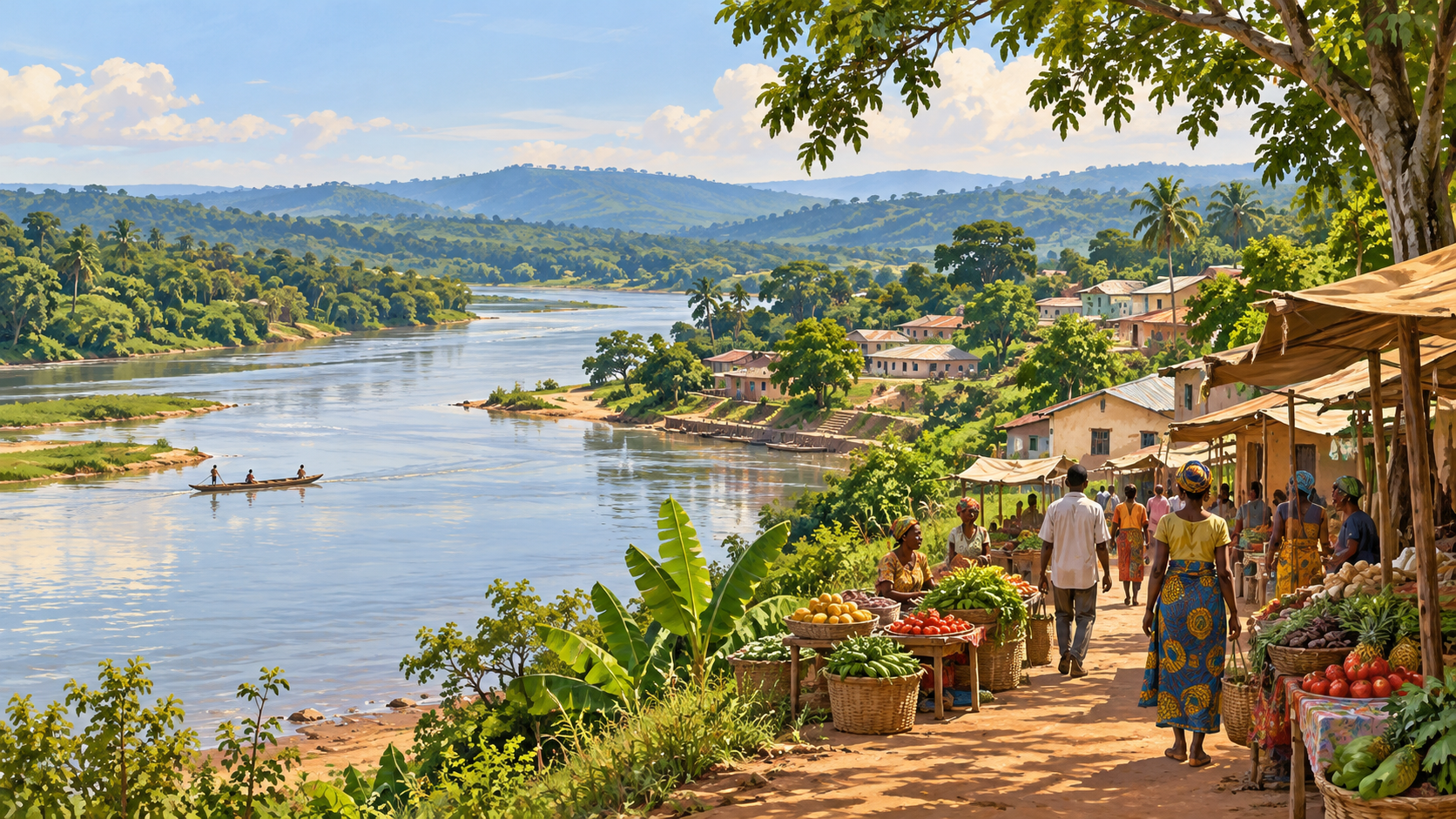
How does the Central African Republic’s government work, who runs its 20 prefectures, and why do diamonds, gold, roads and security affect everyday life? The Central African Republic, often shortened to CAR, is a landlocked country in central Africa. President Faustin-Archange Touadéra began a new term in March 2026 following the December 2025 election. Prime Minister Félix Moloua leads government coordination. National ministries, regional and prefectural authorities, local councils and public workers operate alongside the United Nations peacekeeping mission MINUSCA and humanitarian partners, each with different roles.
The most useful way to understand CAR is to follow a basic need: national decision → security and local administration → usable roads, power and water → school, clinic, market or household. The country has substantial mineral and forest resources, but a resource does not become a family’s livelihood without safe access, skills, fair rules and reliable delivery. Conflict, displacement, chronic poverty and long travel distances make those final links especially important.
Central African Republic at a glance
- Government: republic under a constitution adopted in 2023, with president, prime minister, National Assembly and other institutions.
- 2026 leadership: President Faustin-Archange Touadéra, inaugurated 30 March; Prime Minister Félix Moloua, reappointed in May.
- Territorial map: seven administrative regions and 20 prefectures, including Bangui in the current territorial framework.
- Capital: Bangui on the Ubangi River.
- Money: Central African CFA franc, used within the CEMAC monetary union.
- Economy: agriculture, gold, diamonds, timber, services and trade; dependable jobs and electricity remain major challenges.
- Transport: the Douala–Bangui corridor through Cameroon is a vital import and export route.
- Security: national institutions, peace agreements, armed-group activity and the UN mission MINUSCA all affect the environment in which services operate.
This reader-first guide is reviewed on 20 October 2026. The World Bank’s CAR overview supplies political and economic context. The United Nations’ June 2026 briefing documents the elections and presidential inauguration. The Prime Minister’s Office identifies Félix Moloua.
1. Who leads the Central African Republic in 2026?
Faustin-Archange Touadéra is president and head of state. Prime Minister Félix Moloua leads the government’s work under the constitutional system and the president’s policy priorities. Ministries are responsible for sector decisions involving schools, health, water, agriculture, public works and other services.
The president was inaugurated on 30 March 2026 following the elections at the end of 2025. The National Assembly began its eighth legislature on 4 May, and a new government was formed on 21 May. These dates are important because an older guide may describe the election as upcoming or treat pre-2026 transitional arrangements as current.
Political officeholding is only one part of governance. A minister may announce a road rehabilitation plan, but a local household will benefit only when staff, contractors, financing, security and maintenance turn that decision into a dependable route.
2. What changed with the 2023 Constitution and the 2025–2026 elections?
The Central African Republic adopted a new constitution in 2023, leading to institutions associated with what authorities call the Seventh Republic. The 2025–2026 election cycle included presidential and legislative elections, as well as local and regional voting.
The UN reported that municipal elections had not been held since 1988, making the 2025–2026 process a significant institutional milestone. In April 2026, a second round of parliamentary, regional and municipal voting addressed races and locations that required further ballots.
The completion of voting does not imply that all administrative capacity or democratic safeguards are fully established. Political competition, local participation and civilian safety still require careful observation. A citizen’s opportunity to vote and the actual power of a local council are two separate questions.
3. What does the National Assembly do?
The National Assembly is part of the country’s national legislative framework. Its members debate and adopt legislation, budgets and related policy under the applicable constitutional rules. The executive government then operates ministries and programmes, while courts and oversight bodies have separate functions.
The prime minister’s 2 July 2026 government-policy address was presented to elected deputies, with a programme connected to the 2024–2028 national development plan.
A policy address describes intended direction. A budget may authorize funding. Neither automatically proves that a child has a textbook or a village has safe drinking water. Those outcomes require implementation and independent evidence.
4. Why does CAR have seven regions and twenty prefectures?
Administrative reforms reorganised the country into seven regions and 20 prefectures, with lower territorial units including sub-prefectures and communes. Bangui is part of the current arrangement with its own distinctive capital-city status. Older references to 16 prefectures may describe the pre-reform map rather than the structure currently in use.
Regions and prefectures help connect national decisions to distant communities, but they are not identical offices with unlimited powers. A territorial administrator, elected local representative, technical ministry and service operator may have different responsibilities over the same locality.
A local road, school or market question therefore has two parts: where is the service, and which institution actually has the legal competence and resources? An administrative map can help with the first question without settling the second.
5. What is different about Bangui and rural prefectures?
Bangui is the capital and an important centre of government, commerce, services and transport. It lies along the Ubangi River near the border with the Democratic Republic of the Congo. Rural prefectures may contain settlements separated by long journeys and roads whose condition varies seasonally.
An urban resident might be relatively close to a hospital but face power or affordability constraints. A rural resident might need several hours of travel before reaching an appropriately staffed facility. One national number about healthcare access will not capture these different obstacles.
This explains why public-sector planning must consider the final journey, not only the number of facilities announced. Geographic equity is measured through the actual service available to people in different places.
6. Why does security matter so much to ordinary public services?
CAR has experienced repeated conflict and armed-group activity over many years, leading to displacement, interrupted farming, damaged infrastructure and loss of trust. Improvements in parts of the security environment matter, but the country continues to face local risks and humanitarian needs.
A school may be built but unable to operate if staff and pupils cannot travel safely. A clinic may have medicine stored in a regional town but unable to receive it because the freight route is insecure. A farmer may be reluctant to plant crops if the path to fields or buyers is threatened.
In this setting, peacebuilding is also an education, healthcare and economic issue. Security should be assessed from the civilian’s perspective: can people work, learn, obtain food and reach help without unacceptable danger?
7. What is MINUSCA, and is it part of the government?
MINUSCA is the United Nations Multidimensional Integrated Stabilization Mission in the Central African Republic. It is a UN peacekeeping mission established by the Security Council, not a department of the CAR government. Its authorised responsibilities include civilian protection and support for political and peace processes within its mandate.
The Security Council renewed the mission’s mandate through 15 November 2026. Its mission objectives, operational areas and resources may change with later Council decisions; an article written in October should not promise it will have precisely the same mandate indefinitely.
Consult the official MINUSCA mandate and October 2026 Security Council forecast. The UN mission may cooperate with national authorities, but their legal duties and accountability structures differ.
8. What did local elections change?
Local elections can give communities representatives who raise issues about public services, budgets and local priorities. The 2025–2026 elections were especially notable after a long interruption in municipal voting. However, elected status alone does not provide immediate office space, trained staff or sufficient funding.
The United Nations reported increased representation of women in local councils following the 2026 elections, including a newly elected female mayor in Bangui. That is a real institutional change, but stronger local service outcomes still require follow-through.
The useful question is whether a new council can identify a broken water point, arrange a legal response, coordinate the responsible operator and make public information accessible. That is how political representation reaches everyday life.
9. Why is CAR landlocked, and why does that raise costs?
The Central African Republic has no seacoast. To import machinery, fuel, medicines or many consumer products by ocean shipping, businesses often use ports in neighbouring countries and then move goods by road. This creates additional border, transport, security and scheduling requirements.
A short road distance on a map can still be expensive if the surface is damaged or checkpoints delay vehicles. For some goods, reliable arrival matters more than a low quoted transport rate. A clinic needing medicine cannot simply wait indefinitely for a cheaper truck.
An inland economy can prosper when freight corridors work predictably, but it also needs trade agreements, safe highways, customs arrangements and functioning local markets.
10. Why is the Douala–Bangui corridor essential?
The road and logistics corridor linking Cameroon’s Port of Douala to Bangui is a lifeline for the Central African Republic. It connects international shipping to the national market, carrying imported goods and exports along more than 1,400 kilometres of interconnected routes.
The World Bank stated in June 2026 that the corridor handled more than 80% of CAR’s external trade but suffered high costs, long transit times, road deterioration and checkpoints. It approved a US$1.12 billion multiphase programme for corridor improvements, with a US$525 million first phase.
The World Bank’s 12 June 2026 announcement gives the figures. Funding approved does not mean all construction has been completed or that every truck can already travel at the planned improved speed.
11. How does one blocked road affect a family?
Original fictional example: a truck bringing flour, school materials and medical supplies travels toward Bangui. After a bridge closure, the driver takes a longer route and the goods arrive late. The price of flour increases, a school runs short of supplies and a clinic delays a delivery.
The family sees separate problems—higher food cost, interrupted lessons and less reliable healthcare—but one transport bottleneck connects them. This is why a road project can have a wider social impact than its immediate engineering description suggests.
The right response identifies asset ownership, safety requirements, an alternative supply route and the schedule for a durable repair. Repairing a road is valuable when users receive predictable access again.
12. What is the role of the Ubangi River?
The Ubangi River connects Bangui to waterways of the wider Congo Basin and serves as a source of water, small-scale transport, livelihoods and ecological functions. River conditions vary with seasons, and the usefulness of boat transport depends on water levels, safe vessels, landing places and regulations.
A riverside market can benefit from water transport where suitable, but a river journey does not eliminate the need for road connections and storage. Some goods require refrigeration, safe handling or onward land delivery before reaching customers.
A good geographical guide should look at the river as both an ecosystem and infrastructure, without pretending it is a year-round equivalent of a well-maintained highway.
13. Why do gold and diamonds not automatically create prosperity?
CAR possesses gold and diamond resources, alongside timber, agricultural potential and other natural assets. Mining can generate exports and income, but deposits underground do not provide household jobs or public services by themselves. Extraction requires permits, safety, finance, monitoring, transport and buyers.
The World Bank’s October 2026 poverty brief described a strong 2025 growth figure supported by gold production reporting, higher prices and statistical adjustments, followed by much slower projected growth in 2026. Gold exports can therefore rise without most households experiencing immediate improvements.
The responsible question is: who works in extraction, what revenue reaches the public budget, how are labour and environmental rules enforced, and what part of the value remains with local communities?
14. What is special about diamond certification?
Rough diamond exports are subject to international controls, including the Kimberley Process certification system, designed to reduce trade in conflict diamonds. CAR has experienced restrictions and changes in eligibility due to security and traceability concerns.
A certificate is part of an export-control framework, not a guarantee that every mine is safe or that all workers earn appropriate wages. Independent oversight, traceable supply chains, labour standards and local security are still necessary.
This demonstrates a wider principle: a legal trade route and a socially beneficial industry are related but separate achievements. Regulations help, but performance depends on honest implementation.
15. What is the place of forestry and farming?
CAR has extensive forested areas and significant agricultural potential. Families grow crops and raise livestock under varied conditions. Timber production can earn revenue, while forests also provide biodiversity, water regulation and livelihoods to communities.
Farm productivity depends on tools, roads, security, weather and access to local buyers. A farmer producing cassava may not earn more if the market is too far away or prices collapse when harvests arrive together.
A sustainable forestry or mining policy should also consider Indigenous and local community rights, habitat loss and enforcement. Natural resources can support future generations only when they are not exhausted or managed for short-term benefit alone.
16. Why is electricity access such a difficult issue?
Electricity generation and connections are limited across much of the country. The World Bank reports that a large majority of households lack electricity and describes major investment needs in generation, transmission and distribution. Rural settlements may have particularly limited access.
The World Bank country overview discusses a US$113 million Electricity Sector Strengthening and Access Project, supporting distribution and related improvements. Those investments are not proof of full nationwide electrification.
A power station can produce electricity while distant families remain unconnected. A new line can reach a village while maintenance problems cause outages. Measure the delivered service, not only installed generating capacity.
17. Why does electricity matter to a clinic and a business?
Clinics need lighting, communications, refrigeration and equipment. Schools may need electricity for digital learning, while businesses depend on refrigeration, manufacturing equipment and payment systems. If the power supply is unreliable, people adopt expensive backup arrangements or go without useful services.
Illustrative case: a rural health clinic has trained staff but its refrigerator cannot maintain a safe temperature. An electricity failure becomes a healthcare problem. Repairing that supply may improve treatment capacity without constructing an entirely new building.
The shared dependency is easy to miss in sector budgets: water, health, education and commerce all rely on functioning energy systems.
18. How does safe water connect to disease prevention?
Clean water and sanitation are essential for public health, particularly for children and vulnerable people. A water service includes source protection, treatment, safe storage, distribution and appropriate hygiene arrangements. The availability of a river nearby does not guarantee that household drinking water is safe.
Infrastructure must also survive rainy seasons and be maintained. A broken pump, missing chemical supply or damaged pipe can turn a completed project into an unusable facility.
National reporting on water or sanitation should therefore distinguish installed water points from reliable access, quality tests and whether women, children and people with disabilities can use the service safely.
19. How does insecurity affect schools and children’s futures?
Education requires safety, available teachers, learning materials and sustained attendance. Displacement and armed conflict have interrupted schooling in parts of the Central African Republic, while poverty can make school supplies and travel difficult for families.
The education system includes primary, lower-secondary, upper-secondary and technical pathways. But a formal curriculum does not guarantee learning when classes are interrupted or children are unable to reach school.
For further details consult eduKateSG’s Schools of the Central African Republic, How Education System of the Central African Republic Works and How Ministry of Education for the Central African Republic Works. The exact linked routes should be verified if school rules change.
20. What are refugees and internally displaced people?
An internally displaced person has been forced to leave home but remains within their country. A refugee has crossed an international border seeking protection. CAR has substantial numbers of both internally displaced people and citizens living as refugees in neighbouring countries.
The World Bank’s 2026 overview referred to roughly 428,000 internally displaced people and 719,000 refugees at the end of 2025. Those are time-specific figures, not a live headcount for every day in October 2026. Humanitarian reports may use different cut-off dates and categories.
Displacement affects schools, healthcare, shelter, food supplies and host communities. The right question is whether people can return voluntarily and safely, access adequate services, or obtain other durable solutions.
21. What role do international humanitarian organisations play?
UN agencies and humanitarian groups support protection, healthcare, food, education, water and other needs under their own mandates. They may work with national and local authorities, but are not simply departments inside the CAR government.
For example, an aid agency can deliver medical supplies to a district facility while the national health system is responsible for broader governance and ongoing services. Both roles matter, yet one emergency delivery is not a permanent solution to the financing of a health network.
The UNHCR country programme outlines protection and services for displaced people, refugees and host communities. Long-term improvement should strengthen local capability rather than depend forever on emergency shipments.
22. What makes the Central African CFA franc important?
CAR uses the Central African CFA franc as a member of the Central African Economic and Monetary Community, CEMAC. The regional central bank, BEAC, issues the currency. The CFA franc is fixed against the euro at €1 = 655.957 XAF under the monetary arrangement.
A fixed exchange rate can reduce some forms of currency uncertainty, but it does not make every imported product affordable. Freight costs, border checkpoints, local supply and household income still influence prices.
When a Bangui shop imports goods, the final price may reflect transport from Douala, customs, financing and delays in addition to the currency conversion. A stable rate cannot compensate for every logistical problem.
23. What can recent road investment realistically improve?
The World Bank describes rehabilitation of around 1,700 kilometres of roads in parts of CAR, supporting connections to markets, jobs and services for hundreds of thousands of people. Rehabilitation is significant, but maintenance funding and safe passage are necessary for those gains to last.
A road can become useful to a farmer, a schoolchild and a clinic at once. Conversely, one damaged culvert or unsafe section may limit all three. The highest-value infrastructure is often that which removes several daily obstacles simultaneously.
Do not confuse kilometres repaired with proof that every household along a wider regional route has full year-round access. Follow real journey times and reliability.
24. What is the difference between GDP growth and household wellbeing?
Gross domestic product estimates the value of production. It is not identical to average household income or the ability to buy food. Economic output can rise because gold production or prices increase, while many people remain in subsistence agriculture or the informal economy.
The World Bank’s October 2026 Poverty and Equity Brief describes pervasive poverty, fragile institutions and limited per-person gains despite recent headline growth. Where population rises faster than output, average living standards may deteriorate even when total GDP grows.
A strong national report should therefore examine poverty, jobs, school learning, access to clean water, healthcare and electricity together. A single economic percentage is not a complete description of the country.
25. A family case: follow medicine from port to a rural clinic
Original fictional teaching example: a health authority purchases medicine abroad. Cargo arrives at Douala, crosses Cameroon by road, passes through the relevant controls, reaches Bangui and continues to a rural clinic. The final part of the route may be affected by rain, a damaged bridge or security conditions.
Even when the medicines are paid for, the patient receives no benefit until storage, staff, transport and distribution are coordinated. If refrigeration is required, electricity and temperature monitoring add more dependencies.
To understand the whole system, draw six boxes: purchase, port, border, national warehouse, clinic and patient. Write the possible failure above each arrow. That is how public finance, regional trade, roads, health and security connect.
26. How does CAR compare with Singapore?
The Central African Republic is a large landlocked country with difficult inland access, mineral resources and significant security and humanitarian challenges. Singapore is a small urban island state with a globally connected port and dense infrastructure. They face very different conditions.
Yet both need functional education, transport, safe water, public administration and information systems. The useful comparison is the chain from a decision to an outcome: can a person reach a school, obtain medicines or sell a product reliably?
Read How Singapore Works and How Singapore Connects | Roads, Expressways and Junctions for a compact city-state case. The aim is to understand functions, not copy policies without considering geography.
Frequently asked questions about the Central African Republic
Who is president in 2026?
Faustin-Archange Touadéra, inaugurated for a new term on 30 March 2026. Félix Moloua is prime minister.
How many prefectures does CAR have?
Twenty prefectures under the territorial reorganisation, grouped into seven regions. Bangui has a distinct capital-city role within the current framework.
Is the Central African Republic landlocked?
Yes. It has no ocean coast, and a great deal of trade moves through neighbouring countries, including Cameroon.
What is MINUSCA?
The United Nations peacekeeping mission with an authorised mandate including protection of civilians and support for political and peace processes. It is not the CAR government.
Why is the Douala–Bangui corridor important?
It is a major route for imports and exports connecting CAR with Cameroon’s seaport infrastructure, and road costs or delays strongly affect prices.
Does CAR use the euro?
No. It uses the Central African CFA franc, which is pegged to the euro through the regional monetary arrangement.
Why do gold and diamonds not guarantee prosperity?
Mineral income depends on extraction, legal markets, safe jobs, taxation and governance. Export earnings can rise without reaching most households.
Do all pupils have regular access to school?
No. Poverty, travel, teacher availability and security conditions can interrupt learning, particularly in vulnerable areas.
What is the difference between a displaced person and refugee?
An internally displaced person remains within their own country; a refugee has crossed a national border seeking protection.
What is a good way to understand public services in CAR?
Follow one real need from the national rule through financing, security, transport, local administration and staff to the intended person.
Explore the country and Singapore collections
This guide belongs to How Countries Work, the international sibling of How Singapore Works. Continue to Canada’s federal services, Chad’s oil, water and regional system, Chile’s copper, lithium and earthquake preparedness and Cameroon’s port and transport networks.
Sources and editorial review
- World Bank CAR overview, 2026 — economy, poverty, electricity, security and administration.
- MINUSCA briefing, June 2026 — 2025–2026 elections and inauguration.
- Security Council Report, October 2026 — peacekeeping and political developments.
- MINUSCA official mandate — civilian protection and 15 November 2026 mandate end date.
- CAR Prime Minister’s Office, May 2026 — Félix Moloua and new government.
- World Bank Douala–Bangui programme, June 2026 — trade corridor costs and proposed improvements.
- World Bank Poverty and Equity Brief, October 2026.
- UNHCR country programme — displaced people and access to services.
- Reviewed: 20 October 2026. Local-family cases are fictional teaching scenarios. Security and humanitarian numbers are time-specific, not current real-time totals.