
What should you know about Cuba beyond its name? A country cannot be explained by a postcard, a political slogan or one economic measure. This guide follows the evidence into landscapes, historical turning points, institutions and cultural practices, keeping individual places and communities visible alongside national patterns.
Begin with geography and history, or move directly to food, music, learning and the environment. Cultural knowledge deserves close attention in its own right. Contemporary challenges also need careful evidence, without allowing one event or statistic to stand in for an entire country.
Cuba at a glance
- Capital: Havana.
- UN statistical region: Caribbean.
- Reading date: 20 October 2026; individual observations retain their own dates.
The capital and regional classification are listed in the UNData country profile. This guide uses specific dated sources for the other subjects rather than treating an old country summary as a current account of every institution.
This is an educational overview, not a travel itinerary or personalised medical, legal or financial advice. A cultural or environmental designation does not establish present access or safety. National data cannot replace the experiences of particular households and communities.
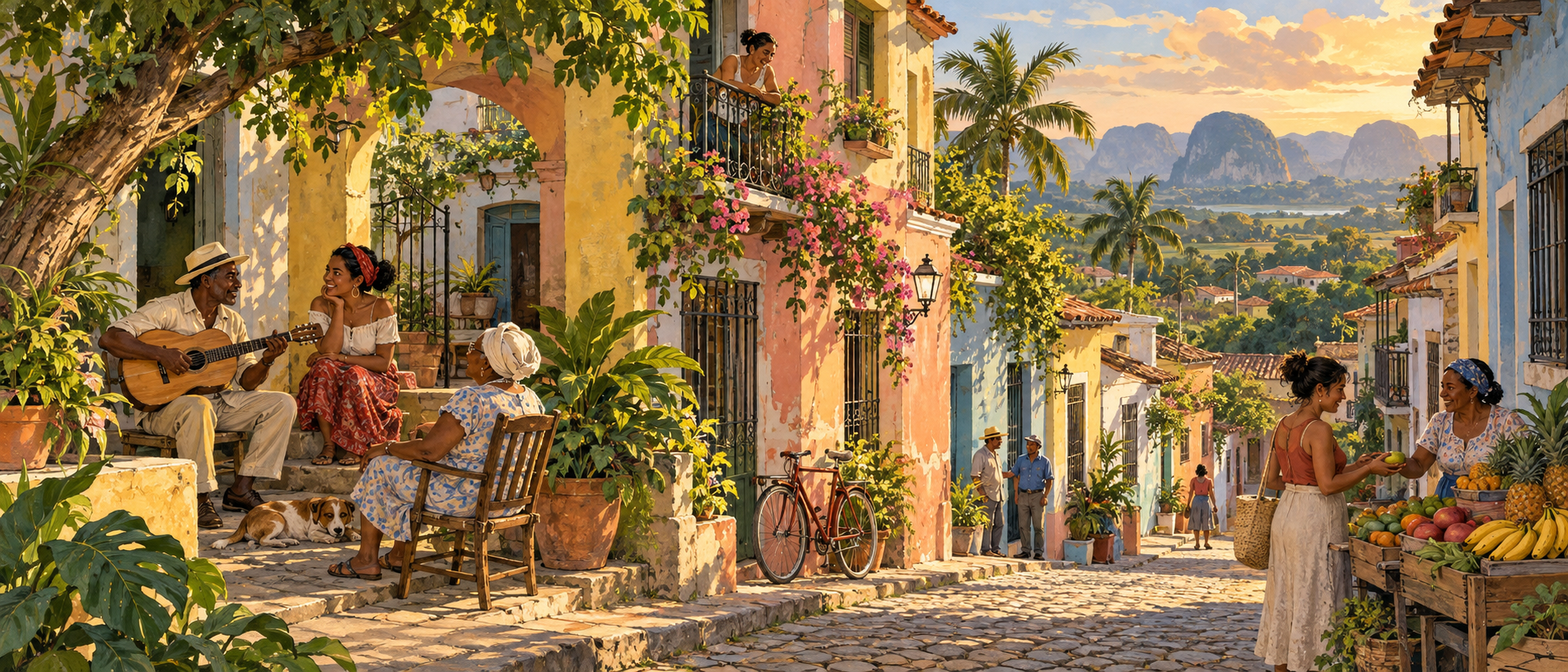
Cover illustration: an original AI-generated artistic interpretation of neighbours, a musician, a bicycle and a fruit stall among colourful houses, trees and distant hills. This is a nonliteral composite, not a photograph or an exact view of a named place.
Choose your route through Cuba
- 1. Geography
- 2. Regions and Places
- 3. Earlier History
- 4. Modern History
- 5. Government and Public Institutions
- 6. People and Languages
- 7. Economy and Work
- 8. Agriculture and Food Production
- 9. Infrastructure and Connections
- 10. Education and Learning
- 11. Health and public services
- 12. Food and shared tables
- 13. Music and oral traditions
- 14. Arts and ways of making
- 15. Community and everyday life
- 16. Heritage and historical places
- 17. Environment and living systems
- 18. Science and practical skills
- 19. Connections with the wider world
- 20. Student connections with Singapore
1. Geography
An island and its surrounding waters
Cuba’s setting is easier to understand when nearby land and water are visible together. A December 2018 image from NASA’s Terra satellite places it beside the Bahamas and the southern United States. The deeper Florida Strait appears dark blue, contrasting with turquoise water above the shallower Bahama Banks. These colour differences help reveal underwater geography. The sea surrounding the island is not one uniform space, but contains varying depths and submerged platforms. (NASA island image)
Cuba, the largest Caribbean island, has a complex coastline. NASA’s account of western Cuba describes offshore island chains, reefs and broad lagoons. In places, reefs form long, nearly continuous barriers separated from the land by shallow water. A map that omits these smaller features misses much of the coastal landscape. Its offshore islands make the country an archipelago, not simply one isolated landmass. (NASA western coastline)
Relief and seasonal rain
Mountain ranges interrupt the island’s otherwise broad stretches of lower terrain. The Sierra Maestra stands out in southeastern Cuba, while the Sierra del Escambray occupies part of the south-central region. ESA’s satellite view makes their position visible within the larger island. That view was assembled from several observations in April and May 2011, rather than one perfectly clear instant. Satellite images are therefore constructed records that can reveal regional patterns while combining different observation dates. (ESA terrain image)
Rainfall has a strong seasonal rhythm, with a wetter period broadly from May to October and a less-rainy period from November to April. Research on western Cuba examined how rainfall varied through time and across locations, rather than assuming that every wet season was identical. Its seasonal comparison included 1961–1993. Its distinction between seasonality and variability remains useful: a familiar annual pattern does not mean that each year supplies the same amount of water. (Western rainfall study)
Rivers and moving plates
The Cauto basin provides an example of how rivers connect landscapes beyond individual settlements. Researchers modelled water availability in its La Fuente and Las Coloradas subbasins, using observed streamflow to test their calculations before examining a climate scenario. Their 2018 study linked rainfall changes with river flow and groundwater recharge. The important geographical connection is that water arriving as rain can follow several pathways; changes in one part of the cycle affect supplies elsewhere downstream. (Cauto basin research)
Southern Cuba also lies beside an active tectonic boundary. The United States Geological Survey attributed the magnitude 6.8 earthquake of 10 November 2024 to shallow, mainly sideways fault movement near the Septentrional-Oriente fault zone. This boundary separates the North American plate from the Gonâve microplate. The event demonstrates that the landscape is not shaped only by weather and rivers. Movement deep within the Earth also influences the island’s surroundings over both sudden and much longer timescales. (USGS November 2024 earthquake)
2. Regions and Places
Administrative geography and the west
Cuba’s administrative map comprises fifteen provinces and the special municipality of Isla de la Juventud. The national tourism authority lists 168 municipalities when that special municipality is included. These units differ from informal descriptions such as western, central and eastern Cuba. The map has also changed: a reform approved in 2010 created Artemisa and Mayabeque from the former Havana province. Older maps may therefore use provincial names and boundaries that no longer match today’s arrangement. (Administrative geography)
Pinar del Río occupies the western end of the main island. Its Guaniguanico mountain system includes the Sierra de los Órganos and Sierra del Rosario, with landscapes shaped by limestone. Steep-sided mogotes, caves and enclosed depressions give parts of the province a distinctive appearance. These features belong to a wider karst landscape, where water acts on soluble rock. The province’s geography consequently includes both the visible hills and drainage routes that continue beneath the surface. (Pinar del Río geography)
Plains and contrasting coasts
Matanzas reaches from the Florida Strait on the north to the Caribbean Sea on the south. The narrow Hicacos peninsula and the extensive Zapata wetland illustrate very different coastal forms within one province. Much of its territory is comparatively flat, and groundwater is an important part of its water resources. A beach-centred description would overlook the plains, wetlands and underground water that connect settlements and productive activities across the province. (Matanzas geography)
Camagüey lies in the central-eastern part of Cuba and contains extensive plains and savannas. Crop cultivation and grazing form part of this broad lowland landscape. Offshore, the Jardines del Rey island chain lies to the north and Jardines de la Reina to the south. The province combines inland territory with island-studded coastal waters. Its shape encourages a useful comparison between the open spaces of the interior and the fragmented geography of its maritime edges. (Camagüey geography)
Eastern mountains and a separate island
Santiago de Cuba province faces the Caribbean in the east of the country. Its territory includes part of the Sierra Maestra, where Pico Turquino reaches 1,974 metres. The province also shares the Cauto river basin with neighbouring provinces, showing how physical systems cross administrative borders. Mountain slopes, river catchments and the coast belong to the same regional picture. Following the water on a map can therefore reveal connections that a list of provincial capitals would leave unexplained. (Santiago de Cuba geography)
Isla de la Juventud lies southwest of the main island within the Canarreos archipelago. Its northern section has rolling plains and hills, while the southern section is flatter and strongly associated with limestone. The Lanier swamp separates these contrasting landscapes across much of the island. Its administrative position should not obscure this variety. Even a relatively small island can contain different terrain, drainage conditions and settlement possibilities rather than one uniform environment from shore to shore. (Isla de la Juventud geography)
3. Earlier History
Indigenous lives and colonial disruption
Cuban history begins long before European colonisation. Smithsonian research on Caribbean Indigenous legacies has worked with communities in eastern Cuba to document knowledge and practices that remain alive. Farming traditions, fishing techniques, basketry and words can preserve connections across generations, even after profound disruption. This evidence challenges a simple story in which Indigenous people disappear from history after conquest. Their descendants and cultural practices belong within accounts of the present as well as discussions of the distant past. (Smithsonian Indigenous legacies)
Spanish colonisation transformed the islands through military occupation, extractive activity and plantation agriculture. The Library of Congress describes the severe effects of disease, overwork and mistreatment on Indigenous populations, followed by the forced arrival of enslaved Africans. Sugar, coffee and tobacco became valuable export crops. Their commercial importance cannot be separated from coercion. Colonial prosperity for owners and merchants was built alongside dispossession, forced labour and unequal control over land and political power. (Library of Congress colonial history)
Slavery and struggles for change
The SlaveVoyages research database provides a way to investigate the forced movement of Africans to Cuba and other American destinations. It brings together evidence about ships, embarkation places, destinations and the people transported. Individual recorded voyages and estimates of the wider trade are not interchangeable: surviving records are incomplete. Behind the tables were people separated from families and communities. Studying the records helps restore the scale and organisation of this violence without reducing enslaved people to numbers alone. (SlaveVoyages research database)
An independence uprising began on 10 October 1868 and developed into the Ten Years’ War. Fighting ended in 1878 without securing Cuban independence. The period nevertheless altered colonial politics and the struggle over slavery; slavery finally ended in 1886. Ending legal enslavement did not immediately produce national sovereignty, nor did political reform erase colonial inequalities. (Cuba in 1898)
Renewed war and a changed international setting
José Martí helped organise a renewed independence movement that drew support across racial and social divisions. Fighting resumed in eastern Cuba in February 1895. The conflict spread and became destructive for civilians as well as combatants, particularly when Spanish forces concentrated rural inhabitants in towns. Martí’s political project sought Cuban independence, not simply a transfer of colonial authority. That distinction matters when considering the United States’ subsequent intervention in the war. (Cuba in 1898)
War between Spain and the United States in 1898 changed the international outcome of Cuba’s independence struggle. The Treaty of Paris, signed on 10 December, required Spain to relinquish its claim to Cuba. Its treatment of Cuba differed from the cession of Puerto Rico, Guam and the Philippines. The end of Spanish sovereignty did not mean that Cubans immediately controlled an unrestricted independent state. The settlement introduced a new period in which United States power shaped Cuba’s political future. (Treaty of Paris history)
4. Modern History
Republic and revolution
The early republic developed under restrictions associated with the Platt Amendment. Conditions adopted by the United States in 1901 were incorporated into a treaty with Cuba in 1903, including a claimed right of intervention. Most of these arrangements were repealed in 1934, while provisions concerning naval stations remained. Independence and freedom from outside influence are not identical. A country can possess republican institutions while facing substantial constraints imposed through its international relationships. (National Archives Platt Amendment)
Fulgencio Batista’s seizure of power in 1952 helped define the political conflict of the following years. United States diplomatic records themselves acknowledged the illegality of that takeover. A January 1959 memorandum recorded his departure on New Year’s Day after advances by the revolutionary movement led by Fidel Castro. It also described a provisional government headed by Manuel Urrutia. These records capture a transition, not a finished political system with its later direction settled. (Diplomatic records of 1958–1959)
Cold War confrontation
In April 1961, a United States-backed force of Cuban exiles attempted to overthrow the revolutionary government. Brigade 2506 landed at the Bay of Pigs on 17 April, but the invasion failed. The Kennedy Library’s archival teaching materials show how planning, intelligence, air support and decisions in Washington shaped the operation. The episode was therefore both a Cuban conflict and an international intervention, with consequences extending beyond the landing site. (JFK Library Bay of Pigs archive)
The October 1962 missile crisis brought Cuba to the centre of a confrontation between the Soviet Union and the United States. American reconnaissance identified Soviet missile installations, and President Kennedy imposed a naval quarantine. Correspondence and negotiation eventually produced an agreement to remove the missiles, alongside American assurances against invasion. The archival record reveals a crisis managed through both military pressure and communication. Cuba’s territory was central, although the decisive exchanges were conducted between the two superpowers. (JFK Library missile-crisis records)
Economic upheaval and diplomatic openings
The loss of Soviet support and trading relationships contributed to the severe economic crisis remembered as the Special Period. In research published in 2005, economist Carmelo Mesa-Lago examined the contraction and the uneven recovery that followed. He found that improvements after 1994 did not restore every social indicator to its earlier level and that inequality had increased. This historical assessment complicates accounts that describe either uninterrupted social progress or a recovery experienced equally by every household. (Mesa-Lago historical research)
On 17 December 2014, President Barack Obama announced that the United States would begin discussions to restore diplomatic relations with Cuba. His statement marked a major policy opening after decades of estrangement. It was an announcement of a process, not evidence that every dispute had disappeared that day. The episode illustrates how diplomatic relations, trade restrictions and political disagreements can change at different speeds. It remains a historical turning point, not a description of present policy. (White House statement of 2014)
5. Government and Public Institutions
Constitution and representation
The constitution proclaimed in 2019 defines Cuba as a socialist republic and assigns the Communist Party a leading role in society and the state. It identifies the National Assembly of People’s Power as the supreme organ of state power. These provisions describe a political system organised differently from competitive multiparty parliamentary government. Constitutional statements alone cannot establish how fully rights are protected in practice. (Constitution of 2019)
The Inter-Parliamentary Union records that the National Assembly election of 26 March 2023 offered 470 candidates for 470 seats, with all candidates elected. Those figures describe that election, rather than the number of occupied seats at every later date. They also show why participation in voting should not be confused with a contest among rival parties for government. Nominations and the available alternatives are important parts of understanding any electoral system. (IPU election record 2023)
Executive offices and territorial administration
The 2019 constitutional framework distinguishes the president as head of state from the prime minister as head of government. The National Assembly elects the president and appoints the prime minister on the president’s proposal. These offices should not be treated as interchangeable titles. Later amendments also matter when using the original text: an old constitutional provision should not automatically be presented as unchanged current law. (Constitutional offices)
Government administration also operates through provinces and municipalities. UNDP’s PADIT programme supports connections among these levels, including territorial planning, local development strategies and cooperation with universities. It works on practical capabilities such as financing, information and coordination between public institutions and local enterprises. These activities show that administration involves more than decisions made at national headquarters. They describe an effort to strengthen local management, without proving that every community has equal influence over the decisions affecting it. (UNDP territorial administration)
Oversight and rights in practice
Cuba’s 2018 submission to the United Nations anti-corruption working group described the Comptroller General’s Office, established in 2009. That submission described responsibilities including auditing and oversight of public resources. Such a mandate identifies who is assigned to examine the handling of public assets. It does not by itself demonstrate how independently investigations operate or how effective they are. Institutional design and observed accountability require different kinds of evidence. (Cuba audit submission 2018)
The Inter-American Commission on Human Rights offered a sharply critical assessment in its annual report covering 2025. It documented restrictions on political participation, expression and peaceful assembly, including the criminalisation of dissent and protest. These findings belong alongside descriptions of formal institutions in an account of government. They are the Commission’s assessment of actual conditions. A balanced introduction distinguishes official constitutional claims, administrative responsibilities and independent scrutiny instead of treating any one of them as sufficient. (IACHR report on 2025)
6. People and Languages
Population as a changing picture
A population number is meaningful only when its date and method are clear. The United Nations statistical report lists 11,167,325 people for Cuba’s September 2012 census. That is a historical census result, not a claim about how many people live in Cuba today. Births, deaths and migration alter the population between counts, while different statistical systems may define residence differently. The reference date prevents an older, precise-looking total from misleading readers about the present. (UN historical census table)
At a July 2026 discussion organised by UNFPA and the University of Havana’s demographic research centre, participants examined declining fertility, migration and population ageing. They connected these changes with housing, employment, care and young people’s plans for their lives. Ageing was discussed as a reality requiring appropriate support, not as a failure by older people. This brings human choices and material circumstances into demography alongside its numerical descriptions. (UNFPA demographic discussion 2026)
Spanish and other linguistic inheritances
Spanish is central to Cuba’s public and literary life, but it is not a language used identically everywhere. The Cuban Academy of the Language, founded in 1926, studies and cultivates Spanish with particular attention to its Cuban forms. Its work includes research, publications, teaching and advice. Such institutions help document vocabulary and usage rather than making everyday speech perfectly uniform. Regional expression and changing language habits remain part of the living material that scholars investigate. (Cuban Academy language history)
Haitian migration has also left linguistic and community legacies in Cuba. A field study published in 2009 documented migrants and descendants in Camagüey communities including Caidije and Guanamaca. Interviews carried out in 2002–2004 recorded the continuing role of Haitian Creole and knowledge passed between generations. This was research in particular communities, not a national count of speakers. It demonstrates why a country’s dominant language does not exhaust its languages and memories. (Camagüey community fieldwork)
Migration and connections across the sea
Cuban mobility extends across several parts of Latin America and the Caribbean. IOM’s monitoring for January–May 2026 examined movements and settlement in the Caribbean, Central America and South America. The resulting picture is more varied than a single departure route leading to one destination. People may pass through several places or remain along the way. Observations at particular borders help describe these patterns, but they should not be added together as if each crossing represented a different person. (IOM mobility monitoring 2026)
The Chinese in Cuba Archive at the Chinese University of Hong Kong preserves another history of transnational connections. Its materials include letters, photographs, printed documents and interviews, with records spanning 1918–2019. These sources reveal relationships between Cuba, China and Chinese communities elsewhere through the details of family and organisational life. They also broaden the meaning of migration history: movement is not only an arrival or departure, but can involve correspondence, obligations and memories maintained over many decades. (Chinese in Cuba Archive)
7. Economy and Work
A changing economic framework
Cuba’s economy has faced overlapping domestic and external pressures. In its December 2025 preliminary overview, ECLAC forecast a 1.5 percent contraction for that year after a 1.1 percent decline in 2024. It discussed low investment, delayed reforms, fuel shortages, weaker tourism and external shocks. The forecast is a dated assessment, not a final measurement of 2025 output. Productive capacity, policy choices and international conditions interact in shaping economic performance. (ECLAC December 2025 forecast)
The economy includes enterprises with different forms of ownership. A 2024 decree-law on micro, small and medium enterprises recognises state, private, mixed and organisational ownership. It classifies microenterprises as having one to ten occupied persons, small enterprises eleven to thirty-five, and medium enterprises thirty-six to one hundred, counting partners as well as workers. These categories describe scale, not business success. They also show why the presence of private enterprise cannot be reduced to one uniform type. (Enterprise framework of 2024)
Trade and monetary change
Merchandise trade connects Cuban production and consumption with suppliers and buyers abroad. European Commission tables on trade with Cuba separate goods such as food, beverages, tobacco and manufactured products, showing that imports and exports have different compositions. These bilateral tables cover the European Union’s trade with Cuba, not all Cuban trade worldwide. They also exclude services. Identifying the trading partner, product category and statistical scope prevents mistaking one subtotal for the entire economy. (EU goods-trade tables)
A major monetary reorganisation began in January 2021. ECLAC’s contemporary survey explained that the convertible peso, or CUC, was being discontinued while the Cuban peso, or CUP, remained the national currency. The reform also involved wages, prices, pensions and subsidies. It was therefore more than a change in banknotes: it altered the accounting relationships facing enterprises and households. Historical exchange arrangements should not be mistaken for current rates or purchasing-power comparisons. (ECLAC monetary-reform account)
Local businesses and industrial production
UNDP’s Mi Emprendimiento project illustrates support aimed at local businesses rather than the economy as a single aggregate. Its programme includes business learning, links between producers, advice, women’s participation and small-scale financing pilots. The project connects enterprise development with local institutions and relationships between public and private actors. These are practical business needs: an enterprise needs knowledge and reliable connections as well as equipment. Programme activities, however, do not guarantee that every participating business becomes profitable. (UNDP Mi Emprendimiento)
Nickel and cobalt production illustrates the economy’s industrial and international connections. Sherritt reported that its Moa joint venture produced 25,240 tonnes of finished nickel and 2,729 tonnes of cobalt in 2025, on a full venture basis. The production chain links mining in Cuba with refining in Canada, so these are not quantities refined entirely inside Cuba. The company also described constraints from mined feed, procurement, power interruptions and hurricane disruption. Its dated report shows how infrastructure affects industrial output. (Sherritt production report 2025)
8. Agriculture and Food Production
Fields and cooperative production
Food production depends on land, inputs, water and dependable energy. FAO’s December 2024 assessment expected below-average maize and paddy harvests, linking the outlook to reduced planted areas, costly or scarce inputs and disruptive weather. Storm damage added to the difficulties. This describes that season, not every later harvest. It shows why a productive crop variety alone cannot resolve shortages when farmers also face constraints on cultivation, irrigation and harvesting. (FAO crop assessment 2024)
Cooperatives have been important partners in programmes to improve maize and bean production in eastern Cuba. IFAD’s independent evaluation of PRODECOR found gains in technical knowledge and postharvest handling, but less progress than expected in yields and incomes. Limited inputs, spare parts and difficult trading conditions affected results. This evaluation resists a simple success label. Better processing can reduce losses while other obstacles still prevent farmers from obtaining the expected increase in production or earnings. (IFAD PRODECOR evaluation)
Tree crops and fruit chains
Coffee and cocoa cultivation connect agriculture with eastern Cuba’s mountainous landscapes. IFAD’s 2019 design for PRODECAFE proposed support for cooperatives through planting systems, processing, training and improved participation by women and younger people. Agroforestry was part of the approach, linking tree cover with crop production. A project design sets out intended changes rather than proving that they have already occurred. It reveals the work involved in strengthening a crop chain beyond harvesting. (IFAD coffee and cocoa design)
Mango, guava and papaya are the focus of UNDP’s Agrofrutales project. Its activities connect planting material and cultivation with processing and marketing, treating the fruit chain as a series of linked stages. A fruit can be grown successfully yet still fail to reach consumers if handling or processing is inadequate. This approach makes nurseries, equipment, skills and local business connections part of agricultural development. Value created after harvesting matters alongside what grows in an orchard. (UNDP Agrofrutales)
Specialised crops and fisheries
Tobacco cultivation involves different growing conditions for leaves intended for different purposes. The producer Habanos distinguishes shade-grown wrapper leaves from sun-grown leaves used for other parts of a cigar. Harvested leaves also undergo curing and preparation before manufacturing. Describing these stages explains a specialised agricultural skill without promoting tobacco consumption. The crop’s economic identity depends on coordinated work from the field onward, including the careful handling and classification of material that may look similar to an inexperienced observer. (Tobacco cultivation account)
Fisheries add another kind of food production, drawing on marine resources rather than cultivated fields. In August 2026, FAO described work with state and private fishers around the Gulf of Guacanayabo under the Conpescas project. More selective fishing gear was intended to reduce unwanted catch and improve fishing practices. These interventions do not establish that entire fish populations have recovered. Production methods and ecological outcomes need to be examined together over time. (FAO fisheries project 2026)
9. Infrastructure and Connections
Moving people and goods
Transport infrastructure includes local journeys as well as major roads and ports. In January 2023, UNDP described the opening of a public-bicycle pilot associated with CUJAE and Reloj Club in Havana. The Neomovilidad programme also worked on electric tricycles and pedestrian spaces. Such projects address the short trips that connect people with education, work and nearby services. A pilot demonstrates an approach, not comprehensive transport coverage across a city or country. (Havana mobility pilot 2023)
Mariel’s container terminal illustrates the infrastructure needed to move goods between ships and inland destinations. A port presentation in 2017 described facilities in a sheltered bay west of Havana, including a 702-metre berth and railway connections in its 2016 inventory. It also distinguished existing facilities from a much larger future expansion plan. These are historical design and infrastructure figures, not current cargo volumes. A port’s significance depends on connections and use as well as physical dimensions. (Mariel infrastructure presentation)
Electricity and system reliability
IRENA’s profile, updated in September 2025, reported that non-renewable sources supplied about 95 percent of Cuban electricity generation in 2023. Renewables supplied the remainder through bioenergy, solar, hydropower and wind. This describes electricity generated, not simply installed equipment capacity. The distinction is important because a generator’s rated capacity does not tell us how often it operates. Fuel availability, maintenance and network conditions affect how much electricity ultimately reaches users. (IRENA generation profile)
The United Nations’ 2026 response described a much more immediate problem: severe fuel shortages disrupting essential activity. Its revised March action plan and a May account by the Resident Coordinator connected energy constraints with water supply, transport, food production and public services. These assessed an unfolding crisis, not long-term targets. They demonstrate how failures in one network can spread across others, because pumps, vehicles, refrigeration and communications all depend on reliable energy in different forms. (UN energy response 2026)
Water systems and digital links
Water infrastructure must manage the resource below ground as well as the pipes above it. JICA’s Cuban case study describes heavy groundwater use in Havana, Artemisa and Mayabeque, with declining water levels and salinity creating difficulties. Its work supports monitoring, basin councils and coordination between water and agriculture institutions. A well cannot be understood in isolation. Several users drawing from connected groundwater systems need information and planning that extend beyond a single municipal boundary. (JICA groundwater case study)
Digital communication also relies on physical infrastructure that is often invisible from land. Orange Marine records the Arimao submarine cable project connecting Cuba with Martinique in 2023. An undersea cable is part of the international route along which information can travel, but it is only one layer of connectivity. Domestic networks, equipment, electricity and service arrangements still shape what users can access. The existence of a new international link therefore does not mean every household has affordable, reliable broadband. (Orange Marine Arimao project)
10. Education and Learning
Literacy and the early years
The 1961 literacy campaign remains a major reference point in Cuban educational history. Its documentary collection, entered in UNESCO’s regional Memory of the World register in 2017, preserves teaching materials, letters from learners and other records. These sources show how a mass educational campaign reached different localities and brought teachers and learners together. They offer evidence about methods and individual experiences, rather than merely a celebratory slogan. Archives allow later generations to question earlier educational efforts. (UNESCO literacy-campaign archive)
Early learning is not confined to a conventional classroom. UNICEF’s publication on Educa a tu Hijo describes a non-institutional approach involving families, community members and trained facilitators. Activities support children’s development through everyday relationships and can be adapted to local circumstances. The programme grew from attention to children who were not attending institutional preschool provision, including rural communities. Its design highlights caregivers’ educational role and guidance connecting professional knowledge with daily family life. (UNICEF early-learning publication)
School pathways and practical skills
The school system includes six years of primary education followed by compulsory basic secondary education. Beyond this stage, preuniversity and technical-professional routes serve different educational purposes. UNESCO’s SITEAL profile also describes specialised provision and support for learners with disabilities. These pathways should not be collapsed into one identical experience for every child. The organisation of schooling combines common stages with different settings, programmes and forms of support. (SITEAL school structure)
Technical and professional education connects classroom learning with occupational skills. UNDP’s PROFET project, running from 2019 to 2026, worked with polytechnic institutions and employment partners in fields including agriculture, construction, services, transport, mechanics and communications. Its activities addressed teaching, equipment and inclusion alongside links with workplaces. This combination recognises that practical competence requires opportunities to apply knowledge. Training can improve preparation for work, although completion of a programme cannot by itself guarantee that suitable employment will be available. (UNDP vocational training)
Further study and learning evidence
Higher education includes degree programmes, master’s qualifications, specialisations and doctorates. The Ministry of Higher Education has responsibility for directing and supervising policy at that level. Separate adult-education routes allow learners to complete primary, basic secondary and upper-secondary equivalents. Continuing education offers routes for people whose studies were interrupted or whose work and interests lead them towards further learning. (SITEAL further education)
Cuba participated in UNESCO’s ERCE 2019 regional assessment, which examined learning in primary-school grades three and six. The study covered reading, writing and mathematics, with science also assessed in grade six. Such exercises provide evidence about specified skills among a defined group of students. They are not complete verdicts on a country’s education system or measurements of pupils studying many years later. Their value comes from clear questions, comparable methods and attention to learning conditions. (UNESCO ERCE 2019)
11. Health and public services
Primary care in Matanzas
Matanzas provides a concrete starting point for understanding health services. PAHO’s account of HEARTS traces Cuba’s participation to the Carlos Verdugo polyclinic in 2016. The initiative brings cardiovascular prevention and hypertension management into primary care. Its emphasis is organisational as well as clinical: teams need consistent procedures, useful records and ways to follow patients over time.
The same account describes continuing staff training and work on data quality in 2024. These are less visible than a hospital building, but they influence how services are organised and assessed. A documented improvement programme is not, by itself, evidence that every person can obtain every needed consultation or medicine. Distinguishing an initiative from its measured reach helps avoid easy national slogans.
Reading a dated achievement
On 30 June 2015, WHO validated Cuba’s elimination of mother-to-child transmission of HIV and syphilis. The announcement described maternal care, testing and treatment, supported by an international assessment. This was recognition of a defined public-health achievement at a particular time, not a declaration that the infections had disappeared or that maintaining prevention would no longer require sustained work.
WHO explained that elimination in this context means transmission has fallen sufficiently low to cease being a public-health problem; it does not necessarily mean zero cases. The assessment also considered rights and the quality of services. Keeping the definition beside the date is essential. A historical validation cannot establish today’s medicine availability, staffing, or an individual family’s experience.
Resources behind everyday care
PAHO’s summary of its 2025 work in Cuba, published in April 2026, offers a more recent view of practical constraints. It describes cooperation to secure essential medicines amid limitations affecting production and imports, alongside work on immunisation, emergencies and other health priorities. The careful reading is that institutions were responding to identified needs, not that those needs had all been resolved. For a patient, a national programme and a usable service are different things. Supply, continuity and local circumstances therefore belong in any discussion of care, alongside documented achievements and the work of health professionals.
Public services also depend on water and power. UNICEF’s November 2025 account describes three portable treatment plants moved to Río Cauto and Cauto Cristo in Granma after Hurricane Melissa damaged water systems and flooded wells. The plants had their own generators, allowing operation apart from the electricity network. Prepositioned equipment and coordination with Cuba’s water institute mattered before the emergency as well as afterwards. This example makes preparedness tangible: machines, fuel, transport and trained operators must come together. It records a response in particular communities, rather than guaranteeing present water quality throughout the country.
12. Food and shared tables
Cassava bread as knowledge
Cassava bread connects Cuba with a wider Caribbean and Latin American history. UNESCO’s 2024 multinational inscription includes Cuba alongside four other countries and emphasises knowledge rather than one identical product. Bread can vary in size, thickness, texture and taste. Preparing the tuber and transforming it into bread involves inherited judgement, tools and coordinated stages of work.
The inscription traces transmission through families and communities, with culinary institutions and media also contributing. Its account recognises Indigenous and African heritage without making every contemporary loaf represent the same household story. This is a useful distinction between shared tradition and uniformity. A brief cultural description is not a preparation guide: safe processing requires knowledge that a classroom summary cannot replace.
A Camagüey cooking pot
Camagüey’s regional tourism account gives ajiaco a particular local setting. It describes a broth bringing meats together with ingredients such as maize, pumpkin, plantain and root crops, accompanied by casabe. The interest lies partly in combination: ingredients retain their different textures while contributing to a shared pot. Naming Camagüey is more informative than presenting one recipe as every Cuban family’s meal.
The same account associates communal preparation with the San Juan festivities around 24 June, when neighbours contributed ingredients. Read this as a documented local tradition, not a promise that every street follows an unchanged annual routine. Food history includes decisions about contribution, preparation and distribution. The pot can reveal relationships among participants as well as the names of its ingredients.
Cuisine and food access
Cuba’s official gastronomy presentation places tamales, tostones, congri and roast pork among a wider range of dishes. It also describes historical influences from Indigenous peoples, Spain, Africa and later migrations, and identifies privately operated paladares within the food landscape. Such a list is an introduction to culinary vocabulary, not a survey of what households can buy or cook each day. Nor should cultural mixture erase the unequal circumstances in which people travelled and worked. A thoughtful food chapter can appreciate preparation and memory while leaving room for regional variation, personal preference, religious practice and changing resources.
Food security asks another kind of question. In July 2025, WFP announced a Canadian-supported project with UNICEF running through December 2029 in six municipalities of Holguín and Mayabeque. Its planned connections between producers and social institutions included schools, childcare settings and maternity homes, with attention to nutrition and hygiene. These are project intentions and an identified area of cooperation, not proof that all intended improvements have occurred. Comparing this institutional account with a cuisine description shows why a celebrated dish and reliable access to adequate food should never be treated as interchangeable measures of wellbeing.
13. Music and oral traditions
Rumba as an encounter
UNESCO’s rumba account locates important roots in Havana and Matanzas neighbourhoods and recognises African, Antillean and Spanish influences. Singing, percussion, clapping and gesture belong together. The performance is not simply a tune played to a passive audience: exchanges between dancers, musicians and onlookers help shape what happens. Place and participation matter alongside the sound.
The 2016 inscription also describes transmission through families and neighbourhood relationships. Learners observe, imitate and join in, developing knowledge through interaction rather than a written score alone. This does not make the practice effortless or unchanging. Recognising the coordination involved gives more respect to performers than treating rumba as spontaneous entertainment that everyone in Cuba must naturally know.
Son and skilled collaboration
Cuban Son entered UNESCO’s Representative List in 2025. Its description brings together singing, instrumental playing, rhythm and movement, with structured patterns that leave room for improvisation. The tres, a stringed instrument, has an important role. A song can connect everyday subjects with arrangements that musicians recognise, negotiate and renew as they perform together.
The same account draws attention to people beyond the lead singer, including instrument makers and those who teach. Family settings, bands, communities and schools provide different routes into the practice. Listening closely can therefore become an exercise in identifying roles: who introduces a phrase, who responds, and what holds the group together? Son is collaboration developed through listening and practice, not merely a national soundtrack.
Different histories of song
La Tumba Francesa preserves a distinct Afro-Haitian history in eastern Cuba. UNESCO connects its arrival with people displaced from Haiti during the upheavals of the 1790s, including enslaved people brought to Cuba. The tradition combines song, dance and percussion. A lead singer, the composé, introduces the singing; the catá provides a struck wooden sound, while hand-played drums called tumbas contribute other parts. Naming these roles prevents a vague description of all percussion as the same rhythm. The tradition’s history also reminds listeners that cultural movement can arise from coercion and upheaval, not only voluntary exchange.
Bolero offers another relationship between voice and experience. Cuba and Mexico share the UNESCO inscription added in 2023, which highlights emotion, poetry and the expression of everyday feelings through song. Performance can occur in households, public spaces, concerts and serenades, while learning involves both informal transmission and specialist study. The shared inscription does not erase differences between singers or countries. Instead, it provides a way to discuss exchange without assigning exclusive ownership to one place. Students can examine phrasing, accompaniment and performance setting without copying lyrics or assuming that every love song belongs to the same tradition.
14. Arts and ways of making
Looking at Wifredo Lam
Wifredo Lam’s La jungla, or The Jungle, dates from 1942–43. MoMA’s object record identifies oil and charcoal on paper mounted on canvas. Its crowded, elongated figures appear among plant forms, including sugar cane. Looking first at the surface, arrangement and materials helps establish what the artwork actually presents before a viewer moves towards interpretation.
The museum’s interpretation connects the painting with plantation histories and Afro-Caribbean experience. That reading should be identified as curatorial interpretation, not confused with a photograph of one recorded event. Hybrid bodies, compressed space and repeated vertical forms are artistic choices. They allow students to ask how a painter can address history without illustrating it as a straightforward sequence of scenes.
Posters as documentary heritage
Cuban film posters received international Memory of the World registration in 2023. UNESCO’s record describes materials preserved by the Cinemateca de Cuba and connects them with cinema, events and retrospectives. A poster initially has a practical task: drawing attention to a screening. Its lettering, colour and image must communicate within the limits of a designed sheet.
The same record notes how posters also entered homes and workplaces as decorative objects. Their movement from publicity to collection changes how they are viewed and preserved. Documentary heritage is not restricted to formal manuscripts. A poster can reveal relationships between graphic artists, films and audiences, while its design remains different from the moving images it originally helped to promote.
Books and bodies in motion
Matanzas offers a different meeting of text and material through Ediciones Vigía. A Library of Congress conservator’s December 2024 account describes handmade artist books using paper and additions such as fabric, thread, wood or shells. These irregular, sometimes projecting elements create preservation problems that ordinary shelving cannot solve. Custom boxes and supports must fit the object without crushing its details. The example makes conservation a form of attentive problem-solving: measuring, selecting materials and anticipating movement matter alongside reading. An artist book is not only a container for words; its physical construction can be part of the work.
Dance adds another dimension to artistic skill. Les Grands Ballets’ historical biography of Alicia Alonso records her early training in Havana, further study in the United States and the founding of Ballet Alicia Alonso in 1948, a predecessor of Cuba’s national ballet company. Her career connects technique, performance and institutional creation across borders. The useful lesson is not that one celebrated artist represents every dancer. It is that training requires sustained practice and that a company depends on many kinds of work. Choreography, teaching, rehearsal and musical collaboration help turn an individual performance into a continuing artistic institution.
15. Community and everyday life
Preparing the Parrandas
Las Parrandas, recognised by UNESCO in 2018, brings together several kinds of making in central Cuba. The inscription traces the festivities to Remedios and describes competing neighbourhood groups preparing floats, costumes, lights and performances. Much of the activity takes place before the public celebration. Designing and assembling something together can be as important to community relationships as the finished display.
The account also emphasises the transmission of practical skills between generations. Older forms and new ideas meet through the work of builders, designers and performers. Rivalry here belongs to a particular festive organisation; it should not become a claim about how every Cuban community behaves. Describing preparation makes participants visible as skilled contributors rather than anonymous figures in a colourful spectacle.
Learning responsible service
An IFRC account from 2025 describes Cuban Red Cross work in Varadero, including a school interest group and supervised preparation for helping others. Communication matters: recognising when help is needed and conveying a location are different from attempting a medical procedure. The account places practical learning within an organised service, where responsibility and supervision accompany the wish to be useful.
Local radio also appears in the account, including collaboration with Radio Varadero’s Sonido Azul programme. Public communication can extend preparedness beyond the people attending a workshop. This is a concrete relationship between volunteers, institutions and listeners, not proof that emergency assistance is always immediately available. Students can ask who trains volunteers and how information is checked before proposing a community service activity.
Conversation and shared decisions
In Guantánamo, UNICEF’s October 2025 account of the Andando workshop describes adolescents using an expression and innovation kit after Hurricane Oscar. Group conversation explored respect, emotions, violence prevention and relationships. The setting matters: participants were not simply receiving a lecture, but making room to speak and listen together with support from facilitators. This is evidence of a particular activity, not a measurement of every young person’s wellbeing. It suggests a useful question for any school: how can adults create conditions in which students can contribute without being pressured to disclose private experiences or speak for an entire community?
A different kind of participation appears in UNESCO’s 2025 account of a Trinidad heritage workshop. Cultural associations, planners, guides and tourism students discussed sustainable itineraries and the safeguarding of living practices. The point was not only to attract visitors, but to consider how activities relate to the communities that sustain them. A workshop proposal is not an implemented policy, and tourism can create competing demands on space and attention. Nevertheless, the documented discussion shows why residents and practitioners belong in decisions about heritage. A place is more than a backdrop, and its everyday users are more than supporting characters.
16. Heritage and historical places
Reading Old Havana
Old Havana’s World Heritage record links the city founded in 1519 with its bay, maritime connections and defensive structures. Plazas such as Armas, Vieja and San Francisco organise different urban spaces. Residences with arcades, balconies and courtyards add another scale of evidence. The historical place is therefore an arrangement of streets and buildings, not just a collection of impressive façades.
Baroque and Neoclassical features reflect different periods of construction and taste. Reading these layers requires attention to use as well as style: a fortification, a courtyard dwelling and a public square answer different needs. Heritage recognition does not mean a city stopped changing. Its buildings belong within a living urban setting, where conservation and everyday occupation must be considered together.
Sugar landscapes around Trinidad
Trinidad and the Valley de los Ingenios connect town architecture with the sugar economy that helped finance it. UNESCO’s record identifies grand residences alongside mills, plantation buildings and transport routes in the surrounding valleys. Keeping these elements together changes the interpretation. Urban elegance cannot be understood fully if the fields, machinery and labour that supported it disappear from the story.
The landscape includes evidence of enslaved labour, including barracks associated with plantation production. Naming that history is essential rather than an optional qualification to a picturesque description. Students can trace relationships between residence, worksite and route on a map. Such an exercise asks where wealth came from and who produced it, not merely which building has the most decorative frontage.
Two ways of organising a city
Cienfuegos offers a specific example of planned urban space. Founded in 1819 by French settlers within Spanish territory, its historic centre developed around a grid and public spaces, including the area of today’s Parque José Martí. UNESCO highlights attention to light, ventilation and the organisation of streets, alongside Neoclassical and later eclectic buildings. Planning is therefore part of the heritage, not simply the background behind individual monuments. A classroom sketch can mark blocks, open spaces and connections, then ask what the plan made convenient and whose needs it prioritised. Those questions interpret evidence without assuming that orderly geometry creates equal living conditions.
Camagüey’s historic centre invites a different kind of close reading. UNESCO describes irregular streets, small squares, alleys and blocks, with religious buildings serving as landmarks. Earthen construction and large clay water-storage vessels add evidence about materials and domestic needs. A map alone will not reveal all of this: a building detail or courtyard object can explain something that the street pattern cannot. Students can therefore combine plans with photographs and object descriptions, labelling what each source shows. The aim is not to call an unfamiliar layout chaotic, but to understand how particular urban forms developed and were used.
17. Environment and living systems
Plants and difficult ground
Alejandro de Humboldt National Park lies in the Nipe-Sagua-Baracoa region of eastern Cuba. Its UNESCO record connects biological diversity with varied geology and terrain. Some underlying rocks create demanding conditions for plants, and adaptation to those conditions contributes to the area’s ecological distinctiveness. The relationship begins beneath the vegetation: a forest cannot be explained only by counting trees.
The protected landscape includes different elevations and forest types, rather than one uniform tropical habitat. Comparing those environments encourages attention to soils, exposure and connections between places. Endemic species are associated with particular evolutionary and geographical circumstances, not simply national pride. The educational value lies in investigating why organisms occur where they do, while avoiding assumptions that designation removes every conservation pressure.
Limestone terraces and time
Desembarco del Granma National Park, around Cabo Cruz in Granma province, preserves limestone terraces both above and below sea level. UNESCO explains them through the interaction of tectonic uplift and changing sea levels. A visible step in the landscape can therefore contain evidence of processes operating across very different timescales. Present coastlines are not permanent boundaries written into the Earth.
Caves, sinkholes and other karst features add another dimension to the park’s geology. Water and soluble rock help produce forms that are not obvious from a coastline photograph. A student diagram could separate uplift, sea-level change and rock dissolution rather than treating every landform as the product of one event. The named landscape makes these abstract processes easier to distinguish.
Wetlands and deeper reefs
Ciénaga de Zapata was identified as Cuba’s first Ramsar site in the convention’s May 2001 announcement. The account describes a mosaic including marshes, lakes, swamp forest, tidal areas and underground water connections in karst terrain. This is not simply a large expanse of identical wet ground. Water moves through connected environments, creating different conditions for plants and animals. The historical designation recognises ecological importance; it does not establish that every part of the wetland is currently undisturbed. Reading the habitat description alongside its date prevents a conservation label from becoming a timeless guarantee about environmental condition.
A joint Cuban–United States expedition in 2017 investigated deeper reef habitats using a remotely operated vehicle. The original cruise report documents dives, photographs, video, specimens and station information. These different records help researchers relate an organism or seabed feature to the place where it was observed. They also show why ocean science involves more than a striking underwater image. An expedition samples particular locations during a defined period; it cannot describe every reef indefinitely. For students, the practical lesson is to keep observation, location and date together before using an appealing photograph to make a wider environmental claim.
18. Science and practical skills
Environmental records in Cienfuegos
Cienfuegos’ environmental research centre appears in the IAEA’s collaborating-centre programme for 2024–2028. Its work programme includes ocean acidification, microplastics and blue carbon, alongside the analysis of water, sediment and living organisms. These are connected research questions, but not interchangeable measurements. Choosing a sample means deciding which part of an environmental system the investigation can actually describe.
The centre’s account also describes dated sediment cores as tools for investigating environmental history. Layers can help researchers examine changes in deposition, pollution or stored organic matter. The important skill is connecting an analytical result to a chronology and a sampling location. The programme description sets out capabilities and objectives, rather than proving that every proposed environmental benefit has already occurred.
Testing a mosquito intervention
A 2021 research paper reports a field trial involving irradiated male Aedes aegypti mosquitoes in El Cano, near Havana. Arroyo Arenas served as an untreated comparison area. Researchers monitored eggs and their hatch rates, comparing conditions before and during the intervention. The study’s structure matters: a comparison helps distinguish a proposed effect from changes that might occur without the releases.
The authors reported suppression of the local target population in the release area. That is an entomological finding within a particular trial, not evidence that dengue disappeared from Cuba or that one technique replaces every other measure. Students can separate the intervention, the measured outcome and the broader public-health question. Each belongs at a different level of explanation and requires appropriate evidence.
Teaching and making research tools
The March 2024 ZIGZAG school in Havana linked physics and mathematics through lectures, exercises and practical learning. ICTP’s programme included topics such as quantum and statistical physics, geometry and computing, alongside skills useful for working with others. A short school cannot represent an entire national education system, but its design shows how advanced learning can cross subject boundaries. Mathematical ideas become tools for physical questions, while exercises require participants to test their understanding rather than merely recognise terminology. This is a historical teaching example, not an invitation to enrol in a course whose dates have already passed.
Research tools can also connect science with conservation. In a 2022 IAEA conference contribution, Havana researcher Ariadna Mendoza Cuevas described portable X-ray approaches and the use of three-dimensional modelling and printing in archaeometric work. Designing equipment and sample supports becomes part of investigating cultural materials. The conference abstract presents methods and aims, not a complete independent evaluation of every claimed advantage. Nevertheless, it offers a concrete bridge between subjects often separated at school: physics, materials, design and heritage care. A useful question is how the instrument can obtain information while respecting the object being studied.
19. Connections with the wider world
Caribbean and European collaboration
UNESCO’s 2025 concluding account of Transcultura describes five years of cooperation with European Union support. The programme connected Caribbean cultural practitioners with training, mentoring, mobility and professional opportunities. Cuba contributed institutions within its regional training hub. This is a network of people and organisations, rather than a simple story of culture moving in only one direction.
Courses, incubators and encounters with festivals or markets represented different forms of support. Participation in an activity does not establish lasting employment or equal access for every artist. Reading the programme at that scale makes its contribution clearer: it created particular opportunities and working relationships. International cooperation is most informative when the actual mechanism is named, rather than described only as friendship.
Sharing ways of teaching music
A UNESCO report published in June 2026 describes a Caribbean exchange on cultural and arts education involving Cuba, the Dominican Republic and Venezuela. One Cuban example was Sonido Auténtico at Havana’s Manuel Saumell music school. The account connected ensemble learning with Cuban repertoire, including son, guajira and contradanza, alongside broader musical study. Local material became part of a shared educational conversation.
The experience discussed listening, participation and working together through music. These are practitioners’ educational observations, not experimental proof that an orchestra produces a particular social outcome. The distinction does not make the exchange unimportant. It allows teachers to compare approaches, ask questions and consider adaptation without assuming that an activity transfers unchanged between schools, countries or groups of learners.
Recognition and its precise labels
The UNESCO-Carlos J. Finlay Prize for Microbiology provides another kind of international connection. Supported by Cuba and UNESCO, it recognises contributions to microbiology and its applications by individuals or organisations. Its remit includes research rather than only a public ceremony. For students, the example opens a discussion about how scientific work is recognised and how institutions encourage fields of investigation. A prize is not a ranking of a whole country’s laboratories or a substitute for evaluating a particular study. The relevant evidence remains the research itself, while the award creates a public framework for acknowledging contributions.
International labels also require precision. UNESCO’s report of 9 October 2026 describes an evaluation mission to Viñales following its application for Global Geopark status. The report explicitly states that the mission does not confer designation or anticipate the outcome. Students can practise separating a proposal, an assessment and a formal decision, recording the date beside each. The same habit applies to memberships, project plans and scientific announcements. Recognising a place’s potential importance need not involve claiming a status that the cited record has not yet granted. Accurate labels make cooperation easier to understand, not less interesting.
20. Student connections with Singapore
Compare different kinds of voice
Start with a research question about sound. Amaya Carricaburu Collantes’s 2023 doctoral study at the University of Salamanca examines Cuban punto through commercial recordings from 1900–2015 and fieldwork. Its abstract identifies continuity and change, including the role of broadcasting. Students can plan a source sheet recording performer, date, setting and recording purpose. A recording preserves an event selectively; it does not provide an unfiltered account of an entire community.
Singapore’s National Archives describes an Oral History Centre established in 1979 to record and preserve life histories and eyewitness accounts. Use that institutional purpose to ask a different question: what does an interview seek that a musical performance may not? Consider the interviewer’s prompts, the speaker’s recollection and the circumstances of recording. The comparison should clarify types of evidence, not rank one voice as more authentic or assume every archived account is publicly accessible.
Read landscapes of production
UNESCO’s record of the early coffee plantations in southeastern Cuba brings together remains in Santiago de Cuba and Guantánamo. Water systems, roads, processing structures and labour-related buildings make production visible across a landscape. Students can draw connections between those elements and label where further evidence is needed. The history includes enslavement: a map of production must not turn forced labour into an invisible detail behind attractive ruins or a familiar drink.
For Singapore, the Botanic Gardens’ World Heritage record describes botanical research and the development and distribution of rubber plants within a wider regional history. Ask how a research garden differs from a site organised around crop production. Buildings, plant collections and scientific records answer different questions from one another. Comparing purposes is more useful than declaring the places equivalent because both involve plants; institutions, labour relationships and historical settings require separate investigation.
Compare habitats without flattening them
Baconao Biosphere Reserve, east of Santiago de Cuba, offers a Cuban case for mapping environmental variation. UNESCO’s profile describes coastal and mountain settings, including mangroves, dry forest and rainforest. Make a diagram that distinguishes those environments rather than colouring the entire reserve as one habitat. Then identify what observations would help test the boundaries you have drawn. A designation names an area; ecological investigation explains relationships within it and beyond it.
At Sungei Buloh Wetland Reserve, NParks explains how mudflats support migratory birds feeding and resting along the East Asian–Australasian Flyway. Different bill shapes help birds reach food at different depths. Add function to a habitat diagram: where is food obtained, and what features make that possible? Compare documented relationships, not assumed species lists or migration routes. The strongest Singapore–Cuba connection is a method of asking careful questions, not a claim that distant ecosystems are interchangeable.
Frequently asked questions about Cuba
What is Cuba’s capital?
Havana is the capital.
Which statistical region includes Cuba?
The United Nations places Cuba in the Caribbean.
What is La Tumba Francesa?
It is a tradition of song, dance and drumming associated with eastern Cuba’s Afro-Haitian heritage.
Which countries share UNESCO’s bolero inscription?
Cuba and Mexico share the bolero inscription, added to UNESCO’s Representative List in 2023.
Do the latest pages always contain current statistics?
No. Check each observation’s reference year and footnotes. Reading a page today does not turn an older observation into a current measurement.
Does a heritage designation establish safe access?
No. Heritage value and current access or safety are different questions. This article is for learning, not planning a journey.
Does one local example represent everyone?
No. Keep the people, place and date attached to an account. A documented example can explain a relationship without establishing a nationwide pattern.
How should students use the chapters?
Choose a focused question, preserve dates and definitions, and connect relevant evidence. Explain what remains uncertain instead of filling gaps with assumptions.
Continue reading: specialist guides to Cuba
These links provide subject-specific background. Their travel-themed titles do not establish that visiting is safe or feasible; use them as reading resources here.
- How Education System of Cuba Works | Nine-Year School, University Admission and 2026–27 Changes
- What Is Taught in School | Cuba
- Tutors of Cuba | How Legal Repaso, 2026 Rules and University Preparation Work
- Mathematics Tutors of Cuba | School Maths, 2026 Entrance Changes and Learning
- Science Tutors of Cuba | MINED School Science, 2026–27 Changes and University Entry
- Top 100 Percussion Vocabulary Words | Cuba
- Food traditions of Cuba
- Cultural and landscape learning about Cuba
Explore the Everything About Countries archive for national overviews. The How Singapore Works collection offers a different national case study; comparisons should account for history, scale and institutional responsibilities.
Keep the country’s people in the explanation
An explanation becomes stronger when it connects a national institution with a concrete question: who can use a service, how knowledge is passed on, what a measurement records, or how a change affects everyday work. Ask whose experience is represented and what additional evidence would help. That keeps analysis clear without turning people into illustrations of a single story.
Sources and further evidence
Sources were checked for this edition in October 2026. Statistical observations retain their own reference periods. Policy announcements and project plans are distinguished from completed outcomes.
- UNData country profile
- NASA: Beautiful Cuba
- NASA: Western Cuba
- ESA: Caribbean islands from space
- López Deulofeu and colleagues: Rainfall changes in western Cuba
- Montecelos-Zamora and colleagues: Hydrological modelling of the Cauto basin
- USGS: Cuba earthquake of 10 November 2024
- Cuban tourism authority: Administrative divisions
- Cuban tourism authority: Pinar del Río geography
- Cuban tourism authority: Matanzas geography
- Cuban tourism authority: Camagüey geography
- Cuban tourism authority: Santiago de Cuba geography
- Cuban tourism authority: Isla de la Juventud geography
- Smithsonian: Caribbean Indigenous Legacies project
- Library of Congress: The Fairest Island
- SlaveVoyages: Transatlantic database and estimates
- Library of Congress: Cuba in 1898
- US Office of the Historian: Spanish-American War and Treaty of Paris
- US National Archives: Platt Amendment
- US diplomatic archives: Cuban transition, 1958–1959
- JFK Library: Bay of Pigs archival lesson
- JFK Library: Cuban Missile Crisis archive
- Mesa-Lago: Social and economic problems in Cuba, CEPAL Review 86
- Obama White House archive: Cuba policy statement
- Constitution of the Republic of Cuba, 2019 text
- IPU: Cuba parliamentary election, March 2023
- UNDP: Territorial development platform PADIT
- Cuba submission to UNODC: Public audit and accountability
- IACHR: Annual Report 2025, Cuba
- UN Statistics Division: Population and Vital Statistics Report 2017
- UNFPA Cuba: Youth aspirations and demographic futures
- ASALE: Cuban Academy of the Language history
- Volpato and colleagues: Haitian communities in Camagüey
- IOM: Cuban migration dynamics, January–May 2026
- Chinese University of Hong Kong: Chinese in Cuba Archive
- ECLAC: Preliminary Overview 2025, Cuba
- Cuban Official Gazette: Decree-Law 88 on enterprises
- European Commission: EU goods trade with Cuba
- ECLAC: Economic Survey 2021, Cuba
- UNDP: Mi Emprendimiento project
- Sherritt: 2025 production results
- FAO GIEWS: Cuba brief, December 2024
- IFAD Independent Evaluation: PRODECOR
- IFAD: PRODECAFE project design
- UNDP: Agrofrutales
- Habanos: Cultivation and preparation of tobacco leaf
- FAO: Conpescas fisheries project progress
- UNDP: Havana public-bicycle pilot
- Terminal de Contenedores de Mariel: AAPA presentation
- IRENA: Cuba renewable energy statistical profile
- United Nations Cuba: Energy contingency response, 2026
- JICA: Integrated water-resource management case studies
- Orange Marine: Arimao submarine cable project
- UNESCO: National Literacy Campaign documentary collection
- UNICEF: Readings on Educa a tu Hijo
- UNESCO IIEP SITEAL: Cuba education profile
- UNDP: PROFET vocational training project
- UNESCO: ERCE 2019 regional learning assessment
- Iniciativa de cooperación en Cuba: Mejor atención y control de las Enfermedades No Trasmisibles
- WHO validates elimination of mother-to-child transmission of HIV and syphilis in Cuba
- Informe anual 2025: Cuba
- Three Water Treatment Plants Bring Safe Water to Communities Affected by Hurricane Melissa
- Traditional knowledge and practices for the making and consumption of cassava bread
- Tradiciones y costumbres de Camagüey: el ajiaco
- Gastronomy: Cuban food
- Cuba: Canadá, WFP y UNICEF colaboran para mejorar la seguridad alimentaria y nutrición
- Rumba in Cuba, a festive combination of music and dances and all the practices associated
- The practice of Cuban Son
- La Tumba Francesa
- Bolero: identity, emotion and poetry turned into song
- Wifredo Lam: La jungla (The Jungle), 1942–43
- Cuban Movie Posters
- To Build a Better Box: Preserving Artist Books as a GCCS Intern
- Alicia Alonso
- Festivity of Las Parrandas in the centre of Cuba
- From beaches to streets: 16,000 Cuban Red Cross volunteers save lives with first aid and rescue
- Cuando el diálogo se vuelve refugio para la adolescencia
- UNESCO promotes community resilience in Trinidad, Cuba, through sustainable tourism and the safeguarding of living heritage
- Old Havana and its Fortification System
- Trinidad and the Valley de los Ingenios
- Urban Historic Centre of Cienfuegos
- Historic Centre of Camagüey
- Alejandro de Humboldt National Park
- Desembarco del Granma National Park
- Cuba joins the Ramsar Convention
- Cuba’s Twilight Zone Reefs: Remotely Operated Vehicle Surveys of Deep/Mesophotic Coral Reefs and Associated Fish Communities of Cuba
- Centro de Estudios Ambientales de Cienfuegos
- Sterile Insect Technique: Successful Suppression of an Aedes aegypti Field Population in Cuba
- School of Physics and Mathematics Without Frontiers (ZIGZAG), 2024
- A sustainable approach to archaeometrical and conservation studies using nuclear techniques
- Transcultura celebrates five years of cultural partnership between the Caribbean and Europe in Brussels
- When creativity transforms learning: Cultural and arts education experiences for lasting peace in the Caribbean
- UNESCO-Carlos J. Finlay Prize for Microbiology
- Una misión de la UNESCO evalúa la candidatura de Viñales como Geoparque Mundial
- El punto cubano desde la etapa republicana hasta la actualidad. Conservación, continuidad y cambios
- National Archives of Singapore: Our roles
- Archaeological Landscape of the First Coffee Plantations in the South-East of Cuba
- Singapore Botanic Gardens
- Baconao Biosphere Reserve
- Birdwatching at Sungei Buloh Wetland Reserve