
What should you know about Egypt beyond its name? This guide connects a country’s landscapes with the people, institutions and skills that give places meaning. It follows historical evidence and contemporary examples across community life, work, learning and cultural expression, without letting one image or headline stand for the whole country.
Begin with geography and history, or move directly to food, music, learning and the environment. Cultural knowledge deserves close attention in its own right. Contemporary challenges also need careful evidence, without allowing one event or statistic to stand in for an entire country.
Egypt at a glance
- Capital: Cairo.
- UN statistical region: Northern Africa.
- Reading date: 20 October 2026; individual observations retain their own dates.
The capital and regional classification are listed in the UNData country profile. This guide uses specific dated sources for the other subjects rather than treating an old country summary as a current account of every institution.
This is an educational overview, not a travel itinerary or personalised medical, legal or financial advice. A cultural or environmental designation does not establish present access or safety. National data cannot replace the experiences of particular households and communities.
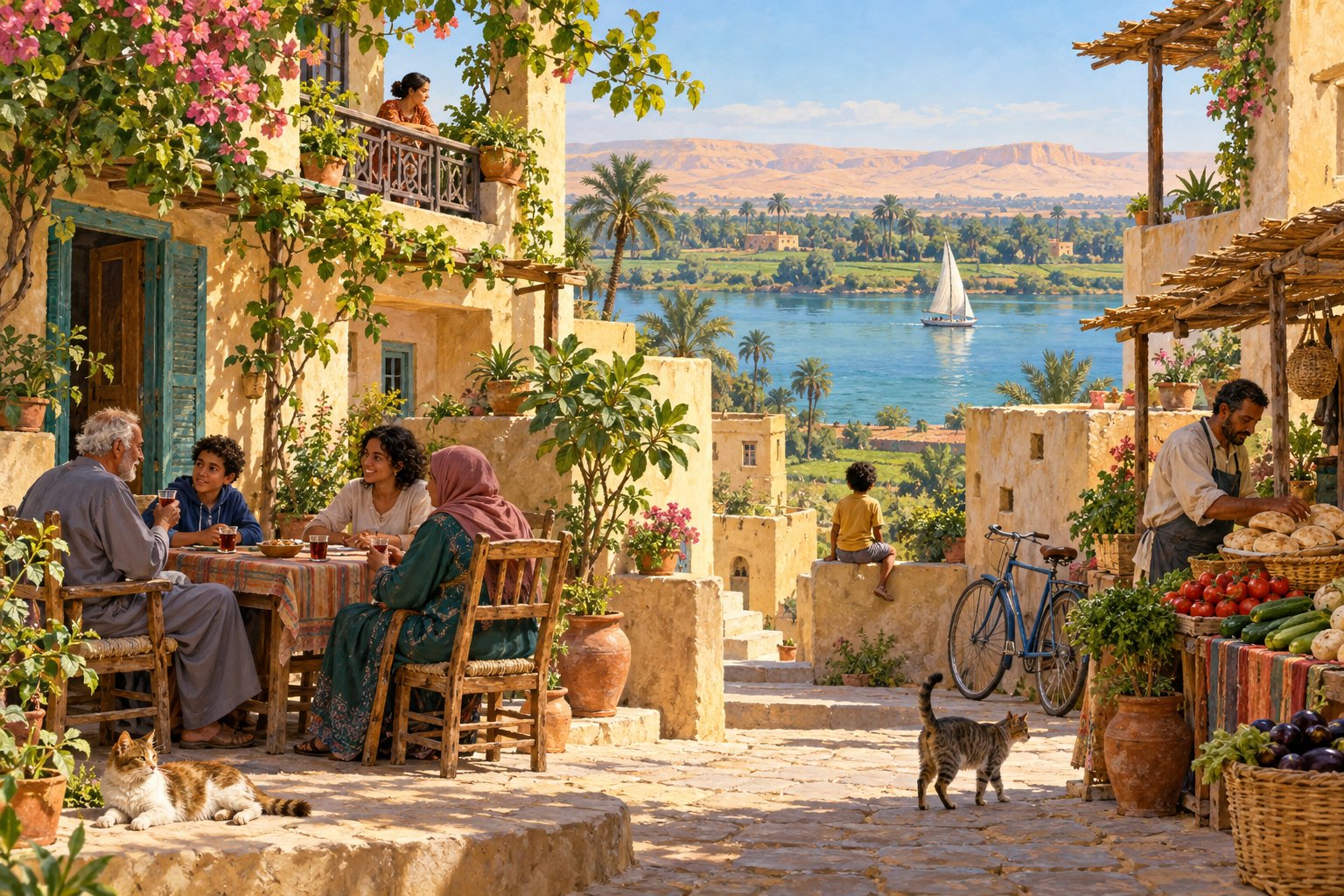
Cover illustration: an original AI-generated artistic interpretation of neighbours conversing beside a bread-and-produce stall in a riverside courtyard, with a bicycle, sailboat and distant cultivated banks. This is a nonliteral composite, not a photograph or an exact view of a named place.
Choose your route through Egypt
- 1. Geography and Landscapes
- 2. Regions, Cities and Urban Change
- 3. History across Many Egyptian Eras
- 4. Independence and the Modern Republic
- 5. Constitution, Government and Public Decisions
- 6. The Economy, Enterprise and Working Life
- 7. Agriculture, Food Production and Rural Livelihoods
- 8. Infrastructure, Energy and Connections
- 9. People, Languages and Connections Abroad
- 10. Education, Skills and Research
- 11. Food and shared meals
- 12. Music, performance and festivals
- 13. Literature, arts and heritage
- 14. Sport, skill and participation
- 15. Biodiversity and conservation
- 16. Health, science and discovery
- 17. Egypt and international relationships
- 18. Challenges and resilience
- 19. Daily life and communities
- 20. Learning connections and careful comparisons
1. Geography and Landscapes
A river corridor between deserts
Egypt occupies the northeastern corner of Africa, with a Mediterranean coast to the north and a Red Sea coast to the east. Sinai extends the country into Asia. Its physical geography is commonly divided into the Nile Valley and Delta, the Western Desert, the Eastern Desert and Sinai. These are landscape regions rather than administrative divisions. Together they explain why a national map contains both broad desert expanses and a much narrower ribbon of cultivated land. (SIS geographical profile)
The Nile Delta spreads northward from the Cairo area toward the Mediterranean. NASA’s account of a 1996 space photograph identifies its western Rosetta, or Rashid, branch and eastern Damietta, or Dumyat, branch. Between them, branching waterways and cultivated fields form a broad fan. The delta is a landscape made through river sediment, although the High Dam has changed sediment delivery downstream. Its present appearance therefore reflects both natural processes and major engineering interventions. (NASA Nile Delta)
Oases and mountain country
Western Desert oases show why desert should not be confused with an uninhabited, uniform surface. Siwa combines settlement streets, cultivated palms and olive trees, springs and saline lakes. Beyond the oasis lie the dunes of the Great Sand Sea. These neighbouring features create sharply different local environments within one wider arid region. An oasis is consequently more than a picturesque pool: it is a settled landscape where water, cultivation and built space meet. (Egypt Tourism Siwa)
Southern Sinai offers another kind of desert landscape, shaped by high mountains, rocky passages and deep contrasts in relief. The official tourism profile identifies Saint Catherine at 2,642 metres and describes canyons, boulders, rock formations and springs. Such terrain differs markedly from an image of Egypt made entirely of flat sand. Mountain slopes and the nearby Gulf of Aqaba belong to the same regional setting, bringing elevation and coastal environments into close geographical relationship. (Egypt Tourism mountains)
Two seas and changing skies
Along the eastern side of the country, the Red Sea separates northeastern Africa from the Arabian Peninsula. The European Space Agency explains its warm, saline waters partly through the surrounding hot, dry conditions and strong evaporation. Shallow coastal shelves and reefs contrast with deeper offshore water. These marine features are an important part of Egypt’s geography, not an ornamental edge to the desert. The sea also occupies a geological boundary between the African and Arabian plates. (ESA Red Sea explanation)
Aridity does not mean that every Egyptian landscape looks cloudless every day. NASA’s January 2024 Foggy Nile image shows low cloud covering parts of the delta while surrounding desert remains visible. Moist air, cooling and weak winds can produce fog during cooler months. The scene illustrates the importance of season and local conditions when interpreting a satellite image. A single morning’s weather helps explain a landscape, but it cannot substitute for a long-term climate record. (NASA Foggy Nile)
2. Regions, Cities and Urban Change
Administrative and metropolitan geography
Egypt’s Ministry of Local Development works across twenty-seven governorates. This administrative map serves a different purpose from the division into deserts, valley and delta: governorates organise public responsibilities and local development. The ministry describes coordination involving government bodies, businesses and communities, with attention to each area’s circumstances. Reading a place name therefore requires checking whether it refers to a city, a governorate or a broader region, because these geographical units need not cover the same territory. (Local Development Ministry)
Cairo illustrates this distinction particularly clearly. The governorate’s own introduction describes Greater Cairo as extending beyond Cairo itself to include Giza and Shubra El Kheima in Qalyubia. When comparing populations, services or transport networks, the geographical unit matters. A figure for Cairo city, Cairo Governorate or the wider urban area can describe a different set of residents even when everyday conversation uses the same name. (Cairo Governorate profile)
Ports and the canal cities
Alexandria’s maritime role extends beyond a single historic harbour. Official maritime descriptions place Dekheila to the west as an extension of the Alexandria port system, on land formerly used as an airbase. Nearby industrial activities help explain its location and function. Port infrastructure connects shipping with production. Ships, storage areas and industrial sites form an economic landscape that reaches beyond the familiar seafront streets and public waterfront. (Dekheila port profile)
Port Said, Ismailia and Suez form the principal canal-zone communities identified by the Suez Canal Authority. Their relationship with the waterway is social as well as commercial. The authority describes its involvement in housing, schools and medical facilities alongside its navigation responsibilities. This does not mean that it provides every local service, but it shows how a major infrastructure institution can shape urban life. The canal is therefore also a lived corridor of workplaces and neighbourhoods. (SCA canal communities)
Southern towns and new development
Farther south, Aswan’s urban identity is closely connected with the Nile and its banks. The official city description places markets and the urban centre on the east bank, while describing Nubian guesthouses and other accommodation on the west. This river-based geography brings everyday commerce, homes and visitor services into view alongside famous monuments. Aswan should not be reduced to an archaeological stop: its contemporary streets and settlements are part of the southern Egyptian landscape too. (Egypt Tourism Aswan)
Government relocation is reshaping the urban geography east of Cairo. In July 2023, the Presidency reported that more than one hundred agencies, including thirty ministries, had moved to the development commonly called the New Administrative Capital. That report describes a particular stage of an administrative transition, not the completion of an entire new city. Moving offices changes where employees work and services are organised; it must be distinguished from the separate constitutional question of the country’s capital. (Presidency relocation briefing)
3. History across Many Egyptian Eras
Before and beyond the pyramids
Egyptian history begins before the dynastic rulers whose monuments are best known. The Antiquities Ministry’s predynastic account identifies distinct archaeological cultures, including Maadi in Lower Egypt, Badarian communities near Asyut and Naqada in Upper Egypt. Social development and increasing complexity preceded the emergence of a unified state and writing around 3100 BCE. These differences matter: early Egypt was not a finished political system waiting for its first king, but a landscape of communities undergoing significant change. (Antiquities predynastic account)
Memphis and its surrounding necropolises reveal the scale of Old Kingdom organisation. UNESCO describes a capital near the meeting of the Nile Valley and Delta, associated with temples, workshops and residential activity as well as royal burial grounds. Giza, Saqqara and Dahshur preserve different monumental expressions, including the Step Pyramid. They are evidence of concentrated resources and authority, rather than a complete portrait of ancient everyday life. (UNESCO Memphis property)
New centres and Mediterranean connections
Thebes shifted the historical focus southward. Its temples at Karnak and Luxor, together with the royal burial landscapes across the Nile, reflect a centre of political and religious power associated with the Middle and New Kingdoms. UNESCO emphasises the importance of Amun and the monumental ensemble on both banks. Reading the sites together connects temples, rulers and funerary practices. Separating each monument into an isolated attraction obscures the relationships that gave this ancient landscape its meaning. (UNESCO Thebes property)
Alexander entered Egypt in 332 BCE, and Ptolemy established his own kingship in 305 BCE after Alexander’s successors divided his empire. The Metropolitan Museum’s account describes Alexandria’s Hellenistic institutions alongside continuing Egyptian temple traditions. Greek and Egyptian languages, artistic forms and political imagery interacted without becoming identical. The dynasty lasted until 30 BCE. This period therefore belongs within Egyptian history as both a continuation of older practices and a new configuration of Mediterranean rule and exchange. (Met Ptolemaic Egypt)
Successive centres of authority
Roman rule began in 30 BCE, when Octavian dismantled the Ptolemaic monarchy and placed Egypt under an appointed prefect. The country supplied grain to Rome and exported products including papyrus and glass, while routes through the Nile and Red Sea connected wider trading regions. Artistic evidence also records change: funerary portraits incorporated contemporary Greco-Roman fashions. Political annexation, commercial integration and cultural adaptation were related processes, but they did not erase every older Egyptian practice at once. (Met Roman Egypt)
Later political centres left another sequence of urban landmarks. The Arab conquest associated with Amr ibn al-As in 641 brought Fustat to prominence; the Fatimids founded Cairo in 969 and established Al-Azhar. Ayyubid and Mamluk rule followed before the Ottoman conquest in 1517. These names describe successive ruling formations, not an unchanged era. The changing centres help explain why Egyptian cities contain historical layers extending far beyond the ancient temples and royal tombs. (SIS Islamic-era outline)
4. Independence and the Modern Republic
Occupation and qualified independence
Britain occupied Egypt in 1882 following a conflict shaped by strategic interests, financial involvement and the revolt associated with Ahmed Urabi. The National Army Museum’s campaign history links British concern to the Suez route and describes the bombardment of Alexandria and subsequent military operations. Armed intervention imposed a new relationship of power. The occupation became an essential background to later Egyptian struggles over sovereignty and political authority. (National Army Museum history)
In 1922 Britain recognised Egypt as an independent sovereign state and terminated the protectorate it had declared in 1914. A contemporary diplomatic notification preserved in United States records also states that certain imperial interests remained reserved for future agreement, with existing arrangements continuing meanwhile. This qualification matters. Formal recognition opened space for Egyptian diplomatic representation, but did not mean that all British influence or unresolved questions disappeared on the same day. (Diplomatic records 1922)
Republican transformation and Suez
The 1952 revolution and the proclamation of the republic in 1953 marked a different transformation, ending the monarchy rather than simply repeating the earlier declaration of independence. Muhammad Naguib became the first president, followed by Gamal Abdel Nasser. The official modern-era account connects the republican period with land reform and the High Dam. These developments placed the state at the centre of major political and economic changes, while establishing institutions distinct from the preceding monarchical order. (SIS modern-era history)
The Suez Crisis made control of infrastructure an international confrontation. Nasser nationalised the Suez Canal Company on 26 July 1956. Israel invaded in October, followed by British and French intervention; international pressure subsequently helped bring a ceasefire. Nationalisation concerned the company operating an existing waterway, not the canal’s original construction. The episode linked Egyptian sovereignty with shipping, colonial power and Cold War diplomacy, showing how a domestic decision could rapidly acquire consequences far beyond the country’s borders. (US Historian Suez account)
Peace agreements and later transitions
Diplomacy later produced another major turning point. Anwar Sadat, Menachem Begin and Jimmy Carter met at Camp David in September 1978, reaching frameworks that preceded the Egyptian-Israeli peace treaty signed in March 1979. The framework and the treaty are separate steps, with different dates and purposes. Their importance should not be confused with a settlement of every regional dispute. The Palestinian question and the broader Arab-Israeli conflict were not resolved simply because Egypt and Israel concluded peace. (US Historian Camp David)
The twenty-first century brought further political ruptures. Hosni Mubarak left office during the uprising of February 2011. Mohamed Morsi won the presidency in 2012, but the military removed him in July 2013; Abdel Fattah El-Sisi was elected president in 2014. The Congressional Research Service’s background account distinguishes these successive events. Describing them as one smooth democratic transition would conceal the different roles of protest, elections and military intervention in determining who exercised national authority. (CRS political chronology)
5. Constitution, Government and Public Decisions
Constitutional rules and executive office
Egypt’s Constitution defines a republic and establishes a formal framework of political pluralism. Arabic is the official language, while Article 222 explicitly names Cairo as the capital. These provisions require careful distinction from practical administrative changes: relocating ministries does not by itself amend the constitutional text. Constitutional principles establish a framework, not proof that every stated principle is fully realised in practice. (Constitution articles 1–5 and 222)
The presidency is a separate institution from the legislature before which its holder takes the constitutional oath. Abdel Fattah El-Sisi took the oath for a new presidential term on 2 April 2024 at the House of Representatives’ headquarters in the New Administrative Capital. The official account records both the officeholder and the setting of that institutional event. It also illustrates why the location of a state ceremony should not be mistaken for a constitutional renaming of the capital. (SIS presidential oath record)
Two parliamentary chambers
Egypt has a bicameral parliament rather than a single legislative chamber. The Inter-Parliamentary Union’s electoral records identify the House of Representatives as the lower chamber and date its latest election across November and December 2025, followed by a first session in January 2026. Election and opening-session dates describe different stages. They provide a concrete institutional timeline, without answering separate questions about political competition, representation or the effectiveness of legislative scrutiny. (IPU parliamentary records)
The Senate forms the other parliamentary chamber. Its first regular session of the second legislative term opened in October 2025, according to the State Information Service. The chamber has three hundred members: two hundred elected and one hundred appointed by the president. This mixed composition is important when interpreting references to parliamentary representation. Not every senator reaches office through the same route, and the existence of two chambers does not mean they have identical membership arrangements or responsibilities. (SIS Senate opening)
Rights and local public reporting
In its 2023 concluding observations, the UN Human Rights Committee raised concerns about arbitrary and prolonged pretrial detention, restrictions on expression and obstacles to peaceful assembly in Egypt. It called for stronger procedural safeguards and protection for journalists and civic participation. These are the committee’s dated treaty assessments, not government statements about reform. They show why constitutional promises and institutional descriptions must be read alongside evidence about the exercise of rights. (UN Human Rights Committee 2023)
Local reporting offers another perspective on development. Fayoum, Port Said and Beheira prepared voluntary local reviews with support from the Planning Ministry and UNDP, presenting them internationally in July 2023. These reviews apply sustainable-development questions to particular governorates rather than treating national averages as descriptions of every locality. Their value lies in relating broad goals to place-specific conditions and priorities. They are reporting and planning instruments, not a substitute for following implementation or hearing how communities experience public services. (Planning Ministry local reviews)
6. The Economy, Enterprise and Working Life
National output and everyday money
Egypt’s economy combines domestic activity with important external connections, including tourism, remittances and shipping revenues. In its July 2026 review, the IMF reported growth of 5.2 percent over the first nine months of the fiscal year, while identifying continuing fiscal and competition challenges. This was a dated assessment with estimates and forecasts, not a final account of every subsequent development. Output growth alone cannot show how gains and price pressures affect different households. (IMF July 2026 review)
Currency arrangements can become visible through small everyday transactions. In July 2026, the Central Bank clarified that it was not printing new paper notes in the twenty-five-piastre, fifty-piastre and one-pound denominations, while existing notes remained valid through their circulation cycle. The statement distinguished banknotes from coins and new issuance from continuing acceptance. It illustrates the central bank’s role in managing currency information, where an announcement about production should not be misread as immediate cancellation of money already circulating. (Central Bank currency clarification)
Employment and smaller businesses
Employment statistics answer narrower questions than a general impression of economic wellbeing. The official second-quarter 2026 labour-force release reported unemployment of 5.8 percent. This measure concerns people counted in the labour force, not everyone in the population. It therefore cannot be converted into a claim that the remaining share of all Egyptians has a job. Understanding work also requires attention to participation, earnings, job security and the kinds of employment available, alongside the headline unemployment rate. (CAPMAS second-quarter release)
Smaller enterprises need more than an initial business idea. MSMEDA describes support involving finance through partner institutions, training, mentoring, incubators, business information and help with formalisation. These services address successive stages: obtaining resources, acquiring skills, understanding procedures and organising operations. Enterprise support is broader than lending. The availability of assistance does not guarantee that every applicant receives it or that every supported enterprise becomes commercially sustainable over time. (MSMEDA enterprise services)
Trade and changing opportunities
Trade and investment policy influence the kinds of jobs businesses can offer. An ILO study published in 2022 examined these relationships in Egypt, including smaller enterprises and opportunities for women and young people. It considered pandemic-related disruption and potential connections with European production networks, while recommending dialogue among government, employers and workers. These are recommendations, not automatic employment gains. Expanding trade is consequential for working life through the conditions under which production and hiring actually occur. (ILO trade and work study)
Changes in energy and production also raise questions about who can participate. An ILO analysis published in 2024 connected Egyptian employment, environmental transition and gender equality, including the position of women entrepreneurs. Its approach links environmental and labour-market policy. Training, business opportunities and institutional support influence whether new activities are accessible. A transition described as green should therefore be examined for its employment arrangements as well as its environmental objectives. (ILO employment and gender study)
7. Agriculture, Food Production and Rural Livelihoods
Fields, crops and research
Agricultural production depends on seasonal decisions as well as annual totals. FAO’s June 2026 country brief forecast a wheat harvest of about ten million tonnes, nearly seven percent above average, linking the outlook to expanded planted area and government procurement prices. It also described the seasonal timing of wheat harvesting and maize and rice planting. Because the figure was a forecast, it should not be presented as the final measured harvest. (FAO June 2026 crop brief)
Cotton demonstrates the importance of agricultural research beyond the field itself. The Agricultural Research Center’s breeding department works on long and extra-long staple varieties, connecting fibre characteristics with spinning quality and productivity. Its research agenda also addresses earlier maturity and resilience to stresses such as heat and salinity. These objectives do not guarantee identical performance everywhere. Seed development links farm production to industrial requirements while responding to the conditions under which farmers must actually grow the crop. (ARC cotton breeding)
Oasis systems and fish farming
Siwa’s date-palm system offers a different model of productive land use. FAO’s agricultural-heritage profile describes layered cultivation, with palms above other fruit trees and lower-growing vegetables or fodder. Dates and olives are central, while irrigation arrangements and accumulated farming knowledge support the system. Recognised in 2016, the heritage designation concerns a continuing relationship between people, water and cultivation. It is not simply a label for an old orchard preserved apart from the livelihoods of its present users. (FAO Siwa agricultural heritage)
Fish farming belongs in the account of Egyptian food production alongside crops. In December 2025, WorldFish announced a twenty-five-year extension of its research partnership with Egypt, building on a relationship dating from 1997. The programme includes work on improved tilapia, feeds and more sustainable production practices. Adoption targets remain ambitions, not measured results. Research, breeding and farm management consequently shape the supply of an important food. (WorldFish partnership renewal)
Markets and irrigation institutions
Producing more is not the only rural-development objective. IFAD’s evaluation of PRIME, which entered into force in 2012 and completed operations in 2021, examined efforts to improve market and financial access for smallholders, landless people, women and young people. It found results below expectations and weaknesses in design and early implementation. The evaluation distinguishes intentions from delivery: market connections require workable institutions and sustained implementation, not simply a project announcement. (IFAD PRIME evaluation)
Water management also depends on organisation among users. The On-farm Irrigation Development Project in the Oldlands, completed in 2020, combined work on irrigation distribution with water-user associations, research and financial support across eight governorates. Its completion review provides a specific example of an institutional approach to farm water, alongside engineering. Channels and equipment matter, but so do arrangements for operation, coordination and participation. Objectives remain distinct from benefits demonstrated on every farm. (IFAD irrigation project review)
8. Infrastructure, Energy and Connections
Railways and urban mobility
Railway investment affects access to work as well as the movement of trains. The World Bank’s April 2026 account of the RISE project described signalling improvements along the Alexandria–Cairo–Nag Hammadi corridor, together with station lighting, pedestrian access and measures addressing women’s safety. These changes concern passengers as well as technical equipment. Reported improvements apply to the covered works and services; they should not be expanded into a claim that the entire national network has been transformed. (World Bank RISE account)
Greater Cairo’s monorail illustrates why project dates need precision. Alstom reported that commercial service began on the first portion of the East of Nile line on 6 May 2026, with sixteen of its planned twenty-two stations included at that stage. This section operates, but it is not the whole planned network. An inauguration ceremony, a first passenger service and eventual completion describe different milestones in a large transport development. (Alstom commercial-service announcement)
The canal and electricity supply
The Suez Canal is an artificial sea-level waterway linking the Mediterranean near Port Said with the Gulf of Suez and the Red Sea. Its operation depends on navigation arrangements, maintained banks, markers and services for vessels, as well as the channel itself. A map may present the canal as a line, but keeping a maritime passage usable requires an organised system around the water through which ships move. (SCA canal description)
Benban’s solar plants were connected to the national grid in 2019, according to the EBRD. The EBRD’s renewable-energy account connects project financing with policy arrangements, including movement from feed-in tariffs toward competitive procurement. It also discusses further renewable expansion under the NWFE programme. Operating solar installations and future programme targets must be kept separate. The example shows that new generating capacity depends on contracts, financing and purchasing arrangements as well as the physical availability of sunlight. (EBRD renewable-energy case study)
Networks for public services
The Electricity Holding Company’s 2023/24 report shows that thermal generation still dominated the electricity mix, alongside hydropower and other renewable sources. Installed capacity and electricity actually generated are different measures: the first describes potential output under specified conditions, while the second records energy produced over a period. This distinction prevents misleading comparisons between a new plant announcement and annual supply. National generation totals also do not establish that every household received uninterrupted electricity throughout the reporting year. (EEHC annual report 2023/24)
Digital infrastructure increasingly supports interactions with government. In July 2026, the communications minister reported 242 digital services and a target exceeding 270 by the end of the year. Identity systems, electronic signatures and network development form part of that agenda. The count and target are distinct. Moving a service online can change how it is accessed, but practical access also depends on connections, usable interfaces and the ability of people to complete the required steps. (SIS digital-services statement)
9. People, Languages and Connections Abroad
Counting residents and recognising language variety
Population knowledge is produced through surveys, registration systems and censuses rather than a single timeless figure. In October 2026, officials reviewed preparations for a population census planned for 2028, including digital collection and analysis of demographic, urban and economic information. This is planned, not a completed count. Knowing where people live and how communities change supports public planning. Different statistical products must still be compared with attention to their dates and definitions. (SIS census preparations)
Arabic in Egypt includes distinctions between formal and conversational use. The American University in Cairo teaches both Modern Standard Arabic and Egyptian Colloquial Arabic across its course levels, with reading, writing, listening and speaking developed for different purposes. This institutional example makes linguistic variety concrete without suggesting that all speakers use language identically. A formal written text, a classroom exercise and an everyday conversation may involve different registers, even when all are discussed under the broad name Arabic. (AUC Arabic instruction)
Nubian and Siwi linguistic heritage
Nubian languages connect communities whose histories extend across the present Egyptian-Sudanese border. Kirsty Rowan’s research discusses languages including Nobiin and Kenuz, alongside the effects of displacement and the importance of safeguarding oral heritage. Nubian is neither one uniform language nor an identity confined within a modern boundary. Recording stories and speech can preserve evidence of lived experience, while the people who use these languages remain contemporary communities rather than historical exhibits. (Rowan on Nubian heritage)
Siwa adds another language tradition to Egypt’s linguistic landscape. A Max Planck documentation project examined Siwi, a Berber or Amazigh language, through its sounds and word formation, supported by recordings and other archived material. Documentation examines language structure rather than merely listing minority groups. It also avoids stereotypes about speakers. The existence of an archive should not be mistaken for a current census of everyone using the language. (Max Planck Siwi project)
Migration and family connections
Egypt is also a country of immigration. An IOM assessment in 2022 estimated approximately nine million international migrants from 133 countries. That estimate belongs to its stated year and category; it is not a current 2026 total or a count solely of registered refugees. This distinction matters because migration statistics can describe different populations under different definitions. People moving for work, family, study or protection may appear in overlapping public discussions without belonging to the same administrative category. (IOM migrant-stock assessment)
Connections abroad are also visible through money sent home. The Central Bank reported remittances of US$34.9 billion during July 2025–March 2026, compared with US$26.4 billion in the corresponding earlier period. These are financial flows over nine months, not the number of Egyptians living overseas or a measure of every receiving household’s circumstances. The figures nevertheless show that relationships across borders have a substantial economic dimension, linking employment and earnings abroad with resources transferred to people in Egypt. (Central Bank remittance release)
10. Education, Skills and Research
School pathways and classroom change
The Education Ministry’s 2024–2029 strategic plan describes a system with six years of primary schooling followed by three preparatory years. Secondary pathways include general and technical education, usually lasting three years, with some technical programmes extending to five. The plan also distinguishes responsibilities at ministry, governorate, local-department and school levels. These pathways and administrative layers help explain why education policy involves more than changing textbooks: it must connect stages of learning with the institutions responsible for delivering them. (Education Ministry strategic plan)
Reform has also focused on what learning and assessment should reward. A World Bank account published in May 2024 described examinations emphasising higher-order thinking, teacher and leadership development, kindergarten quality and assessments of Arabic and mathematics in grade four. It also identified constraints involving classrooms, staffing and established expectations about memorisation. A new assessment system does not establish that every learner has mastered the intended skills. (World Bank education reform)
Reaching learners in different settings
Community education addresses children who may not be reached effectively through conventional provision. UNICEF describes support dating from 1992 for small, often multigrade settings, with particular attention to excluded children and girls. Its programme involves the ministry, nongovernmental organisations and local communities in different responsibilities, including materials, staffing, implementation and upkeep. The approach brings education closer to particular communities rather than assuming that one school model fits every setting. Access and the quality of learning must still be considered together. (UNICEF community education)
Digital resources include official examination materials. In August 2024, the Education Ministry made four versions of the previous school year’s secondary examinations, with answer models, available through the Madrasetna Plus application and website. Learners could examine actual questions alongside expected responses. Publishing past papers does not establish universal access or demonstrate that practice alone develops the broader understanding sought by education reform. (Education Ministry examination resources)
Technical and university study
Technical education links schooling with occupational skills and workplace requirements. GIZ’s second technical-education transformation project, running from 2024 to 2028, supports quality, transparency and labour-market relevance, including assessment arrangements, school planning and teacher development. Gender considerations are also part of its design. Because the project is ongoing, these activities and objectives should not be presented as a completed national transformation. Its emphasis shows how vocational education depends on institutional cooperation and credible assessment as well as practical instruction. (GIZ technical education project)
University education encompasses a broad range of disciplines. Cairo University’s faculty and institute directory includes medicine, engineering, agriculture, law, arts, computing and artificial intelligence, alongside specialised graduate study. This breadth connects professional preparation with research and scholarship rather than reducing higher education to one career pathway. A directory establishes the presence of institutions and subject areas, not their comparative quality or the experience of every student. It nevertheless illustrates the diversity of university work. (Cairo University directory)
11. Food and shared meals
Ingredients and cooking
Egypt's tourism authority describes taameya as fritters made from fava beans, unlike versions elsewhere that use chickpeas. Foul medames also begins with fava beans, while eish baladi supplies flatbread. Following one ingredient into different preparations reveals culinary technique: grinding, seasoning and cooking create contrasting textures from an apparently familiar starting point.
The same official guide describes molokhiya as a green soup flavoured with garlic and coriander, and Umm Ali as a baked dessert combining bread or pastry with milk. They introduce possibilities within Egyptian cooking, not a fixed menu eaten by every family daily.
Food as living heritage
Koshary and its associated practices entered UNESCO's Representative List in 2025. The inscription describes rice, pasta, lentils and fried onions, with condiments adjusted to taste, and recognises preparation at home, in restaurants and at street carts. Its significance therefore extends beyond an ingredient list. Cooks, vendors and cart makers contribute different skills, while sharing food links households and neighbours. Regional variations also matter: a recognisable dish can retain its identity without requiring identical recipes or preferences.
Egypt participates in the multinational UNESCO inscription concerning date palm knowledge and practices, expanded in 2022. Dates connect nourishment with a much wider set of skills: leaves, fronds and fibres also become useful crafted objects, while the palm appears in poetry and song. This makes a productive comparison between a food crop and a cultural resource. Rather than treating the edible fruit as the whole story, learners can trace how different parts of a plant acquire value through skilled work and how that knowledge passes between generations.
Work and access
A 2023 UNIDO account from Minya followed women entering date processing at Greens Farm through the Rabeha training programme. The example concerned work with Majdoul and Barhy dates and efforts to widen women's employment opportunities in a sector described as traditionally male dominated. It places workers inside the food story instead of leaving them behind the finished product. Training, recruitment and workplace opportunity affect who benefits from a crop. One farm's experience is informative, but it does not demonstrate that employment barriers have disappeared across the national industry.
In February 2025, WFP and Spain announced a two-year school feeding partnership in Assiut governorate. Its planned support combined fortified date-bar snacks, cash assistance linked to attendance, and awareness sessions about nutrition and inclusion. This is a different way of understanding food: not only through taste or heritage, but through access and the organisation of public support. The announcement describes a programme design, rather than proving its eventual results. Evaluating it would require asking who received assistance, whether it continued reliably, and what changed for the participating children and households.
12. Music, performance and festivals
Instruments and communities
The semsemiah is a harp-like instrument associated with communities around the Suez Canal. UNESCO's account describes a body joined to three wooden poles forming a triangle, often made by players using natural or reused materials. Crafting the instrument and performing with it are connected skills rather than completely separate occupations.
Egypt and Saudi Arabia share the semsemiah inscription added to UNESCO's Representative List in 2024. Its music accompanies weddings, holidays, festivals and other gatherings. Families, bands and experienced practitioners transmit the skills. Shared recognition identifies connections without making every local repertoire or performance occasion identical.
Stories and observances
Al-Sirah Al-Hilaliyyah combines storytelling with musical performance rather than existing only as a written text. UNESCO describes poets singing the epic with percussion or a rabab, while learning demanding memory and instrumental skills. Performers may add improvised commentary to make the narrative meaningful for contemporary listeners. That detail helps explain how continuity and change can coexist within an oral tradition. Remembering established verses is one skill; deciding how to address a particular audience is another. A short staged extract cannot automatically represent the scope of an extended performance.
Festivals connected with the Holy Family's journey in Egypt entered UNESCO's Representative List in 2022. The heritage description records participation by Coptic Christians and Muslims, with singing, processions, performances, shared food and voluntary help for visitors. These are descriptions of living commemorative traditions, not independent proof of every event within the sacred narrative. They also show that a festival involves preparation and hospitality as well as its most visible ceremony. Participation can carry religious, family and community meanings that differ among the people attending the same gathering.
Institutions and new work
Cairo Opera House's announcement for its 2025 Arab Music Festival placed Umm Kulthum at the centre of the programme in the fiftieth anniversary year of her death. The scheduled October events combined concerts with other cultural activities, including calligraphy exhibitions. This institutional programme illustrates how music can be remembered through curation: organisers choose artists, themes and settings that connect earlier work with new audiences. An announcement establishes what was planned, not how every performance unfolded. It supplies a dated example of continuing musical life beyond archaeology.
The Downtown Contemporary Arts Festival presents a different part of Cairo's cultural landscape, including theatre, dance, music, film and new media. Its organisers describe using spaces such as the Radio Cinema and Kodak Passageway, making the surrounding city part of the experience. Venue choice changes the relationship between artwork and audience: a passageway offers possibilities unlike a conventional auditorium. D-CAF's own account represents its aims and practices, rather than a complete survey of independent arts. Together, these examples resist the idea that Egyptian culture belongs only to a distant past.
13. Literature, arts and heritage
Words and skilled making
Naguib Mahfouz received the 1988 Nobel Prize in Literature, becoming the first Arabic-language writer awarded that prize. Nobel's account connects his work with the development of the modern Egyptian novel and highlights the Cairo Trilogy, published in 1956–1957. Fiction offers another route into a city: characters, households and moral choices matter alongside monuments. Fiction is not a census, but imagined relationships can prompt questions about historical change and everyday experience.
Cairo joined UNESCO's Creative Cities Network for Crafts and Folk Art in 2017. The city's profile highlights traditions including pottery, glassblowing, copper work, ceramics and jewellery, together with fairs and proposals for community participation. These practices depend on makers, tools, materials and customers, not simply finished objects in display cases. Looking at a workshop therefore invites attention to learning and livelihood. Recognition alone cannot ensure that practitioners can continue working.
Museums with different purposes
The Grand Egyptian Museum's own chronology dates its formal opening to 1 November 2025. That inauguration should not be confused with every earlier trial-access phase or with the subsequent date of general public admission. Museum development is a process, not just an opening ceremony. A major museum brings questions of collection care, interpretation and public presentation into the present. Its ancient objects are encountered through choices made by contemporary curators, conservators, designers and educators.
The National Museum of Egyptian Civilization describes a remit extending from prehistory to the present, encompassing tangible and intangible heritage. Its royal mummies form one prominent part of that broader approach. The institution's scope encourages readers to connect periods rather than treating Egyptian history as ending with the pharaohs. In a classroom, arranging object photographs chronologically or thematically creates different pathways through the same past. Museum interpretation makes arguments through what is included and what receives less space.
Archives and preservation
The Egyptian Museum in Tahrir opened on 15 November 1902, according to the Ministry of Tourism and Antiquities' institutional history. It is distinct from both the Grand Egyptian Museum and the National Museum of Egyptian Civilization. Keeping those names separate prevents confusion about collections and opening dates. The earlier museum also reminds us that collecting and exhibiting have histories of their own. An object's ancient manufacture and its later acquisition, conservation and display belong to different layers of evidence.
Bibliotheca Alexandrina's Manuscripts Museum links rare books and manuscripts with conservation, digitisation and training. Its stated work includes making digital materials available to researchers and developing restoration expertise. Preserving writing requires more than retaining the words: paper, ink, bindings and physical damage can also carry evidence. Digital copies can widen access while the original still needs careful care. The programme shows contemporary Egyptian institutions producing and protecting knowledge, not merely inheriting an ancient name.
14. Sport, skill and participation
Team competitions
CAF's historical records list Egyptian men's Africa Cup of Nations victories in 1957, 1959, 1986, 1998, 2006, 2008 and 2010. The sequence includes three consecutive tournament titles, showing sustained achievement rather than one isolated success. Dated results avoid unsupported claims about present strength. Football history can be studied through coaching, teamwork and changing generations of players, while remembering that a national team's record does not describe every person's sporting interests or access to facilities.
Egypt hosted the men's handball World Championship from 13 to 31 January 2021. The International Handball Federation records a competition involving 32 teams, with venues in Alexandria, Cairo, Giza and the New Capital. Hosting and winning are different accomplishments, and the location of a tournament should never be mistaken for its result. Organising such an event also involves scheduling, facilities and coordination beyond the court. Handball broadens a sports portrait often dominated by football.
Individual excellence
The PSA World Championships' history records Mostafa Asal and Nour El Sherbini as the men's and women's champions for 2024–2025. It also records Nouran Gohar's women's title in 2023–2024. These results demonstrate achievement without labelling those players current champions indefinitely. Squash rewards movement, control and tactical decisions within a confined court. Comparing results across several seasons can reveal changing rivalries, but the score alone cannot explain the coaching, practice and support behind a player's development.
Ahmed Elgendy won the men's modern pentathlon gold at the Paris Olympics on 10 August 2024. UIPM recorded him as the first African Olympic champion in the sport, with a world-record total at that event. His achievement required performance across different disciplines rather than one movement. The 2024 competition included riding, so its format should be described historically rather than assumed unchanged forever. Rules evolve, while documented results remain attached to their original competition.
Inclusion and inherited games
Sherif Osman won Paralympic powerlifting gold in Beijing in 2008, London in 2012 and Rio in 2016, followed by silver at Tokyo. The International Paralympic Committee's profile traces his start in the sport to 2005 and the encouragement of coach Said Abd El Hafez. Discussing technique, competition and coaching respects the athlete's work; disability should not reduce a competitor to a simplified story of personal inspiration.
Tahteeb, recognised by UNESCO in 2016, connects physical skill with music and social gathering. The inscription describes a controlled stick game associated especially with Upper Egypt, in which striking is not permitted. Its emphasis on restraint makes control as important as strength. This is not simply a modern championship sport under another name: family and community transmission form part of its meaning. Comparison opens questions about rules and learning without erasing differences in purpose and setting.
15. Biodiversity and conservation
Evidence across deep time
Wadi Al-Hitan, or Whale Valley, preserves fossils documenting an important stage in whales' transition from land animals to marine life. UNESCO inscribed the Western Desert site in 2005. A desert landscape can therefore contain evidence of a very different past environment. The fossils matter through anatomy and geological setting, not size alone. Conservation here protects scientific relationships among remains and rock layers, helping future investigators ask questions that today's exhibitions may not yet consider.
Ras Mohammed lies at the southern tip of Sinai near the meeting of the gulfs of Suez and Aqaba. Egypt's State Information Service describes coral reefs alongside mangroves, salt marshes and intertidal flats. These neighbouring habitats show why a marine protected area cannot be understood as coral alone. Water, shoreline and shallow coastal environments form linked living systems. Their variety does not establish excellent condition: ecological health requires dated observations, not scenic reputation.
Wetland connections
Ramsar's description of Lake Burullus identifies a shallow saline lagoon, islands and a narrow connection with the Mediterranean. It highlights habitat used by birds during wintering, migration and breeding. The underlying information is dated, so it should not be treated as a fresh census or a current pollution assessment. Connections between sea and inland water influence conditions for living things, and a wetland's importance can extend far beyond the birds visible on one particular day.
The Ramsar information sheet for Wadi El Rayan describes two main lakes at different elevations connected by a marshy channel. Its habitat categories also include springs and saline or brackish wetlands. This variety complicates the idea that a desert contains only sand and sparse vegetation. A map of water connections can help explain why different habitats occur close together. Protection requires attention to the wider water system, not merely its most attractive view.
Different tools for protection
The Convention on Biological Diversity's older Egypt profile describes both conserving species in their habitats and maintaining resources outside them through germplasm banks or breeding centres. These are complementary approaches, not interchangeable substitutes. A seed collection may preserve material, while a functioning habitat supports relationships among organisms. The profile also links biodiversity knowledge with databases and scientific collections. Its old targets are not present achievements, but distinguishing protection, documentation and restoration remains useful.
A May 2023 UNDP account explains how Egyptian wind-energy development can overlap important migratory bird routes. The Migratory Soaring Birds project used observation and shutdown-on-demand procedures so turbines could be stopped when necessary. This example exposes a real environmental trade-off: renewable electricity and wildlife protection must be planned together. The account also describes training women as bird observers. Monitoring creates skilled employment; judging success requires evidence about both bird safety and energy production.
16. Health, science and discovery
Public health achievements
WHO awarded Egypt gold-tier status on the path toward hepatitis C elimination in October 2023. This recognised programme coverage achievements, not a declaration that hepatitis C had vanished. Distinguishing progress toward a target from the final target itself is essential when interpreting public health headlines and comparing different kinds of certification.
WHO's account connects Egypt's progress with large-scale testing, treatment and efforts to prevent new infections. These activities perform different roles: finding infection, helping affected people and reducing future transmission. A successful campaign therefore involves linked services rather than a single medicine or announcement, and continued measurement remains important after public recognition.
Prevention and capability
Egypt received WHO certification as malaria-free on 20 October 2024. The certification concerns interruption of indigenous transmission, supported by evidence covering at least three consecutive years and the capacity to prevent its return. It does not mean that an imported case could never occur or that surveillance is no longer necessary. The milestone illustrates how public health systems work. Detection, reporting and response remain important precisely because maintaining an achievement requires ongoing work, rather than assuming a historical risk has become permanently impossible.
WHO identifies BioGeneric Pharma in Egypt as a recipient in its mRNA technology-transfer programme. The wider programme combines technical knowledge and training to strengthen the ability to develop and manufacture health products. Participation should not be confused with regulatory approval for a particular vaccine or proof that every planned product is commercially available. Scientific capability involves people and processes as well as buildings: methods must be learned, quality must be checked, and production has to meet demanding standards before a laboratory idea can become a reliable product.
Research across borders
Ahmed Zewail, born in Damanhur and educated at Alexandria University before continuing his studies abroad, received the 1999 Nobel Prize in Chemistry. His work used extremely short laser pulses to investigate rapid changes during chemical reactions. This helped researchers study processes that ordinary observation cannot resolve. The scientific lesson is about measurement: improving the time scale of an instrument can reveal a previously hidden stage of an event. His career connects Egyptian education with international research rather than assigning discovery exclusively to one country.
Egypt is a member of SESAME, the regional synchrotron research centre in Jordan. The centre's membership brings together countries whose wider political relationships can be complicated, and its council oversees development and financial matters. Shared scientific facilities provide a practical setting for cooperation because sophisticated research equipment and specialist expertise can serve users from multiple places. Membership alone does not prove that political disagreements have been resolved. It does, however, show that international relations include laboratories, research governance and continuing professional contact, not only summits and formal diplomatic statements.
17. Egypt and international relationships
Membership and regional identities
Egypt was an original member of the United Nations from 24 October 1945. The UN's membership history also records the union with Syria as the United Arab Republic in 1958 and Syria's return to separate membership in 1961. State names and international membership can therefore follow different histories. Institutions keep records of continuity and change, allowing readers to distinguish the founding of an organisation from later political transformations.
The African Union records Egypt's membership date as 25 May 1963, referring to the Organisation of African Unity, its predecessor. The distinction prevents the present-day AU from being projected backwards under the same institutional form. Egypt's continental participation belongs alongside its Arab and Mediterranean relationships rather than being displaced by them. A country can participate in several overlapping regional systems. Understanding those connections requires examining institutional roles, decision-making and shared concerns.
Cooperation and service
Egypt's Foreign Ministry marked the Arab League's eightieth anniversary in March 2025, recalling its establishment in Cairo on 22 March 1945. The statement described cooperation in political, economic, social and cultural fields and Egypt's role in hosting its headquarters. This official statement describes priorities, not proof that every initiative succeeded. The organisation provides a framework for coordination among distinct states; shared participation does not mean identical interests or automatic agreement on difficult regional questions.
The UN Peacekeeping tribute to Egypt includes a documented example of Egyptian personnel distributing water and flour in North Darfur in September 2011. A dated example avoids presenting old troop totals as current. Peacekeeping also illustrates a different dimension of international participation from diplomatic negotiation. It involves people deployed within missions with defined responsibilities. Evaluation requires attention to each mission's mandate and circumstances, not an assumption of unlimited conflict-resolution powers.
Partnerships with different scales
The first EU–Egypt summit took place on 22 October 2025, following the Strategic and Comprehensive Partnership signed in March 2024. The European Council's account identifies cooperation across political relations, economic stability, trade, migration, security and human capital. A partnership therefore joins several policy areas rather than constituting a single project. The summit's stated ambitions should be distinguished from completed outcomes. Following implementation requires examining agreements, resources and results; partners may interpret their priorities differently.
Singapore's account of President Tharman Shanmugaratnam's September 2025 state visit noted Egypt's early recognition of Singaporean independence in 1965. It also looked ahead to sixty years of diplomatic relations in 2026 and identified cooperation in areas including health, agricultural research, technical education and maritime activity. Recognition and the establishment of diplomatic relations are related but distinct milestones. This history connects Singapore readers with Egypt without implying identical geography, institutions or development experiences.
18. Challenges and resilience
Interconnected pressures
The World Bank's 2022 Egypt climate report identified uncertainty in water availability as a major development challenge. It connected climate adaptation with more efficient resource use rather than treating environmental protection as a separate subject. The useful question is not only how much water exists, but how reliably it reaches different needs.
The same report highlighted risks facing densely populated cities and coastal areas, including heat, flooding, air pollution and rising seas. These pressures can overlap rather than arrive one at a time. Its recommendations are proposals for action, not evidence that all measures have already been implemented or that every forecast is inevitable.
Preparing and adapting
UNDP's North Coast and Nile Delta adaptation project describes planned sand-dune dikes at vulnerable coastal locations alongside integrated coastal management. Its project page listed work continuing into 2026. Physical protection and long-term planning address different parts of the problem: a barrier cannot by itself determine where future construction should occur or how changing risks will be monitored. The programme aims to reduce vulnerability, not eliminate flooding. Stated construction targets should remain targets unless a dated completion record establishes what was actually delivered.
Cairo hosts the UN Office for Disaster Risk Reduction's regional office for Arab States, established in 2007. Its described support includes risk information, disaster-loss data, early-warning systems and planning. Those categories make resilience more concrete: authorities need to understand hazards, identify exposed people and assets, communicate warnings and prepare responses. Hosting expertise does not guarantee adequate local protection. It does demonstrate that disaster reduction involves sustained institutions and information before an emergency, rather than beginning only when rescue teams are deployed after damage occurs.
People and opportunity
UNHCR's January 2026 Egypt update reported around 10,700 newly registered refugees and asylum-seekers during that month, with Sudanese nationals forming the majority. This is a monthly registration flow, not the total number of refugees or all people who crossed the border. Those categories must remain separate. Registration and documentation are part of an operational response, while the people concerned also have family relationships, skills and ambitions. A national portrait can acknowledge humanitarian pressures without reducing displaced communities to numbers or a uniform group.
An ILO youth-employment project in Damietta ran from 2019 to 2023 and combined business skills, entrepreneurship support and job matching. Its design involved government bodies, employers, workers' representatives and civil society, with attention to women and people with disabilities. Employment requires more than individual effort. Skills, recruitment pathways and institutional support interact. A project description does not prove nationwide success, but it provides specific questions for evaluation: were opportunities accessible, did placements last, and were the resulting jobs genuinely decent?
19. Daily life and communities
Work passed between generations
Handmade weaving in Upper Egypt entered UNESCO's Urgent Safeguarding List in 2020. Its description follows the demanding stages of preparing a loom, threading and weaving. Men and women have practised the craft as both inherited family knowledge and paid work, linking domestic settings with specialised skill and the production of textiles.
The same account describes changing materials and equipment, including shifts from expensive silk towards cotton and the use of wider looms. It also records pressures involving earnings, material costs and space for a loom. Living heritage is therefore affected by practical household decisions, not preserved automatically because a tradition is old.
Stories and shared space
Al-Aragoz hand puppetry combines a concealed performer, a portable stage and an assistant who interacts with the audience. UNESCO's account describes a comic performance using a distinctive altered voice and themes drawn from daily life. The spectators are part of the event rather than silent recipients of a finished object. This helps explain why preserving a puppet alone cannot preserve the whole practice: manipulation, timing, music and improvisation also require teaching and opportunities to perform. Its 2018 urgent-safeguarding inscription identifies a need for support.
A November 2024 World Urban Forum event in Cairo presented a public-space initiative built around community needs and stakeholder participation. UN-Habitat described an Egyptian programme intended to test practical, relatively low-cost ways to improve access. The example makes everyday space a public issue: places to meet and spend time are shaped by design and decision-making. Different users may notice different obstacles. An event description establishes the approach being proposed, not that every neighbourhood has already benefited or that consultation automatically resolves competing priorities.
Voices and inclusion
UNICEF's 2023 account of Dawwie volunteers at an Aswan youth centre describes storytelling circles, dialogue between generations and digital learning. The initiative aims to help girls express their views and develop skills, while involving the wider community. This offers a specific example of young people participating in change rather than appearing only as recipients of adult decisions. Individual experiences illuminate programmes without representing every Egyptian household. Listening carefully means allowing differences in circumstances, aspirations and opportunities to remain visible.
UN Women's reporting describes a women-friendly public space in Ezbet El Borg, Damietta, developed with community participation and local partners. The stated approach connected safety with opportunities for economic activity and public participation. Such a project links questions often discussed separately: who feels able to use a place, who can work there, and who influences its design? The project cannot establish universal safety. It does provide a concrete example of institutions and residents attempting to reshape daily environments, reminding readers that communities are active participants in contemporary Egypt.
20. Learning connections and careful comparisons
Water and historical choices
UNESCO's international Nubia campaign began in 1960 after Egypt and Sudan requested help protecting monuments threatened by the Aswan High Dam's reservoir. Its account records documentation, excavation and the relocation of temples including Abu Simbel and Philae. A classroom investigation could compare plans, photographs and maps to ask what was moved and why. This monument-focused account cannot explain every community's experience; additional voices and evidence are needed.
Singapore's PUB describes four water-supply sources: local catchment, imported water, NEWater and desalination. For readers studying Egypt, this offers a comparison of questions rather than a ready-made policy prescription. How are different sources combined, which technologies are required, and how are reliability and demand managed? Shared concern about water does not make the countries' climates, scales or river relationships equivalent. Identify constraints and choices before transferring a solution between settings.
Culture as practice
Egypt participates in UNESCO's multinational Arabic-calligraphy inscription, added in 2021. The description connects handwriting, artistic form and transmission through both formal teaching and informal learning, using traditional and modern tools. A learning activity could examine how line, spacing and material influence a design without treating a script as decoration detached from language. Recognising a beautiful object differs from understanding its production. Skills require time, instruction and use, not merely a place on a heritage list.
Singapore's hawker-culture inscription describes shared dining spaces, dishes shaped by multiple cultural influences and skills passed through families or apprenticeships. This offers a productive conversation with the food traditions explored in this article: who prepares a meal, who teaches the recipe, and where do people gather to eat? The comparison should preserve difference rather than rename an Egyptian street cart a hawker centre. Histories and working conditions differ, despite shared connections between food and social relationships.
Evidence and investigation
UNESCO describes Singapore Botanic Gardens as a tropical botanical institution combining scientific work with public recreation, including a history of research connected with rubber cultivation. Comparing such a place with Egyptian conservation examples calls for attention to purpose and evidence, not a claim of matching ecosystems. A garden, wetland and fossil site protect different kinds of value. Ask what is recorded, what management preserves, and how visitors learn, distinguishing research from attractive presentation.
Bibliotheca Alexandrina's Planetarium Science Center describes interactive exhibits at its ALEXploratorium and workshops designed around hands-on exploration. It provides a contemporary Egyptian example of learning by testing, observing and asking questions. That approach can organise a final country project: separate measurements from interpretations, label the dates of evidence, and distinguish an announced ambition from a demonstrated result. Egypt then becomes more than a collection of famous images. Its institutions and communities connect geography, history, science and culture through careful investigation.
Frequently asked questions about Egypt
What is Egypt’s capital?
Cairo is the capital.
Which statistical region includes Egypt?
The United Nations places Egypt in Northern Africa.
When was koshary recognised by UNESCO?
Koshary and its associated practices were inscribed in 2025.
When was Egypt certified malaria-free?
WHO certified Egypt as malaria-free on 20 October 2024.
Do the latest pages always contain current statistics?
No. Check each observation’s reference year and footnotes. Reading a page today does not turn an older observation into a current measurement.
Does a heritage designation establish safe access?
No. Heritage value and current access or safety are different questions. This article is for learning, not planning a journey.
Does one local example represent everyone?
No. Keep the people, place and date attached to an account. A documented example can explain a relationship without establishing a nationwide pattern.
How should students use the chapters?
Choose a focused question, preserve dates and definitions, and connect relevant evidence. Explain what remains uncertain instead of filling gaps with assumptions.
Continue reading: specialist guides to Egypt
These links provide subject-specific background. Their travel-themed titles do not establish that visiting is safe or feasible; use them as reading resources here.
- How Egypt Works | Government, Nile River, Suez Canal and Economy
- Egypt Education System: School Stages, Baccalaureate and University Routes
- How to decide which Science Tutor to go to? | Egypt
- How to decide which Mathematics Tutor to go to? | Egypt
- How to decide which English Tutor to go to? | Egypt
- English Tuition | Egypt
- Food traditions of Egypt
- Cultural and landscape learning about Egypt
Explore the Everything About Countries archive for national overviews. For the complete alphabetical directory, browse How Countries Work | A–Z Guide to 195 Countries and Everyday Life. The How Singapore Works collection offers a different national case study; comparisons should account for history, scale and institutional responsibilities.
Keep the country’s people in the explanation
An explanation becomes stronger when it connects a national institution with a concrete question: who can use a service, how knowledge is passed on, what a measurement records, or how a change affects everyday work. Ask whose experience is represented and what additional evidence would help. That keeps analysis clear without turning people into illustrations of a single story.
Sources and further evidence
Sources were checked for this edition in October 2026. Statistical observations retain their own reference periods. Policy announcements and project plans are distinguished from completed outcomes.
- UNData country profile
- SIS: Basic geographical information
- NASA: Nile Delta from space
- Egypt Tourism: Siwa oasis landscape
- Egypt Tourism: Sinai mountain trails
- ESA: Deep blue Red Sea
- NASA: Foggy Nile
- Local Development Ministry: Governorates and coordination
- Cairo Governorate: Cairo in lines
- Maritime Transport Sector: Dekheila port
- Suez Canal Authority: Canal and society
- Egypt Tourism: Aswan city
- Presidency: Government relocation briefing
- Antiquities Ministry: Predynastic period
- UNESCO: Memphis and its necropolis
- UNESCO: Ancient Thebes
- Metropolitan Museum: Ptolemaic Egypt
- Metropolitan Museum: Roman Egypt
- SIS: Islamic-era historical outline
- National Army Museum: Egypt and Sudan campaign
- US diplomatic records: Egyptian independence in 1922
- SIS: Modern-era political outline
- US Historian: Suez Crisis of 1956
- US Historian: Camp David and the treaty
- Congressional Research Service: Egypt background
- Egypt: Constitution
- SIS: Presidential oath in April 2024
- IPU: Egyptian House electoral calendar
- SIS: Senate opens its second term
- UN Human Rights Committee: Egypt observations 2023
- Planning Ministry: Voluntary local reviews
- IMF: July 2026 programme review
- Central Bank: Small banknotes clarification
- CAPMAS via SIS: Second-quarter 2026 employment
- MSMEDA: Enterprise support services
- ILO: Trade, investment and decent work
- ILO: Employment, environment and gender study
- FAO GIEWS: Egypt June 2026 brief
- Agricultural Research Center: Cotton breeding
- FAO: Siwa date-palm agricultural heritage
- WorldFish: Egypt research partnership renewed
- IFAD Evaluation: PRIME market project
- IFAD Evaluation: On-farm irrigation project
- World Bank: RISE railway accessibility
- Alstom: East of Nile commercial opening
- Suez Canal Authority: About the canal
- EBRD: Scaling up Egyptian renewables
- Electricity Holding Company: 2023/24 annual report
- SIS: Digital government services in July 2026
- SIS: Preparing the 2028 population census
- American University in Cairo: Arabic course levels
- SOAS repository: Flooded Lands, Forgotten Voices
- Max Planck Institute: Siwi language documentation
- IOM: Egyptian migrant-stock estimate 2022
- Central Bank: Remittances July 2025–March 2026
- Education Ministry: Strategic plan 2024–2029
- World Bank: Preparing students for tomorrow
- UNICEF: Community education in Egypt
- Education Ministry: Madrasetna examination resources
- GIZ: Technical Education Initiative II
- Cairo University: Faculties and institutes
- Experience Egypt: Gastronomy
- UNESCO: Koshary and associated practices
- UNESCO: Date palm knowledge and practices
- UNIDO: Women in Egypt's date sector
- WFP: Assiut school feeding partnership
- UNESCO: Semsemiah crafting and playing
- UNESCO: Al-Sirah Al-Hilaliyyah epic
- UNESCO: Holy Family festivals
- Cairo Opera: Arab Music Festival 2025
- D-CAF: Contemporary arts in downtown Cairo
- Nobel Prize: Naguib Mahfouz and modern fiction
- UNESCO: Cairo, Crafts and Folk Art
- Grand Egyptian Museum: Museum story
- National Museum of Egyptian Civilization
- Egyptian Museum: Our story
- Bibliotheca Alexandrina: Manuscripts Museum
- CAF: Africa Cup of Nations records
- IHF: Egypt's 2021 World Championship
- PSA World Championships: Champions history
- UIPM: Ahmed Elgendy's Paris gold
- IPC: Sherif Osman
- UNESCO: Tahteeb stick game
- UNESCO: Wadi Al-Hitan
- State Information Service: Ras Mohammed
- Ramsar: Lake Burullus
- Ramsar: Wadi El Rayan information sheet
- CBD: Egypt biodiversity conservation profile
- UNDP: Migratory birds and wind turbines
- WHO: Egypt's hepatitis C gold tier
- WHO: Egypt certified malaria-free
- WHO: mRNA technology partners
- Nobel Prize: Ahmed Zewail
- SESAME: Members and observers
- United Nations: Egypt membership
- African Union: Egypt membership
- Egypt Foreign Ministry: Arab League anniversary
- UN Peacekeeping: Egypt's service
- European Council: EU-Egypt summit 2025
- Singapore MFA: State visit to Egypt 2025
- World Bank: Egypt climate and development report
- UNDP: North Coast and Delta adaptation
- UNDRR: Regional office in Cairo
- UNHCR: Egypt operational update, January 2026
- ILO: Youth employment in Damietta
- UNESCO: Handmade weaving in Upper Egypt
- UNESCO: Traditional hand puppetry
- UN-Habitat: Public-space initiative in Cairo
- UNICEF: Dawwie volunteers in Aswan
- UN Women: Safer public spaces in Egypt
- UNESCO: International Nubia rescue campaign
- PUB: Singapore's water story
- UNESCO: Arabic calligraphy
- UNESCO: Singapore hawker culture
- UNESCO: Singapore Botanic Gardens
- Bibliotheca Alexandrina: Planetarium Science Center