
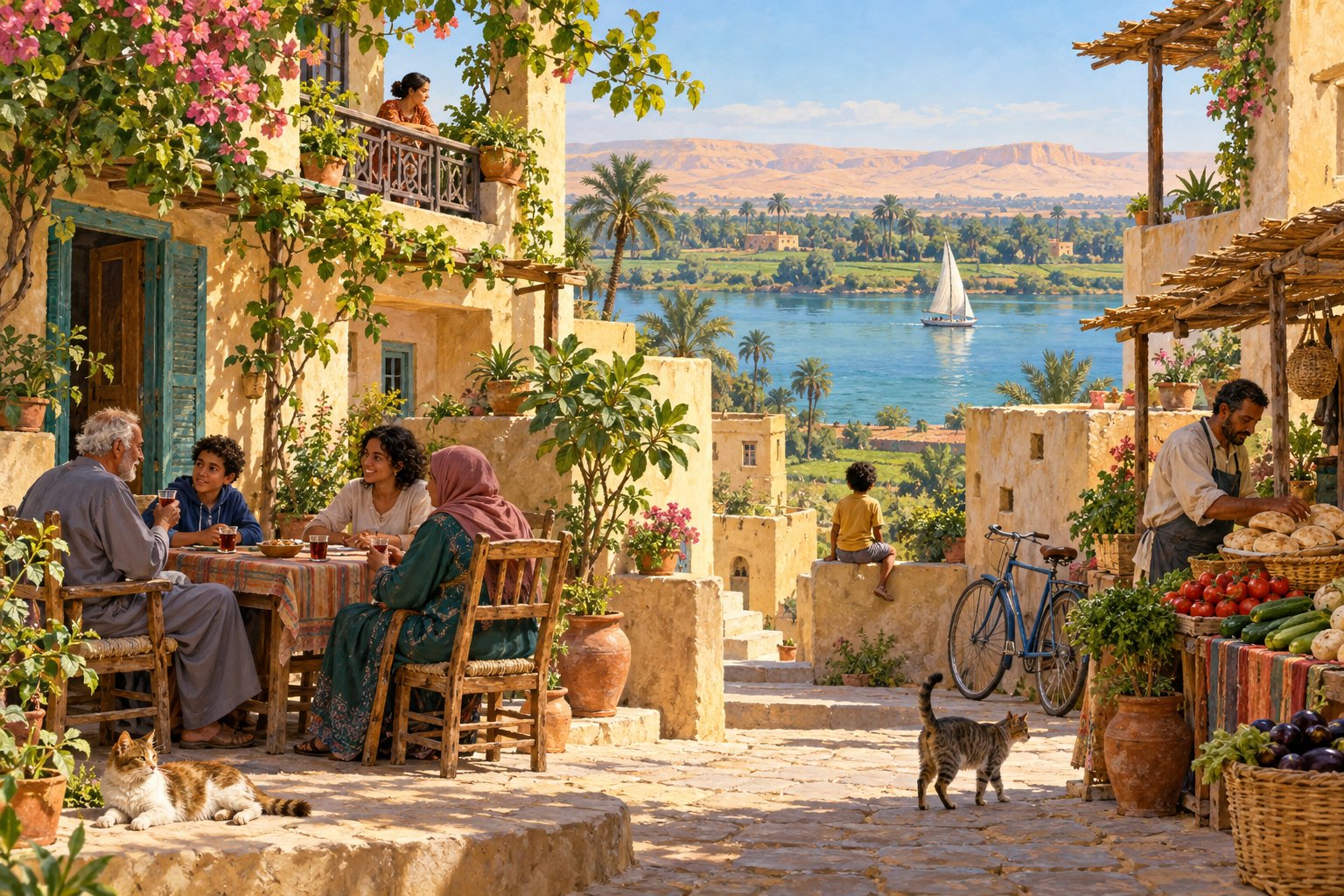
Egypt is endlessly fascinating when its most famous landmarks become the beginning of a question instead of the end of a sightseeing checklist. A pyramid belongs to an organised ancient society, a Nile-side temple preserves religious and political memory, a relocated monument reveals the modern science of conservation, and whale fossils in the desert tell a story older than human civilisation. These top 10 things to learn when visiting and touring Egypt connect archaeology, geography, architecture, living culture and natural history.
For Singapore families exploring Egypt travel, the Pyramids of Giza, Luxor, Abu Simbel, Historic Cairo, UNESCO World Heritage and educational holidays, this guide offers ten substantial and approachable lessons. We learn from all seven of Egypt’s World Heritage properties, including the 2025 conservation milestone at Abu Mena, and explore the semsemiah instrument and koshary food traditions newly recognised by UNESCO in 2024 and 2025. English–Chinese vocabulary, official sources and relaxed questions help travellers and readers understand Egypt without pretending a short itinerary can cover everything.
Current travel advice — October 2026: Read the full UK FCDO Egypt advisory. It advises against all travel to North Sinai, most of the Egypt–Libya border and other specified areas, and against all but essential travel to additional regions including parts of South Sinai and the Western Desert. There are exceptions for certain established locations, but these do not override local permits, security checks and current conditions. Historic sites and living religious spaces have particular restrictions. This guide is educational, not a route through desert or security-sensitive areas, a fossil-collecting manual, or permission to enter protected monuments.
Choose your reading route
Read in order or begin with one historical, scientific or cultural question. A country this large has different local safety and access requirements; the chapters are not one travel itinerary. Contents · Family route · Vocabulary · Country directory
Contents
- Understand the Nile as a geographical and historical system
- Read the Giza pyramids within the wider history of Memphis
- Explore Luxor and the ancient necropolis of Thebes through institutions
- Understand Abu Simbel and Philae as a modern conservation achievement
- Read Historic Cairo as a living neighbourhood network
- Learn why Abu Mena remains important after a conservation milestone
- Understand Saint Catherine as living faith, manuscripts and a sensitive mountain landscape
- Discover why Whale Valley contains ocean history in a desert
- Hear the semsemiah and appreciate Egyptian performance skills
- Follow koshary, recognised in 2025, from ingredients to shared everyday life
Egypt becomes easier to understand when you place the Nile River and its delta on a physical map. Much of the country’s population and many ancient settlements developed in or near its cultivated valley, while large areas beyond are desert. The relationship between water, fertile land and settlement is important without being a complete explanation of Egyptian civilisation.
Find Cairo near the Nile Delta, Memphis just to the south, Luxor farther upstream and Aswan in southern Egypt. Each has a distinct archaeological history, and an outline map cannot tell you how ancient people organised government, belief, labour or trade. It is a starting point for informed questions.
UNESCO currently lists seven World Heritage properties in Egypt. Six are cultural, including ancient, medieval and early Christian sites, and one is natural, the remarkable fossil landscape of Wadi Al-Hitan. An international list recognises selected properties rather than ranking every meaningful Egyptian village, building or tradition.
The Nile’s water system has been transformed by modern infrastructure and decisions about agriculture, energy, settlement and conservation. A map of an ancient floodplain and a modern river photograph may show different circumstances. Avoid treating the past and present as one unchanging scene.
Try marking the seven properties on a map before examining any individual photograph. Put the natural property in a separate category and write one question about what it can teach that a temple cannot. The result is a useful structure for learning rather than a claim that all Egypt can be covered on one short trip.
Notice and discuss: Why did a river matter so much to settlement while leaving room for human decisions and change? Family enquiry: Make a source-based map connecting river, cultivation and distinct heritage locations. Give one attributed explanation, not just an observation.
Reliable official source: Understand the Nile as a geographical and historical system. Heritage interpretation and practical visitor safety are separate matters; current local rules must always be checked.
Memphis and its Necropolis – the Pyramid Fields from Giza to Dahshur is a UNESCO World Heritage property inscribed in 1979. UNESCO describes a vast landscape of pyramids, mastabas, temples and tombs connected with Memphis, one of the great capitals of ancient Egypt. The Pyramids of Giza are famous examples within that broader cultural landscape.
Imagine the evidence required to construct monumental buildings: skilled labour, materials, logistics, administration and specialised knowledge. An impressive stone face alone cannot show precisely how every step was organised. Archaeological research uses tools, records, building traces and studies of the wider setting to develop explanations.
Memphis occupied a strategic location near the Nile Delta and important historical routes. UNESCO connects its role with the administration of a unified kingdom. Geography contributed to the city’s significance, but its institutions, royal priorities and labour arrangements are also necessary to understand its monumental legacy.
Tombs and funerary architecture reveal religious and political ideas, yet photographs of inscriptions and decoration need careful translation and interpretation. Avoid inventing a ruler’s private thoughts or presenting an untested dramatic theory as the settled scientific account.
Choose a pyramid and a smaller funerary structure from UNESCO’s documented property. Ask what function each served and how their scale differs. A more meaningful family question is what the archaeological context establishes, not simply which structure makes the biggest photograph.
Notice and discuss: How does a pyramid record organised human work as well as royal ambition? Family enquiry: Identify one evidence-based building question and the kind of source needed to address it. Give one attributed explanation, not just an observation.
Reliable official source: Read the Giza pyramids within the wider history of Memphis. Heritage interpretation and practical visitor safety are separate matters; current local rules must always be checked.
LESSON 3 OF 10
3. Explore Luxor and the ancient necropolis of Thebes through institutions
Ancient Thebes with its Necropolis was inscribed on the World Heritage List in 1979. UNESCO describes an extraordinary ensemble around modern Luxor, including the temples of Karnak and Luxor on the eastern bank of the Nile and extensive burial landscapes to the west.
The contrast between temple and tomb is essential. Monumental temple complexes were spaces associated with religious institutions and royal ceremonies, while necropolises preserve evidence of funerary practices and commemorations. They belong to linked belief systems but served different functions.
UNESCO documents a history spanning several dynasties, with Thebes especially prominent during the Middle and New Kingdoms. A building’s expansion and later additions may reflect changing rulers and religious priorities. One photograph should not be used to give a single date to a large, multi-period complex.
Archaeological interpretation requires reading surviving texts, paintings and material evidence. They provide insight into the ancient world, including neighbouring peoples, but are not unbiased descriptions of every person or society. The work and experiences of artisans deserve attention alongside famous rulers.
Study an official map of Karnak, Luxor and the western necropolis. Write two observations about their positions and one explanation of why UNESCO protects the ensemble as a whole. Follow modern access limits and conservation rules; no tomb or decorated surface is an unrestricted photographic backdrop.
Notice and discuss: What changes when ancient temples and burial landscapes are studied together? Family enquiry: Compare a temple’s documented purpose with a tomb’s and explain the archaeological evidence. Give one attributed explanation, not just an observation.
Reliable official source: Explore Luxor and the ancient necropolis of Thebes through institutions. Heritage interpretation and practical visitor safety are separate matters; current local rules must always be checked.
LESSON 4 OF 10
4. Understand Abu Simbel and Philae as a modern conservation achievement
Nubian Monuments from Abu Simbel to Philae, inscribed as World Heritage in 1979, includes remarkable temples and other remains of southern Egypt and ancient Nubia. UNESCO describes important structures such as the temples built under Ramesses II at Abu Simbel and the sanctuary of Isis at Philae.
One of the most extraordinary modern chapters is the international effort to rescue monuments threatened by water rising behind the Aswan High Dam. From the 1960s to 1980, UNESCO coordinated a campaign that involved moving key temples and structures to safer locations. The buildings tell both an ancient story and a modern engineering one.
Relocation raises interesting conservation questions. A monument can retain important physical fabric and artistic significance even though its location has changed. The official record explains why decisions were made and how international teams worked together, rather than allowing a photograph to suggest every structure remains exactly where it originally stood.
These monuments also belong to the histories of Nubian communities, whose experiences of displacement and transformation must not be erased by a triumphant story about saving stone. Heritage conservation and social consequences need to be discussed together with appropriately sourced accounts.
Make two timelines: the ancient construction period of one monument and the twentieth-century rescue campaign. Ask what preservation protects and what moving a structure cannot preserve automatically. The strongest family discussion holds engineering achievement and human history in one frame.
Notice and discuss: How can moving an ancient monument protect art while changing its relationship to place? Family enquiry: Separate an original ancient building function from its modern conservation history. Give one attributed explanation, not just an observation.
Reliable official source: Understand Abu Simbel and Philae as a modern conservation achievement. Heritage interpretation and practical visitor safety are separate matters; current local rules must always be checked.
Historic Cairo became UNESCO World Heritage in 1979. UNESCO describes an exceptional urban landscape whose development includes mosques, madrasas, water fountains, commercial streets, palaces and houses, reflecting the city’s growth across different Islamic historical periods and its relationships with trade and learning.
The important unit of history is sometimes a whole neighbourhood, not a single famous façade. A public water fountain, religious institution and marketplace may be connected with the organisation of everyday life. A street name linked to a craft or occupation can offer evidence about work and social history.
UNESCO’s account emphasises centuries of development, not one city built and completed in a single era. Historic Cairo also contains evidence of Christian and Jewish communities in the wider city and changing political institutions. A respectful guide should avoid turning the whole population into one undifferentiated cultural label.
Conservation must account for densely used buildings, residents, commerce and modern infrastructure. Historic centres need repairs and planning, but the people who live there also need ordinary services. A beautiful old doorway does not grant permission to enter a home or interrupt worship.
Choose one UNESCO-documented type of structure—a madrasa, sabil or market street—and explain its public function. Ask how it relates to neighbouring buildings and the Nile setting. This kind of source-led urban reading makes a city more memorable than a rushed list of architectural landmarks.
Notice and discuss: Why can a water fountain or market street reveal as much about a city as a palace? Family enquiry: Compare civic, commercial and religious functions within an urban neighbourhood. Give one attributed explanation, not just an observation.
Reliable official source: Read Historic Cairo as a living neighbourhood network. Heritage interpretation and practical visitor safety are separate matters; current local rules must always be checked.
LESSON 6 OF 10
6. Learn why Abu Mena remains important after a conservation milestone
Abu Mena, inscribed in 1979, preserves the archaeological remains of an early Christian pilgrimage centre near Alexandria. UNESCO describes churches, baptisteries, streets, housing and workshops associated with the tomb of Saint Menas, a revered martyr of the late third century.
The site grew through centuries of pilgrimage, especially during the fifth through seventh centuries. The surviving buildings show how worship, accommodation, trade and communal services could be organised within a religious centre. A set of ruins becomes more interesting when the functions of its different spaces are named.
Conservation is part of Abu Mena’s modern story. The property was placed on the List of World Heritage in Danger in 2001 because of threats involving groundwater and deterioration. UNESCO’s official record now shows its period on the Danger List ended in 2025. That change marks an important institutional milestone rather than proof that no risks remain.
UNESCO also documents continued conservation and management reporting in 2026. Such sources make it possible to distinguish recognition, threats, remedial work and ongoing monitoring across time. An archaeological place does not become maintenance-free when a danger status changes.
Create a small timeline with 1979 inscription, 2001 danger listing, 2025 removal and later reporting. Add one question about groundwater, buildings and conservation responsibility. This offers a thoughtful lesson about early Christian history and today’s need to protect evidence.
Notice and discuss: How does a World Heritage site’s conservation status tell a continuing story after inscription? Family enquiry: Compare a pilgrimage building’s historical purpose with the modern reasons for protecting it. Give one attributed explanation, not just an observation.
Reliable official source: Learn why Abu Mena remains important after a conservation milestone. Heritage interpretation and practical visitor safety are separate matters; current local rules must always be checked.
LESSON 7 OF 10
7. Understand Saint Catherine as living faith, manuscripts and a sensitive mountain landscape
The Saint Catherine Area in the Sinai Peninsula was inscribed by UNESCO in 2002. Its sixth-century Orthodox monastery is associated with religious traditions revered in Christianity, Islam and Judaism, and UNESCO describes significant manuscripts, icons, Byzantine buildings and the surrounding mountain landscape.
The monastery is not just an architectural shell. It has continued its original religious function over centuries, making living practice essential to its meaning. Ancient manuscripts and images also require expert care, and protected collections should not be treated as objects to handle for a photograph.
UNESCO’s description acknowledges the significance of local Bedouin communities and their relationship with the landscape. The site’s history and current management should not erase them or reduce people to guides positioned beside a monument.
Modern South Sinai has specific travel restrictions and security procedures. UK FCDO advises against all but essential travel to some northern parts of South Sinai, while other resort and permitted areas are treated differently. This article supplies no route to the monastery or summit and no guarantee of admission.
Read UNESCO’s official description from home and choose one material object, one living religious function and one environmental question. State what each kind of evidence explains and why respectful access matters. Historical significance can be studied without demanding entry.
Notice and discuss: How can a working monastery remain part of a major historical and cultural landscape? Family enquiry: Differentiate a sacred practice, a manuscript and a conservation responsibility. Give one attributed explanation, not just an observation.
Reliable official source: Understand Saint Catherine as living faith, manuscripts and a sensitive mountain landscape. Heritage interpretation and practical visitor safety are separate matters; current local rules must always be checked.
Wadi Al-Hitan, or Whale Valley, is Egypt’s one natural World Heritage property, inscribed in 2005. Located in the Western Desert’s Faiyum region, it contains exceptionally important fossil remains of early whales, including anatomical evidence from a period when whale ancestors were becoming fully adapted to life in the ocean.
The extraordinary image is of marine animal fossils now surrounded by desert. That fact invites two scientific questions: what kind of environment existed when the organisms lived, and how do their preserved bones help explain evolution? Geological research places evidence across deep time rather than relying on the present appearance of the landscape.
UNESCO emphasises the quality and concentration of early whale fossils and their importance to understanding the transition from land-dwelling ancestors to ocean-going mammals. A fossil specimen is evidence, but reconstructing the whole history requires comparison with other material and careful scientific method.
The property is strictly protected, and the wider Western Desert has specific travel and permit considerations. UK advice gives exceptions for parts of Faiyum but requires attention to current regulations; it does not grant access to every fossil locality. Never remove remains, leave marked permitted areas or attempt isolated desert exploration.
Make a family timeline showing land-mammal ancestry, early whales and later marine adaptations as a simplified evolutionary sequence. Explain what the fossils demonstrate and what researchers infer. The learning is far more striking than treating the desert as a fossil souvenir shop.
Notice and discuss: How can fossils in a desert help explain the evolution of ocean mammals? Family enquiry: Separate the physical fossil from the scientific interpretation of its age and relationships. Give one attributed explanation, not just an observation.
Reliable official source: Discover why Whale Valley contains ocean history in a desert. Heritage interpretation and practical visitor safety are separate matters; current local rules must always be checked.
Semsemiah instrument crafting and playing entered UNESCO’s Representative List of Intangible Cultural Heritage in 2024 through Egypt and Saudi Arabia. UNESCO describes a harp-like instrument associated in Egypt especially with the Suez Canal region and communities of sailors, fishers, traders and local musicians.
The craft of making an instrument matters as much as its sound. Materials, shaped wooden pieces, strings and tuning depend on skilled decisions, and performances involve people who know particular songs and social occasions. A recorded melody is the result of both craft and teaching.
UNESCO explains that semsemiah practice can be maintained through family learning, community groups and more organised training. It is a living expression, not a museum object restricted to one old performance style. The international inscription recognises related forms while allowing each community its own context.
Egypt has other UNESCO-listed performance practices, including tahteeb, a traditional stick game inscribed in 2016. UNESCO describes its present form as a festive, controlled, non-violent exchange linked with music and respect. It should not be copied by children as a physical combat activity from a brief video.
An excellent family activity is to listen to a semsemiah recording and identify the relationship between instrument and social setting. Then compare that with the values named in UNESCO’s tahteeb explanation. Two practices can share community teaching without being the same tradition.
Notice and discuss: What kinds of skill and trust turn an object or movement into living heritage? Family enquiry: Name the makers, performers and transmitted knowledge rather than only what a video looks like. Give one attributed explanation, not just an observation.
Reliable official source: Hear the semsemiah and appreciate Egyptian performance skills. Heritage interpretation and practical visitor safety are separate matters; current local rules must always be checked.
LESSON 10 OF 10
10. Follow koshary, recognised in 2025, from ingredients to shared everyday life
UNESCO inscribed koshary, the everyday dish and practices associated with it, on its intangible cultural heritage list in 2025. This recent recognition makes a delightful conclusion to Egypt learning: heritage can be found not only in monuments, but also in the knowledge involved in preparing a familiar, accessible meal.
UNESCO describes koshary through ingredients such as rice, pasta, lentils and fried onions, often combined with tomato-based or other condiments according to preference. It is prepared and sold in different homes, shops and street-food settings. A list of ingredients, however, does not explain all the timing, preparation or social choices made by cooks.
The dish is closely connected with ordinary urban and family life. An individual cook may have a preferred balance of ingredients, while customers and families bring their own habits to the meal. It is inaccurate to declare one restaurant’s presentation the only authentic version for all Egyptians.
UNESCO’s recognition concerns the people and practices surrounding koshary, not a requirement that travellers buy a particular product. The subject can be studied through official information and appropriate food safety knowledge. Ask about ingredients and allergies directly when trying any prepared dish.
Finish by comparing an ancient pyramid, a whale fossil and a modern bowl of koshary. The three need different sources and methods to understand them. Their shared lesson is that knowledge becomes richer when we ask who made, studied, cared for or passed it on.
Notice and discuss: How can a simple daily meal deserve cultural recognition alongside magnificent monuments? Family enquiry: Make a three-column note: historical building, scientific fossil and living culinary practice. Give one attributed explanation, not just an observation.
Reliable official source: Follow koshary, recognised in 2025, from ingredients to shared everyday life. Heritage interpretation and practical visitor safety are separate matters; current local rules must always be checked.
A gentle family learning route
Before reading about a famous monument, locate it on the Nile map and choose a question you really want to answer. A child might wonder how a pyramid was built, why temples were moved or how archaeologists learn from painted tombs. Use one official source before building a long collection of facts.
At home, compare two kinds of evidence: a monument’s architectural plan and a fossil site’s geological explanation. One can reveal human planning; the other provides clues about changes in life over deep time. Their methods differ, but both require careful interpretation.
For living culture, listen to the semsemiah or read UNESCO’s new koshary recognition. Name the people who make and teach the practice rather than treating the final object or meal as all that matters. A short, relaxed conversation can be the entire lesson.
Finish with a clear summary that includes an observation, a sourced explanation and one open question. Follow current official travel advice and protected-area rules if a later journey is considered. Understanding Egypt does not require visiting every monument or entering restricted land.
English–Chinese vocabulary for learning about Egypt
These English–Chinese conceptual equivalents support historical and scientific understanding. They are not Arabic translations; use specific place and community names accurately.
| English | 中文 | Learning use |
|---|---|---|
| Nile floodplain | 尼罗河泛滥平原 | Read a documented historical landscape. |
| pyramid complex | 金字塔群 | Explain an archaeological or geological relationship. |
| necropolis | 古墓群 | Identify modern conservation responsibilities. |
| archaeological inscription | 考古铭文 | Name the people involved in a living practice. |
| heritage relocation | 遗产迁移保护 | Read a documented historical landscape. |
| historic neighbourhood | 历史街区 | Explain an archaeological or geological relationship. |
| pilgrimage centre | 朝圣中心 | Identify modern conservation responsibilities. |
| Byzantine manuscript | 拜占庭手稿 | Name the people involved in a living practice. |
| early whale fossils | 早期鲸类化石 | Read a documented historical landscape. |
| intangible heritage | 非物质文化遗产 | Explain an archaeological or geological relationship. |
| instrument craftsmanship | 乐器制作工艺 | Identify modern conservation responsibilities. |
| daily food heritage | 日常饮食遗产 | Name the people involved in a living practice. |
Questions families often ask
How many UNESCO World Heritage properties does Egypt have?
Seven as of October 2026: six cultural properties and the natural fossil property Wadi Al-Hitan.
Are Abu Simbel’s famous temples still in their original positions?
Some Nubian monuments, including Abu Simbel and Philae’s temples, were moved during the UNESCO-led international rescue campaign in the 1960s to 1980. Their relocation is part of modern heritage history.
Is Abu Mena still listed as World Heritage in Danger?
UNESCO’s official record identifies its Danger List period as 2001–2025. Ongoing conservation and monitoring remain important despite the change in status.
Can we enter any desert fossil site or Sinai heritage location freely?
No. Government security and permit rules vary by region, and archaeological and religious sites have restrictions. Check current official advice before any journey.
What living Egyptian tradition did UNESCO recognise in 2025?
Koshary, daily life dish and practices associated with it, was inscribed on the Representative List of Intangible Cultural Heritage in 2025.
Are the glossary’s Chinese entries translations of Arabic?
No. They are English–Chinese conceptual equivalents for reading the guide, not an Arabic language course or phrasebook.
Continue the country learning journey
Return to the World Country Learning Directory. The preceding alphabetical guide is Ecuador. Continue with El Salvador, Equatorial Guinea, Eritrea, Estonia.
Browse the Travel Vocabulary Directory and World Travel Hub to connect Egypt’s heritage and living culture with wider learning.