
What should you know about Eritrea beyond its name? This guide connects a country’s landscapes with the people, institutions and skills that give places meaning. It follows historical evidence and contemporary examples across community life, work, learning and cultural expression, without letting one image or headline stand for the whole country.
Begin with geography and history, or move directly to food, music, learning and the environment. Cultural knowledge deserves close attention in its own right. Contemporary challenges also need careful evidence, without allowing one event or statistic to stand in for an entire country.
Eritrea at a glance
- Capital: Asmara.
- UN statistical region: Eastern Africa.
- Reading date: 20 October 2026; individual observations retain their own dates.
The capital and regional classification are listed in the UNData country profile. This guide uses specific dated sources for the other subjects rather than treating an old country summary as a current account of every institution.
This is an educational overview, not a travel itinerary or personalised medical, legal or financial advice. A cultural or environmental designation does not establish present access or safety. National data cannot replace the experiences of particular households and communities.
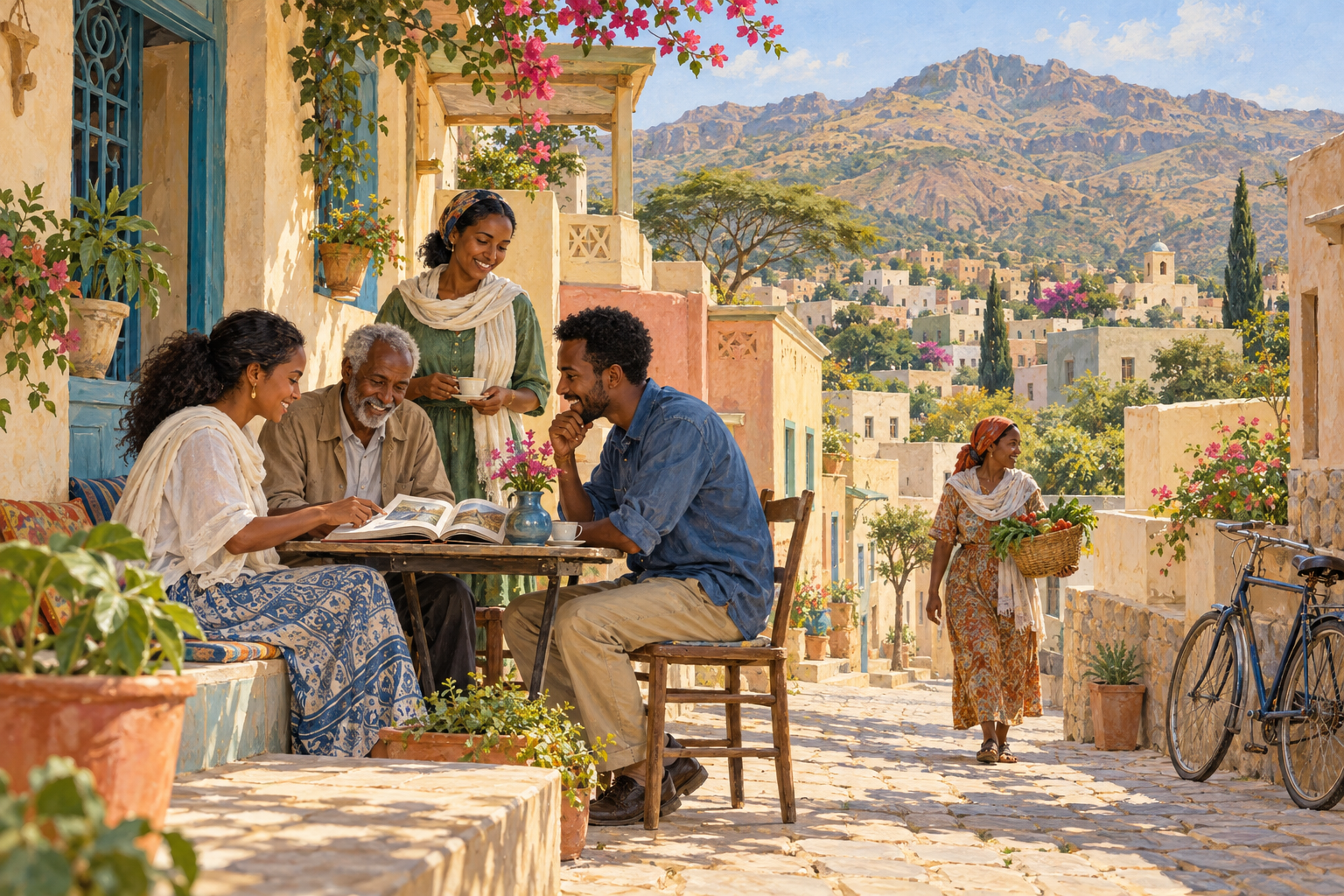
Cover illustration: an original AI-generated artistic interpretation of neighbours sharing a book in a highland-inspired town, with a produce basket, bicycle and distant mountain ridge. This is a nonliteral composite, not a photograph or an exact view of a named place.
Choose your route through Eritrea
- 1. Geography and physical landscapes
- 2. Regions and principal cities
- 3. Historical foundations
- 4. Independence and the modern state
- 5. Constitution and governance
- 6. Economy and working life
- 7. Agriculture and food production
- 8. Infrastructure, energy and transport
- 9. People and languages
- 10. Education and learning institutions
- 11. Food, coffee and the shared table
- 12. Music, performance and festivals
- 13. Literature, art and living heritage
- 14. Athletes, races and sporting pathways
- 15. Biodiversity and the work of conservation
- 16. Health, laboratories and public services
- 17. International relations and changing partnerships
- 18. Current challenges and the meaning of resilience
- 19. Daily life, care and community
- 20. Learning carefully, including from Singapore
1. Geography and physical landscapes
Highlands and lowlands
Eritrea occupies the northeastern edge of the African continent, with Sudan to the west, Ethiopia to the south and Djibouti toward its southeastern end. The Red Sea forms its eastern frontage. A central highland belt separates western lowlands from the coastal lowlands. This combination gives the country markedly different physical settings within relatively short distances, rather than a single continuous desert landscape. FAO distinguishes savannah, steppe and desert environments in its geographical profile. (FAO geography)
Rainfall does not follow one national calendar. Eritrea’s 2007 adaptation programme describes summer rains, concentrated around July and August, in the central highlands and western lowlands. Parts of the coast and eastern escarpment instead receive winter rainfall between November and March. Elevation and topography influence these contrasts. Rain can also vary considerably between nearby places and from year to year, making a countrywide annual average a poor description of any particular farming district. (Climate programme)
An active geological setting
The Danakil area belongs to a landscape shaped by crustal extension and volcanism. At Alid, a volcanic centre rising roughly 700 metres, US Geological Survey researchers investigated hot ground and fumaroles during the 1990s. Their gas analyses suggested a hot underground reservoir, but they emphasized that drilling would be needed to establish the resource. The investigation documents geological heat and scientific potential, not an operating geothermal power station or a confirmed electricity supply. (USGS Alid study)
Nabro provides another example of active geology in southeastern Eritrea. The Smithsonian’s Global Volcanism Program describes a large volcanic complex in the Danakil Alps and records its substantial eruption in June 2011. Satellite observations were important to documenting activity in this remote setting. Nabro’s caldera and surrounding volcanic terrain belong to a much longer geological history than that single eruption. An eruption chronology describes recorded events; it does not by itself predict the next one. (Smithsonian Nabro)
The Red Sea edge
Along the sea, Eritrea’s geography extends beyond the mainland shoreline to islands, shallow shelf waters and numerous natural harbours. FAO’s coastal description identifies the Dahlak Archipelago and historical harbour sites at Dahlak Kebir and Adulis in Zula Bay. Massawa and Assab are the major port locations, with smaller coastal places between them. These features make the maritime landscape a combination of offshore islands, bays and mainland settlements rather than simply a straight coastal boundary. (FAO coastal profile)
The Dahlak islands have also provided evidence for studying climate beyond the land itself. A 1997 research paper analysed a 63-year sequence of oxygen and carbon isotopes preserved in a Porites coral from the archipelago. The researchers compared seasonal and longer variations while evaluating the coral as a record related to the Asian monsoon. This is a specific scientific archive of environmental change, not a modern weather forecast or a measurement of today’s coral condition. (Coral research)
2. Regions and principal cities
The administrative map
Eritrea is divided into six regions, commonly called zobas: Anseba, Maekel, Debub, Gash Barka, Northern Red Sea and Southern Red Sea. The names appear in government administration and development reporting, but regional boundaries are not the same as climatic or linguistic boundaries. Gash Barka occupies much of the west, where Barentu, Agordat and Tessenei are towns. Reading these administrative names alongside a physical map helps distinguish inland districts from the two coastal regions. (Government regional account)
Asmara stands on the highland plateau at more than 2,000 metres. UNESCO inscribed its modernist urban landscape in 2017, recognizing residential, commercial, industrial and public buildings developed largely during Italian colonial rule. The property also includes the indigenous quarters of Arbate Asmera and Abbashawel. Its architectural interest therefore involves both distinctive twentieth-century design and the unequal colonial planning system, including racial segregation, within which Eritrean labour and local materials helped produce the city. (UNESCO Asmara)
Highland and coastal cities
Massawa’s urban form contrasts with the highlands. Its older districts occupy the islands of Re’esi Midri and Tawalud, connected with mainland neighbourhoods. Coral stone is an important element of its historic buildings. An official city account describes architectural layers associated with Ottoman, Egyptian and Italian periods, alongside the harbour setting. The islands and mainland together form the city, so treating Massawa only as a port or only as an old island quarter misses its wider geography. (Massawa city account)
Keren, in Anseba, is surrounded by rocky hills and mountains. A government architectural account published in January 2025 identifies a varied townscape. Its examples include St Michael’s church, the Al Atiq mosque, the Luigi Riva palace, the Grand Hotel and municipal buildings. These landmarks combine religious, administrative and commercial uses. They offer concrete points for understanding the city’s built environment without making one building representative of every resident. (Keren architectural account)
Regional centres and planning
The Southern Red Sea region runs toward Eritrea’s boundary with Djibouti, with Ethiopia inland and the sea to the east. Its landscapes include plains, mountains and volcanic terrain. Assab is the principal port city in the region, while Rahayta lies farther toward the southeastern frontier. A 2017 regional account described road links toward Rahayta and north toward Massawa. Those named connections establish the regional layout, but that historical description does not establish present transport schedules or road conditions. (Southern Red Sea account)
Regional cities also face planning questions beyond their monuments. UN-Habitat’s 2010 urban policy assessment recorded Mendefera commissioning a private planning firm to address the town and surrounding satellite villages. It contrasted this with Keren’s lack of a master plan at the time and discussed municipal staffing and resource constraints. These are dated findings, not a verdict on every municipality today, but they show that urban development includes coordination between established centres, expanding settlements and local institutions. (UN-Habitat urban assessment)
3. Historical foundations
Ports and highland archaeology
Archaeology at Adulis reveals connections across a wider maritime world. A 2022 study examined pottery from contexts dated between the fifth and seventh centuries CE, during intensive occupation. Imported ceramics linked the site with the eastern Mediterranean, the Levant, the Arabian Peninsula and the Indian Ocean. Scientific analysis of amphorae adds evidence about production and exchange to the excavated record. Ancient trade connections should not be confused with the borders of today’s states. (Adulis archaeological study)
Qohaito offers a highland counterpart to the coastal archaeology. Eritrea’s 2011 UNESCO submission describes a plateau around 2,600–2,700 metres above sea level, with numerous archaeological remains and substantial Aksumite-period evidence. Its position connected routes between Adulis and the interior around Aksum. Standing architectural remains require interpretation across different periods. Qohaito is on UNESCO’s Tentative List, which is a proposed nomination inventory, not the same status as an inscribed World Heritage property. (Qohaito submission)
Colonial rule and its aftermath
Italian colonial rule, conventionally dated from 1890 to 1941, reshaped administration, settlement and economic activity. Historical research by Morten Jerven, Donatella Strangio and Jacob Weisdorf examines the interaction of private enterprise, agricultural settlement schemes and public expenditure. Its analysis links colonial infrastructure to domination rather than neutral development. The authors also trace the subsequent chronology: eleven years of British military administration, federation with Ethiopia in 1952, and Ethiopian annexation in 1962. (Colonial economic history)
The end of Italian rule did not immediately settle Eritrea’s political future. During 1941–1952, competing proposals and organized interests shaped debates about what would follow. Historian Emanuele Ertola’s research describes political confrontation, armed activity with anticolonial dimensions and Italian settlers organizing to defend their position. His account challenges the idea that decolonization simply passed over a passive population. Different groups pursued different strategies while international institutions debated the territory’s eventual arrangement. (Ertola historical study)
Federation and armed struggle
In December 1950, the UN General Assembly adopted a federal framework for Eritrea and Ethiopia. Resolution 390 A(V) envisaged an autonomous Eritrean unit under the sovereignty of the Ethiopian Crown, with Eritrean institutions responsible for domestic affairs. Defence, foreign affairs and other specified matters belonged at federal level. The resolution was not a declaration of Eritrean independence. Currency, finance and international commerce were also federal responsibilities, making the allocation of powers central to the proposed arrangement. (UN federal framework)
Armed struggle began in 1961 and continued through successive Ethiopian governments until the Eritrean People’s Liberation Front’s victory in 1991. Africa Watch’s contemporary investigations placed the war within a wider history of violence against civilians, including abuses by Ethiopian forces and scrutiny of insurgent conduct. The final military defeat of the Ethiopian government’s forces transformed who exercised power in Eritrea. It did not erase the destruction, displacement and institutional consequences accumulated over decades of conflict. (Africa Watch historical account)
4. Independence and the modern state
The transition to sovereignty
After the EPLF took Asmara in May 1991, a provisional administration governed during the transition to an independence referendum. Voting took place on 23–25 April 1993, with overseas arrangements for Eritreans abroad. The UN observer mission reported an overwhelming vote for independence and judged the process free and fair overall, while recording procedural problems and corrective measures. Its assessment concerned this referendum, not every later political institution. (UN referendum report)
Eritrea’s application to join the United Nations included a declaration accepting the obligations of the UN Charter. Presented on 12 May 1993, it was signed by Isaias Afwerki on behalf of the provisional government. The Security Council recommended admission on 26 May; the General Assembly admitted Eritrea on 28 May through resolution 47/230. These separate documents trace the formal membership process, from the government’s undertaking to the two UN organs’ decisions. (UN admission record)
War and legal settlement
The Algiers Agreement, signed by Eritrea and Ethiopia on 12 December 2000 after their border war, combined an end to hostilities with mechanisms for unresolved disputes. It provided for an independent boundary commission and a separate claims commission, alongside humanitarian provisions concerning prisoners and other people affected by conflict. The two bodies had different tasks: establishing the boundary was not the same as deciding claims for losses and injuries resulting from violations of international law. (Algiers Agreement)
On 13 April 2002, the Eritrea–Ethiopia Boundary Commission issued its delimitation decision. Its mandate required applying the relevant colonial treaties and international law, with the border examined in western, central and eastern sectors. Delimitation identifies the legal line; physical demarcation and practical implementation involve further steps. The decision therefore remains a central legal document in the relationship, but reading its map alone cannot establish the location of every military force or the condition of any crossing today. (Boundary Commission decision)
The 2018 diplomatic opening
A major diplomatic opening came on 9 July 2018, when President Isaias Afwerki and Ethiopian Prime Minister Abiy Ahmed signed a Joint Declaration of Peace and Friendship. They declared the state of war ended and committed to restoring diplomatic ties, transport, communications and trade. The declaration also promised implementation of the boundary decision and cooperation for regional peace. Its five points record what the leaders agreed at that moment, rather than guaranteeing uninterrupted implementation in subsequent years. (Joint Declaration 2018)
In November 2018, the UN Security Council adopted resolution 2444, lifting the UN arms embargo, travel bans and asset freezes imposed on Eritrea. This changed a specific Security Council sanctions regime; it did not automatically cancel measures imposed separately by every other jurisdiction. The resolution also retained attention to outstanding Eritrea–Djibouti issues and the need for peaceful settlement. The end of those UN sanctions was thus an important diplomatic milestone, not resolution of every regional dispute. (UN resolution 2444)
5. Constitution and governance
Written design and present authority
Eritrea’s Constituent Assembly ratified a constitution on 23 May 1997. Its text envisages a unitary state, a National Assembly, a president elected by that assembly and an independent judiciary. It also contains protections for expression, due process and equality, including equal standing for languages. These provisions describe constitutional design, not institutions brought into operation merely by ratification. Distinguishing the text’s promises from actual authority is essential to understanding governance. (Constitution 1997)
Isaias Afwerki remained president in 2026, delivering the official Independence Day address on 24 May. In its domestic section, he emphasized improving livelihoods in underserved areas, raising productivity, expanding processing and manufacturing, and involving young professionals and the diaspora. He also announced intended expansion of roads, housing, electricity, water and social services. These are the president’s stated priorities and plans. The speech establishes the officeholder and government agenda, not confirmation that every improvement was delivered. (Presidential address 2026)
National service and political rights
The UN Special Rapporteur’s May 2026 report describes a sharply different institutional reality from the constitutional design: the constitution remained unimplemented, presidential authority lacked institutional checks, and there were no national elections or independent political parties. It also identified indefinite national service as a continuing rights concern. The government denied the rapporteur access; the report therefore relied on remote monitoring, interviews and documentary evidence. Its findings are explicitly attributed, with that investigative limitation visible. (UN rapporteur 2026)
National service has a statutory framework dating to Proclamation 82/1995. Article 8 specifies active service for citizens aged 18–40, combining six months of training with twelve months of military service and development tasks. Other provisions establish reserve obligations and permit extended service during war or mobilization. Those written categories explain the programme’s legal architecture, but the nominal eighteen-month period must not be presented as a dependable description of actual service duration or an individual’s entitlement to release. (National Service Proclamation)
Accountability and international scrutiny
Political detention has also been examined through African human rights institutions. In the 2003 Zegveld and Ephrem decision, the African Commission considered the detention of eleven former senior officials arrested in September 2001 after public criticism of government policy. It found violations involving liberty, fair trial, discrimination and expression. The case addressed inaccessible remedies and detention without charges or court proceedings. This historical finding does not establish each detainee’s whereabouts or condition today. (African Commission decision)
International review produces recommendations as well as findings. During Eritrea’s May 2024 Universal Periodic Review, the United Kingdom welcomed reported progress in clean water, sanitation and efforts against female genital mutilation, while calling for independent scrutiny and political reform. Its recommendations addressed access for the Special Rapporteur, national service, constitutional implementation, an elected legislature, independent media and civil society. This was one government’s diplomatic statement within the UN process, not a judgment issued on behalf of the entire United Nations. (UK UPR statement)
6. Economy and working life
Reading the economic evidence
Eritrea’s economy combines agriculture with a mining sector important for foreign exchange. The World Bank’s April 2026 assessment stresses measurement difficulties: national accounts are not published, available inflation data cover Asmara, and balance-of-payments information is incomplete. It also notes the long gap in monetary poverty statistics. Its growth estimates and projections must therefore be read with those limitations, rather than treated as precise measures of household incomes. (World Bank outlook 2026)
The African Development Bank’s country outlook, updated in October 2026, estimated growth at 3.2 percent in 2025, with mining and services contributing alongside consumption and public spending. It reported a fixed official exchange rate of fifteen nakfa to one US dollar. The same assessment highlighted transparency gaps, including the absence of a publicly available recent debt sustainability analysis. The official exchange rate and growth estimate describe the system, not every household’s access to money or goods. (AfDB outlook 2026)
Mining and practical skills
Bisha illustrates the scale and international ownership of industrial mining. Operator Zijin’s profile places the mine in Gash Barka and describes zinc, copper and silver production using open pits, underground workings and flotation processing. Its current ownership description assigns 55 percent to Zijin and 45 percent to Eritrea’s state mining company, ENAMCO. The operator reported 83,000 tonnes of zinc and 23,000 tonnes of copper for 2025 on a whole-mine basis, rather than as the foreign shareholder’s portion alone. (Bisha operator profile)
Work also depends on skills outside large mines. A 2023 Nexus study examined training needs in Asmara and Massawa through research with employers, workers, jobseekers, students and training providers. It identified demand for hospitality skills, refrigeration and air-conditioning expertise, and maintenance of computers, servers and software. The fieldwork coincided with pandemic disruption and covered selected sectors in two cities. Its findings illuminate concrete training needs, but should not be converted into a nationally representative unemployment rate. (Labour survey 2023)
Employment constraints and trade systems
Employment statistics alone do not explain freedom to choose work. The US State Department’s 2023 investment assessment described national service as a major constraint on the labour market, including difficulties moving into alternative employment without release. It also reported shortages of specialized skills and limited reliable unemployment information. These were dated embassy assessments, not a household survey. They underline why a low modelled unemployment figure cannot, by itself, demonstrate adequate wages, voluntary employment or unrestricted occupational choice. (US investment assessment 2023)
In January 2026, Eritrea launched the ASYCUDAWorld digital customs platform with UNDP and UNCTAD support. UNDP reported that it replaced a legacy system in use since 2007 and included training and transfer of technical capacity. Customs modernization concerns how declarations and trade information are processed, part of moving goods across borders. The launch demonstrates an institutional milestone; it does not itself measure increased exports, lower consumer prices or shorter clearance times. (UNDP customs report)
7. Agriculture and food production
Crops and locally tested knowledge
Sorghum, barley, wheat, legumes and vegetables form part of Eritrea’s crop production, alongside livestock keeping. Wheat is especially associated with the highlands. ICARDA’s 2017 account identified moisture stress, diseases, weeds, weak seed systems and limited inputs as constraints. Working with the National Agricultural Research Institute at Halhale, its research programme produced six wheat varieties for Eritrean conditions. Their release and seed multiplication were specific research milestones, not evidence that every farm subsequently achieved the same yield. (ICARDA wheat research)
Hanfets combines wheat and barley in the same crop. In research published in 2008, scientists tested sixteen mixtures across three Eritrean locations over three years, involving farmers in selecting preferred combinations. Average grain yield resembled that of barley grown alone and exceeded that of wheat alone, but not every mixture proved more stable. Farmers valued yield and early maturity. The results demonstrate mixed cropping’s sophistication and the importance of testing combinations locally. (Hanfets field trials)
Water and extension services
In the eastern lowlands, spate irrigation diverts seasonal floodwater from wadis onto fields. Abraham Mehari Haile’s research on Wadi Laba examined how highland runoff supports cropping on a much drier coastal plain, including sorghum and maize. His 2007 thesis found that new concrete works did not automatically meet irrigation targets. Sediment, maintenance, intake layout and water distribution rules all mattered. The case connects engineering with farmers’ access to water rather than treating construction alone as agricultural success. (Wadi Laba research)
IFAD’s June 2024 supervision of the Integrated Agriculture Development Project describes work spanning fields, watersheds and information services. Activities included soil and water conservation, compost and biofertilizer promotion, agricultural weather information and extension support. The report also discussed plant and animal information systems and training related to date palms. At the same time, it identified weaknesses in agribusiness partnerships. The record presents agricultural activities alongside unresolved implementation problems. (IFAD supervision 2024)
Protecting crops and livestock
Animal and plant health services support production beyond the farm gate. A December 2021 government report described rehabilitation of five regional laboratories following an assessment of staffing, equipment and administrative needs. The work included equipment installation and training in handling samples, preservation and diagnostic techniques. Regional facilities were intended to work with the National Animal and Plant Health Laboratory as a referral centre. The report documents the programme, not every laboratory’s present capacity. (Laboratory programme account)
Locust surveillance is another part of crop protection. In May 2026, FAO named Eritrea among countries receiving its upgraded eLocust4 system. Rugged tablets and satellite antennas allow survey officers to transmit field observations even where mobile coverage is absent. Those observations feed national centres and FAO’s wider desert locust monitoring system, with training accompanying deployment. This is evidence of an early-warning initiative, not a statement that Eritrea was experiencing a particular infestation or crop-loss level on that date. (FAO locust monitoring)
8. Infrastructure, energy and transport
Solar power at different scales
A new electricity milestone was reported at Dekemhare in April 2026. Contractor CEEC said its 30-megawatt solar plant connected to the grid at full capacity on 2 April, alongside battery storage rated at 15 megawatts and 30 megawatt-hours. The project also includes a substation and a short transmission connection. These are contractor specifications and a commissioning report; annual generation is forecast, not measured output or proof of uninterrupted service. (CEEC commissioning report)
Smaller solar systems have targeted settlements beyond the main grid. In November 2021, the European Union reported completion of mini-grids at Areza and Maidma and thirty-three surrounding villages. The completed installation total was 2.25 megawatts, with approximately 7,000 households among the reported beneficiaries. Training and maintenance support accompanied construction. The project illustrates a different scale of electrification from Dekemhare, but dated completion figures do not audit operating performance in 2026. (EU mini-grid report)
Ports and roads
Port rehabilitation has had a longer and uneven history. The World Bank’s 2012 completion report records how a project originally covering Massawa and Assab was narrowed after conflict, with Assab works removed from its scope. At Massawa, container facilities, berths, causeways and repairs to the existing oil jetty were completed, but a proposed new oil jetty was not. The project closed in 2011. Its record distinguishes completed physical works from objectives that remained unmet. (Ports completion report)
Mountainous terrain complicates road transport between the highlands and lower country. In a November 2019 announcement, the Ministry of Information described the planned Adi Guadad–Aqurdat highway and an initial Habela–Che’atat section. Officials identified the narrow existing Asmara–Keren route and steep changes in elevation as constraints for moving people and goods and for construction itself. That account establishes the project’s purpose and launch, not completion of the entire route or the condition of every road today. (Highway announcement 2019)
Rail and digital connections
The Asmara–Massawa railway is also part of Eritrea’s transport history. A government account published in December 2019 dated the restoration initiative to April 1994 and reopening to February 2003. It described use by domestic and international tourists at the time of publication. This history should be separated from claims about current railway services: the account supplies no 2026 timetable or freight statistics. Restoration and continuous operation are different questions. (Railway restoration account)
Digital access likewise needs dated measures. ITU’s dashboard estimated internet use at 27 percent of the population in 2022. Its earlier network estimates placed mobile coverage at 85 percent and 3G coverage at 35 percent in 2021. Coverage is not the same as ownership, regular use or affordable service. The dashboard uses data collected through December 2023 and rounds most indicators, so these figures describe a documented baseline rather than a fresh measurement for October 2026. (ITU digital dashboard)
9. People and languages
Population evidence and linguistic diversity
Population evidence comes from sources with different purposes and dates. Eritrea’s National Statistics Office and Fafo conducted the 2010 Population and Health Survey to examine fertility, mortality, family planning and health. Its estimates covered all six regions and distinguished urban from rural areas, allowing comparisons beyond national averages. That historical survey remains useful for studying demographic change, but its findings are not a census of today’s population or every household. (NSO and Fafo survey)
Eritrea’s linguistic landscape includes more than the languages most visible in national administration. Glottolog’s country inventory lists Tigrinya, Tigre, Saho, Afar, Bilin, Beja, Kunama, Nara and Dahalik, together with Arabic varieties and Ge’ez. Such a catalogue identifies languages and linguistic varieties; it does not assign every resident to one exclusive group. Nor does inclusion in an inventory establish an official legal status, a speaker percentage, or the language an individual prefers in a particular setting. (Glottolog language inventory)
Languages across borders
Tigrinya is used in government, education, administration and media, and its speakers also live in Ethiopia and diaspora communities. A 2023 linguistic study describes its writing system as an expanded Ethiopic syllabary. Its grammar includes plurals that change a word’s internal shape, rather than simply adding an ending. These features distinguish language structure from citizenship: speaking Tigrinya does not, by itself, identify a person’s nationality, political views or other languages. (Tigrinya linguistic study)
Saho is an East Cushitic language spoken in Eritrea and northeastern Tigray in Ethiopia, and it is closely related to Afar. Giorgio Banti and Moreno Vergari’s fieldwork-based study describes a complex pattern of differences among Saho varieties rather than a completely uniform language. Their work draws on pronunciation and grammatical distinctions across the speaking area. Cross-border linguistic relationships are therefore important, but close relationship does not mean that Saho and Afar are interchangeable names for one language. (Saho dialect research)
Local varieties and documentation
Bilin is associated with Keren and its surroundings. F. R. Palmer’s original grammatical study classified it within Cushitic while noting similarities in sounds, and some word structure, with neighbouring Tigre and Tigrinya. The study was published in 1957, although its online publication date is much later. It provides an example of why linguistic classification and resemblance must be distinguished: languages can share features without being classified in the same immediate branch. (Bilin grammatical study)
Dahalik documentation shows how field research can expand an apparently familiar language map. In her 2005 assessment, Marie-Claude Simeone-Senelle described research on Dahlak Kebir, Nora and Dehil, including recordings with adult and child speakers. The project examined grammar, collected texts and began lexical documentation for a dictionary. These island varieties required direct work with speakers, not assumptions drawn from mainland labels. The report records a particular research programme and should not be used as a current speaker census. (Dahalik fieldwork report)
10. Education and learning institutions
School organization and reform priorities
Eritrea’s basic-education structure comprises two pre-primary years, five elementary years and three middle years. Its government’s report to the UN children’s rights committee, submitted in 2020, describes mother-tongue instruction at the first two levels and English from middle school. It also describes a three-year complementary elementary programme for children who missed regular schooling, equivalent to five formal elementary years. Educational pathways do not prove equal access or learning outcomes. (Government education report)
The 2023–2027 Partnership Compact refocuses reform around school readiness, foundational literacy and numeracy, and stronger education leadership. Its proposed actions include continuing teacher development, more appropriate materials for girls and children with disabilities, and better collection and use of education data. It also identifies barriers involving resources, teacher preparation and unequal access to early learning. These are agreed priorities and a theory of change, not independently measured improvements in children’s learning. (Education Partnership Compact)
Participation and teaching
The UNESCO Institute for Statistics profile generated in June 2025 illustrates both participation problems and measurement gaps. For 2022, it gives a primary out-of-school rate of 40.4 percent from administrative data and 45 percent from modelling. These are different statistical series, not two interchangeable observations. The profile also lacks several measures of learning proficiency and completion. Using its figures responsibly therefore means retaining the indicator, method and reference year rather than presenting a timeless education score. (UIS education profile)
Teachers’ experiences provide another perspective. Research published in 2021 interviewed thirteen teachers in five deliberately selected schools in the Central region. Respondents connected departures with low pay, leadership problems, distance between home and school, and assignments that did not match their preferences. Reasons for staying included attachment to teaching and pupils, alongside limited alternatives. The small qualitative study cannot establish national prevalence, but identifies working conditions that recruitment numbers alone do not reveal. (Teacher retention research)
Higher education and national service
Higher education includes specialized professional institutions. In July 2026, the government reported 375 graduates at Hamelmalo College of Agriculture, spanning degree, diploma and veterinary programmes. The fields included agronomy, animal science, horticulture, plant pathology, veterinary science, and food science and technology. This provides an example of agricultural and food-system training. The graduation announcement establishes a reported cohort and subject range, not a national institutional inventory or verified graduate employment outcomes. (Hamelmalo graduation report)
Education also intersects with coercive national service. Human Rights Watch’s 2019 investigation drew on seventy-three interviews with former students and teachers concerning experiences during 2014–2018. It documented the combination of final-year secondary schooling and military training at Sawa, and teachers assigned through national service with little control over their work. These explicitly dated findings identify restrictions that conventional school statistics can miss. They should be read as an independent investigation of those experiences, not new fieldwork in 2026. (HRW education investigation)
11. Food, coffee and the shared table
Seasons change the meal
An April 2025 Ministry of Information essay describes Ramadan meals beginning with dates, soup and sambuusa. These filled pastries may contain meat or vegetables. The account places food within a religious calendar, reminding readers that the same household's cooking can change with the occasion rather than follow one permanent national menu.
The same essay describes Lenten dishes made from pulses, including shiro, hilbet and timtimo. Ground chickpeas, beans and lentils provide different textures and preparations. Its discussion of the shared meadi also connects eating with hospitality, although an official cultural portrait cannot tell us how every family cooks, hosts or observes fasting.
Cooks carry their knowledge
Wedad, an Eritrean cook profiled by Migrateful, describes fermented injera served with shiro and salata banzinjan. Her story moves from a shared family plate to teaching in Britain, where an English lesson about favourite food helped open a route into cookery classes. That small sequence reveals culinary knowledge as something a person explains, adapts and earns recognition for. It is more informative than presenting a cuisine as an anonymous list of dishes detached from its cooks and their changing lives.
The Brisbane restaurant Mu’ooz offers another concrete view of Eritrean cooking abroad through its own menu. Enjera accompanies preparations such as red lentil brusn, chickpea shiro, vegetable alicha and berbere-seasoned zighni. Ingredients and spelling can vary between kitchens, so this is evidence of one restaurant's repertoire rather than a rulebook for Eritrea. Reading the menu alongside a cook's account brings out the practical relationship between bread, sauces and vegetables, without assuming that a restaurant meal represents everyday household affordability or consumption.
Objects and nourishment
A 2019 Kunstkamera research abstract documents coffee-ceremony objects collected in Eritrea and Tigray during 2018. Its thirty objects include five sets centred on northern-type jebena coffee pots, together with filters and supports. The collection makes the material skills of preparing and serving coffee visible: a drink depends on vessels, handling and arrangement, not only beans. Because the evidence concerns particular collected objects, it should not be expanded into claims that every Eritrean community uses an identical ceremony or that a museum collection captures all living variations.
UNICEF's November 2020 account of nutrition volunteers describes screening young children and referring those needing support to Villago Community Hospital. Volunteers Genet and Tieba used mid-upper-arm measurements as part of that local work. This adds an important dimension to a chapter about food: celebrated recipes and reliable nourishment are different subjects. The story documents a screening and referral pathway, not a current national malnutrition rate. It also places knowledge in neighbourhood relationships, where noticing a problem and connecting a family with services can matter as much as describing a meal.
12. Music, performance and festivals
Listening across time
Smithsonian Folkways' 1951 album Folk Music of Ethiopia includes recordings identified with Eritrea and Sudan as well as Ethiopia. Its catalogue names flute music from the Gura Valley and instruments including the shambuko, embilta and masenqo. The title therefore needs its track notes: historical catalogue labels do not map neatly onto today's countries.
The same collection includes walking songs by Sudanese migrant workers recorded in Eritrea. This is a particularly useful reminder that a recording's location, a performer's origin and a musical tradition are not necessarily identical. The archive preserves a dated encounter, rather than proving that today's repertoire or population has remained unchanged.
Artists make new versions
Faytinga's own February 2026 announcement traces Asha’aley from a 1997 cassette release to a new remix and video. The single appeared in December 2025, followed by the video on 13 February 2026; she describes the work as a tribute to actor, director and writer Isaias Tsegai. Here, tradition is not the opposite of innovation. An artist revisits an earlier recording through new production and distribution, while attaching it to a personal and creative memory. Her Kunama heritage is part of her public identity, not a limit on her artistic choices.
Yonatan Tewelde's 2016 Music In Africa overview names women as instrumentalists as well as singers. Its account of Shushan Band includes guitarist Senait Debessai, saxophonist Freweini Tewelde and keyboard player Almaz Berhe, while discussing Helen Meles among prominent vocal performers. These names complicate a familiar habit of treating women only as visible voices at the front of a stage. The dated overview is a route into individual careers and ensemble histories, not a complete census of musicians working in Eritrea now.
Gatherings have distinct voices
Festival Eritrea's organisers advertised a Dallas-area programme for 31 July to 2 August 2026 combining music, dance, cuisine, fashion, art and discussion. Such a programme shows how a diaspora gathering can bring several forms of cultural expression into one setting. The organisers' description should remain recognisable as their own presentation: it does not independently establish attendance, outcomes or agreement among all Eritreans abroad. A festival can express the identity of its participants without being appointed the single representative of a diverse population.
The Asmara Addis Festival in Exile artist directory includes Desta Haile, a British-Eritrean musician, educator and writer. A directory bringing writers, performers and speakers together offers a different way to approach cultural life from a narrowly national concert list. It encourages attention to collaboration across disciplines and to the places where people now work. Listing an artist does not by itself prove participation in every edition. For the reader, the useful next step is to follow a named person's work and the specific programme, rather than imagine one unified diaspora scene.
13. Literature, art and living heritage
Books cross languages
Sulaiman Addonia's publisher connects his writing with a life spanning a Sudanese refugee camp, Saudi Arabia, London and Brussels. Its record for Silence Is My Mother Tongue also identifies the creative writing academy he established for refugees and asylum seekers. These details place a modern Eritrean-connected writer within several literary settings, rather than confining him to a national label. His academy also creates opportunities for other people to write.
Haji Jabir's April 2023 interview with Brittle Paper reflects on the new attention generated by Black Foam in English. He notes that his work had already appeared in Italian, Persian and Hebrew, making the English reception a question about visibility rather than the beginning of his career. The first book available in one's own language is not necessarily a writer's first achievement, nor the full extent of the audience that already knows the work.
Poetry and its conditions
PEN America's case record identifies Amanuel Asrat as a poet, journalist and former editor of Zemen. It dates his arrest to 23 September 2001 and describes detention without trial, with his whereabouts and health unknown. Literary history cannot honestly separate published work from the conditions under which writers can speak or disappear from public life. The record does not license invented details about his present location or fate.
Yirgalem Fisseha Mebrahtu's Ich bin am Leben appeared with Wunderhorn in 2023 as a bilingual Tigrinya-German poetry volume. The publisher credits Kokob Semere, Miras Walid and Mekonnen Mesghena for translation, with poetic reworking by Hans Thill. Poems written during and after imprisonment connect testimony with literary form. Naming the translators recognises translation as collaboration rather than an invisible process. The paired languages allow readers who know both to consider rhythm, wording and interpretation together.
Images and cultural memory
Dawit L. Petros's Prospetto a Mare exhibition at Chicago's Museum of Contemporary Photography ran from August to December 2024. The museum describes work examining Italian colonialism through propaganda, aerial technologies, monuments, archives and photographs, including connections with Chicago. Eritrea therefore enters an artistic inquiry extending well beyond its borders. Rather than treating colonial buildings or images as merely attractive remnants, this approach asks who made them, what power they served and how later audiences remember or overlook those relationships.
UNESCO's November 2018 account describes three activities undertaken between 2014 and 2018 to strengthen Eritrean living-heritage safeguarding skills. Government and community participants were involved in learning how to document and sustain cultural practices. This is different from listing a monument or declaring every custom protected. Living heritage depends on people continuing, changing and teaching practices. A training programme can support that work, but its existence alone does not prove that every community participated equally or that all threatened knowledge has been secured.
14. Athletes, races and sporting pathways
Cycling beyond the finish
Biniam Girmay's 2024 Tour de France brought three stage victories and the final green jersey, as recorded in the UCI annual report. Riding for Intermarché-Wanty, he achieved success in a competition rewarding points across the race, not the overall time classification. Winning a stage, winning a jersey and winning the Tour outright are different accomplishments, and none needs to be inflated into another to deserve attention.
The UCI's July 2024 account also identifies Girmay as a former World Cycling Centre trainee. Its report describes eight young African riders visiting the Tour's sixth stage between Mâcon and Dijon. This adds institutions and opportunity to the story of an elite result: coaching, exposure to competition and contact with established riders are part of a sporting pathway. The event makes development work visible beside the podium, without implying universal access.
Running across disciplines
World Athletics records Zersenay Tadese's bronze in the men's 10,000 metres at Athens in 2004 as Eritrea's first Olympic medal. Its 2009 profile also discusses his cross-country bronze and Berlin track silver that year. His career invites readers to distinguish surfaces and formats within distance running. A track race, a cross-country course and a road competition create different demands, even when an outstanding runner performs across more than one of them.
Ghirmay Ghebreslassie won the men's marathon at the 2015 World Athletics Championships in Beijing at nineteen. The federation's contemporary report identifies it as Eritrea's first gold at those championships. The precise competition matters: this was neither an Olympic title nor a claim that Eritreans had never previously won a world-level road event. Reading the result with its date and event preserves a young athlete's remarkable achievement without collapsing the separate histories of championship athletics, road running and the Olympic Games.
Wider sporting stories
Nazret Weldu placed fourth in the women's marathon at the 2022 World Athletics Championships in Oregon. The official results list 2:20:29 and mark the performance as a national record at that competition. Her result widens the story beyond male champions. It also demonstrates careful use of sports data: an event's record marker describes the situation then, not a guarantee that the same mark remains the national record years later.
CAF reported that Eritrea defeated Eswatini 4–1 on aggregate in March 2026 to reach the next AFCON 2027 qualifying round. A 2–1 second-leg victory included two goals from Ali Suleiman. This is a significant dated football result, but it did not by itself secure a place at the finals. Following the distinction between a preliminary tie, later qualification and a final tournament makes a national team's progress easier to understand without substituting enthusiasm for the competition's actual structure.
15. Biodiversity and the work of conservation
Mangroves need more than planting
Eritrea's 2019 biodiversity report describes mangroves as working coastal habitats under pressure from cutting, grazing and altered water flows. Its examples include uses for fuel and boats alongside restoration efforts. Conservation here concerns the relationship between vegetation and livelihoods, not an imagined coastline untouched by people or automatically protected by remoteness.
The report also warns that mangrove-area estimates differ with definitions, data and methods. Its comparison of satellite images from 1999, 2009 and 2017 is therefore historical evidence, not a 2026 forest census. Planting totals cannot alone establish success when browsing animals or a blocked river can undermine the conditions seedlings need.
Species and the evidence gap
An IUCN Save Our Species project for 2019–2020 focused on the Critically Endangered African wild ass in Eritrea. The project description included recruiting, training and equipping Afar community scouts and pursuing protection for the Messir Plateau. It places local knowledge and continuing observation at the centre of conservation work. Those are stated project objectives, however, not proof that a protected area was legally established or that the population recovered. A species account becomes stronger when it distinguishes a funding commitment, field activity and a measured biological outcome.
The Global Coral Reef Monitoring Network's national assessment exposes how thin an apparently impressive marine evidence base can be. For Eritrea, the dataset behind its 2020 global report contained two sites offshore from Massawa, each surveyed once in 2000. This does not mean there are only two reefs; it means that particular dataset had extremely limited coverage. Nor can such observations certify present reef health. Repeated surveys across more locations would be needed to describe change confidently, especially before using reassuring words such as pristine or resilient.
Animals and people connect places
A 2023 green-turtle study followed five animals tagged at Jadir Island in Saudi Arabia during 2021. One travelled to a foraging area in Eritrea's Dahlak archipelago, while the study identified destinations in three countries. The small sample is not a map of every turtle's route, but it demonstrates that nesting and feeding habitats can lie across national boundaries. Protection designed around only one beach may therefore miss other places an animal uses, making shared research and regional coordination ecologically meaningful rather than simply diplomatic aspirations.
UNDP's April 2025 story about Taba Hamadae describes women from Embardae undertaking terracing and tree planting in a project begun in 2014. It follows that work into beekeeping support in 2024, connecting land restoration with skills and possible income. This is the implementing organisation's account, not an independent ecological audit. Even with that limitation, it offers a specific community and sequence of activities to examine: who maintained the land, how later livelihoods related to it, and whether benefits and responsibilities could be sustained over time.
16. Health, laboratories and public services
Science and the last mile
WHO's July 2026 account describes expanding genomic sequencing capacity at Eritrea's National Health Laboratory. It profiles molecular biology specialist Mansoura Saeed, who joined in 2014 and returned after postgraduate study in biochemistry. The work links scientific training with identifying pathogens and understanding drug resistance. This connects scientific capacity with people and laboratory practice. It should not be mistaken for evidence that advanced testing is already available to every patient or that new equipment alone guarantees better outcomes.
WHO's April 2026 vaccination story describes teams serving seven remote villages from Dirfo every two months. Four could be reached by vehicle, while three required travel on foot or by camel, according to local staff. That detail makes service delivery tangible: a vaccine programme also needs transport, planning, communication and reliable follow-up. Health authorities and international partners support this work. It is not a reason to assume that distance and seasonal movement no longer interrupt access.
Reading health evidence properly
The WHO–UNICEF immunization dashboard identifies its 2026 release as containing coverage estimates through 2025. It distinguishes those estimates from country-reported disease cases and explains that some non-reporting countries' values are extrapolated. A careful Eritrea comparison must identify the vaccine, dose, age group, reference year and kind of measure before drawing conclusions. The general extrapolation note does not establish Eritrean non-reporting; coverage is not an infection count.
WHO's 2025-edition Eritrea malaria profile, published in February 2026, distinguishes areas with different transmission levels. Its epidemiological section identifies both Plasmodium falciparum and Plasmodium vivax, rather than presenting malaria as one uniform local condition. The profile draws on dated national reporting and global assessment methods. It does not classify the entire country as malaria-free. The geographical and statistical distinction matters: reported cases, estimated burden and the share of people living in a transmission zone answer different questions.
Capacity and dignity
WHO published Eritrea's joint external evaluation in February 2026 following an August 2025 mission. The publication overview highlights immunization and community health while describing an assessment of capacities under the International Health Regulations. An evaluation of preparedness is different from a guarantee that every emergency will be detected or contained. The mission assessed a particular moment, not an automatic certification extending indefinitely into the future.
UNFPA's May 2025 account identifies the National Fistula Center in Mendefera as a place supporting women affected by obstetric fistula. It links care with dignity, independence and reintegration, while stressing access to emergency obstetric services. Health services must address these needs alongside laboratories and vaccination. The large figure in the article's global headline must not be mistaken for Eritrean prevalence. This account explains an institutional response, not an individual diagnosis or a substitute for professional medical care.
17. International relations and changing partnerships
Regional ties are not static
IGAD announced on 12 December 2025 that Eritrea had communicated its decision to withdraw through a formal diplomatic note. This makes older descriptions of Eritrea simply as an active IGAD member misleading. The organisation's statement recalls Eritrea's return in June 2023, showing how quickly a regional institutional relationship can change again.
IGAD also said Eritrea had not participated in its activities after that return and expressed regret at the withdrawal. These are the secretariat's statements about a disputed relationship, not a neutral ruling on every disagreement behind it. They illustrate why membership, attendance and substantive cooperation should be examined separately rather than treated as synonyms.
Institutions and conversations
The African Union's member-state register lists Eritrea with an accession date of 24 May 1993. The register explicitly includes entry into the AU's predecessor, the Organisation of African Unity, so the date should not imply that today's AU already existed under its present form in 1993. Membership establishes a formal continental relationship; it does not prove agreement with every initiative or ratification of every treaty. Distinguishing institutions from particular commitments helps when comparing regional alignments.
The European External Action Service reported a visit to Asmara by Rita Laranjinha and Jonas Jonsson in April 2025. Its account identifies discussion of regional developments, economic issues and human rights. Such a meeting is evidence that a diplomatic channel was used, not evidence that disagreements were resolved or a new agreement concluded. Reading the agenda alongside the institution publishing it helps separate the subjects officials wished to discuss from demonstrated outcomes. Conversation and criticism can coexist within the same relationship.
Cooperation and competing accounts
The UN–Eritrea Sustainable Development Cooperation Framework covers 2022–2026 and was signed in December 2021. Its joint statement sets out cooperation around economic transformation, employment, institutional capacity and climate resilience, with attention to gender equality and young people. This is a negotiated programme framework rather than a completed-results ledger. It tells readers what the parties intended to work on and how they framed that work. Judging achievement requires subsequent evidence about delivery, access and outcomes, not simply repeating the priorities as if their inclusion meant they had been fulfilled.
Foreign Minister Osman Saleh's October 2025 UN Day remarks emphasised sovereign equality, self-determination and national ownership of development. He also acknowledged capacity and resource constraints while calling for continued cooperation. These remarks provide direct evidence of the government's stated diplomatic outlook, not independent confirmation that all partnerships meet those ideals. Placing the speech beside other institutional accounts makes disagreement visible without assuming one statement resolves it. Understanding foreign relations requires attending both to principles governments announce and to the specific arrangements through which they cooperate, withdraw, negotiate or contest outside scrutiny.
18. Current challenges and the meaning of resilience
Rights affect everyday choices
Human Rights Watch's World Report 2026 describes prolonged conscription and severe restrictions on civic freedoms in its account of 2025. It identifies the ruling People’s Front for Democracy and Justice (PFDJ) as the only permitted political party. At the same time, the report's coverage year remains important: it is independent evidence about documented conditions, not a claim to record every development throughout 2026.
Amnesty International's 2025/26 Eritrea report highlights arbitrary detention and enforced disappearance, including the unresolved fate of people detained in 2001. Families confront an absence of reliable information. That cannot become certainty about deaths or locations. Accountability includes knowing who is held, under what authority and with what access to legal process. The report therefore directs attention to both restrictions and the unanswered questions that continue across many years.
Information and displacement
Reporters Without Borders placed Eritrea 180th of 180 in its 2026 World Press Freedom Index. Its country profile distinguishes state-controlled domestic outlets from media operating in exile. This assesses press conditions, not Eritrean people or their creativity. For researchers, those conditions also affect the available evidence: absence of a public report cannot safely be read as absence of a problem, and official success stories require careful attribution rather than automatic acceptance.
UNHCR's April 2026 guidance records more than 679,000 Eritrean refugees and asylum seekers worldwide as of December 2025. That category is not interchangeable with the entire diaspora, which also includes people with other statuses and histories. The guidance discusses continuing protection concerns and replaces its earlier 2011 note. These findings do not determine individual legal eligibility. Recognising displaced lives does not require personalised immigration advice or assumptions that everyone left for the same reason.
Resilience needs institutions
Eritrea's first biennial update report, submitted under the climate convention in 2021, includes a greenhouse-gas inventory for 2018, using 2015 as its base year. Its sectoral work and discussion of data constraints show that environmental planning depends on sustained technical capacity as well as physical infrastructure. An inventory is not a current emissions reading, and accounting work does not by itself demonstrate successful adaptation. Institutions need to update evidence, retain expertise and connect findings with practical decisions, rather than stop at a completed report.
UNDP's Independent Evaluation Office published its Eritrea country-programme assessment in January 2026, covering the 2017–2021 and 2022–2026 cycles. The public summary recognises contributions to capacity, livelihoods and climate resilience while identifying constraints around resources, scale and sustainability. Resilience is not an unlimited personal trait. Projects can create genuine benefits and still struggle to endure or reach enough people. The assessment foregrounds financing, institutional continuity and lasting results, rather than expecting communities alone to compensate for structural pressures.
19. Daily life, care and community
Services travel through relationships
WHO's July 2026 story follows community health worker Amatazgi Gumbot of Shasharama village near Keren. Home and school visits connect health information with places people already use. The account describes a person carrying knowledge between families and services, rather than a system consisting only of buildings, equipment or distant administrative offices.
The story also describes first-line support and referral to Keren Hospital where needed. Distances of several kilometres matter when someone must seek care. Such work illustrates the value of a local connection, but it does not establish that every community has equivalent coverage or that a community worker can replace a fully equipped clinical service.
Household effort and practical support
UNICEF's February 2023 account of Ukubu Tekele in Assab traces a small retail enterprise supported by cash assistance during the pandemic. Social workers and the 2021 support programme form part of that story alongside her own decisions. One household cannot establish that this business model works everywhere. It does, however, show why descriptions of daily life should include practical resources and institutions. Initiative takes shape within the opportunities, support and constraints available to a person, rather than appearing through determination alone.
A July 2022 UNICEF story about Adi-Baro school describes water storage, separate latrines and arrangements supporting menstrual hygiene. These are ordinary facilities with direct implications for privacy and the experience of attending school. The account makes visible details that a national enrolment number cannot convey: whether water is available, whether a space is usable and whether pupils can manage a bodily need with dignity. This particular school account does not establish current nationwide provision.
Family connections and change
In March 2016, the ICRC documented a mother and daughter's reunion after eighteen years of separation across the Eritrea–Ethiopia divide. Messages and photographs carried through Red Cross channels had helped preserve contact before the reunion, which required practical coordination. The story shows family relationships continuing across political barriers without pretending that separation is easily overcome. It is historical evidence of a humanitarian pathway, not proof that borders are now freely open or that the same arrangements are currently available to everyone. Personal connection and institutional assistance mattered in this case.
The GEF Small Grants Programme's Eritrea portfolio includes a Qnafna resident's account of household fuel and hopes for solar energy. That testimony makes an environmental project legible through an everyday activity rather than an abstract technology target. Anticipated improvements should still be described as expectations, not confirmed results. A useful account of community change asks whether equipment arrived, who can use it, who maintains it and whether the benefit lasts. Those practical questions respect local aspirations without converting one testimony or a programme's ambition into a claim about every Eritrean household.
20. Learning carefully, including from Singapore
Compare questions before answers
Singapore's NParks describes Nature Ways as planted connections designed to help wildlife move between habitats. For Eritrea, ask which places need ecological connections, and what interrupts them. It does not supply a ready-made planting plan for a different climate or landscape. The transferable habit is to identify the function of a connection and test whether it works. Copying the visible appearance of a corridor without understanding species, water and land use would miss the mechanism.
Singapore's National Heritage Board presents hawker culture as community dining and culinary practice, inscribed by UNESCO in 2020. For a reader thinking about Eritrean food, the productive comparison is how skills are learned, sustained and recognised by the people practising them. Recognition can make practitioners more visible, but a designation and a living livelihood are different things. Any comparison should keep cooks, customers and the conditions of transmission in view.
Systems depend on context
PUB describes Singapore's water supply through four sources: local catchment, imported water, NEWater and desalination. This prompts questions about diversification, not a prescription that Eritrea reproduce the mix. A technology's role depends on its energy needs, maintenance, financing and location. The useful exercise is to distinguish the problem being solved from the particular solution adopted elsewhere, then ask what evidence would establish that another setting could operate and sustain an appropriate version.
The National Archives of Singapore explains access to photographs, maps, oral histories and selected records through its reading-room and online services. That guide suggests a practical learning method for any country study: compare different kinds of evidence and record where each came from. Photographs, documents and remembered experiences answer different questions. Nor should online availability be confused with a complete archive. Attending to selection, provenance and missing voices is more valuable than assuming one source can tell the whole story.
Language and statistical humility
SingStat's Table Builder guidance makes definitions, footnotes and metadata part of using a statistical table. That is a particularly useful discipline when comparing Eritrea with Singapore, because similar indicator names can conceal different reference years, populations or methods. Before ranking a result, establish what is counted and what is missing. Extra decimal places cannot rescue an unfair comparison. Keeping the definition beside the value helps readers see both the information and its limits.
Punggol Primary School's account of Mother Tongue Language learning links communication with cultural understanding and cross-cultural competencies. Its Chinese, Malay and Tamil provision is a specific Singaporean educational arrangement, not a template for Eritrea's linguistic communities. Ask how learners gain language resources to participate, remember and create. Learning about another country should widen the questions we can ask, while leaving room for its people to describe priorities that a comparison cannot decide on their behalf.
Frequently asked questions about Eritrea
What is Eritrea’s capital?
Asmara is the capital.
Which statistical region includes Eritrea?
The United Nations places Eritrea in Eastern Africa.
Who won Eritrea’s first Olympic medal?
Zersenay Tadese won men’s 10,000-metre bronze at Athens in 2004.
Did Eritrea’s March 2026 win secure AFCON finals qualification?
No. The Eswatini tie advanced Eritrea to the next qualifying round.
Do the latest pages always contain current statistics?
No. Check each observation’s reference year and footnotes. Reading a page today does not turn an older observation into a current measurement.
Does a heritage designation establish safe access?
No. Heritage value and current access or safety are different questions. This article is for learning, not planning a journey.
Does one local example represent everyone?
No. Keep the people, place and date attached to an account. A documented example can explain a relationship without establishing a nationwide pattern.
How should students use the chapters?
Choose a focused question, preserve dates and definitions, and connect relevant evidence. Explain what remains uncertain instead of filling gaps with assumptions.
Continue reading: specialist guides to Eritrea
These links provide subject-specific background. Their travel-themed titles do not establish that visiting is safe or feasible; use them as reading resources here.
- How Eritrea Works | Government, Red Sea Ports, National Service and Economy
- Education in Eritrea: School Stages, Sawa, Examinations and College Routes
- How to decide which Science Tutor to go to? | Eritrea
- How to decide which Mathematics Tutor to go to? | Eritrea
- How to decide which English Tutor to go to? | Eritrea
- English Tuition | Eritrea
- Food traditions of Eritrea
- Cultural and landscape learning about Eritrea
Explore the Everything About Countries archive for national overviews. For the complete alphabetical directory, browse How Countries Work | A–Z Guide to 195 Countries and Everyday Life. For government and infrastructure, see How Eritrea Works. The How Singapore Works collection offers a different national case study; comparisons should account for history, scale and institutional responsibilities.
Keep the country’s people in the explanation
An explanation becomes stronger when it connects a national institution with a concrete question: who can use a service, how knowledge is passed on, what a measurement records, or how a change affects everyday work. Ask whose experience is represented and what additional evidence would help. That keeps analysis clear without turning people into illustrations of a single story.
Sources and further evidence
Sources were checked for this edition in October 2026. Statistical observations retain their own reference periods. Policy announcements and project plans are distinguished from completed outcomes.
- UNData country profile
- FAO: Physical geography, 2005
- Eritrea: Climate adaptation programme
- USGS: Alid geothermal investigation
- Smithsonian: Nabro volcano
- FAO: Eritrean coastal setting
- Klein and colleagues: Red Sea coral record
- Eritrean government: Regional geography
- UNESCO: Asmara World Heritage property
- Eritrean government: Massawa cityscape
- Eritrean government: Keren architecture
- Eritrean government: Southern Red Sea region
- UN-Habitat: Urban policy assessment
- Adulis amphorae archaeometric research
- UNESCO: Qohaito tentative submission
- Jerven and colleagues: Colonial Eritrea
- Ertola: Decolonization and settlers
- UN: Eritrean federation resolution
- Africa Watch: War and abuses
- UN: Referendum observation report
- UN: Admission of Eritrea
- Eritrea and Ethiopia: Algiers Agreement
- Boundary Commission: Delimitation decision
- Eritrea and Ethiopia: Joint Declaration
- UN Security Council: Resolution 2444
- Eritrea: Ratified Constitution 1997
- President Isaias: Independence address 2026
- UN Special Rapporteur: Eritrea 2026
- Eritrea: National Service Proclamation
- African Commission: Zegveld decision
- United Kingdom: Eritrea UPR statement
- World Bank: Macro outlook April 2026
- African Development Bank: Economic outlook 2026
- Zijin Mining: Bisha operations
- Nexus: Labour and training survey
- US State Department: Investment assessment
- UNDP: Digital customs launch
- ICARDA: Eritrean wheat research
- Woldeamlak and colleagues: Hanfets trials
- Mehari Haile: Wadi Laba irrigation
- IFAD: Integrated agriculture supervision
- Eritrean government: Regional farm laboratories
- FAO: eLocust 4 deployment 2026
- CEEC: Dekemhare grid connection
- European Union: Areza and Maidma grids
- World Bank: Ports project completion
- Eritrean government: Highway construction 2019
- Eritrean government: Railway restoration history
- ITU: Digital Development Dashboard
- National Statistics Office and Fafo: Survey 2010
- Glottolog: Languages of Eritrea
- Bulakh: Tigrinya language study
- Banti and Vergari: Saho dialectology
- Palmer: The Verb in Bilin
- Simeone-Senelle: Dahalik fieldwork assessment
- Eritrean government: Education report to CRC
- Ministry of Education: Partnership Compact
- UNESCO UIS: Education indicators
- Fessehatsion and Peng: Teacher retention
- Eritrean government: Hamelmalo graduation 2026
- Human Rights Watch: Education and conscription
- Fasting dishes, Ministry of Information, 2025
- Wedad, Migrateful chef profile
- Mu’ooz restaurant menu
- Steblin-Kamensky, coffee objects, 2019
- UNICEF, nutrition volunteers, 2020
- Smithsonian, Folk Music of Ethiopia, 1951
- Faytinga, Asha’aley remix, 2026
- Tewelde, women in Eritrean music, 2016
- Festival Eritrea, Dallas programme, 2026
- Asmara Addis Festival, artist directory
- Indigo Press, Sulaiman Addonia
- Brittle Paper, Haji Jabir interview, 2023
- PEN America, Amanuel Asrat
- Wunderhorn, Ich bin am Leben, 2023
- MoCP, Dawit Petros exhibition, 2024
- UNESCO, Eritrean safeguarding training, 2018
- UCI annual report, cycling season 2024
- UCI, African cycling training, 2024
- World Athletics, Zersenay Tadese, 2009
- World Athletics, Ghirmay Ghebreslassie, 2015
- World Athletics, women’s marathon, 2022
- CAF, Eritrea–Eswatini qualifier, 2026
- Eritrea, sixth biodiversity report, 2019
- IUCN SOS, African wild ass project
- GCRMN, coral monitoring assessment
- Tanabe and colleagues, turtle tracking, 2023
- UNDP, Taba Hamadae forest, 2025
- WHO, Eritrean genomic sequencing, 2026
- WHO, vaccination outreach, 2026
- WHO–UNICEF immunization dashboard, 2026
- WHO, malaria profile, 2025 edition
- WHO, Eritrea health-capacity evaluation
- UNFPA, Mendefera fistula care, 2025
- IGAD, Eritrean withdrawal, 2025
- African Union, member-state register
- EEAS, Asmara visit, 2025
- UN–Eritrea cooperation framework, 2022–2026
- Osman Saleh, UN Day remarks, 2025
- Human Rights Watch, Eritrea, 2026
- Amnesty International, Eritrea, 2025/26
- RSF, Eritrean press freedom, 2026
- UNHCR, Eritrea guidance, April 2026
- Eritrea, first biennial update report, 2021
- UNDP independent country evaluation, 2026
- WHO, community health workers, 2026
- UNICEF, Ukubu’s small enterprise, 2023
- UNICEF, Adi-Baro school water, 2022
- ICRC, family reunion, 2016
- GEF Small Grants, Eritrea portfolio
- NParks, nature corridors and ways
- NHB, Singapore hawker heritage
- PUB, Singapore’s water story
- National Archives Singapore, access guide
- SingStat, definitions and metadata
- Punggol Primary, language curriculum, 2026