
What should you know about Estonia beyond its name? This guide connects a country’s landscapes with the people, institutions and skills that give places meaning. It follows historical evidence and contemporary examples across community life, work, learning and cultural expression, without letting one image or headline stand for the whole country.
Begin with geography and history, or move directly to food, music, learning and the environment. Cultural knowledge deserves close attention in its own right. Contemporary challenges also need careful evidence, without allowing one event or statistic to stand in for an entire country.
Estonia at a glance
- Capital: Tallinn.
- UN statistical region: Northern Europe.
- Reading date: 20 October 2026; individual observations retain their own dates.
The capital and regional classification are listed in the UNData country profile. This guide uses specific dated sources for the other subjects rather than treating an old country summary as a current account of every institution.
This is an educational overview, not a travel itinerary or personalised medical, legal or financial advice. A cultural or environmental designation does not establish present access or safety. National data cannot replace the experiences of particular households and communities.
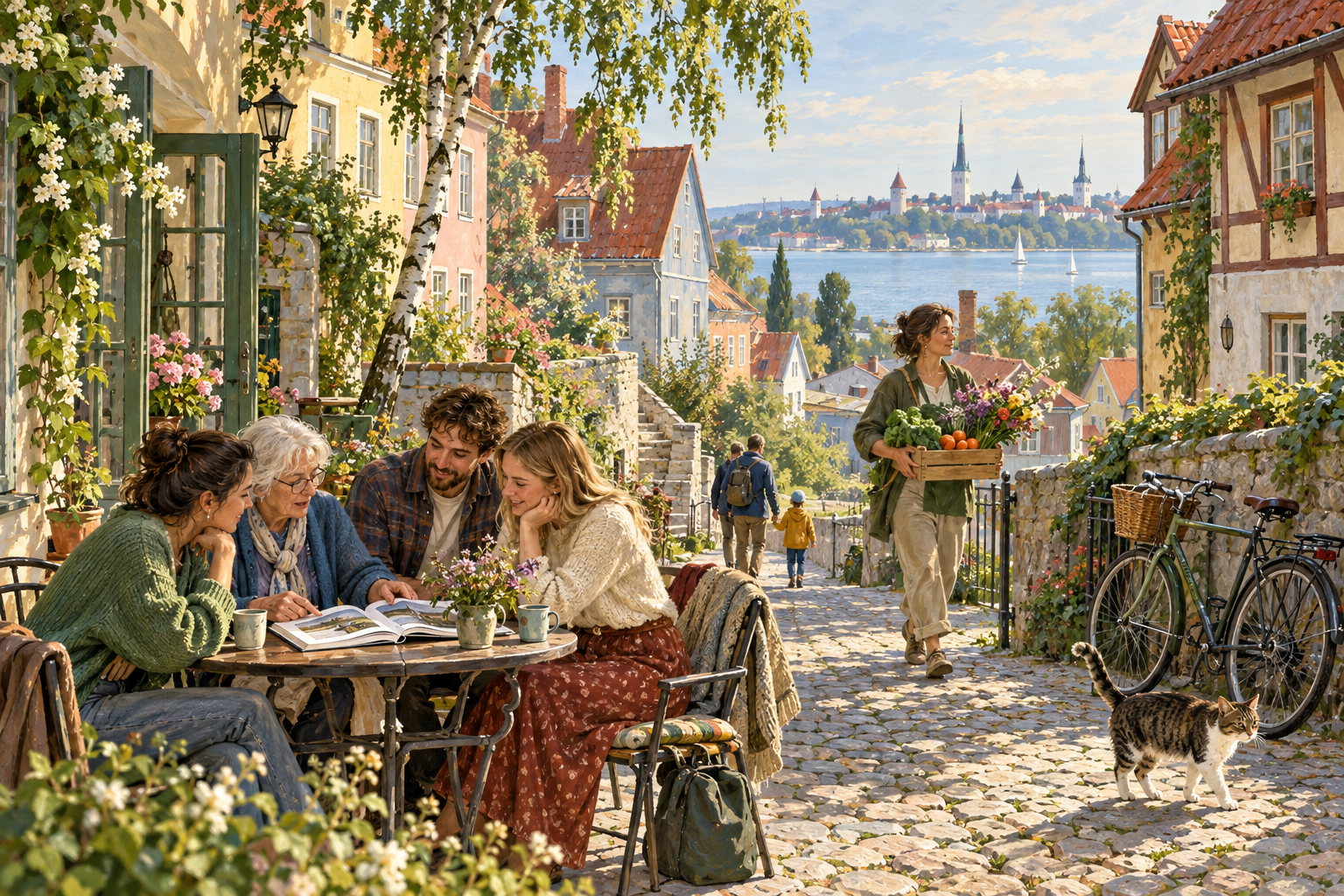
Cover illustration: an original AI-generated artistic interpretation of neighbours reading in an Estonian-inspired Baltic town, with bicycles, flowers and a distant waterfront. This is a nonliteral composite, not a photograph or an exact view of a named place.
Choose your route through Estonia
- 1. Geography and Natural Setting
- 2. Regions, Cities and Local Life
- 3. Historical Foundations
- 4. Independence and Restoration
- 5. Government, Law and Digital Institutions
- 6. Economy, Trade and Work
- 7. Agriculture and Rural Production
- 8. Infrastructure, Transport and Energy
- 9. People, Languages and Belonging
- 10. Education and Lifelong Learning
- 11. Food and regional tables
- 12. Music and shared celebrations
- 13. Literature, art and living heritage
- 14. Sport, achievement and participation
- 15. Biodiversity and conservation work
- 16. Health, research and scientific ambition
- 17. Estonia in international relationships
- 18. Current challenges and resilience
- 19. Daily life and community connections
- 20. Learning from Estonia, comparing carefully
1. Geography and Natural Setting
A Baltic location
Estonia occupies the northern end of the three Baltic states, with Latvia to the south and Russia to the east and southeast. The Baltic Sea borders its western and northern sides. Across the Gulf of Finland lies Finland, while Sweden lies across the wider Baltic. These relationships place Estonia within a network of nearby shores rather than at an isolated continental edge, with land borders and maritime connections both shaping its geographical setting. (Geographical setting)
The landscape belongs to the northwestern part of the East European Plain, but calling it simply flat misses important local differences. Glacial processes left uplands, plateaus, lowlands and depressions. Haanja and Otepää contrast with the Pandivere plateau and lower areas such as Soomaa. Suur Munamägi, approximately 317 metres high, is the highest point. Estonia’s relief is therefore modest in absolute height, yet sufficiently varied to give different districts recognisably different terrain. (Landscape regions)
Land and seasonal contrasts
Beneath that terrain, limestone and dolostone form important parts of the older sedimentary bedrock. Younger deposits contain sand, gravel and clay, materials used in construction. The Geological Survey distinguishes the properties and distribution of these resources rather than treating all stone or aggregate as interchangeable. Northern limestone formations and the patchier deposits of sand and gravel illustrate how geological history influences the materials available for roads, buildings and other everyday infrastructure. (Construction minerals)
Seasonal contrasts are clear in the Environment Agency’s 1991–2020 climate normals. At Tallinn-Harku, January averaged minus 2.9 degrees Celsius and July 17.6; at Tartu-Tõravere the corresponding values were minus 4.1 and 18.0. The inland station thus had colder winters and slightly warmer midsummers in this reference period. These are averages across thirty years, not promises about a particular season, and they preserve differences between observing stations that a single national temperature would conceal. (Climate normals)
Lakes, coasts and islands
Lakes are unevenly distributed, with especially lake-rich landscapes in southern and southeastern Estonia. Peipsi and Võrtsjärv stand out for their size, while Rõuge Suurjärv is notable for a depth reaching 38 metres. Large surface area and great depth are different characteristics, so the biggest lake is not necessarily the deepest. The ministry’s water overview also treats biological and chemical monitoring as necessary for understanding lake condition, beyond the visible appearance of the water. (Estonian lakes)
Small Baltic islands and islets add another scale of landscape. On exposed rocks, vegetation may remain sparse, with lichens and plants adapted to dry, windy conditions. Brackish water, sunlight, wind and continuing land uplift influence these habitats. Their importance is not measured only by human settlement: some provide resting or nesting places for birds and gathering places for seals. This ecological description should not be confused with a fixed national island count, which depends on definitions. (Baltic islet habitat)
2. Regions, Cities and Local Life
Administrative and urban geography
In October 2026, the regional ministry lists 78 local governments: 15 towns and 63 rural municipalities. These are administrative categories, not a division between urban and agricultural populations. Municipalities have comparable public responsibilities, while their territory and settlement patterns differ. Distinguishing counties, municipalities and settlements explains why a place name can refer both to a town and to a much wider jurisdiction. (Local government system)
Tallinn is more than its historic streets. The municipality identifies scenic neighbourhoods such as Kadriorg, Kassisaba, Uue-Maailma, Torupilli and Veerenni through planning and protection maps. Their inclusion draws attention to the character of streets and residential environments beyond a single monumental centre. A neighbourhood approach also makes the city easier to understand as a collection of lived places, where conservation decisions concern ordinary buildings and surroundings as well as celebrated landmarks. (Tallinn neighbourhoods)
River and border cities
Tartu’s relationship with the Emajõgi helps explain the city. Flowing from Võrtsjärv toward Peipsi, the river linked western Hanseatic commerce with eastern trading centres in the medieval period. Its commercial importance changed as navigation conditions changed. The municipal account still presents the river as a defining urban feature, while recognising flooding and water depth as practical considerations. A river can therefore be both a symbol and a physical constraint on urban life. (Tartu and the Emajõgi)
Narva’s built environment records several distinct periods rather than one continuous architectural style. The fortress, Swedish bastions and town hall connect it to earlier political and trading histories. The nineteenth-century Kreenholm textile complex includes industrial buildings alongside housing and public facilities. Destruction during the Second World War and subsequent rebuilding profoundly changed the older townscape. Reading these layers together avoids reducing Narva either to a border fortress or to its later industrial development alone. (Narva urban heritage)
Larger municipalities and island communities
Pärnu demonstrates why municipal boundaries matter when describing cities. Its current municipality includes areas beyond the city as it existed before the 2017 administrative merger. The municipality’s planning page describes several existing comprehensive plans and work toward a unified framework. The central settlement plan therefore does not cover every part of the wider jurisdiction. Discussions of development, services or land use need to specify whether they concern the built-up city, adjoining settlements or the entire municipality. (Pärnu spatial planning)
Saaremaa municipality was formed in October 2017 by combining Kuressaare with eleven rural municipalities. Kuressaare is its administrative centre, but the municipality also encompasses numerous villages and small boroughs, including communities on smaller inhabited islands such as Abruka and Vilsandi. Local district councils provide another layer of representation within this extensive territory. The municipal map consequently brings together a town, dispersed rural settlements and island communities whose local circumstances cannot be captured by the centre alone. (Saaremaa communities)
3. Historical Foundations
Settlement and trading towns
Archaeology places human settlement at Pulli, beside the Pärnu River, around 9000 BCE. Reinterpretation remains possible: University of Tartu investigators re-examined an item previously described as a bone pendant and identified a small animal figure made from birch tar. Its age is associated with the settlement context rather than direct dating. Such findings show both the depth of settlement history and the provisional nature of archaeological explanations. (Pulli archaeological research)
Medieval urban commerce left substantial institutions and buildings. Tallinn’s Great Guild Hall, completed in 1410, served a merchant organisation connected with the Hanseatic trading world. The building accommodated more than transactions: its history includes gatherings, ceremonies and other civic activities, followed by later commercial and cultural uses. The hall illustrates how merchant wealth, urban organisation and public space intersected. It records a particular institution, not every resident’s experience. (Great Guild Hall history)
Learning and national expression
The University of Tartu’s history reflects successive political and linguistic settings. Founded under Sweden’s Gustav II Adolf in 1632, it later reopened in 1802 within the Russian Empire with German as its principal teaching language. Estonian became the university’s language of instruction in 1919. These changes connect education with wider transformations in authority and public culture. They also remind readers that the history of an institution may include interruptions and reinventions rather than uninterrupted continuity. (University of Tartu history)
Nineteenth-century national expression developed through writing alongside political organisation. Friedrich Reinhold Kreutzwald, a physician and writer, assembled and reshaped folkloric material into Kalevipoeg. The epic appeared in sections between 1857 and 1861 with a German translation, followed by a popular Estonian edition in 1862. Its importance to the national awakening lay partly in giving vernacular cultural material a substantial literary form. Folklore and authored literature met here, rather than remaining separate categories. (Kreutzwald and Kalevipoeg)
Occupation and coercion
The twentieth century brought successive occupations and mass violence. Soviet forces occupied Estonia in 1940, followed by annexation into the Soviet Union. Nazi Germany occupied the country in 1941; German security institutions and Estonian auxiliaries participated in the persecution and murder of Jews, including people deported there from elsewhere. Soviet rule returned in 1944. Responsibility must be described through institutions and perpetrators, not assigned collectively to every member of an ethnic or national community. (Occupation and Holocaust history)
Soviet repression also transformed rural society. The March 1949 deportation operation, known as Priboi, targeted the Baltic states in the context of suppressing resistance and enforcing agricultural collectivisation. The Estonian Institute of Historical Memory’s research publication examines the operation through security-service documentation and scholarly analysis. Forced removal was not an ordinary movement of workers or a voluntary farming reform. Understanding coercion alongside institutional change is essential to explaining the disruptions experienced by families and countryside communities. (March 1949 deportation research)
4. Independence and Restoration
Founding a republic
The independence manifesto dated 24 February 1918 proclaimed Estonia an independent democratic republic. It promised equality before the law irrespective of religion, ethnic background or political views, together with civil freedoms and protections for minority cultures. It also anticipated urgent work on land, labour, food and finances. These statements expressed the founders’ programme during upheaval. A declaration establishes political principles and claims, but does not demonstrate immediate fulfilment. (Independence manifesto)
Elections for the Constituent Assembly took place in April 1919 while the War of Independence continued. The assembly first met on 23 April and undertook fundamental institutional work, including the land law of October 1919 and the constitution adopted in June 1920. That constitution provided for a hundred-member parliament without a separate presidency. The early republic’s design therefore differed from Estonia’s present arrangements, and its constitutional development cannot simply be equated with today’s institutions. (Constituent Assembly)
Recognition and democratic interruption
The Tartu Peace Treaty, signed on 2 February 1920, ended the war between Estonia and Soviet Russia and included recognition of Estonia’s independence. Its twenty articles addressed borders, security, economic relations, transport and social questions. Ratifications were exchanged the following month. The treaty belongs to the history of establishing the republic’s international position. References to its territorial provisions describe that historical settlement and should not be presented as a simple map of every present boundary arrangement. (Tartu Peace Treaty)
Interwar independence was not an uninterrupted period of parliamentary democracy. Constitutional changes took effect in January 1934, and a state of emergency followed in March under Konstantin Päts. Parliamentary activity was subsequently interrupted, opening the authoritarian period often called the era of silence. The Riigikogu’s own historical account records this break. A balanced national history therefore distinguishes the creation of democratic institutions from the later concentration of power, rather than treating the period as uniform. (Parliamentary interruption in 1934)
Public mobilisation and restored sovereignty
On 23 August 1989, people formed the Baltic Way across Estonia, Latvia and Lithuania. The roughly 600-kilometre human chain marked fifty years since the German-Soviet pact and expressed a peaceful demand for freedom. UNESCO’s Memory of the World recognition concerns documentary evidence of this mobilisation, not a World Heritage landscape designation. The cross-border scale matters: Estonia’s movement was part of coordinated Baltic action, while each country retained its own political history and institutions. (Baltic Way documentary record)
On 20 August 1991, at 23:03, Estonia’s Supreme Council adopted the resolution restoring national independence with 69 votes. The formulation of restoration expressed continuity with the republic proclaimed in 1918, rather than the creation of an entirely unrelated state. The Riigikogu’s anniversary account preserves the decision and its timing. This milestone should be understood alongside the earlier public mobilisation: mass participation and institutional action were different, complementary elements in the recovery of sovereignty. (Restoration of independence)
5. Government, Law and Digital Institutions
Constitution and head of state
Estonia’s constitutional order rests on popular sovereignty, a democratic republic and the separation and balance of powers. The Riigikogu is the national legislature, with 101 members elected through proportional representation. The constitution also establishes the state as unitary and identifies Estonian as its official language. These provisions describe the formal organisation of public authority. They should be distinguished from judgments about how effectively particular governments perform, or whether a specific policy is fair, popular or successful. (Current Constitution)
On 20 October 2026, Estonia’s president is Ülle Madise. She took the oath of office on 12 October, succeeding Alar Karis, after the parliamentary election in September. The inauguration account stresses that the presidency does not replace the work of parliament, government or courts. Dates matter: descriptions prepared earlier in 2026 can describe Karis correctly yet become outdated after the October transfer of office. (Presidential inauguration, October 2026)
Executive and judicial responsibilities
Kristen Michal remains prime minister in October 2026, having entered office in July 2024. The government’s institutional description identifies the prime minister as the organiser and representative of the cabinet, directing policy coordination and chairing its meetings rather than personally heading every ministry. Ministers retain defined areas of responsibility. Executive leadership therefore combines collective decisions and specialised departmental work, rather than concentrating all administration in one office. (Prime minister and responsibilities)
The court system has three instances: district and administrative courts, circuit courts on appeal, and the Supreme Court. The Supreme Court also performs constitutional review. Independence in deciding cases does not mean that every aspect of court administration is detached from the executive: lower courts are administered through cooperation involving the justice ministry and the judicial administration council. The Supreme Court administers itself. Distinguishing adjudication from budgeting and administration gives a more accurate institutional picture. (Court-system overview)
Participation and information exchange
Internet voting is one participation method, not a replacement for every paper ballot. The electoral office describes encryption, separate handling of keys, testing and verification procedures. A voter may submit a later electronic vote, while a valid paper vote overrides an electronic one under the applicable process. These safeguards address particular risks; their existence is not evidence that any voting technology is infallible. Estonia’s electoral arrangements combine digital procedures with rules governing alternatives and the counting process. (Internet and paper voting)
X-tee, Estonia’s data-exchange layer, connects participating information systems without turning them into one unrestricted central database. Data owners retain control, and exchanges depend on agreements and access permissions. Authentication, authorisation, logging, encryption and digital signatures are among its safeguards. This explains digital administration more precisely than claims that government knows everything. A technical channel enables authorised exchanges; it does not by itself create a lawful purpose, remove access limits or guarantee perfect operation. (X-tee operating principles)
6. Economy, Trade and Work
Production and international exchange
Manufacturing gives Estonia’s economy a material dimension alongside its digital reputation. Official industry reporting identifies wood products, food, fabricated metals, electronics and electrical equipment as important activities. In 2025, manufacturing output increased by 3.1%, while total industrial production grew more slowly because mining and energy followed different paths. Manufacturing also sells heavily abroad. These distinctions matter because a technology business, a factory and an electricity producer need not experience the same economic cycle. (Industry in 2025)
Goods trade connects Estonia especially closely with neighbouring markets. In 2025, the leading export destinations were Finland, Latvia, Sweden and Lithuania. Statistics Estonia recorded goods exports of 18.6 billion euros and imports of 22.4 billion euros at current prices. Those totals include cross-border goods movements, not the complete services economy. The agency also distinguishes goods of Estonian origin from other exports, a necessary distinction between domestic production, distribution and re-export activity. (Goods trade in 2025)
Money and labour markets
Estonia adopted the euro on 1 January 2011, when Eesti Pank joined the Eurosystem. The national central bank participates in common monetary-policy arrangements and carries out related functions within Estonia. Price stability is a central objective, alongside responsibilities connected with financial stability and payment systems. Estonia does not independently set a separate national currency policy. The institutional connection links domestic economic conditions with decisions made for the wider euro area. (Eesti Pank and the euro)
Labour-market figures answer different questions. In the second quarter of 2026, Statistics Estonia reported participation of 73.4%, employment of 68.6% and unemployment of 6.6% for people aged 15–74. Employment and participation compare groups with the relevant population, while unemployment is measured within the labour force. Someone outside the labour force is therefore not automatically counted as unemployed. Keeping these denominators distinct prevents a small unemployment percentage from being mistaken for the share of all adults without jobs. (Labour market, second quarter 2026)
Recovery and productivity
Eesti Pank’s September 2026 forecast projected economic growth of around 2.5% annually over 2026–2028. It linked the initial recovery partly to bringing unused capacity back into production, while stressing that later progress would require investment, technology and skills. Energy-price pressures and increasing public debt remained concerns. These are dated projections rather than completed annual results. A forecast offers a conditional account of the path ahead, not a guarantee of equal benefits across households, industries or regions. (September 2026 economic forecast)
The OECD’s 2026 survey cautions against oversimplifying the digital economy. Strong information-technology activity and investment do not automatically translate into productivity gains throughout manufacturing, construction and other services. Wider adoption depends on organisational change, infrastructure and workers’ capabilities. Diffusion beyond specialist technology firms matters. Estonia’s economic story includes digital strengths, but also the ordinary challenge of helping a broad range of businesses produce greater value with available labour and capital. (OECD Economic Survey 2026)
7. Agriculture and Rural Production
Land and farm structure
Estonian agriculture combines many small holdings with concentrated commercial output. The 2023 Farm Structure Survey counted approximately 10,700 holdings, averaging 91 hectares of utilised agricultural land. Most holdings were smaller than twenty hectares, yet the largest 2,400 accounted for 93% of production. The average consequently describes neither typical small holdings nor the largest businesses well. The survey also applies a threshold, rather than counting every household garden. (Farm Structure Survey 2023)
The 2025 agricultural land table records about 982,000 hectares in use. Cereals include wheat, barley, oats and rye, alongside pulses, rape, potatoes and crops grown for animal feed. Arable farming and livestock production are consequently connected activities. Area under a crop is also different from the quantity harvested: a larger sown area does not necessarily produce a proportionately larger crop. Separating land use from yield helps clarify agricultural statistics. (Agricultural land and crops)
Livestock and production standards
Dairy farming is supported by systematic livestock performance recording. The producer organisation’s 2025 yearbook reports average recorded milk yield of 11,896 kilograms, while explaining the role of breeding, feeding and herd management in performance. Records let participating farmers compare herds and follow changes over time. They are not a measure of milk drunk by residents or a claim about every individual cow. The same recording system also documents developments in beef cattle and other livestock. (Livestock performance yearbook 2025)
Organic farming is a defined production approach, not simply natural-looking countryside. The agriculture ministry’s overview includes plant and livestock production, beekeeping and aquaculture, with requirements extending to processing and marketing. Restrictions apply to genetically modified organisms and to the additives permitted in processing. Organic and conventional production therefore should not be blurred together. The existence of an organic sector says something about production standards and choices, not that every Estonian farm uses identical methods. (Organic production framework)
Policy and rural livelihoods
The Common Agricultural Policy plan for 2023–2027 frames support around a competitive and resilient agricultural sector, food security and the economic, environmental and social needs of rural areas. The European Commission approved Estonia’s fourth amendment in August 2026. Annual performance reports are intended to account for spending, outputs and results. That distinction is important: an approved programme establishes priorities and instruments, while subsequent evidence is needed to assess their accomplishments for farms and communities. (Estonia CAP Strategic Plan)
The Agriculture and Fisheries Strategy 2030 looks beyond crop output. Its priorities include plant and animal health, food safety, soil condition, viable rural and coastal communities, and sustainable use of fish stocks. Fisheries and aquaculture sit alongside farming and food processing within this framework. These are policy objectives rather than proof that all pressures have been resolved. They illustrate how rural production depends on ecological conditions, business viability and the continuing life of communities. (Agriculture and Fisheries Strategy 2030)
8. Infrastructure, Transport and Energy
Roads and maritime gateways
Estonia’s national road network measured 16,990 kilometres at the start of 2026, including designated walking and cycling infrastructure. Main, basic and secondary roads perform different roles, while municipal, private and forest roads belong to other categories. The Transport Administration also lists potential ice roads separately because their availability depends on weather. An inventory does not imply identical surfaces, capacity or year-round conditions. (Road network, January 2026)
The Port of Tallinn is an organisation operating several harbours, not simply one waterfront inside Tallinn. Its portfolio includes the passenger-oriented Old City and Saaremaa harbours and the cargo-oriented Muuga and Paldiski South harbours. Containers, bulk commodities and vehicles carried on roll-on/roll-off vessels require different facilities. This division of functions helps explain why passenger arrivals, industrial land and freight handling occupy different locations, despite their common ownership. (Port of Tallinn harbour network)
Rail services and construction
Passenger railway developments differ from future construction projects. Elron’s chronology records the introduction of new Škoda trains in December 2025, services to Tapa in January 2026, and the start of the Tallinn–Tartu–Riga service on 12 January. Earlier coordination with Latvian and Lithuanian operators enabled journeys toward Vilnius with transfers. These are developments on operating services; their existence does not mean that the separate Rail Baltica infrastructure has already opened. (Elron service developments)
Rail Baltica remained a construction and systems-delivery project in 2026. In its April industry update, RB Rail reported work on 107 kilometres of Estonian mainline and the Ülemiste terminal, together with electrification and procurement milestones across the Baltic states. Cross-border coordination involves more than laying track: stations, electricity supply, operating systems and other contracts must fit together. The April figures describe a dated construction position, not completed passenger service or a guarantee that every later deadline will be met. (Rail Baltica construction update)
Electricity systems and generation
A major electricity-system change was completed in February 2025. Estonia, Latvia and Lithuania disconnected from the Russian frequency area on 8 February, operated an island test, and synchronised with continental Europe on 9 February. Elering describes extensive preparation and cooperation with neighbouring system operators, including Poland’s connecting role. Synchronisation concerns coordinated frequency management and grid operation. It should not be confused with producing all electricity domestically, eliminating imports or removing every possible interruption to supply. (Continental grid synchronisation)
Electricity generation also has a varied resource base. Statistics Estonia’s 2025 renewable-generation table records substantial output from wood chips and waste, wind and solar, with much smaller hydroelectric production. Solar generated 1,162 gigawatt-hours, compared with 1,019 from wind in that year. These figures measure electricity produced, not installed capacity or the renewable share of all energy consumed. Comparing clearly defined quantities is essential when discussing an energy transition that includes generation, networks and changing patterns of demand. (Renewable generation, 2025)
9. People, Languages and Belonging
Population and linguistic diversity
The revised official population estimate was 1,360,745 on 1 January 2026. Statistics Estonia reported a decline of 9,250 people during 2025, reflecting both more deaths than births and more emigration than immigration. The April 2026 release superseded preliminary estimates published earlier in the year. Dating these figures matters because population is not a timeless country characteristic: births, deaths, movement and statistical revisions all affect the total, sometimes reversing earlier trends. (Revised population estimate 2026)
The 2021 census recorded 243 mother tongues and allowed respondents to identify two. Estonian and Russian formed the largest dual-language combination, while sign languages were also represented. These findings challenge a division into two uniform communities. The language survey covered people aged three and older, with a reference date at the end of 2021. It therefore does not describe subsequent arrivals of refugees from Russia’s full-scale invasion of Ukraine. (Census language diversity)
Estonian and regional languages
Estonian belongs to the Uralic language family and is closely related to Finnish. Its relationship with Latvian, Russian and Swedish is different: these neighbouring languages have contributed vocabulary but are not its close linguistic relatives. Standard Estonian has fourteen grammatical cases and no grammatical gender; stress usually falls on the first syllable, with exceptions among borrowed words. These features describe language structure, not uniform thought or proficiency determined by nationality. (Estonian language structure)
Regional speech adds further complexity. The Võru Institute describes Võro as part of the South Estonian linguistic tradition, with features including vowel harmony and a glottal stop. It also emphasises the distinct self-identification of Seto speakers rather than treating nearby varieties as interchangeable. Language and dialect labels carry cultural, political and linguistic meanings. Recognising those distinctions makes room for regional belonging without assuming that it excludes a wider Estonian identity. (Võro linguistic traditions)
Participation across communities
The 2023 Integration Monitoring study examines language, citizenship, participation, identity and trust as related but distinct dimensions. Its findings include positive connections with Estonia among many residents of other ethnic backgrounds, alongside socioeconomic inequalities and barriers to trust. These findings do not imply identical outlooks among Russian speakers or citizenship groups. Integration is better understood through varied experiences and relationships than through an assumption that a single label determines someone’s loyalties, opportunities or sense of home. (Integration Monitoring 2023)
Language learning offers one practical setting for participation across communities. The Integration Foundation describes adult courses, specialised language training, independent learning, cultural activities, adaptation support and counselling. Different formats can address different starting points and purposes, from practising conversation to developing skills needed in daily life. These programmes show that language acquisition is supported through institutions and social opportunities, not only expected from individuals. Provision does not establish universal access or identical outcomes. (Language-learning opportunities)
10. Education and Lifelong Learning
School pathways and participation
Basic education normally covers nine grades, divided into three stages. National curricula provide a common framework, including a simplified curriculum for learners who need it. After basic school, pathways include general upper secondary education and vocational study; general upper secondary education normally lasts three years. This does not permit everyone to leave education after grade nine. The newer learning obligation changes participation requirements while preserving different educational pathways. (General education structure)
The learning-obligation reform applies from the 2025/2026 academic year. It requires affected learners to continue until eighteen or completion of secondary or vocational education. The first cohort includes under-eighteen students completing basic school in spring 2026. Those who completed basic school, or turned seventeen, before 1 September 2025 are excluded under the transitional rules. The reform also provides for guidance and preparatory study, supporting learners in finding their next educational step. (Learning-obligation reform)
Language transition and learning outcomes
The transition toward Estonian as the language of instruction began in kindergartens and grades one and four in 2024, with completion targeted for 2030. It is a phased process, not an already completed change across every classroom. The ministry identifies teachers’ language skills, training and support as necessary conditions. Its stated goals include reducing educational segregation and widening opportunities. Those objectives should be distinguished from measured results, while implementation continues. (Language-of-instruction transition)
PISA 2022 found that Estonia’s fifteen-year-old students performed above the OECD average in mathematics, reading and science. However, the same assessment recorded an 81-point mathematics gap between the most and least socioeconomically advantaged quarters of students. School leaders also reported teaching-staff shortages. Strong national averages therefore coexist with unequal circumstances and staffing pressures. PISA offers a dated assessment of particular skills among students, not evidence of equal success or proof of a single policy’s effectiveness. (PISA 2022 findings)
Higher education and adult skills
Higher education follows bachelor’s, master’s and doctoral cycles, with professional higher education also available at the first level. Some fields, including medicine, use integrated programmes rather than a simple sequence of separate degrees. Institutions can set additional admission requirements beyond completed secondary education. These distinctions help explain the range of academic and professional routes. Programme lengths, selection requirements and the purposes of qualifications vary. (Higher-education pathways)
Adult learning extends the education picture beyond school and university entrants. The ministry’s VÕTI programme supports flexible pathways, continuing training, microcredentials and recognition of earlier learning or work experience. Its objectives include reducing participation differences between age groups and regions, with training informed by labour-market forecasts. These are programme aims and instruments, not guarantees of employment or equal access. Skills can thus be renewed throughout working life, rather than acquired once and retained unchanged. (Adult learning and VÕTI)
11. Food and regional tables
Bread and everyday ingredients
Dark rye bread, or mustleib, is one of Estonia’s characteristic foods. Rye’s tolerance of cold and relatively poor soils helps explain its place in the food story. A slice can accompany soup or herring, or be eaten simply with butter, connecting an agricultural crop with an ordinary meal rather than only a ceremonial dish.
Estonian bread also includes lighter loaves made by blending rye and wheat. Visit Estonia describes both bakery production and home baking, reminding us that a familiar food need not have one fixed recipe. Comparing loaves reveals choices about grain, texture and taste; a national symbol can still leave considerable room for personal preference.
Familiar dishes, changing forms
Kama combines flour from barley, rye, oats and peas, and can be mixed with buttermilk or kefir. It also appears in newer desserts, including combinations with whipped cream and cranberry jelly. Another familiar sweet is kohuke, a chocolate coated curd snack sold in different flavours. Together these foods complicate the idea that tradition and convenience belong to separate worlds: a grain mixture can enter restaurant experimentation, while a small packaged snack can carry a recognisable dairy flavour into everyday shopping.
Mulgipuder, the potato and barley porridge associated with Mulgimaa, makes regional identity tangible through a modest list of ingredients. The regional account describes preparing the grains and potatoes together and serving the dish with pork. Its account also records UNESCO recognition in 2024. The interesting feature is not luxury but transmission: knowing the proportions, cooking sequence and desired texture turns basic ingredients into a recognisable dish. Heritage recognition therefore concerns knowledge and practice, not a claim that every household cooks identically.
Regions and edible history
Visit Estonia’s regional food account distinguishes island seafood from freshwater fish traditions around inland waters. Its discussion of the Lake Peipsi area connects Old Believer communities with onions, fish and tea from a samovar. Such examples make a food map more useful than a single national menu: waters, settlement histories and local livelihoods matter. The tourism account offers selected encounters rather than a survey of what everyone eats, so its restaurant examples should be read as invitations to explore regional variation.
Kolu inn at the Estonian Open Air Museum presents food within a nineteenth century roadside inn setting. The museum describes homestyle dishes such as pea soup alongside preparations including kama foam, while the venue also hosts celebrations and cultural events. Eating here can therefore become a way to consider how a building’s social purpose shapes a meal. It remains a museum interpretation and a working hospitality venue, not an untouched fragment of the past or a representative sample of present household diets.
12. Music and shared celebrations
Singing together
UNESCO traces Estonia’s first national song celebration to 1869 and places it within the wider Baltic song and dance tradition. Amateur choirs and dance groups prepare through regular local rehearsals, while festival repertoires connect inherited songs with newer compositions. The gathering is thus part of a longer social process. Conductors, rehearsal rooms and voluntary commitment belong to the tradition’s practical foundation.
The 2025 Song and Dance Celebration took place on 3–6 July under the title Iseoma, rendered in English as Kinship. Its programme brought together choral singing, orchestras, folk music, dance and a procession. These are distinct forms of participation, not simply one concert. Looking at how the programme connects stages, streets and performers helps explain the event’s civic scale, while avoiding the assumption that a national celebration expresses every resident’s identity in precisely the same way.
Local voices and composed sound
Seto leelo, inscribed by UNESCO in 2009, is a polyphonic singing tradition associated with Seto communities. A lead singer delivers a line, and the choir joins its final syllables before repeating the line. Composition and responsiveness matter alongside memory: this is skilled musical interaction, not just the preservation of a fixed recording. The practice shows why a country’s musical culture is better understood through particular communities and techniques than through a single supposedly national sound.
The Arvo Pärt Centre introduces the composer’s work through silence, words, sound and the compositional approach known as tintinnabuli. Its manuscripts allow visitors to follow sketches, diagrams and drafts towards completed scores. That material gives an unusually concrete way into music often discussed in abstract spiritual language: composition also involves revision, decisions and patient work on paper. Pärt’s international prominence is one strand of Estonia’s musical life, not a template that explains every Estonian musician or audience.
Festivals as meeting places
The Viljandi Folk Music Festival uses the town and its Castle Hills as settings for concerts, workshops, singing, playing and dancing. Its organisers present traditional music as something that can develop in contemporary conditions, with Estonian performers meeting artists from elsewhere. This makes the festival more than a display of costumes or old instruments. Workshops and participatory formats invite attention to how skills travel between generations and across borders, without requiring every performance to sound like an earlier historical version.
Tallinn Music Week’s music programme ranges across experimental, electronic, classical and other contemporary forms. Its presentation includes musicians such as Maarja Nuut and Mari Kalkun alongside very different bands and producers, emphasising stylistic diversity. A showcase format also frames music as exchange between artists, audiences and industry participants. Set beside choral celebrations and local singing traditions, this scene prevents the country’s cultural portrait from becoming frozen in folklore or reduced to one internationally famous composer.
13. Literature, art and living heritage
Writing and historical imagination
Tartu’s international residency programme for writers and translators began in 2017. The City of Literature programme offers visiting authors time to work and opportunities to introduce their writing to local readers. It also describes an exchange with Norwich in 2020–22 and a separate residency for translators of Estonian literature introduced in 2023. These activities make literary exchange tangible: a city can support literature through working time, encounters and translation, not only through commemorating famous names.
Jaan Kross began as a poet and translator before turning to prose in the late 1960s, according to the Estonian Literature Centre’s account. His imprisonment and exile in 1946–54 preceded historical fiction including Between Three Plagues, centred on the chronicler Balthasar Russow. Historical setting does not make such writing a substitute for an archive. It offers another route into questions of loyalty, judgement and constrained choices, and an individual’s place within a political order.
Museums and urban fabric
Kumu combines the roles of a national art gallery and a museum of contemporary art. Its permanent displays move through Baltic German and Estonian artistic histories, the Soviet period and later developments, while temporary exhibitions introduce other perspectives. The sequence matters: images emerge from different institutions, patrons and political circumstances rather than from an unchanging national essence. Visiting several sections allows comparison across time without universalising one painting.
Tallinn’s World Heritage historic centre preserves the relationship between the administrative upper town of Toompea and the merchant city below. UNESCO highlights streets, plots, public buildings and houses as well as the surviving fortifications. The heritage value therefore lies in an urban structure, not merely a collection of picturesque towers. Looking at how authority, worship, trade and domestic life occupied different spaces helps explain the old town as a working historical city rather than a decorative backdrop.
Making images, maintaining practices
Nukufilm, established in Tallinn in 1957, provides a different entry into Estonian visual culture through stop motion animation. The studio presents artistic short films and production work, showing that animation is not only entertainment for children. Its craft also invites a useful question about what a moving image conceals: the finished sequence depends on constructed objects and many carefully arranged changes. A studio history complements museum collections by following cultural production rather than finished objects alone.
UNESCO’s Kihnu cultural space concerns traditions maintained on Kihnu and Manija, including songs, dances and handicrafts. Its account emphasises women’s role in transmitting cultural knowledge and practices within community life. The focus is a living social setting, not an isolated costume in a display case. Heritage descriptions should also leave room for change and individual choice: recognising particular practices does not mean island residents must perform a timeless identity for outsiders.
14. Sport, achievement and participation
Precision and shared achievement
Estonia won the women’s team épée title at the Tokyo 2020 Olympic Games, held in 2021. The International Fencing Federation’s report records the victory on 27 July. Keeping the official Games name and the actual competition year together avoids a common chronological confusion when reading Olympic results.
A team fencing title also directs attention beyond a single star. Separate bouts contribute to a shared result, making the achievement a useful example of individual responsibility within collective competition. It should not be expanded into a claim that one medal measures the sporting participation, resources or opportunities of an entire population.
Different routes to a result
Erki Nool won the Sydney 2000 Olympic decathlon with 8,641 points, according to World Athletics’ results record. The points total is central to understanding the achievement: decathlon rewards performance across a programme rather than a single finishing time or distance. For a learner, the event offers a useful contrast with specialisation. Following the overall classification asks how strengths and weaknesses accumulate, and why a final placing can only be understood after the complete competition rather than from one memorable moment alone.
Ott Tänak and co-driver Martin Järveoja secured the 2019 World Rally Championship title with Toyota, as the championship’s historical account records. Their season included six rally victories, with the title settled in Spain. Naming the co-driver is important because rally success is not solely the work of the person steering. The record also illustrates why sporting categories must remain distinct: a driver’s championship, a co-driver’s championship and a manufacturers’ contest concern related competition, but they are not interchangeable descriptions of the same trophy.
Winter sport beyond one podium
Kelly Sildaru won Olympic slopestyle bronze at Beijing in 2022 and finished fourth in halfpipe, according to the International Ski Federation’s January 2023 retrospective. The same account records her slopestyle World Cup success and X Games superpipe gold. These results belong to different events and competitions, even though all involve freestyle skiing. Keeping them separate gives a more informative picture of versatility than a compressed medal list, and avoids making an Olympic placing stand for every performance during a long competitive season.
Tartu Maraton’s 2026 event information connects a race first held in 1960 with a broader programme of distances and formats. The classic technique routes include 63 kilometres from Otepää to Elva and a shorter 31 kilometre option, alongside other races and children’s events. This is a useful counterpoint to elite medal stories: organisers create several ways to enter the same sporting occasion. A programme describes opportunities offered, however, not proof that everyone participated or that conditions and access were identical for all entrants.
15. Biodiversity and conservation work
Species and inhabited landscapes
Estonia’s Environmental Board places protected species in three categories reflecting different conservation needs. Its examples include the flying squirrel and white tailed eagle in category I, and the ringed seal in category II. Such categories are tools for deciding attention and protection, not a ranking of how interesting an animal is. A species’ habitat, distribution and vulnerability matter alongside its recognisable appearance.
The Environmental Board describes cultural heritage protection as part of the work of Estonia’s six national parks. Lahemaa’s coastal landscapes, Karula’s hills and Soomaa’s wetlands present different relationships between land and human activity. A protected landscape need not be a place without people or history. Buildings, practices and local knowledge can belong within the conservation picture, while the protection of natural features still requires attention to the particular purposes of each area.
Wetlands and restoration
A 2021 study of Matsalu National Park describes coastal and floodplain meadows, reed beds, wooded meadows and islands supporting a major migratory bird stopping area. The landscape also includes livelihoods such as livestock keeping and fishing. Reading these elements together explains why habitat conservation is not simply the act of drawing a boundary. Different places supply feeding and resting opportunities, while management decisions operate within an inhabited landscape with changing seasonal functions.
The European Commission’s March 2024 account of the LIFE Mires Estonia project reports restoration of natural water conditions across nearly 8,000 hectares at six sites. Hydrological observations, botanical work and remote sensing formed part of the project’s monitoring. The example makes restoration concrete: changing water conditions and checking ecological responses are different tasks, both necessary for understanding progress. A reported treatment area should not be mistaken for proof that every species has recovered or that the whole country’s peatlands are now secure.
Management rather than labels alone
The Environmental Board’s guidance for heritage meadows links their conservation with practical maintenance and restoration under the 2021–27 action plan. Coastal meadows, floodplain meadows, wooded meadows and alvars require attention to their particular characteristics. The phrase heritage meadow captures a productive tension: these are valuable habitats shaped through relationships between ecological processes and land use. Simply leaving every site alone is not an adequate universal recipe. Conservation instead asks which activities sustain the habitat and how their effects are checked over time.
Estonia’s Natura assessment guidance requires attention to the effects of proposed activities on protected sites’ conservation objectives and integrity. This adds a decision making dimension to the country’s nature portrait: biodiversity is affected not only by reserve management but also by choices about development. The framework does not guarantee success. It offers questions about evidence, alternatives and cumulative pressures before a project is judged compatible with conservation.
16. Health, research and scientific ambition
The everyday health system
Estonia’s Health Insurance Fund describes the family physician and family nurse as central points of first contact in primary care. Their work includes prevention, management of chronic conditions and decisions about specialist referral. This makes the ordinary consultation a more useful starting point than the image of a highly specialised hospital alone.
The primary care model also includes electronic consultation between family doctors and specialists. That is a way to organise professional communication, not evidence that every patient receives immediate care. Distinguishing the service design from waiting times and individual experience helps avoid turning a digital feature into an unsupported claim about the entire health system.
Access and unequal needs
A World Health Organization brief published in May 2025 describes Estonia’s efforts to strengthen mental health care through primary care financing, infrastructure, training and leadership. It also identifies specialist shortages, regional disparities and financial barriers. The combination matters: reform activity and unmet needs can exist at the same time. A balanced portrait follows both the institutions being built and the people who may struggle to reach them, rather than assuming that a new programme has already removed every obstacle to support.
WHO’s November 2024 review of refugee health in Estonia examines needs associated with increased displacement from Ukraine since 2022. Its overview addresses primary care, mental health, refugees’ workforce integration and barriers to access. These concerns show why a health system’s capacity cannot be understood only through buildings or technology. An evaluation must examine whether services are reachable, not only whether they formally exist. The review is a dated assessment, not a current count of refugees or a description of every individual’s experience.
From research resources to experiments
The University of Tartu describes an Estonian Biobank cohort exceeding 210,000 participants, with genetic data supporting research into health and disease. Participants provide broad consent, while research access involves ethical and scientific oversight. The resource illustrates how population research depends on governance as well as laboratory methods: information becomes useful through carefully framed questions and controlled access. A large dataset is not, by itself, proof that every patient benefits from personalised treatment or that a research association establishes a clinical answer.
ESA identifies ESTCube-1 as Estonia’s first space mission, launched aboard Vega in May 2013. The small satellite was designed to investigate electric solar sail technology. This is an instructive scientific story because the launch, the intended experiment and the eventual performance of an instrument are separate questions. The mission can introduce learners to how a compact spacecraft carries a specific research objective, without treating reaching orbit as proof that every planned technical test succeeded or that an experimental propulsion idea was already operational.
17. Estonia in international relationships
Different institutions, different roles
Estonia joined NATO on 29 March 2004, when seven new members deposited their instruments of accession. The alliance’s contemporary announcement places the event within a wider enlargement that also included Latvia and Lithuania. The date anchors the security relationship in an institutional decision, not a vague label such as Western. It also separates the act of joining from later decisions about exercises, deployments and responses to particular incidents, which require their own evidence and dates.
Estonia entered the European Union on 1 May 2004 and the Schengen area on 21 December 2007. The EU records distinct milestones: European integration is not one event or organisation. Membership connects Estonia to shared institutions and cross border arrangements, but each framework has its own purposes. Keeping the names separate avoids confusing EU participation with NATO membership or assuming every European country belongs to every grouping.
Regional coordination and practical assistance
Estonia coordinates the Nordic-Baltic Eight cooperation format in 2026, according to its Foreign Ministry. NB8 brings together the five Nordic and three Baltic countries in an informal arrangement without a separate permanent organisation. Its value lies in recurring coordination between governments, parliaments and diplomatic services rather than a new supranational authority. This illustrates overlapping partnerships: shared discussions and joint initiatives do not dissolve the participating countries’ distinct interests.
Estonia’s development agency describes reconstruction work in Ukraine that includes a kindergarten in Ovruch and support for family style homes. Its account links physical construction with training for educators and foster parents, and cooperation with other donors. The example gives international relations a practical scale alongside summit meetings: a building, the people who use it and the skills needed to sustain its purpose. Agency reported projects remain different from proof that reconstruction needs are met across a whole region or country.
Dialogue and rights scrutiny
Estonia has participated in the OSCE since 1991, and the organisation’s country page records its mission in Estonia from 1993 to 2001. It also lists the later conclusion of a separate role concerning military pensioners. These dates distinguish historical presences from current ones. The OSCE relationship adds a diplomatic and security dialogue setting to Estonia’s international profile, illustrating why a country’s external ties cannot be reduced to military alliances alone or treated as an unchanged list across decades.
Estonia became a Council of Europe member on 14 May 1993. The organisation’s country portal brings together mechanisms dealing with matters including torture prevention, racism, corruption, minority protection and social rights. This is a different institution from the European Union, despite the similar names. Its monitoring links show how public commitments are examined, not merely announced. Membership and the existence of review mechanisms should not be mistaken for a finding that every rights obligation has already been fulfilled.
18. Current challenges and resilience
Readiness without alarmism
The Estonian Rescue Board’s 2022 preparedness guide asks households to consider how they would manage disruptions to essential services. Its seven day planning horizon concerns practical continuity when water, electricity or communications are interrupted. The publication is guidance for readiness, not a prediction that a specific emergency will occur on a particular date.
The guide also gives neighbours, apartment associations and village communities a place in preparedness. That emphasis expands resilience beyond private supplies: people need ways to share information and recognise who may need assistance. A useful reading therefore combines household preparation with relationships and coordination, without assuming that everyone has identical resources or circumstances.
Digital strengths and environmental pressures
The European Commission’s 2026 Digital Decade assessment recognises Estonia’s strong digital public services while identifying gaps in skills and cybersecurity. Its account highlights difficulties affecting older people and shortages of specialists, including in cybersecurity and artificial intelligence. This is a necessary correction to the idea of a uniformly digital society. A service can exist online while some people still need help using it, and successful public platforms do not automatically mean that every business has strong security or sufficient technical expertise.
Estonia’s Climate Ministry describes warming faster than the global average and changes extending to rainfall, snow, extreme weather and the sea. Its current information programme, developed with TalTech and the University of Tartu, schedules factsheets from September 2026 to February 2027, with fuller reports expected in 2027. Those publications are not all completed as of October 2026. The programme shows the practical task ahead: connecting climate information to decisions about adaptation while keeping observed changes, projections and future research products distinct.
Regional transition and external security
The European Commission’s 2022 Just Transition Fund factsheet assigned €354 million to Estonia’s programme, focused on Ida-Viru. It described economic diversification, support for businesses and research, worker skills, brownfield redevelopment and social infrastructure. These are elements of a transition design, not evidence that every promised job or training place has materialised. The regional focus is important because national adjustment can distribute costs unevenly. Evaluating the programme requires following what happens to workers and communities as well as counting projects announced or money allocated.
On 19 September 2025, Estonia’s government announced that it would request NATO Article 4 consultations after an airspace violation. Its account said three Russian MiG-31 aircraft remained in Estonian airspace for twelve minutes and were intercepted by allied fighters. This dated, attributed episode shows why security remains a concrete concern rather than an abstract foreign policy theme. The announcement concerned consultations and coordinated next steps; it should not be rewritten as an Article 5 invocation or as a prediction of an inevitable wider conflict.
19. Daily life and community connections
Practices and shared resources
UNESCO’s recognition of the Võro community’s smoke sauna tradition includes much more than bathing. The account encompasses building and repairing saunas, preparing whisks, smoking meat and passing knowledge within families and communities. These activities connect material skills, hospitality and relationships. They should not be universalised to all Estonians or turned into unsupported health claims. Respect for privacy also matters: living heritage belongs to the people practising it, not simply to an audience seeking cultural experiences.
The National Library’s MIRKO service connects readers with physical books from participating libraries and with electronic books and audiobooks. Its lending arrangements include delivery through parcel machines or couriers, alongside digital access. The service connects a dispersed collection with readers beyond one building’s shelves. Availability and delivery conditions still matter, so the existence of the platform should not be read as a promise that every title reaches every reader instantly or without practical constraints.
Working together and remembering change
Teeme Ära grew from Estonia’s 2008 clean-up initiative into a broader collective action tradition. Its English account of the 2024 action day included work around water safety and biodiversity gardens at schools. Such examples make community participation concrete: people gather around a defined local task rather than an abstract call to be civic minded. The programme demonstrates cooperation, not universal volunteering or a solution to every neighbourhood maintenance need.
The Estonian Open Air Museum’s apartment building presents four homes set in 1967, 1978, 1993 and 2019. Originally built in 1964 for dairy workers in Räbi, it was moved to the museum in 2019. The exhibit presents rural change through rooms and possessions, rather than treating the countryside as exclusively old farmhouses. Its reconstructed households help visitors compare periods, while remaining selected historical interpretations rather than a statistical portrait of how every rural family lived.
Participation and language practice
Tallinn’s 2025 participatory budgeting guide describes a process in which residents propose ideas, feasibility is assessed and district voting helps select projects. The focus includes facilities intended for public access. This adds a local scale to political participation, concerning shared places and specific uses. Yet a winning idea and a completed facility are different stages, so the process is best understood by following implementation as well as the vote itself.
The Integration Foundation’s language cafés offer adults informal opportunities to practise conversational Estonian. Its programme describes support for learners around A2–B1 level, with volunteers helping discussion of everyday subjects such as family, work and travel. The emphasis is spontaneous use rather than a conventional grammar lesson. Such a setting makes language learning a social activity, but participation should not be confused with a measured proficiency gain. Different learners bring different histories, confidence and opportunities to continue practising outside the meeting.
20. Learning from Estonia, comparing carefully
Digital identity is not one product
Estonia’s e-Residency programme offers a digital identity that allows non-residents to use specified electronic services and manage business online. The programme’s April 2026 explanation describes an administrative tool, not relocation. Understanding what the credential enables is more useful than treating the name as proof that its holder lives in Estonia.
E-Residency does not confer citizenship, physical residence, entry permission or automatic tax residence. It is not a travel document, and a bank account is not guaranteed. These limits are essential to the comparison: access to a digital business service should never be confused with access to a territory or membership of a political community.
Compare purposes before copying designs
Singapore’s GovTech describes Singpass as a national digital identity serving residents across government and business services. Features include digital signing and form prefilling, placing it in a different user relationship from Estonia’s e-Residency offer to non-residents. A careful comparison therefore starts with who the system serves, what transactions it supports and how identity is established. Shared language about digital convenience does not make two products equivalents, and neither description alone measures whether all intended users can use every service confidently.
Singapore’s Community in Nature initiative connects conservation with citizen science, schools, habitat enhancement and public learning. Its programme offers a useful counterpart to the Estonian conservation examples without implying that the two countries share identical ecosystems or land pressures. The transferable question is how institutions help people observe and care for nearby nature. Comparing participation methods, monitoring and stewardship can be illuminating; copying a habitat intervention without considering local ecological conditions would be a much weaker lesson from the same evidence.
Research questions and responsible conclusions
The Estonian Research Council’s funding portfolio includes research grants, international mobility, infrastructure and thematic applied research. This reveals a mechanism behind scientific ambition: institutions allocate resources to people, equipment and questions over time. For a Singapore comparison, it is more useful to examine how such support connects inquiry with public needs than to infer a national character from a successful laboratory. Funding categories describe instruments, however, not proof of their returns; evaluating results requires evidence beyond the existence of a grant programme.
Singapore’s National Library Board teaches the SURE framework: Source, Understand, Research and Evaluate. It offers a practical way to finish this country study by checking who makes a claim, what it means and what other evidence is needed. A learner could compare one Estonian and one Singaporean programme, separate stated aims from measured results, and record the dates and limits of each source. The strongest conclusion is not that either country supplies a universal model, but that careful questions make comparison more informative.
Frequently asked questions about Estonia
What is Estonia’s capital?
Tallinn is the capital.
Which statistical region includes Estonia?
The United Nations places Estonia in Northern Europe.
What is Seto leelo?
It is a Seto polyphonic singing tradition involving a lead singer and choir.
When was ESTCube-1 launched?
Estonia’s first satellite launched aboard Vega in May 2013.
Do the latest pages always contain current statistics?
No. Check each observation’s reference year and footnotes. Reading a page today does not turn an older observation into a current measurement.
Does a heritage designation establish safe access?
No. Heritage value and current access or safety are different questions. This article is for learning, not planning a journey.
Does one local example represent everyone?
No. Keep the people, place and date attached to an account. A documented example can explain a relationship without establishing a nationwide pattern.
How should students use the chapters?
Choose a focused question, preserve dates and definitions, and connect relevant evidence. Explain what remains uncertain instead of filling gaps with assumptions.
Continue reading: specialist guides to Estonia
These links provide subject-specific background. Their travel-themed titles do not establish that visiting is safe or feasible; use them as reading resources here.
- Food traditions of Estonia
- Top 10 Places to Visit When Touring Estonia
- Cultural and landscape learning about Estonia
- Top 10 Things to Do When Visiting and Touring Estonia
- Top 100 Choral Singing Vocabulary Words | Estonia
- Top 100 Kihnu Island Cultural Heritage Vocabulary Words | Estonia
- Top 100 Lichen Ecology Vocabulary Words | Estonia
- Education in Estonia: School Stages, Compulsory Learning, Exams and Degree Routes
Explore the Everything About Countries archive for national overviews. For the full 195-country directory, use How Countries Work | A–Z Guide to 195 Countries and Everyday Life. To focus on digital government and public services, read How Estonia Works. The How Singapore Works collection offers a different national case study; comparisons should account for history, scale and institutional responsibilities.
Keep the country’s people in the explanation
An explanation becomes stronger when it connects a national institution with a concrete question: who can use a service, how knowledge is passed on, what a measurement records, or how a change affects everyday work. Ask whose experience is represented and what additional evidence would help. That keeps analysis clear without turning people into illustrations of a single story.
Sources and further evidence
Sources were checked for this edition in October 2026. Statistical observations retain their own reference periods. Policy announcements and project plans are distinguished from completed outcomes.
- UNData country profile
- Education agency: Estonia’s geographical setting
- Environment portal: Estonian landscape regions
- Geological Survey: Construction minerals
- Environment Agency: Climate normals 1991–2020
- Climate Ministry: Estonian lakes
- Environment portal: Baltic islet habitat
- Regional Ministry: Local government system
- Tallinn municipality: Scenic neighbourhoods
- Tartu municipality: Emajõgi River
- Narva municipality: Urban and industrial heritage
- Pärnu municipality: Spatial planning
- Saaremaa municipality: Places and administration
- University of Tartu: Pulli artefact research
- History Museum: Great Guild Hall
- University of Tartu: Institutional history
- Tartu literary research: Friedrich Kreutzwald
- USHMM: Estonia and the Holocaust
- Historical Memory Institute: Priboi research
- Estonia: Declaration of Independence 1918
- Riigikogu: Constituent Assembly 1919–1920
- Foreign Ministry: Tartu Peace Treaty
- Riigikogu: Parliamentary interruption in 1934
- UNESCO: Baltic Way documentary heritage
- Riigikogu: Restoration of independence
- Estonia: Constitution and separation of powers
- Riigikogu: Ülle Madise takes office
- Government: Prime Minister Kristen Michal
- Supreme Court: Court-system overview
- Electoral Office: Internet and paper voting
- Information System Authority: X-tee
- Statistics Estonia: Industry in 2025
- Statistics Estonia: Goods trade in 2025
- Eesti Pank: Central bank and Eurosystem
- Statistics Estonia: Labour-market indicators
- Eesti Pank: September 2026 forecast
- OECD: Economic Survey of Estonia 2026
- Statistics Estonia: Farm Structure Survey 2023
- Statistics Estonia: Agricultural land and crops
- Livestock Recording: Yearbook 2025
- Agriculture Ministry: Organic production
- European Commission: Estonia CAP plan
- Agriculture Ministry: Agriculture and Fisheries 2030
- Transport Administration: Road network 2026
- Port of Tallinn: Harbour functions
- Elron: Passenger rail developments
- RB Rail: Construction update April 2026
- Elering: Continental grid synchronisation
- Statistics Estonia: Renewable electricity sources
- Statistics Estonia: Population on 1 January 2026
- Statistics Estonia: Census language diversity
- Estonian Institute: Estonian Language 2019
- Võru Institute: Võro language
- Culture Ministry: Integration Monitoring 2023
- Integration Foundation: Language opportunities
- Education Ministry: General education
- Education Ministry: Learning-obligation reform
- Education Ministry: Language-of-instruction transition
- OECD: PISA 2022 Estonia findings
- Education Ministry: Higher-education pathways
- Education Ministry: VÕTI adult-learning programme
- Visit Estonia: Estonian black bread
- Visit Estonia: five classic foods
- Mulgimaa: Mulgi puder
- Visit Estonia: regional flavours
- Estonian Open Air Museum: Kolu inn
- UNESCO: Baltic song and dance celebrations
- Song and Dance Celebration: Iseoma 2025
- UNESCO: Seto leelo
- Arvo Pärt Centre: music and manuscripts
- Viljandi Folk Music Festival: introduction
- Tallinn Music Week: music
- Tartu City of Literature: residencies
- Estonian Literature Centre: Jaan Kross
- Kumu: permanent exhibitions
- UNESCO: historic Tallinn
- Nukufilm: studio introduction
- UNESCO: Kihnu cultural space
- FIE: Estonia’s Tokyo team épée gold
- World Athletics: Sydney decathlon results
- WRC: championship history
- FIS: Kelly Sildaru’s 2022 season
- Tartu Maraton: event programme
- Environmental Board: species conservation
- Environmental Board: landscapes and heritage
- Matsalu community research, 2021
- European Commission: mire restoration, 2024
- Environmental Board: heritage meadow management
- Environmental Board: Natura assessment
- Tervisekassa: primary health care
- WHO: Estonia’s primary mental health care, 2025
- WHO: migrant health review, 2024
- University of Tartu: Estonian Biobank
- ESA: ESTCube-1
- NATO: seven new members, 2004
- European Union: Estonia country profile
- Foreign Ministry: Nordic-Baltic cooperation
- ESTDEV: rebuilding Ukraine
- OSCE: Estonia
- Council of Europe: Estonia
- Rescue Board: Be Prepared, 2022
- European Commission: Digital Decade 2026
- Climate Ministry: Estonia climate projections
- European Commission: Estonia Just Transition Fund
- Government: Article 4 request, September 2025
- UNESCO: Võro smoke-sauna tradition
- National Library: MIRKO lending
- Teeme Ära: collective action day
- Estonian Open Air Museum: apartment building
- Tallinn: participatory budgeting
- Integration Foundation: language cafés
- E-Residency: scope and limits
- Singapore GovTech: Singpass
- Singapore NParks: Community in Nature
- Estonian Research Council: funding
- Singapore NLB: SURE learning resources