
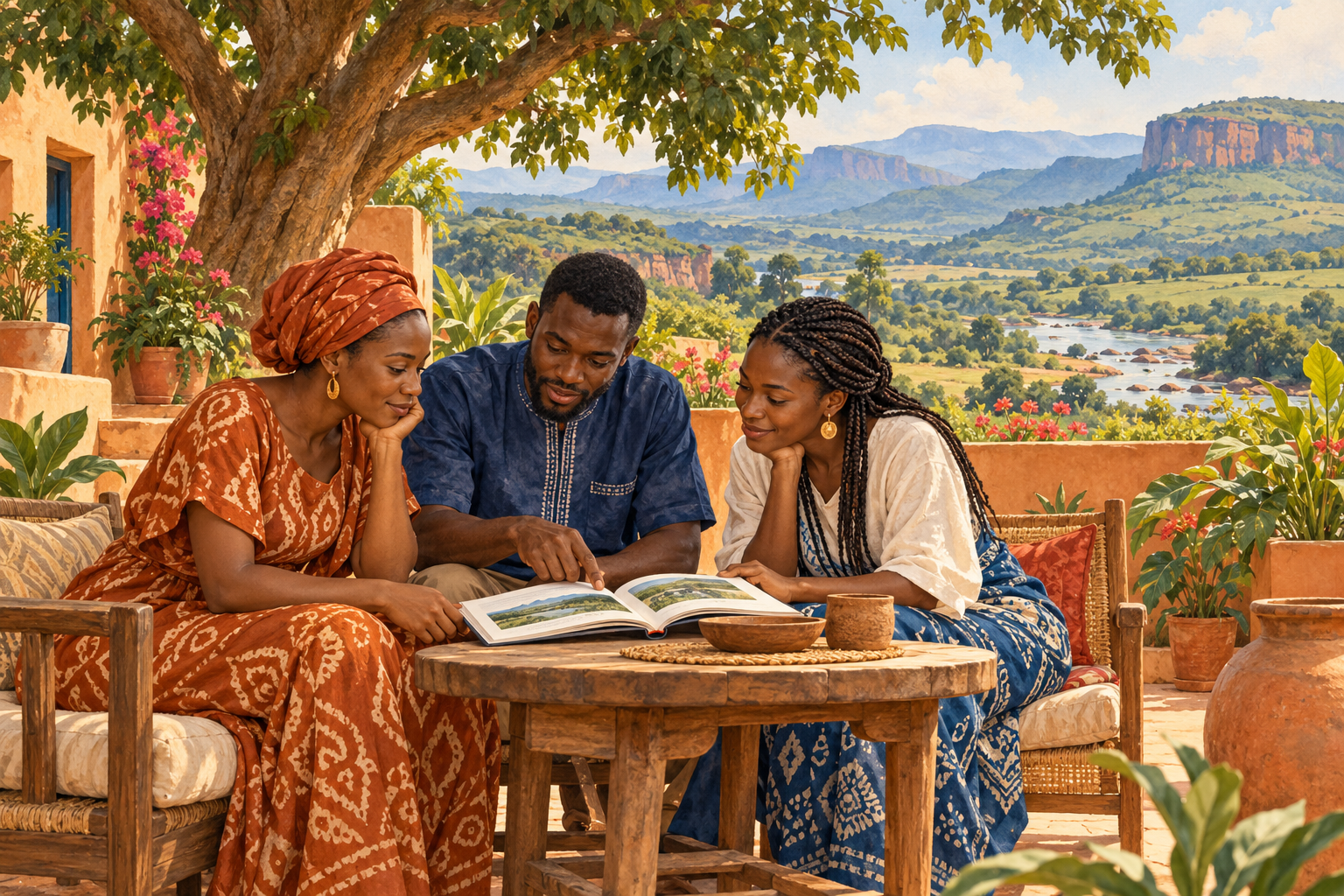
What should you know about Guinea beyond its name? This guide connects a country’s landscapes with the people, institutions and skills that give places meaning. It follows historical evidence and contemporary examples across community life, work, learning and cultural expression, without letting one image or headline stand for the whole country.
Begin with geography and history, or move directly to food, music, learning and the environment. Cultural knowledge deserves close attention in its own right. Contemporary challenges also need careful evidence, without allowing one event or statistic to stand in for an entire country.
Guinea at a glance
- Capital: Conakry.
- UN statistical region: Western Africa.
- Reading date: 21 October 2026; individual observations retain their own dates.
The capital and regional classification are listed in the UNData country profile. This guide uses specific dated sources for the other subjects rather than treating an old country summary as a current account of every institution.
This is an educational overview, not a travel itinerary or personalised medical, legal or financial advice. A cultural or environmental designation does not establish present access or safety. National data cannot replace the experiences of particular households and communities.
Cover illustration: an original AI-generated artistic interpretation of three adults reading together in a leafy courtyard overlooking imagined Guinea-inspired highland ridges and a stream. This is a nonliteral composite, not a photograph or an exact view of a named place.
Choose your route through Guinea
- 1. Geography and landscapes
- 2. Cities and regions
- 3. Early history
- 4. Modern history
- 5. Government and institutions
- 6. Economy and Work
- 7. Agriculture and Resources
- 8. Infrastructure
- 9. People and Communities
- 10. Education
- 11. Food and culinary knowledge
- 12. Music and performance
- 13. Literature and arts
- 14. Health and community
- 15. Wildlife and biodiversity
- 16. Climate and environmental action
- 17. Sport and sporting pathways
- 18. Science and research
- 19. Opportunities and challenges
- 20. Guinea and Singapore
1. Geography and landscapes
Coast and foundations
Guinea faces the Atlantic Ocean and borders Guinea-Bissau, Senegal, Mali, Côte d’Ivoire, Liberia and Sierra Leone. Its government distinguishes four natural regions: maritime Guinea, the middle highlands, upper Guinea and forest Guinea. This division gives readers a useful first map of contrasting landscapes, rather than one uniform tropical country. Coastal plains, upland country, savannah plateaus and forested hills connect within the same national territory, while extending towards different neighbouring countries. (Government: geography)
Beneath those landscapes lies a varied geological foundation. The British Geological Survey describes much of Guinea as ancient Precambrian basement belonging to the West African Craton, alongside younger sedimentary formations towards the west. Coastal deposits include relatively recent marine and river sediments. These differences matter below ground as well as at the surface: water in hard basement rocks commonly depends on weathered layers and fractures, rather than flowing through evenly porous rock everywhere. (BGS: rocks and groundwater)
Seasons and headwaters
Guinea’s seasonal rhythm follows the movement of the tropical rain belt. The historical climate profile reproduced by UNDP describes a generally wet period from May to October, with the strongest rains usually between July and September. Temperatures tend to be lower during the wettest months. Rainfall also varies considerably from year to year, so a familiar annual pattern does not imply identical conditions each season. The profile describes climate, rather than a forecast for any particular year. (UNDP: seasonal climate)
The Bafing-Source wetland dossier offers a closer view of the highlands. Designated under the Ramsar Convention in October 2007, the site lies around the headwaters in the Mamou region, across hilly terrain rising roughly 800 to 1,500 metres. Its recorded habitats include wooded and shrubby savannah, gallery forests and wet meadows. Ponds retain particular importance during dry periods, when they provide refuges within a landscape whose available surface water changes through the seasons. (Ramsar: Bafing headwaters)
Mountain and shoreline
Mount Nimba rises to 1,752 metres, with forested lower slopes giving way to mountain grasslands. UNESCO’s description emphasises how altitude and seasonal conditions create varied local climates across the range. The massif extends across Guinea, Côte d’Ivoire and Liberia, whereas the World Heritage property itself is shared by Guinea and Côte d’Ivoire. That distinction matters: a mountain system and an internationally designated conservation property do not necessarily follow the same geographical outline. (UNESCO: Mount Nimba)
Coastal geography is changing too. A study published in Geotrope in 2024 examined a 25 kilometre stretch at Kaback, using satellite imagery, geographical information systems and surveys. Its shoreline comparison covered 1975 to 2016, while the land-cover analysis compared 1990 and 2022. The authors recorded expansion of built land, cultivated areas and fallow ground alongside reductions in vegetation and mangroves. These observations reveal interacting settlement and coastal changes within one specifically studied locality. (Bah et al.: Kaback coast)
2. Cities and regions
Peninsula and highland markets
Conakry’s elongated form shapes everyday connections. The World Bank’s 2019 urban review described development spreading inland from the peninsula while employment and economic activities remained concentrated towards Kaloum, including its port area. Housing and workplaces were therefore increasingly separated along a narrow urban corridor. The review treated transport and land use as connected problems: where homes are built affects journeys, and the location of jobs influences the pressure placed on routes across the city. (World Bank: Conakry)
Labé’s municipal plan for 2020 to 2024 presents a highland trading centre linked to surrounding countryside and neighbouring countries. It describes a central market, secondary markets and weekly markets. Finished goods move out through these markets, while agricultural and gathered products arrive from rural areas for local consumption or onward trade. The planning portrait records artisan activity, showing a town where commercial distribution and practical craft skills support overlapping local livelihoods. (Labé: municipal plan)
Planning urban change
A development plan for Kindia, prepared with a horizon of 2015, describes a road crossroads connecting routes towards Conakry, Mamou, Télimélé, Forécariah and Sierra Leone. Its portrait also includes livestock activity around the urban outskirts and weekly markets linking the town with producers. Reading the plan as a historical document makes its value clearer: it shows how municipal planners understood Kindia’s role as an intermediary between transport routes, surrounding farms and urban exchange. (Kindia: planning portrait)
N’Zérékoré provides another perspective on urban growth. A national spatial-planning review produced in 2020 used Landsat imagery to compare the city’s physical extent between 1990 and 2019. Its mapped built area increased from approximately thirteen to more than twenty-eight square kilometres. The maps separated buildings from water, vegetation and bare ground or rock. They describe the spread of the urban footprint, not a direct count of residents or proof that services expanded at the same rate. (UN-Habitat: urban mapping)
Courtyards and built heritage
A UNDP field account from May 2021 describes Kankan through the Milo River, commercial connections and the mango trees lining roads, school grounds and household courtyards. Its author visited during the Be In initiative, which brought university students and civil-society participants into discussions about local problems and possible solutions. Meetings beneath trees and visits to brickmaking sites gave the account a grounded urban perspective, connecting the city’s public institutions with informal gathering places and working spaces. (UNDP: Kankan fieldwork)
Dalaba’s built heritage includes the former governor’s Villa Jeanine and the Case à Palabres, associated with meetings of traditional chiefs during French colonial rule. ICOMOS’s 2002 assessment describes the latter’s local materials, traditional building techniques, large thatched dome and decorated interior. It also records weather damage and concerns about restoration undertaken without an adequate conservation plan. This dated assessment preserves architectural observations and a conservation warning, rather than establishing the buildings’ condition or accessibility today. (ICOMOS: Dalaba heritage)
3. Early history
Reading material evidence
Early history becomes tangible through archaeology in the Upper Niger basin. In their 2013 field report, Cameron Gokee and colleagues describe reconnaissance around Mandiana and Siguiri, recording settlement remains, fortified villages and iron-production sites. Furnaces, slag and occasional fragments of air pipes reveal skilled metalworking, while building foundations and defensive walls preserve traces of community life. The researchers treated these remains as evidence for investigating changing settlement patterns, rather than simply illustrating stories already accepted. (Gokee et al.: early settlements)
Niani, beside the Sankarani River, illustrates why historical identifications require testing. François-Xavier Fauvelle’s 2012 reassessment examined the claim that the village concealed the fourteenth-century capital of the Mali kingdom. He concluded that the available archaeological evidence did not support that identification. This is a scholarly argument about locating an imperial centre, not a denial of the wider kingdom’s history. Distinguishing a hypothesis from demonstrated evidence leaves room for future discoveries and revised interpretations. (Fauvelle: Niani evidence)
States and Atlantic connections
Joseph Earl Harris’s research traces the Fouta-Diallon kingdom from the Muslim-led conflict beginning in 1725. Timbo became its political centre, while Fougoumba retained religious and coronation functions. The almamy governed through councils and provincial authorities, with rival ruling families eventually alternating in office. Enslaved agricultural communities also contributed produce to rulers. This political order combined religious authority, negotiated leadership and unequal social relationships, rather than resembling either a modern nation-state or an undifferentiated community. (Harris: Fouta state)
The Rio Pongo coast was connected to the Atlantic trade in enslaved people. Bruce Mouser’s archival study follows the Spitfire, captured in March 1845 while collecting captives in the river. British and American naval forces were involved, and the captain subsequently faced trial in Boston. The case exposed efforts to obscure a vessel’s nationality and ownership, alongside the role of an American resident broker. Following one documented ship makes the trade’s international commercial connections concrete. (Mouser: Rio Pongo trade)
Conquest and colonial administration
Samori’s political and military movement transformed southern savannah societies and resisted French conquest. Historian Yves Person reconstructed its development using extensive oral testimony alongside written records, recognising that eyewitnesses mainly remembered its later years. His account treats warfare as central to the movement’s expansion and changing fortunes, rather than reducing it to one encounter. The associated chronology records Samori’s capture in September 1898 and subsequent deportation, marking the defeat of his armed resistance. (Person: Samori)
Colonial administration was divided by competing assumptions. Christopher Harrison’s archival study of French policy in Fouta Jallon between 1909 and 1912 describes officials treating Muslim leaders with suspicion while debating how education might extend colonial influence. A proposed medersa stalled when officials could not agree on its location. His analysis also follows the renewed exile of Alfa Yaya. Such episodes show administration operating through surveillance, disputed alliances and coercion, not merely through formal treaties. (Harrison: colonial rule)
4. Modern history
Independence and sovereignty
Guinea’s independence proclamation was adopted on 2 October 1958, following the referendum of 28 September. The original document links rejection of the French proposal to the creation of an independent Republic of Guinea. It also declares adherence to the principles of the United Nations Charter. When Ambassador Diallo Telli submitted the country’s membership application that December, the proclamation accompanied it, connecting the national decision with a formal request for recognition within the international organisation. (Guinea: independence declaration)
In November 1970, Guinea faced an armed invasion. Security Council resolution 290, adopted on 8 December, attributed the attacks of 22 and 23 November to Portuguese naval and military units operating from Guinea-Bissau. The Council endorsed its investigative mission’s conclusions, condemned Portugal and demanded compensation for damage to life and property. It also appealed for assistance to defend Guinea’s independence. These were diplomatic findings and demands, not evidence that the requested compensation was subsequently paid. (UN: invasion resolution)
Military rule and accountability
After Sékou Touré’s death, the military seized power in 1984 and Lansana Conté became the country’s leader. An archived United States government account describes his election in 1993 and subsequent victories in 1998 and 2003, while noting irregularities in those polls. It also records major strikes in 2006 and 2007 and the appointment of a prime minister in March 2007. The sequence shows electoral institutions developing alongside persistent conflict over governance and political authority. (US archive: Conté period)
The violence at Conakry’s stadium on 28 September 2009 remains a major episode in Guinea’s history. An international commission of inquiry verified the identities of 156 people killed or disappeared and documented serious sexual violence. Its report assessed the attacks as sufficiently grave to warrant classification as crimes against humanity, while explicitly recognising the role of a competent court in final determinations. The inquiry therefore supplies documented findings and recommendations, rather than a substitute for judicial judgment. (UN: 2009 inquiry)
Coup and subsequent elections
The African Union condemned Guinea’s coup on 5 September 2021 and demanded President Alpha Condé’s immediate release. Its chair and Commission chair also called for an urgent Peace and Security Council meeting. During a December visit, Commission chair Moussa Faki Mahamat discussed the transition with Colonel Mamadi Doumbouya. The Union’s account records Doumbouya reiterating that he would not contest the next elections, while Faki called for a consensual transition following a precise timetable. (AU: September 2021 coup; December visit)
The presidential election took place on 28 December 2025. An African Union statement issued in January recorded the Supreme Court’s announcement of final results giving Mamadi Doumbouya 86.72 per cent of the vote. The presidency subsequently documented his inauguration on 17 January 2026 at the Lansana Conté stadium in Nongo. Its account also describes an evening banquet for visiting delegations, connecting the public ceremony with diplomatic meetings at the start of the presidential period. (Presidency: January 2026; AU results)
5. Government and institutions
Framework and executive
Guinea’s Constitution, promulgated in September 2025, describes a unitary and secular republic. It assigns executive power to the president, prime minister and government, and provides a seven-year presidential term renewable once. The enacted parliamentary structure comprises a National Assembly and Senate. Its language provisions recognise both national languages and French as official, with French designated the working language. These are constitutional rules, which should be distinguished from the operation of institutions. (Gazette: 2025 Constitution)
A Primature account dated 19 October 2026 identifies Amadou Oury Bah as prime minister and Mamadi Doumbouya as president. It describes Bah chairing an interministerial coordination meeting involving eight departments. Participants reviewed decisions and discussed agricultural zones, fishing ports and contracts requiring arbitration. This provides an example of executive coordination: ministries brought connected dossiers into one forum. The account states ambitions to remove administrative obstacles, without establishing that every discussed project had been completed. (Primature: October 2026)
Assembly and local decisions
The electoral administration reported that 147 deputies elected on 31 May 2026 took office on 17 July. An official account of the October parliamentary opening identifies Dansa Kourouma as president of the National Assembly and describes his introduction of visiting parliamentary delegations. These records document the legislature’s installation and subsequent activity during 2026. They offer dated institutional evidence rather than a reason to keep describing the country solely through its earlier transitional arrangements. (DGE: legislature 2026)
Local administration has statutory detail. The revised Local Authorities Code of 2017 lists communal responsibilities including roads, public lighting, hygiene and shared facilities. It assigns councils deliberative and budgetary functions, while local executives implement decisions and manage services. The text also requires publication and communication of local decisions. These provisions explain how the code organises business below national level; they do not demonstrate that every municipality has the staff or resources to deliver each function. (Assembly: local code)
Capacity and civic freedoms
The Justice Ministry reported a recruitment examination for one hundred trainee court clerks in August 2026. More than 1,600 applications had been received, with 1,323 candidates admitted to the written tests. Its account acknowledged shortages of clerks and presented recruitment as a way to strengthen the courts. This is evidence of an examination and a staffing initiative, not proof that one hundred graduates had already completed training or taken up posts across the judicial system. (Justice: clerk recruitment)
Institutional developments require scrutiny of civic freedoms. On 18 March 2026, the African Commission on Human and Peoples’ Rights expressed concern about a ministry order dissolving forty political parties earlier that month, including major opposition parties. It highlighted possible consequences for association, assembly and participation in public affairs, and called on the authorities to protect political pluralism. The statement is an attributed regional human-rights assessment, distinct from a court judgment or the government’s own account of its reforms. (ACHPR: party dissolutions)
6. Economy and Work
Growth and money
Guinea’s economic outlook is closely connected with the expansion of mining. In August 2026, an International Monetary Fund mission described a resilient economy and expected faster growth as mineral production increased. It also identified rising inflationary pressures and vulnerability to commodity prices, financing shocks and prolonged cash shortages. Its discussions included developing human capital and employment beyond mining. These priorities frame diversification as an economic objective, rather than an outcome already secured. (IMF mission assessment)
Everyday money also carries carefully designed information. The central bank’s leaflet for the 2022 banknote worth one thousand Guinean francs explains raised marks that help blind and partially sighted users recognise the denomination. Tilting the note reveals particular lettering and a changing colour effect. Holding it against light reveals a portrait and the denomination as a watermark. A security thread incorporates the letters GNF and the number identifying the note’s value. (BCRG banknote leaflet)
Enterprises and workplaces
Starting an enterprise involves an organised sequence of administrative steps. Guinea’s investment promotion agency, APIP, describes a single window where applicants submit documents, make payment and receive commercial registration and a fiscal identification number. Its company procedure additionally includes checking the statutes and issuing a letter for opening a bank account and depositing capital. The guide distinguishes these requirements from the simpler individual enterprise pathway, helping explain how business formation is organised. (APIP enterprise guide)
Workplaces also have administrative relationships with the national social security fund. The CNSS explains employer registration as the assignment of a social security number to an employer. Applicants complete its registration request in duplicate. After processing, the fund notifies the employer of the assigned number and the contribution rates for its different branches. The identifier itself combines an activity code, a geographical zone and a sequential number, linking workplace records with administration. (CNSS employer registration)
Employment and administration
Finding work can involve guidance as well as searching advertisements. AGUIPE-E’s employment platform describes a pathway beginning with an account and a completed personal profile. A jobseeker then arranges an appointment at a nearby agency and meets an orientation counsellor. That discussion can direct the person towards training, employability support or entrepreneurship. The platform also separates opportunities by location, activity sector and contract type, providing several ways to organise a job search. (AGUIPE-E employment services)
Digital administration requires people to learn new procedures. A tax authority account dated November 2020 describes practical training for companies using Guinea’s eTax portal. Sessions covered electronic declarations and payments, payment order validation, online authentication and user account management. Participants practised the system through simulated exercises and discussed how to enter declarations and execute payment orders. This dated rollout account shows the training behind an administrative tool, without establishing present tax obligations. (DGI eTax training)
7. Agriculture and Resources
Farm organisations and fields
Farmer organisations can shape agricultural development rather than simply receive assistance. IFAD’s account of Guinea’s PNAAFA programme describes implementation through farmers’ own organisations, with support for federations, unions and their members. Capacity building and financial assistance were directed towards selected agricultural value chains. The programme also emphasised participation by women and young people. Its regional focus included potatoes, onions and maize in Fouta Djallon, illustrating how collective support could reflect different production settings. (IFAD PNAAFA programme)
Mangrove rice cultivation depends on managing alternating kinds of water. A December 2011 technical study describes rainfed fields in Guinea’s lower estuaries, protected from tides by dikes during cultivation. Farmers allow seawater into plots during the dry season, helping limit soil acidification, suppress weeds and maintain the dikes. Rainwater subsequently washes the soil, while drainage regulates flooding. Near the end of the crop cycle, sufficient freshwater must remain available for the plants. (Mangrove rice study)
Fishing and food production
Fishing livelihoods extend beyond catching fish at sea. The World Bank’s October 2022 completion report describes the Koukoudé landing complex inaugurated in May 2021. Its facilities included a landing site, processing facilities, an access road and an internet centre through which traders could obtain market information. Community associations received management and accounting training, with service fees helping support operations. The report nevertheless identified continued monitoring of communities’ maintenance capacity as an important consideration. (WARFP completion report)
Access to planting material and fertiliser can shape a farming season. The African Development Bank’s November 2022 appraisal of Guinea’s emergency food production project described planned support following sharp increases in agricultural input and food prices. Proposed distributions included rice and maize seed, cassava cuttings, yam planting material, potatoes and several fertilisers. The design aimed to increase production across these crops. Its projected harvest gains were expectations attached to the project, not verified results. (AfDB food production appraisal)
Minerals and transparency
Bauxite extraction creates a chain of specialised industrial activities. The Compagnie des Bauxites de Guinée describes Sangarédi, in the Boké region, as its principal extraction site, operating since 1973. Mining takes place in open pits: surface layers are removed before ore is extracted and sent for crushing and sizing. Rail transport then connects the mining area with Kamsar. This operational account follows material from the deposit towards processing and shipment rather than treating mining as one activity. (CBG Sangarédi operations)
Resource governance also involves comparing financial records. Guinea’s extractive transparency report for 2023 examines payments declared by companies alongside revenue reported by public bodies. Its reconciliation process identifies differences, requests explanations and adjusts figures where supporting information justifies changes. The report covers the calendar year and describes both contextual and financial disclosures. Importantly, its agreed procedures are not a financial audit, so publication should not be mistaken for a guarantee that every discrepancy disappeared. (ITIE Guinea 2023)
8. Infrastructure
Maritime and air links
Conakry’s port combines navigation infrastructure with facilities for different cargoes. Its container terminal provides loading, unloading, handling, security and stock management services. The port authority also describes conventional berths and specialised positions for bulk vessels, alongside an access channel marked by buoys. These elements serve different stages of a ship’s visit, from approaching the harbour to transferring goods. The terminal’s stock management and handling functions therefore belong to a wider system of maritime operations. (Port facilities)
Airport development is another part of Guinea’s transport investment. A presidency account of a visit on 11 July 2025 described extension work at Ahmed Sékou Touré International Airport. The stated objective was to increase passenger handling capacity as air traffic grew. During the visit, the airport operator reported the first phase as ninety five percent complete and anticipated delivery in September 2025. That contemporary progress statement does not itself confirm subsequent completion. (Presidency airport account)
Roads and electricity
A planned road corridor links Guinea’s interior with Senegal. The African Development Bank’s project description follows Labé, Mali town, Kédougou and Fongolembi within the wider Conakry to Dakar connection. Its proposed route totals 240.71 kilometres, including 178.11 kilometres in Guinea and 62.60 in Senegal. Mali here means the Guinean town, not the neighbouring country. Approved in November 2024, the project record gives December 2029 as its planned completion date, rather than an accomplished opening. (AfDB road project)
Electricity supply involves several connected but distinct tasks. Électricité de Guinée describes its responsibilities as generation, transmission, distribution and sale of electrical energy. Transmission moves power from generating stations towards distribution networks, which then serve consumers. The company’s customer services include subscriptions, bills and payment information. Its institutional description therefore spans both physical infrastructure and the commercial relationship with users. This explains the operator’s functions without implying that every household receives continuous service. (EDG activities)
Water and communications
Water networks need maintenance as well as new construction. The Société des Eaux de Guinée identifies reducing pipe and connection leaks, improving subscriber records and installing meters among its priorities. Pumping and treatment also require electricity, making energy supply an operational challenge. Its project overview describes using generators when ordinary electricity supplies are interrupted. These tasks connect the condition of pipes, the organisation of connections and the energy needed to move water through the network. (SEG network priorities)
Guinea’s telecommunications regulator tracks several kinds of digital connection. Its report for the second quarter of 2026 distinguishes mobile telephony, internet services, infrastructure operators and mobile money. Mobile charts separate prepaid from postpaid subscriptions and distinguish calls within an operator’s network, between networks and internationally. The report defines mobile penetration through subscriptions relative to population. That definition matters: a count of subscriptions measures service connections, not necessarily the number of different people using phones. (ARPT second quarter 2026)
9. People and Communities
Population and identity
Guinea’s fourth population and housing census provides a new demographic reference point. Preliminary results released by the national statistics institute on 25 February 2026 put the population in 2025 at 17,521,167. They described a young population, with forty-three percent aged under fifteen, and reported that 61.3 percent lived in rural areas. These figures belong to the preliminary census results for 2025, rather than an estimate of the population on any later day. (INS preliminary census)
Birth registration connects families with a child’s formal identity. A November 2022 UNICEF account describes civil registration desks operating inside health facilities, including ANAIM Hospital in Kamsar. Staff directed parents towards the registration service before leaving, allowing them to obtain birth certificates within the hospital grounds. The arrangement linked administrative offices with the place where births were recorded. It illustrates a practical way to simplify paperwork for families, rather than a nationwide registration guarantee. (UNICEF civil registration)
Mobility and participation
Movement across borders forms another part of community life. IOM’s report covering July to September 2025 describes two active monitoring points: Kourémalé in Siguiri prefecture and Boundoufourdou in Koundara prefecture. These sites recorded incoming and outgoing flows along cross-border corridors. The report combines a flow register with individual traveller surveys, connecting observed movements with information about travellers. Its scope is therefore movement captured at selected points during that quarter, not every migrant in Guinea. (IOM flow monitoring)
Community participation can influence local public decisions. In a January 2026 account, ANAFIC described participatory budgeting alongside sessions in which residents assessed local services. The process combined preparation of communal budgets with feedback on how services were experienced. It also described more experienced communes helping newer ones conduct participatory monitoring. This exchange between local authorities illustrates learning through practice, while the agency presented accountability and closer relationships with citizens as purposes of the approach. (ANAFIC participation account)
Families and volunteers
Family support can aim to prevent separation as well as provide alternative care. SOS Villages d’Enfants Guinea describes a community child protection programme operating through sites in Conakry, Nzérékoré, Kankan and Labé. It prioritises children at risk of losing family care. Where social assessments find that an existing family can provide affection and security, the organisation works to strengthen that family’s capacity. Its approach therefore includes helping caregivers become more independent in supporting children. (SOS family strengthening)
Volunteers also connect communities with organised assistance. The IFRC’s February 2025 plan for Guinea describes cooperation between the national Red Cross, local councils, district representatives and civil protection bodies during emergencies. Its development objectives included updating volunteer records, supporting local volunteer coordinators and strengthening training. The plan also discussed collaboration around floods, fires and landslides. These are organisational arrangements and stated priorities, not proof that every planned activity or funding requirement was fulfilled. (IFRC Guinea network plan)
10. Education
Primary school and assessment
Primary education in Guinea comprises six years, organised into three stages of two years each: preparatory, elementary and middle courses. The education ministry’s statistical yearbook for 2023–2024 recorded public, private and community schools, alongside information on pupils, teachers, classrooms and materials. It explains that financing delays postponed that school census until the third quarter of 2025. The reporting year and collection date are therefore different, an important distinction when interpreting the publication’s figures. (MEPUA primary yearbook)
Learning assessments examine what pupils can do. Guinea participated in PASEC2019, a study of fourteen education systems whose international report was launched in December 2020. Reading and mathematics tests were accompanied by questionnaires about pupils’ home and school environments. Information came from sampled pupils, teachers and school directors. The design related learning performance to educational resources and practices, using nationally representative school samples rather than testing every child enrolled in the participating systems. (CONFEMEN PASEC2019)
Teaching and learning
Preparing education professionals involves learning before and during a teaching career. Guinea’s higher institute of education sciences, ISSEG, describes initial and continuing training for teachers, pedagogical supervisors and school administrators. Its institutional profile includes professional bachelor’s and master’s programmes and applied educational research. It also identifies support for schools and prefectural education offices seeking to improve teaching practices. This combination places professional preparation, further development and inquiry within the same specialist educational institution. (ISSEG institutional profile)
Classroom support can be adapted to pupils’ existing skills. UNICEF’s March 2024 case study describes a pilot in ten schools in Kindia district, involving pupils in grades three to five. From December 2022 to May 2023, learners received daily sessions in mathematics and French, grouped by demonstrated competency rather than age. School directors coached teachers, and tailored materials supported lessons. The account concerns a specific pilot, not evidence that every Guinean classroom uses this approach. (UNICEF foundational learning)
Skills and university pathways
Vocational learning also responds to needs identified by employers. In its official notice for the 2026 training cycle, the national professional training office, ONFPP, asked partner companies to submit proposed training plans. The requested file combined a formal application, a completed statement of training needs and descriptions of proposed activities. Physical and electronic submission routes were offered. The notice shows how workplace learning requests were organised, without promising that every proposal would receive support. (ONFPP training notice)
University study requires academic guidance and reliable records. At Université Gamal Abdel Nasser de Conakry, the student affairs service describes responsibilities for admissions, registration and progression through bachelor’s programmes. It supplies information on study options, coordinates course choices and keeps students’ official files and marks. It also prepares certificates and diplomas once programme requirements have been met. These services connect individual learning pathways with the administrative evidence needed to document completed university study. (UGANC student services)
11. Food and culinary knowledge
Grains, roots and sauces
Fonio illustrates the connection between a small grain and varied culinary skills. A field study in Fouta Djallon records preparations involving boiling and steaming, as well as toasting grain and grinding it into flour. The researchers describe soups and sweet porridges alongside dishes resembling rice or couscous preparations. Their account follows processing as well as serving, showing that a crop’s place in food culture includes the knowledge needed to transform it into meals. (Burton et al.: fonio preparations)
A meal can also be understood through the relationship between its base and accompaniments. Guinea’s tourism office describes tô as a cassava preparation served with sauces. Its examples include okra, sweet potato leaves and peanuts. This short culinary account therefore identifies more than one possible combination, rather than a single compulsory version. Reading the dish through those components offers a concrete introduction without assuming that every household cooks or serves it in exactly the same way. (ONPA: tô and sauces)
Condiments and oils
Soumbara brings another layer of preparation to the table. Mabetty Touré’s fieldwork in Upper Guinea describes this condiment made from néré seeds and used with dishes including tô, lafidi and fidi. Processing and fermentation involve practical decisions by makers, followed by shaping the finished product. Recipes vary, so the account treats preparation as knowledge carried through people’s work rather than a completely uniform procedure. Its culinary role should be distinguished from unverified medicinal claims. (Touré: soumbara knowledge)
Palm oil likewise has distinct forms and production histories. A practical guide developed for Guinea describes oil extracted from fruit pulp, distinguishing red oil from dura palms, paler tenera oil and fermented tobogui. Its production sequence includes sorting fruit, cooking, extracting the oil, clarification and storage. Those stages make visible the skilled work behind a cooking ingredient. The guide documents production choices rather than establishing that every oil has identical qualities or health effects. (Gret and MGE: red palm oil)
Gathered fruits and preserved fish
Gathered fruit connects food preparation with seasonal markets. A study published in 2003 followed two Guinean markets at fortnightly intervals between 1998 and 2000, identifying twelve important fruit species. Among its examples was baobab, whose floury pulp could be eaten directly or mixed with cold water as a drink. These observations describe particular markets and practices at a historical moment. They should not be converted into a current national estimate of fruit consumption. (N’Diaye et al.: gathered fruits)
Preservation also influences where food can travel. An October 2005 fisheries study distinguished fresh, lightly smoked, dry-smoked and dried or salted fish in Guinea’s trading system. Lightly smoked products circulated nearer their production areas, while more thoroughly preserved fish could travel farther. The account connects processing methods with distribution rather than treating the catch and the final meal as the same stage. Its historical market portrait does not establish present conditions or offer food-safety instructions. (Faro: preserved fish markets)
12. Music and performance
Instruments and the stage
The Sosso-Bala links an instrument with a community of custodians and learners. UNESCO describes the sacred balafon at Nyagassola, safeguarded by the Dökala family of the Kouyaté lineage. Wooden slats and gourd resonators form its physical structure, while the Balatigui transmits playing knowledge to younger learners. Its cultural space was inscribed on the Representative List in 2008. The designation concerns performance, teaching and remembered narratives, not simply an object separated from its social setting. (UNESCO: Sosso-Bala heritage)
Contemporary performance also reinterprets remembered history. In March 2026, Guinea’s culture ministry described the premiere of Mansa Moussa by the Ballets Africains at the Palais du Peuple. Dance, music and narration presented an artistic interpretation of the fourteenth-century ruler of Mali. The production connects historical subject matter with choices made for a modern stage. The ministry’s accompanying references to future touring were announcements, not evidence that each proposed performance had already taken place. (MCTA: Mansa Moussa production)
Artists and arrangements
Mory Kanté’s 2004 album Sabou offers an example of acoustic musical arrangement. The label describes the project through his griot background, while the recording credits identify kora, balafon, flute, percussion and voices among its resources. Kanté himself contributed several instrumental parts. Reading these credits reveals a collaboration assembled through particular performers and instruments. The documented acoustic format is one creative choice within a changing career, rather than a boundary enclosing all of his music. (Riverboat: Mory Kanté’s Sabou)
Sékouba Bambino’s label biography traces connections across different ensembles and styles. His career included Bembeya Jazz and Africando, the latter linking his singing with Latin music. For the 2012 album Innovation, the account describes work with Manu Lima and inspiration from Portuguese-speaking musical settings. These collaborations illustrate movement between arrangements and creative partners. They are specific stages in a recorded career, rather than evidence that Guinean music follows one fixed sound or one exclusive direction. (Lusafrica: Sékouba Bambino)
Collaboration across borders
Musical connections extend beyond Guinea itself. Smithsonian Folkways’ Badenya project documents musicians from several West African countries working in New York. Its Guinea-associated Keme Burema track combines tambin flutes, kora and bala, with the notes identifying the performers and describing some words sung through a flute. This is a recorded collaboration, not a portrait of every diaspora musician. The album’s setting shows how identifiable instruments and practices can participate in shared musical environments. (Folkways: jaliya in New York)
Changing instrumentation is also part of the Amazones de Guinée story. The women’s ensemble’s Wamato press account describes a movement from acoustic strings and percussion towards electric guitars and bass, drums and brass. Its recording narrative follows rehearsals in Conakry before studio work in Bamako. The account brings preparation and performance together across two cities. As a historical account of that project, it does not establish the ensemble’s present membership or represent all Guinean women’s experiences. (Amazones: Wamato project)
13. Literature and arts
Memory and movement
Camara Laye’s The Dark Child presents childhood through an individual voice rather than a national portrait. The memoir recalls Koroussa, his father’s work as a goldsmith, family beliefs and the experiences accompanying his passage towards adulthood. Its publisher’s synopsis identifies a central tension between attachment to home and the educational opportunities drawing him towards distant cities. Family, craftsmanship and learning become connected parts of a remembered life, shaped into literature through personal recollection. (Macmillan: The Dark Child)
Tierno Monénembo received the Académie française’s Grand Prix de la Francophonie in 2017. The Academy’s award address emphasised wandering, exile and the search for identity in his writing. It described stories moving across settings including Guinea, Abidjan, Lyon and Brazil, with Les coqs cubains chantent à minuit unfolding in Havana and Bled in Algeria. This literary geography connects Guinean experience with other places, while allowing different fictional lives to occupy each setting. (Académie française: Monénembo)
Carving and cloth
A wooden D’mba headdress in the Metropolitan Museum of Art’s collection illustrates sculpture designed for performance. Attributed to a Baga artist in Guinea, the object dates from the late nineteenth to the first half of the twentieth century. The museum interprets D’mba as an ideal of motherhood, rather than simply a representation of an individual woman. During performance, the carved headdress joins a costume of raffia and cloth, forming a larger moving ensemble. (Met: D’mba headdress)
Textile construction is visible in a Guinean cotton wrapper catalogued by the Smithsonian’s National Museum of African Art. Eleven strips are sewn together by hand, creating a surface patterned with even horizontal stripes of indigo blue and white. Two edges are fringed. The record makes assembly as important as colour: the finished cloth combines repeated units, joins and a continuous striped pattern. This particular object offers a close view of material choices and skilled making. (Smithsonian: Guinean cloth)
Screen and page
Cheick Fantamady Camara’s fictional film Clouds Over Conakry follows Bangali, a cartoonist also known as BB, and his relationship with Kesso, a computer professional. His father’s expectations collide with the couple’s choices, while drought and political manipulation enter the plot. In the original press dossier, Camara explains working with two screenplay consultants to develop several subjects within one story. The drama brings personal relationships and public conflict together without presenting its characters as typical Guinean families. (Camara: Clouds Over Conakry)
Books also need places where readers can encounter them. Writing before Conakry’s 2017 World Book Capital programme opened, Guinea PEN Centre founder Koumanthio Zeinab Diallo described school clubs and rural libraries around Labé. Writers, publishers, booksellers and students were preparing activities, while further reading points and media libraries were proposed. Her account connects literary celebration with practical access: attracting attention to authors was accompanied by efforts to bring books into schools and communities. (Diallo: books and reading)
14. Health and community
Prevention and delivery
In January 2025, the World Health Organization validated Guinea’s elimination of gambiense human African trypanosomiasis, or sleeping sickness, as a public health problem. WHO credited improvements in diagnosis, treatment delivery and sustained programme support. Reported cases had fallen below its specified threshold throughout endemic areas. The designation marks a defined public health achievement, not eradication or proof that no infections remain. Its precise wording preserves the difference between controlling disease burden and ending transmission completely. (WHO: sleeping sickness milestone)
Vaccine delivery depends on equipment reaching the places where care is provided. UNICEF’s August 2019 field account describes a solar refrigerator and motorcycle supplied to Irié’s health post earlier that year. Refrigeration allowed staff to keep vaccines locally, while the motorcycle supported journeys to people who had not been reached. Women in the community also passed information to neighbours. The account shows storage, transport and local communication working together around one health post. (UNICEF: Irié vaccine logistics)
Learning in care
Professional skills can develop through colleagues learning together at work. A May 2025 UNFPA account from Friguiagbé describes a midwife mentor coaching maternity staff on site. Sessions alternated between simulations using anatomical mannequins and supervised practice in real situations. Learning was introduced gradually, with understanding checked before moving to the next stage. The approach combined technical instruction with shared experience and supportive relationships, placing continuing professional development within the routines of a maternity team. (UNFPA: midwife mentoring)
Listening to people receiving care reveals concerns that service statistics alone may miss. Kolié and colleagues’ study, published in 2024, drew on seventeen interviews and five focus groups conducted in four Conakry facilities in 2018. Participants valued confidentiality, caring attitudes and flexible access, but also described communication difficulties and financial burdens. Psychosocial counsellors helped connect patients and providers. These qualitative findings illuminate experiences within the studied facilities, rather than measuring the prevalence of problems nationwide. (Kolié et al.: listening in HIV care)
Roles and routines
Community health programmes depend on how responsibilities are understood and exercised. Delamou and colleagues’ 2025 study examined policy implementation during 2017 to 2021, analysing 168 community health workers within a larger research dataset. It distinguished choices formally permitted by policy from decisions workers reported making in practice. Community workers and volunteer relays demonstrated substantial knowledge of their roles. The analysis directs attention to local capacity and responsibility, showing why written arrangements and everyday implementation need separate examination. (Delamou et al.: community roles)
At Faranah Regional Hospital and two associated health centres, researchers followed infection prevention practices from April 2020 to April 2021. The programme combined staff training, visual workplace reminders and observation of patient triage, alongside locally produced hand rub. Observed triage practices improved during follow-up. Published in 2024 and corrected in 2025, the study highlights the practical relationship between staff learning, supplies and clinical routines, without establishing that training alone caused every observed change. (Landsmann et al.: safer clinical routines)
15. Wildlife and biodiversity
Learning from animal behaviour
Bossou’s chimpanzees have helped researchers examine how tool skills vary between individuals. A study published online in 2024 analysed twenty-five years of video involving twenty-one chimpanzees opening oil palm nuts with stone hammers and anvils. Researchers compared time, strikes, success and other aspects of performance, finding consistent individual differences and effects of age. The observations came from an outdoor laboratory where materials were supplied, giving the team repeated opportunities to compare this activity. (Berdugo et al.: chimpanzee tool skills)
Forest elephants can be studied through traces that remain after they have moved away. During the 2004 Ziama survey, researchers arranged fifty-four transects and marked fresh dung piles to measure how quickly they decayed. Combining those observations helped estimate elephant abundance. Their analysis also related distribution to roads, settlements and marsh habitat. The report therefore records both a historical survey and the reasoning needed to interpret animal signs, rather than a present-day headcount. (Barnes and Awo: elephant survey)
Wetlands and forest records
The Tristao islands appear in a 1993 Ramsar information sheet as a varied coastal wetland near the mouth of the Cogon. Mangroves dominate its description, alongside sandy islets and estuarine waters. Katarak and Kapken are crossed by older barrier beaches where villages stand. The account brings settlement into the habitat picture instead of describing an unoccupied wilderness. It preserves a dated description of connected land and water environments within the same wetland site. (Ramsar: Tristao wetland mosaic)
A Guinean and British team surveyed Kounounkan Forest in late 1992, recording birds, mammals and vascular plants at three field sites. Their paper, published in 1994, reported sightings and nesting evidence for the white-necked picathartes, extending its confirmed range into southwestern Guinea. Local interviews contributed information alongside biological observations. The study shows how field records can change a species map, while its historical findings remain distinct from evidence about populations living there today. (Barnett et al.: forest bird records)
Identification and conservation
Myotis nimbaensis drew researchers’ attention through its striking orange and black appearance. The bat was encountered during fieldwork in Guinea’s Nimba Mountains in 2018 and formally described in 2021. Establishing its identity required more than colour: investigators combined anatomical comparisons, measurements, echolocation and genetic evidence, including comparisons with museum specimens. Guinean researchers and conservation participants joined the team. The discovery illustrates how field observation and collections work together when scientists distinguish a previously undescribed species. (Simmons et al.: orange and black bat)
Plant conservation likewise begins with knowing what grows where. In a May 2026 retrospective, Kew described its partnership with Guinean specialists to identify twenty-two Tropical Important Plant Areas. The programme connected field research on threatened species and habitats with accessible records and capacity building. Officials had expressed an intention to incorporate these areas into the protected-area network. Identifying botanical priorities and establishing legal protection are related steps, but the account does not make them interchangeable. (Kew: plant conservation partnership)
16. Climate and environmental action
Evidence and commitments
A 2025 climate study examined temperature and rainfall changes across Guinea using reanalysis, satellite precipitation records and climate model scenarios. Its historical analysis covered 1991 to 2024 and found warming alongside geographically uneven rainfall trends, including coastal increases and decreases in mountainous areas. Future simulations explored alternative scenarios rather than one guaranteed trajectory. The work highlights why temperature, rainfall and location must be examined together when discussing changes that differ across the country. (Climate: regional change study)
Guinea’s third nationally determined contribution, prepared in 2025, sets out climate commitments with a horizon of 2035. It distinguishes measures the country undertakes unconditionally from additional action depending on international support. The submission identifies finance, technology transfer and capacity building as necessary parts of that conditional pathway. Reading these categories carefully matters: they describe commitments and requirements for implementation, not reductions already measured. National planning therefore connects domestic action with expectations of international cooperation. (UNFCCC: Guinea’s climate pledge)
Information and restoration
Early warning depends on turning observations into information people can use. A UNDP project designed for 2019 to 2023 linked weather and hydrological monitoring with data transmission, archives, modelling and a central information hub. Technician training was intended to support equipment operation and maintenance, while risk maps would inform warnings and local planning. This design connects instruments with institutions and users; a station alone cannot represent the full chain described in the project. (UNDP: early warning design)
A Guinée Écologie account from 2021 describes several approaches to restoring mangroves on the Tristao islands. Planting was combined with assisted restoration and natural regeneration, rather than relying on one technique everywhere. The organisation also described community involvement, nurseries, work on dykes and patrols by conservation staff. Its account presents restoration as continuing cooperation between local users and conservation bodies, while reporting the implementer’s activities rather than independently establishing the long-term condition of every restored site. (Guinée Écologie: Tristao restoration)
Waste and resource practices
An independent UNIDO evaluation visited Guinea’s Sodiaplast recycling pilot in 2019. It described collection equipment, protective gear and training for waste collectors, alongside machinery for sorting and compacting plastics. Recycled material became products such as chairs and water containers. However, the evaluator noted that a flue-gas treatment device had not yet been installed. That detail separates progress in collecting and reprocessing waste from the additional equipment needed to address pollution within the assessed pilot. (UNIDO: recycling pilot evaluation)
A programme launched with UNEP support in April 2023 aimed to reduce mercury use in Guinea’s artisanal gold mining. Its design linked formalisation, access to finance and adoption of mercury-free technologies, rather than treating equipment as the only obstacle. Dialogue between artisanal miners and a nearby industrial operation formed another component, alongside sharing lessons through the wider planetGOLD network. The launch account sets out a proposed route for change, not a measurement of achieved reductions. (UNEP: mercury reduction programme)
17. Sport and sporting pathways
Football across generations
Guinea’s 1976 Africa Cup of Nations campaign ended in a four-team final round, not a single championship final. CAF’s historical account explains that the leading two teams from each initial group advanced to play one another. Guinea entered the last match in second place and led Morocco before an equaliser produced a draw. The result secured Morocco’s title, showing why the competition’s particular format matters when interpreting Guinea’s place in that tournament. (CAF: the 1976 final round)
A decisive football match took place at Clairefontaine in May 2024. Guinea defeated Indonesia by one goal to nil to qualify for the men’s Olympic tournament, with Ilaix Moriba scoring a first-half penalty. CAF’s report describes opportunities for both teams before Guinea secured the result. Qualification placed the team in a group with France, the United States and New Zealand. This was an achievement in the qualifying contest, separate from the subsequent Olympic campaign. (CAF: Olympic qualification)
Team competition
FIBA’s records for AfroBasket 2025 place Guinea ninth, with two victories and two defeats. Its match against Mali illustrates how a score can conceal changing momentum. Guinea scored twenty points to Mali’s seven in the third quarter, but Mali ultimately won by seventy to sixty-seven in the contest for a quarterfinal place. The tournament records also distinguish scoring, rebounds and assists, offering perspectives on players’ contributions rather than reducing team performance to one statistic. (FIBA: Guinea at AfroBasket 2025)
Guinea’s women competed at the 2024 world junior handball championship in Skopje, an event for players under twenty. Their placement match against Tunisia finished twenty-two to twenty-one in Guinea’s favour. The official match sheet records a level first half and a narrow Guinean advantage in the second, producing twenty-third place. Both the age category and the placement stage are essential context: the result belongs to this junior tournament, not to a senior world championship final. (IHF: women’s junior championship)
Individual preparation
In a July 2024 interview, archer Fatoumata Sylla described a pathway beginning at school in Conakry, where she practised with improvised equipment. She later joined Matam Archery Club and trained in Lausanne through an Olympic Solidarity scholarship. Her account emphasised learning to select and set up equipment, alongside gaining competition experience and managing emotions. The interview gives preparation a concrete shape, connecting local beginnings, club participation and specialist training rather than presenting selection as isolated. (World Archery: Sylla’s training)
Marie Branser’s victory at the 2026 Upper Austria Grand Prix marked a milestone in Guinean judo. The International Judo Federation described it as the country’s first gold on its circuit. In an April interview, Branser discussed changing coaches shortly before the Paris Olympics and deciding to continue because their work together was unfinished. Her account connected the medal with preparation and further ambitions, distinguishing an achieved competition result from goals still ahead. (IJF: Branser’s Grand Prix gold)
18. Science and research
Trials and genetic evidence
The Ebola Ça Suffit trial turned chains of contact into a research design. Investigators identified contacts and contacts of contacts around confirmed cases, then assigned groups to immediate vaccination or vaccination twenty-one days later. Conducted in 2015 in Guinea and parts of Sierra Leone, the trial assessed disease beginning at least ten days after assignment. Its final results supported substantial protection, demonstrating how a carefully defined comparison could generate evidence during an epidemic. (Henao-Restrepo et al.: vaccine trial)
Genetic analysis offered another way to investigate an outbreak. In a 2021 study involving Guinean research institutions, three laboratories combined sequencing data to reconstruct twelve Ebola virus genomes. Their close relationship with viruses from the 2013–2016 epidemic, together with unexpectedly few genetic changes, supported prolonged viral persistence rather than a fresh introduction from animals. This was an inference from biological evidence, not identification of a particular person responsible for the outbreak or grounds for blame. (Keita et al.: outbreak genomes)
Crops and animal hosts
Agricultural research can compare living collections across decades. A 2023 study involving IRAG and CIRAD examined rice collected in Guinea in 1979 and 1982 against collections made in 2011. Later samples developed seed heads earlier. Two methods of scanning the genome identified selection signals associated with reproductive development. The researchers connected adaptation with genetic variation already present within landraces, showing why diversity within a named crop can matter as growing conditions change over time. (Ahmadi et al.: rice adaptation)
A seven-year experiment in Upper Guinea tested whether controlling rodents would reduce their Lassa virus infection. Published in 2024, the study found that rodent numbers fell after control measures but subsequently rebounded. Intensive trapping in the final year was followed by a higher prevalence of Lassa-virus antibodies among rodents. The unexpected result separates two outcomes that might otherwise be confused: reducing animal abundance and reducing infection within the remaining population are not necessarily the same achievement. (Mariën et al.: rodent experiment)
Recorded waters and laboratory tests
Research records can remain useful long after fieldwork ends. The 2019 PPEAO data paper documents Guinean fish sampling undertaken between January 1993 and March 1994. Researchers compared the Fatala estuary with Dangara, an inlet without a river connection. Fatala sampling alternated purse seines and gillnets; Dangara used purse seines only. Repeated sampling of channel and bank habitats preserved a structured record of seasonal variation, rather than a snapshot presented as today’s fish population. (Simier et al.: estuary sampling)
In Mamou, laboratory researchers examined how different animal wastes produced biogas. Their 2019 paper describes three experiments, each lasting forty-five days, comparing cow dung, droppings and a mixture of both. They measured material characteristics alongside the volume of gas produced. The mixture yielded more gas within that experimental setup. This small controlled comparison identifies a question for further energy research, rather than establishing the economics and practical performance of larger operating systems. (Baldé et al.: laboratory biogas)
19. Opportunities and challenges
Networks and innovation
Digital opportunity involves more than laying cables. The World Bank’s December 2023 announcement placed Guinea within a four-country programme combining connectivity infrastructure with competition, affordability and digital skills. Its design also addressed financial services and barriers affecting women’s participation. Cooperation among institutions, universities and businesses formed part of the proposed approach. These were programme objectives, not completed access gains; the announcement shows how infrastructure and people’s ability to use it were being planned together. (World Bank: regional digital project)
An innovation bootcamp in Guinea illustrates the work between an idea and a prototype. UNDP’s December 2025 account describes four weeks of mentoring for participants from African countries. Five projects were presented at the closing ceremony, with other opportunities to pitch to potential investors and continue incubation through university innovation hubs. The account also recognised the need for financing beyond prototypes. Presenting an invention and securing the resources to develop it remain distinct steps. (UNDP: regional innovation bootcamp)
Livelihoods and practical skills
A Dubréka initiative connected a change in salt production with collective enterprise. BirdLife’s July 2019 project account describes producers, mostly women, using sunlight and tarpaulins instead of fuelwood. Développement Pour Tous and Fondation Agir Pour l’Afrique worked with support from the Critical Ecosystem Partnership Fund. Alongside technical learning, the women’s group was receiving help to become a registered business. The example joins environmental concerns with organisation and livelihoods, without establishing that registration had already been completed. (BirdLife and CEPF: solar salt)
Skills programmes also need to respond to workers’ circumstances. An ILO account describes agricultural training held in Beyla and Sinko during July and August 2025, following an assessment of needs. Sessions combined production techniques with fundamental rights at work and information about institutions dealing with abuse. Participants also identified needs for storage, preservation and marketing support. Their recommendations extend the discussion beyond a training session to the practical conditions surrounding work and sales. (ILO: agricultural workers’ training)
Community learning and public information
Community learning can make shared spaces serve several purposes. A Tostan field account published in 2013 describes Tanènè’s community centre hosting preschool activities during the day and empowerment classes in the evening. Across the visited villages, participants used local languages, questions, speeches and dramatic performances to discuss topics such as democracy, problem solving and project management. The account records people presenting their own initiatives, illustrating participation through specific meetings rather than a national measure of change. (Tostan: community learning)
Reliable discussion also depends on showing how claims are checked. GuinéeCheck’s published methodology distinguishes factual assertions from opinions and describes consulting documents, data and relevant experts. Linking evidence allows readers to examine the reasoning, while labelled corrections or updates make revisions visible. This is the newsroom’s stated process, not an independent guarantee that every article is accurate. It offers a model for asking what supports a claim and how errors can be addressed. (GuinéeCheck: verification method)
20. Guinea and Singapore
Diplomatic records across decades
Guinea’s connections with Singapore include a diplomatic message preserved by the United Nations. In November 1970, Singapore’s foreign minister expressed solidarity with Guinea against aggression by foreign mercenaries and supported practical United Nations measures to protect its territorial integrity. Singapore’s representative transmitted the message to the Security Council the following month. The document records a stated diplomatic position, rather than proving that Singapore supplied military assistance or determining the results of the conflict. (UN: Singapore’s 1970 message)
Diplomatic representation provides another concrete connection. On 24 October 2018, Guinea’s ambassador Senkoun Sylla presented his credentials to President Halimah Yacob at Singapore’s Istana. The accompanying biography described a diplomat based in Japan whose responsibilities also covered Singapore and several other countries. His career included political, economic and cultural work. This dated record shows how one diplomatic appointment can connect several capitals, without implying that its named officeholders remain in those positions today. (Singapore MFA: Guinea credentials in 2018)
Training and shared experience
Guinea’s planning ministry included Singapore among overseas training destinations in its account of activities during 2024. Officials also travelled to Japan, China, India, Malaysia and Egypt. The ministry linked these exchanges with technical and managerial skills, including planning and statistics across the overall programme. Its account illustrates an international dimension of public administration learning. It does not specify that every subject was taught in Singapore or independently measure how participants later applied their training. (MPCI: international training in 2024)
A February 2026 Singapore announcement named Guinea among thirteen countries whose United Nations representatives were invited for a study visit that March. The fifteenth Forum of Small States Fellowship Programme planned discussions, briefings and site visits covering international law, urban planning, sustainability, education and digital transformation. Its stated purpose was to encourage exchanges of experience and stronger partnerships. The announcement describes the intended programme, rather than confirming that every scheduled activity subsequently took place. (Singapore MFA: small-state study visit in 2026)
Multilateral discussion and practical proposals
International discussion also creates occasions for agreement without a bilateral treaty. In an October 2021 United Nations statement on sustainable development, Singapore aligned itself with remarks delivered by Guinea for the Group of 77 and China. Singapore then emphasised efficient resource use, resilience and inclusive recovery, alongside support for capacity building. These were Singapore’s elaborations in that debate; the statement should not be read as evidence that Guinea separately endorsed every policy example it contained. (Singapore UN mission: sustainable development in 2021)
Commercial meetings can connect diplomatic engagement with specific proposals. Guinea’s planning ministry reported that its delegation at the August 2025 Africa–Singapore forum discussed skills transfer with TOP International Holding. It also described talks with the Supply Chain and Logistics Academy about a proposed partnership to train young Guineans. These discussions linked investment with the capabilities needed around it. The report documents conversations and intentions, not proof of completed courses, new jobs or guaranteed local benefits. (MPCI: Africa–Singapore forum in 2025)
Frequently asked questions about Guinea
Which ocean borders Guinea?
The Atlantic Ocean. (Government: geography)
How high is Mount Nimba?
Its highest point reaches 1,752 metres. (UNESCO: Mount Nimba)
When did Guinea declare independence?
On 2 October 1958. (Guinea: independence declaration)
What presidential term does the 2025 Constitution prescribe?
Seven years, renewable once. (Gazette: 2025 Constitution)
Does Conakry have a container terminal?
Yes. It provides container loading, unloading and handling services. (Port facilities)
How long is primary education in Guinea?
Six years, divided into three stages of two years. (MEPUA primary yearbook)
What is Guinean tô made from?
Cassava. (ONPA: tô and sauces)
When was the cultural space of the Sosso-Bala inscribed on UNESCO’s Representative List?
In 2008. (UNESCO: Sosso-Bala)
Continue reading: specialist guides to Guinea
These links provide subject-specific background. Their travel-themed titles do not establish that visiting is safe or feasible; use them as reading resources here.
- How Guinea Works | Why Does Guinea Export So Much Bauxite? Mines, Railways, China and Alumina Refining Explained
- How Guinea Works | Government, Bauxite, Iron Ore, Water and Public Services Explained
- Education | Guinea
- How to decide which Mathematics Tutor to go to? | Guinea
- Top 10 Things to Eat When Visiting and Touring Guinea
- Top 10 Places to Visit When Touring Guinea
- Top 10 Things to Learn When Visiting and Touring Guinea
- Top 10 Things to Do When Visiting and Touring Guinea
Explore the Everything About Countries archive for national overviews. The How Singapore Works collection offers a different national case study; comparisons should account for history, scale and institutional responsibilities.
Continue exploring Guinea: Visit the How Countries Work A–Z directory for the worldwide reading map, or follow how Guinea works for its government, infrastructure and everyday services.
Keep the country’s people in the explanation
An explanation becomes stronger when it connects a national institution with a concrete question: who can use a service, how knowledge is passed on, what a measurement records, or how a change affects everyday work. Ask whose experience is represented and what additional evidence would help. That keeps analysis clear without turning people into illustrations of a single story.
Sources and further evidence
Sources were checked for this edition in October 2026. Statistical observations retain their own reference periods. Policy announcements and project plans are distinguished from completed outcomes.
- UNData country profile
- Government: geography
- BGS: rocks and groundwater
- UNDP: seasonal climate
- Ramsar: Bafing headwaters
- UNESCO: Mount Nimba
- Bah et al.: Kaback coast
- World Bank: Conakry
- Labé: municipal plan
- Kindia: planning portrait
- UN-Habitat: urban mapping
- UNDP: Kankan fieldwork
- ICOMOS: Dalaba heritage
- Gokee et al.: early settlements
- Fauvelle: Niani evidence
- Harris: Fouta state
- Mouser: Rio Pongo trade
- Person: Samori
- Harrison: colonial rule
- Guinea: independence declaration
- UN: invasion resolution
- US archive: Conté period
- UN: 2009 inquiry
- AU: September 2021 coup
- AU: December 2021 visit
- Presidency: January 2026
- AU: January 2026 election results
- Gazette: 2025 Constitution
- Primature: October 2026
- DGE: legislature 2026
- Assembly: local code
- Justice: clerk recruitment
- ACHPR: party dissolutions
- IMF 2026 Guinea Article IV mission
- Le billet de 1000 Francs Guinéens, 2022
- Comment créer mon entreprise ?
- Immatriculation employeur
- AGUIPE-E emploi et orientation
- Portail eTax Guinée : formation des contribuables
- National Programme to Support Agricultural Value Chain Actors
- Caractéristiques du riz de mangrove, Guinée
- West Africa Fisheries Program: Completion Report 2022
- Guinée : production alimentaire d’urgence, évaluation 2022
- Mine de Sangarédi
- Rapport ITIE Guinée 2023
- Nos installations portuaires
- Visite des chantiers : aéroport Ahmed Sékou Touré
- Route Labé–Mali–Kédougou–Fongolembi
- Electricité de Guinée : activités
- SEG : Nos projets
- Observatoire des marchés, deuxième trimestre 2026
- Résultats préliminaires du RGPH-4
- Des coins d’état-civil pour enregistrer les naissances
- Guinée : suivi des flux, juillet–septembre 2025
- Budgétisation participative et suivi citoyen
- SOS Guinée : renforcement de la famille
- Guinea 2025–2026 Network Country Plan
- Annuaire statistique du primaire 2023–2024
- Rapport international PASEC2019
- ISSEG : L’Institut
- Empowering teachers in Guinea
- ONFPP : communiqué sur les plans de formation 2026
- UGANC : Service de scolarité
- Burton et al.: fonio preparations
- ONPA: tô and sauces
- Touré: soumbara knowledge
- Gret and MGE: red palm oil
- N’Diaye et al.: gathered fruits
- Faro: preserved fish markets
- UNESCO: Sosso-Bala heritage
- MCTA: Mansa Moussa production
- Riverboat: Mory Kanté’s Sabou
- Lusafrica: Sékouba Bambino
- Folkways: jaliya in New York
- Amazones: Wamato project
- Macmillan: The Dark Child
- Académie française: Monénembo
- Met: D’mba headdress
- Smithsonian: Guinean cloth
- Camara: Clouds Over Conakry
- Diallo: books and reading
- WHO: sleeping sickness milestone
- UNICEF: Irié vaccine logistics
- UNFPA: midwife mentoring
- Kolié et al.: listening in HIV care
- Delamou et al.: community roles
- Landsmann et al.: safer clinical routines
- Berdugo et al.: chimpanzee tool skills
- Barnes and Awo: elephant survey
- Ramsar: Tristao wetland mosaic
- Barnett et al.: forest bird records
- Simmons et al.: orange and black bat
- Kew: plant conservation partnership
- Climate: regional change study
- UNFCCC: Guinea’s climate pledge
- UNDP: early warning design
- Guinée Écologie: Tristao restoration
- UNIDO: recycling pilot evaluation
- UNEP: mercury reduction programme
- CAF: the 1976 final round
- CAF: Olympic qualification
- FIBA: Guinea at AfroBasket 2025
- IHF: women’s junior championship
- World Archery: Sylla’s training
- IJF: Branser’s Grand Prix gold
- Henao-Restrepo et al.: vaccine trial
- Keita et al.: outbreak genomes
- Ahmadi et al.: rice adaptation
- Mariën et al.: rodent experiment
- Simier et al.: estuary sampling
- Baldé et al.: laboratory biogas
- World Bank: regional digital project
- UNDP: regional innovation bootcamp
- BirdLife and CEPF: solar salt
- ILO: agricultural workers’ training
- Tostan: community learning
- GuinéeCheck: verification method
- UN: Singapore’s 1970 message
- Singapore MFA: Guinea credentials in 2018
- MPCI: international training in 2024
- Singapore MFA: small-state study visit in 2026
- Singapore UN mission: sustainable development in 2021
- MPCI: Africa–Singapore forum in 2025