
What can you learn about Portugal? Begin with a place, an everyday practice or a question. These twenty chapters connect geography, history, community life and creativity. Read from the beginning, or choose a route and explore the subjects that interest you.
Choose a reading route: country foundations, everyday life, culture and discovery, or connections and perspectives. Each route leads to the complete chapters.
At a glance
- Location: UN M49 groups Portugal in Southern Europe.
Source: UN M49.
This educational overview is not a travel itinerary or personalised medical, legal or financial advice. Historical places, programmes and cultural accounts do not establish current access or service availability. Surveys, historical accounts and institutional plans answer different questions. Their dates and limits matter when comparing experiences or deciding what to investigate next.
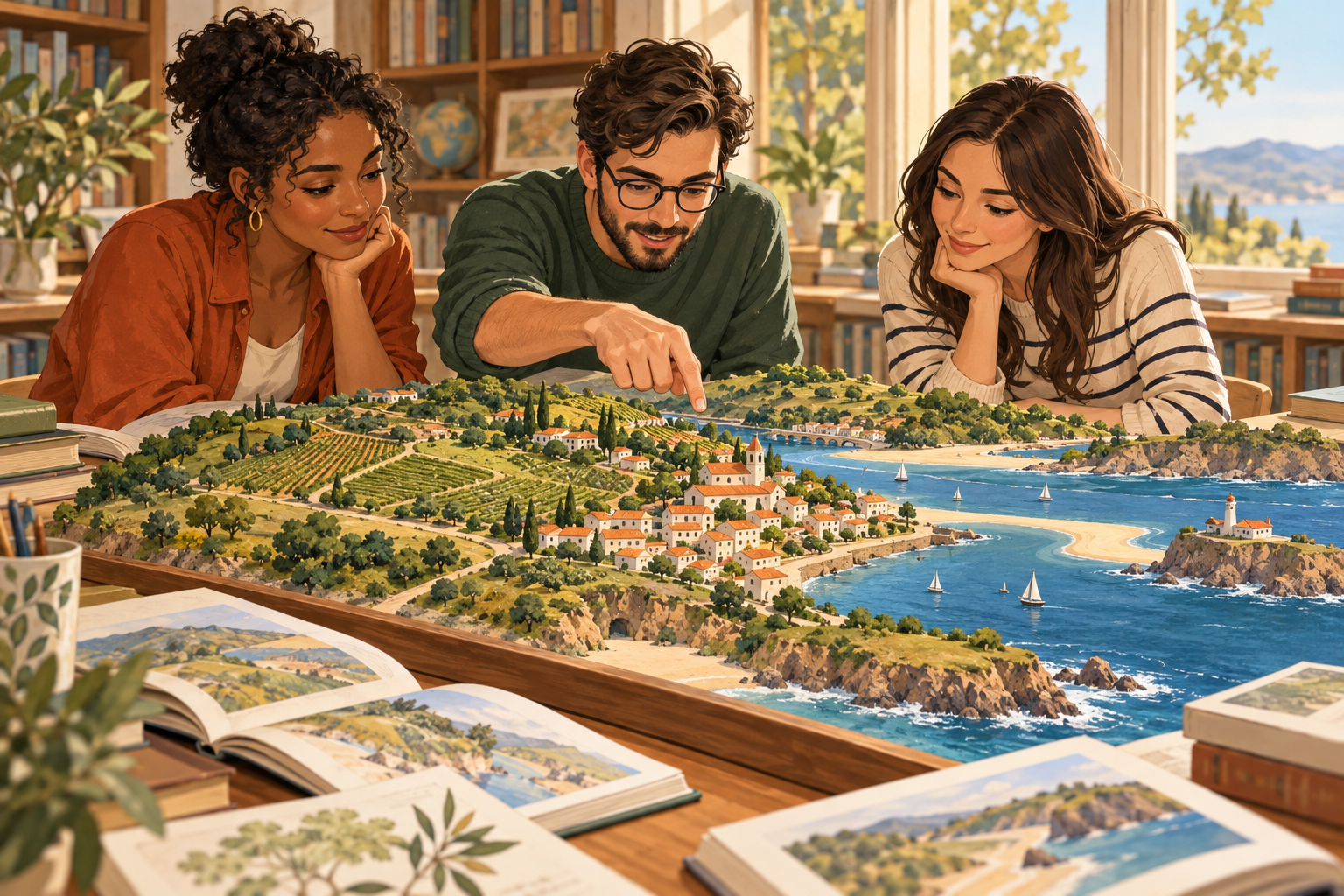
Cover illustration: original AI-generated artwork of three fictional adults studying a handmade hills, town, estuary and coast miniature in an imagined library. This is a nonliteral artistic composite, not a photograph, an accurate map, an exact view of a named place or a representation of all Portuguese communities.
Choose your reading route
Country foundations
Everyday life
Culture and discovery
Connections and perspectives
Chapter 1: Geography and different ways of mapping
Mainland and Atlantic settings
United Nations statistical geography places Portugal in Southern Europe, within Europe. Its M49 entry gives the numerical code 620 and the alphabetic code PRT. The UN explains that these regional groupings serve statistical convenience and do not imply a political affiliation. Source 1.1
An ESA account published on 5 July 2024 describes a Sentinel-2 image of Madeira in the North Atlantic, off northwestern Africa. The archipelago comprises inhabited Madeira and Porto Santo and the uninhabited Desertas and Selvagens groups. Its caption places Funchal on Madeira’s southeastern coast and the airport runway on the eastern coast. On Porto Santo, sandy beaches line the south coast near Vila de Porto Santo, with its airport northwards and hills at both ends. ESA identifies Madeira as an autonomous Portuguese region, with Madeira the larger of its two inhabited islands. The image credits Copernicus data from 2024. Source 1.2
Geological and administrative maps
The geological map issued by LNEG in 2010 brings mainland Portugal, the Azores and Madeira into a national compilation of geological knowledge at a scale of one to one million. Its catalogue distinguishes digital map files for the mainland, each archipelago and the continental shelf, alongside JPG and PDF sheet images and a geopackage. The submerged mainland shelf is represented through information accumulated over more than thirty years of marine geology research. Source 1.3
Administrative mapping records a different set of boundaries. CAOP2025 was approved by the Director-General of Territory on 28 January 2026 and notified on 18 February, incorporating changes from 16 March to 31 December 2025. Its catalogue separates mainland, Azores and Madeira products and includes administrative areas, perimeters and relationships with statistical regions. An overview represents municipal and district boundaries and statistical regions at one to 600,000 for the mainland and one to 800,000 for the autonomous regions. A separate version is prepared for A4 printing. Source 1.4
Rivers and neighbourhoods
Portugal’s 2010 national communication to the UN climate convention distinguishes the mainland in southwestern Europe from the Atlantic archipelagos of the Azores and Madeira. Its geographical account names the Tagus, Douro, Guadiana, Minho and Lima as rivers with basins shared with Spain. Wholly national rivers are described as smaller and more irregular, with the Vouga, Mondego and Sado among the examples. Source 1.5
At neighbourhood scale, Vicente Tang and Marco Painho’s 2023 research combines mapping and street-network modelling in two historic Lisbon neighbourhoods. Participants sketched boundaries, which the researchers compared through polygon orientations and local street patterns. Their exploratory analysis examines relationships between urban form and the extent of places as people perceive them. The authors present the findings as useful for refining unofficial neighbourhood definitions, outlining urban districts and discussing how urban form relates to perceptions. Source 1.6
Chapter 2: History through documents and recorded lives
Admission and democratic change
The UN treaty record dates Portugal’s admission to 14 December 1955, under resolution 995(X), adopted at the General Assembly’s 555th plenary meeting. A declaration signed in Lisbon on 4 February 1956 undertook to discharge the Charter obligations from the date of admission. It was presented to the Secretary-General on 21 February. The declaration was made on behalf of the Portuguese state by its foreign minister. Source 2.1
Parliament’s historical account identifies the military movement led by the MFA on 25 April 1974 as ending the authoritarian Estado Novo regime. Elections for a Constituent Assembly followed on 25 April 1975. This assembly had a specific task: to draft and approve a Constitution. It did not possess ordinary legislative powers or responsibility for political oversight. The assembly approved the constitutional text on 2 April 1976, ten months after beginning its work. Source 2.2
Historical collections and enslavement
The Corpo Cronológico collection preserves public manuscripts concerning Portuguese relations with peoples in Africa, Asia and Latin America. UNESCO dates a substantial majority to the fifteenth century and the first half of the sixteenth. Its catalogue describes material relevant to political, diplomatic, military, economic and religious history across those regions. Portugal submitted the collection in 2006, and it entered the Memory of the World register in 2007. Source 2.3
In Lagos, the Rota da Escravatura museum addresses the city’s connection with fifteenth-century slave trading. Its account describes human remains discovered during a 2009 excavation at Vale da Gafaria, outside the city walls, alongside construction of an underground car park. More than 150 skeletons were identified through study as Africans brought to Lagos through slave-trading routes. A separate municipal caption identifies the museum’s former Vedoria building as seventeenth-century, with earlier customs, guardhouse and military-prison functions. The remains lay within an early modern rubbish deposit, according to the museum’s account of the archaeological work. Source 2.4
Resistance and women’s associations
The Aljube Museum’s Vidas Prisionáveis programme gathers testimony from former political prisoners and people who resisted dictatorship. School groups and the wider community form its audiences. Sessions are recorded on video, with the stated purpose of supporting future consultation through the museum’s documentation centre and sharing the recordings through virtual channels. Source 2.5
Anne Cova led a research project on women’s associativism in Portugal from 1914 to 1974, spanning the beginning of the First World War and the end of dictatorship. Life stories and biographical notes helped explore relationships between civilians, political elites and successive regimes, including colonial policy and support for or resistance to dictatorship. The project ran from September 2018 to August 2022. Its findings appeared in a 2022 book by Ana Costa Lopes, Anne Cova, Vanda Gorjão, Isabel Freire and Natividade Monteiro. Source 2.6
Chapter 3: Languages, learning and belonging
Household language and Mirandese
The ICOT survey distinguishes remembered childhood language from language used later at home. Its December 2023 release estimated that 486,400 people had spoken another language alongside Portuguese up to age fifteen, while 661,700 then used Portuguese and another language at home. The national design selected 35,035 principal family dwellings, with one adult aged eighteen to seventy-four chosen in each by the latest birthday rule. Selected dwellings are not a count of completed interviews. Source 3.1
Law 7/99, published on 29 January 1999, recognised Mirandese as cultural heritage, a means of communication and an expression of Miranda identity. The historical instrument recognised children’s right to learn the language and the right to scientific and educational support for preparing teachers, subject to regulation. It also allowed public institutions based in Miranda do Douro municipality to accompany their documents with a Mirandese version. Source 3.2
Heritage speech and signing
Cristina Flores’s 2019 study examines Portuguese heritage speakers raised in Germany who moved to Portugal during childhood or adolescence. Among fourteen speakers, exposure to German was associated with accuracy in nominal inflection. A separate case followed one returnee who reentered a German environment after four years in Portugal. Comparisons found fewer errors in case, gender and plural marking after renewed exposure. Flores interprets this as supporting a hypothesis that linguistic knowledge can become stable again. Source 3.3
A university account dated 15 November 2025 describes the Contemporary Dictionary of Portuguese Sign Language as a research project under construction. It reports more than 2,000 annotated entries, searchable by text or by handshape, location, palm orientation, movement and facial expression. The design allows signers to propose terms through text or video and vote on new entries. Coordinated by Paulo Vaz de Carvalho with Joana Rato and Hugo Nicolau, the project is described as being developed with and for Deaf people. Source 3.4
Teaching and migrant experiences
At the University of Lisbon, ICLP is a teaching and research unit within the Faculty of Letters, directed towards people without Portuguese as their mother tongue. Its mission includes preparing teachers of Portuguese as a foreign language and designing courses for particular professional purposes. It also researches language acquisition and teaching. The institutional description connects this work with learner corpora, teaching materials and resources for both classroom and distance learning. Source 3.5
A 2025 study by Maria Luís Queirós, Isabel Margarida Duarte and Pedro D. Ferreira draws on interviews conducted in northern Portugal from 2022 to 2025. Its purposive sample included ten teachers, four trainers, eight volunteers and twenty adult learners. Teachers identified practical barriers in host-language education, while learners described emotional and sociocultural obstacles. The authors caution that differences in migration profiles, policies and resources limit transfer of these findings to other regions or countries. Source 3.6
Chapter 4: Public institutions and participation
Constitutional design and young representatives
The Constitution’s seventh revision, dated 2005, describes a democratic state founded on popular sovereignty, pluralism, fundamental rights and the separation and interdependence of powers. Its territorial article distinguishes the European mainland from the Azores and Madeira. The state is defined as unitary while respecting island self-government, local autonomy and democratic decentralisation. Both archipelagos are described as autonomous regions with their own political and administrative statutes and institutions of self-government. Source 4.1
Parlamento dos Jovens introduces parliamentary processes through a school programme approved in June 2006. Its audience includes pupils in the second and third cycles of basic education and in secondary education in public, private and cooperative schools on the mainland, the autonomous islands and overseas constituencies. The design moves from school sessions to district or regional sessions and then a national session. Pupils form candidate lists, campaign, elect representatives and prepare recommendations. At the national stage, representatives debate in committees before approving final recommendations on the edition’s theme. Source 4.2
Complaints and audit methods
The Ombudsman’s 2024 report, presented in July 2025, treated poverty as a theme cutting across public administration. Its structure separated broader problems, selected topics examined during the year and activity as a national human rights institution. The accompanying release reported complaints from 11,790 people and 2,582 investigated complaint procedures. Similar complaints could be treated together, while other cases received a more immediate response without investigation. People and procedures therefore represent different administrative units. Source 4.3
The Court of Auditors describes several manuals serving different purposes. Its fundamental-principles manual comprises ten chapters arranged around a risk-based approach to auditing. A results-audit manual brings together procedures for conducting those audits and presenting findings. The compliance manual adapts INTOSAI guidance to the court’s particular constitutional and legal setting and also addresses quality control. Source 4.4
Participation in Lisbon and Évora
Participation attracts research. A 2018 study by Mijail Naranjo Zolotov, Tiago Oliveira and Sven Casteleyn examined continued intention to use Lisbon’s online participatory budget. The researchers applied structural-equation modelling to responses from 370 people with experience of the system. They associated competence, meaning and habit with continued intention, while reporting variation by age and gender. In their analysis, meaning had a stronger relationship for older men than for younger women. Source 4.5
Évora’s account of 22 April 2026 describes a youth assembly at the Paços do Concelho. Students from Severim de Faria presented recommendations on waste collection and a broader university offer in social sciences and humanities. The announced agenda included shared public bicycles from André de Gouveia students, road safety and affordable housing from Severim de Faria, and environmental, housing and cultural concerns from Gabriel Pereira. Gabriel Pereira was to raise historic-centre depopulation and limited cultural activities for young people. Source 4.6
Chapter 5: Economic institutions and working lives
Historical money and policy priorities
A monetary instrument published on 26 May 1911 defined the gold escudo as equivalent to the gold unit of 1,000 réis and divided it into one hundred centavos. Its territorial exception for India belongs to Portugal’s historical colonial jurisdiction, not its present borders. Proposed gold coins were to show a symbolic figure and an inscription naming the Portuguese Republic on one face, with national arms and value on the other. A competition among national artists was planned for the designs. Source 5.1
The IMF’s 2026 staff appraisal recommended encouraging new housing and bringing unused buildings or short-term rentals into sale or longer leases. It favoured housing allowances and dedicated social housing for households on lower and middle incomes. On productivity, staff called simpler central and local bureaucracy essential and welcomed educational gains, efforts to reduce skill mismatches and preparation for the spread of artificial intelligence. These were recommendations in a report completed on 28 May, within the consultation package released in June. Source 5.2
Business evidence and learning
The World Bank’s Portugal Enterprise Survey profile labelled 2023 draws on interviews with owners and senior managers in 1,007 firms between April 2023 and February 2024. Its universe is the formal private economy outside agriculture. Manufacturing and many services are included, such as retail, hotels, construction, transport and information technology; public utilities, government, health and financial services are excluded. Sampling is organised by industry, company size and geographical region, with small, medium and large firms distinguished. Source 5.3
IAPMEI’s Academia de PME describes business learning through training sessions, webinars, workshops and supporting resources. An account updated in September 2026 names financial literacy, business management, digital transition and sustainability among its topics. The institution’s complementary profile includes training-action programmes, thematic seminars and awareness sessions. It also describes producing and sharing technical knowledge for business management in response to identified needs. Source 5.4
Local food chains and pottery
The reLOCALiza project investigated whether local family farms could supply public canteens through shorter supply chains. Led by the Confederação Nacional de Agricultura and financed through the Common Agricultural Policy, the study ran from May 2019 to September 2021 in five Portuguese municipalities. Activities included studies in each municipality, focus groups, webinars and presentations to local and national authorities. Source 5.5
Black pottery provides a different local perspective on enterprise. Carla Susana Marques and colleagues interviewed three young artisan entrepreneurs and one cultural booster in a peripheral area of northern Portugal. Their qualitative analysis used detailed interviews and NVivo software. The authors describe commercial activity and innovations in design and production processes alongside local materials, culture and traditional knowledge. They explicitly relate the limits of their conclusions to the small sample and its particular geographical setting. Source 5.6
Chapter 6: Households and community support
Survey design and older residents
INE’s annual ICOR survey examines household income, living conditions and risks of poverty or social exclusion. Its FAQ illustrates the reference period with collection in 2025 asking about annual income in 2024. The design planned interviews in approximately 21,830 dwellings across the mainland, Azores and Madeira, using personal and telephone interviews. Its universe consists of people in principal family dwellings: residents of collective accommodation and people without housing are excluded. The FAQ places collection between April and July and includes comparisons with other European Union countries among the survey’s purposes. Source 6.1
Lisbon’s RADAR project is part of Lisboa, Cidade COM VIDA Para Todas as Idades. In an account updated on 7 October 2026, it aims to identify residents over sixty-five while considering their expectations, privations and potential. This information is intended to inform community-based intervention. The described network joins project partners with families, neighbours, local businesses, pharmacies and organisations with social responsibilities, bringing these different participants into an integrated model of support. Source 6.2
Care roles and housing work
Carers for a Day approaches community life through gender and occupational choices. Coordinated by CITE, its planned period runs from 6 January 2025 to 5 January 2027, with Portuguese, Spanish and Croatian partners. The design combines research, practical experience and awareness work to challenge stereotypes associated with care professions. A Portuguese school pilot is intended for students, teachers and other educational actors, with the student audience aged twelve to eighteen. Portuguese partners include the University of Coimbra’s Centre for Social Studies. Source 6.3
In Porto, a technical office connected with the FAUP studies centre supports Porto Vivo applications to the 1.º Direito housing programme. Its described work concerns ilhas and homes of direct municipal beneficiaries. Tasks include surveying households and building conditions, examining urban-planning constraints, calculating financing and preparing application documents. The office also describes supporting owners and technicians through rehabilitation processes. Source 6.4
Volunteering and neighbourhood experiences
The Confederação Portuguesa do Voluntariado organised its 2025 training schedule around a manual developed by Working Group One. Module headings range from concepts of solidarity and volunteering to teamwork, participation and global citizenship. Other topics include motivations for volunteering, the responsibilities of volunteers and organisations, ethics, accountability and interpersonal relationships. A further module considers voluntary action and solidarity in relation to inequalities and social differences. Source 6.5
Robyn Lea Ribeiro’s 2020 thesis explores gentrification through seven inhabitants of Santos-o-Velho in Lisbon who lived, or had lived, there for at least five years. Participants varied in age, gender, social class and education. Each took part in a walking interview, followed by thematic analysis. Ribeiro reports a preference for earlier neighbourhood conditions and perceptions that local services and spaces no longer suited the preexisting community. Source 6.6
Chapter 7: Education and different routes to learning
Inclusive design and children’s rights
The inclusive-education act published on 6 July 2018 describes inclusion through responses to diverse needs and participation in learning and life in the educational community. It organises support into universal, selective and additional measures. Teachers define measures after hearing parents and other professionals working with the pupil, and different levels can be combined. The act took effect from the 2018–2019 school year. Its application to the Azores and Madeira respects the educational competences of their autonomous governments. Source 7.1
UNICEF’s Escolas pelos Direitos da Criança places children’s rights within everyday school practices and culture. Its described audience extends from preschool to secondary education, across public and private establishments. Support includes educator training, technical assistance, pedagogical resources and participation in a national school network. The programme’s action-plan guidance calls for children and professionals to take part from the identification of needs and opportunities. Source 7.2
Assessment and virtual learning
Portugal’s PISA 2022 assessment involved 6,793 students in 224 schools, representing about 96,600 students aged fifteen and an estimated 93% of that age group. The country note reports that 70% reached at least Level Two in mathematics, including interpreting simple situations such as comparing route distances or converting currencies. Students completed subject tests and a questionnaire; school principals also answered questions about management and learning environments. The OECD judged the Portuguese data to meet its reporting standards. Source 7.3
UAb’s February 2025 account of its virtual pedagogical model identifies four pillars: learning centred on the student, flexibility, interaction and digital inclusion. Students are described as organising their time, monitoring learning, setting goals and forming learning communities. The model is asynchronous. Interaction includes discussion among students within virtual classes as well as exchanges with teachers, while educational strategies are intended to support the acquisition and development of digital literacy. Source 7.4
Reading partnerships and school practice
Todos Juntos Podemos Ler has been developed since the 2011–2012 school year by the school-library network, the national reading plan and DGE’s special-education and social-support service. It promotes projects involving reading, writing and oral language for children and young people facing learning or accessibility barriers. Its design asks school libraries, teachers and other partners to work together. Public school clusters and individual schools form the programme’s intended audience, with collaborative activities central to project planning. Source 7.5
Maria Antunes Garcia’s 2026 case study examines an inclusive-education team in one school cluster in central Portugal. Six professionals participated, including teaching, leadership, psychology and social education. Interviews, direct observation and documents were examined through content analysis. Garcia reports coordination in identifying needs and planning differentiated teaching, alongside collaboration with families and other resources. Participants also identified limited time, administrative workload and insufficient specialised training as constraints on their work. Source 7.6
Chapter 8: Health institutions and professional learning
Reviewing services and training audiences
A government account published on 23 September 2026 described a WHO Europe assessment of mental-health reform that had begun on 21 September and was scheduled to end on 24 September. Experts were to meet the national coordination body, civil society and other organisations, and visit services. The planned review concerned legislation, governance, deinstitutionalisation and funding, with recommendations intended for management, finance and human resources. Portugal requested the assessment within cooperation with WHO Europe, alongside the Quality Rights programme and the Pan-European Mental Health Coalition. Source 8.1
The Portuguese Red Cross describes its Mealhada delegation as a training hub within the national first-aid school. Its stated audiences include professionals, institutions, businesses and the wider community. The catalogue lists basic and European first aid, paediatric first aid and basic life support, including a version with automated external defibrillation. It also distinguishes transport-ambulance and emergency-ambulance training, with recertification for each, as well as a community first-aid technician course. Source 8.2
Governance and digital practice
The vaccination-governance instrument published on 22 March 2024 assigned coordination at three levels: the Directorate-General of Health nationally, regional public-health services regionally, and local health units locally. It assigned central purchasing, the central vaccine register and communication campaigns to the shared services of the health ministry, SPMS. The hospitals’ common services organisation, SUCH, was assigned central logistics covering receipt, storage, dispatch and distribution. Source 8.3
A circular of 7 May 2025 describes Dia Digital e Telessaúde as an SPMS initiative chiefly for health professionals. Its design includes demonstrations, exchanges of practice and presentations of projects. Named tools include Live for teleconsultation and Telecuidados for remote monitoring and rehabilitation, with online professional training through Academia SPMS. The proposal involved information-system departments and internal telehealth promoters following equipment deliveries in 2024 under the Recovery and Resilience Plan. Source 8.4
Training histories and student research
The P.PORTO health school dates approval of its emergency-medical training centre, CFEM, to September 2009. Its history describes building an instructor pool between 2010 and 2014, followed by CPR/ERC accreditation from 2014 and INEM accreditation from 2019. For 2015–2023, it reports 59 courses: 28 with CPR/ERC certification and 31 with INEM certification. That period included an interruption in 2020–2021. Management belonged to Cardiopneumology. Source 8.5
A 2023 study by Marques and colleagues examined satisfaction with simulated clinical experiences at the Portuguese Red Cross health school in Lisbon. Its convenience sample comprised 223 nursing students in their second and third years during 2018–2021. The researchers used a quantitative, cross-sectional design and the ESECS questionnaire. Its seventeen items addressed practical, cognitive and realism dimensions, with satisfaction rated from one to ten. The scale allowed students to express their views about simulated experiences, with higher numbers indicating greater satisfaction. Source 8.6
Chapter 9: Connections, infrastructure and public technology
Rail plans and urban extensions
Ferrovia 2020 was presented in February 2016 as a railway investment plan based on PETI3+. Its stated priorities included international commitments with Spain and the Atlantic Corridor, freight transport and exports, and connections between Portuguese ports and the principal land borders with Spain. Named corridors linked Sines, Setúbal and Lisbon with Caia, and Leixões and Aveiro with Vilar Formoso. Strategic aims included shorter journeys and greater capacity in train numbers and length. Source 9.1
A Lisbon Metro announcement dated 29 July 2026 projected the Circular Line’s opening for the first quarter of 2027. The project was to connect Rato with Cais do Sodré, adding more than two kilometres and the new Estrela and Santos stations. Its design joined the Yellow and Green lines into a central ring. The project description also envisaged remodelling Cais do Sodré station and connecting the Campo Grande viaducts. Source 9.2
Ports and aviation regions
The Sines port authority’s history begins its construction chronology in 1973 and dates the authority’s creation to 14 December 1977. Initially a public institute with administrative and financial autonomy, it managed the petroleum terminal then in place. In 1998 it became a publicly owned company structured to grant concessions to private operators. A March 2014 instrument transferred the commercial ports of Faro and Portimão to APS, including associated jurisdictional functions, assets, staff and financial resources. Source 9.3
NAV’s account of 26 May 2025 dates full operation of the Lisbon Point Merge traffic-sequencing model to July 2024. It also explains two flight-information regions: Lisbon covers mainland Portugal and Madeira, while Santa Maria includes the Azores and a broad area of the North Atlantic. These describe aviation-service responsibilities, not national sovereignty over the ocean. The account identifies control centres in Lisbon and Santa Maria and control towers at named mainland and island airports. Source 9.4
Research networks and identity documents
A profile of 9 June 2026 by FCCN, the digital-services unit of FCT, presents RCTS as a shared digital infrastructure for higher education and research across mainland and island institutions. Universities, polytechnics, laboratories and research centres are among its audiences. The catalogue groups services under computing, connectivity, security and collaboration. Named examples include eduroam, the Fibra network service, RCTSaai authentication, Estúdio multimedia production, Videocast event broadcasting and FileSender. Source 9.5
On 10 June 2024, the justice ministry announced that a redesigned Citizen Card would begin issue the following day. Its description included a mar largo pavement motif, a larger photograph, English document wording and an EU flag marked PT. The chip moved to the reverse and supported contact and contactless use, including electronic authentication and signature. Transport tickets and check-in were presented as possible future uses, not already delivered functions of the announcement. Source 9.6
Chapter 10: Skills and learning across adulthood
Recognition and industrial training
DGERT’s account of Centros Qualifica, updated on 10 January 2023, describes guidance, referral and follow-up for adult qualification pathways. Recognition, validation and certification can concern skills gained through formal, nonformal or informal learning, leading towards school, professional or dual certification. Guidance examines individual adult profiles, life and work experience, qualification goals and learning needs. Adults may then be directed towards training, recognition procedures or an assessment and certification commission. The latter route concerns incomplete qualifications, with partial certifications obtained through multiple education or training modalities or recognition procedures. Source 10.1
CENFIM’s institutional history dates its founding protocol to 15 January 1985. The metallurgical and metalworking vocational-training centre was established by IEFP, AIMMAP and ANEME, bringing together the employment and training institute and industry associations. An adaptation followed on 6 March 1987. The account describes public legal personality, a nonprofit purpose, administrative and financial autonomy and assets belonging to the institution. Source 10.2
Tourism and craft institutions
Turismo de Portugal describes Academia Digital as a platform supporting executive and specialist professional training developed by its twelve hospitality and tourism schools. The network’s mission includes initial and continuing learning, developing existing skills and preparing people for different roles. Its listed mainland locations extend from Viana do Castelo, Porto and Lamego to Coimbra, Lisbon, Setúbal and the Algarve. The mission addresses both professionals and tourism businesses. The list also includes Estoril, Portalegre, Caldas da Rainha and Óbidos, Portimão, Faro and Vila Real de Santo António. Source 10.3
CEARTE dates its creation as a vocational-training centre to 1986. Its institutional history places the headquarters in Coimbra and centres in Semide, in Miranda do Corvo, and Alvaiázere. It describes partnerships with craft associations, schools and other institutions. Named activities include developing professional and training profiles for the National Qualifications Catalogue, creating a knowledge-resource centre for research and participating in national and transnational innovation projects. Source 10.4
Older students and teacher development
Marisa Maia Machado and Rosa Madeira studied five people aged sixty-seven to eighty-three attending conventional courses at an unnamed Portuguese public university. Their exploratory interviews concern educational projects during retirement. The authors interpret intergenerational coexistence in relation to rebuilding identity and developing solidarity between generations. The account appears in a 2016 journal issue. Source 10.5
The Camões teacher-training catalogue includes active learning, distance education and Portuguese as a non-native language. A task-based teaching course proposes work on principles, lesson sequences, methods and materials. Vozes das margens is described as four modules on writing by African and Afro-descendant women. Its planned contextual reading addresses colonial legacies, historical memory, migration, belonging and strategies of resistance. Another course targets the basic training needs of teachers and educators working, or preparing to work, with learners of Portuguese. Source 10.6
11. Landscapes and nature education
Forest and lagoon
Madeira’s Laurisilva entered UNESCO’s World Heritage List in 1999. The property’s forest covers steep valleys running from the island’s central plateau and ridge towards the northern coast. UNESCO describes evergreen trees and shrubs with flat, dark green leaves, alongside waterfalls, cliffs and old trees on valley floors. Its named vegetation communities include Til Laurisilva, Barbusano Laurisilva and Vinhático Laurisilva. (Source 11.1).
A Ramsar information sheet dated 5 November 1992 describes Ria Formosa on the Algarve coast, facing Faro, Olhão and Tavira. This saltwater lagoon has sediment surfaces exposed at low tide. Long, low barrier islands separate it from the sea, with vegetation growing on their sand dunes. The sheet records no major upstream river basin and describes freshwater arrivals as irregular, often torrential. Ramsar designation dates to 24 November 1980. (Source 11.2).
Wetlands and learning
Paul do Boquilobo’s institutional profile dates its biosphere designation to 1981. It places the wetland on the Almonda shortly before that river joins the Tejo. The description includes a mixed colony of herons, spoonbills and other birds arriving from North Africa, alongside waterbirds from northern Europe. Its stated territory encompasses Azinhaga, Golegã, Pombalinho and the combined parishes of Brogueira, Parceiros de Igreja and Alcorochel. Its river setting is described near the locality of Rabo-dos-Cágados. (Source 11.3).
Peneda-Gerês offered schools an environmental education programme for 2009–2010 through five park gateways and the Vidoeiro centre. The gateways were in Melgaço, Arcos de Valdevez, Ponte da Barca, Terras de Bouro and Montalegre; Vidoeiro was in Vilar da Veiga. Municipalities managed the gateways, while the park and ICNB managed the centre. Planned activities linked school curricula with heritage conservation and research fields such as geography, geology and archaeology, using contact with the natural environment as a laboratory complementing classroom study. The programme aimed to introduce research methods and instruments from biology. (Source 11.4).
Island projects and ocean classrooms
An institutional account updated in August 2022 describes LIFE Ilhéus do Porto Santo as a partnership between Madeira’s natural park service and SPEA, with European LIFE support. Work concerned six islets: Cal, Farol, Ferro, Fonte da Areia, Cenouras and Fora. The account identifies approximately 232 hectares as land where intervention occurred. Around 45 conservation actions were planned; that figure describes the proposed programme rather than a verified tally of completed actions. (Source 11.5).
Oceanário de Lisboa’s education catalogue for 2025–2026 combines aquarium activities with auditorium sessions. Named school programmes include Vasco e o mergulho no tempo and Replay: (a) Tempo de escolher, the latter aimed at older pupils. Its +Oceano platform was designed as a teacher community for sharing experiences, educational material and interactive activities. The same account describes workshops for educators and teachers in both physical and online formats. (Source 11.6).
12. Food, memory and everyday places
Markets and rural networks
Brackenbury’s photographic project examined three markets undergoing renewal: Arroios in Lisbon, Bolhão in Porto and Lavradores in Funchal. The 2025 article describes three years of photographic investigation, including repeated exploratory walks. Its purpose was to document each market’s distinctive features and character during alteration. Gordon Cullen’s photographic explorations of towns and cities, including Townscape, provided an intellectual starting point for considering the forms, features and experiences encountered in these markets. (Source 12.1).
Paola Andrea Hernández’s 2024 thesis investigates access to local food in rural Portugal. It maps local food networks and distinguishes versatile networks from fixed ones, then uses territorial comparison and ethnographic work to explore residents’ perspectives and practices. The study also examines how small farms enter local food systems through markets, reciprocity and redistribution. Its findings emphasise the interaction of geography, social and cultural circumstances, and governance in shaping these networks and everyday access. (Source 12.2).
Historical and literary approaches
Maria Antónia Pires de Almeida’s 2023 conference contribution asks what people ate in twentieth-century Alentejo. She identifies sources ranging from parish registers and censuses to local newspapers, commercial directories and estate inventories. Institutional and agricultural archives add further material, alongside popular music, poetry, craft, literature and oral memory. Her examination of some agricultural account books, presented at an international congress on food sovereignty, found information about payments in goods to permanent workers employed on annual contracts, connecting food history with employment arrangements. (Source 12.3).
Rhian Atkin’s 2020 literary study follows Portuguese-American food writing in the United States, focusing on cookbook authors Maria Lawton and David Leite. It considers how cooking represents ethnic heritage and evokes home, while allowing people to express a Portuguese-American identity. Food’s material qualities and particular dishes become ways of negotiating memory, emotion and cultural belonging in this reading of culinary literature. The article appeared online on 12 May 2020. (Source 12.4).
Symbols and school documents
José Manuel Sobral and Patrícia Rodrigues approach cod as a symbol of Portuguese identity in their 2013 essay. Their account traces the historical combination of religious, economic, political and ideological influences rather than treating a food preference as timeless. They connect these influences with processes of social learning and incorporation into everyday life. The authors present their argument as a genealogical reconstruction of that relationship. (Source 12.5).
An August 2018 Directorate General of Education circular illustrates a different setting for food knowledge: school refectories. Developed through consultation and collaboration with partners, the guidance included 40 vegetarian menu proposals and 15 Mediterranean proposals, each accompanied by technical sheets. It also addressed meal constituents and menu components. A monitoring grid was intended for school management teams. The package set out food, nutritional and environmental criteria for school lunch provision. (Source 12.6).
13. Music, collections and film
Museums of song
The Fado Museum in Lisbon opened in 1998. Its account describes a permanent exhibition on Fado and the Portuguese guitar, alongside temporary exhibitions, a school, specialist documentation centre and auditorium. A digital sound archive contains recordings dating from the early twentieth century. The museum occupies a former water-pumping station built during the later nineteenth century. The building underwent restoration and enlargement to accommodate the museum. Its facilities also included a theme shop. (Source 13.1).
A 9 August 2021 announcement set the inauguration of Serpa’s Cante Museum for 14 August. The interpretive centre would join existing facilities: the Manuel Dias Nunes documentation centre, an exhibition gallery, shop and auditorium. The account identifies the Alentejo regional culture directorate as a partner in the museographic project and European regional development funding through Alentejo 2020. The opening ceremony was scheduled at the castle’s Alcaçova, connecting the announcement with a named setting in Serpa. (Source 13.2).
Recorded celebrations and tile collections
Portugal: Festas in Minho presents field recordings made during two pilgrimages in August 1998. One was the celebration of Our Lady of Agony in Viana do Castelo; the other was São João d’Arga, around a chapel in Serra d’Arga. The album credits António Tilly and Maria João Lima with recording, mixing and mastering. Both pilgrimages took place within the district of Viana do Castelo, in northwestern Portugal. Its Smithsonian Folkways edition is dated 2013, distinct from the recording year. (Source 13.3).
The National Azulejo Museum occupies Lisbon’s Madre de Deus convent, founded by Queen Leonor in 1509. The institution was created in 1965 and became a national museum in 1980. Its stated mission is to explain the history of tiles in Portugal. The collection follows that history from the middle of the fifteenth century to contemporary work, while also including ceramics, porcelain and faience from the sixteenth through twenty-first centuries. (Source 13.4).
Literary acquisitions and fictional worlds
A government announcement on 13 August 2026 described manuscripts acquired for the National Library of Portugal. The group included poems by Fernando Pessoa and his correspondence to Ofélia Queiroz, Teixeira de Pascoaes’s manuscript O Homem Universal, a story by Vitorino Nemésio, and letters by Camilo Castelo Branco and Ana Plácido. The state exercised its right of preference in the acquisition. The documents came from a Lisbon auction held on 1 June; the purchase was completed on 10 August. (Source 13.5).
Ibermedia lists Tabu as a Portuguese fiction film released in 2012, directed by Miguel Gomes and written by Mariana Ricardo and Gomes. Its synopsis moves from Lisbon to colonial Africa through the story of a temperamental woman, her maid from Cabo Verde and a neighbour in the same apartment building. The listing names O Som e a Fúria and Gullane. (Source 13.6).
14. Built heritage and historical memory
Palaces and university spaces
UNESCO places Sintra’s cultural landscape near the Atlantic in central Portugal, where wooded granite hills rise above countryside. Around 1840, Ferdinand II transformed a ruined monastery into a castle combining Gothic, Egyptian, Moorish and Renaissance elements. The description distinguishes the Royal Palace in the town centre from Pena Palace high in the Serra. Within the nineteenth-century palace, the monastery’s church, cloister and refectory retain their place in the architectural ensemble. (Source 14.1).
Coimbra’s Alta and Sofia property comprises two components in the old town. The university was established in the Royal Palace of Alcáçova in 1537 and developed through colleges. UNESCO identifies the palace, Saint Michael’s Chapel and Joanine Library, alongside the botanical garden, university press and the University City created during the 1940s. The dossier also attributes a role in training colonial elites to Coimbra, connecting its institutional history with universities in Portuguese colonies. (Source 14.2).
Townscapes and border architecture
Guimarães developed around a northern castle and a southern monastic complex. Its historical building forms include granite ground floors with timber structures above. UNESCO’s expanded property also encompasses two monastic complexes and the Couros district, whose name recalls leather tanning. Although that craft ceased there in the middle of the twentieth century, the dossier describes surviving tanneries, workers’ houses and urban spaces, chiefly from the nineteenth and early twentieth centuries. Civic facilities and squares developed during 1498–1693. (Source 14.3).
Elvas was fortified between the seventeenth and nineteenth centuries between Lisbon and Madrid. Its serial heritage property includes the historic centre, Amoreira Aqueduct, Santa Luzia fort and connecting covered way, Graça fort, and three fortlets: São Mamede, São Pedro and São Domingos. Within the walls, barracks stand alongside churches and monasteries, some adapted for military uses. The aqueduct supplying the town was built in the late sixteenth and early seventeenth centuries. (Source 14.4).
Royal design and resistance
Mafra’s royal complex brings together a palace, basilica, convent, Cerco Garden and the Tapada hunting park. Architect Johann Friedrich Ludwig had trained in Rome. The basilica was consecrated on 22 October 1730 while the monument remained unfinished. UNESCO also identifies six organs commissioned from Portuguese makers António de Machado Cerveira and Peres Fontanes late in the eighteenth century. In the garden, watercourses from the Tapada converge on a central lake beside a well. (Source 14.5).
Peniche’s National Resistance and Freedom Museum defines its mission around preserving and communicating resistance to Portugal’s fascist regime. Its 2024 exhibition guide describes a memorial bearing former political prisoners’ names and the room where families visited. Documents in an adjacent room address solidarity from Peniche’s population towards prisoners and relatives. The guide also assigns the Santa Bárbara chapel material about fortress history and maps showing city development. (Source 14.6).
15. Science and research collections
Space and international laboratories
An institutional account dated 5 March 2024 reports that AEROS MH-1 launched from Vandenberg in California the previous day aboard a Falcon 9. The satellite’s name honours Manuel Heitor and his contribution to Portuguese science policy. The programme began in 2020 under Thales Edisoft and CEiiA, working with MIT through MIT Portugal. Its consortium included the universities of Minho, Porto and Algarve, alongside Instituto Superior Técnico, SpinWorks, Dstelecom, Colab +Atlantic and other research organisations. (Source 15.1).
Braga hosts the International Iberian Nanotechnology Laboratory, created through an agreement between Portugal and Spain and inaugurated in 2009. FCT’s May 2025 profile describes researchers, engineers and technicians from different countries. Listed research areas include nanoelectronics, advanced materials, energy and sustainability, and quantum information technologies. FCT represents Portugal on the laboratory’s council and supports connections with other research institutions, technology centres and companies. (Source 15.2).
Mining heritage and fossils
Lousal’s science centre uses georesources to introduce geology, chemistry, physics and geophysics through interactive activities, exhibitions and experimental spaces. Its association was created in 2010, and the centre opened on 30 June that year within the national Ciência Viva network. The mining museum had opened on 20 May 2001 in the former power plant. That plant supplied the mining complex and local population from 1934 to 1992; extraction at the mine ran from 1900 to 1988. (Source 15.3).
Christophe Hendrickx and Octávio Mateus’s 2014 study examined dinosaur material from the Lourinhã Formation in central western Portugal. A right upper jaw and incomplete tail vertebral centrum had previously been assigned to Torvosaurus tanneri. Comparing that material, the authors proposed Torvosaurus gurneyi as a distinct species. Their stated differences included fewer than eleven teeth in the upper jaw and an interdental wall almost aligned with the jaw’s outer wall. They also proposed terminology and notation for theropod upper jaws. (Source 15.4).
Atlantic observations and stone references
Pico Mountain Observatory in the Azores presents preliminary particle observations from 2015–2017. Its catalogue suggests that particles probably travelled long distances across the Atlantic from surrounding continents. Described series distinguish particles larger than 0.3 and 0.4 micrometres and measure light scattering at blue, green and red wavelengths. A 2016 note says the particle counter stopped on 3 August while scattering observations continued. The provider cautions that displayed data are only minimally processed and quality controlled. (Source 15.5).
LusoLit is a reference collection at the University of Algarve described by Telmo Pereira, Anne Farias and Eduardo Paixão in 2016. At that early stage, it contained several hundred chert samples from central and southern Portugal. The authors described sampling, cataloguing and mapping raw material diversity to assist archaeological and anthropological research. They initially concentrated on chert because they considered it the least ubiquitous material across the landscape. (Source 15.6).
16. Sporting moments and participation
Olympic organisation and jumping
The International Olympic Committee profile identifies Comité Olímpico de Portugal and gives 1912 as its recognition year. Its profile lists the committee’s postal address as Travessa da Memoria, number 36, in Lisbon, with postal code 1300-403. (Source 16.1).
Patrícia Mamona, a Sporting athlete representing Portugal, won triple jump silver at the Tokyo Olympics, according to the club’s report of 1 August 2021. Her opening attempt measured 14.91 metres. She lost balance on her second attempt and recorded 12.30 metres. On her third attempt she took a risk to approach fifteen metres, but the jump was invalid by two centimetres. On the fourth attempt she reached 15.01 metres. Her remaining jumps measured 14.66 and 14.97 metres. Spain’s Ana Peleteiro finished third with 14.87 metres. (Source 16.2).
Football and canoeing
Portugal’s national team defeated host France in the European Championship final on Sunday 10 July 2016. Played at Stade de France in Saint-Denis, the match ended in a Portuguese victory after extra time. The French football federation records the final score as one goal to none, with Eder scoring in the 109th minute. Its account describes the Portuguese forward’s shot from 25 metres, beyond the reach of goalkeeper Lloris. Mark Clattenburg officiated as principal referee. (Source 16.3).
Fernando Pimenta won the K1 1000 race for men at the canoe sprint world championships in Copenhagen, reported on 18 September 2021. His previous world title had come in 2018, followed by bronze at the Tokyo Olympics. Hungary’s Balint Kopasz, the reigning world and Tokyo Olympic champion, took silver in Copenhagen; Aleh Yurenia of Belarus took bronze. Pimenta recalled taking days completely away from training after returning to Portugal. Resuming long sessions had been difficult, but he described improved feelings during the preceding two weeks and happiness with the result. (Source 16.4).
Paralympic results and inclusive programmes
An account by OIS and World Para Athletics, dated 1 September 2024, reports that Portugal’s Miguel Monteiro won the Paris Paralympic F40 shot put for men with 11.21 metres. Battulga Tsegmid of Mongolia took silver and Garrah Tnaiash of Iraq bronze. Monteiro said his attention stayed on the throws still to come, because his rivals remained capable of improving. Monteiro said that his objective throughout the competition had been to win a medal. (Source 16.5).
Special Olympics Portugal’s June 2021 fact sheet records its foundation in 1987. Its stated mission combines year-round sports training and competition for children and adults with intellectual disabilities. Listed sports include athletics, basketball, football, equestrian sport, golf, handball, petanque, swimming, table tennis, and artistic and rhythmic gymnastics. The programme list names family support, Young Athletes, Unified Sports, Unified Schools, Unified Champions Schools, motor activities training and the Law Enforcement Torch Run. (Source 16.6).
17. Environment and adaptation projects
Mainland observations
IPMA’s summary published on 29 May 2025 describes 2024 as very hot and dry in mainland Portugal, with an average air temperature of 16.49 degrees Celsius. It reports 64 new maximum temperature extremes, 177 new minimum temperature extremes and eight heat waves. The summary also identifies persistent weak to moderate meteorological drought between May and September and during December. These observations concern the mainland excluding Madeira and the Azores from this geographical denominator. (Source 17.1).
NASA’s account of 16 February 2022 compares Alto Rabagão and Alto Lindoso reservoirs in northern Portugal. Its caption describes low water and exposed shorelines in paired images taken on 6 March 2021 and 5 February 2022. The Operational Land Imager aboard Landsat 8 acquired the scenes. Lauren Dauphin prepared the images using Landsat data from the United States Geological Survey. (Source 17.2).
Local participation and water systems
LIFE Águeda’s project description places its work in the Vouga basin, coordinated by the University of Évora with scientific and technical support from MARE. Águeda municipality’s planned contribution included environmental education, awareness activities and volunteering, particularly involving younger people. Mora municipality, through its aquarium team, was to help design and implement educational programmes. It also planned to develop and test a citizen science application in collaboration with recreational fishers. (Source 17.3).
An EIB project profile describes Águas de Portugal’s investment programme for 2025–2029 across the mainland. Planned work included construction and rehabilitation of water supply systems spanning municipal boundaries, and wastewater collection and treatment facilities. Its objectives included stronger efficiency and resilience, climate adaptation, pollution prevention and protection of water resources. The page records release on 11 June 2025 and an approval milestone on 18 December 2025. The design covered both bulk supply and retail systems serving municipalities. (Source 17.4).
Landscapes and offshore energy
LIFE Montado-Adapt addressed landscapes in both Portugal and Spain. Its area covered Alentejo, Extremadura and Andalusia, with twelve pilot areas across the project rather than twelve Portuguese sites. The programme described support for landowners and managers using integrated land use and diversification strategies. Its aim combined economic, social and environmental sustainability under changing climatic conditions. The recorded project interval ran from 1 September 2016 to 1 September 2021, with support through the European LIFE Climate Action programme. (Source 17.5).
WindFloat Atlantic’s operator dates first generation off Viana do Castelo to February 2020 and full operation to July. Earlier prototype testing took place near Aguçadoura during 2011–2016. Construction during 2018–2020 included manufacturing components, transporting turbine components and platforms to Ferrol, and installing turbines on platforms there. The described installation has three turbines on three floating structures, with an operating base at Viana’s commercial port. The installation was designed for an operating life of 25 years. (Source 17.6).
18. International connections
Trade and European accession
The WTO profile dates Portuguese membership to 1 January 1995. It separately records participation in GATT from 6 May 1962 and identifies Portugal as a European Union member state. (Source 18.1).
The European Commission’s Portuguese representation traces accession through several stages. Portugal formally applied to the European Economic Community on 28 March 1977, and the Community’s Council unanimously approved that formal request on 6 June 1978. The accession treaty was signed at Lisbon’s Jerónimos monastery on 12 June 1985. It entered into force on 1 January 1986, when Portugal joined the then Community. The representation presents this chronology in its account marking forty years of membership in 2026. (Source 18.2).
Alliances and civic participation
NATO’s historical account identifies Portugal as a founding member in 1949 and names foreign minister Jose Caeiro da Matta at the treaty signing in Washington on 4 April. Lisbon later hosted the ninth North Atlantic Council session from 20 to 25 February 1952, at Instituto Superior Técnico. That meeting made the Council permanent, with representatives from member countries. Allies also decided to appoint a secretary general to lead a new international secretariat supporting the Council’s increasing range of responsibilities. (Source 18.3).
The OECD’s Civic Space Review of Portugal, published on 11 December 2023, examines national legal frameworks, policies, institutions and practices relevant to civic space, emphasising user input in public service reform. Its three areas are protecting civic freedoms and the information environment, strengthening stakeholder and citizen involvement, and developing inclusive, accessible public services. Recommendations include an overarching policy framework, reduced administrative burdens and funding gaps for civil society organisations, and better communication and feedback. The review also calls attention to targeted outreach and representation of people whose voices are underrepresented in public decision making. (Source 18.4).
Language and cultural cooperation
A Community of Portuguese Language Countries (CPLP) account dated 24 August 2026 reports an anniversary meeting held in Dili on 19 August. It recalls the organisation’s founding in Lisbon on 17 July 1996 by Angola, Brazil, Cabo Verde, Guinea-Bissau, Mozambique, Portugal and São Tomé and Príncipe. Timor-Leste joined in 2002 and Equatorial Guinea in 2014. The anniversary meeting’s adopted declaration reaffirmed diplomatic coordination, cooperation across several fields, promotion of Portuguese and economic cooperation among the participating sovereign countries. (Source 18.5).
PROCULTURA’s programme description sets out cooperation in cultural and creative employment in Portuguese-speaking African countries and Timor-Leste. The European Union financed the initiative, which Camões managed and cofinanced, with additional cofinancing from the Gulbenkian Foundation. Its stated execution plan covered April 2019 to June 2023. The design linked artistic, technical and management skills with contemporary production in music, performing arts and children’s literature. The programme sought income-generating cultural activities in those partner countries. (Source 18.6).
19. Enterprise and creative production
Innovation and business development
WIPO’s 2026 Global Innovation Index profile places Portugal thirtieth among 139 economies, with a confidence interval spanning ranks 28–32. Its input ranking is twenty-eighth and its output ranking twenty-seventh. It cautions that data availability and changes to the index model affect comparisons between years. (Source 19.1).
A government announcement on 7 May 2025 described the fourth StartUP Voucher call for graduates aged up to 29 in Alentejo, Centro and Norte. Its nine months were divided into developing an idea, defining a business model and preparing a business plan. Mentoring, incubation, bootcamps and seminars formed part of the proposed support. The published deadline was 5 August 2025. The programme aimed to develop technological business models and help graduates create their own employment. (Source 19.2).
Incubation and media arts
The European Space Agency (ESA) reports inaugurating the Centro and Tagus business incubation centres in May and June 2026, implemented by Instituto Pedro Nunes and Técnico Venture Lab respectively. Centro focused on Portugal’s Centro region. Its distributed sites included IPN’s incubator, Pampilhosa da Serra and Incuba+ Santa Maria, while Tagus focused on Greater Lisbon. The account reports 69 startups supported through the preceding Portuguese programme during 2014–2024. The two new centres linked their launches to initial selection and planned to support 36 startups over three years, with calls extending through 2028. (Source 19.3).
Braga joined UNESCO’s Creative Cities Network in Media Arts in 2017. Its profile describes GNRation’s interactive workshops and the Semibreve festival’s audiovisual performances and experimental live electronic music. The festival also displayed work by students from Minho University’s engageLab. Envisaged initiatives included media arts learning, a centre for creators, researcher exchange and collaborations with other creative cities. Another stated aim connected artistic creation and technology with the city’s history and memory. (Source 19.4).
Film and game narratives
Catarina Vasconcelos wrote and directed The Metamorphosis of Birds, a 2020 Portuguese production by Primeira Idade. Its press kit classifies the 101-minute film as documentary and fiction. The synopsis portrays Beatriz, naval officer Henrique and their six children, including Jacinto, the director’s father. Shared maternal loss connects father and daughter. Vasconcelos explicitly describes rearranged times, characters and words, and explains that she imagined letters and relatives’ younger lives rather than presenting an unaltered family record. (Source 19.5).
Nerd Monkeys, identified as a Portuguese studio in its event profile, describes Out of Line as a hand-drawn adventure in two dimensions. Its fictional protagonist San seeks to escape the Factory that was once home, with the world revealed through successive chapters. The studio describes collaborations with independent developers and work on its own intellectual properties. It also states a mission of helping aspiring developers learn through opportunities adapted to their experience and needs, alongside inclusivity and honesty. (Source 19.6).
20. Community participation and local projects
Children and digital learning
UNICEF Portugal’s Child Friendly Cities programme places children’s rights within municipal policies, programmes and budgets. Its four pillars combine a holistic understanding of children, participation, a strategy based on rights and assessment of policy impacts. Municipalities joining the programme commit to a coordination mechanism, a local strategy covering four years and annual action plans. The design asks that children’s views be considered in decisions affecting them, with assessment before, during and after local policies are implemented. (Source 20.1).
The Descodifica-te project registry describes structured training in digital skills without coding, directed towards women in vulnerable circumstances, including career transitions, mothers and carers. The promoter is NOCODE INSTITUTE. The execution interval runs from 1 November 2024 to 31 October 2027. The registry gives 40 intended participants and a 2027 target for employment or demonstrably improved contractual circumstances. Economic autonomy is the stated training aim; the figures are targets. (Source 20.2).
Neighbourhood partnerships and choices
Lisbon’s account of the 2024 BIP/ZIP edition reports approval of approximately five million euros in municipal support within a framework from 2024 to 2027. Ecossistema projects were designed to last three years, potentially renewable for another three, while Ignição projects retained a one-year duration. The 52 funded applications planned 364 activities involving 168 organisations. Those comprised 50 promoters and 118 partners, including eleven parish councils. (Source 20.3).
A Cascais participatory budget page, referring to editions held in 2011–2015, describes citizens identifying, debating and prioritising municipal projects. Categories included school and green spaces, cultural and sporting facilities, roads, street furniture, accessibility and mobility, alongside health and social action. Proposals concerned the parish hosting each participation session. The municipality’s technical assessment preceded final voting. The described model planned municipal delivery of winning projects during the following two years. (Source 20.4).
Community programmes and orchestras
On 12 December 2023, the government announced a second Bairros Saudáveis edition and a three-year extension of the programme created in July 2020. Its mainland focus was small community projects, including collective planning and renewal of public or shared spaces. The seven stages comprised preparation, outreach and capacity building, applications, assessment, results and funding agreements, execution, and participatory evaluation with accounts. Associations and residents’ organisations were among the bodies proposing these small-scale interventions. (Source 20.5).
Orquestra Geração’s history places its beginning in Casal da Boba, Amadora, during the 2007/2008 school year, involving the municipality, Conservatório Nacional and Gulbenkian Foundation. It reached Vialonga schools in Vila Franca de Xira that school year and Casal da Mira in 2008. Inspired by Venezuela’s El Sistema, the model combined orchestral practice, teacher development and financial partnerships. The education ministry arranged teacher recruitment, while municipalities and private organisations contributed instruments and activities, according to the programme’s institutional account. (Source 20.6).
Frequently asked questions about Portugal
Where does UN statistical geography place Portugal?
M49 places Portugal in Southern Europe, within Europe. Source FAQ1
What does the Aljube oral-history programme collect?
Vidas Prisionáveis gathers testimony from former political prisoners and people who resisted dictatorship, recording sessions for future consultation and dissemination. Source FAQ2
How does the sign-language dictionary organise searches?
Its described search options include text, handshape, location, palm orientation, movement and facial expression. Source FAQ3
What does ICOR’s dwelling figure mean?
Approximately 21,830 dwellings were planned for interviews, not an achieved response count. Source FAQ4
Which island contains the Laurisilva World Heritage property?
Madeira. (Source 11.1).
When were the Festas in Minho field recordings made?
August 1998. (Source 13.3).
When did Portugal join the WTO?
On 1 January 1995. (Source 18.1).
Where did Orquestra Geração begin?
In Casal da Boba, Amadora. (Source 20.6).
Continue reading: specialist guides to Portugal
These guides offer focused educational reading. The companion How Portugal Works explains government, regions and economic connections; this overview offers a broader route through geography, history, culture and everyday life. Visitor-oriented pages do not confirm current access, safety, opening times or services, and vocabulary material is a reading resource rather than a claim about every community.
- Systems and everyday services: How Portugal Works
- Economic development guide
- Education systems guide
- Place-based learning ideas
- Visitor-oriented learning ideas
- Place-specific reading routes
- Cork vocabulary
- Fado vocabulary
Explore the Everything About Countries archive for more national overviews. The companion How Countries Work archive follows the systems behind everyday life.
Bring the evidence together
Choose a place, practice or community project from these chapters. Which details describe observations, which explain an earlier event, and which set out an aim? Compare two examples and write a question that would help you understand them more fully.
Sources and further evidence
Sources consulted 27 October 2026; observations retain their original dates.
- Source 1
- Source 2
- Source 3
- Source 4
- Source 5
- Source 6
- Source 7
- Source 8
- Source 9
- Source 10
- Source 11
- Source 12
- Source 13
- Source 14
- Source 15
- Source 16
- Source 17
- Source 18
- Source 19
- Source 20
- Source 21
- Source 22
- Source 23
- Source 24
- Source 25
- Source 26
- Source 27
- Source 28
- Source 29
- Source 30
- Source 31
- Source 32
- Source 33
- Source 34
- Source 35
- Source 36
- Source 37
- Source 38
- Source 39
- Source 40
- Source 41
- Source 42
- Source 43
- Source 44
- Source 45
- Source 46
- Source 47
- Source 48
- Source 49
- Source 50
- Source 51
- Source 52
- Source 53
- Source 54
- Source 55
- Source 56
- Source 57
- Source 58
- Source 59
- Source 60
- Source 61
- Source 62
- Source 63
- Source 64
- Source 65
- Source 66
- Source 67
- Source 68
- Source 69
- Source 70
- Source 71
- Source 72
- Source 73
- Source 74
- Source 75
- Source 76
- Source 77
- Source 78
- Source 79
- Source 80
- Source 81
- Source 82
- Source 83
- Source 84
- Source 85
- Source 86
- Source 87
- Source 88
- Source 89
- Source 90
- Source 91
- Source 92
- Source 93
- Source 94
- Source 95
- Source 96
- Source 97
- Source 98
- Source 99
- Source 100
- Source 101
- Source 102
- Source 103
- Source 104
- Source 105
- Source 106
- Source 107
- Source 108
- Source 109
- Source 110
- Source 111
- Source 112
- Source 113
- Source 114
- Source 115
- Source 116
- Source 117
- Source 118
- Source 119
- Source 120