
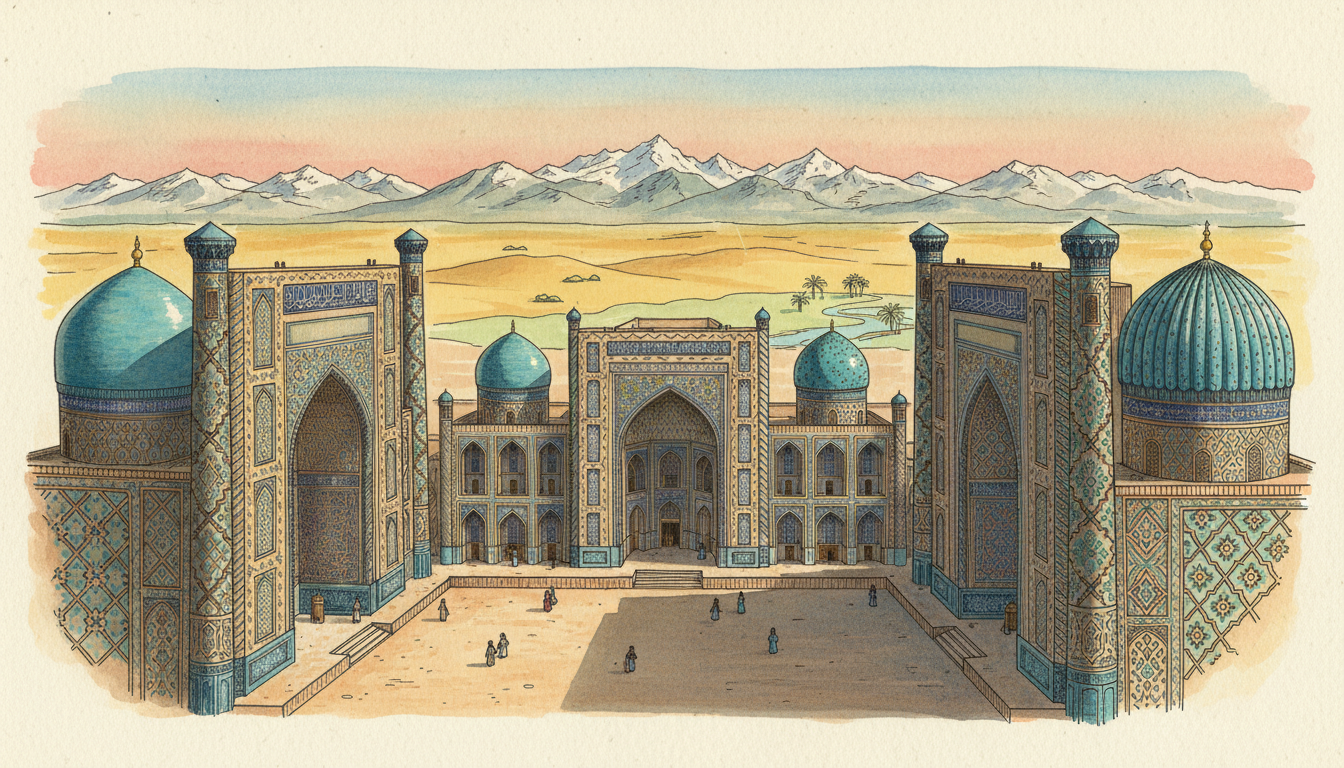
Where is Uzbekistan, why is Uzbekistan famous for Samarkand and the Silk Roads, and what does it mean to be doubly landlocked? Uzbekistan is a sovereign country in Central Asia, bordered by Kazakhstan, Kyrgyzstan, Tajikistan, Afghanistan and Turkmenistan. Its capital is Tashkent. The country is known for the extraordinary historic cities of Samarkand, Bukhara and Khiva, blue-tiled madrasas, scholars and astronomers, caravan trading routes, cotton and textile traditions, gold mining, mountain valleys, and the tragic environmental history of the Aral Sea. Uzbekistan is doubly landlocked because every country that borders it is itself landlocked: reaching an ocean port by land involves crossing at least two national borders.
Everything about Uzbekistan in one connected guide: the country is more than a colourful Silk Road photograph. It has large urban economies, farms that depend on river water, industrial plants, transport corridors, an autonomous republic at the former Aral Sea’s southern edge, families with different languages and histories, and young people preparing for an increasingly changing education system. As of October 2026, President Shavkat Mirziyoyev leads the country; the International Monetary Fund estimates 7.7% GDP growth in 2025 and projects about 6.8% for 2026. Uzbekistan’s UNESCO World Heritage count is now eight, with Tashkent’s modernist architecture inscribed in July 2026. A new National Curriculum Framework launched in August 2026, while a major US–Central Asia meeting took place in Samarkand on 19 October. This guide gives the essential answers first and then connects history, geography, government, water, people, economy, culture, education and everyday life.
Uzbekistan at a glance: the quick facts readers need
- Official name: Republic of Uzbekistan (Oʻzbekiston Respublikasi).
- Where is it? Central Asia, between major Asian continental transport and river basins.
- Capital: Tashkent.
- Five land neighbours: Kazakhstan, Kyrgyzstan, Tajikistan, Afghanistan and Turkmenistan.
- Doubly landlocked? Yes, along with Liechtenstein, using the standard definition of needing to cross at least two sovereign national borders to reach an ocean coast.
- Surface area: approximately 448,900 square kilometres.
- Population: around 38.2 million in the IMF’s 2025 estimate; the IMF’s June 2026 report projects around 38.9 million in 2026, which is a forecast, not a newly enumerated population count.
- Official language: Uzbek. Karakalpak has official status in the autonomous Republic of Karakalpakstan, while other languages are spoken by different communities.
- Currency: Uzbek soʻm or sum (UZS).
- Time zone: Uzbekistan Time, UTC+05:00.
- President in October 2026: Shavkat Mirziyoyev.
- Government: a presidential republic with a bicameral Oliy Majlis (parliament), executive government, courts and territorial authorities.
- Highest administrative level: 12 regions, the autonomous Republic of Karakalpakstan and Tashkent City.
- Independence: declared on 31 August 1991; Independence Day is celebrated on 1 September.
- Important geographic features: the Amu Darya and Syr Darya river systems, Fergana Valley, Kyzylkum Desert, western plains, Tien Shan and other mountain environments.
- Key economic activities: gold, natural gas, copper, textiles, manufacturing, farming, trade, construction and services; household remittances matter too.
- 2025 economic growth: 7.7%, according to the IMF’s June 2026 review.
- 2026 projected growth: around 6.8% in that IMF review, subject to changing conditions.
- Eight UNESCO World Heritage properties: six cultural and two natural; the eighth was Tashkent Modernist Architecture in July 2026.
- Education milestone: a National Curriculum Framework launched on 18 August 2026, with reforms designed to benefit about seven million learners.
- Current international development: Samarkand hosted US–Central Asia meetings in October 2026, illustrating the country’s growing diplomatic and commercial profile.
The facts above come from dated institutional sources, especially the IMF’s 18 June 2026 country review, UNESCO’s Uzbekistan World Heritage list, the constitution of Uzbekistan and UNICEF’s 18 August curriculum announcement. Read a population projection as a forecast, a signed investment deal as a commitment and a UNESCO inscription as an officially recognised property—not as a guarantee about current tourism access.
1. Where is Uzbekistan on a map, and why does its position matter?
Uzbekistan lies in the centre of Eurasia, without a coastline or a direct maritime port. Kazakhstan is to the north and northwest, Kyrgyzstan and Tajikistan to the east and southeast, Turkmenistan to the southwest, and Afghanistan along a shorter southern frontier. Mountains and valleys in the east contrast with lowland river systems and arid landscapes farther west.
The map matters because food, machinery, energy and people must move through routes defined by terrain and national borders. A business importing a machine may use a seaport in another country, then travel overland by rail or road, perhaps through another transit state, before reaching Uzbekistan. A farmer exporting produce faces the same general challenge. Regional agreements, good border procedures, stable transport and reliable inland logistics can therefore affect everyday prices and business opportunities.
Is Uzbekistan in Europe or Asia?
Uzbekistan is in Asia, specifically Central Asia. It has historical connections with the Iranian cultural sphere, China, South Asia, the Russian Empire, Soviet states and Islamic scholarly networks. Those connections explain its international history without shifting the country into a different continent.
Why is Uzbekistan doubly landlocked?
A landlocked country has no direct coast on an open ocean or connected sea. A doubly landlocked country is surrounded only by other landlocked countries, requiring the crossing of at least two state borders before reaching an ocean coastline. All five of Uzbekistan’s neighbours are classified as landlocked; Kazakhstan and Turkmenistan have shores on the inland Caspian Sea, which does not provide an open-ocean coast. Liechtenstein is the other generally recognised doubly landlocked state.
This is a fact about sovereign geography, not a claim that exports are impossible. Rail and road routes, pipelines, air cargo and other connections can support trade. But a business often depends on foreign transit rules and facilities before its cargo reaches a seaport. The existing How Uzbekistan Works | Doubly Landlocked, Railways and Trade guide explains the transport mechanics in detail.
Does Uzbekistan border China or Russia?
No. Uzbekistan has historical and commercial relationships with both, but neither is among its five direct land neighbours. On a map, Kazakhstan and Kyrgyzstan help separate Uzbekistan from some of those larger markets. Direct trade need not require a shared border, but the transport route must be identified correctly.
Is Uzbekistan mostly desert?
A large portion of the west and central country is arid, including the Kyzylkum Desert, but eastern mountain valleys and irrigated oases are strongly associated with settlement and farming. The term “desert country” can be useful for understanding water stress yet misleading if it suggests everyone lives among shifting dunes. Geography determines where people can farm, locate cities and build infrastructure.
Worked example: the cost of crossing two borders
Imagine a textile manufacturer shipping finished goods to an overseas buyer. The garments must reach a border, pass customs, travel through a neighbouring transit country and eventually arrive at an ocean port in another country. A delay in border clearance can undo the efficiency gained at a modern factory. This hypothetical shipment illustrates why trade facilitation is an economic system rather than an administrative side issue.
2. What are the Fergana Valley, Tien Shan mountains and Kyzylkum Desert?
Uzbekistan contains several distinct physical environments. The Fergana Valley is a fertile and densely settled region shared across parts of Uzbekistan, Kyrgyzstan and Tajikistan. The Tien Shan and neighbouring highlands shape weather and water catchments. The Kyzylkum covers arid ground between major river systems. Oases support historic cities, while western environments are closely linked to the Aral Sea disaster.
These regions create opportunities and limits. Mountains can provide runoff and attractive ecosystems but complicate roads and settlements. Valleys can support farming and industry yet face density and water-management questions. Deserts contain mineral resources, habitats and traditional livelihoods but require long-distance utilities and careful land use.
Why is the Fergana Valley so important?
The valley has fertile land, major communities, market towns, industry and intense connections across several international borders. Farming requires dependable irrigation, while dense settlement creates demand for roads, schools and jobs. The three-country geography makes cooperation important: changes to water allocation or transport access can affect people well beyond one border crossing.
What is a mountain catchment?
It is an area of terrain where rain and snowmelt flow into rivers or reservoirs. Rivers used downstream for irrigation may originate in mountain areas located partly outside Uzbekistan. An upstream decision about reservoir releases or land use can affect downstream water availability. Understanding a catchment helps explain why national water policy and international relationships are connected.
What does the name Kyzylkum mean?
It is often rendered “red sand” in Turkic-language usage. The desert spans parts of Central Asia between the Amu Darya and Syr Darya systems. However, not every part consists of deep dunes; arid landscapes can include stony plains, vegetation, settlements, mines and transport routes. Desert farming and mining create different pressures on water and infrastructure.
Does Uzbekistan have four seasons?
Much of the country experiences strongly continental conditions: hot summers, cold winters and comparatively large temperature swings, with important local differences caused by altitude and geography. The best weather for walking through Samarkand’s historic streets may differ from the season needed to study mountain snow or a particular agricultural crop. A country weather average is not a substitute for a city-specific forecast.
Worked example: why one national temperature is misleading
Imagine a morning in Tashkent and another high in the mountains. The dates match, but altitude and local weather can produce different temperatures, snow or precipitation conditions. A travel itinerary or school excursion needs specific local information. This is a hypothetical comparison; it teaches why a map’s elevation layer is often as important as a weather icon.
3. What were the Silk Roads, and why was Uzbekistan at their heart?
The Silk Roads were networks of routes and exchanges linking many parts of Eurasia over long periods. There was never just one paved east–west road with a single owner or timetable. Traders, pilgrims, scholars, diplomats, craftspeople and travellers moved goods, ideas and technologies through connected cities and waystations. Places such as Samarkand and Bukhara became important because they were crossroads of water, commerce, administration and knowledge.
Silk was one famous trade commodity, but the networks also carried textiles, metals, horses, ceramics, paper, food and religious and scholarly ideas. Goods could change hands repeatedly rather than travel with one merchant from their origin to final buyer. The UNESCO Silk Roads: Zarafshan–Karakum Corridor property documents a 866-kilometre series of connected cultural landscapes across Uzbekistan, Tajikistan and Turkmenistan.
Was the Silk Road one route from China to Rome?
No. It was an evolving network of overland and related maritime exchange, with many branches and changing centres. Routes shifted in response to political authority, security, rivers, desert crossings and commercial incentives. Calling one place a “Silk Road city” points toward a history of connections but does not mean every traveller or commodity used the same sequence of streets.
Why did oasis cities matter?
A caravan or long-distance traveller needed water, shelter, food, animals, information and markets. Oasis settlements could combine wells, gardens, religious institutions, workshops, inns and customs or political administration. Their importance lay in services as well as geography. A flourishing oasis was an organisational achievement, not simply a lucky patch of greenery.
What was a caravanserai?
A caravanserai was a lodging and service facility associated with merchant travel, often providing space for people, animals and goods. Specific forms varied by period and region. The design helped support long-distance trade by making overnight stays and logistics more predictable. See the site’s Uzbekistan caravan-trade vocabulary guide for precise historical terms.
How did trade spread knowledge?
Travel connected languages, mathematical ideas, astronomy, medicine, architecture and technologies, although the movement of a text or technique was neither instantaneous nor identical everywhere. Scholars learned from predecessors and adapted ideas through translation, criticism, observation and teaching. A strong historical explanation names the documented route, institution or manuscript rather than imagine a universal exchange without evidence.
Worked example: why a caravan cannot run on monuments alone
Imagine a caravan journey through a fertile valley and then into an arid region. A famous gate does not feed the pack animals or provide water. The route requires maintenance, reliable information, storage, security and people whose work rarely appears in the photograph of a restored monument. That is why infrastructure and labour belong in the story of the Silk Roads.
4. Why is Samarkand famous, and what is the Registan?
Samarkand is one of Central Asia’s great historic cities, closely associated with trade, scholarship, Islamic architecture and the Timurid period. UNESCO’s Samarkand – Crossroad of Cultures property recognises its long development from ancient settlement through later centuries. The Registan is a celebrated public architectural ensemble, with three grand madrasas featuring decorated portals, tiled surfaces and the urban spaces surrounding them.
An image of the Registan is instantly striking, but its structures also express political patronage, craft technology, religious and secular learning, building skills and the public role of a city centre. Blue and turquoise tiles are material objects requiring raw materials, firing, pattern design and installation. A tiled wall records many hours of work and knowledge.
Which three madrasas make up the Registan?
The Ulugh Beg, Sher-Dor and Tilya-Kori madrasas form the classic three-sided ensemble. They were not built in exactly the same year; their differing dates and functions illustrate successive historical patronage. A madrasa was an institution of learning, although curricula and functions varied by period. A modern tour should not present the ensemble as a single building designed by one architect at one moment.
Who was Ulugh Beg?
Ulugh Beg was a Timurid ruler and important patron and practitioner of astronomy and mathematics. His observatory at Samarkand and astronomical tables have an important place in the history of scientific measurement. The historical value is not only that he used instruments, but that skilled teams made repeatable observations, calculations and records that could be checked and improved.
What is Shah-i-Zinda?
Shah-i-Zinda is an architectural and religious ensemble associated with historic tombs, mausolea, elaborate tilework and local traditions. The name is often translated in relation to a “living king”. Different parts date to different periods, making the complex a useful place to study craft evolution and historical memory, not merely collect photographs.
What does the Gur-e Amir tell us about Timur?
The Gur-e Amir mausoleum is associated with Timur, often known as Tamerlane, and later Timurid rulers. Monumental patronage, empire and war form part of the same history. Appreciating architecture need not involve romanticising military conquest. A fair account recognises both artistic development and the enormous human consequences of campaigns.
Did Samarkand stop being important after the Silk Roads changed?
No. Cities adapt to new transport, political arrangements and markets. Samarkand remains a functioning modern city with homes, industry, institutions and people. Its heritage is an important part of its identity and economy, but not the only thing residents do. The companion Why Samarkand Is Famous | Silk Road and Registan Explained covers the city’s history and monuments in greater detail.
5. What makes Bukhara and Khiva different from Samarkand?
Bukhara and Khiva are another two great historic centres in present-day Uzbekistan. Bukhara became renowned for scholarship, religious institutions, urban architecture and trading life, while Khiva is associated with the walled inner city of Itchan Kala and the history of the Khorezm region. Their forms and political histories differ, and neither should be described as a smaller copy of Samarkand.
UNESCO inscribed the Historic Centre of Bukhara in 1993 and Itchan Kala in 1990. The sites help explain why conserving historic cities requires attention to residents, workshops, traffic, public spaces, repairs and groundwater as well as preserving monuments.
Why was Bukhara a centre of learning?
Scholars, religious institutions, manuscript traditions and long-distance intellectual relationships contributed to Bukhara’s influence. It is associated with major figures of Islamic scholarship and Central Asian history. Learning did not exist in isolation from cities: book production, patronage, teachers, students, libraries, merchants and building institutions all supported it.
What is Itchan Kala?
Itchan Kala is the historic walled inner town of Khiva, with preserved urban fabric, monuments and architectural ensembles. The walls help define a heritage landscape, but the most useful questions involve how people lived, traded and maintained buildings within them. It is an excellent example of urban heritage as a whole environment rather than an isolated museum piece.
Which city should a curious reader study first?
Choose a question rather than a popularity ranking. Samarkand is helpful for examining Timurid architecture and science; Bukhara for scholarship and urban heritage; Khiva for walled city form and regional trade; Tashkent for modern city history. The Uzbekistan places guide offers a separate cultural geography reading route.
Worked example: why restoring a historic street is more complicated than painting its walls
Imagine a town renovates a historic lane. The project needs archaeological care, compatible materials, drainage, working utilities, safe access and the consent and needs of residents. If conservation focuses only on exterior appearance, homes may remain damp or difficult to use. This is a hypothetical example illustrating how architectural heritage, public services and daily life connect.
6. How did Uzbekistan’s history develop before and after independence?
The territory now called Uzbekistan has many layers of history. Ancient Bactria, Sogdiana and Khorezm are useful geographic and historical names for different parts of Central Asia, while cities such as Samarkand and Bukhara belonged to shifting kingdoms, empires and religious and commercial networks. The story includes Iranian-speaking cultures, Turkic migrations, Islamic scholarship, Mongol conquest, the Timurid age, khanates, Russian imperial rule, Soviet administration and modern independence.
A modern country is not identical to a historical dynasty simply because it includes some of its former territory. The names and borders of the ancient and medieval polities differ, and the identities of their inhabitants cannot simply be converted into contemporary citizenship categories.
- Ancient periods: oasis settlements, farming, crafts and trade developed in Central Asian river valleys and urban centres.
- Sogdian and other trading networks: merchants and communities linked Central Asia to other parts of Eurasia; multiple religions and languages interacted.
- Early Islamic centuries: Islam and Arabic scholarship expanded in the region alongside existing languages and cultural traditions.
- Ninth to twelfth centuries: cities including Bukhara and Samarkand became important centres of scholarship, science and commerce under changing dynasties.
- Thirteenth century: Mongol conquest transformed cities, political authority and populations, with lasting consequences.
- Fourteenth and fifteenth centuries: the empire of Timur and the succeeding Timurid period brought major architectural, artistic and intellectual patronage, accompanied by military conquest and violence.
- Sixteenth through nineteenth centuries: different khanates and emirates, including Bukhara, Khiva and Kokand, shaped politics and trade in the region.
- Nineteenth century: Russian imperial expansion changed political control, infrastructure and commercial relationships.
- Twentieth century: the Soviet period brought industrialisation, mass education, language and nationality policies, collectivisation and very large agricultural and water-management changes.
- 1991: the independent Republic of Uzbekistan emerged as the Soviet Union collapsed; the country celebrates Independence Day on 1 September.
- 1991–2016: Islam Karimov led the country for much of its independent history, amid significant economic development and concerns about political and civic restrictions.
- 2016 onward: Shavkat Mirziyoyev became president and pursued reforms in parts of the economy, state services and international relationships.
- 2022: serious protests in the autonomous Republic of Karakalpakstan followed proposed constitutional changes; people were killed and injured, and questions of accountability remain.
- 2023: a revised constitution was adopted, with provisions concerning state institutions, rights and Karakalpakstan’s status.
- 2026: curriculum changes, additional World Heritage recognition, economic investment discussions and international meetings marked the country’s continuing development.
This outline shows why the most interesting question is not just “who ruled Uzbekistan?” but how changes in political authority affected a farmer’s access to water, a merchant’s ability to trade, a child’s education and the languages used in public institutions. Different communities may remember the same historical period differently.
Why was the Soviet period so influential?
The Soviet era reshaped administration, industry, urban planning, education, agriculture, energy and infrastructure. Uzbekistan’s cotton economy and some of the major irrigation choices contributing to the Aral Sea crisis were strongly connected to Soviet central planning. At the same time, cities developed universities, transport networks, scientific institutions and architectural forms. Historical judgement requires considering all these dimensions without excusing political repression or environmental damage.
Did Uzbekistan have a written identity and scholarship before Russian rule?
Yes. Central Asian cities were centres of written scholarship and trade long before Russian imperial expansion. Historical scientific and literary work appeared in different languages and institutional settings. Figures associated with the region include the astronomer Ulugh Beg, mathematician al-Khwarizmi’s broader Khwarezm background, and renowned scholars connected with Bukhara and surrounding cities. Modern borders should not be imposed casually on their original historical identities.
What happened when Uzbekistan became independent?
The end of the Soviet Union in 1991 changed Uzbekistan’s legal sovereignty, institutions, currencies, external relationships and economic choices. Transition did not instantly replace Soviet-era roads, schools or production systems. A country’s independence date establishes a constitutional and international milestone; the everyday consequences often unfold over decades.
Why does the 2023 constitution matter?
The new constitution governs national institutions, rights, presidential terms and territorial arrangements. It also preserves important provisions concerning the Republic of Karakalpakstan. A constitutional document sets formal rules, while the practical protection of rights and the performance of institutions must be assessed using implementation evidence and independent reporting. Consult Uzbekistan’s official constitutional text and other legal sources for exact wording.
7. How does Uzbekistan’s government work in 2026?
Uzbekistan has a president, executive government, a two-chamber national parliament known as the Oliy Majlis, courts and regional and local authorities. President Shavkat Mirziyoyev has held the office since 2016 and was re-elected after the 2023 constitutional referendum and early presidential election. Formal governing institutions and their interactions determine how national policy becomes law and how those laws reach residents.
In Uzbekistan, the Legislative Chamber and Senate make up the parliament, but constitutional duties and political practice should not be described as if they were exactly the same as a multiparty parliamentary democracy elsewhere. The formal rights and electoral provisions are laid out in the constitutional text. Independent organisations also document restrictions on political expression, civil society and the press that readers should not ignore.
How are the highest administrative divisions organised?
Uzbekistan comprises 12 regions (viloyatlar), Tashkent City and the autonomous Republic of Karakalpakstan. Districts and cities provide more local layers, and community institutions known as mahallas have roles in the social and administrative landscape. An administrative name is not enough to identify which body handles one particular water connection, housing application or school record. Use the current competent authority for practical matters.
What is a mahalla?
A mahalla is a local neighbourhood or community institution with deep historical and changing modern meanings. In different settings, mahalla structures can connect families, local administration, social assistance and community activities. Its actual legal responsibilities and residents’ experience depend on current rules. It should not be romanticised as an informal village gathering or assumed to replace independent courts and formal public services.
What is Karakalpakstan, and is it part of Uzbekistan?
The Republic of Karakalpakstan is an autonomous republic within Uzbekistan, with its own constitutional position and institutions. It is not an independent sovereign state. The constitution recognises specific provisions concerning its territorial status and the right of secession through a referendum of Karakalpakstan’s people; these are sensitive questions that must be described carefully in their legal and historical context. Articles 85–89 of the official constitution provide the authoritative text.
Why were there major protests in Karakalpakstan in 2022?
Proposed constitutional amendments raised concerns about the autonomy and status of Karakalpakstan. Protests in July 2022 were met with severe responses; Human Rights Watch reported at least 21 deaths and extensive injuries and documented what it described as unjustified and excessive force against many peaceful demonstrators. The proposed changes to the region’s relevant status provisions were withdrawn. See Human Rights Watch’s evidence-based November 2022 investigation. The experience is an essential part of the region’s contemporary history; it should not be erased from a country profile concerned with government and rights.
What are the most important political questions in October 2026?
Economic and service-delivery reform, corruption and accountability, independent civic participation, access to justice and rights in Karakalpakstan all remain relevant. Human Rights Watch’s Uzbekistan country page reported new prosecutions and concerns in October 2026, while official sources describe their own reforms and institutional programmes. A fair guide distinguishes documented reforms and specific improvements from continuing unresolved rights issues.
Worked example: how a regulation becomes a useful local service
Imagine a government introduces an online business permit. The legislation defines the requirement, but residents still need accessible forms, working internet, reliable identification and a predictable appeal process. A family without a good connection or familiarity with the administrative language might still face difficulties. This hypothetical example illustrates why a digital portal’s launch is not proof that the service is accessible to everyone.
8. Why did the Aral Sea shrink, and what happened to its southern shores?
The Aral Sea was a large inland lake historically supplied by the Amu Darya and Syr Darya rivers. Because the lake had no outlet to the ocean, its water balance depended on river inflows and precipitation replacing losses from evaporation. From the Soviet period onward, massive river diversions for irrigated agriculture, especially cotton, reduced inflow severely. Over decades, much of the lake shrank, and what remains is divided into different bodies of water and degraded environments.
The disaster is not accurately explained as one drought suddenly emptying a sea. It was a long-term chain of policy decisions, water withdrawals, irrigation inefficiencies, changing inflows and evaporation. The consequences include loss of fisheries, economic dislocation, exposed salty sediments, dust and health and ecosystem concerns. The dedicated Aral Sea guide explains the hydrology, cotton economy, regional differences and restoration work in depth.
Was the Aral Sea really a sea?
It was a large inland lake, commonly called a sea because of its scale and salinity. It did not provide an open route to the world ocean. Its former extent made it an important fishing and ecological system, but its name should not confuse readers about Uzbekistan’s landlocked geography.
Is the North Aral Sea recovering?
Parts of the northern Aral Sea, mainly in Kazakhstan, have benefited from water-management and restoration measures. That does not mean the southern Aral Sea in Uzbekistan has returned to its former size. A photo of improved water conditions in one area should not be presented as proof that the entire system has recovered. The geography and restoration programmes must be named separately.
What happened near Muynak?
Muynak (Moynaq) was once associated with the Aral Sea fishing economy; the receding shoreline left parts of the former fishing landscape far from the water. The abandoned boats that visitors and photographers encounter are powerful symbols, but the deeper story involves families losing work, changing water quality, migration and the search for sustainable livelihoods. The UNDP Uzbekistan programme provides an institutional starting point for current community and environmental responses.
What is the Aralkum Desert?
The exposed former seabed has become a new desert-like environment sometimes called the Aralkum. Bare sediment can contribute to dust and salt movement depending on conditions, creating challenges for ecosystems and nearby communities. Vegetation projects, including planting hardy species, aim to stabilise some exposed surfaces. Claims that a planting target equals permanent restored forest cover must be verified over time.
What caused the problem: cotton or farmers?
Cotton became a central commodity in agricultural planning, but attributing the entire environmental disaster to individual farmers is misleading. Large-scale systems of water allocation, canals, state production targets, technology and pricing influenced the incentives. Understanding responsibility requires examining institutions and historical policy, while recognising that farming households themselves were part of the affected communities.
Worked example: how irrigation efficiency changes an upstream–downstream system
Imagine a canal supplying many fields. Water can be lost through seepage, evaporation or poor scheduling before reaching farms farther away. Repairing a leak or measuring flows better may reduce waste, but the benefit depends on whether saved water is retained for environmental recovery or used to expand irrigation elsewhere. This is a hypothetical canal example illustrating a real governance challenge: technical efficiency and environmental outcomes must be measured separately.
9. How do rivers, irrigation and water sharing affect daily life?
The Amu Darya and Syr Darya are major Central Asian river systems whose flows cross national boundaries and support agricultural production and settlements. Uzbekistan’s irrigation networks enable farming in areas that would otherwise be too dry for many crops. Hydropower operations in upstream countries, seasonal demand and changing snow and rainfall conditions can influence the timing and quantity of water available farther downstream.
A water agreement is only one step; reliable measurement, infrastructure maintenance, information-sharing and working local distribution rules determine whether farms and towns have usable supplies. Water is simultaneously an agricultural resource, public-health necessity, industrial input and environmental requirement. Its use can create trade-offs among users and generations.
Where does Uzbekistan’s drinking water come from?
Sources can include surface water and groundwater, subject to local systems. Public water provision requires collection, treatment, storage, distribution and monitoring. Even a city beside a river needs functioning pipes and safe water quality. An installed network connection is not evidence of uninterrupted supply if a community still faces outages or contamination.
Why are canals important to Uzbek agriculture?
Large irrigation canals carry water across considerable distances to agricultural land and settlements. They are engineering systems requiring careful allocation, maintenance and timing. A canal may improve farm productivity, but inefficient withdrawals or poor drainage can contribute to salinity and environmental stress. The correct policy question is how much crop value and household wellbeing are produced per unit of water without undermining long-run sustainability.
How does salinity affect a farm?
When salts accumulate in soils, some crops grow poorly or require different management. Irrigation without appropriate drainage may worsen salinisation in arid areas. Soil testing, crop choice, water quality and drainage investments matter, and outcomes vary by location. A national irrigation expansion figure alone cannot indicate whether the land remains healthy.
Why does water management need international cooperation?
Rivers cross borders but households still need predictable deliveries. Water released from a reservoir for electricity at one season can affect irrigation or ecosystem flows at another. Cooperation requires agreed information, rules, institutions and dispute resolution, rather than assuming the upstream or downstream country can solve every issue alone.
A worked example: why a school needs both a water connection and a healthy basin
A school requires safe water for drinking and hygiene. A nearby farmer needs irrigation and an urban employer may use water for processing. If a town expands without careful allocation and leakage reduction, all users can experience pressure. A working service plan therefore connects the catchment, water authority, utilities and users instead of treating every pipe as an isolated project. These institutions are illustrative; the precise jurisdiction depends on local law.
10. What drives Uzbekistan’s economy in 2026?
Uzbekistan’s economy combines services, construction, agriculture, mining, manufacturing, energy and trade. Gold and other minerals are particularly important to some export revenues, while textile and garment production, machinery, food processing and other industries support work across several regions. Remittances sent by Uzbek citizens employed abroad can affect household spending and external finances. Tourism is visible, especially in Silk Road cities, but it should not be mistaken for the whole economy.
The IMF’s June 2026 Article IV consultation estimated real GDP grew 7.7% in 2025 and projected around 6.8% for 2026. It recorded consumer-price inflation at 7.0% year-on-year in April 2026, while urging authorities to contain excessive demand pressures, manage fiscal risk and continue reforms that allow competitive private-sector activity. These numbers describe different periods and should not be merged into a claim that households are now universally wealthy.
Is Uzbekistan rich in gold?
Uzbekistan has major gold deposits and mining operations, and international gold prices can materially affect export earnings. But underground deposits, refined output, a company’s profits and a state’s available public revenues are four different measures. An economy can earn substantial foreign exchange while particular communities still experience housing, health or education problems. A responsible national overview follows where value is created, how it is managed and whether it reaches sustainable local opportunities.
What is the role of natural gas?
Natural gas has been important for electricity, heat and industrial processes. Production, domestic demand, pipeline arrangements and trade obligations can change; a source stating that the country has gas reserves does not establish how much is available to consumers at any given time. Energy system questions require examining production, distribution, demand and maintenance as well as prices.
What makes the textile and cotton sectors important?
Uzbekistan has a long history of cotton production and textile-related industry. Cotton cultivation depends on water, soil conditions, labour, processing and markets. Turning fibre into finished garments can create more kinds of work than exporting raw cotton alone, but requires equipment, skilled workers, energy, quality control and buyers. Cotton also has a difficult labour-rights history. International efforts in recent years found an end to systematic state-imposed forced labour in the cotton harvest, while broader labour conditions and enforcement still need ongoing attention.
Why is construction growing?
Urban population growth, transport needs, modern housing and industrial expansion can increase demand for roads, apartments, factories, schools and utilities. Construction creates jobs and useful assets, yet costs, land decisions, environmental pressure and financing must be managed. A new building does not become a fully usable service until occupants can access it safely and affordably.
What are remittances?
Remittances are transfers from people working abroad to households or other recipients back home. They can help pay for housing, education, healthcare and business activities. But they depend on the sender’s employment and the security and cost of financial channels. Higher remittances may support growth without eliminating the need for productive local jobs.
Why does inflation matter even during fast GDP growth?
Economic growth measures how national output changes; inflation measures changes in the general price level. Imagine a family whose nominal wage rises by 8% while essential spending increases by 10%. Its purchasing power for those items may decline despite both national growth and a higher cash wage. This is an illustrative example, not an actual Uzbek household calculation. The IMF’s focus on inflation reminds readers that overall growth and household budgets are different questions.
11. How does the Uzbek soʻm, banking and household finance system work?
The Uzbek soʻm (UZS) is the national currency. The Central Bank of Uzbekistan has monetary-policy and financial-sector responsibilities, and banks provide payment, deposit and credit services under applicable regulations. A currency’s exchange rate can affect the local cost of imported machinery, electronics or medication, but the price consumers actually pay depends on the seller, taxes, transport and other costs too.
The Central Bank’s stated medium-term inflation target is 5%, with the IMF’s June 2026 assessment discussing progress and the risks of domestic demand pressure. A target is the intended future outcome, not a statement that prices are already stable every month. Readers should distinguish policy intention, observed inflation and a forecast.
What makes a banking system useful to a family?
Reliable banking allows wages to arrive, bills to be paid, savings to be protected and appropriate credit to be considered. But access depends on fees, local language, identity documents, technology and trust. A phone banking application is helpful only if customers can actually use it and understand the transaction. Consumer protection and the ability to resolve mistakes matter alongside digital convenience.
Why do businesses need credit?
A small textile maker may need to buy yarn and pay staff before receiving income from a completed order. Credit or working capital can bridge that period, provided repayment conditions match cash flow and the business remains viable. Expensive borrowing can also create pressure. The right question is whether financing supports useful activity at a manageable risk rather than whether more loans were issued.
Worked example: a savings goal in two currencies
Imagine a household saving for equipment priced in foreign currency while earning Uzbek soʻm. The future soʻm cost may change with the exchange rate and overseas price. A careful plan considers timing, fees and uncertainty, rather than copying a six-month-old online conversion rate. These are hypothetical finances, not investment advice.
12. How do Tashkent, Samarkand and other cities connect everyday life?
Tashkent is the national capital and a centre of administration, industry, transport, education and services. Samarkand and Bukhara have prominent heritage roles alongside modern businesses and institutions. Fergana Valley cities such as Andijan, Namangan and Fergana matter to manufacturing, trade and growing populations. Nukus is the capital of the Republic of Karakalpakstan and is connected to the Aral Sea region. Other provincial cities support the connections between agriculture, transport and national markets.
Urban life depends on water, energy, housing, public transport, schools and healthcare. A city may have a restored historical centre that attracts visitors while other neighbourhoods face practical infrastructure needs. Both are genuine parts of the same city. A skyline or tourist plaza is not enough to assess every resident’s quality of life.
Why does Tashkent have a distinctive architectural identity?
In addition to older urban neighbourhoods and historic markets, Tashkent has a significant layer of twentieth-century modernist architecture shaped by Soviet-era planning and reconstruction following the 1966 earthquake. The city is also notable for its metro system, public institutions and broad avenues. Local artistic and architectural traditions were incorporated into various modern buildings rather than simply replaced by uniform designs.
Is Samarkand only a tourist city?
No. It has residents, industry, services and institutions alongside its internationally celebrated historic centre. A city that attracts tourists still needs reliable daily transport, waste services, schools and healthcare. Heritage tourism is an economic activity that should work with local living conditions rather than displace them.
Why do trade routes shape Uzbekistan’s cities?
A city may develop around a river crossing, caravan route, rail junction, border corridor or industrial supply chain. Its usefulness changes as technology and markets change. Samarkand’s historical importance came partly from regional exchange; modern transport requires different skills and systems, but the principle of connecting markets remains.
Worked example: a resident travelling across a growing city
Imagine a university student commuting from a residential neighbourhood to classes and part-time work. The usefulness of a bus or metro depends on routes, transfer times, safety and fares, not simply the number of kilometres of rail built. A new apartment without convenient transport can impose substantial costs on a household. This is an illustrative student, not a survey finding.
13. Why did Tashkent’s modernist buildings become UNESCO World Heritage in 2026?
On 26 July 2026, UNESCO’s World Heritage Committee inscribed Tashkent Modernist Architecture. Modernity and Tradition in Central Asia, recognising an ensemble of ten buildings and complexes associated with the city’s twentieth-century transformation. It is Uzbekistan’s eighth World Heritage property and one of the first major World Heritage recognitions of Central Asian modernist architecture.
The official UNESCO property entry explains how urban planning, industrialised construction, earthquake-resilient engineering, climate and regional artistic traditions meet in the buildings. The ten components include housing, museums, cultural venues, infrastructure and a market. UNESCO’s 48th-session inscription decision is the dated primary decision.
Why is a metro station part of World Heritage?
The Kosmonavtlar metro station is included as an example of integrated public transport architecture and design in the larger modernist ensemble. Public infrastructure can be culturally significant when it embodies ideas about architecture, art, engineering and society. A station is not simply a machine for moving people; it is also a public space with choices about materials and visual language.
Is the Hotel Uzbekistan part of the 2026 UNESCO inscription?
Not within the ten currently inscribed components. The World Heritage Committee’s 2026 decision asks Uzbekistan to consider possible later boundary modifications involving additional landmarks, including the Hotel Uzbekistan and Tashkent TV Tower. A future possibility is not already inscribed status. This is a common error in social media lists that combine famous architecture with the official property boundaries.
How does modern architecture connect with earthquake risk?
Tashkent’s 1966 earthquake influenced the reconstruction and development of urban planning and building systems. Engineering measures, materials and seismic conditions are part of the heritage significance. An old building’s recognition does not remove the need for contemporary safety inspection and maintenance.
Why does the date of the UNESCO listing matter?
Older guides say Uzbekistan has seven World Heritage properties. That count is outdated after the 2026 inscription. Its other entries, including the Silk Roads and two natural properties, must also be counted using UNESCO’s current register. The right source for the exact total is UNESCO’s country page, not a fixed list reproduced before July 2026.
14. What are Uzbekistan’s eight UNESCO World Heritage properties?
The 2026 list comprises six cultural and two natural properties. Some are shared across national boundaries and should not be broken into extra independent entries:
- Itchan Kala (1990, cultural) — historic walled inner city of Khiva.
- Historic Centre of Bukhara (1993, cultural) — urban religious and trading heritage.
- Historic Centre of Shakhrisyabz (2000, cultural) — historic town associated with Timur and later urban changes.
- Samarkand – Crossroad of Cultures (2001, cultural) — archaeological, historical and architectural layers of a major Silk Road city.
- Western Tien-Shan (2016, natural) — shared natural property with Kazakhstan and Kyrgyzstan, recognising important mountain biodiversity.
- Cold Winter Deserts of Turan (2023, natural) — transnational natural property covering distinctive arid ecosystems.
- Silk Roads: Zarafshan–Karakum Corridor (2023, cultural) — shared with Tajikistan and Turkmenistan, showing trading routes and adapted settlements.
- Tashkent Modernist Architecture. Modernity and Tradition in Central Asia (2026, cultural) — ten modernist urban buildings and complexes.
The official UNESCO World Heritage list for Uzbekistan records each property, title, year and category. Other important sites may be on a Tentative List or recognised nationally; they are not additional inscribed World Heritage properties until UNESCO adopts an inscription decision.
What is UNESCO’s List of World Heritage in Danger?
It highlights recognised sites where significant threats to their outstanding universal value require attention. The Historic Centre of Shakhrisyabz has faced major conservation concerns linked to urban interventions and authenticity; a site’s inscription or danger designation should be read using the current official record. A title on the List in Danger is not automatically a site removed from World Heritage.
What does “transnational World Heritage” mean?
A single listed property can contain components in multiple sovereign countries. The Zarafshan–Karakum Corridor covers Uzbekistan, Tajikistan and Turkmenistan, while Western Tien-Shan is shared with Kazakhstan and Kyrgyzstan. Counting the same cross-border property several times inside one country’s total would be incorrect.
Are all UNESCO sites suitable for casual travel?
No. Heritage recognition does not guarantee accessibility or safety on a particular date, and a protected natural area may restrict visitors to certain routes. Conservation programmes and local community needs also matter. Check official authorities and up-to-date conditions rather than treat UNESCO status as a booking guarantee.
15. Who lives in Uzbekistan, and which languages do people speak?
Uzbekistan has a large and growing population, with varied urban and rural experiences. The IMF’s June 2026 review used an estimate of 38.2 million people in 2025 and a projection of 38.9 million in 2026. Those numbers describe different statistical periods and should not be confused with an exact real-time census. Large families, younger workers, city professionals, farmers, craftspeople and students all participate in the economy, but national averages cannot tell us how each household lives.
Uzbek is the state language. Different communities use Karakalpak, Tajik, Russian, Kazakh, Kyrgyz and other languages. Language practices vary by locality and generation, and multilingual families can use different languages for home, school, trade and administration. A child struggling with terminology in a second-language classroom may understand a subject concept very well in their first language.
Is Uzbek related to Turkish?
Yes. Uzbek and Turkish are Turkic languages, but they are not the same language and cannot be treated as identical in vocabulary or grammar. Uzbek is predominantly written in a Latin-based alphabet officially, while Cyrillic remains encountered in different publications and contexts. A foreign visitor should verify the preferred spelling and language of a particular name rather than presume an English transliteration is the only acceptable version.
Is Russian still spoken in Uzbekistan?
Yes, Russian remains used in some business, education, media and interregional contexts, alongside Uzbek and other languages. Its contemporary role partly reflects Soviet history, but individuals’ language choices are varied. Being able to speak Russian does not determine someone’s identity or political outlook.
What is the Karakalpak language?
Karakalpak is a Turkic language with its own literary and community traditions, especially associated with the autonomous Republic of Karakalpakstan. It has official status within that republic. Its survival and use depend on speakers, education, cultural institutions and social conditions, not simply formal recognition on paper.
What religions and beliefs are part of Uzbekistan’s society?
Islam is the predominant religion, and Sunni traditions are important, alongside other religious communities and personal beliefs. Long histories of scholarship, Sufism, local traditions and secular public institutions are also part of the region’s story. It is inappropriate to infer an individual’s religion or politics from their name, language or clothing.
How does migration affect families?
People travel for study and work within Uzbekistan and abroad, including to other regional economies. Labour remittances can support housing, education, healthcare and everyday expenses, while separation can create social and care burdens. A family’s economic decisions should be viewed through available work, household needs, legal migration rules and the cost of sending money.
16. How does Uzbekistan’s school and higher education system work in 2026?
Uzbekistan’s education system links early childhood provision, general secondary schooling, technical and vocational routes and higher education. General schooling has historically used eleven numbered grades, commonly organised into primary and later secondary stages, while a twelve-year framework and curricular changes are being developed and introduced in stages. The correct pathway for a student depends on their cohort, programme, school, assessment and current legal and ministerial guidance—not simply a sentence saying every student must now take twelve identical school years.
In August 2026, Uzbekistan’s Ministry of Preschool and School Education launched a new National Curriculum Framework with UNICEF and other partners, aimed at approximately seven million learners. The 18 August statement highlights clearer learning objectives, practical use of knowledge, literacy and numeracy, digital literacy, climate education, social and emotional competencies, teacher preparation and assessments. These are programme aims and a policy milestone; implementing them in classrooms takes time. Read UNICEF’s original announcement.
What are the normal school stages?
Early childhood provision prepares children for learning. The general school structure has primary and later secondary phases, with Grade 9 and Grade 11 transitions historically significant. Technical and vocational institutions provide additional routes, while universities offer bachelor’s, master’s and doctoral studies subject to programme rules. Proposed or phased restructuring must not be confused with a completed transition affecting every cohort in exactly the same way.
The specialist Understanding the Education System of Uzbekistan explains current and legacy cohorts, school-leaving assessments, vocational qualification evidence, university admissions and recognition, including late-2026 administrative changes.
Why does a new curriculum matter to parents?
A curriculum defines what students are expected to understand and demonstrate, but it only works when teachers have good materials, training and assessment information. A student may need mathematics explained from basic structure before being asked to apply it in unfamiliar settings. If a reform promises stronger real-world applications, the teaching and tests need to support that promise consistently. The number of books delivered is a useful output, but the ability of students to reason independently is a deeper outcome.
How can a family navigate changing school cohorts?
First identify the student’s actual enrolment year and curriculum. Then obtain the current grade’s learning objectives, assessment arrangements and likely next qualification. A parent should not assume a younger sibling will take the identical route followed by an older sibling if the framework is changing. It is better to ask the school for the cohort-specific path than rely on an outdated internet timetable.
What about examinations and certificates?
Grade-level assessments, school-leaving qualifications and university entrance arrangements may have separate administration and dates. A student planning to move internationally needs transcripts, subjects, grades, the original awarding institution and recognition requirements. A qualification with a familiar name does not automatically meet every foreign university’s requirements.
Why does technical and vocational education matter?
Industry, construction, transport, agriculture, healthcare and services need people able to carry out professional tasks safely and accurately. Vocational learning may involve supervised practice, workshop assessments and recognised certificates. An educational system should help learners find suitable routes and allow progression rather than imply every capable student must follow the same university programme.
Worked example: a mathematics transfer problem
Imagine a learner transfers to a new school after a curriculum reform. The student has good arithmetic but has not covered the algebra topic assumed by the receiving class. A sensible teacher checks prerequisite skills and repairs the specific gap, rather than treating the student as generally incapable. The learner is hypothetical. The principle is the same whether the transition happens within Uzbekistan or between countries.
17. How do healthcare, housing and public services work for ordinary people?
Public services become meaningful when a person can obtain the help promised in law and policy. Healthcare requires trained staff, facilities, medicines, water, energy and working referrals. Housing requires safe construction, utilities and access to work and school. Roads and transport provide useful connections only if the household can safely and affordably travel. Different regions have different service conditions, so one national improvement statistic should not be presented as universal access.
The IMF’s 2026 report discusses public investment management, fiscal sustainability and the need to strengthen private productivity. Those topics can sound remote from daily life, but budgets, procurement and maintenance influence whether a regional hospital, a water pipeline or a school continues operating beyond its opening ceremony.
Why is health access more than the number of hospital beds?
A bed without trained staff, medicine or diagnostic equipment cannot provide the same service as a fully operating medical ward. Patients may face travel times and indirect costs even when treatment is nominally available. A fair country comparison therefore examines services delivered, patient safety, staffing and affordability, not just the count of buildings.
How does urban housing relate to labour markets?
A manufacturing company needs workers, and workers need places to live. If apartments are scarce near industrial zones or transport is unreliable, employers may struggle to recruit while households face longer commutes. Housing, wages, urban planning and transport are one linked economic question from a family’s perspective.
Worked example: a clinic and a water system
Suppose a clinic has doctors and vaccines but unreliable clean water. It still faces difficulties with infection prevention, hygiene and patient care. A district-wide water improvement can therefore support both households and healthcare outcomes. The scenario is hypothetical; the purpose is to show why public infrastructure and social services cannot be managed as if they were unrelated.
18. How does Uzbekistan produce electricity and manage energy?
Uzbekistan has used natural gas extensively within its energy system, alongside hydropower and growing interest in solar, wind and other sources. Electricity must be generated, transmitted, distributed and maintained before it becomes reliable power for a household or factory. Rapid urban and industrial demand can create pressures on older infrastructure, while energy reforms involve prices, investment, environmental impacts and service quality.
A solar project can reduce dependence on fuel in suitable conditions, but variable generation needs grid integration and planning. Gas stations require fuel supply and functioning equipment. Hydropower depends on water conditions and competing uses. A country’s energy security is a portfolio of technical systems and institutions rather than one dramatic power plant.
Why do energy costs matter to cotton and textiles?
Irrigation pumps may need electricity or fuel, while cotton processing and textile machinery require dependable energy. If energy prices increase or outages occur, agricultural and factory costs can rise. A business may have to delay an order, and the resulting cost can spread through wages, suppliers and customers. Energy decisions therefore influence the competitiveness of non-energy exports.
Can clean energy solve water shortages?
Renewables can supply pumps and treatment plants, but cheap pumping may increase groundwater withdrawals unless resource rules are respected. Electricity solves one constraint while sustainable water management solves another. A project should measure both the safe water delivered and the long-term state of the basin.
Why do households notice maintenance rather than generation plans?
A family may care less about national capacity figures than about whether the lights and heating work during a winter evening. Grid maintenance, voltage quality, distribution losses and emergency repair services affect that outcome. An installed plant is an achievement only when its benefits can be delivered reliably.
19. What can Uzbekistan’s food, textiles and crafts teach us about culture?
Uzbek cultural life includes food traditions, music, crafts, architecture, festivals, poetry and regional communities, with both historical and contemporary influences. Famous dishes such as plov and breads such as non are linked to everyday meals and hospitality, while textiles such as ikat and embroidered textiles preserve sophisticated material knowledge. These practices are not static museum objects; people make, adapt and teach them.
What is Uzbek plov?
Plov, often called palov or osh, is a rice-based dish commonly cooked with vegetables, meat or other ingredients, with substantial regional and household variation. Its social meaning often includes hospitality, family gatherings and communal preparation. UNESCO inscribed Palov culture and tradition as intangible cultural heritage in 2016, recognising living practices and social transmission rather than declaring one recipe the only authentic version.
What is ikat weaving?
Ikat involves resist-dyeing yarns before weaving so that patterns emerge through carefully organised threads. The techniques require planning, skill, colour knowledge and coordinated labour. Traditional Uzbek textiles are associated with rich pattern and colour, and artisans continue to innovate. The Uzbekistan ikat vocabulary guide explains the materials and methods used to describe the craft precisely.
What is Navruz?
Navruz is a springtime new-year celebration shared across numerous communities and countries, with local traditions varying. It illustrates how cultural connections cross modern borders without making every participant’s national identity the same. An annual celebration can involve family gatherings, food, music and public festivities, but current programme details should be checked for each locality and year.
What is Shashmaqom?
Shashmaqom is a classical music tradition of Central Asia with historical links to the urban cultures of Bukhara and surrounding regions, shared across national and linguistic histories including Uzbek and Tajik communities. It has been recognised through UNESCO intangible cultural heritage processes. Musical traditions should be understood as performance knowledge transmitted by teachers and musicians, not just as recordings in an archive.
Are all Uzbek communities culturally identical?
No. Cultures differ between regions, languages, generations and individual households. Khorezm, Fergana, Karakalpakstan, Samarkand and Tashkent each have distinctive historical connections and contemporary life. A restaurant menu in a tourist quarter cannot function as a complete national cultural survey.
Worked example: why a woven pattern is a lesson in mathematics
Imagine a weaver planning a repeating pattern in a fabric. The work involves sequence, symmetry, counting and predictable colour placement, as well as creative judgement. A miscount early in the process may change a motif many rows later. The example is a general craft analogy, not a claim that all textiles use identical mathematical methods; it shows how traditional material knowledge and formal reasoning can meet.
20. What is happening with Uzbekistan’s international relationships in October 2026?
Uzbekistan maintains relationships with neighbouring Central Asian countries, Afghanistan, China, Russia, Europe, the United States and other partners. These connections involve rail, energy, trade, labour migration, education and diplomacy. Regional location matters because Uzbekistan lies near several major economic and security relationships without being wholly dependent on one route or neighbour.
One recent event is particularly relevant. On 19 October 2026, Samarkand hosted a major US–Central Asia diplomatic and business visit involving US Secretary of State Marco Rubio and a C5+1 regional forum. Reuters described a delegation of more than 200 business leaders, discussions of investment, mineral resources, and announcements including an agreement reported at US$12 billion and Uzbekistan’s participation in the Artemis Accords. See Reuters’ 19 October report. A signed investment agreement does not establish that all investment money has been paid or every proposed project delivered.
What is C5+1?
The format brings together the five Central Asian states—Uzbekistan, Kazakhstan, Kyrgyzstan, Tajikistan and Turkmenistan—with the United States for diplomatic and economic discussions. Its name describes participants, not a new sovereign state or customs union. Agreements and initiatives arising from meetings need individual terms, budgets and implementation evidence.
Why was Samarkand chosen as a diplomatic setting?
Its symbolic importance as a historic crossroads gives it international resonance, while contemporary meeting facilities and government engagement make it a practical venue. A famous historical site can be used for diplomacy without its entire purpose becoming political theatre. The correct account distinguishes the heritage site from what was actually negotiated.
What are the Artemis Accords?
They are a framework of principles for civil space exploration cooperation, and participation is not the same thing as sending a spacecraft to the Moon or automatically receiving a space-programme budget. News about signing or joining should be described as a diplomatic or policy step until concrete missions and projects are independently documented.
Why do Afghanistan and transregional trade matter?
Uzbekistan borders Afghanistan, and proposals for rail and other transport links may seek better access to southern routes and markets. However, proposed, financed, constructed and operational railway stages are different. Safety, agreements, engineering and regional conditions must be verified for the specific route and date.
How does international diplomacy reach everyday life?
Trade agreements and investment could affect factory orders, training opportunities and jobs, but they do not automatically deliver those outcomes. A student might gain a scholarship, a manufacturer an overseas customer, or a farmer a more reliable logistics route if the right programmes become operational. The distinction between an announcement and the final user benefit is central to evaluating international relations.
21. What environmental challenges will shape Uzbekistan’s future?
Uzbekistan’s long-term environmental challenges include water allocation, soil salinity, desertification, air quality, energy demand and the impacts of rising temperatures or changing precipitation. The Aral Sea is especially well known, but it is not the only environmental issue. A growing city needs water, waste management and clean air; a farm needs stable soil; an industrial plant must manage emissions and energy use; and a highland village may face different climate hazards.
Environmental planning is most useful when it recognises trade-offs rather than promising one universal cure. Expanding irrigation can increase production but also require more water. Building new housing may be necessary while creating additional energy and transport demand. Installing cleaner technology can help but requires trained staff, affordable financing and maintenance.
Why can an economy grow while environmental pressure rises?
More construction, industrial production and household consumption can increase demand for electricity, water and materials. Growth may also create resources to invest in cleaner technologies and infrastructure. The outcome depends on how investment and regulation actually work. A high GDP-growth rate does not automatically prove sustainability or its absence.
Does tree planting restore the old Aral Sea?
No. Planting suitable species on some exposed former seabed can help stabilise sediments and support specific ecological objectives, but it is not the same as restoring historic lake volume and fisheries. Environmental success must be measured with survival rates, soil and water data and effects on nearby communities. A campaign photograph of seedlings is not evidence of long-term restoration by itself.
What can ordinary households do?
Using water carefully, maintaining plumbing, participating in responsible local waste programmes and supporting better public information can help. However, household action cannot substitute for effective river-basin policies, accountable utilities and industrial standards. The most consequential changes often require coordinated infrastructure and governance.
22. What should travellers check before visiting Uzbekistan?
Uzbekistan’s historic cities, cultural sites and landscapes attract substantial interest from visitors and researchers. Travel plans should distinguish broad cultural information from current operational guidance. Visa conditions depend on nationality and length of stay; border crossings, road conditions, train schedules, weather and museum access can change. Use current official government travel advice and the relevant Uzbek immigration authority when planning a real journey.
Can you visit Samarkand, Bukhara and Khiva in one trip?
They are all in Uzbekistan but occupy different parts of the country. Rail and road connections can make travel practical, yet a realistic itinerary should account for station access, journey times, tickets, rest and local weather. An online itinerary listing three sites does not prove that every proposed connection exists on a specific date.
Is Uzbekistan safe to visit?
Risk varies by person, activity, route, time and prevailing conditions. Historic sites may be busy and urban conditions different from remote border or mountain areas. No country guide can guarantee personal safety. Check updated official advisories, local restrictions, medical needs and the terms of insurance before making a booking.
Why should travellers respect historic preservation?
Buildings, tiles, inscriptions and archaeological layers can be damaged by careless handling, inappropriate climbing, littering or poorly managed crowds. Respect site staff and local communities and follow rules for access and photography. Historic architecture belongs to ongoing civic and cultural life, not merely to an international collection of images.
23. What is everyday life like in Uzbekistan?
Daily life involves schooling, commuting, farming, shopping, work, healthcare, religious and cultural activities, and family relationships. Residents of Tashkent may have different access to transport and services from people in a remote western settlement or highland village. Some work in manufacturing, mining, retail or government; others in agriculture, technology, professional services and trade. A useful country guide sees this variety rather than turning every resident into a Silk Road merchant or tourist guide.
Why does a modern neighbourhood need so many connected systems?
A family needs a home with water and electricity, a way to reach work, safe roads, affordable food, schools and healthcare. A new housing development can look successful on a plan while still requiring bus routes, flood drainage and medical facilities. A modern country must coordinate the invisible connections as carefully as the visible buildings.
A worked example: a family’s ordinary Monday
Imagine one adult working in a textile business, another selling produce from a small shop and a child attending school. The textile firm needs energy and transport; the shop needs agricultural supply and stable prices; the child needs qualified teaching, water and safe travel. A disruption to irrigation can influence the shop’s stock, and a power failure may disrupt both industry and evening study. This hypothetical family illustrates why separate policy subjects eventually meet in the same household.
How can a country improve without losing its heritage?
Modernisation can provide better homes, transport, education and healthcare. Heritage preservation can protect architectural knowledge, local livelihoods and identity. They are not necessarily opposites, but achieving both requires planning, participation, conservation skills and careful evaluation of the impact on actual residents. The new UNESCO recognition of Tashkent’s modernist architecture is an example of valuing recent history as well as older Silk Road monuments.
Frequently asked questions about Uzbekistan
Is Uzbekistan a country in Central Asia?
Yes. Uzbekistan is an independent sovereign country in Central Asia, bordered by Kazakhstan, Kyrgyzstan, Tajikistan, Afghanistan and Turkmenistan.
What is the capital of Uzbekistan?
Tashkent, a major urban and administrative centre with historical layers, a metro network and architecture including newly recognised twentieth-century modernist buildings.
Why is Uzbekistan doubly landlocked?
It has no ocean coast and all five surrounding countries are landlocked. Reaching an ocean shoreline by land generally involves crossing at least two national borders. Liechtenstein is the other recognised doubly landlocked country.
Is Uzbekistan close to China or Russia?
It has close trade and historical connections with both, but neither is a direct land neighbour of Uzbekistan.
What languages do people speak in Uzbekistan?
Uzbek is the state language. Other languages, including Karakalpak, Tajik, Russian, Kazakh and Kyrgyz, are used by different communities and in different settings.
What is Uzbekistan’s money called?
The Uzbek soʻm, currency code UZS. Exchange rates and prices change, and a numeric quote should always include a date and currency.
How many people live in Uzbekistan?
The IMF’s June 2026 report uses about 38.2 million as a 2025 estimate and projects 38.9 million for 2026. A projection should not be described as a newly completed census.
Is Uzbekistan rich?
It has important natural resources and a growing economy, but “rich” depends on whether you mean total output, income per person, public wealth or household welfare. The IMF estimated 7.7% growth in 2025 and forecast about 6.8% for 2026, while recognising remaining structural challenges.
What is Uzbekistan most famous for?
Samarkand, Bukhara, Khiva, the Silk Roads, the Registan, decorated blue-tiled architecture, science and scholarship, plov, ikat textiles and the Aral Sea’s environmental history.
Who built the Registan?
Different madrasas were commissioned and built across different historical periods under Timurid and later patronage, drawing on the work of architects, builders and artisans. It is not the work of one modern architect or one construction year.
Is the Aral Sea completely gone?
No. Its historical extent has contracted severely and the system changed into separate remaining water bodies and exposed seabed. Parts of the northern Aral Sea in Kazakhstan have benefited from restoration, which should not be confused with recovery of the southern Aral Sea in Uzbekistan.
Why did the Aral Sea shrink?
Large-scale diversion of the Amu Darya and Syr Darya river waters for irrigation, particularly during the Soviet period, sharply reduced inflows over decades. Evaporation continued. The collapse involved major policy and engineering choices, not one dry year.
Is Karakalpakstan an independent country?
No. It is an autonomous republic within Uzbekistan under the country’s constitution, with distinct legal provisions and institutions. Its recent political history, including the 2022 protests, requires careful treatment.
Who is the President of Uzbekistan in 2026?
Shavkat Mirziyoyev. Constitutional changes in 2023 and later political developments form the current institutional context.
What is Uzbekistan’s main export?
Gold is an important export category, alongside textiles, minerals and other goods; annual rankings vary with prices, volumes and definitions. A dated trade report is needed to identify the precise top category in a given year.
Does Uzbekistan have World Heritage Sites?
Yes. UNESCO lists eight properties as of October 2026: six cultural and two natural. The eighth inscription, Tashkent Modernist Architecture, was added in July 2026.
Why is Tashkent’s architecture important?
Its twentieth-century modernist buildings embody architecture, urban planning, art and responses to climate and seismic conditions. UNESCO’s 2026 inscription covers ten specified components, not every famous modern building in Tashkent.
What is Uzbekistan’s school system like?
General schooling has used eleven numbered grades, with reforms and a transition toward a twelve-year framework requiring attention to cohorts and updated rules. A new National Curriculum Framework launched in August 2026, with stronger learning objectives and practical competencies.
Can a student take a degree abroad after finishing school in Uzbekistan?
Potentially, but the receiving institution needs to check recognised certificates, subjects, grades, programme requirements and sometimes language proficiency. A general country article cannot guarantee admission. Use the detailed education-system guide and the university’s official admissions policy.
What happened in Samarkand in October 2026?
The city hosted a major US–Central Asia C5+1 meeting and investment discussions on 19 October. Reuters reported agreements and Uzbekistan’s signing of the Artemis Accords. Announced deals should be distinguished from funded and completed projects.
Is Uzbekistan part of the European Union?
No. Uzbekistan is a Central Asian sovereign country with diplomatic and commercial relationships with European and other partners.
Is Uzbekistan safe for tourists?
The answer depends on current official travel advice, the location, the journey and individual circumstances. Check visas, transport, weather and local restrictions rather than assume a heritage designation guarantees safety.
What is the most important lesson from studying Uzbekistan?
Geography, water, history, institutions, trade, skills and everyday life form one connected system. A river helps a farm, a transport link helps trade, education builds skills and a historic building preserves generations of knowledge. Each subject becomes more useful when connected to the others.
Continue reading: Uzbekistan’s specialist guides and the global country atlas
This article gives the broad picture. The following existing eduKateSG articles take narrower questions into the depth they deserve:
- How Uzbekistan Works | Government, Water, Silk Roads and Economy Explained — institutions, services, rights and practical systems.
- How Uzbekistan Works | Why Is Uzbekistan Doubly Landlocked? — railways, regional borders and trade costs.
- How Uzbekistan Works | Why Did the Aral Sea Dry Up? — irrigation, farming, environmental harm and restoration.
- How Uzbekistan Works | Why Is Samarkand Famous? — Registan, science, history and Silk Road exchange.
- Understanding the Education System of Uzbekistan — school, qualifications, university and cohort-specific changes.
- Mathematics Tutors of Uzbekistan — how to select subject support for a specific curriculum.
- Top 10 Places to Visit When Touring Uzbekistan — heritage and landscape subjects with current travel conditions checked separately.
- Top 100 Ikat Weaving Vocabulary Words | Uzbekistan — textile processes, design and craft.
- Top 100 Caravan Trade Vocabulary Words | Uzbekistan — the terms behind Silk Roads logistics and history.
- Everything About Countries — the complete broad country atlas.
- How Countries Work — the separate systems-explainer collection.
- How Singapore Works | Civilisation — a distinct Singapore case study.
Continue exploring Uzbekistan: Visit the How Countries Work A–Z directory for the worldwide reading map, or follow how Uzbekistan works for its government, infrastructure and everyday services.
Primary sources, dates and how to keep the facts accurate
This article’s changing information is framed for 21 October 2026. For future updates, use the underlying source, not an undated search snippet. The following documents support the most significant facts:
- IMF: 2026 Article IV consultation, June 18, 2026 — estimates for 2025, 2026 forecasts, inflation, external balances and reforms.
- Official Constitution of Uzbekistan — national institutions, electoral and rights provisions, and Karakalpakstan’s legal status.
- UNESCO World Heritage Centre: Uzbekistan — eight inscribed properties, including the 2026 inscription.
- UNESCO World Heritage Committee: 2026 Tashkent Modernist Architecture decision — inscription and exact components.
- UNESCO: Samarkand – Crossroad of Cultures — ancient and Timurid history and major monuments.
- UNESCO: Silk Roads: Zarafshan–Karakum Corridor — the historic multinational trading route.
- UNICEF: Uzbekistan launches National Curriculum Framework, August 18, 2026 — reform goals and the planned learner reach.
- Human Rights Watch: Karakalpakstan protests and use of force — evidence of the 2022 events and rights concerns.
- Human Rights Watch: Uzbekistan country profile — contemporary civic and human-rights developments, including October 2026.
- Reuters: US–Central Asia meetings in Samarkand, October 19, 2026 — dated diplomacy and investment announcements.
- UK FCDO: Uzbekistan travel advice — current entry and safety guidance, subject to change.
- UNESCO Intangible Cultural Heritage: Palov culture and tradition — community food practices and safeguarding.
Editorial maintenance: keeping Uzbekistan’s country guide genuinely useful
The heart of the article is a clear national portrait, not a running feed of every new policy announcement. When population data change, preserve the exact year and source. When a final economic outcome becomes available, replace a projection with its actual reference period. When government officeholders or school rules change, identify the legal or institutional authority and apply the change only to the cohorts and services it actually affects. When UNESCO adds or modifies a property, use the official inscription and boundaries.
The country’s most important story is the interaction of historic crossroads and current choices: oases and rivers supported old trading cities, their crafts and scholarly institutions left a powerful heritage, and modern roads, businesses and schools support new opportunities. The Aral Sea reminds us that economic activity without sustainable water management can impose huge costs. A country becomes easier to understand when its geography, history, institutions and ordinary people’s lives remain connected.