
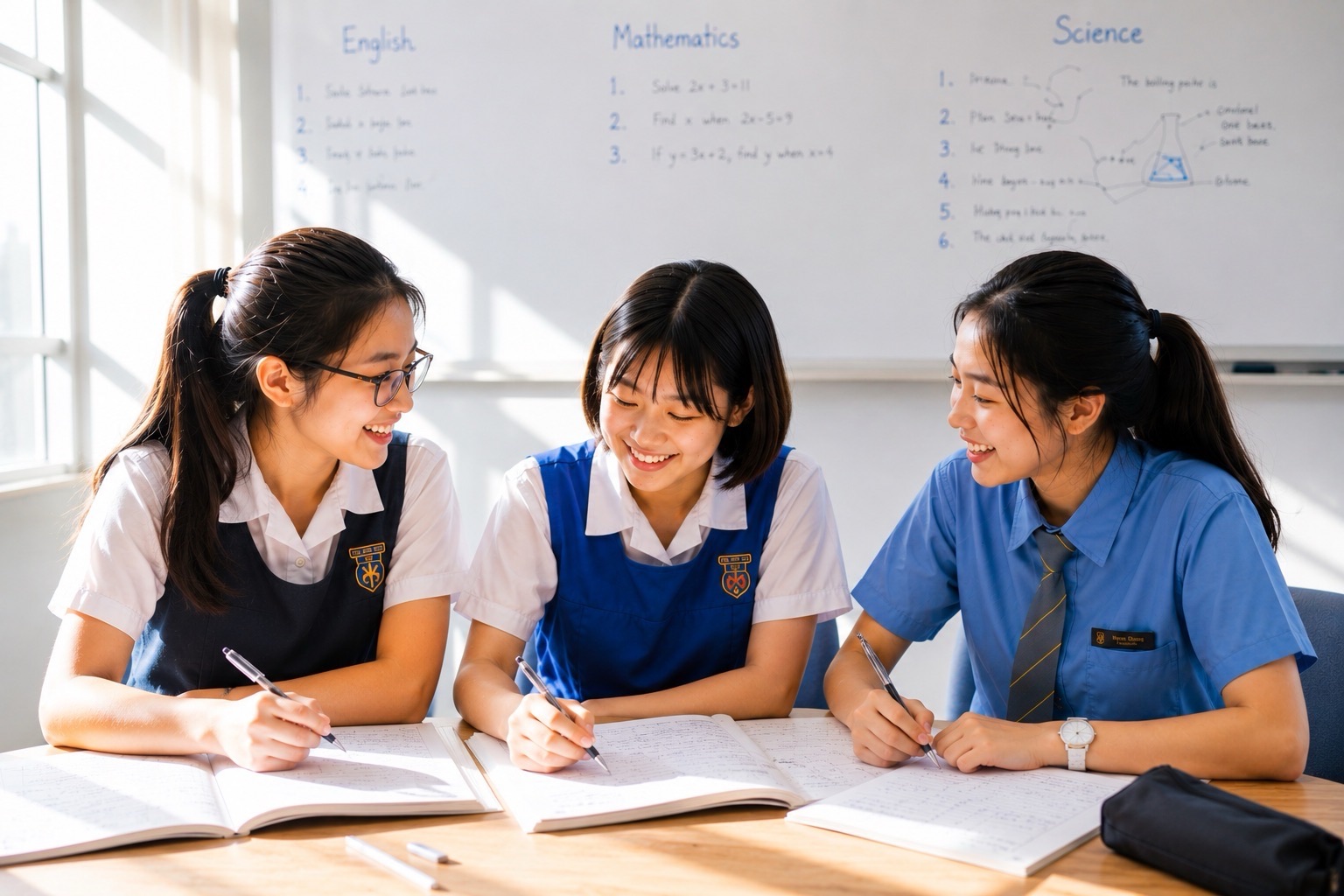
G3 Science tutorials for Bedok students should teach more than the ability to recognise a formula at the top of a familiar worksheet. At eduKateSG, three-student small-group teaching puts the pupil’s own scientific reasoning at the centre: define the system, select a valid model, calculate with meaningful units and explain why the evidence supports the answer. We deliberately change the next question so the learner has to choose again without the tutor providing the first hint.
Parents searching for G3 Science tuition in Bedok, Combined Science tutors, separate Physics and Chemistry support or SEC Science examination preparation often notice that a child knows the theory yet struggles with application. A force might act on the wrong body in the student’s diagram, a chemical coefficient might be used for the wrong substance, or a Biology explanation might turn an observation into an unsupported cause. Each mistake is a different scientific decision that can be taught.
This guide is for families from Bedok. It is not a claim that eduKateSG runs a tuition classroom in Bedok or has an arrangement with a local school. Suitable classes and consultations are arranged at 8 Fourth Avenue, Singapore 268674, near Sixth Avenue MRT. We confirm both the school year and registered G3 Science route before recommending teaching or examination questions.
You can enquire about G3 Science tutorial suitability with a marked problem or arrange a parent–student consultation. Every material property, device rating, experiment, student situation and numerical reading below is a hypothetical teaching example rather than real data collected at Bedok Reservoir or any local facility.
The Hidden Reason Familiar Formulas Fail on Unfamiliar Questions
A formula describes a relationship but cannot decide which body or interval a question refers to. A learner might apply resultant force equals mass multiplied by acceleration using only a driving force, overlooking an opposing force. The equation is remembered; the physical system has been misidentified.
Chemistry offers a parallel challenge. A correctly balanced equation contains several coefficients, but only the relevant reactant and product coefficients determine a particular mole ratio. A child who uses the largest printed coefficient has chosen numbers without their meaning.
Biology adds conditions that cannot be reduced to a formula triangle. An expected genetic ratio applies under certain parental genotypes and inheritance assumptions. A data trend may indicate a relationship without proving a unique biological cause.
Our first diagnostic asks for the pupil’s initial decision. Which object is under study? What is the requested quantity? Which condition supports using that particular model? If the wrong choice happens there, completing more arithmetic may only make the mistake faster.
We teach a clear first example, then a contrast with one important condition changed. An unseen task follows without the topic heading. We want the child to be able to explain why the method fits, not just repeat the last sequence of calculations.
The Correct G3 Science Course Comes Before the Practice Paper
MOE’s Full Subject-Based Banding guidance distinguishes G3 subject level from the student’s secondary year. A younger pupil studying a G3 subject and an examination-year learner have different immediate priorities.
SEAB’s 2027 G3 Science directory lists Combined Science Physics/Chemistry K326, Physics/Biology K327 and Chemistry/Biology K328. Separate Physics K323, Chemistry K324 and Biology K325 have their own content and assessment documents.
A Combined Science learner should not automatically be assigned every advanced concept found in a separate Chemistry textbook. Conversely, a pupil taking separate Biology may need coverage beyond a Combined Science summary. We identify the registered subjects and intended exam cohort before selecting past papers.
The Singapore-Cambridge SEC certificate begins in 2027, bringing national certification together while preserving subject-level differences. SEC does not create a fourth Science level above G3.
For an earlier secondary year, current chapters and prerequisites remain the reference. A question about an upper-secondary idea not yet taught is not evidence that the pupil has fallen behind. We distinguish teaching ahead deliberately from repairing a concept that should already be secure.
After identifying the course, we examine a strong and a difficult piece of work. Their difference may show how a changed diagram or condition affects the student’s choice more clearly than a single overall score.
Bedok’s Parks as an Invitation to Define a Scientific System
NParks places Bedok Town Park at Bedok North Avenue 3, with Bedok Reservoir Park nearby. Bedok Park Connector links Bedok Reservoir Park towards East Coast Park. These official descriptions support the local setting, but do not supply actual water quality, flow rate, wave speed or biodiversity data.
An imagined model of energy transfer
A fictional model pump draws 2,500 joules of input energy over a stated operating interval and transfers 1,500 joules to a named useful output. Its useful-output fraction is 0.60, or 60%. We ask the pupil to define what counts as input, useful output and other energy transfers.
A second model has a larger useful output but an even larger input. Which is more efficient? The child must compare defined fractions, not simply the largest joule number. We do not claim these readings describe any equipment at Bedok Reservoir.
A follow-up supplies only power and running time. That may help calculate an input-energy estimate under suitable conditions, but without the useful output it cannot uniquely determine efficiency. Recognising the missing measurement is a correct scientific choice.
An imaginary reservoir-flow accounting problem
A model tank receives 1.6 litres per minute and releases 1.1 litres per minute under constant rates. It accumulates 0.5 litre per minute. In eight minutes, stored volume rises by four litres under the stated simplified model.
The next task supplies a graph showing only net stored volume. Students must not invent exact individual inflow or outflow rates when both are unspecified. We draw what crosses the system boundary and what the instrument measured.
The model is a classroom accounting problem, not an environmental claim about Bedok Reservoir’s actual water balance.
A park photograph cannot establish ecological mechanism
A bird and a plant visible in the same photograph do not prove one feeds on the other. We supply a fictional observation log and explicit interactions before asking pupils to construct a food web.
The task then changes to an unseen ecological dataset from another environment. We check whether the child can separate measured observation from proposed mechanism without relying on familiar Bedok scenery.
A field-inspired experiment still needs controls
An imaginary study compares how two surface materials warm but also changes thickness and exposure time. The learner identifies which factors confound an inference about material alone and proposes comparable conditions.
A precise control is more useful than a stock phrase about fairness. No actual surfaces in Bedok Town Park are measured or assessed.
Physics: Forces Belong to a Chosen Body
The resultant is not automatically the driving force
A fictional 15-kilogram trolley experiences 120 newtons of forward force and 45 newtons of resistance. The resultant is 75 newtons forward, giving acceleration of 5 metres per second squared under the model.
A pupil who substitutes 120 directly has not identified the resultant on the trolley. We draw the arrows acting on that body and identify their directions before using the equation.
Next resistance increases to 120 newtons, leaving zero resultant and therefore zero acceleration. This does not require the trolley to be stationary if it already has velocity; constant velocity is possible under the stipulated model.
Action and reaction do not act on the same body
A diagram may show a person pulling a trolley and a force the trolley exerts on the person. They are interaction forces on different bodies, so they should not be cancelled as though both act on the trolley.
We define the system before adding forces. That habit helps the student avoid combining visually nearby arrows that belong in separate free-body diagrams.
A changed diagram removes the familiar trolley
An unfamiliar hanging load has upward and downward forces with magnitudes supplied. The learner chooses a direction convention, computes the resultant and interprets the acceleration. The concept should work beyond the earlier horizontal diagram.
A result in newtons is not an acceleration, and one in metres per second squared is not speed. We ask students to state the physical quantity alongside every calculated value.
Kinetic Energy: The Final Value Is Not Always the Answer
An imaginary object of mass 4 kilograms speeds up from 3 to 7 metres per second. Its initial kinetic energy is 18 joules and final kinetic energy is 98 joules. The gain is 80 joules.
A learner who gives 98 when asked for the change has calculated one correct quantity but not the requested one. We label initial, final and difference in separate rows.
Doubling speed at fixed mass gives a fourfold kinetic-energy value in the model, not merely double. By contrast, doubling mass at fixed speed doubles the energy. We ask for predictions before arithmetic to build the relationship.
If net work is stated to equal the 80-joule change across a 10-metre displacement in the direction of an equivalent constant resultant force, its magnitude is 8 newtons under those assumptions.
That figure is not automatically the work by one named applied force if other work contributions have not been accounted for. We teach pupils to read the net-work condition rather than guess at the physical system.
A subsequent question provides an unfamiliar mass-speed table without the original object picture, testing independent selection of the energy quantity.
Motion Graphs: Gradient and Area Are Not Interchangeable
Suppose a fictional speed–time graph rises uniformly from 2 to 10 metres per second during four seconds. The gradient is acceleration of 2 metres per second squared, while area under the graph is distance of 24 metres in the stipulated one-direction model.
The same graph therefore contains different information depending on which property is requested. Units distinguish acceleration from distance and can catch a wrong first operation.
A new diagram plots distance against time. Its gradient is speed rather than acceleration, so a pupil who repeats the previous statement about gradients without reading axes will make an error.
We then change scale divisions and start the plotted values above zero. A graph’s apparent steepness on the page cannot replace reading labelled numerical coordinates.
Finally, the observations appear in a table. The pupil reconstructs a suitable relationship and answers the question without relying on one familiar curve.
Electricity: Connectivity Before Resistance Formulae
An ideal 12-volt source supplies two 6-ohm resistors in parallel. Each branch carries 2 amperes; total source current is 4 amperes and equivalent resistance is 3 ohms.
A pupil adding the two six-ohm values and obtaining twelve ohms has used a series rule on a parallel diagram. We trace shared nodes and conducting paths before deciding how the network behaves.
Next, the components are visually rearranged while their electrical connections remain unchanged. The learner should preserve the interpretation despite a new-looking drawing.
A switch then opens one branch with ideal source voltage fixed. Current in the remaining branch stays 2 amperes, while total source current falls to 2 amperes in the model.
We ask which assumptions support this result. A real non-ideal source may require further properties that are not supplied here. The paper exercise does not invite unsupervised electrical experiments.
Chemistry: Balanced Equations Carry Specific Ratios
The theoretical equation 2Mg + O₂ → 2MgO gives a one-to-one mole ratio between magnesium and magnesium oxide, because both relevant coefficients are two. A pupil who doubles a magnesium amount again has not compared the named substances correctly.
If oxygen is in excess and 0.25 mole of magnesium reacts completely, theoretical magnesium oxide is 0.25 mole. With molar mass stated as 40 grams per mole for the exercise, theoretical product mass is 10 grams.
We separate the ratio step from the mass-per-mole conversion and ask the learner to explain what each numerical relationship expresses.
A changed equation introduces different coefficients. The pupil identifies the species required, writes the relevant ratio and calculates without importing the first example’s multiplier.
When a reaction model omits an essential starting quantity, the scientifically accurate response may be that the result cannot be uniquely determined. We teach students to name missing information rather than guess it.
Limiting Reagents: Why the Smaller Mole Number Can Be Misleading
A hypothetical symbolic reaction 2A + B → 2C has 0.30 mole of A and 0.20 mole of B initially. The available A requires 0.15 mole of B, so A is limiting. Under ideal completion, 0.30 mole of C forms and 0.05 mole B remains.
The child must compare amounts against the balanced ratio rather than assume whichever starting number is smaller determines the limit. We ask for a short explanation before any lengthy substitution.
A second case changes A to 0.50 mole and retains B at 0.20 mole. B becomes limiting, allowing 0.40 mole A to react and creating 0.40 mole C, with 0.10 mole A remaining.
Students may recognise the same equation and still need to change their decision. A contrast is successful when the learner explains why the limiting reagent switched.
This is paper-based theoretical reasoning and not a chemical handling instruction. We also check whether the student’s actual G3 Combined or separate Chemistry syllabus requires a particular extension before assigning it.
Conservation and Chemical Change: What Is on the Balance?
An imaginary sealed vessel and contents have mass 420 grams before and after a reaction producing gas. Conservation of total mass in the closed model does not mean no chemical reaction occurred; the substances may have changed identity.
If the vessel is opened and gas leaves what is on the balance, the measured remaining mass can change without contradicting conservation for a larger appropriately closed system that includes the escaped gas.
We draw the boundary around what is weighed and label the material leaving or remaining. This prevents the false claim that every balance must show the same figure regardless of what exits.
A fictional materials-storage diagram then tests whether the pupil can transfer system accounting to a different setting, while interpreting the relevant physical quantities correctly.
Chemical notation and observation should remain connected. We discourage balancing equations mechanically without understanding what each species represents.
Chemical Tests: Describe the Evidence Before Naming a Substance
A simulated qualitative test produces a precipitate under specified reagent and sample conditions. The pupil first describes the appearance, then uses the relevant test information to identify what the observation supports.
A similar-looking result in a different test does not automatically establish the same chemical identity. Conditions, reagents and the scope of the test all matter.
A chromatogram with references run under comparable conditions can support particular comparisons, but one paper spot alone is not unlimited proof of every substance property.
These are classroom data exercises, not instructions to handle unknown chemicals or carry out reactions in parks or at home.
The final item removes the familiar apparatus picture and describes its observations in words. The student should still distinguish what was seen from what can be inferred.
Biology: Structure Needs a Meaningful Function
A pupil can label a specialised cell correctly and still struggle to explain how a feature helps a stated biological process. We build a causal chain connecting the feature, exchange or transport process and outcome under the question’s conditions.
An example may involve a surface with many extensions, but ‘large surface area’ is not a complete universal answer. The child should explain which particular substance moves and why the feature is relevant.
A new diagram shows a different structure, so the previous memorised paragraph may no longer fit. We teach relevance rather than length.
Removing one label or arrow from a pathway reveals whether the pupil can reconstruct the mechanism independently.
The actual subject course sets the required biological depth. Combined and separate Science do not have identical demands.
Osmosis: An Observed Change Must Have an Appropriate Explanation
A fictional tissue sample begins at 12.0 grams and ends at 10.8 grams, a loss of 1.2 grams or 10% of the original mass. We ask the pupil to name initial, final, absolute change and percentage separately.
Dividing by the final mass would answer a different percentage question. We deliberately contrast two prompts using the same readings.
An explanation involving osmosis needs relevant membrane and water-potential conditions. The mass values alone do not uniquely prove a particular cause.
A second task reverses the relative solution conditions and asks for a new prediction. A learner who repeats that all samples lose water has memorised one result without its conditions.
A new graph replaces the numerical table, checking whether the pupil still distinguishes measured change from scientific mechanism.
Genetics: Expected Ratios Are Probabilities, Not Guaranteed Counts
In a simplified single-gene model where allele A is completely dominant over a, parents Aa × Aa have expected genotype proportions 1 AA : 2 Aa : 1 aa, giving expected phenotype ratio 3:1.
A real group of four offspring is not guaranteed to include exactly three of one phenotype and one of the other. The ratio expresses probabilities under the specified model.
Changing the cross to Aa × aa gives an expected 1:1 phenotype ratio. The pupil constructs the new combinations rather than carry over the first familiar result.
If a parent is described only by a dominant phenotype, their genotype may be AA or Aa, so the question may not justify one unique prediction. We ask students to recognise this missing information.
We explicitly state the model assumptions. Real inheritance can be more complex, and the learner follows the registered Biology syllabus rather than applying simple dominance as a universal explanation.
Ecological Data: A Relationship Is Not Necessarily a Cause
An invented population table records two organisms at several periods. One count rises while another falls. A pupil may describe the trend but cannot uniquely determine competition or predation from those numbers alone.
We ask what feeding interactions, sampling methods and environmental conditions were observed. A stronger causal inference needs evidence appropriate to the proposed mechanism.
A changed fictional investigation provides additional observations and controls. Students explain how the new evidence alters the conclusion without inventing certainty.
No organism counts in the exercise come from Bedok Reservoir Park or Bedok Town Park. The locations are inspiration for enquiry rather than asserted research findings.
Practical Science: Control and Repetition Solve Different Problems
A simulated investigation compares cooling through two materials but changes material, thickness and exposure duration together. A learner cannot uniquely attribute the difference to material under that design.
We ask which variable the experiment is intended to test, what should remain comparable and which measurable outcome would answer the question.
Repeating the same confounded setup may reveal variation without separating the effects. We explain why replication does not substitute for controlled conditions.
Another fictional instrument records 8.1, 8.0, 8.0 and 8.1 units while a reference indicates 10.0. The readings are closely grouped but offset. Repeatability and closeness to a reference are distinct measurement qualities.
We propose a calibration check where appropriate, rather than simply taking many more readings with the same offset. A different error caused by inconsistent positioning may need a different method correction.
Students should preserve unusual observations and investigate documented procedural errors honestly. Practical interpretation can be taught on paper, while hands-on apparatus competence requires proper supervised facilities.
Integrated Worked Problem: Four Answers From One Motion Record
An invented object has mass 5 kilograms, initial speed 2 metres per second and final speed 6 metres per second. Its initial kinetic energy is 10 joules and its final kinetic energy is 90 joules.
The energy gained is 80 joules. This is a different quantity from both final and initial energy. We ask the learner to state which result the wording requests before calculating.
If the model stipulates net work equal to this gain over an eight-metre displacement in the resultant force’s direction, the equivalent constant net force is 10 newtons. The word net matters.
A student may claim one specific force transferred the full 80 joules without information about others. We explain why this conclusion requires a different set of conditions than the original numerical answer.
A new task uses different units and a changed speed. We look for model choice, unit checks and evidential restraint, not a memorised result from the earlier record.
Three Learners Can Have Three Different First Mistakes
Imagine three fictional students taking the same Chemistry question. One balances the equation incorrectly, another balances it but chooses the wrong mole ratio, and a third uses the correct product amount but the molar mass of the wrong compound.
A polished model answer alone might hide all three problems. We preserve independent working, teach the common concept and give targeted follow-ups for atom conservation, species comparison and mass conversion.
Each learner then attempts a new balanced equation without prompts. A correct explanation reached after listening to classmates is useful progress, but an independent correct first choice demonstrates more stable understanding.
A quieter pupil receives time to think, while a stronger learner might be asked which assumptions a model requires. A three-student group makes such choices possible when the syllabus depth and pacing are compatible.
No class format guarantees grades. Actual group suitability, availability, duration and lesson timing are confirmed before placement.
A Lesson From Retrieval to a New Scientific Decision
An illustrative session starts with short no-notes retrieval of one earlier concept and a changed-context diagnostic. The tutor notes which step first becomes uncertain, rather than immediately showing a complete solution.
The relevant model is rebuilt through a diagram, symbolic relation or accessible numerical example. The pupil explains in their own words what each quantity represents.
We then contrast a second case with one meaningful condition changed. An energy question requests gain instead of final value, or a chemical calculation changes which reactant is limiting.
The original worked solution is removed. Each student chooses a method on an unseen question before discussion. Mixed practice follows once the concept is secure enough for independent selection.
A later lesson revisits the corrected decision after a delay, because immediate familiarity is not the same as durable recall. Actual session timing and materials are confirmed through the enquiry.
Three Learning Routes: Repair, Stabilise, Extend
Repair the earliest unstable foundation
One pupil may struggle with kinetic-energy questions because final value and change are confused. Another may use incorrect mole ratios or have insecure graph units. We repair the specific prerequisite within current schoolwork.
A fresh independent correct first step is a milestone, followed by a changed diagram to check transfer. Repair is an instructional route, not a judgement about the student’s intelligence.
Stabilise knowledge on mixed assessments
A capable learner may understand chapters separately but lose accuracy when headings disappear. We interleave concepts and require pupils to name the model and its conditions.
We classify errors by knowledge, reading, model selection, numerical execution, writing or time. A delayed new problem tests whether the correction remains available.
Extend a secure learner through evaluation
A confident student can compare scientific models, challenge a proposed cause or suggest a measurement to distinguish hypotheses.
Extension should deepen reasoning within the actual G3 Combined or separate Science route rather than automatically import every unrelated advanced textbook exercise.
G3 Assessment Preparation Should Match the Registered Subject
The published 2027 G3 Combined Science scheme includes multiple-choice, selected-discipline written papers and practical work. Separate Physics, Chemistry and Biology have their own requirements.
For Combined Science, the official scheme weights multiple choice at 20%, each discipline’s written component at 32.5% and practical at 15%. We do not apply this scheme automatically to separate Sciences.
A pupil who selects the correct option still needs practice writing the scientific cause when answer choices disappear. Practical assessment adds planning, observation, measurement and safe apparatus handling at the appropriate level.
Full papers are useful for integrated readiness when enough concepts are secure. Short targeted tasks may be better for repairing a specific incorrect scientific model.
If time is the difficulty, we inspect whether minutes are spent reading, choosing, calculating, writing or checking. The teaching response differs for each bottleneck.
Repeated familiar-paper success immediately after reviewing the mark scheme is not equal evidence to an unseen paper completed independently later.
A Sustainable G3 Revision Rhythm
We recommend retrieval, reconstruction, application and evaluation as complementary learning activities rather than rereading notes alone.
- Retrieve a previously learned scientific relationship and name its assumptions.
- Reconstruct one force diagram, chemical equation or biological process from memory.
- Apply the idea to an unfamiliar table or apparatus without the chapter heading.
- Evaluate one claim and identify which evidence supports or limits it.
- Revisit an earlier corrected error after a delay and explain what changed.
Parents can ask what body a force acts on, what chemical species a coefficient compares or why an ecological claim follows from the observations. These prompts encourage the student to think without requiring parents to deliver advanced lessons.
A useful error note says ‘used final kinetic energy instead of gain’ or ‘selected the limiting reagent from raw amounts’. Such descriptions lead to precise practice.
We avoid dangerous unsupervised experiments. Paper models and school-supervised practical work can support the required learning.
Study volume should fit school commitments and rest. An exhausted pupil copying answers may show less independent readiness than one unfamiliar task completed carefully.
How Families Can Recognise Scientific Improvement
A student making progress identifies the system and unknown before substituting, uses correct units and links an explanation with the conditions the question actually supplies.
Self-correction is especially valuable. A learner who notices an incorrect ratio or unsupported biological inference without the tutor’s prompt has begun to develop an internal scientific check.
We compare unseen tasks after intervals and record how much guidance was needed. A correct guided answer and an independently constructed unfamiliar answer provide different evidence of readiness.
No fixed examination grade can responsibly be guaranteed. School learning, starting knowledge, independent practice and assessment demands all influence results.
Additional tuition is not required for every pupil. Where school and self-study already support confident progress, parents may decide against extra classes.
Bedok Families: Teaching Location and Consultation
The stated eduKateSG teaching venue is 8 Fourth Avenue, Singapore 268674, near Sixth Avenue MRT. Bedok is the community this guide serves, not a new tuition centre address.
Bedok is a large estate, and travel from homes or schools around it varies. We do not invent one universal door-to-door commute time; families should check actual public transport, walking and return journey.
Bring the pupil’s school year, exact Combined or separate G3 Science subjects, examination cohort and representative marked work. A strong question alongside a difficult one can reveal which change of condition created confusion.
Group compatibility matters for content depth and pace. Actual timetable, duration, teaching materials and seat availability are confirmed during the enquiry.
Frequently Asked Questions About G3 Science in Bedok
Is G3 the same as Secondary 3?
No. G3 is a subject level under Full Subject-Based Banding, separate from the pupil’s school year.
Are G3 Combined Science and separate Sciences interchangeable?
No. Their depth, registered subject titles and assessment arrangements differ. Practice should follow the actual course.
Why does my child know formulas but lose application marks?
They may identify the wrong system, quantity or condition before calculating. We find the earliest unsupported choice and teach it through contrasts.
Must every lesson use a full timed paper?
No. Targeted concept teaching and unfamiliar short tasks can be more useful when a foundation is unstable. Full papers help assess integrated performance later.
Can a tutor replace supervised practical work?
No. Paper-based planning and experimental evaluation complement, but do not replace, hands-on practical skills in appropriate facilities.
Are classes physically held in Bedok?
This article serves Bedok families. The stated eduKateSG venue is Fourth Avenue near Sixth Avenue MRT, subject to confirmed arrangements.
Can tuition guarantee a G3 or SEC grade?
No fixed examination outcome can responsibly be promised. We aim for demonstrable independent scientific reasoning.
What should parents bring to the first consultation?
The student’s year, actual Science subjects and one question they could not explain independently, alongside a related successful response.
Connected Bedok G3 Science Reading
The companion routes are G1 Science Tutorials | Bedok, G2 Science Tutorials | Bedok and SEC Science Tutorials | Bedok. They serve different subject levels and cross-level examination planning.
Younger learners have separate routes such as PSLE Science Tuition | Bedok. Local education guidance appears in Tutors | Bedok and Education and Tuition | Bedok. The Science Tuition by Area Index connects other localities.
Official references are MOE Full Subject-Based Banding, SEAB’s 2027 G3 syllabus directory and SEAB’s SEC framework overview.
The Goal Is an Answer With a Scientific Reason
A stronger G3 learner can define a system, select its relevant law, use meaningful units and recognise whether the available evidence supports a proposed explanation. That capacity matters most when the next question looks unfamiliar.
Bedok’s reservoir, park and connector routes can make scientific models approachable. The real learning check comes after the locality story is removed and the student can still solve a new laboratory or data problem.
Enquire about G3 Science tutorials for Bedok with the learner’s registered subjects, year and one representative difficult question. A precise, independently testable teaching target is more useful than a promise about marks.