
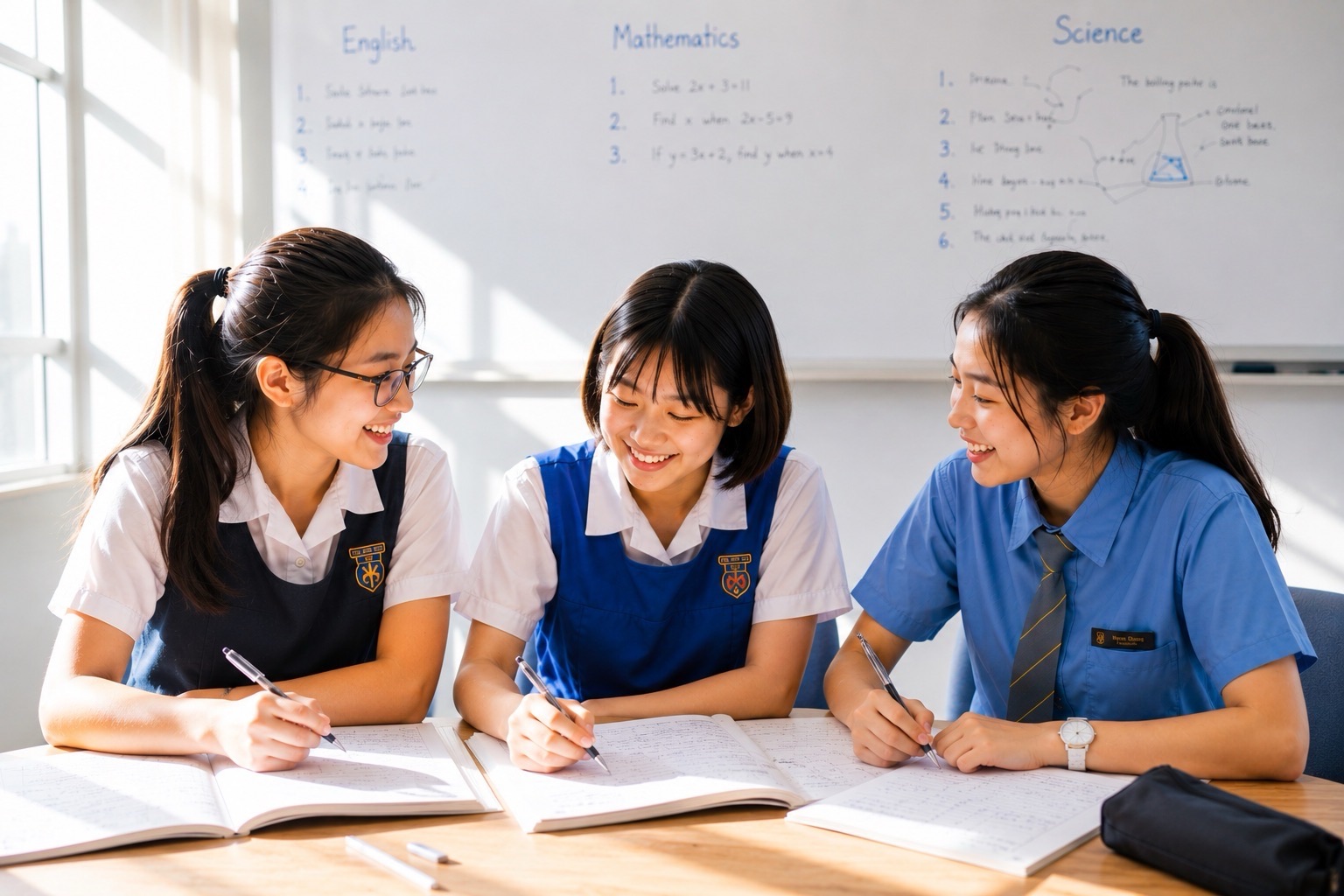
SEC Science tutorials for Bedok families should start with the right Science subject and one good look at what the student can explain independently. At eduKateSG, our three-student small-group approach connects concept understanding, practical investigation reasoning, clear written responses and examination routines. We ask what a question reveals about the student’s thinking before deciding whether a full paper, an unfamiliar graph or a focused explanation exercise is the next useful task.
Parents searching for Singapore-Cambridge Secondary Education Certificate Science tuition in Bedok, G1 G2 G3 Science lessons, Combined Science tutors or separate Physics, Chemistry and Biology preparation often ask how many papers their child should complete. A universal paper count would hide important differences. One student needs help choosing a scientific model, another needs to express a mechanism without options, and another understands the concepts but cannot finish in time. We begin by finding the reason rather than repeating the same prescription.
Bedok is the locality addressed by this article, not a newly announced eduKateSG classroom in Bedok or a claim of affiliation with any school there. Suitable lessons and parent–student consultations are arranged at 8 Fourth Avenue, Singapore 268674, near Sixth Avenue MRT. We establish the learner’s actual secondary year, registered subject level, Science pairing and examination cohort before discussing suitable class arrangements.
Families can enquire about SEC Science tutorial suitability with a representative marked question. All numerical values, learner profiles and experimental records below are deliberately fictional classroom examples, not measurements made at Bedok Reservoir or claims about real SEC examination results.
SEC Is a Certificate, Not Another Science Level
SEAB explains the Singapore-Cambridge Secondary Education Certificate as the certification framework beginning in 2027. It brings earlier N(T), N(A) and O-Level national certification arrangements under one certificate while subjects continue to be examined at their registered G1, G2 or G3 levels.
MOE’s Full Subject-Based Banding information makes a second distinction: G1, G2 and G3 are levels at which subjects are studied, not alternate names for Secondary 1, Secondary 2 and Secondary 3. The child’s school year and Science level are separate facts.
That distinction matters more than it first appears. A younger pupil studying G2 Physics/Chemistry needs teaching aligned with current chapters, while an examination-year G3 Combined Science student needs appropriately integrated assessment practice. Both may work towards a Singapore-Cambridge SEC qualification without needing the same tuition plan.
The school confirms the registered course and examination year. A book labelled SEC Science may contain suitable questions for one route while omitting parts of another. Older examination questions can remain useful for shared concepts, but their full paper structures should not be assumed interchangeable.
We therefore begin with the curriculum destination and the pupil’s present evidence of understanding. The registered syllabus tells us what matters; an independent problem reveals which scientific decision the student cannot yet make confidently.
2027 SEC Science Subjects: Select the Exact Route
| Subject level | 2027 Science subject | Syllabus code |
|---|---|---|
| G1 | Science | K123 |
| G2 | Science (Physics, Chemistry) | K223 |
| G2 | Science (Physics, Biology) | K224 |
| G2 | Science (Chemistry, Biology) | K225 |
| G3 Combined | Science (Physics, Chemistry) | K326 |
| G3 Combined | Science (Physics, Biology) | K327 |
| G3 Combined | Science (Chemistry, Biology) | K328 |
| G3 separate | Physics / Chemistry / Biology | K323 / K324 / K325 |
SEAB lists these course titles and codes in its G1 directory, G2 directory and G3 directory for 2027 school candidates. Families should confirm their own registration through the school and consult the documents for the actual examination cohort.
A G2 Physics/Biology candidate should not spend core revision hours on Chemistry simply because a generic booklet places it beside Physics. A G3 Combined Physics/Chemistry candidate and a separate Chemistry candidate may need different depth and practical preparation even when they share elementary concepts.
The table is a route finder, not a label for a student’s general ability. We should never infer which subject is weak or which class suits the child from the code alone. Two learners with the same registered subject may require different lessons because their first errors differ.
We ask whether content was already taught in school. The absence of an upper-secondary topic from an earlier-year pupil’s current knowledge does not automatically indicate a gap; it may simply not have been introduced. Teaching ahead and repairing a missed prerequisite are different instructional decisions.
Assessment Formats Should Shape Practice Without Dominating It
G1: a computer-based and a written component
The published 2027 G1 Science K123 assessment includes a computer-based component and a written component with different response demands. Recognition of a correct choice and construction of a written causal explanation are related but different skills.
We practise reading stimuli, identifying what is asked and supplying supported responses. Official school familiarisation should guide interaction with the actual examination interface. An ordinary online quiz cannot be assumed to reproduce the national digital assessment in every detail.
G2: questions belong to the registered two-discipline combination
The G2 routes combine two specified disciplines and include multiple-choice and structured-response demands in each. A tutor should check whether the learner can both identify a scientifically correct option and articulate why it fits the specified conditions.
We do not treat timed whole papers as the first solution for every child. If a learner cannot explain the relevant relationship at an accessible pace, a targeted contrast can be more useful than repeating the same misconception under a clock.
G3 Combined: written and practical work both matter
For 2027 G3 Combined Science, the published framework weights multiple choice at 20%, each of two written discipline components at 32.5%, and practical assessment at 15%. Separate G3 Physics, Chemistry and Biology have different subject documents, which must be consulted individually.
Experimental planning and evaluating supplied data can be taught in tutorials, but actual apparatus competence requires safe, appropriately supervised practical experience. A learner who writes a strong investigation plan has demonstrated valuable reasoning, not automatically every hands-on skill needed in a laboratory.
The examination scheme provides a map, but it cannot diagnose the student from percentages alone. We examine actual item-level work to understand why marks are lost.
Bedok’s Water and Park Landscapes as a Thoughtful Science Starting Point
NParks describes Bedok Reservoir Park as surrounding a former sand quarry converted into a reservoir and part of the Eastern Coastal Loop. Siglap Park Connector links Bedok Reservoir Park, Bedok Town Park and other eastern green spaces. These verified places can inspire scientific questions, but they do not provide the imaginary temperatures, flow rates or species counts in our examples.
Model a storage change without claiming a real water measurement
A fictional storage vessel begins at 50 litres and contains 68 litres after six minutes. Its net increase is 18 litres and average net accumulation is 3 litres per minute. The calculation is straightforward, but the scientific interpretation matters.
The result does not establish that inflow alone is 3 litres per minute if unknown outflow also exists. We ask the pupil to draw a system boundary, label the measurements and identify what other information would be needed to separate component flows.
The figures are an imaginary classroom model, not a statement about water entering or leaving Bedok Reservoir. No reservoir sampling is needed to answer the question.
A fictional path journey distinguishes two valid averages
An imaginary walker covers 300 metres in four minutes, pauses one minute and walks another 120 metres in two minutes. The complete seven-minute interval covers 420 metres, giving an average of 60 metres per minute.
During moving time alone, the average is 420 metres over six minutes, or 70 metres per minute. We ask the learner to name what each denominator represents and select the one the prompt requests. A graph replaces the story in a later task.
A landscape photograph cannot establish a species interaction
A bird and plant visible in one image do not prove that the bird eats from the plant. An imaginary food-web task supplies explicit observation and feeding information. We draw only the relationships supported by those records.
The new setting becomes an unfamiliar ecosystem with different organisms. The pupil should still distinguish observed coexistence from measured or supported interaction.
The goal is scientific transfer beyond Bedok
When the park and reservoir disappear from the worksheet, the student should continue reading the evidence carefully. A reservoir-inspired flow question becomes a laboratory vessel. A path becomes a model cart. The scientific model ought to survive the change of nouns and images.
A Mark Is a Result, Not a Diagnosis
Imagine two fictional students each scoring 60% on a Science paper. Student A leaves several structured items unanswered yet explains attempted questions accurately. Student B finishes every item early but repeatedly chooses incorrect models.
The same headline percentage hides different needs. A may need help identifying where time goes—reading, model selection, writing, calculation or checking. B may need untimed contrasts that teach why one relationship applies and another does not.
A third pupil might do very well on multiple-choice questions while struggling to write the same causal explanation without options. The difficulty could be constructing the reasoning independently rather than recognising it when presented.
Another might know the concepts but misread a graph’s scale or use incompatible area units. Assigning more conceptual memorisation would not repair a missing square-unit conversion.
We describe mistakes in terms of specific teachable decisions. ‘Compared raw force without considering contact area’ is actionable. ‘Science is careless’ does not specify what the learner should practise tomorrow.
The Fencing Method: Five Decisions Before Starting
What has the question actually supplied?
We label measurements and their units, separate observations from inference and identify the parts of a diagram that provide relevant information. A photograph alone cannot give a specific thermal property unless the question supplies a measured value.
What quantity is the answer supposed to represent?
A temperature difference, final reading, average rate and total energy are not interchangeable. We ask the pupil to name the unknown before choosing numbers and operations.
What changed between the two cases?
A pause may be added to a journey, a circuit branch may open, or a chemical reactant amount may become limiting. We ask which decision should be reconsidered when that condition changes.
Which conditions need to be comparable?
A scientific investigation testing one variable requires relevant controlled conditions. We teach pupils to identify a specific control and explain why it matters rather than write ‘make the test fair’ automatically.
How far can the conclusion go?
The data may establish a change while leaving the cause unknown. We want a precise supported result, followed where appropriate by a statement identifying the missing evidence needed for a broader inference.
A Four-Part Diagnostic Before a Full Revision Programme
First: a small no-notes retrieval check
We choose a concept already covered at school. The student explains what it means and when it applies. If retrieval is weak, concept reconstruction and spaced review may be the right starting point.
If the idea is recalled accurately, we do not waste the entire session reteaching the definition. We move to a changed presentation to see whether the learner can use it.
Second: change the representation
A graph becomes a table, a circuit picture becomes a textual description and a particle explanation becomes a symbolic equation where appropriate. The student identifies the same relationship under a different surface appearance.
A pupil who fails only when the axes change needs a focused graph-interpretation lesson. A pupil who cannot express the mechanism in words needs a different intervention.
Third: remove the chapter title
A short mixed set presents speed, density, pressure and percentage questions without telling the learner which is which. Each item should be within the content already taught or explicitly supplied.
The child names the relevant quantity and model. We then ask why a tempting alternative formula would answer another question.
Fourth: add timing for a clear reason
When the relationship is sufficiently secure, an appropriately timed section can reveal whether the learner spends too long reading, selecting, calculating, writing or checking.
The new routine is later tested using another unseen task. We do not presume that every timing difficulty can be repaired simply by telling the pupil to work faster.
Worked Example: What One Table Can and Cannot Tell Us
An invented tank begins with 40 litres of liquid and holds 56 litres after eight minutes. Final volume is 56 litres, net increase is 16 litres and the average net increase is 2 litres per minute.
Relative to the starting 40 litres, the increase is 40%. These values answer different questions: final quantity, absolute change, rate and percentage change.
The data alone do not identify the separate inflow and outflow rates. A learner claiming inflow is exactly 2 litres per minute has made an inference not justified by the reported net change.
Suppose an additional measurement supplies a steady outflow of 0.5 litre per minute. Under the simplified model the inflow would be 2.5 litres per minute. Now there is enough information to separate the components.
We then reverse the trend and change the reference volume. The student should preserve the direction and select the appropriate percentage base rather than reuse the earlier result.
This type of task is particularly useful because a correct calculation is only half the lesson. The child must explain what the calculated quantity physically represents.
Worked Example: Percentage Increase and Decrease Are Not Symmetrical
An imagined sample rises from 80 to 100 units. Absolute increase is 20 units and percentage increase relative to 80 is 25%. When the sample falls from 100 to 80, the decrease is the same 20 units but percentage decrease relative to 100 is 20%.
A pupil who reports 25% both ways has remembered an answer without understanding which starting value belongs in the denominator.
We ask the learner to label initial, final and change. Then the question is repeated using an unfamiliar mass or temperature table. The mathematical relationship should remain clear after the context changes.
A further question asks why the reading changed. The numerical record alone does not identify a cause. Physics, Chemistry and Biology mechanisms require their own relevant conditions.
The student finally creates two valid prompts from the same dataset, one asking for final value and the other for percentage change. Making an appropriate question is a useful indicator of conceptual ownership.
Worked Example: Weighted G3 Combined Science Scores
Consider a wholly fictional 2027 G3 Combined Science practice record. Multiple-choice accuracy is 80%, one discipline’s written result is 70%, the other written result is 60%, and practical accuracy is 90%.
| Component | Fictional result | Published weight | Weighted contribution |
|---|---|---|---|
| Multiple choice | 80% | 20% | 16 percentage points |
| Discipline A written | 70% | 32.5% | 22.75 percentage points |
| Discipline B written | 60% | 32.5% | 19.5 percentage points |
| Practical | 90% | 15% | 13.5 percentage points |
The weighted total is 71.75%, not the 75% simple mean of the four component percentages. This illustrates why families should not treat assessment components as equally weighted when the official scheme says otherwise.
The weaker written component merits a closer look, but its percentage does not by itself reveal whether the losses came from missing knowledge, explanation writing, graphs, model selection or timing.
We do not automatically allocate every hour to that one component. Stronger topics need occasional retrieval while the most consequential gaps receive focused teaching.
These weights are only for the specified G3 Combined route. G1, G2 and separate G3 Sciences require their own assessment schemes and should not borrow these percentages.
Practical Science: Identify the Actual Experimental Flaw
A fictional experiment varies water temperature to study dissolving time, but also changes stirring rate. A student attributes the different result entirely to temperature, overlooking the confounding variable.
The corrective answer should name the relevant control: keep stirring comparable while varying temperature deliberately, and define a consistent measured endpoint. ‘Make it fair’ without naming what changes is too vague.
Repeating the unchanged confounded procedure many times may show variability but does not automatically isolate the effect of temperature. Repetition and experimental control address different questions.
An imaginary instrument reports values closely grouped around 11.9 when an appropriately stated reference is 10.0. We distinguish repeatability from closeness to a reference and discuss why checking calibration might be more useful than collecting many more biased readings.
Unexpected observations should be recorded honestly. A student can investigate an identified procedural problem and propose a safe supervised repeat, but not simply erase a reading because it breaks the expected pattern.
Paper-based teaching helps with method planning, apparatus interpretation and evaluation. Real laboratory competence still requires suitable supervision, equipment and facilities.
Physics: Name the Body Before Using Force Equations
Imagine a fictional six-kilogram trolley receiving a 30-newton forward force and a 12-newton resistive force. The resultant is 18 newtons forward, giving acceleration 3 metres per second squared under the stated model.
A pupil who uses the forward 30 newtons directly has calculated from the wrong force, although their division may be accurate. We ask for a free-body diagram on the trolley before accepting substitutions.
Next, both forces become 30 newtons. Resultant and acceleration are zero, but the trolley need not be stationary if it was already moving. This distinction tests understanding of velocity and acceleration.
The illustration changes to forces on two interacting objects. An action force acting on one body and reaction on another cannot simply be added as though both act on one body.
A changed diagram with a hanging load tests the same skill without the familiar trolley image.
Physics: Graph Operations Have Physical Meanings
A fictional speed–time graph rises uniformly from 2 to 10 metres per second in four seconds. The gradient gives acceleration of 2 metres per second squared, while the area beneath the graph gives 24 metres travelled in the one-direction model.
The pupil must read the axes before choosing gradient or area. Calculating a gradient accurately and labelling it as distance answers the wrong physical quantity.
A new distance–time graph has a similar appearance but a different vertical variable. Its gradient corresponds to speed rather than acceleration. We change scale divisions to avoid reliance on visual slope alone.
A graph may describe motion without proving why an object accelerated or paused. We ask which extra information a proposed cause would require.
The transfer task gives a table instead of a plotted graph, asking for the same interpretation independently.
Chemistry: A Balanced Equation Is Not Just a Multiplication Cue
The theoretical balanced equation 2Mg + O₂ → 2MgO expresses a one-to-one mole relation between magnesium and magnesium oxide under its complete-reaction model. The relevant coefficients must be compared, not simply applied indiscriminately.
If oxygen is in excess and 0.30 mole magnesium reacts completely, the theoretical amount of MgO is 0.30 mole. At an assumed molar mass of 40 grams per mole, the theoretical mass is 12 grams.
A student who multiplies by two again because the product coefficient is two has not identified which species the ratio compares. We write the relevant coefficient ratio explicitly.
A new equation changes the coefficients and starting amounts. We check whether the pupil chooses the model independently or copies the earlier operation.
This is a paper example, not a direction to mix chemicals. We also check the actual registered Science route before assigning quantitative extensions.
Chemistry: Limiting Reactants Need the Relevant Ratio
In an abstract theoretical reaction 2A + B → 2C, initial amounts of 0.30 mole A and 0.20 mole B are supplied. A needs only 0.15 mole B to react, so A is limiting, theoretical C is 0.30 mole and 0.05 mole B remains.
A pupil who always selects the smaller raw starting amount as limiting would choose B and be wrong. The balanced equation determines what proportions the reaction requires.
The next case increases A to 0.50 mole while B remains at 0.20 mole. Now B limits the reaction and can produce 0.40 mole C, leaving 0.10 mole A unreacted under the stipulated complete model.
We ask why the limiting choice changes even though the equation is unchanged. The task tests concept selection rather than memory of a particular set of values.
A final version omits one starting amount. The pupil should identify the missing information rather than manufacture a unique limiting reagent.
Biology: Explain Function, Not Just Label the Diagram
A specialised cell diagram may be labelled correctly while the learner is unable to say why its structure supports a particular process. We ask the pupil to connect the relevant feature, movement or exchange and consequence under stated conditions.
A large exchange surface can be useful, but ‘large surface area’ is not an answer that fits every cell or organ question. The actual function and process must be named.
We remove one label or arrow from a biological flowchart, then ask the learner to reconstruct the missing causal link without a model paragraph beside them.
An unfamiliar organism is introduced with relevant structural data supplied. The pupil should still identify the appropriate explanation rather than depend on recognising the earlier textbook illustration.
The depth follows the registered Biology or Combined Science subject, not one universal separate-science syllabus.
Biology: Recorded Change and Its Proposed Cause
An imaginary tissue sample begins at 15.0 grams and ends at 13.5 grams, a loss of 1.5 grams or 10% of the initial mass. The student distinguishes final mass, absolute decrease and percentage change.
An explanation through osmosis requires the relevant membrane and relative water-potential conditions. The two mass readings alone do not establish a complete unique mechanism.
We provide suitable conditions in a changed task and ask for direction of net water movement. A learner who repeats the previous outcome without checking the gradient needs further concept repair.
A graph replaces the mass table. This tests whether the numerical distinction survives an unfamiliar representation.
Similarly, a trend in ecological counts does not uniquely prove why one organism increased while another decreased without relevant interaction or environmental evidence.
A Three-Student Group Needs Three Independent First Attempts
Imagine three fictional students answering a similar Physics question incorrectly. One reads the wrong graph axis, another chooses a method appropriate to the wrong quantity, and the third calculates accurately but writes an unsupported conclusion.
We begin with quiet individual work so those differences remain visible. The tutor then teaches the common concept and chooses follow-up tasks matched to each difficulty.
One learner practises unusual scales, another contrasts competing models and the third identifies the observation that would support a proposed causal claim. Everyone receives an unseen common question afterwards.
Group discussion is valuable, but repeating the strongest classmate’s answer is not proof of independent mastery. The unfamiliar solo attempt reveals whether the correction has become usable.
A small class works well when syllabus depth, learning pace and teaching needs are compatible. The three-student format is an opportunity for purposeful attention, not a guarantee of results or immediate available placement.
Repair, Stabilise and Extend Require Different Lessons
Repair a specific missing foundation
A student may struggle with percentages because the starting reference is unclear, or with Chemistry because mole ratios are chosen incorrectly. We repair the smallest prerequisite within current schoolwork.
An independent first correct step on a changed question is a meaningful milestone. We then revisit the skill after a delay rather than assume immediate copying means mastery.
Stabilise knowledge that fails in mixed papers
Another learner may handle clearly labelled chapters but hesitate when the topic heading disappears. We interleave previously taught models and ask for a short justification before calculation.
We distinguish errors in knowledge, interpretation, numerical execution and writing so that practice addresses the actual bottleneck.
Extend a secure student through evidence evaluation
An already confident learner can critique an experimental design, identify a missing measurement or construct a counterexample to an overly broad scientific claim.
Such work develops intellectual depth inside the registered course rather than assign unrelated advanced questions for their own sake.
An Achievable Revision Week for Bedok Families
A sustainable home routine includes independent retrieval, one unfamiliar application and a later revisit of a corrected error. The amount of practice should fit ordinary school commitments, sleep and the learner’s current readiness.
- Retrieve one scientific relationship without notes and explain when it applies.
- Answer a question using a new table, graph or diagram with no chapter heading.
- Compare two similar-looking questions that require different quantities or methods.
- Revisit an old error after a delay and identify the first decision that should now change.
- Use a short mixed or timed section when it provides a meaningful check of readiness.
Parents can ask ‘What does this number actually measure?’ or ‘Which observation supports the proposed cause?’ without needing to teach every advanced Chemistry or Biology topic themselves.
When the child is stuck, recording a precise uncertainty is more useful than an adult-written finished answer. A tutor can teach ‘which species do the coefficients compare?’ far more effectively than act on a vague statement that Chemistry is difficult.
We do not encourage unsafe practical experiments with household mains power, unknown chemicals or natural water sources. Printed data, school-provided materials and appropriate supervised practical work are sufficient for many revision goals.
A large paper count alone cannot demonstrate independent thinking. We prefer fewer purposeful questions with feedback and clear evidence of what has changed.
An Illustrative Eight-Week Preparation Sequence
Weeks one and two might identify the registered course, review schoolwork and repair the most consequential missing relationships. The exact plan depends on how much content the pupil has already covered.
Weeks three and four might strengthen application across altered diagrams and short constructed explanations. Earlier corrected concepts return after an interval, allowing the tutor to see whether they remain available.
Weeks five and six could incorporate suitably matched mixed and timed sections, with practical planning and data analysis appropriate to the registered subject. Marks are analysed by the first cause of error.
Weeks seven and eight might focus on targeted retrieval, revisiting previously mistaken decisions, concise written responses and appropriate full papers. A concept still weak near the examination should not be ignored solely because the calendar says another paper is due.
This schedule is an illustration, not a guarantee of readiness or a grade after eight weeks. Younger secondary learners often need a different school-year horizon.
How Parents Can Recognise Useful Progress
A student making progress names the system and unknown quantity before calculation, reads unfamiliar axes carefully, checks meaningful units and expresses causal explanations within the supplied evidence.
Self-correction is especially valuable. The pupil may recognise an inappropriate denominator or an unjustified conclusion before the tutor provides a hint.
We compare changed-context work and record how much help was required. A familiar repeated paper after reading the answer key gives different evidence from an unseen independently completed task.
No examination grade or mark increase can responsibly be guaranteed. A transparent tuition plan should identify the skill, teaching response and later independent check.
Tuition is not automatically necessary for every pupil. Where school teaching and suitable personal revision are already effective, a family may reasonably decide no additional classes are needed.
Class Location and Suitability for Bedok Families
eduKateSG’s stated teaching location is 8 Fourth Avenue, Singapore 268674, near Sixth Avenue MRT. This Bedok guide does not advertise a teaching centre within the Bedok estate.
Bedok is geographically extensive, so journey planning must use the student’s actual starting point. Families should check buses, trains, walking, changes of service and the return journey instead of relying on a universal invented travel time.
Bring the secondary year, exact registered Science subjects, examination cohort, recent marked work and a question the learner cannot yet explain alone. A related strong answer can help isolate what changed in the difficult task.
A suitable three-student group needs compatible content depth, pace and timing. Actual class duration, materials and availability are confirmed before any arrangement is made.
Frequently Asked Questions About SEC Science in Bedok
Is SEC Science a new fourth level beyond G3?
No. SEC is a certificate framework. Subjects continue at the applicable G1, G2 or G3 level.
Does G1 mean Secondary 1, or G2 mean Secondary 2?
No. G1 and G2 are subject levels. The student’s secondary year is a separate detail needed for correct teaching.
Can every student use the same Science paper?
No. The subject combination, depth, assessment instructions and examination year matter. Shared concepts do not make entire papers interchangeable.
Should an earlier-secondary pupil begin with full examination papers?
Not automatically. Current school chapters and prerequisites should guide everyday work, with selected unfamiliar questions where useful.
Does a high multiple-choice score prove written readiness?
No. Recognising a correct response and constructing a scientific explanation independently are different demands.
Can tuition replace school laboratory practical learning?
No. Tutorial planning and data evaluation complement, but cannot replace, safe supervised apparatus experience.
Are classes located in Bedok?
This article serves Bedok families. The stated eduKateSG venue is Fourth Avenue near Sixth Avenue MRT.
Can a tutor guarantee an SEC grade?
No fixed grade or improvement timeline can responsibly be promised. We focus on meaningful independent learning evidence.
What should parents bring to consultation?
The current school year, registered Science subjects, examination cohort, a strong piece of work and one difficult marked question.
Connected Bedok Science Guides and Authoritative References
Explore G1 Science Tutorials | Bedok, G2 Science Tutorials | Bedok and G3 Science Tutorials | Bedok for level-specific examples. The present guide organises examination-route decisions across those subject levels.
For primary Science, use PSLE Science Tuition | Bedok. Neighbourhood guidance includes Tutors | Bedok and Education and Tuition | Bedok. The Science Tuition by Area Index connects wider subject reading.
Official route references include SEAB’s SEC overview, 2027 G1, 2027 G2, 2027 G3 directories and MOE’s Full Subject-Based Banding guidance. Use the documentation applicable to the child’s actual cohort.
The Strongest SEC Plan Starts With Two Clear Answers
First, which Science course is the pupil really registered for? Second, what does an independent attempt reveal about the first unstable choice? With those answers, teaching can proceed through concept repair, unfamiliar application, practical reasoning, constructed explanations and useful timed practice.
Bedok Reservoir and the area’s park connections can make Science questions feel close to everyday life, but examination confidence comes when the learner can use the same model in a new situation without the local story or the tutor’s hint.
Enquire about SEC Science tutorial suitability for Bedok with the student’s school year, exact subjects and one representative question. A specific, testable learning decision is a more useful starting point than an unsupported promise about paper counts or marks.