
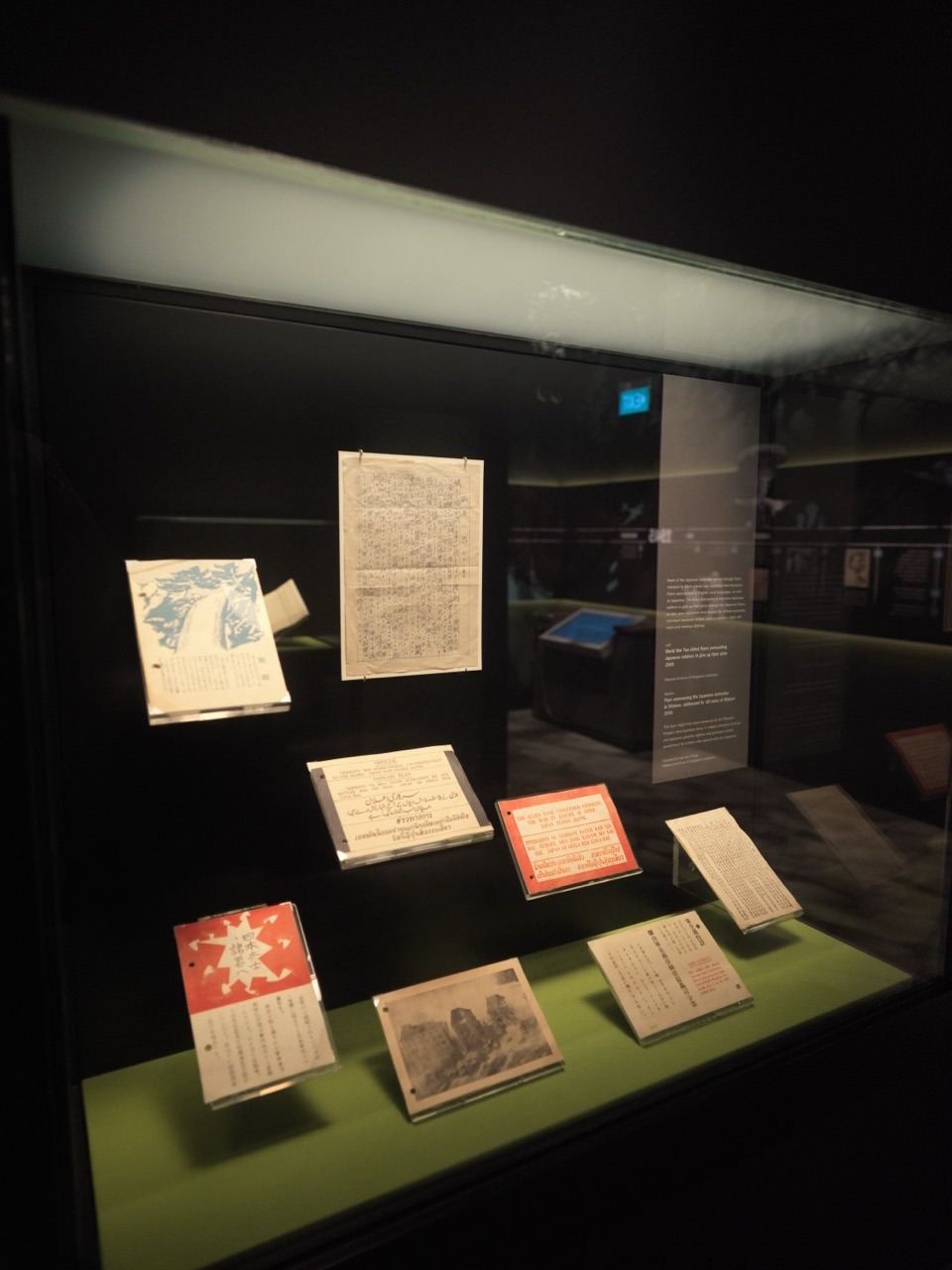
In 1942, Singapore suffered invasion, military defeat and the beginning of Japanese occupation. The year also remade work, education, healthcare and the daily search for security.
January: a city already living with war
A new year under pressure
Singapore entered 1942 already at war. The New Year's Day Straits Times carried an assurance from Winston Churchill that the island would hold out, alongside much smaller notices showing how the emergency was changing local life. The Indian Bank's Ipoh office was being operated through its Singapore branch. A planting agency from Kuala Lumpur announced a Singapore office. Businesses were moving south as the fighting approached.
The same issue advertised dinner, dancing and cinema shows, published a birth announcement, and reported a prosecution over an unshaded light. These different kinds of notice belong together. Families continued to mark ordinary events, while blackout rules reached into private homes and firms tried to keep their operations working. Reading January only as a countdown to surrender would miss this uncertainty: people had responsibilities to meet before they knew what the next weeks would bring. Source
Shelter, food and limited escape
By the end of January, the arrangements for daily survival had become more visible. The Straits Times reported that a quota allowing 500 Chinese women and children from Singapore to evacuate to the Netherlands Indies was already full. A letter described residents carrying bundles of spare clothing in case bombing destroyed their homes. Leaving the island and remaining in it each involved practical decisions with sharply limited options.
Municipal business continued amid the crisis. Commissioners suspended the usual annual reduction in hawker licences, while another report announced that ration cards would be needed for frozen meat and butter from 8 February. At a municipal meeting, flooded public trenches prompted a blunt instruction that residents should empty them themselves. These records expose the strain on civilian protection: shelter, access to food and the preservation of possessions were immediate problems, even while the newspaper continued reporting the military front. Source
The fighting reaches Singapore
From the Causeway to the island battle
The last British Empire troops withdrew across the Causeway on 31 January. The defence of Malaya had contracted to Singapore itself. Japanese forces then landed on the island's northwestern coast during the night of 8–9 February, opening the decisive week of fighting. The defenders included troops from Britain, India and Australia, as well as local forces; the consequences of their defeat would reach families across many countries.
The Australian War Memorial places the campaign within the failure of the prewar Singapore strategy. The naval base was intended to support an imperial fleet, but the resources needed to defend Malaya had not been supplied adequately while Britain fought in Europe. That strategic imbalance matters more than the comforting image of an impregnable fortress. By 15 February, the Allied position had collapsed and Lieutenant-General Arthur Percival accepted the Japanese demand for unconditional surrender. Source
Confusion in a participant’s diary
The available archival transcription of Avon Reah Smith-Ryan's diary gives a smaller, less orderly view of the island battle. The transcription is marked as awaiting approval. His entries for 9–13 February repeatedly describe confusion, incomplete communication and uncertainty about neighbouring units. He recorded withdrawals, separation from stores and difficulty finding other men. The diary also contains corrections and later annotations, reminders that even a participant's account could be revised as information became available.
On 11 February, his uncertainty extended to casualties. He could not immediately establish how many members of his group had been killed, wounded or gone missing. A later check replaced that uncertainty with individual names. This is a useful counterweight to the clean arrows of a campaign map. Command decisions were experienced by men who were tired, separated and often unable to see the wider situation. Their partial knowledge does not make their testimony worthless; it defines what the testimony can tell us. Source
Local volunteers and Dalforce
Local Chinese volunteers also took part in the defence through the force associated with Lieutenant-Colonel John Dalley. Its members came from markedly different backgrounds, including students, labourers, office workers and people with communist affiliations. Their presence prevents the battle from being understood solely as something fought by overseas soldiers while Singapore's residents watched from the sidelines.
The National Heritage Board's account emphasises the hurried nature of their preparation and shortages of equipment. Commitment to resistance did not provide the training, supplies or organisational support that a regular military formation needed. Nor did defeat bring the volunteers one common fate. Some were killed in the fighting; others faced danger under occupation or continued resistance elsewhere. Dalforce belongs in the year's history both as an example of local participation and as a reminder of how late and unevenly that participation had been supported. Source
The Malay Regiment at Bukit Chandu
The Malay Regiment's defence culminated at Bukit Chandu on 14 February. The fighting associated with Lieutenant Adnan Saidi became one of the defining local memories of the campaign. Yet the regiment's history in 1942 also includes what happened after organised resistance ended. Surrender did not remove the danger faced by men who had served in its ranks.
The National Heritage Board's account records that about 600 detained members were ordered to remove their uniforms and either join Japanese forces or be released as civilians. A number were executed after refusing to take off their uniforms. Among the museum's surviving objects is a tin cup belonging to Lieutenant Ibrahim Sidek, whose story is presented alongside his widow's recollection. Such an ordinary possession brings the aftermath back to a particular life and family. The consequences of the battle continued beyond its final positions and its last day. Source
Patients, evacuees and surrender
Violence at Alexandra Hospital
Alexandra Hospital was attacked by Japanese troops on 14 February, as the battle reached its surroundings. The National Heritage Board's historic-site account states that around 300 patients and medical staff were killed over two days. The attack therefore belongs to both the final fighting and the immediate passage into occupation. It should not be compressed into the later civilian screenings or treated as an ordinary combat encounter.
The hospital had opened in 1940 to serve the enlarged British military presence. Its medical role makes the killings especially important to the human history of the defeat: a place organised around treatment and recovery became a place of mass death. The victims included people whose work was to care for others and people already in need of that care. Responsibility lies with the troops who committed the atrocity and the military structures involved, rather than with an ethnicity or later generations. Source
The danger continued beyond the harbour
Evacuation did not guarantee safety. The Vyner Brooke left Singapore on the evening of 12 February carrying 181 passengers, most of them women and children, including 65 Australian nurses. A vessel accustomed to a much smaller passenger load had become part of an emergency movement away from the threatened island. On 14 February, Japanese aircraft sank it near Banka, also spelt Bangka, in the Netherlands Indies.
Many survivors reached shore only to face captivity or further violence. Japanese troops murdered a group of nurses and other survivors at Radji Beach; Vivian Bullwinkel survived the shooting and later endured internment. These events occurred outside Singapore, but arose directly from the evacuation of people who had been there. The distinction is important: leaving the city changes the location of their story, not its connection to the fall. The risks and suffering of nurses and civilians extended beyond the moment a ship cleared the harbour. Source
15 February and the beginning of Syonan
Percival surrendered at the Ford Motor Factory on 15 February 1942. British rule on the island had been defeated, and Singapore was renamed Syonan-to, usually translated as Light of the South. The end of the battle did not bring a return to civilian security. It began a different relationship between the population and a conquering military administration.
The National Archives dates the start of mass screening of the Chinese community to three days after the surrender. This short interval matters. The change in power was followed almost immediately by state-sanctioned violence against people categorised as potentially hostile. The occupation authorities promoted the promise of a Greater East Asia Co-Prosperity Sphere, but the local experience included coercion, suffering and failed promises. For an annual history, surrender is therefore a turning point within 1942, not the point at which the year's account should end. Source
The first weeks of occupation
Sook Ching and the problem of counting loss
During Sook Ching, Japanese military authorities summoned Chinese males for screening, detained those they identified as suspect, and took victims to execution sites around Singapore. The process did not establish individual guilt through a fair hearing. Its consequences reached far beyond the people assembled at the screening centres: families lost relatives, income and certainty about what had happened.
A National Library account reproduces testimony from Chan Cheng Yean, who survived an execution at Bedok on 28 February, and Yap Van Hong, who survived a killing at Changi. Their accounts establish that people survived to bear witness, without making either individual representative of every victim. The total number killed remains uncertain and estimates differ widely. Giving an apparently exact total would conceal that evidential difficulty. Uncertainty about the count does not weaken the evidence that organised mass killing occurred or lessen the responsibility of the Japanese military authorities. Source
A religious community loses its abbot
The losses also entered places of worship. Venerable Pu Liang, the abbot of Shuang Lin Monastery, had supported relief activities connected with the war in China. Japanese soldiers arrested him and two disciples during Sook Ching. They were taken to the Jalan Besar screening point and did not return. People from the monastery searched for them without success.
The National Library's reconstruction draws on monastery records, newspapers and oral history. It concludes that the three were probably executed at Changi, while acknowledging the uncertainty surrounding their precise fate. Keeping that qualification matters: a disappearance, a community's search and a later historical reconstruction are different kinds of evidence. What is clear is the destruction of a small group of religious and charitable workers. Their story shows how prewar relief networks could become grounds for suspicion under occupation, and how violence damaged institutions that had helped people beyond their own immediate membership. Source
Indian soldiers face a different turning point
For captured Indian soldiers, the aftermath also opened a political struggle over what military service should mean. On 17 February, thousands were assembled at Farrer Park on Japanese orders. Officers urged them to join a Japanese-sponsored army for Indian independence rather than remain prisoners. The assembly cannot be understood only through the experience of British or Australian captivity.
The National Museum's Iskander Mydin draws attention to this less prominent strand of war memory. For some participants, Farrer Park became associated with a decision to fight for India's freedom. Others did not make that choice. The setting remained one of military defeat and captivity, where the range of genuinely free decisions was constrained. Including these soldiers restores an important part of Singapore's wartime population to the narrative. It also prevents the much better-known arrival of Subhas Chandra Bose in the following year from absorbing events and decisions that belonged to 1942. Source
The first Indian National Army
The first Indian National Army was led by Captain Mohan Singh. Singapore became a centre for recruitment and political mobilisation, linking the occupied island to the struggle against British rule in India. The army drew heavily on captured Indian soldiers, while local Indian networks provided support. Its ambitions were therefore both military and political, with consequences extending beyond Singapore.
The Encyclopedia of Singapore Tamils distinguishes voluntary participation from encouragement and coercion. That distinction helps avoid two misleading simplifications: treating every recruit as a free enthusiast, or treating every Indian involved as having identical motives. Anti-colonial aspirations could be genuine even within a project supported by an imperial occupying power. The later INA under Bose belongs to a subsequent phase beginning in 1943. Keeping the phases separate allows the choices made in 1942 to remain visible without importing the later women's regiment or provisional government into the wrong year. Source
Money and coercion
The forced fifty-million-dollar contribution
The occupation also imposed a large financial demand on the Chinese community. A document of lien dated 23 June 1942, presented by the National Heritage Board, records the association's connection with the Yokohama Specie Bank. Its accompanying account explains that Lim Boon Keng and other prominent leaders had been ordered to raise fifty million dollars for the Japanese war effort. Eleven businessmen signed the document after borrowing was needed to meet the demand.
The surviving document makes the coercive character of this payment harder to disguise. Describing it simply as a donation would repeat the language of authority while removing the circumstances in which the money was demanded. It also shows how occupation could act through recognised community figures and financial paperwork. The existence of an association, signatures and a bank loan did not make the underlying obligation freely chosen. Community leadership had become a means through which military demands were imposed. Source
New notes in familiar denominations
Money itself carried the new authority. The National Museum's one-dollar-note record states that the Yokohama Specie Bank was authorised in early 1942 to issue a first series for Malaya in one-, five- and ten-dollar denominations. The notes combined familiar monetary units with the authority of the Japanese government. Another museum record explains that the banana-tree image on the ten-dollar note gave rise to the familiar name banana money.
This was a form of economic control as well as a change in appearance. People could continue to reckon prices in dollars and cents while using paper issued under a different regime. The surviving notes reveal denominations, inscriptions and circulation codes; they do not by themselves measure what a household could buy on a particular day. The dramatic inflation associated with the later occupation should therefore not be projected wholesale onto every transaction in 1942. Source
Making the city function under military rule
Orders reach the workplace
The occupation newspaper dated 23 February shows how quickly the new authority entered practical life. An Electricity Department notice ordered joiners, assistant joiners and wiremen to report to the Armenian Street substation by noon on 25 February. Another decree demanded that food prices be held at their prewar level and that shops display prices. These were instructions, not evidence that electricity service or affordable food was already secure everywhere.
The newspaper also printed Japanese vocabulary for familiar items such as water, rice, sugar and bread. A reader looking for news encountered language teaching beside military declarations, official notices and advertisements. This was an attempt to make the occupying regime's words and requirements part of routine transactions. The resumption of services required the labour and knowledge of existing workers, even while the political authority controlling their work had changed. Technical continuity and coercive government could exist at the same time. Source
Finding relatives and finding work
The small advertisements of 25 February reveal needs that grand declarations left unresolved. One asked for news of a woman believed to have been evacuated with the Medical Auxiliary Service. Others offered the skills of wireless operators and an electrical engineer seeking employment. A photographic studio announced that its people and premises had survived and that it was continuing business.
Reopening proceeded business by business. The aerated-water manufacturer Framroz advertised a return on 2 March, while ship-chandlers Mohamed Ayoob and Company announced 27 February. The newspaper itself sought a reporter able to work in Japanese and English, offering a concrete example of how language skills affected employment. These were announcements rather than a survey of recovery, but they identify people trying to resume particular trades. Beside them, the unanswered appeal for family news showed a different kind of interruption, one that reopening a shop could not resolve. Source
Civilian medicine after the takeover
Medical institutions were reorganised almost immediately. The College of Medicine Building's medical school closed on 16 February, and Japanese forces took over the General Hospital on 18 February for military use. The former main civilian hospital became a major surgical facility for Japanese troops in Southeast Asia. These changes affected who could use established buildings, equipment and trained staff.
Singapore General Hospital's institutional history also emphasises the increased responsibility carried by local doctors and other staff when expatriate doctors were interned. Hospitals serving civilians still had to operate, despite shortages and disrupted manpower. This was more than a change of signs or administrative titles: local practitioners had to sustain care under a system whose priorities had shifted towards an occupying army. Later wartime malnutrition and disease would deepen the difficulty, but the decisive displacement of institutions and responsibility began in the first days after surrender. Source
Communication, schooling and public culture
Reconnecting with Malaya
By May, notices were announcing the restoration of some connections with the peninsula. The Syonan Times of 15 May stated that telephone trunk calls between Singapore and Kuala Lumpur would resume on 21 May, with Japanese, Malay or English permitted. A postal notice said that letter services had been restored to other parts of Malaya except Kelantan and Trengganu. These were specific restorations with stated limits, rather than a general return to prewar communication.
The same issue explained that households could buy rice from retailers at controlled prices after supplying family details. Communication and distribution were being rebuilt through registration, rules and selected channels. For residents, a working telephone line or the possibility of sending a letter could matter as much as a public proclamation. But the existence of a notice establishes an official arrangement; it cannot tell us how reliably every household could use it or whether every message reached its destination. Source
Learning under occupation
Education was interrupted and then redirected. The Ministry of Education's heritage account states that dedicated language schools, including Syonan Nippon Gakuen, were established in 1942 for students of different ages and occupations. Their courses combined Japanese-language instruction with teaching about Japanese life and the spirit the authorities wished students to adopt. Schooling was being used to reshape allegiance as well as to teach communication.
Japanese became compulsory in schools during the year. Teachers had to learn it, and the heritage account records that English was prohibited in school instruction and that teachers who could not or would not learn Japanese could lose their positions. The pressure therefore reached both pupils and the adults responsible for teaching them. A classroom could reopen without restoring the education its students had previously expected. Lessons, employment and political conformity were brought together, while the original interruption to children's studies remained unrepaired. Source
Radio, cinemas and a new financial institution
The July newspaper reveals a city in which entertainment continued within an altered public world. Its cinema schedules used Japanese theatre names while retaining older names in brackets, and its radio listings placed Japanese news alongside Chinese music. Language lessons appeared elsewhere on the page. The programme was neither an untouched continuation of prewar culture nor evidence that residents accepted the occupation's political message.
A short report in the same issue stated that the Southern Development Banking Corporation had begun business in Singapore on 1 July. This dates an institutional opening, rather than demonstrating that ordinary depositors had regained control of their savings or that trade had recovered. The combination of broadcasting, cinema listings and banking news shows the breadth of the occupying administration's presence. It sought to organise how people heard about the world, how they spent their leisure, and the institutions through which the local economy would operate. Source
Food, work and assistance in the occupied city
Rice distribution and municipal reorganisation
On 4 August, the newspaper printed municipal Notice 97 concerning the distribution and supply of rice. Its stated aim was a systematic supply to the public. Beside it, Notice 98 described a reorganisation of the municipality effective from 1 August, listing departments for secretarial work, accounts, revenue and enemy property. Food allocation and the machinery of local government were being formalised together.
These notices show the occupation reaching beyond spectacular acts of force into the administration of households and businesses. The difference between issuing a rule and achieving its purpose remains important: orderly wording does not prove that enough rice reached everyone. A report in the same issue about a fine imposed on a tapioca-flour dealer shows that commodity trading was also subject to prosecution. People needed supplies from shops and markets, while the authorities tried to direct prices and distribution through offices, notices and penalties. Source
Assistance and apprenticeships
September reporting acknowledged destitution alongside official claims of reconstruction. The newspaper described an Overseas Chinese Association proposal initially intended to assist 1,000 unemployed and impoverished Chinese residents. It also reported that the local Indian Independence League was exploring relief for destitute Indians. These were separate community initiatives operating within the occupation order, rather than a single universal welfare system.
A municipal notice sought young applicants for a proposed technical training depot dealing with electrical and aeroplane work. Elsewhere, the Wada Gurdawara Committee on Queen Street listed contributions for Indian National Army hospitals, including eating utensils. The details show different ways people sought work or helped others: training, organised relief and the collection of practical goods. They also show the limits of the evidence. A recruitment notice records an invitation, while a proposed scheme records an intention; neither alone proves the eventual scale or effectiveness of assistance. Source
Captivity inside Singapore
Changi was more than the prison
Captivity created another geography within Singapore. Changi initially consisted of several camps spread through a former military base area, rather than all prisoners being confined inside Changi Gaol. The Australian War Memorial dates the movement of most captured Australians into the area to 17 February. Many occupied Selarang Barracks; the civilian prison had a different population of internees.
By early March, fences restricted movement between the camps. Working parties were sent elsewhere in Singapore and Malaya, and from May larger parties began leaving Changi for projects beyond the island. A person's arrival at Changi therefore did not necessarily mean remaining there for the rest of the war. Keeping these locations and movements distinct helps explain why accounts of captivity differ. The gaol, the barracks, a work camp elsewhere on Singapore and a railway camp overseas were connected parts of a larger system, but they were not interchangeable places. Source
The Selarang crisis in September
The pressure on prisoners intensified at Selarang. After a demand for a pledge not to escape and the prisoners' refusal, roughly 15,000 British and Australian men were crowded into the barracks area in early September. The available accommodation, water and sanitation were grossly inadequate. Dysentery spread, and Japanese authorities refused requests to move sick men to hospital.
The captors also executed four recaptured escapees. Allied senior officers eventually instructed the prisoners to sign the pledge to protect the men's health, and they returned to their previous camps on 5 September. The sequence is a stark example of agreement obtained through coercion. A signature produced under those conditions cannot be treated as an ordinary voluntary promise. The episode also shows that captivity was not a passive interval after battle: prisoners and their officers continued making consequential decisions under the threat of punishment, disease and death. Source
Art and faith at Roberts Barracks
At Roberts Barracks, a different response to captivity began to take shape. The hospital chapel of St Luke occupied part of a ward, and prisoner Stanley Warren started painting New Testament scenes there in September 1942. The five-mural sequence continued into May 1943, so it would be inaccurate to present the complete set as a finished achievement of the first occupation year.
Warren's work addressed suffering, faith and shared humanity. Kevin Blackburn's study notes that fellow prisoners served as models and that their weakened bodies and worn clothing entered the paintings. The images were created for a community that included sick and dying men, not for the heritage visitors who would see them decades later. Their importance lies partly in that original setting. Art offered a means of expressing belief and recognising other people as human beings while the institution around them deprived them of freedom. Source
Civilian internees make music
Civilian internees also organised cultural activity during 1942. A choir formed in late March gave its debut in April. In May, the camp newspaper recorded performances by a trio and the arrival of pianos. The Japanese commander, Lieutenant Okasaki, took an interest in music and helped make instruments available. In July, the camp orchestra presented its first production, Changi Bandwagon, in front of the women's camp.
These events complicate an account in which every relationship within captivity is described in exactly the same way. A commander's support for music was a specific action; it did not end internment, overcrowding or dietary inadequacy. The musicians, meanwhile, brought professional and amateur skills into circumstances that threatened their previous identities. Rehearsing and performing offered continuity and shared activity. Their achievement should be recognised without turning a concert into evidence that the wider system of confinement was humane. Source
The later months of 1942
School changes and an art exhibition
The late-October newspaper shows that occupation institutions could change even within their first year. It published the principal's address marking the closing of Syonan Nippon Gakuen at a graduation ceremony. The closing of this particular institution did not mean an end to official Japanese-language promotion: the same issue continued language lessons and carried an argument for Japanese as a common language for Malaya.
An announcement also set out arrangements for an art exhibition sponsored by the municipality and the newspaper, with works to be received at the former Cathay Restaurant auditorium. Cultural production continued, but its public presentation was bound up with official institutions. Students, teachers and artists were navigating a changing environment in which opportunities came with political expectations. The coexistence of a school closing, continued language instruction and a planned exhibition is a more precise picture of that autumn than a general statement that education or culture simply stopped. Source
Food for pupils and the search for employment
On 10 November, the newspaper reported a plan to provide one meal each school day for 900 Indian pupils, with the proposed start in the following week. It also described efforts to reopen the College of Medicine, while announcing a new military-administration language school. These were different projects at different stages. The medical-college report was not proof that teaching had already resumed there.
A small employment report gave a further measure of civilian need: of 10,389 people registered as unemployed with the local office, 848 had been placed in work. The categories included clerks, engineers, mechanics and apprentices. These were the administration's published figures, not a complete independent measurement of unemployment. Even so, the gap between registration and placement is striking. Announcements of reconstruction existed alongside a substantial population still seeking wages, while the proposed school meals acknowledged that children's nourishment required organised attention. Source
Protecting the Botanic Gardens
Scientific work followed a different path from the closure of the medical school. Within days of the occupation, Professor Hidezo Tanakadate assumed responsibility for the Botanic Gardens and museums and asked senior staff, including R. E. Holttum and E. J. H. Corner, to resume work. The Gardens' institutional history credits cooperation among staff with helping preserve Singapore's scientific and cultural collections.
In December 1942, Kwan Koriba, a botanist from Kyoto, took over as director. Holttum and Corner were relieved of administrative responsibilities and continued research. The preservation of collections was consequential: living plants, specimens and accumulated knowledge could not readily be replaced after destruction. But this history was uneven. The Gardens also records that other staff experienced forced labour and death during the occupation. The survival of an institution and the different fates of the people connected with it have to be held together. Source
The year ends under continuing controls
The final newspaper issue of the year still mixed public entertainment, commercial regulation and political direction. It reported that the Syonan Sports Association had discussed a tennis championship and a large athletics meeting. Another item described a court fine for charging an excessive price for ghee. The need to obtain goods and the desire to organise recreation continued inside the occupation's regulatory framework.
The issue also recorded a meeting at which the head of the Military Propaganda Department addressed local newspaper editorial staff. That encounter is a useful reminder of the conditions under which the year's occupation press was produced. Its reports preserve announcements and fragments of everyday activity, while its political claims served the ruling authority. By December, Singapore's residents were living with an established system of military government. The year had moved from a threatened colonial city to an occupied one, without an end to insecurity. Source
Explore related histories
Forced labour and prisoners of war
Occupation education and propaganda
Continue to Singapore in 1943. Explore the Singapore history Atlas.
Change your view of 1942: move from this year-wide account into the surrender and opening of occupation, then into Bukit Timah’s longer place history. For a close traversal, keep Point in the Former Ford Factory boardroom or follow the surrender table as an object through time. Return to the Singapore Atlas to switch between time, place, system and evidence.