
How does Afghanistan’s government work, who controls its provinces, and how do ordinary people receive education, healthcare, electricity and other public services? As of October 2026, Afghanistan is governed in practice by Taliban de facto authorities who took control in August 2021. National directives, ministries and provincial or district administrations interact with local communities and aid organisations. The presence of an office or a national policy does not mean that every household receives the same service.
To understand how Afghanistan works, follow five connections: authority → provincial administration → geography and transport → service delivery → the household. Each connection can help, delay or block the next. Mountains, seasonal weather, funding, rules restricting women and girls, employment opportunities, international relationships and local capacity all affect what is possible. This article explains the machinery in everyday language, without pretending that one national diagram describes every district.
Afghanistan at a glance: the answer in one minute
- Government: Taliban de facto authorities exercise effective control; their institutions are not the same as the former constitutional republic.
- Territory: provinces are divided into districts, but distances and local capacity make service access uneven.
- Daily life: roads, clinics, farms, markets, schools, water and electricity are interconnected, not separate issues.
- Economic engine: agriculture, trade, construction, services and household livelihoods operate alongside major financial and investment constraints.
- Education: primary learning and access vary; girls and women remain excluded from formal secondary and higher education by restrictive policies.
- Best reading method: ask who makes a decision, who carries it to a community, who pays for it and whether the person concerned can actually use it.
This is a country-level systems guide, not a live directory of government offices. Rules and humanitarian conditions change. For current status, compare dated reporting from the United Nations Assistance Mission in Afghanistan (UNAMA), UNICEF Afghanistan and the World Bank.
1. Who runs Afghanistan today?
The first distinction is between a government in effective control and the older constitutional arrangements that a history book may describe. Following the 2021 collapse of the former republic, Taliban authorities re-established control over national institutions. UN reporting calls them the de facto authorities. It describes nationwide control as well as continuing serious concerns about rights, inclusive governance and women’s participation. An old description of the president, elected parliament or republic-era provincial structure must not be copied into a 2026 answer as though nothing changed.
The de facto authorities operate through national leadership, a cabinet-like administrative system, ministries, security bodies and subordinate provincial offices. Ministries associated with finance, public works, health, education, water and power, commerce or agriculture each face a different delivery problem. They can issue rules from the centre, but a rule only becomes a public outcome after employees, budgets, supplies, local permissions and roads make implementation possible.
A second distinction matters: describing who holds administrative power is not the same thing as endorsing that system or claiming every state is diplomatically treated alike. Recognition, international engagement, sanctions and banking relationships are separate questions. UNAMA’s September 2026 Security Council briefing distinguishes reported administrative control from unresolved rights and governance concerns.
2. How do provinces and districts connect Kabul to a village?
Imagine the country as a series of linked worktables. Kabul is one table, a provincial administration is another, a district office is a third, and a village or neighbourhood is the table where a resident finally experiences a decision. A notice can travel in minutes. Money, qualified staff, equipment and trust do not necessarily move at the same speed.
Provinces and districts provide geographic points for administration. Their capacities differ. An urban health facility may be near a paved route and a major supplier; a highland community may be separated from a district centre by snow, landslides, a poor road or seasonal river crossings. Even where two households are inside the same province, one may live close to services and the other several hours away.
This means the practical question is not simply, ‘Which office is responsible?’ It is also, ‘Which journey must a person or shipment complete?’ A medical referral, school attendance, registration request or agricultural delivery has to cross actual terrain. In a country with dramatic mountain and desert geography, distance is a form of administrative cost.
3. Why do mountains and roads matter so much to government?
Geography is part of Afghanistan’s operating system. The Hindu Kush and other mountain ranges shape settlement, winter access, valley agriculture, trade corridors and the cost of connecting places. Roads do more than carry vehicles. They connect a clinic to medicine, a teacher to a school, a farmer to a buyer and a household to a city market.
A road may appear on a map, yet availability depends on maintenance, bridges, weather, security, fuel and vehicle condition. The final few kilometres to a remote settlement can matter as much as a national highway. A supply chain with seven strong segments and one blocked bridge is still a broken supply chain for the family at the end of it.
Consider a bag of flour. Its price in one town reflects not only the price at which it was produced, but also border trade, fuel, transport, storage, local competition, currency conditions and road disruptions. This is why transport belongs in a conversation about food security, inflation and public well-being rather than only in an article about vehicles.
4. How is a public service supposed to reach an Afghan household?
A service needs at least five ingredients: a decision, a responsible organisation, the people who do the work, usable resources and access for the intended person. Remove any ingredient and a programme may exist on paper without working at the doorstep. Some services are managed by local authorities; others depend heavily on humanitarian partners or community organisations.
Worked example — a fictional clinic supply problem: A nurse notices that essential medicine is running low at a rural clinic. The clinic records the shortage and reports it through the appropriate health-administration or supporting-agency channels. The request needs verification, an available budget or allocated stock, a supplier, permitted staff, transport and a usable road. If the stock reaches a provincial store but cannot reach the district before a mountain pass closes, national availability has not become household access.
Notice that this example does not assume a single universal chain of command. Actual routes differ among facilities and partners. The lesson is to map information flow, funding flow and physical delivery separately. A successful announcement is not proof of a successful last-mile delivery.
5. What pays for public services and why is the economy under pressure?
Government revenue, customs collections, household spending, domestic production, remittances, business activity and international assistance influence different parts of economic life. Public budgets cannot solve a service problem if logistics or trained staff are missing. Equally, a functioning road cannot fund a hospital by itself. Each system needs the others.
The World Bank reported in May 2026 that Afghan economic activity showed resilience while living standards remained under strain. It pointed to population growth, import dependence, constrained finance, weak electricity reliability and declining external support. The important distinction is between total economic growth and improvement per person: production may rise while the number of people needing jobs, food, homes or services rises even faster.
For a parent or student, translate macroeconomics into everyday questions. Can the household afford transport to school? Can a shop replace stock? Can a farm irrigate? Can an employer pay wages reliably? A national growth headline never answers those household questions on its own. See the World Bank’s May 2026 update for the dated context.
6. How do farms, water and markets support daily life?
Agriculture remains a central livelihood for many Afghan households. Crops and livestock rely on weather, land, irrigation, transport, access to tools and prices offered by buyers. Water is not merely a household utility: it also determines what a family can grow, whether livestock survive and whether rural income can withstand a dry season.
A useful way to read a market is to ask what happened before the goods arrived. Rainfall influences harvests; roads influence transport; imports influence supply; demand influences prices; credit influences how much stock a trader can afford. An agricultural challenge can become a nutrition challenge, a school-attendance challenge and eventually a health challenge.
That chain is why projects involving irrigation, flood management, roads or veterinary services may have effects beyond their original label. However, benefits require local maintenance and equitable access. Building an installation is an event; operating it safely for years is a system.
7. What does electricity change, beyond switching on a light?
Reliable electricity is useful at home, but its deeper value lies in what it enables. A clinic can refrigerate temperature-sensitive supplies, a teacher can use digital materials, a shop can keep goods cool and a small factory can plan production. Unreliable supply forces households and businesses into backup arrangements, raising costs.
Electricity also connects to water pumping, mobile communications and safety. If a water pump loses power, a power failure becomes a water problem. If a clinic cannot charge equipment, it becomes a health problem. The same outage can reach several parts of daily life through one shared dependency.
Not every place receives power through the same arrangement. Grid access, local generation, solar systems and imported electricity create different costs and risks. The reader should therefore avoid treating a national connection statistic as a guarantee of reliable service at every household.
8. How does Afghanistan’s education system fit into the larger country?
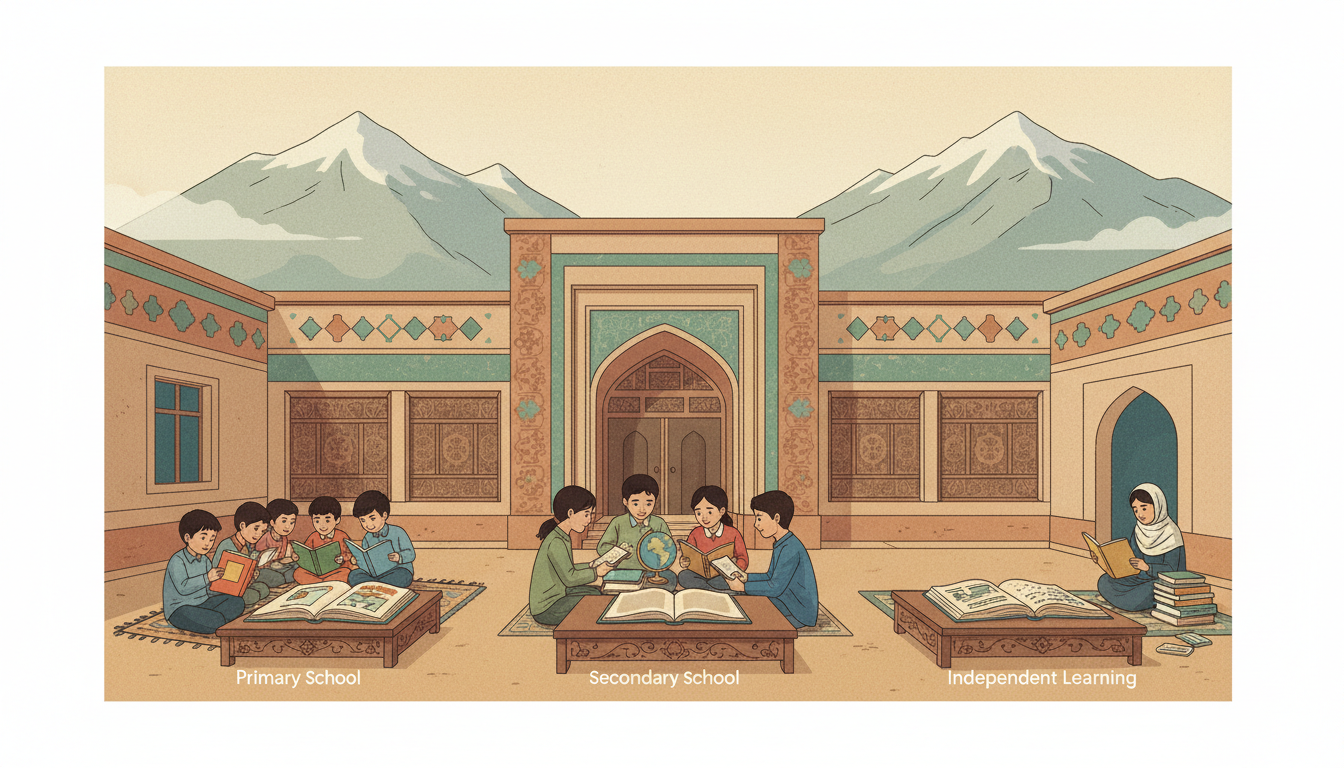
Education is the mechanism by which today’s children become tomorrow’s healthcare workers, builders, teachers, administrators, technicians and entrepreneurs. Primary schools, community learning, formal secondary pathways and technical skills are therefore connected to future public-service capacity, not simply examination results.
But Afghanistan’s present restrictions are an indispensable part of an accurate 2026 explanation. UNICEF reported in August 2026 that more than 2.6 million girls had been denied secondary education since 2021, and that formal secondary and higher education remained effectively closed to girls and women. This is not a small footnote: it affects rights, careers, future staffing, household income and the capacity of clinics and schools to serve women and girls. Read UNICEF’s August 2026 report.
For a closer, education-specific explanation, use eduKateSG’s Schools of Afghanistan guide, What Is Taught in School | Afghanistan and How Ministry of Education for Afghanistan Works. Those pages answer questions about school structures and curriculum; this page explains their place inside the wider national machinery.
9. What changes when women and girls cannot participate freely?
A country does not operate only through buildings. It depends on people being allowed to learn, work, travel, seek treatment and participate in institutions. Rules constraining women and girls affect far more than individual choice. They reduce the available workforce and can make it harder for women to obtain appropriate professional services.
UNICEF warned in April 2026 that continued restrictions could weaken the pipeline of female teachers and health workers. Think about the practical mechanism: a girl cannot complete higher education; fewer women qualify for training; a clinic or school has fewer potential employees; another generation encounters reduced access. This is a long feedback loop, not a one-year problem. The UNICEF analysis explains the projected risks.
Any serious account of how Afghanistan works must therefore include both what administrative institutions do and who is excluded from their benefits. A transport or budget diagram can be technically neat while missing the life of the person who cannot reach or use the service.
10. What role do neighbours, borders and international partners play?
Afghanistan is landlocked. Its access to goods, overseas markets, financial channels and humanitarian supplies is shaped by transport links and relationships with neighbouring states. A border restriction can affect merchants, food prices and employment far from the crossing point. Diplomatic statements and the physical movement of goods should be evaluated separately.
The United Nations, humanitarian agencies and local non-governmental groups carry out important work under their own mandates and operational limits. Their programmes do not erase the distinction between local state administration and independent humanitarian action. Funding interruptions, access restrictions and weather can disrupt delivery even after needs have been assessed.
When a news item says that assistance has been allocated, the right follow-up is not ‘so everyone received it’. Ask: for which province, which population, which period, through which implementing agency, and against what evidence of delivery?
11. A day in the system: how one family meets five institutions
Illustrative case, not a report about an identifiable family. A household in a rural district needs to sell crops, obtain a routine health consultation and arrange a child’s education. The crops must reach a road and buyer. The health visit requires a clinic with staff, medicine and safe access. School attendance needs a local institution, teacher, learning materials and permission to attend. Income from sales helps pay transport and household expenses. None of these is purely a ‘family choice’ because each depends on surrounding systems.
Now change just one condition: heavy weather closes the principal route for several days. Produce cannot move easily, medical supplies are delayed, some teachers may not arrive and fuel costs may rise. One small infrastructure failure becomes four household pressures. The problem looks like food, health, schooling and cost of living at the same time, but the underlying bottleneck is shared.
A good civic analysis therefore traces the chain backwards. Which link failed first? Who can maintain it? What alternative route or stock exists? Who bears the delay? This is the same method a student can use to understand interconnected systems in a classroom.
12. What is the difference between an institution, a service and an outcome?
- Institution: an education administration or health authority with assigned responsibilities.
- Service: teaching delivered in a classroom or medicine administered at a clinic.
- Outcome: a child learns to read, or a patient receives timely care.
- Indicator: a measure such as attendance, reading proficiency, travel time or stock availability.
- Limit: indicators may be incomplete, dated, differently defined or unable to capture excluded groups.
This separation protects readers from seductive but weak comparisons. A country may build a school without having enough teachers; record a clinic without reliable medicines; or announce a power project before households receive electricity. Conversely, local teams may deliver valuable outcomes with limited infrastructure and little publicity. Ask for both input and outcome evidence.
13. How is Afghanistan different from Singapore?
Both countries depend on education, transport, food supply, administration, public trust and outside connections. The differences are profound. Singapore is a compact, highly urbanised island city-state with coordinated dense infrastructure. Afghanistan spans mountainous terrain, dispersed settlements and land borders, with different security, fiscal, political and humanitarian realities. A Singapore-style timetable cannot simply be transplanted into a distant Afghan valley.
The useful comparison is a method, not a claim of superiority. Start with the person, identify the need, follow the transport and administrative connections, and ask where the service becomes usable. In How Singapore Works, the road, school, hospital and port are studied as parts of one city-state. Afghanistan makes the challenge of geography, last-mile access and human participation especially visible.
14. Four questions that help you read Afghanistan news critically
- Who is the source? Distinguish a de facto authority’s statement, an aid agency’s field report, a household account and an independent assessment.
- When did it happen? A 2020 account of elected institutions or a 2023 access number cannot automatically describe October 2026.
- Where did it happen? Kabul, a border city and a remote highland village may not share the same conditions.
- What was measured? Announced spending, completed projects, open buildings, trained staff and real access are different things.
Keep a small three-column notebook: claim, evidence, and the unanswered question. For example: ‘A new clinic opened’ is a claim; a dated facility record supports the opening; medicine availability and patient access remain open questions. This habit is more useful than memorising a string of ministerial titles.
15. A short classroom exercise: trace a system, not just a fact
Take the question ‘Why might the price of bread rise in one Afghan town?’ Draw six boxes: harvest, transport, border trade, milling, retailer and household. Place a possible obstacle above each box: drought, road closure, import delay, electricity interruption, fuel cost and weak purchasing power. Then mark which obstacles a national authority, local official, business, humanitarian organisation or household could realistically influence.
There is no single universal answer. The educational achievement is learning to differentiate cause from coincidence and identify which evidence would settle the question. A similar diagram can be drawn for medicine, school attendance, water or electricity.
Frequently asked questions about how Afghanistan works
Is Afghanistan currently governed as the former Islamic Republic?
No. The governing institutions and distribution of power changed substantially following the Taliban’s return in August 2021. Historical constitutional descriptions must not be treated as a live 2026 government directory.
Does one ministry control every service in every province?
No. Responsibilities, implementation capacity, local offices and external partners differ by sector. A national rule and the lived availability of a service are not the same thing.
Why is accessing a school or hospital harder in some places?
Distance, terrain, weather, road conditions, affordability, staffing, policy restrictions and available supplies can all matter. A national average cannot explain one community on its own.
Can Afghanistan’s economy grow while household living standards fall?
Yes. If total output grows more slowly than population and needs, per-person outcomes may worsen. The World Bank’s 2026 discussion makes this distinction explicit.
Are girls currently allowed into secondary school?
UNICEF reported in August 2026 that formal secondary education continued to be barred for girls, with exclusion from higher education for women. Consult current UNICEF and UNAMA reporting for any changes.
What is the single best way to understand a country system?
Follow an actual need from a household back through the road, local institution, budget, national rule and international connection. Then check whether reliable evidence shows that the intended outcome occurred.
Explore the connected eduKateSG civilisation library
This article belongs to How Countries Work, a country-by-country companion to How Singapore Works. Compare the first four country systems: Albania’s government and municipalities, Algeria’s president, parliament and wilayas, and Andorra’s co-princes, parishes and schools.
Sources and date of review
- UN Assistance Mission in Afghanistan — current mandate and field reporting.
- United Nations Security Council briefing, 16 September 2026 — government, rights and engagement context.
- UNICEF, 14 August 2026 — restrictions on girls’ secondary education.
- UNICEF, April 2026 — implications for teaching and health-workforce capacity.
- World Bank, May 2026 — economic constraints and household outcomes.
- Editorial review: 20 October 2026. Examples are explanatory scenarios, not claims about named individuals or uniform service procedures.