
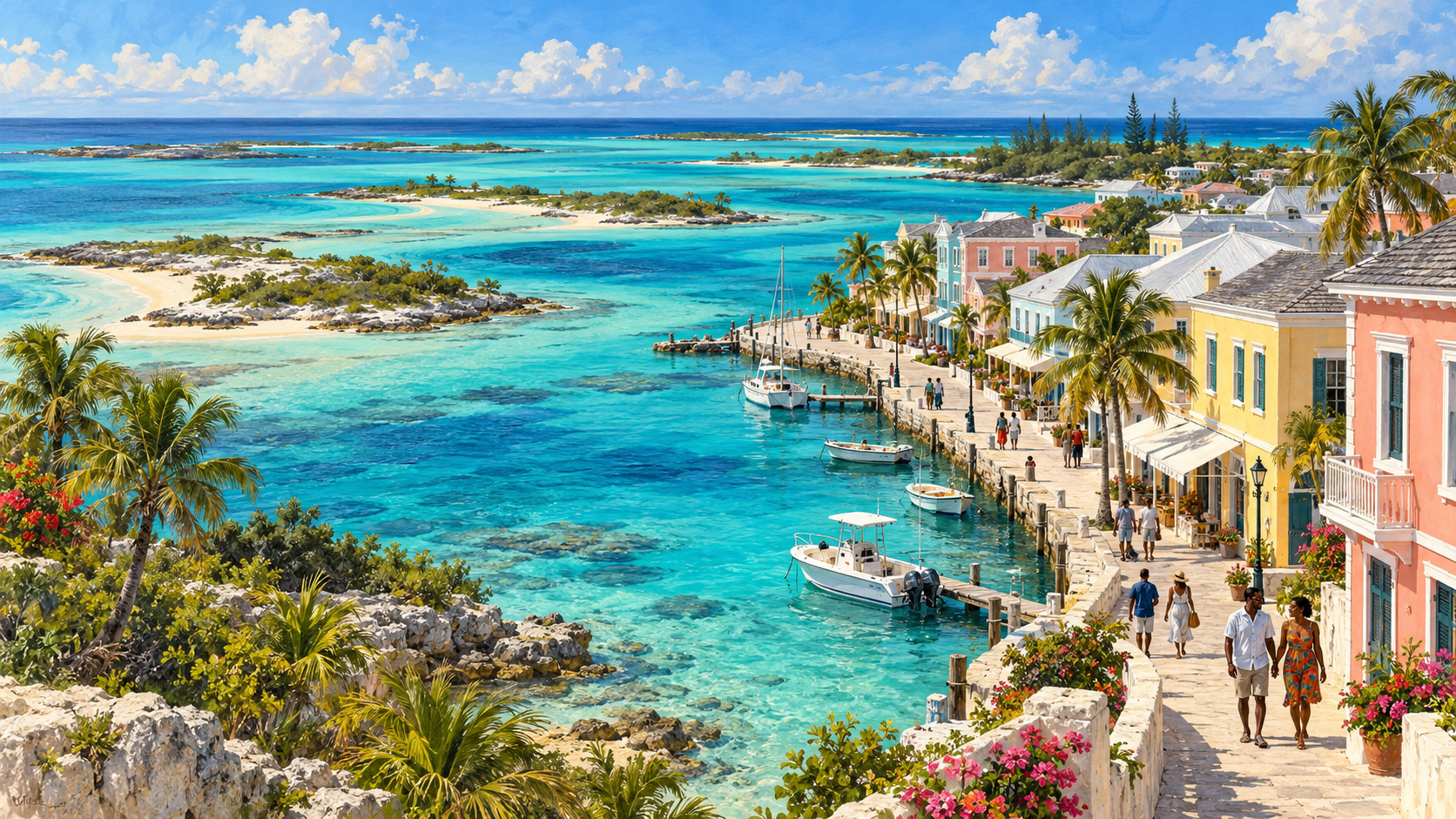
How does the government of The Bahamas work, why are the Family Islands governed differently from Nassau, and how do tourism, hurricanes, banking, ports and schools connect? The Bahamas is an independent parliamentary democracy and constitutional monarchy made up of many islands and cays in the Atlantic near Florida and Cuba. The prime minister leads the government, the governor-general represents the monarch as head of state, and Parliament includes an elected House of Assembly and an appointed Senate. Local-government arrangements on the Family Islands add another practical layer.
To understand how The Bahamas works, follow one ordinary journey: government policy → boats and planes → utilities and public services → tourism, jobs and family life → preparation for the next storm. Nassau is a major centre, but a family living on Abaco, Eleuthera or Exuma may depend on very different transport and supply arrangements. A strong tourism year does not automatically mean every island has reliable clinics, affordable groceries or resilient electricity.
The Bahamas explained in seven quick answers
- Government: parliamentary constitutional monarchy using a Westminster-derived structure, with a prime minister and cabinet, governor-general, House of Assembly, Senate and courts.
- Where people live: Nassau is on New Providence; Grand Bahama and the Family Islands have different transport, public-service and economic conditions.
- Local government: Family Island districts operate through institutions authorised by the Local Government Act, alongside national public services and administrators.
- Economy: tourism and related services are central, alongside financial services, construction, trade and public administration.
- Currency: the Bahamian dollar is maintained at a one-to-one parity with the US dollar under the central bank’s framework.
- Climate: hurricanes, sea-level rise, heavy rain and coastal exposure shape infrastructure and disaster planning.
- Education: primary and secondary systems include national assessments such as GLAT, BJC and BGCSE.
For the constitutional structure use the Government of The Bahamas. For finance, use the Central Bank. For the economy, consult the World Bank’s 2026 country assessment. The most useful reading method is to separate who has legal authority from the organisation that actually delivers a service.
1. Is The Bahamas an independent country or a British territory?
The Bahamas became independent in 1973. It remains a constitutional monarchy within the Commonwealth with King Charles III as head of state, represented in the country by a governor-general. That arrangement does not make The Bahamas a British overseas territory. The country has its own parliament, government, courts, budget and international relationships.
The prime minister is the head of government. The cabinet directs executive policy, and the Parliament makes laws within the Constitution. When a person hears that ‘the King is head of state’, it is important not to assume that the monarch personally sets the daily water supply schedule or directs the national tourism budget.
Political institutions are easier to understand when their functions are kept apart: constitutional representation, parliamentary lawmaking, executive administration and judicial decisions belong to different offices. The country’s official government overview describes these branches.
2. Who makes laws in The Bahamas?
The Bahamas has a bicameral Parliament: an elected House of Assembly and a Senate whose members are appointed under constitutional arrangements. The prime minister ordinarily emerges from the parliamentary system, and the cabinet manages government policy. Parliamentary debate and scrutiny give representatives routes to question spending, laws and decisions.
A parliamentary bill is not the same as an operating service. A law might establish a system for disaster-risk management, but agencies still need staff, equipment, secure buildings, communications, budgets and training. A parliamentary decision is one step in a much longer chain.
When you read a policy announcement, ask whether it concerns proposed legislation, a passed law, a cabinet decision, an allocation in the budget, a signed contract or a service that has started working. Those stages answer different questions and should not be combined in a single claim of success.
3. Why does local government work differently across islands?
The country’s many inhabited islands are separated by stretches of sea. The needs of a small settlement may be quite different from those of Nassau or Freeport. The Local Government Act, 1996 provides for districts, local councils and town committees and also refers to Family Island administrators and the Department of Local Government.
The legislation allows district arrangements and boundaries to be changed through lawful processes. For an exact present-day district count, the reader should consult the current law and related orders rather than an undated list. The main principle is more durable: local representation deals with assigned island and town matters, while national ministries and other public authorities retain separate responsibilities.
Imagine a public wharf needing repairs. Who owns it? Which authority can authorise maintenance, and which body is financing the work? A council may be close to residents, but an asset’s legal ownership and the relevant national department matter more than a generic statement that ‘local government is responsible’. See the Local Government Act.
4. Why are New Providence, Grand Bahama and the Family Islands different?
Nassau, on New Providence, concentrates many national functions, institutions, health services, businesses and transport connections. Grand Bahama contains Freeport and major port, industrial and tourism activities. Other islands support tourism, fisheries, small businesses and community life, with different population sizes and access costs.
A national promise to provide medicine must be executed differently in a dense urban district and on an outer island. The first may need an efficient urban supply chain and queues managed across facilities; the second may need weather-resilient shipments, a well-stocked clinic and a reliable referral route to a larger hospital.
This geography makes the phrase ‘national coverage’ incomplete unless it means what people can actually access. An island may be included in a national network on paper yet still face delays when the sea is rough or air services are interrupted.
5. What is the difference between an island’s port and its public service network?
A port connects an island to maritime movement, but port availability alone does not deliver groceries or medical supplies. A shipment must be loaded, cleared, moved inland, stored, paid for and distributed. Airports and inter-island vessels serve additional roles, and schedules depend on weather, maintenance and commercial arrangements.
Worked example — fictional grocery shipment: A shop on a Family Island orders rice, cooking oil and refrigerated supplies. The goods arrive in Nassau, are sorted and loaded onto an inter-island vessel, travel to a local dock and continue by truck. The shop must have storage and reliable electricity. One damaged dock or delayed sailing can leave shelves empty despite adequate stock in Nassau.
The lesson applies to education and healthcare too. Books, diagnostic equipment, spare parts and specialist workers travel through real networks. Infrastructure is only successful when the last mile reaches its intended person.
6. How does the tourism economy actually work?
Tourism supports accommodation, cruises, air travel, attractions, food services, taxis, excursion operators, cleaning, repairs and many behind-the-scenes jobs. It also creates demand for imported goods, reliable utilities, roads, waste systems and environmental protection. A tourism destination is a network of workers and services rather than only a collection of beaches.
The Ministry of Tourism reported 12.5 million visitor arrivals during 2025, with the bulk arriving by sea rather than air. The 2026/27 budget documents distinguish about 10.8 million sea arrivals from about 1.7 million air arrivals. This matters: a cruise passenger on a short stop contributes differently to the economy from a visitor spending several nights at a hotel.
The number of arrivals is a useful indicator, but it does not reveal how much income stayed with local workers and businesses. To judge value, ask about visitor spending, locally supplied goods, wages, taxes, training opportunities, environmental costs and jobs sustained beyond the peak season.
7. Why does a rise in visitor numbers not guarantee greater household prosperity?
A cruise ship can add thousands of arrivals in a day, but how much local income it generates depends on port arrangements, excursion spending, food purchases and transport services. A long-stay visitor may spend on hotels, restaurants, groceries and services over several days. Different visitors create different demand and costs.
A local entrepreneur also needs access to customers and affordable operating inputs. Rent, electricity, imported supplies, permits and transport may consume a significant share of income. A tourism boom can raise housing or infrastructure pressure even as it creates jobs.
The World Bank’s 2026 assessment notes the country’s concentration in tourism, high import dependence, skills gaps and climate risk. Those structural limits help explain why growing headline demand and unequal household outcomes may occur together.
8. What makes the Bahamas dollar different from the US dollar?
The Bahamian dollar is the country’s own currency. The Central Bank of The Bahamas maintains a one-to-one parity against the US dollar under the exchange-rate framework, backed by reserve management and exchange-control arrangements. Equal value at a particular official rate does not mean the two currencies are legally identical in all settings.
The central bank’s mission and statutory responsibilities include monetary stability, sound banking and protecting the external value of the currency. Its published exchange-rate page distinguishes some transaction rates and charges from cash parity.
A fixed exchange rate can make certain transactions predictable, especially with a major trading partner. Yet imported food can still become expensive if world prices or transport costs rise. A stable currency peg does not by itself make housing, wages and services affordable.
9. Why does the central bank care about foreign reserves?
Foreign reserves support the ability to meet foreign-currency requirements and maintain confidence in the exchange-rate arrangement. In an economy that imports many goods and earns important foreign currency through tourism and financial activity, international payments matter directly to businesses and households.
Imagine a hotel buying specialised equipment from abroad. The supplier must be paid through the relevant banking and currency channels. A predictable payments system makes the transaction easier, but approval procedures, bank services, foreign-exchange availability and shipping still matter.
This is why the central bank’s work affects much more than banknotes. Financial-system supervision, payment safety and reserves form some of the hidden infrastructure supporting trade and public confidence.
10. How does international financial services fit into the economy?
The Bahamas has an international financial-services sector alongside its tourism activities. Banking, insurance, trust and related professional services rely on legal certainty, skilled people, anti-money-laundering measures and international rules. The sector may be less visible to a tourist than a cruise terminal, yet it affects employment and the demand for professional expertise.
A financial institution needs secure information, trained staff, functioning courts, strong customer checks and clear regulatory responsibilities. An attractive tax or business environment alone is not enough for durable trust. International standards and compliance costs also influence the industry’s competitiveness.
It is useful to treat finance as a service supply chain: client identity → lawful onboarding → risk assessment → transaction → recordkeeping → oversight. Shortcuts in one link can create risks for the entire institution and the country’s reputation.
11. What does the National Insurance Board do?
The National Insurance Board of The Bahamas provides social-insurance functions through the contributions-and-benefits framework, including income-support arrangements for eligible people in defined circumstances. It is different from a general government ministry giving every resident the same automatic payment.
The National Insurance Board publishes current contribution information and public notices. For example, its 2026 notices discuss changes to the insurable wage ceiling. Readers must check the current eligibility rules and their circumstances rather than assume a benefit from a broad summary.
The bigger systems lesson is that social protection requires records, contributions, staff, secure payments, communications and sustainable financing. A benefit can be legally available but difficult to receive when documentation or service access fails.
12. Why are hurricanes a national planning issue?
The Bahamas lies in a region exposed to Atlantic tropical cyclones. Wind, storm surge, heavy rain and coastal flooding can damage housing, public buildings, ports, roads, power networks and fresh-water systems. A single storm may affect some islands severely while others experience much less damage.
Hurricane Dorian struck Abaco and Grand Bahama in September 2019, leaving widespread destruction. The disaster demonstrated how damage to a port or airport can delay the restoration of clinics, food distribution and utilities. It is a historical case study, not a claim about current conditions on those islands.
The Disaster Risk Management Authority’s history page explains how the Dorian experience influenced subsequent planning. Readers should use the current national disaster agencies and official weather authorities for live alerts, not this long-term educational article.
13. What changed in disaster management after Dorian?
The country’s disaster-management arrangements have developed to place greater emphasis on preparedness, risk reduction, coordination and recovery. The Disaster Risk Management Authority describes itself as part of a shift in approach after Hurricane Dorian. An older report may use earlier organisational terms such as NEMA; always check which agency and mandate apply to the current service.
Preparedness involves warning systems, emergency shelters, pre-positioned supplies, trained responders, safe building practices and the ability to reconnect islands after damage. During a disaster, information must travel quickly even when normal infrastructure is unavailable.
A sensible measure of preparedness is not simply the number of meetings held before hurricane season. Ask whether people know where to go, whether shelters are accessible, how vulnerable residents are assisted and how long essential power and water take to return.
14. Why is hurricane recovery different on a remote island?
Imagine a major storm damaging a dock and the only reliable road to a small community. Even if national stores contain food and replacement generators, the goods cannot arrive until transport routes become usable or alternative arrangements are organised. A repair crew may require a boat, fuel, tools, communication equipment and safe accommodation.
This is the distinction between national capacity and last-mile resilience. A large stockpile in one place may be helpful but not sufficient. Supplies, skills and backup arrangements must be designed around actual island geographies.
Good disaster planning also considers families with young children, people with disabilities and older residents. Evacuation procedures must work for people who cannot move as easily as a healthy adult with a vehicle.
15. How are climate change, coastal planning and tourism connected?
Sea-level rise, stronger storm surges and coastal erosion can threaten roads, homes, beaches, mangroves and tourism facilities. Coastal development may bring investment and jobs, but buildings or reclaimed areas need engineering, environmental consideration and realistic long-term maintenance.
A hotel that is profitable on opening day can become expensive to protect after repeated flood events. A seawall may protect one location while changing erosion patterns elsewhere. Natural coastal habitats also provide protective and ecological functions that cannot always be replaced with concrete.
The strongest policy question looks past a project’s opening ceremony: what is its lifecycle cost, who pays after damage, which people benefit and what happens to neighbouring communities?
16. How do desalination and freshwater systems work?
Island settlements have varying freshwater sources, storage and distribution arrangements. Some communities rely partly on groundwater, treatment, desalination or transported supplies depending on local conditions. The important lesson is to identify the specific island and operator before generalising about national access.
A drinking-water system needs source protection, treatment, electricity where pumping is required, safe storage, testing and a working distribution network. Even if a production facility operates, a burst pipe or contaminated storage tank can interrupt household supply.
Students can sketch the sequence source → treatment → storage → transport → tap and place a possible risk at every arrow. This simple map often reveals why an engineering project and actual household reliability are separate achievements.
17. What makes electricity particularly difficult across islands?
Electricity provision across multiple islands involves networks of different sizes and operating conditions. Some systems are isolated from others, making spare capacity, fuel deliveries, repairs and backup resources especially important. A storm that damages a local power station or line cannot necessarily be solved by routing power from a distant island.
Solar energy and storage may offer useful opportunities, particularly where fuel costs or transmission distances are high, but they require suitable design, safe installation and long-term maintenance. A rooftop panel does not remove the need for reliable wiring, storage planning and skilled technicians.
Electricity matters to more than lighting. It keeps a clinic refrigerator safe, enables water treatment, supports digital banking and lets a family store food. An outage spreads through multiple sectors at once.
18. How do Bahamian schools support the whole country?
Schools build the literacy, numeracy and technical skills needed for healthcare, public administration, banking, engineering, construction and hospitality. The education system includes primary, junior and senior secondary pathways, with differences according to individual schools and islands.
The Ministry of Education’s examination division explains national assessments including GLAT, the Bahamas Junior Certificate and the Bahamas General Certificate of Secondary Education. These measure different stages and should not be conflated with a universal university-entrance examination.
For the specialist education library, read Schools of The Bahamas, How Education System of Bahamas Works and How Ministry of Education for The Bahamas Works. The country-level guide focuses on their connections to society.
19. Why can education be harder to deliver across multiple islands?
A national curriculum may be shared, but local implementation depends on having trained teachers, buildings, books, internet access and reliable transport. A small island school may need specialist teachers whose services are difficult to provide onsite at all times.
A school administrator must also plan for storm closures, interrupted ferries, repairs and continuity of learning. Remote resources and digital instruction can help if connectivity and devices work, but they do not replace every form of face-to-face teaching or pastoral support.
Fictional example: A science class needs equipment for an experiment. The equipment is ordered nationally but delayed because an inter-island shipment is postponed. The teacher adapts with a simpler lesson, yet some learning objectives still require later practical work. This is a logistics problem inside an education problem.
20. What connects public health, islands and emergency transport?
A clinic on a small island may manage routine care while specialist treatment requires a referral to a larger centre. The journey needs a medical decision, a booking, affordable and safe transport and a facility ready to receive the patient. In a storm, those links can be interrupted even when staff on both islands are available.
That is why resilient healthcare involves more than building clinics. Communication, evacuation arrangements, cold-chain storage, staffing, emergency supplies and social assistance all matter.
When evaluating healthcare equity, ask whether patients in different locations can reach comparable outcomes, not whether every island has exactly the same kind of building.
21. Why does construction matter to a tourism economy?
Construction creates homes, hotels, roads and public buildings and provides work for builders, engineers, electricians and suppliers. But building activity also increases demand for land, imported materials, labour, utilities and maintenance. It can therefore support jobs while adding pressure to affordability.
If a new resort raises seasonal population in a community, water, sewage, waste collection and road networks may need upgrading. A private investment is not isolated from public infrastructure. The fair test is whether its full operating impacts have been planned and financed.
A national budget can support infrastructure, but fiscal resources are limited. The 2026/27 Bahamian budget portal is useful for seeing how the government presents spending priorities and the costs of its programmes.
22. How should students evaluate tourism and economic statistics?
A country may report millions of arrivals, increased GDP or more rooms under construction. None of these alone reveals wages, wealth distribution or food security. A careful reader asks whether the numbers measure cruise visits, overnight air arrivals, hotel nights, spending, employment or tax receipts.
Similarly, an unemployment rate should be accompanied by its date and method. One island’s labour market may differ from another, and national figures can conceal barriers faced by young people or people with disabilities.
A good information habit is to keep the source, year, definition and unanswered question beside each statistic. That makes comparisons more honest and far more useful.
23. The Bahamas compared with Singapore
Both are island nations dependent on overseas connections and vulnerable to global supply interruptions. Singapore concentrates many services on a dense city-state connected by land transport, a major port and airport. The Bahamas spreads service needs across numerous islands and faces especially acute Atlantic hurricane risks. Their infrastructure designs naturally differ.
Singapore’s public transport and water systems illustrate how dense urban networks reduce the cost of movement and distribution. The Bahamas shows why island-to-island shipping, evacuation capacity and decentralised utility resilience matter. A policy that works for a densely populated housing estate may not make sense for a small outer-island village.
Read How Singapore Works and How Singapore Connects | Roads, Expressways and Junctions for a detailed companion case.
Frequently asked questions about how The Bahamas works
Does The Bahamas have a president?
No. It is a constitutional monarchy with a governor-general representing the head of state and a prime minister leading government under a parliamentary system.
Is The Bahamas part of the United Kingdom?
No. The Bahamas has been an independent sovereign country since 1973. Commonwealth membership does not mean it remains a British overseas territory.
What are the Family Islands?
The term commonly refers to the outlying inhabited islands beyond the central Nassau/New Providence setting, though official administrative uses should be checked in context. Their public-service networks vary by location.
Why does the government need special local arrangements?
Many islands are physically separated, so roads, ports, clinics and utilities must be planned with their own local needs. The Local Government Act provides a framework for local districts and representatives.
Why does the country count so many tourist arrivals?
Tourism is a major economic activity. The 2025 figure of 12.5 million arrivals includes both sea and air visitors, whose spending and length of stay differ.
Is one Bahamian dollar always one US dollar?
The Central Bank maintains official one-to-one parity, while transaction charges or particular banking rates may differ. Consult current central bank guidance for a specific transaction.
What did Hurricane Dorian teach The Bahamas?
Dorian’s 2019 devastation showed how damage to housing, ports, airports, power and water can interrupt several essential services at once. Recovery and preparedness must be connected.
How do children take national exams?
The education system uses assessments such as GLAT, BJC and BGCSE at different stages. Use the Ministry of Education’s current timetable and entry guidance for dates and eligibility.
What is a better measure of national success than visitor arrivals?
Measure usable outcomes alongside tourism: reliable water and electricity, accessible health and schools, quality jobs, resilient infrastructure and household affordability.
A five-minute systems exercise: one box of medicine
Draw a path for a box of medicine from an overseas supplier to a patient on a Family Island: ordering, payment, import, airport or port, storage, inter-island transfer, clinic and patient. Add possible breakdowns such as weather, damaged dock, power outage, missing documents or shortage of trained staff. Which points need national action and which are local?
This exercise shows why island geography changes administration. A well-written policy must reach a person through a real route before it becomes an effective public service.
Continue the world country series
This is part of How Countries Work, the world-civilisation sibling of How Singapore Works. Compare Antigua and Barbuda’s two-island system, Andorra’s mountain parishes, and Azerbaijan’s energy and Caspian corridors. Continue with Bahrain’s finance and public services for a different island economy.
Sources and editorial review
- Government of The Bahamas — constitutional structure and departments.
- Local Government Act, 1996 — Family Island governance.
- Bahamas Budget 2026/27 — dated spending and tourism data.
- Ministry of Tourism, January 2026 — 2025 visitor-arrival figures.
- Central Bank of The Bahamas — currency, regulation and reserves.
- World Bank Macro Poverty Outlook, 2026 — tourism concentration and development risks.
- Bahamas Disaster Risk Management Authority — Hurricane Dorian lessons.
- Bahamas Ministry of Education, Examinations and Assessment — GLAT, BJC and BGCSE.
- Reviewed: 20 October 2026. All family and logistics examples are fictional; check current official updates for hurricane alerts, legislation, tax rates and school examination schedules.