
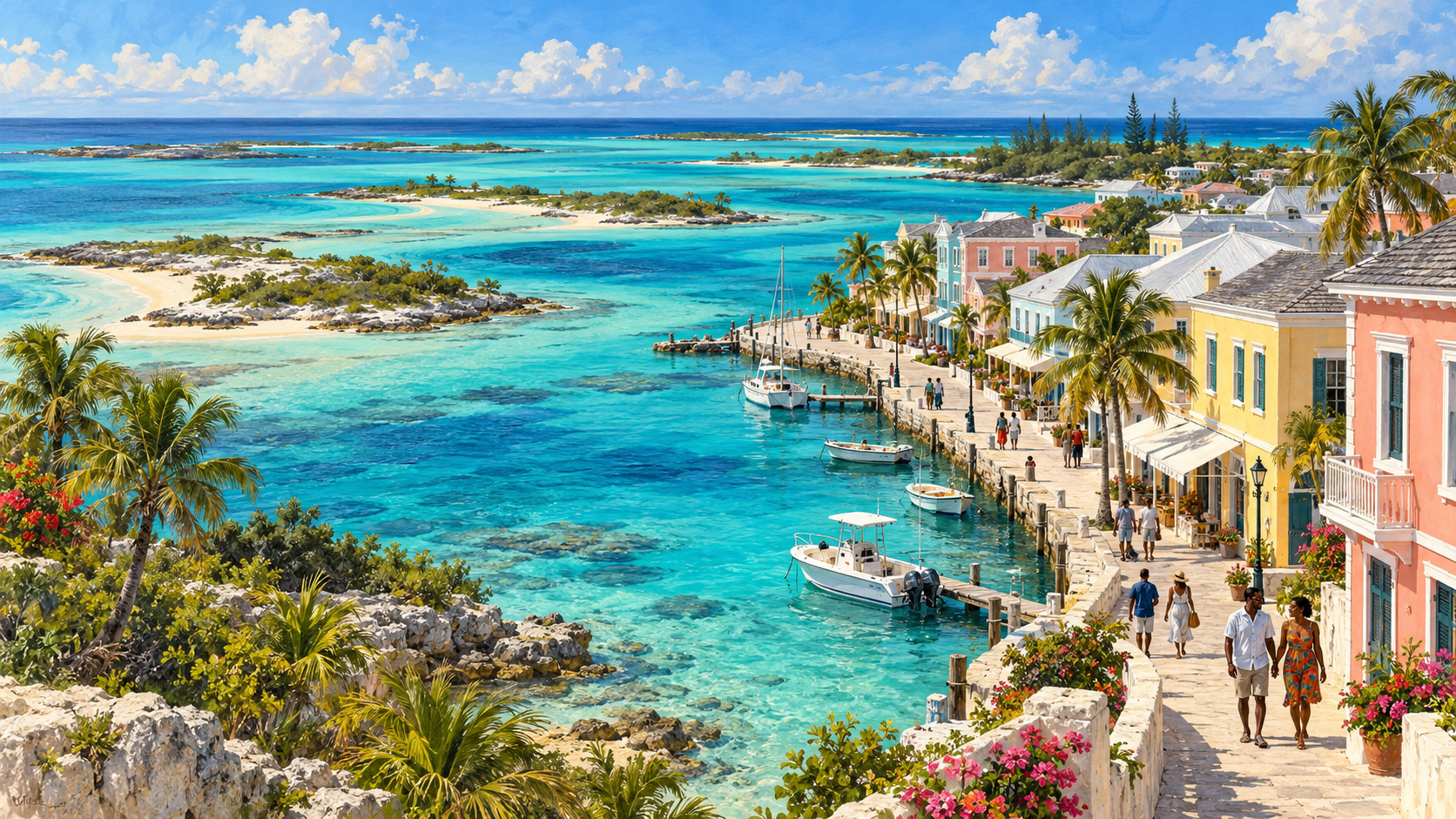
The Bahamas offers far more than one beach holiday. The best things to do when visiting and touring the Bahamas include Nassau’s history, Junkanoo culture, guided reef experiences, the Exumas, Eleuthera and quieter Out Island stays. A thoughtful Bahamas travel itinerary chooses a few islands and gives the journeys between them proper attention.
For a first Bahamas holiday, a family visit or a couple’s island escape, begin with the kind of experience you want. You might enjoy a lively Nassau base, several relaxed beach days, a nature-focused Andros chapter or a smaller island community. This guide introduces ten experiences and helps you connect them without assuming every island is a convenient day trip.
The water is part of both the attraction and the planning. Flights, ferries, transfers and excursions serve different routes and can be affected by weather. Choose the base first, verify the connections and allow time for a changed plan. A beautiful view does not tell you whether a beach, boat outing or swim is suitable that day.
eduKateSG · A WORLD WORTH UNDERSTANDING
Find your way through Bahamas
Choose the part you need now, or follow the whole journey at your own pace.
A short trip can stay on one island and still include culture, food, nature and time by the sea. A longer visit may add one carefully chosen second chapter. Decide whether that chapter is mainly about beaches, marine activities, heritage or quieter daily life before booking transport.
| Experience | Choose it for | Planning decision |
|---|---|---|
| Historic Nassau | A cultural introduction | Use a manageable daytime route |
| Junkanoo and local arts | Music, making and cultural context | Confirm current events or presentations |
| A well-chosen beach day | Rest and coastal scenery | Check access and current water conditions |
| A guided reef outing | Marine learning | Match the activity to ability and supervision |
| An Exuma boat experience | Cays and changing coastal views | Read the route and weather policy |
| Eleuthera and Harbour Island | A slower island chapter | Choose transport and a sensible base |
| Andros’ blue-hole landscape | Geology and nature interpretation | Separate viewing from specialist diving |
| A national park visit | Habitats and conservation | Confirm opening and guiding arrangements |
| Bahamian food | Everyday culture | Ask about ingredients and sourcing |
| Long Island | Community history and an unhurried stay | Check onward connections and local transport |
The ten experiences form a country-wide menu. They should not be read as ten consecutive excursions from Nassau. Some need a dedicated stay or a carefully organised connection.
Nassau gives a Bahamas visit an urban and historical introduction. Choose a daytime route that connects a few heritage stops with a museum or guided explanation and a relaxed meal. The city deserves attention beyond the transfer between an arrival point and a resort.
A local guide can help you connect buildings and public spaces with the people and events that shaped them. Ask what remains visible, what has changed and which details help explain daily life today. This makes the walk more useful than a sequence of photographs without context.
Confirm the current arrangements for any museum or historic site that matters to you. Check whether the visit involves steps, limited shade or a longer walk than expected. If mobility or heat is a concern, choose fewer stops and arrange suitable transport.
Follow current local and official safety guidance when choosing the route. As checked on 8 October 2026, FCDO advice describes violent crime in parts of New Providence and Grand Bahama, including tourist areas. Use established daytime visits and reliable transport, and do not extend a sightseeing walk into unfamiliar or unlit areas after dark.
The official Nassau and Paradise Island guide helps you orient the visit. Ask your accommodation or reputable guide about the exact route and current conditions before setting out.
Junkanoo introduces a rich cultural world of sound, movement and making. A parade, an interpretive presentation and a craft-focused visit are different ways to approach it. Choose what is actually available during your stay rather than assuming a major event happens whenever visitors arrive.
Check current calendars and booking arrangements. If a performance is central to your trip, confirm the date, setting, duration and practical arrangements directly. A previous year’s festival announcement is useful background, but it does not establish this year’s programme.
Where a maker or guide is available, ask about the work behind the spectacle. How is a costume planned? Which materials are used? How do rhythm and movement fit together? The answers can make the experience more memorable than simply recognising a colourful procession.
Photograph and record only where permission allows. Leave space for participants and other spectators, and follow event staff’s instructions. If travelling with children, discuss crowds, noise, meeting points and a suitable exit plan before entering a busy event.
The official tourism site’s Junkanoo introduction offers cultural background. Use current event information for the visit itself and give the experience room beyond a quick entertainment stop.
A good beach day begins with the practical setting. Consider access, facilities, shade, transport and the needs of everyone in the group. The most striking photograph may show a beach that is less suitable for your actual day than a more convenient alternative.
Separate enjoying the coast from deciding to swim. You can appreciate the light, sand and sea while remaining on shore. For swimming, obtain current local advice about conditions, permitted areas and supervision; clear water is not evidence that the outing is safe.
Agree on a simple arrangement for children and belongings. Know where the group will sit, where facilities are located and how you will return. Avoid relying on an unconfirmed pickup from a remote location, especially when mobile coverage or transport options may be limited.
Give the day a rhythm: arrive, settle in, take a short walk where appropriate and leave time for a meal. There is no need to add a boat trip and several distant stops simply to make a relaxed day appear more productive.
For a Nassau-area option, the official Junkanoo Beach page provides location context. Check current local arrangements and choose the beach for suitability as well as appearance.
A reef experience should be chosen for the traveller, not just for the image on the booking page. A beginner snorkeller, a certified diver and a person who prefers a boat-based view need different arrangements. Describe swimming ability and experience clearly before booking.
Ask about the operator’s safety briefing, supervision, equipment, vessel facilities and alternatives for someone who does not enter the water. Confirm the location and the amount of time actually devoted to the activity. Similar tour names can describe very different days.
Marine life is wild. An operator should not need to promise a particular animal encounter to make the outing worthwhile. Look for an experience that provides interpretation and follows responsible wildlife practices. Observe without touching, feeding or chasing animals, and keep clear of coral.
Follow current guidance about water conditions and wildlife risks. FCDO advice for the Bahamas specifically discusses shark risk and warns against night swimming, including dusk. Treat the operator’s briefing and official guidance as essential parts of choosing and completing the activity.
The official Bahamas experiences directory can help identify options. Verify the actual provider’s credentials and arrangements independently before paying, and keep your own comfort level central to the decision.
An Exuma boat outing can reveal how cays, shallow water and open passages change the coastal view. The most useful choice is a route that gives you time at a few suitable stops, with an operator who explains both the landscape and the day’s practical conditions.
Read the itinerary closely. Where does the trip start? How long are the transfers? Which activities are optional? What happens if weather changes the route? A headline promising many stops may leave little time to enjoy any one of them.
Ask about seating, shade, toilets where relevant, lifejackets and the needs of children or travellers with limited mobility. Tell the operator if boarding or moving around the vessel could be difficult. These details can determine whether the outing is comfortable.
Animal attractions should never be treated as a required part of an island day. Choose an operator whose wildlife practices you are comfortable with and decline activities that involve feeding, handling or crowding animals. The water and landscapes offer plenty to appreciate without staging an encounter.
The official Exumas guide introduces the destination. Plan the outing around its actual departure point and connection requirements rather than assuming every Exuma experience can be reached conveniently from your existing base.
Eleuthera and Harbour Island offer a strong option for a slower stay. Choose a base that supports the beaches, settlement visits and meals you want, then investigate the transport needed to connect them. It is a regional chapter to organise thoughtfully, not an automatic extension of every Nassau visit.
Harbour Island’s pink-sand setting is a familiar attraction, but the outing becomes richer when you leave time to notice the town and speak with local businesses where appropriate. Choose a small number of activities and allow the day to remain unhurried.
Eleuthera deserves the same care with distance. Check where your accommodation sits in relation to arrival points and proposed stops. A map’s broad island outline can hide the amount of time spent moving between different parts of a stay.
For beaches and viewpoints, follow current access and safety guidance. Do not cross barriers or approach an exposed edge for a photograph. If you hire transport, confirm licences, insurance, local rules and the practical conditions for using it.
The official getting-around information is a useful starting point. Confirm your exact arrival, transfer and onward arrangements directly with the relevant providers.
Andros offers an opportunity to approach the Bahamas through geology and habitats. A guided visit to the blue-hole landscape can help you understand why these features matter and how they sit within the wider environment.
Begin with interpretation. Ask how a blue hole forms, what can be observed from the visitor area and how the site is managed. You do not need to enter the water to appreciate the feature. A well-explained land-based visit can provide a complete experience.
Separate viewing, swimming and specialist diving in the plan. They involve different conditions, skills and arrangements. This guide recommends a suitably organised nature visit; it does not provide instructions for cave diving, deep diving or unsupervised entry into a blue hole.
Confirm the exact site, access, guide, walking demands and facilities. A remote nature outing may need more preparation than a resort activity. Carry the supplies recommended by the provider and leave enough time for the return journey.
The official Andros guide introduces the island, while the Bahamas National Trust virtual park experience provides background on Blue Holes National Park. Check current visitor arrangements before making the journey.
A national park can give a Bahamas holiday a different visual language from the beach. Forest, wetland or coastal habitats invite you to notice relationships rather than search only for a dramatic view. Choose a park that fits the island where you are staying.
For New Providence, investigate the Primeval Forest National Park; for Andros, Blue Holes National Park may be relevant to your plans. These are separate regional choices. Confirm current opening, access and guided-visit arrangements with the Bahamas National Trust or an authorised provider.
A short interpreted walk can be enough. Ask the guide to explain one habitat relationship, such as how vegetation responds to the ground beneath it or why an animal uses a particular part of the landscape. That connection gives the walk a clear focus.
Use established routes and follow park instructions. Leave plants, rocks and other natural objects in place. If you want a souvenir, choose a permitted local purchase rather than taking something from a protected site.
The Bahamas National Trust park directory helps you identify the relevant place. Check the details for that individual park instead of assuming that all parks have the same facilities or visitor arrangements.
A locally focused meal can connect the landscape to everyday life. Ask what the restaurant is serving, which ingredients are central to the dish and how it is usually prepared. A friendly question can reveal more than ordering the most frequently photographed plate.
Conch, fish and other seafood may appear on menus, but choose responsibly sourced dishes and ask the provider about the ingredients. Seafood is optional. Travellers with allergies, dietary preferences or different appetites should look for a meal that suits them rather than treating one dish as a compulsory experience.
A market or food-focused outing works best when it is arranged around real businesses and their working rhythm. Ask permission before photographing a vendor, buy something you want and keep the conversation considerate when the stall is busy.
For a family, use one dish as a writing prompt. Describe flavour and texture in concrete language, then explain which ingredient or preparation method interested you. Compare it with something familiar without assuming that the unfamiliar version needs to be judged against home.
Check food-related purchases before bringing them across borders. A recipe, a note or a photograph taken with permission may be the most practical souvenir. Food can also be the relaxed centre of a day between more demanding excursions.
Long Island is a choice for travellers who want a distinct Out Island chapter. Give the stay enough time for local history, coastal scenery and ordinary pauses. Confirm onward connections and ground transport before choosing accommodation.
The Long Island Library and Museum is one place to investigate for community history and material culture. Check its current opening arrangements directly. A small museum visit can make the surrounding settlements easier to understand when you look at everyday objects and ask how people used them.
Coastal viewpoints and familiar natural features can be included when current conditions and access permit. Dean’s Blue Hole is a known landmark, but a sightseeing visit does not require entering the water. Deep water, steep edges and specialist diving should never be treated as casual photo activities.
Leave time for a meal, a local purchase and a conversation where welcomed. The appeal of a quieter chapter often lies in having fewer demands on the day. An island should not have to produce a succession of spectacles to be worth visiting.
The official Long Island guide and museum listing provide starting points. Confirm the practical details locally rather than relying on an older published schedule.
Four to six days: one island base
A Nassau or Paradise Island stay can combine a cultural day, a carefully chosen marine outing, local food and time at the coast. These activities need not fill every morning and afternoon. Leave a flexible day in case weather affects the boat plan.
If you arrive on a cruise call, work within the ship’s actual return requirements and the operator’s confirmed arrangements. Do not assume a longer independent excursion is possible merely because it appears in a destination list.
Seven to ten days: one base and one additional chapter
Choose a second chapter for a clear reason: the Exumas for a suitable boat and coastal experience, Eleuthera and Harbour Island for a slower stay, or Andros for nature interests. These are alternatives, not a suggested sequence for a short holiday.
Verify flights or ferries for your dates and the transfer needed at each end. Consider luggage limits, check-in requirements and the consequences of a delay. Let the connection day remain manageable rather than booking an essential activity immediately after arrival.
A longer trip: fewer islands, more time
A longer holiday does not need to become a race through the archipelago. Add days where they allow a second attempt at a weather-dependent activity, a local cultural visit or simply a comfortable rhythm.
If Long Island or another smaller island interests you, investigate its transport and facilities early. Check how the onward connection relates to the flight home, and leave a reasonable buffer. Flexibility is easier to enjoy when the essential logistics are already clear.
Read current safety and weather advice
Consult your own government’s travel advice and local official guidance. The FCDO Bahamas advice and safety page are useful reference points, including their guidance on crime, water activities and storms. Check updates close to departure.
Weather can change a marine activity or connection. Discuss the operator’s cancellation policy, refund terms and alternative arrangements before booking. If a trip is cancelled for conditions, use the planned substitute rather than looking for someone willing to ignore the concern.
Confirm each connection
A country-level destination guide does not establish that two islands have a convenient direct service. Check the exact airport or port, operating dates, transfer points and ground transport. Keep the confirmation where everyone responsible for the itinerary can access it.
Use reliable providers and confirm pickup details. If the group separates for activities, agree on meeting points and what to do if the return is delayed. A little preparation can keep a relaxed island stay relaxed.
Compare the complete budget
Include accommodation, food, transport, boat excursions, admissions, equipment, relevant taxes or charges and appropriate insurance. Ask providers what the advertised price includes. A remote stay may have different meal and transfer options from a larger resort area.
Do not assume that a room rate includes every activity shown in its photographs. Confirm the details that matter before paying, particularly transfers, meals and marine outings. Compare arrangements for your actual group size and dates.
Plan for different needs
Ask about shade, toilets, boarding steps, seating and walking surfaces. For a boat outing, explain mobility needs before booking; access at the departure dock does not automatically describe access at every stop.
Families should discuss swimming ability, supervision and the comfort of the vessel with the operator. Travellers who prefer to remain on land can still enjoy culture, nature interpretation, food and coastal views. Choose shared experiences that welcome everyone.
Check entry information directly
Requirements depend on nationality and personal circumstances. Consult official Bahamas immigration information and the relevant travel advice for your passport. Do not assume that a connection through another country creates the same requirements as a direct arrival.
| English | 中文 | A useful question |
|---|---|---|
| Cay | 沙洲小岛 | Which cays are on today’s route? |
| Island transfer | 岛际接驳 | Where does the transfer depart? |
| Weather cancellation | 因天气取消 | What happens if the boat trip is cancelled? |
| Lifejacket | 救生衣 | Is a suitable size available for my child? |
| Guided snorkelling | 向导带领的浮潜 | What supervision is provided? |
| Blue hole | 蓝洞 | Can we visit without entering the water? |
| Protected habitat | 受保护的栖息地 | Which paths may visitors use? |
| Cultural presentation | 文化展示 | Is this event open to visitors? |
| Dietary requirement | 饮食要求 | Can you confirm the ingredients? |
| Onward connection | 后续转乘 | How much time should we allow? |
These are English–Chinese learning prompts. Practise explaining your needs clearly, especially for water activities and transport. Repeat an important detail back to the provider if you need to check that you understood it correctly.
Begin with one specific observation. You might describe the difference between a harbour and an open coast, the stages of a costume-making process or an object in a local museum. Then explain what that detail helped you understand.
Separate observation from interpretation. “The guide explained how the feature formed” is different from claiming that you established its geology yourself. Record the source of an explanation so that you can return to it later.
For families, compare two settings after a few days. What changed between the busy arrival area and the quieter island chapter? What did transport, facilities or daily routines reveal? Keep the comparison respectful and avoid assuming that a visitor’s brief impression represents every resident’s experience.
The World Travel Vocabulary City Directory offers another language route. The World City Experiences Directory provides focused urban reading alongside this country series.
How many islands should I visit?
Begin with one base and add another only when it contributes something you particularly want. Check actual connections and give each chapter enough time. A short stay can be varied without changing islands repeatedly.
Must I swim or dive to enjoy the country?
No. Heritage visits, arts, food, guided nature walks and coastal views provide many land-based choices. For any water activity, match the arrangement to your ability and the current conditions.
Are blue holes suitable for casual diving?
A sightseeing visit and specialist diving are different activities. This guide proposes interpretation and suitable viewing arrangements. Diving requires the appropriate qualifications, provider, equipment and conditions; do not improvise it from a travel recommendation.
Can I rely on a previous year’s festival dates?
Use previous announcements for background only. Confirm the current programme and visitor arrangements directly before making bookings around an event.
Sources checked on 8 October 2026 include the official Nassau and Paradise Island guide, Junkanoo background, Junkanoo Beach information, Exumas guide, Eleuthera and Harbour Island transport overview, Andros guide, Long Island guide, Long Island museum listing, Bahamas National Trust park directory, virtual park experiences and FCDO safety guidance. Recheck relevant official information and provider arrangements before travel.
Continue alphabetically to Bahrain. Revisit Azerbaijan or choose another destination in the World Country Experiences Directory.