
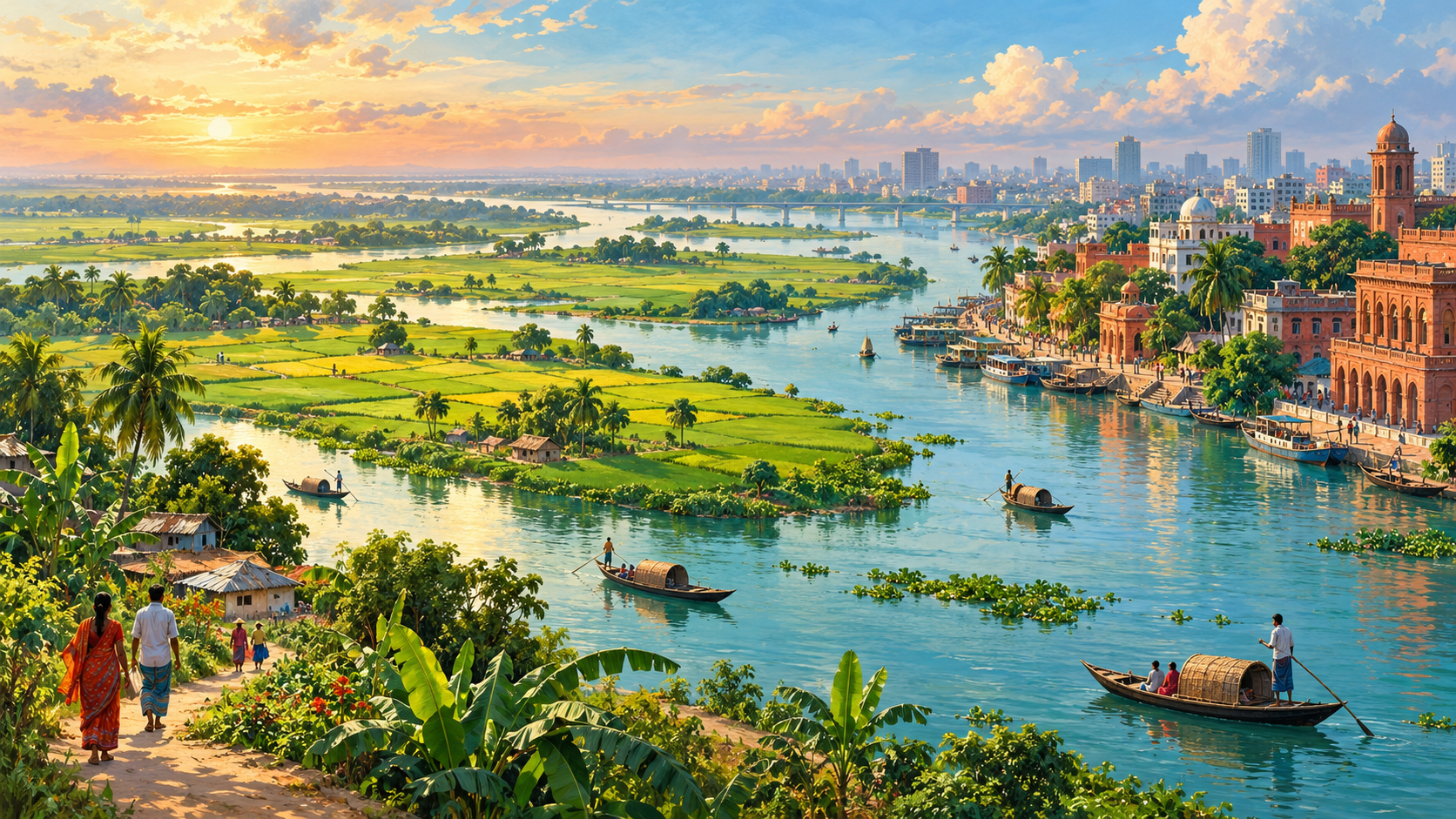
How does Bangladesh’s government work in 2026, how do its eight divisions and 64 districts connect to local services, and why do rivers, garment exports, remittances and cyclones matter to daily life? Bangladesh is a parliamentary republic in South Asia. Following the political upheaval of 2024 and an interim administration, a general election took place in February 2026. The Bangladesh Nationalist Party won a majority, and Tarique Rahman was sworn in as prime minister. The president remains the head of state under the country’s constitutional framework, while the cabinet and parliament have different governing responsibilities.
Bangladesh works through several tightly connected systems: national decisions → divisions, districts and local administrations → rivers, roads and ports → factories, farms and schools → households and climate resilience. The country is a major exporter of ready-made garments and an enormous river delta exposed to floods and cyclones. Bridges can transform travel, but a bridge alone cannot guarantee reliable electricity, affordable food, safe factory work or fair access to healthcare. This guide makes those connections visible.
Bangladesh in one minute: the main answers
- Government in October 2026: a parliamentary republic led by Prime Minister Tarique Rahman after the February 2026 election, with the president as head of state.
- Administrative map: eight divisions and 64 districts, followed by upazilas and local bodies including unions, municipalities and city corporations.
- Geography: the Ganges–Brahmaputra–Meghna river system and low-lying delta shape travel, farming, settlement and flood risk.
- Exports: ready-made garments provide important foreign earnings and jobs, alongside agriculture, other industries and services.
- Overseas links: workers’ remittances and imports of fuel, raw materials and machinery influence household incomes and the national economy.
- Infrastructure: bridges, roads, inland waterways, railways, electricity networks and ports connect Dhaka with regions and foreign markets.
- Education: primary, secondary, higher-secondary, technical and madrasah pathways develop essential future skills.
For administrative geography, consult the Bangladesh national information portal. For the election and transition, see Reuters, 17 February 2026. The World Bank’s October 2026 Bangladesh Development Update provides current economic context. Separate structural facts from events that can change.
1. Who governs Bangladesh after the 2026 election?
Bangladesh’s parliament, known as the Jatiya Sangsad, is central to the parliamentary system. The prime minister leads the government and cabinet, while the president performs constitutional head-of-state functions. Ministries and agencies execute national policies, and courts exercise judicial functions under the legal framework.
The political transition matters because a guide copied from 2023 would describe a different government. Mass student-led protests and political upheaval in 2024 ended Sheikh Hasina’s government, and an interim administration led by Muhammad Yunus operated before the February 2026 vote. Reuters reported that Tarique Rahman took office on 17 February 2026 after his BNP won a commanding parliamentary majority.
Political transition is not the same as unanimous consensus. The election, the exclusion of certain political competitors and proposed constitutional changes generated debate. Readers should distinguish the result of an election, a reform approved in principle, the text of a constitutional amendment and its implementation. Use dated evidence instead of assuming one event resolved every institutional dispute.
2. What does the parliament do, and how is that different from the cabinet?
Parliament debates and passes laws, represents constituencies and performs oversight functions. The cabinet and executive ministries are responsible for managing government programmes and implementing policy. A parliamentary decision can create a legal duty, but local agencies need operating resources before its intended benefit becomes real.
Consider a law that promises better flood shelters. It may set priorities and authorise funding, but engineers, schools, local administrators, suppliers and community volunteers must still identify sites, construct facilities, maintain emergency supplies and explain the evacuation route. Law and delivery are different steps.
If you read that a new scheme ‘has begun’, ask what that means. Was it announced, legislated, funded, tendered, launched in a pilot district or delivered nationally? Those are different stages, even when a news headline uses the same simple phrase.
3. How are Bangladesh’s eight divisions and 64 districts organised?
Bangladesh’s administrative geography includes eight divisions and 64 districts. Beneath them are upazilas, or subdistricts, and a range of local government and administrative bodies. Union parishads, municipalities and city corporations have roles within legally established structures. The exact number of lower-level units can change as places grow or are reorganised.
The national information portal lists divisions, districts, upazilas and unions. Use it rather than memorising an outdated count. A division is a coordination layer; a district and an upazila bring administration closer to communities; a city corporation is a local urban-government body with its own assigned responsibilities.
An important distinction is that administrative offices and elected local councils do not all perform the same task. A citizen seeking a birth record, road repair, vaccination or school service needs the office responsible under the relevant rules. The nearest government building is not always the correct one.
4. Why does the district map matter to a family?
Imagine a child living in a rural upazila where the nearest secondary school is across a river. The family’s education problem also involves a boat service, a road or bridge, rain forecasts and household travel costs. A national school programme will be effective only if the child can reach and learn inside the classroom.
Now consider a hospital referral. A local clinic may be able to assess a patient, but a specialist test could require travel to a district or larger urban hospital. Ambulance arrangements, bridges, reliable power and appointment communication determine whether referral happens in time.
A well-functioning country translates general public obligations into journeys people can complete. Administrative boundaries are useful because they assign responsibility, but the underlying test remains whether the service can actually be used.
5. Why is Bangladesh called a delta country?
Much of Bangladesh lies within the vast delta and floodplains formed by the Ganges, Brahmaputra and Meghna river systems. Rivers move water and sediment, support agriculture and transport, and continually reshape parts of the landscape. They also bring flood risk, bank erosion and difficult decisions about embankments, drainage and settlement.
For some communities, the river is a road, a food source and part of the economy. For others, it is a seasonal barrier or a threat to homes. Heavy upstream rainfall, monsoon patterns, local tides and extreme weather can affect water levels far from the point where the rain originally fell.
A river therefore does not belong only in a geography lesson. It determines how land can be farmed, whether children reach school, how goods reach markets and how a health worker travels. The same river may create opportunity and vulnerability within a single district.
6. What does the Padma Bridge change?
The Padma Multipurpose Bridge links parts of central and southwestern Bangladesh across a major river barrier. It carries road traffic and has rail-related infrastructure, improving connectivity across a long-standing transport divide. Its value is not just its length: it changes how people and goods can cross the river without relying on the older ferry bottleneck.
A farmer sending produce to a city benefits only when the approach roads and market systems also work. A family visiting relatives may save journey time but still need affordable public transport and safe local roads. A factory may gain a faster freight route but remain constrained by electricity or customs delays.
The engineering project documentation explains the bridge’s road and rail design and its wider route connections. It is a historical planning document, not a measure of current traffic or every promised economic benefit. For impact, use observed travel, safety and business data after opening.
7. Why are bridges, ferries and inland waterways all necessary?
Bangladesh’s river system means that different journeys need different tools. A major bridge can serve heavy road traffic, but ferries and local boats may remain important for islands, riverbank communities and places without suitable road crossings. Railways and inland shipping carry other kinds of passenger or freight demand.
The most useful measure is not simply the number of bridges. Ask whether a producer can get goods to a buyer reliably, whether a patient can reach care, whether a student can reach lessons and whether emergency workers can cross during bad weather.
A transport network with several strong routes still suffers when its only link to one community fails. This is why planners need maintenance, alternative routes, clear weather warnings and honest attention to the last mile.
8. How do garments connect Bangladesh to the global economy?
Ready-made garments are a major export industry. A garment order can begin with a retailer overseas, pass through purchasing, fabric and accessory supply, manufacturing, inspection, packaging and shipping, and end in a shop abroad. Bangladesh earns foreign currency and supports a large industrial workforce through this chain.
A completed shirt carries hidden costs: imported fabric or machinery, workers’ time, factory electricity, training, wages, workplace safety, testing, packaging, transport and trade rules. A factory can produce excellent garments yet lose competitiveness if a port delay misses a deadline.
The World Bank’s country overview describes Bangladesh as a major global ready-made garment exporter and recognises the importance of women’s participation in its growth. But export success should be evaluated alongside worker protection, stable employment and opportunities to move into better-paying skills.
9. Why does garment production depend on electricity and ports?
Factories require dependable electricity for machines, lighting, cutting, finishing and quality control. Some stages also require heat and water. A power interruption can delay a production line, reduce earnings and threaten a shipping deadline. Businesses may pay for backup generation, increasing costs.
Once garments are packaged, they often move through roads to ports such as Chattogram and onward to overseas markets. The journey requires vehicles, customs documents, storage, carrier schedules and inspection. A container waiting in the wrong queue can affect thousands of completed products.
This is why energy reforms and port efficiency are employment policies too. They help determine whether companies can secure orders and retain workers.
10. What makes the garment workforce a national social issue?
Industrial employment can offer income and opportunity, especially when jobs are safe, wages are fair and training allows people to progress. But factories also face genuine questions about working conditions, occupational safety, hours, representation and pressure from global buyers seeking low prices.
It is not enough to say either that exporting clothes is automatically good for everyone or that every factory is identical. Worker experiences vary; legal enforcement, purchasing practices and management quality all affect conditions. The most useful evidence includes wages, inspections, safety records, worker testimony and the effectiveness of complaints mechanisms.
A strong garment sector should compete through product quality, efficiency, reliable logistics and workforce development rather than treating people as disposable inputs.
11. Why are remittances so important?
Many Bangladeshis work abroad and send money to families at home. These transfers, called remittances, can support housing, education, food, healthcare and savings. At national level they are an important source of foreign-exchange inflows, but their benefits depend on costs, exchange conditions and what households can buy.
Fictional example: A worker overseas sends money so a younger sibling can stay in school. The transfer travels through an authorised payment network and becomes local household income. The family then pays for books, internet access and transport. One international employment relationship can therefore support several domestic services.
There are also risks: recruitment fees, unsafe working conditions, contract disputes and overdependence on income earned far away. Good policy considers worker protection, efficient remittance channels and investment in skills that offer people meaningful choices.
12. What does the October 2026 World Bank report say?
The Bangladesh Development Update published on 6 October 2026 projected 3.4% economic growth in FY26 and FY27. It highlighted financial-sector stress, weak revenue collection, energy constraints, inflation and subdued investment. These are dated projections and assessments, not permanent characteristics of every business or region.
The report also identified strong remittances and some improvement in foreign-exchange reserves, while warning that poverty had risen and women had lost jobs. It argued for reforms in banking, energy, tax collection and the business environment to create better employment.
The central systems lesson is that an export economy needs functioning banks, a reliable power network and sufficient public revenue. Fixing one of those constraints can help, but long-term growth depends on several reforms working together.
13. What does banking stress mean to a small business?
A bank connects savers and investors, provides payments and may finance business expansion. When banks have high levels of poorly performing loans or weak governance, they may become less able to finance productive firms. A business with a viable order can still fail if it cannot obtain working capital for materials and wages.
The World Bank’s October 2026 report specifically discusses rising non-performing loans and the need for financial-sector reform. Such figures describe a system-level concern, not evidence that every bank or borrower is in the same position.
A useful worked case is a small garment supplier needing fabric before a large shipment. Even with buyers ready, a lack of affordable working capital may prevent the company from filling the order. Improving trustworthy finance can thus create jobs without building a new factory.
14. Why does tax revenue matter to education and healthcare?
A government needs revenue to pay teachers, maintain roads, support public clinics, protect vulnerable households and respond to disasters. If domestic revenue collection is weak relative to the size of the economy, important priorities compete for limited funds. Borrowing can bridge some gaps but carries future costs.
Bangladesh’s October 2026 development update described low revenue collection as a major constraint on public services and investment. A budget announcement is therefore only part of the story: the government needs credible revenues, procurement, staff and implementation capacity.
For a student, the analogy is a school that needs regular building maintenance. A donation might buy a new computer, but ongoing electricity, internet and repairs require predictable resources. Public infrastructure needs the same lifecycle thinking on a much larger scale.
15. How does Bangladesh make and import electricity?
Bangladesh’s electricity supply depends on power plants, fuel such as natural gas, imported energy inputs where relevant, transmission networks and local distribution. Expanding nominal connections is a major achievement, but reliable power also requires fuel, maintenance, financial stability and grid management.
Imported liquefied natural gas and other fuels can expose energy costs to international prices and shipping disruption. Domestic supply conditions and contracts matter as well. A factory cannot plan production confidently if the price or availability of its power changes unexpectedly.
The World Bank’s 2026 reforms agenda treats energy as a constraint on investment and growth. To evaluate improvement, measure actual outage frequency, cost, fuel availability and business confidence rather than only the total number of connected households.
16. Why do floods and cyclones demand long-term planning?
A low-lying river delta can experience seasonal flooding, river erosion, powerful tropical cyclones and coastal storm surge. These hazards are not identical. Floodwater may rise from inland rivers, while a cyclone can bring damaging wind and seawater to coastal communities. Preparedness must suit the actual hazard and location.
Bangladesh has invested in shelters, early warning, embankments and community response over decades. The World Bank’s cyclone-shelter programme summary illustrates how safer buildings, access roads and community use can reduce risks, while the adaptation project documentation explains flood-proof infrastructure and the Bangladesh Delta Plan 2100.
Preparing for the next storm means more than sending a warning. A family must understand it, be able to reach safe shelter, protect essential records and find help afterwards. The person who is least mobile may need the most carefully planned support.
17. What is the Bangladesh Delta Plan 2100?
The Bangladesh Delta Plan 2100 is a long-term strategic framework for managing water, climate risk, ecology and development across the country’s delta. It recognises that flood protection, agriculture, settlement and environmental conditions change over decades. A road or embankment built today may need to function under very different water levels in the future.
Such plans help align decisions with long-lived infrastructure. A young child entering school now may eventually live and work in a community protected by today’s drainage, shelter or water investments. Planning requires maintenance, scientific updates, stakeholder participation and willingness to adjust when evidence changes.
A plan is not the same as a completed programme. Ask which Delta Plan projects have financing, procurement, operating institutions and measured results. Some interventions may need upgrading as risk changes.
18. Why can a cyclone shelter also be a school?
A multipurpose shelter can serve community needs in ordinary weather and become a safer refuge during an emergency. Combining uses can improve the value of public investment, provided the building meets the necessary safety, accessibility and operational requirements.
The World Bank’s coastal-shelter report described investments in new and rehabilitated shelters that also provided classroom space, with access roads supporting evacuation. The numbers in that report concern results documented for its period, not a claim about every present-day shelter.
This is a strong example of integrated planning. Education, emergency management, local government and infrastructure can share a building while retaining distinct responsibilities for school operations and storm response.
19. How do farming, fish and rivers support households?
Rice farming, fisheries, livestock, aquaculture and other agricultural work connect millions of livelihoods to land and water conditions. A productive harvest depends on seed, soil, irrigation or rainfall, workers, machinery and the ability to sell at a worthwhile price.
A fisher needs safe weather information, landing facilities, refrigeration and markets. A farmer may need affordable transport and suitable storage. A drought or flood can damage crops and the road carrying them at the same time, creating more than one economic problem.
Food security is therefore a shared outcome of agriculture, transport, energy, markets, health and social protection. Building production alone is not sufficient if supplies spoil or prices remain out of reach for vulnerable families.
20. What is the importance of schools and examinations?
Bangladesh has primary, secondary and higher-secondary pathways, with public, private, madrasah and technical institutions. The Secondary School Certificate (SSC) and Higher Secondary Certificate (HSC) are important examination stages, with rules that vary by board and educational stream.
The education system creates the human capability required in the rest of the country. Factories need skilled supervisors, ports need logistics specialists, farms need applied science, clinics need health professionals, and government needs administrators who can maintain trustworthy records.
Use the dedicated eduKateSG education references for details: Schools of Bangladesh, How Education System of Bangladesh Works and How Ministry of Education for Bangladesh Works. This guide follows education’s place inside the entire country.
21. How is public health connected to the administrative system?
A healthcare system requires clinics, hospitals, vaccinators, surveillance, medicines, trained workers and reliable data. National plans must be translated into services that reach local families. Gaps in staffing, transport, registration or communication can prevent a national campaign from reaching every child.
Recent health reporting illustrates these pressures. Reuters reported in October 2026 that Bangladesh faced a serious measles outbreak and that gaps in routine immunisation and health-system preparedness were important concerns. The point is not to treat one outbreak as the entire healthcare story, but to recognise how service continuity and reliable local records matter. Check current public-health authority advice for medical decisions.
A national vaccine order is not the same as a completed vaccination. Supplies need to arrive at a safe temperature, staff must be available, records must identify who still needs protection, and families must understand when and where services are offered.
22. How does social protection reach the right people?
Social protection can include cash support, food assistance and other schemes for eligible households. But a programme must correctly identify needs and provide a practical route to benefits. Eligibility lists, local records, payment systems, appeals and community information are crucial.
The World Bank’s October 2026 Bangladesh update said that about half of the poorest households remained outside social-protection programmes and discussed improved targeting through a dynamic social registry. That is an important warning about the gap between public spending and actual coverage.
A good system must avoid excluding people who are hard to document or live far from offices. Its success is measured not only by funds spent but also by whether intended recipients receive timely and adequate support.
23. A worked example: one flood, five everyday problems
Fictional household scenario: A family lives near a river and earns money from a small clothing supply business and seasonal farming. Heavy rain raises river levels, a local road floods and a power interruption affects the business’s equipment. The family cannot send goods on time, and a student’s journey to school is interrupted.
At the same moment, a health worker struggles to reach a nearby settlement, and food traders redirect deliveries to a different market. What looks like a flood has become an employment, transport, education, healthcare and cost-of-living problem. One blocked road may be a shared bottleneck for several systems.
A good response coordinates weather warnings, safe transport, emergency support, electricity repairs and business recovery. The specific authority responsible for each action may differ, but the household experiences them as one interconnected week.
24. How is Bangladesh different from Singapore?
Singapore is a compact urban island and global port with dense, highly managed infrastructure. Bangladesh is a much larger and more populous delta country where rivers, agriculture, manufacturing and climate exposure shape daily movement. Both depend on education, ports, energy, finance and public trust, but the scales and geography change the way these must be organised.
A Singapore road junction connects vehicles within a dense network. A Bangladeshi bridge over a major river may join whole economic regions and change journeys that previously required ferries. Comparing only how many roads each country has would miss the function each route performs.
Read How Singapore Works and How Singapore Connects | Roads, Expressways and Junctions to explore the difference.
Frequently asked questions about how Bangladesh works
Who is Bangladesh’s prime minister in October 2026?
Tarique Rahman was sworn in on 17 February 2026 after his Bangladesh Nationalist Party’s parliamentary election victory. For current officeholders, always confirm against up-to-date official or reliable reporting.
Does Bangladesh have a president and a prime minister?
Yes. It is a parliamentary republic with distinct constitutional roles for the president as head of state and the prime minister as head of government.
How many divisions and districts are there?
The national information portal lists eight divisions and 64 districts. Upazilas and local-government bodies organise more local responsibilities.
Why does Bangladesh have so many floods?
Its delta geography, large river systems, monsoons and low-lying coastal areas create different kinds of flood risk, compounded in some circumstances by cyclones and climate change.
Why is the garment industry important?
Ready-made garment exports generate important foreign earnings and industrial jobs, connecting international buyers with Bangladesh’s factories, ports and workforce.
Are remittances part of the economy?
Yes. Money sent home by workers abroad supports household spending and contributes important foreign-exchange inflows.
What is the Padma Bridge’s main benefit?
It provides a major fixed river crossing connecting central Bangladesh to the southwest, reducing dependence on previous ferry arrangements and opening new transport possibilities.
Does economic growth automatically reduce poverty?
No. Growth must be considered alongside jobs, wages, prices, access to services and distribution. The World Bank’s October 2026 update described slow growth and rising hardship despite the country’s previous development gains.
How do children progress through schools?
The system includes primary, secondary and higher-secondary pathways, with SSC and HSC examinations at major transitions and further madrasah or technical routes.
A classroom exercise: from garment factory to family income
Draw eight boxes: overseas buyer → factory order → imported or domestic inputs → electricity and workers → finished garments → port → export payment → wages and family spending. Put a possible bottleneck above each. Then draw a second chain showing how a flood could affect transport, energy, school attendance and healthcare.
The most valuable lesson is that a country cannot be understood through an election result, one bridge or one export statistic. It works through human institutions and physical connections that either enable or block the next step.
Continue the connected world systems series
This guide is part of How Countries Work, sibling to How Singapore Works. For other national architectures, compare Argentina’s federal economy, Angola’s oil, farming and provincial systems, The Bahamas’ islands and hurricane resilience and Bahrain’s finance, power and desalination networks.
Sources and review date
- Bangladesh National Portal — divisions, districts and upazilas.
- Reuters, 17 February 2026 — election and government transition.
- World Bank, Bangladesh Development Update, 6 October 2026 — current growth, energy, finance, jobs and social protection.
- World Bank Bangladesh overview — long-term development, garment exports and climate adaptation.
- Padma Multipurpose Bridge engineering documentation — the original transport design and purpose.
- World Bank cyclone-shelter case study — shelters, access roads and learning spaces.
- World Bank climate-resilient infrastructure assessment — Delta Plan 2100 and flood resilience.
- Reuters, 17 October 2026 — health-system challenges during the measles outbreak.
- Editorial review: 20 October 2026. Hypothetical household examples are educational rather than reports about named people. Election, economic, health and emergency details must be checked against current official information.