
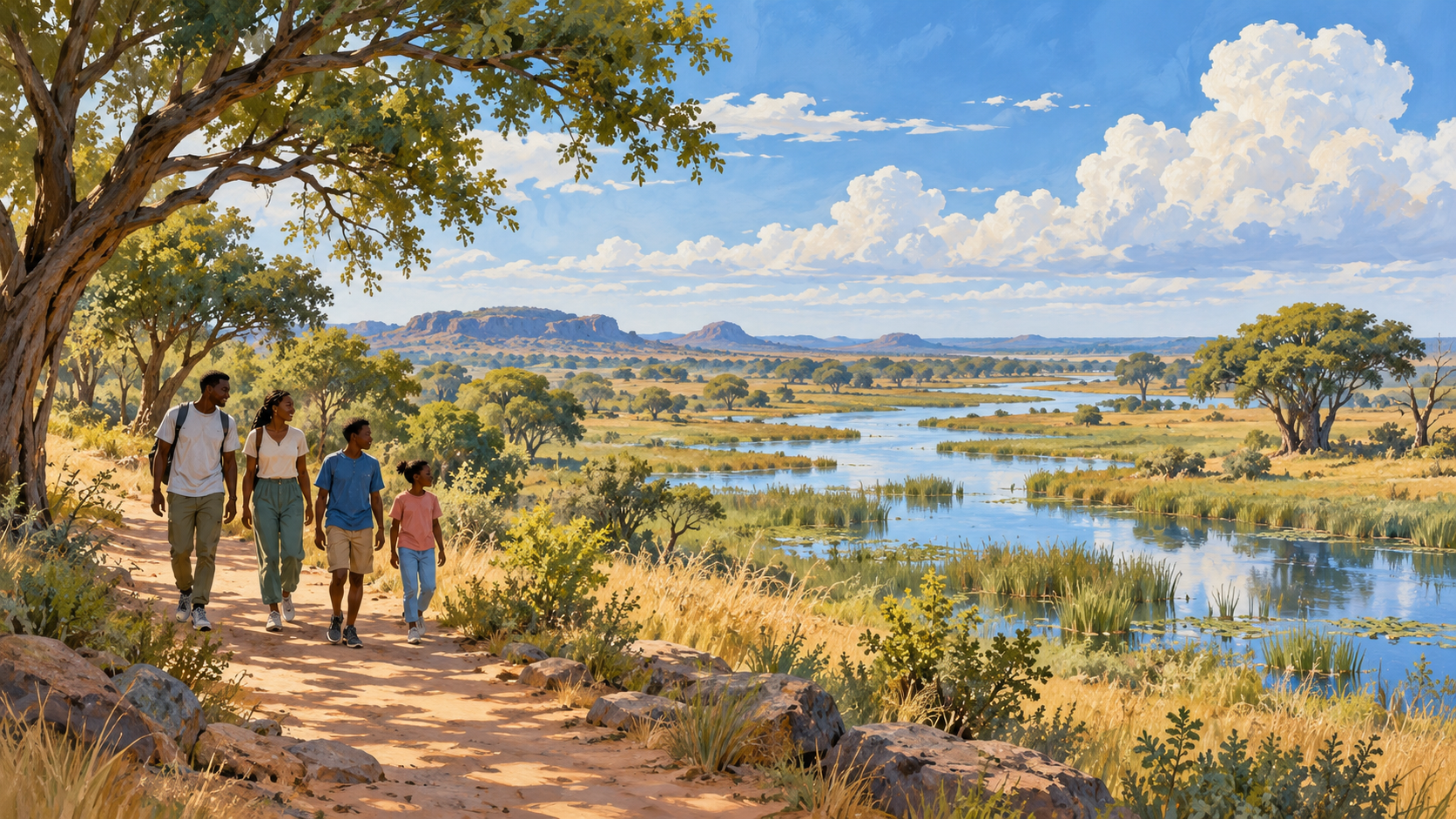
How does Botswana’s government work, why are diamonds important to its economy, and how does the Okavango Delta connect tourism, water and wildlife protection? Botswana is a landlocked parliamentary republic in Southern Africa. President Duma Gideon Boko has led the country since November 2024, when a change of government ended the Botswana Democratic Party’s long period in power. The National Assembly, cabinet, local authorities, land boards, traditional institutions and public agencies all play different roles in everyday life.
The easiest way to understand Botswana is to follow a connected system: political decisions → mineral revenue and public finance → roads, schools, clinics and businesses → households → national resilience. Botswana’s diamond wealth has supported decades of development, but weaker global demand has exposed the limits of relying so heavily on one export. Meanwhile, tourism, agriculture and conservation depend on the landscapes and water networks that make the country distinctive.
Botswana at a glance: the short answers
- Political system: multiparty parliamentary republic with the president as head of state and government.
- President in October 2026: Duma Gideon Boko, who took office on 1 November 2024.
- Legislature: National Assembly; a separate Ntlo ya Dikgosi advises on matters affecting traditional institutions and customary concerns.
- Capital: Gaborone, in the southeast near South Africa.
- Geography: landlocked, with large Kalahari landscapes and the seasonally flooding Okavango Delta in the northwest.
- Economy: diamonds, public services, trade, tourism, farming and other activities, with urgent diversification needs.
- Big national problem: sustaining employment and public finances amid weak diamond demand and high household costs.
- Core method: trace how decisions, resources and services become usable outcomes for people.
For current leadership, use the Government of Botswana. For the change of government, see the Inter-Parliamentary Union election record. The World Bank’s 2026 overview provides economic context, and UNESCO explains the unique Okavango wetland. This guide is reviewed on 20 October 2026.
1. Who runs Botswana in 2026?
Duma Boko is Botswana’s sixth president, taking office after the 30 October 2024 general election. The election gave the Umbrella for Democratic Change (UDC) coalition a parliamentary majority and ended nearly six decades of Botswana Democratic Party rule. The outgoing president conceded, and the transfer of authority took place through constitutional institutions.
Botswana’s president is not elected in a completely separate national presidential vote like the United States president. The presidency is linked to the parliamentary-election system and the resulting National Assembly composition. Voters elect representatives, and the constitutional rules determine presidential selection.
The government’s role includes policy, budgets, national administration and public programmes. But a minister’s announcement cannot repair a rural bridge by itself. Civil servants, engineers, local officials, procurement and communities must carry out the work.
2. How does the National Assembly work?
Botswana’s National Assembly legislates and scrutinises national policy within the constitutional framework. In the 2024 election, 61 constituency seats were directly contested, compared with 57 in the preceding election. The full composition also involves specially elected members, an ex-officio attorney-general arrangement and the speaker under relevant rules.
The Inter-Parliamentary Union records the 2024 distribution, with the UDC winning 36 of the 61 directly elected seats and other parties taking the remainder. Parliamentary majority provides a mandate to govern, but does not prove every programme will succeed.
A new law must still be translated into standards, finances, staff and physical services. A country with a functional legislature needs a delivery system that can turn its decisions into changes people actually experience.
3. What is the Ntlo ya Dikgosi?
Ntlo ya Dikgosi is Botswana’s advisory body associated with traditional leadership and customary matters. It is not simply another party-political upper house equivalent to the Senate of a conventional bicameral parliament. Its constitutional functions concern specified matters linked to tribal organisation, customary law and traditional roles.
Botswana’s institutions combine modern representative government with recognition of historical and community structures. Traditional authorities can have important social roles, but public policy and legal powers still depend on the constitutional and legislative framework.
A useful civics distinction is between a body that passes national laws and a body that advises on matters under its competence. Both may contribute, but they do not carry identical powers.
4. What do districts, councils and land boards do?
Botswana’s local administration includes district and urban councils and various public bodies. Land boards hold important roles in the allocation and management of tribal land under relevant statutes, while other land categories and services have their own competent authorities. District labels do not automatically indicate control over every local asset.
A new family wanting a residential plot may encounter land-board rules and planning processes. Someone reporting a municipal road hazard may need the local authority or road agency. A school issue usually belongs to the relevant education administration. Correctly identifying the owner of a public duty saves time and prevents avoidable disputes.
Land rights also interact with community livelihoods and conservation. A land decision may affect grazing access, housing, roads or tourism activities, so good governance involves clear rules, public information and careful assessment.
5. Why does Botswana’s geography change the cost of services?
Botswana is landlocked and much of its territory lies in the semi-arid Kalahari Basin. Its settlements and economic activities are not evenly spread, and some communities are far from major service centres. Roads, boreholes, telecommunications and electricity networks must cover long distances.
For a person in Gaborone, a daily issue may be congestion or housing cost. For someone near a remote settlement, the first challenge may be reaching a health facility or obtaining a reliable water supply. A national average cannot explain both experiences.
The best service measure includes access time and reliability as well as the number of buildings or kilometres of roads. A functioning last connection often matters more than an impressive central facility.
6. Why have diamonds been so important?
Diamond mining transformed Botswana’s economy after independence in 1966, supporting public revenues, foreign earnings and investment in infrastructure and services. Botswana built an international reputation for prudent resource management during much of that period. Yet diamond demand depends on a global market for luxury products.
The International Parliamentary Union’s 2024 election review cited IMF estimates that diamonds accounted for around 80% of exports, one-third of tax revenues and one-quarter of GDP in the period discussed. These are dated figures, not immutable shares that remain exactly the same each year.
A diamond mine can bring substantial income without generating jobs for every graduate because modern extraction is capital-intensive. The central question is how resource income is saved, invested and converted into diversified productive opportunities.
7. What happened to Botswana’s diamond market?
Global demand for natural diamonds weakened significantly from 2023 onwards, with pressures including competition from laboratory-grown diamonds, slower luxury spending and changing consumer preferences. Botswana’s economy contracted in both 2024 and 2025, placing pressure on public finances and jobs.
The World Bank’s 2026 Botswana Economic Update reports contraction of 2.8% in 2024 and a further 0.7% in 2025. It warns that diversification, productive employment and better public investment are needed.
By October 2026, reporting also described talks about increasing Botswana’s stake in De Beers. The 13 October Reuters report explicitly stated that the proposed change had not been independently confirmed. A negotiation or near-agreement must not be presented as a completed transaction.
8. Why does weak diamond demand affect a school or hospital?
When mineral exports and revenues decline, the government has less fiscal room while essential operating expenses continue. Schools still need teachers, classrooms and materials. Health facilities still need staff and medicines. Infrastructure still requires maintenance.
A government may borrow, reprioritise spending or raise other revenues, but each option has costs. Protecting critical services while restoring fiscal sustainability becomes a major public-finance challenge.
The World Bank’s 2026 overview reported a substantial fiscal deficit and projected public debt near the old 40% of GDP threshold, with weak household spending and high unemployment. A recovery forecast is not a guaranteed improvement in every family’s budget.
9. What does diversification mean in practice?
Diversification means developing sustainable business activity beyond diamonds: services, agribusiness, manufacturing, tourism, energy, technology, logistics and other export opportunities. It requires more than a list of proposed sectors. Companies need skilled workers, finance, infrastructure, predictable regulations and customers.
The government’s Botswana Economic Transformation Programme (BETP) includes priorities for private-sector-led investment and broader opportunity. It is a programme of intended reform and projects, not a statement that every promised job already exists.
The IMF’s December 2025 analysis identifies finance, land tenure, infrastructure and skills as bottlenecks. A new industrial park is useful only when firms can operate productively within it.
10. What is the Okavango Delta, and why does it flood in the dry season?
The Okavango Delta is one of the world’s distinctive inland wetland systems. Water flows from the Angolan highlands through the Okavango River system and spreads across floodplains in northwestern Botswana, with much of it eventually evaporating or soaking into the Kalahari. The delta does not normally empty directly into an ocean.
A remarkable feature is timing: the annual flood pulse reaches large parts of the delta during Botswana’s dry winter months, after upstream rainfall has travelled along the river system. Wildlife and vegetation depend on these seasonal patterns.
UNESCO inscribed the Okavango Delta on its World Heritage List in 2014. That recognition relates to the ecosystem’s extraordinary natural value, not a statement that visitor access is always safe or unregulated.
11. Why is the delta economically valuable?
Wildlife tourism supports guides, accommodation, transport, crafts, hospitality, suppliers and related services. Local communities also depend on the wider environment for livelihoods and cultural connections. The ecosystem provides value that is not fully represented in one tourism receipt.
A lodge may employ guides and hospitality staff. Its boats need fuel and maintenance. Its food supplies use regional transport. Visitors require airports and safe medical access. A protected landscape thus supports a network of businesses and institutions beyond the protected-area boundary.
Tourism should also be assessed against environmental carrying capacity, community benefits and long-term habitat health. More visitors are not automatically better if pressure damages the resource that attracts them.
12. How do Botswana, Angola and Namibia share the river?
The Okavango basin crosses national borders. Rainfall and water use upstream in Angola and Namibia influence conditions downstream in Botswana. The Permanent Okavango River Basin Water Commission (OKACOM) provides an intergovernmental framework for coordinating management and protecting shared water resources.
This is a classic shared-system problem: a new abstraction, dam or land-use decision upstream may create downstream effects, and changing climate conditions add uncertainty. A map of sovereign boundaries cannot describe the whole hydrological network.
UNESCO’s 2021 conservation decision welcomes cooperation among the three countries, while the 2025 decision describes continuing conservation and monitoring work.
13. What threatens the Okavango Delta?
Pressures include water-use decisions, climate variability, invasive species, wildfire, tourism impacts and conflict between people and wildlife. A UNESCO listing helps draw attention and conservation commitments, but it does not remove every ecological risk or solve every local livelihood conflict.
For example, elephants may damage crops or pose safety concerns in some rural areas. Conservation authorities and communities need humane, evidence-based methods that protect both people and ecological systems. Local participation is essential because residents live with the consequences throughout the year.
The 2025 UNESCO decision encourages stronger management, monitoring, community conservation and coordination. Progress should be assessed through actual habitat and livelihood measures, not only a photograph of wildlife.
14. How does tourism fit with the diamond economy?
Diamonds and tourism generate income through different mechanisms. Diamonds are extracted and sold into global mineral and luxury markets. Tourism relies on visitors, service quality, safe access and environmental or cultural experiences. Both can be vulnerable to external demand, but their employment patterns and local spillovers differ.
A lodge can employ guides, cooks, drivers and maintenance workers; an underground mining operation may employ engineers and operators while investing heavily in machinery. The number and kinds of jobs created per dollar can therefore vary substantially.
A diversified economy benefits when businesses can sell to more than one market and workers have transferable skills. Environmental protection and professional service quality are economic investments, not only aesthetic choices.
15. Why do cattle and agriculture matter?
Livestock and farming contribute to rural livelihoods, food and cultural identity. They are exposed to drought, animal disease, grazing conditions, veterinary services and access to markets. The 2026 government published updates on foot-and-mouth disease responses, illustrating the connection between health, trade and agricultural income.
A cattle producer needs reliable water, veterinary care, transport and customers. If a disease restriction limits livestock movements, the economic result can extend to transport firms, processing plants and households. Biosecurity is thus a public-health-like protective system in agriculture.
Farming can create employment but requires water and land management appropriate to semi-arid conditions. Policies should balance production, habitat protection and the rights of communities.
16. Why are water and drought recurring challenges?
Much of Botswana experiences variable rainfall and dry conditions, while the north has distinctive seasonal wetlands. Urban water systems, remote boreholes, reservoirs and livestock water needs create different engineering problems. A wet season in one basin does not guarantee drinking-water security for a household far away.
A water tap depends on collection, treatment, pumping, pipes and maintenance. Drought changes source availability; an electricity outage can stop pumping; a damaged pipe can prevent delivery even when water is stored upstream.
A useful policy measure is how many people reliably obtain safe, affordable water—not merely how many treatment facilities exist on a national map.
17. How does the country produce electricity and manage imports?
Botswana relies on domestic power generation and cross-border regional power arrangements. Mines, urban homes, schools and factories require dependable electricity. Network investment and planned maintenance influence operating costs and commercial confidence.
A workshop can possess excellent machines but still lose orders when outages prevent production. Backup generators are useful but can raise costs, while cleaner energy projects require network planning and trained workers.
A strong energy policy looks at delivered reliability, affordability, safety and environmental impacts rather than celebrating installed generating capacity alone.
18. What is the role of the pula and financial policy?
Botswana’s currency is the pula. The Bank of Botswana conducts monetary policy and manages relevant financial responsibilities. Interest rates, inflation, exchange arrangements and financial stability affect borrowing and household spending, while fiscal decisions influence public investment.
A household’s cost of living responds to food, transport, housing and income. In June 2026, the World Bank reported year-on-year inflation of 10.7%, driven mainly by fuel, food and transport. That dated monthly observation should not be mistaken for the inflation rate of every later month.
To assess whether life is becoming easier, compare incomes and the prices families actually pay, not one headline indicator in isolation.
19. How do schools prepare young people for work?
Botswana’s school system includes seven years of primary education, junior-secondary and senior-secondary pathways, with qualifications such as PSLE, JCE and BGCSE. Training and tertiary education then connect to professional careers. The specific structure and assessment rules should be checked for the relevant student year.
The World Bank’s 2026 Economic Update emphasises ‘Skills for Jobs’ because educational attainment alone does not ensure that graduates can find suitable employment. Employers need technical ability, communication, mathematics, digital skills and dependable workplace practice.
For detailed education guidance, see Schools of Botswana and How Education System of Botswana Works. Those own examination and school-pathway details; this article explains why skills matter to wider development.
20. Why can unemployment remain high after decades of resource income?
Mineral wealth can support infrastructure and public employment, yet extracting diamonds is not inherently labour-intensive enough to employ everyone. Private enterprises need access to markets, finance and land, while graduates need work that matches their training and location.
The World Bank has highlighted elevated unemployment, particularly among young people, together with inequality and weak diversification. These challenges are not explained away by a high GDP per person or past fiscal success.
The proper question is whether the economy is generating sustainable opportunities, especially for households and communities that do not directly benefit from mining.
21. A day in Botswana: one family and five systems
Original fictional case: a family in a rural district farms, operates a small roadside business and sends children to school. Income depends on livestock health, tourism-related demand and transport. The household also needs safe water, reliable electricity and access to medical care.
After an extended dry spell, water becomes more expensive to supply and cattle conditions deteriorate. The family’s income falls while transport and food costs rise. Even if a new school is nearby, the household may struggle to afford the daily journey. A climate event turns into a business, education and family-finance problem.
The useful remedy depends on the bottleneck: emergency water, veterinary advice, safer roads, reliable school transport or appropriate income support. Understanding the links produces better solutions than treating each symptom in isolation.
22. Botswana compared with Singapore
Both Botswana and Singapore have relied on institutions, education and connections to larger markets. Singapore is a dense maritime city-state with limited natural resources and global port and airport networks. Botswana is landlocked, geographically large, resource-rich in diamonds and responsible for significant dryland and wetland ecosystems.
A Singapore-style city transport system cannot be applied without change across sparsely populated Kalahari settlements. A Botswana wildlife-based tourism strategy is not equivalent to Singapore’s port logistics. What can be compared is how each country turns national resources into public trust, services and long-term capability.
Continue at How Singapore Works and How Singapore Connects | Roads, Expressways and Junctions.
How to evaluate a Botswana development headline
- Authority: president, National Assembly, ministry, local authority, land board or private company?
- Time: a 2026 forecast is not an observed final-year result.
- Budget: approved funds are not the same as money spent and audited.
- Service: a completed road is valuable when users reach the jobs, schools or clinics they need.
- Economic outcome: diamond exports, government receipts and employment are different measures.
- Environment: a conservation designation needs sustained protection and community participation.
- Distribution: ask whether people outside major towns benefit fairly from national progress.
Try drawing a diagram starting with one diamond export receipt. Add public revenue, budget choices, road or school operations and the child or worker who uses the service. Then draw a second diagram for a tourist payment in the Okavango Delta. Compare where money and jobs flow, and how natural resources are maintained.
Frequently asked questions about how Botswana works
Who is Botswana’s president in October 2026?
Duma Gideon Boko, who became president on 1 November 2024 after the general election.
Is Botswana a monarchy?
No. It is a republic with a parliamentary-linked presidential selection system and elected National Assembly.
Why are diamonds important?
Diamond exports have generated substantial foreign earnings and public revenue, supporting infrastructure and services over many decades.
Why has Botswana’s economy struggled recently?
Weak demand for natural diamonds, competition from laboratory-grown stones and insufficient diversification contributed to contractions in 2024 and 2025.
What is the Okavango Delta?
A major inland wetland and UNESCO World Heritage Site in northwestern Botswana, created by seasonal river flooding that spreads into the Kalahari Basin.
Why does the Okavango flood during the dry season?
Water from upstream rains in Angola travels downstream and reaches Botswana’s delta after a delay, often peaking during the local dry winter.
Is wildlife tourism enough to replace diamond income?
Not automatically. It creates different kinds of jobs and revenue, but diversification requires multiple productive sectors and sustainable conservation.
What is the Ntlo ya Dikgosi?
A constitutional advisory body associated with traditional leadership and customary matters, distinct from the main legislative functions of the National Assembly.
What examinations do Botswana students take?
Important traditional pathways include PSLE, JCE and BGCSE, with current rules and education reforms to be checked by year.
Does a mining-revenue increase guarantee lower poverty?
No. Results depend on public finance, employment opportunities, prices, skills, delivery and whether benefits reach households.
Explore the world country systems
This Botswana guide belongs to How Countries Work, the international sibling of How Singapore Works. Continue with Bhutan’s hydropower and well-being, Bolivia’s mineral economy and departments, and Bosnia and Herzegovina’s entities and cantons.
Sources and editorial review
- Government of Botswana, 2026 — president, public services and administration.
- Inter-Parliamentary Union, 2024 election — government transition and parliamentary result.
- World Bank, Botswana 2026 overview — diamond pressure, economy, inflation, poverty and jobs.
- World Bank, Botswana Economic Update 2026 — 2024–25 contractions and diversification.
- IMF, December 2025 — growth bottlenecks and private investment.
- UNESCO, Okavango Delta World Heritage listing — ecology and 2014 inscription.
- UNESCO, 2025 conservation decision — current management and risks.
- Reuters, 13 October 2026 — unconfirmed De Beers stake negotiations.
- Reviewed: 20 October 2026. Scenarios are fictional and forecasts are separated from measured outcomes.