
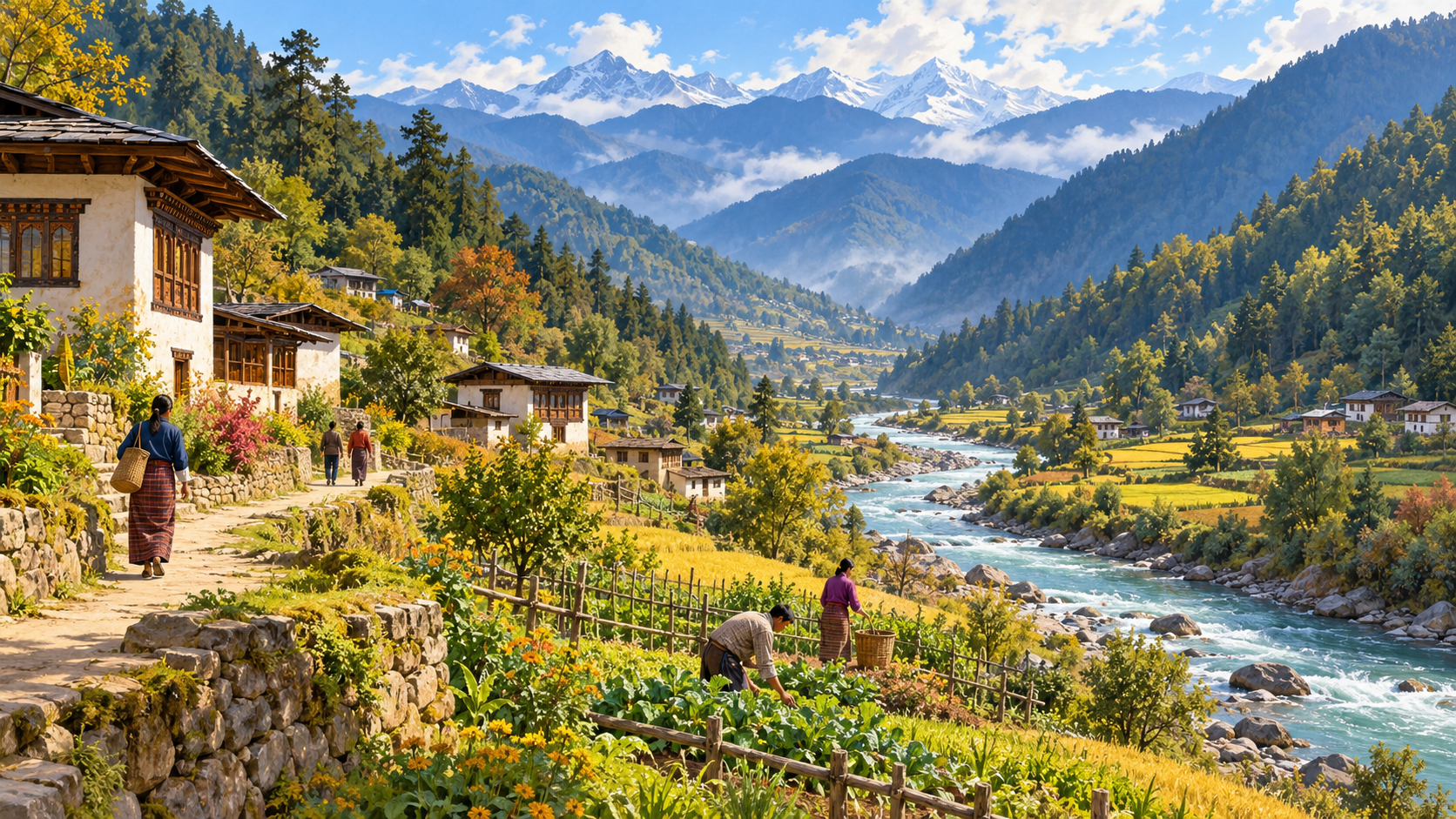
How does Bhutan’s government work, why does it measure Gross National Happiness, and how do hydropower, tourism, villages and schools support daily life? Bhutan is a Himalayan kingdom and democratic constitutional monarchy. King Jigme Khesar Namgyel Wangchuck is head of state, while Prime Minister Tshering Tobgay leads the elected government for the 2024–2028 term. The Constitution establishes a two-house Parliament and twenty districts, known as dzongkhags. Bhutan’s development philosophy, Gross National Happiness, asks the country to consider wellbeing, culture, environment and governance alongside economic growth.
Bhutan’s system becomes easier to understand when we connect constitutional institutions → district and local administration → mountains, rivers, roads and energy → jobs, schools and healthcare → the wellbeing of households. Hydroelectric power earns export income, but not every young person automatically obtains a good job. Tourism can support livelihoods, but it also uses roads and fragile landscapes. A useful country guide follows both the achievements and the remaining practical pressures.
Bhutan at a glance: the clearest answers
- State: democratic constitutional monarchy under the 2008 Constitution.
- Head of state: King Jigme Khesar Namgyel Wangchuck.
- Head of government: Prime Minister Tshering Tobgay, whose current term began in 2024.
- Parliament: a party-based National Assembly and 25-member National Council; the latter has one elected member per district plus five royal appointees.
- Local map: twenty dzongkhags and 205 gewog local-government units in the current election framework.
- Development approach: Gross National Happiness, or GNH, with four broad pillars and nine wellbeing domains.
- Economy: hydropower, agriculture, tourism, public investment and services, with strong trading links to India.
This guide was reviewed on 20 October 2026. Bhutan’s Prime Minister’s Office identifies Tshering Tobgay as the current prime minister. The Constitution explains the institutions and twenty districts. The World Bank’s April 2026 update explains the economy and employment challenges.
1. Is Bhutan a monarchy or a democracy?
Both. Bhutan is a democratic constitutional monarchy, not an absolute monarchy or a republic. The king holds the constitutional head-of-state role, while elected national representatives, the prime minister, ministers and courts exercise their assigned public responsibilities. The modern constitution took effect in 2008, building on political changes initiated under Bhutan’s monarchy.
Article 1 of the Constitution states that sovereignty belongs to the people and that government is a democratic constitutional monarchy. The rule matters because a king’s public vision, a parliamentary law and a ministry’s operational decision are different kinds of national action.
For a reader, this distinction avoids two errors. The first is imagining that the king directly runs every classroom or road programme. The second is assuming that because elections exist, the monarchy has disappeared. Bhutan’s constitutional design deliberately contains both institutions.
2. Who is the king and who is the prime minister?
King Jigme Khesar Namgyel Wangchuck is Bhutan’s fifth hereditary monarch, commonly called the Druk Gyalpo. Tshering Tobgay leads the current government as prime minister. He returned to office following the election process completed in early 2024 and heads the 2024–2028 government term.
The prime minister works with the Cabinet, known as the Lhengye Zhungtshog, to develop and execute government policy. The king has constitutional functions, including roles in appointments, state continuity and national institutions. Their functions are distinct even though they may appear at the same public event.
The Prime Minister’s Office describes its mission as providing policy advice and helping ministries work together to advance national objectives, explicitly connecting coordination to GNH.
3. How does Bhutan’s Parliament work?
Bhutan’s Parliament has two houses. The National Assembly is the main elected party-political chamber with 47 seats under its current electoral framework. The National Council has 25 members: one elected from each of the twenty dzongkhags and five eminent persons appointed by the king. National Council members are required to be nonpartisan.
The houses participate in legislation and oversight within the constitutional process, but they do not have identical rules. The design combines democratic party competition in the National Assembly with a regionally represented reviewing chamber. A bill, budget and ministerial implementation programme remain different stages.
The Constitution’s Article 11 sets out the National Council’s composition. To study any new law, check whether it was proposed, passed, assented to and then actually implemented.
4. What is a dzongkhag?
A dzongkhag is a district-level territorial unit. Bhutan has twenty. District administration links national policy and planning to towns and rural communities. Within districts, the gewog is a local-government area, especially important in rural settings, alongside urban structures called thromdes.
The words matter because they refer to different levels. A dzongkhag is not an independent country or a province of India. A gewog is not automatically identical to every town council. The law assigns local responsibilities, elections and interactions with central government.
Imagine a highland community needing a road repair. The relevant district and local authorities must identify who owns the road, the budget source, engineering risks and when machinery can reach the site. A district name locates the problem; the responsible asset owner makes the repair possible.
5. Does Bhutan have 205 villages or gewogs?
The count of 205 gewog local bodies refers to governance units, not the number of individual villages or settlements. Each gewog may contain multiple communities. Treating 205 as a count of every inhabited village would be incorrect.
In July 2026, the Election Commission discussed the terms of all 205 gewog tshogdes and a local municipal council, ahead of local-government elections due in 2027. A country article should not replace that current local governance information with an old map.
Local governance gives communities a route for priorities such as paths, water, amenities and district development. Yet the quality of service depends on funds, engineering, participation and access — not only the existence of a council.
6. What is Gross National Happiness?
Gross National Happiness, or GNH, is Bhutan’s approach to evaluating national development through more than economic output. The idea is associated with the fourth king, Jigme Singye Wangchuck, and has become central to national identity and policy thinking.
GDP measures the monetary value of production. GNH asks wider questions: Are people healthy and educated? Do communities function well? Is the environment protected? Can families enjoy meaningful time and cultural life? Are institutions trustworthy? Money and productivity still matter, but they are part of a larger assessment.
GNH does not mean that every Bhutanese person is always happy. It is a policy philosophy and measurement system, not an assertion of permanent national contentment. The Royal Bhutanese Embassy’s explanation sets out its origins and intention.
7. What are the four pillars of GNH?
- Sustainable and equitable socioeconomic development: material progress that benefits people across society.
- Environmental conservation: protecting the natural systems needed for future life.
- Preservation and promotion of culture: sustaining traditions and identity while society develops.
- Good governance: capable, responsible and fair institutions that support public wellbeing.
These pillars are useful because they reveal trade-offs. A new hotel may increase economic activity but place pressure on water, heritage and ecosystems. A road can improve access but affect forests or expose settlements to natural hazards. A public policy should ask what is gained and what might be lost.
The GNH Centre’s framework identifies these four pillars and explains their connections. The goal is not to score every question with one easy number, but to keep multiple human needs visible.
8. What are the nine GNH domains?
- Psychological wellbeing.
- Health.
- Time use and balance.
- Education.
- Cultural diversity and resilience.
- Good governance.
- Community vitality.
- Ecological diversity and resilience.
- Living standards.
The nine domains translate the philosophy into areas that can be studied through surveys and indicators. They allow people to ask whether progress in income is accompanied by improvements in health, education, time, environment and community life.
A family may have more income but less time together. A village may gain better road access but worry about environmental degradation. GNH provides a language for recognising such differences, but it does not automatically resolve a difficult policy choice. Results still require evidence.
Read the Centre for Bhutan Studies and GNH Research for the index and the nine-domain approach.
9. How does GNH affect a practical government decision?
Imagine a proposed road that would reduce a remote community’s journey to a hospital. The economic benefit may include lower transport costs and better access to jobs. A broader evaluation also looks at road safety, landslide risk, forest loss, cultural sites, participation and long-term maintenance.
A poor policy analysis might count only construction cost and travel time. A better one asks whether the road improves health and opportunity while protecting the environment and the people most affected.
Original teaching exercise: draw four columns headed economy, nature, culture and governance. List a road project’s benefits and risks under each. Then decide what evidence an engineer, villager, teacher and conservation worker would need before judging the proposal.
10. Why is hydropower so important to Bhutan?
Bhutan’s mountain rivers and steep terrain create opportunities for hydroelectric generation. Hydropower provides domestic electricity and export revenue, especially through sales to India. Energy exports help finance imports and contribute to the economy, but their value depends on seasonal river flows, project financing, maintenance and international power agreements.
A dam or power station produces electricity, which travels through transmission and distribution systems to customers. A generating project can support jobs during construction and later contribute energy revenues, but its direct construction employment is not necessarily permanent. A country therefore needs other productive opportunities alongside its power sector.
The World Bank’s country overview describes hydropower, tourism and trade with India as central to Bhutan’s recent development.
11. What was new in Bhutan’s hydropower programme in 2026?
The World Bank and Bhutan signed financing agreements in May 2026 for the 1,125-megawatt Dorjilung Hydroelectric Power Project, planned on the Kurichhu River. The project is expected to generate more than 4,500 gigawatt-hours annually after completion and support additional electricity exports.
The distinction between financing agreed and electricity actually generated matters. Dorjilung’s projected output is not yet measured annual production from a finished facility. Construction, environmental management, finances, transmission and safe operations must come first.
The May 2026 World Bank announcement is the source for the financing, planned capacity and benefits.
12. Why can a hydropower country need more electricity in winter?
Hydropower depends on river flow and seasonal conditions. Bhutan can have substantial wet-season generation while facing lower flows and higher demand in other periods. Electricity exports and imports are therefore shaped by when power is generated, not only the total generating capacity on a brochure.
A power plant with a large installed rating cannot automatically produce at that level every hour. Reservoir management, maintenance, river conditions and environmental requirements influence usable output. Transmission networks also affect where the electricity can go.
The Dorjilung project has been described as helping close Bhutan’s seasonal energy gap. A good systems lesson is to separate capacity in megawatts from energy produced over time in megawatt-hours. One measures power at an instant; the other measures quantity across a period.
13. How does Bhutan’s electricity link to India?
India is Bhutan’s largest trading partner and an important market for electricity exports. Electricity connections, commercial agreements, financing and borders turn Bhutanese rivers into part of a wider regional energy network. The relationship supports national income but also creates dependencies on demand, transmission and pricing outside Bhutan.
A household may not see the export grid, yet government revenue and economic investment can be affected by its performance. Equally, an export project’s success should be measured against local access and domestic industry needs, not just cross-border sales.
International cooperation becomes useful when agreements are durable, operational infrastructure is reliable and financial arrangements remain sustainable.
14. What are Bhutan’s biggest economic challenges in 2026?
The World Bank’s April 2026 update forecast real GDP growth of 7.1 percent in financial year 2025–26 and 6.4 percent in 2026–27, supported heavily by hydropower and capital investment. Those figures are forecasts. At the same time, it reported youth unemployment of 20.6 percent for the final quarter of 2025 and significant outward migration.
A fast-growing economy can still struggle to create enough suitable private-sector work. Hydropower investments produce value but do not necessarily absorb every graduate or young jobseeker. Skills, business finance, market access, housing and the expectations of young people all shape whether they choose to stay.
This is why GDP should be read beside GNH. Large national projects may grow production while young people seek better earnings elsewhere. Development requires opportunity where people actually live.
15. Why do young people leave Bhutan?
Young Bhutanese may study or work abroad in search of better salaries, professional opportunities, education or career paths. Migration can support families through remittances and broaden skills, but it may also reduce the number of qualified workers available to local hospitals, businesses and schools.
The World Bank estimated in its April 2026 assessment that approximately nine percent of Bhutan’s population had emigrated as of 2025. That is a reported estimate for a defined time, not a statement that nine percent left during the first months of 2026.
The policy question is how to expand meaningful work and training at home while respecting people’s freedom to seek opportunities elsewhere. A new industrial zone, college or power project only helps retention when suitable jobs and conditions genuinely result.
16. How does agriculture connect to rural livelihoods?
Farming and the wider agrifood system support a large share of Bhutanese employment, especially in rural areas. Mountain terrain, transport, water, growing seasons, land size and market distance affect what farmers can produce and sell. Food security also involves imports and storage.
The World Bank’s April 2026 update reported that Bhutan’s agrifood system employed around 55 percent of employed people in the period studied, including large shares of rural and female workers. That broader definition includes activity beyond simply growing crops.
Imagine a farmer with good vegetables but a winding route to a town market. Without suitable road maintenance, transport and buyers, increased production may not mean increased income. A village road can be as relevant to agricultural development as better seeds.
17. How do Bhutan’s mountains shape roads and services?
The Himalayas create extraordinary landscapes but also challenging engineering. A short distance on a map may involve hairpin roads, steep slopes, high passes and seasonal hazards. Landslides and heavy rain can affect mobility and utilities, while maintaining remote roads can be costly.
A school in a mountainous community needs trained teachers, materials and a safe journey for children. A rural clinic needs reliable referrals and transport. A new bridge can reduce travel times, but its safety and upkeep require continued monitoring.
The practical lesson is that access is not the same as distance. Ten kilometres on a good urban road and ten kilometres along a remote mountain route can require very different time, cost and risk.
18. Why does Bhutan protect its forests and biodiversity?
Forests and watersheds provide habitats, help manage water and support cultural and ecological values. Bhutan is widely recognised as one of the few carbon-negative countries, meaning that its carbon sinks have exceeded its greenhouse-gas emissions in the accounting referenced by international analyses. That status does not mean the country has zero emissions or no environmental problems.
Forest protection also creates trade-offs with road construction, farming, housing and energy infrastructure. Conservation works best when local people have feasible livelihoods and a voice in decisions affecting them.
The World Bank’s Bhutan overview recognises its environmental achievements while stressing climate risks and geographic inequality.
19. What are glacial lake outburst floods?
High mountain glaciers can create or enlarge lakes held back by ice, rock or moraine. If a natural barrier fails, a sudden release of water can race downstream, damaging bridges, roads, farms and settlements. These events are known as glacial lake outburst floods, or GLOFs.
The threat connects climate science to ordinary public services. Monitoring a lake is only the first step; warning systems, evacuation routes, safe building locations and emergency response must also function. A school or hospital downstream may need contingency plans even if it is far from the glacier.
A student can draw the chain: temperature and glacier change → lake conditions → monitoring → warning → roads and evacuation → households. Every arrow represents a place where accurate information and preparation matter.
20. What is Gelephu Mindfulness City?
Gelephu Mindfulness City, or GMC, is a special administrative-region development initiative in southern Bhutan near the Indian border. Its vision combines business opportunity, sustainability, wellbeing and Bhutanese cultural values. It was established under a royal charter in 2024 and includes evolving plans for infrastructure and economic activity.
Because it is an ongoing development, not everything announced is complete. In October 2026 its official website reported new agreements and an airfield construction contract. These are steps toward future facilities, not evidence that all the proposed airport, companies and neighbourhoods are already operational.
See GMC’s official project website. A development vision should be evaluated through lawful governance, land and environmental safeguards, completed infrastructure, sustainable jobs and the welfare of surrounding communities.
21. What happened at Gelephu in October 2026?
Bhutan’s Ministry of Infrastructure and Transport announced that a flood-protection project for Gelephu had been formally handed over to GMC on 2 October 2026. It described four interventions along the Mau River, Shetikhari tributary, Thewar River and Jogi stream, co-financed by Bhutan and the Netherlands.
This is a concrete project milestone, not a generic promise of future ‘smart city’ success. Flood protection helps preserve homes, transport links, investment and public safety, but its ongoing performance still depends on maintenance and future hazard conditions.
The ministry’s 3 October update gives the precise work and date. It shows how physical resilience can be an early foundation for a much larger economic plan.
22. How does Bhutan manage tourism?
Bhutan pursues a tourism approach often described as high value and low impact or low volume, aiming to attract visitors while limiting damage to cultural and natural resources. A Sustainable Development Fee is part of its policy framework, with rates and exemptions varying according to the current rules and visitor category.
In May 2026 the National Assembly reviewed tourism-policy implementation, including fee arrangements, governance, operational systems and proposed reforms. This is a reminder that one published fee is not necessarily permanent. Visitors should check the official rules for their nationality and date rather than rely on an old travel blog.
The National Assembly’s May 2026 report records that policy review. Tourism success should be measured through local jobs, service quality, environmental condition and benefits to communities, not visitor numbers alone.
23. How does Bhutan’s currency work?
Bhutan uses the ngultrum. The Royal Monetary Authority explains that it is pegged at par with the Indian rupee. The peg can support predictability in trade with India, Bhutan’s main economic partner, but it also links the country’s monetary conditions to developments in the Indian economy.
A currency peg does not mean every item costs the same in both countries or that all import prices are stable. Transport, taxes, scarcity, wages and international price changes influence household expenses.
The Royal Monetary Authority’s monetary-policy page describes the currency framework and its limits. This is a useful distinction between an exchange-rate policy and a family’s actual purchasing power.
24. How do public education and healthcare support GNH?
Education and health are two of the nine GNH domains, but they also create the practical capability that keeps Bhutan operating. A trained nurse improves health outcomes; an engineer maintains hydropower and bridges; a teacher gives children the reasoning needed for their own careers.
Bhutan’s schooling includes pre-primary and classes up to XII, with assessments such as BCSE and BHSEC, plus vocational and post-secondary opportunities. There are challenges in matching curricula to changing jobs and reaching remote children consistently.
For details, read Schools of Bhutan, How Education System of Bhutan Works and How Ministry of Education for Bhutan Works. Those articles explain qualifications and school governance; this guide shows the wider connection.
25. An illustrative family case: one road supports five futures
Original fictional example: a family in a mountain gewog grows vegetables and has two school-age children. The same road brings teachers, buyers, medicines and materials for a small hydropower-related contractor. After heavy rain, a landslide blocks the route.
The road closure affects farm income, school attendance, health referrals and work schedules. Each might appear as a different departmental complaint, yet all depend on one shared connection. A coordinated response involves risk inspection, safe clearance, information, alternative supplies and maintenance.
Now add GNH to the assessment: which response best protects safety, livelihoods, environment, community confidence and children’s education? The framework does not pick one magical answer. It reminds decision-makers to consider all those consequences.
26. Bhutan compared with Singapore
Singapore and Bhutan are both small countries that use planning, education, international connections and public institutions to convert limited resources into opportunity. But Singapore is a densely urbanised maritime city-state, while Bhutan is a mountainous, landlocked kingdom with substantial hydropower and protected landscapes.
Singapore may improve daily life by shortening an urban bus-to-train transfer. Bhutan may have to maintain a long mountain road or connect a remote gewog to reliable power and healthcare. Their engineering solutions differ, yet the method of tracing a person’s need through transport, public finance and institutions is the same.
Compare How Singapore Works and How Singapore Connects | Roads, Expressways and Junctions for an urban counterpart to Bhutan’s mountain connections.
27. What should students check when reading a Bhutan development story?
- Institution: is the announcement from the king, elected government, parliament, district authority, local body or a project company?
- Stage: a financing agreement, construction contract and finished hydropower station are different.
- Units: megawatts are power capacity; gigawatt-hours measure electricity produced over time.
- Time: FY25/26 growth forecasts and 2025 youth-unemployment statistics should not be reported as final October 2026 outcomes.
- People: a record energy export may coexist with poor job prospects for some young workers.
- Environment: a successful development must account for flood risk, forests, river health and maintenance.
- Wellbeing: GNH is a framework for asking more questions, not a certificate that everybody is happy.
An easy exercise is to take a story about a proposed new electricity project. Draw the finance, engineering, rivers, workers, grid, export market and household outcomes. Then mark what has happened already and what remains a forecast. That is more informative than repeating an exciting project headline.
Frequently asked questions about how Bhutan works
Is Bhutan ruled by a king or prime minister?
Bhutan is a democratic constitutional monarchy. The king is head of state and the elected prime minister leads the government, under the 2008 Constitution.
Who is Bhutan’s prime minister in 2026?
Tshering Tobgay, according to Bhutan’s Prime Minister’s Office, with the current government covering 2024–2028.
How many districts does Bhutan have?
Twenty dzongkhags under the Constitution. The Election Commission’s 2026 notices refer to 205 gewog local-government councils.
What is Gross National Happiness?
A development approach that considers wellbeing across material, social, cultural, environmental and governance dimensions, rather than using GDP alone.
What are the four pillars of GNH?
Equitable socioeconomic development, environmental conservation, cultural preservation and promotion, and good governance.
Are Bhutanese people automatically happier than everyone else?
No. GNH is a philosophy and measurement framework. Individuals have varied experiences, including real employment and affordability pressures.
Why is hydropower important?
Mountain rivers allow domestic electricity generation and exports to India, supporting revenue and economic activity. Seasonal flows and infrastructure capacity also create risks.
Is the Dorjilung hydropower station already finished?
No. The May 2026 source concerns financing for a proposed 1,125 MW project. Forecast electricity output should not be reported as measured production.
What is Gelephu Mindfulness City?
A developing special administrative-region initiative intended to combine sustainability, wellbeing and investment. Some projects have reached specific milestones, but much remains under development.
Is the Bhutanese ngultrum equal to the Indian rupee?
The Royal Monetary Authority operates a one-to-one exchange-rate peg between the ngultrum and Indian rupee. Other transaction costs and prices can still differ.
Why do Bhutanese young people leave the country?
Education, earnings and career opportunities abroad are among the considerations. Policy discussions also focus on creating more and better domestic jobs.
Where can I learn about schools and exams?
The linked eduKateSG Bhutan school-system, education-ministry and examination guides cover PP–XII, BCSE, BHSEC and technical pathways.
Explore the connected world civilisation library
This article belongs to How Countries Work, the international sibling of How Singapore Works. Compare Belgium’s multiple government levels, Belize’s reef and disaster systems, Benin’s ports and local councils, and Armenia’s mountain transport and parliament. Together they show why a country is better understood as connected institutions and everyday services than as a list of facts.
Sources and review date
- Constitution of the Kingdom of Bhutan, 2008 — monarchy, parliament and dzongkhags.
- Bhutan Prime Minister’s Office — Tshering Tobgay and the Cabinet’s role.
- Election Commission, July 2026 — 205 gewog councils and 2027 local elections.
- Royal Bhutanese Embassy, Gross National Happiness — origins and four pillars.
- Centre for Bhutan Studies and GNH Research — nine domains.
- World Bank, April 2026 development update — growth, employment and emigration.
- World Bank, May 2026 — Dorjilung financing.
- Gelephu Mindfulness City authority and Bhutan Ministry of Infrastructure, October 2026.
- Royal Monetary Authority of Bhutan — ngultrum and rupee peg.
- National Assembly, May 2026 — tourism-policy review.
- Reviewed: 20 October 2026. Household examples are original teaching scenarios; conditional projections are distinguished from completed results.