
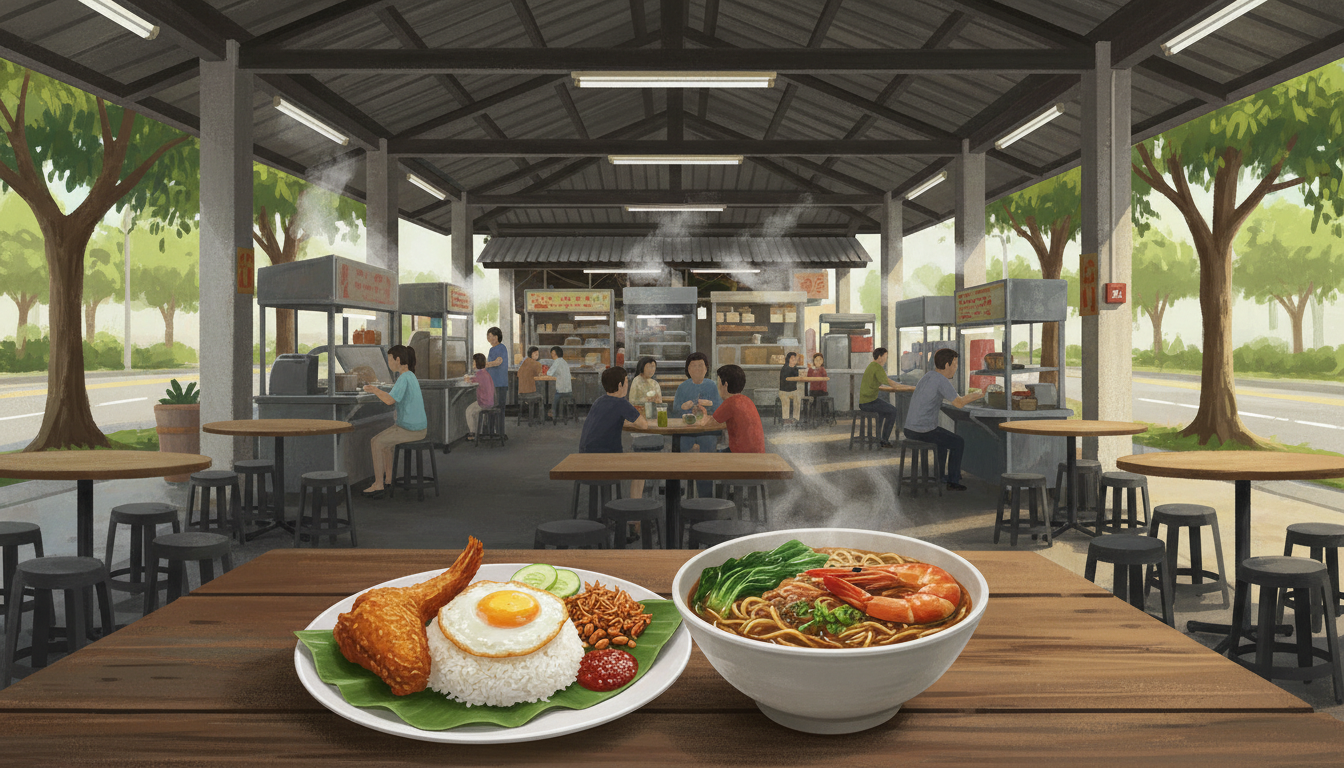
Did you know that one of Bukit Timah’s best-known hawker centres began as a cluster of temporary sheds beside a canal? Adam Food Centre is easy to recognise today as a place for nasi lemak, noodles and other familiar dishes. Its real story, however, also involves road-building, flooding, public hygiene and the determination of stallholders to keep serving customers.
At 2 Adam Road, the present food centre opened on 28 September 1974. It has changed physically several times, including measures to improve ventilation and reduce flood impacts. Yet it continues to serve a simple need that cities cannot ignore: a convenient place where people from different backgrounds can share affordable everyday meals.
The quick answer: the hawker centre survived because the activity it housed continued to matter, even when the original location was no longer suitable. Thirty-two stalls moved from an earlier temporary site to a purpose-built centre in 1974. Later refurbishment tackled flooding, ventilation and maintenance. The centre’s value comes from the interaction of practical infrastructure, hawkers’ livelihoods and the customers who return.
Featured artwork is a conceptual illustration of Adam Food Centre and hawker dishes, not a photograph of current stall operators or menus.
In this guide: Where was the original Adam Road hawker centre? · Why did the hawkers move in 1974? · Why build a food centre without a wet market? · How did Bukit Timah’s flooding affect the building? · What changed in the major 2001–2002 renovation? · Why do the trees and courtyard matter? · Why did nasi lemak become part of its identity? · Who used Adam Food Centre beyond the neighbourhood? · How is Adam Food Centre different from Beauty World Food Centre? · How can a family turn a meal into a local-history lesson? · Practical information for visitors in 2026
1. Where was the original Adam Road hawker centre?
The National Heritage Board (NHB) traces its origins to 1971, when temporary food stalls were set up near Bukit Timah Canal. The collection of makeshift sheds contained around 32 stalls, a relatively compact operation compared with some of Singapore’s much larger markets.
The earlier site stood across the road from the present food centre, near the location of an A&W restaurant. It is easy for readers to assume the current building always stood there, but the road and canal layout changed as Singapore expanded.
Those early hawkers offered prepared food to people who lived, studied and travelled in the district. The appeal of a convenient cluster was already there before a permanent building was completed.
The difference between an informal roadside cluster and a purpose-built hawker centre is important. The latter can provide a more coordinated approach to food preparation, utilities, seating and waste handling, but moving there also changes where customers find the vendors.
2. Why did the hawkers move in 1974?
In 1973, plans for road construction and a link between Adam Road and Farrer Road affected the earlier location. The hawkers were moved across the road to a new site as transport infrastructure developed.
The present Adam Food Centre was officially opened on 28 September 1974 by E. W. Barker, then a government minister. NHB records that it retained 32 cooked-food stalls, continuing the earlier cluster’s function in a more formal building.
Think about the practical challenge. A road project helps people travel, but it can displace the activities that once took place beside the road. Relocating vendors allows a transport improvement to proceed while giving existing livelihoods a potential new location.
That does not mean relocation is effortless for each stall. Customers need to relearn where to go, suppliers may face new delivery arrangements, and stallholders must adapt to a different physical setting. The successful continuation of a food centre is the result of people managing those details.
3. Why build a food centre without a wet market?
Adam Food Centre was part of a period in which Singapore created dedicated facilities for street hawkers. The NHB notes that it was built independent of a wet market, rather than combining prepared-food stalls with a large fresh-produce section.
This distinction matters when families compare local food destinations. A wet market generally sells ingredients such as vegetables, meat or fish; a hawker centre focuses on cooked food and drinks to eat there or take away.
Different functions create different requirements for loading, storage, cleaning, food safety and customer movement. Even two sites that local residents casually call a ‘market’ may have very different operating arrangements.
Adam Food Centre’s relatively small size made it a specialised prepared-food destination, not a substitute for every household’s grocery shopping.
4. How did Bukit Timah’s flooding affect the building?
The early food centre was close to the Bukit Timah Canal and vulnerable to flooding during heavy rainfall. NHB describes customers becoming stranded during serious floods in earlier decades.
This was not merely an inconvenience to someone finishing lunch. Floodwater can interrupt businesses, damage equipment, affect hygiene and make the surrounding roads or footpaths unsafe.
The geographical mechanism is familiar from Bukit Timah’s wider history: heavy tropical rain reaches canals through a built-up catchment, and areas near low-lying drainage routes can be affected when water arrives faster than the network can convey it.
However, a report of flooding in the 1980s is not proof that the present-day food centre floods in the same way. Drainage upgrades across the district and modifications to the building changed conditions over time.
The proper lesson is that a useful public facility must respond to the environmental hazards of its actual location.
5. What changed in the major 2001–2002 renovation?
The centre underwent multiple improvements, including work in 1997 and a major upgrading programme around 2001–2002. NHB records renovation expenditure of approximately S$1.73 million, with the food centre reopening in 2002.
The work addressed ventilation, flooding and the practical comfort of diners. The floor level was raised, the roof was improved, and a renewed courtyard offered seating and more natural air movement.
The heritage account also describes solar-energy-related features introduced during the 2002 upgrading. That is an important historical detail, but it does not establish the exact current output or operating state of any particular solar equipment in 2026.
These upgrades show the difference between preserving a community’s purpose and keeping its physical building completely unchanged. Sometimes an old institution lasts precisely because it is willing to change its infrastructure.
6. Why do the trees and courtyard matter?
NHB’s hawker-heritage account describes a distinctive central courtyard with umbrella-covered tables and the retention of mature angsana trees near the site. These features contribute to the centre’s physical identity and comfort.
Trees can provide shade and help soften an otherwise hard roadside environment. In a noisy transport corridor, vegetation can also be part of a broader landscape design that separates activity from traffic.
A courtyard changes how people use a building. It offers visual openness and another type of dining experience, while the surrounding stalls provide food from different vendors.
Of course, an open-air table is not always more comfortable than a sheltered one. Heat, rain, noise and accessibility influence where people prefer to sit. Good public design considers the needs of different users instead of assuming one seating arrangement is ideal for everyone.
7. Why did nasi lemak become part of its identity?
Adam Food Centre is especially associated with nasi lemak, a dish built around fragrant rice cooked with coconut milk and pandan, commonly served with sambal, anchovies and different accompaniments.
The NHB highlights the local history of Selera Rasa, founded in 1998 by Hassan Abdul Kadir, as one part of the centre’s culinary story. Historical reporting also names mutton soup, Indian rojak and prawn noodles among the dishes associated with the food centre.
The useful distinction is between heritage reputation and live availability. A stall described in a 2018 heritage guide may have changed opening hours, management or menu by October 2026.
Food culture is not fixed in a museum. Recipes, ingredients, businesses and customers can change across generations while certain dishes remain part of a place’s identity.
For a visitor, the best plan is to look up the actual stall, check its current operating hours and accept that not every well-known dish will necessarily be available on every visit.
8. Who used Adam Food Centre beyond the neighbourhood?
Historical accounts mention a wide customer mix: nearby residents, students, workers, drivers and police personnel. In the 1980s it was associated with lunch stops for officers on duty, illustrating the everyday role of food centres for people whose work keeps them moving around the city.
A relatively modest building can therefore serve a surprisingly large social geography. Some customers live nearby; others travel through the district; some return because they remember a particular stall.
That is one reason a hawker centre is more than a line of food counters. It is a shared urban room where people who would otherwise not meet may use the same tables and facilities.
Still, it would be wrong to claim that every type of customer visits in equal numbers or that a particular demographic pattern has remained unchanged since 1974. These are historical observations rather than an up-to-date headcount.
9. How is Adam Food Centre different from Beauty World Food Centre?
Two famous food destinations can lie within the wider Bukit Timah corridor but have distinct histories. Adam Food Centre opened at its present site in 1974 as a purpose-built hawker centre following a relocation from nearby temporary stalls.
Beauty World Food Centre is on the fourth floor of Beauty World Centre at 144 Upper Bukit Timah Road, associated with the relocation of traders from the old Beauty World market when the shopping centre opened in 1984.
A third site, Bukit Timah Market, was closed for redevelopment in 2024, with interim operations at Jalan Seh Chuan. These three places are not interchangeable just because online posts mention hawker food in Bukit Timah.
This distinction is useful for both heritage and practical wayfinding. Each location has a different address, business mix, operating arrangement and development story.
10. How can a family turn a meal into a local-history lesson?
Before eating, ask a child to identify the centre’s opening date and the reason its vendors relocated. Then look for how the building handles real urban problems: ventilation, rain, deliveries, shared seating and pedestrian access.
Discuss one trade-off: what would happen to local food vendors if a road needed to be widened but no alternative site was provided? What could planners do to preserve the community function without keeping the exact old structures?
After the meal, compare the story with a nearby historic shopping centre or a newer rail station. One place may have been rebuilt; another may have been conserved; both are ways cities accommodate change.
The goal is to connect food, engineering and community life—not to turn a relaxing outing into an exam.
11. Practical information for visitors in 2026
Did you know that a simple hawker lunch can sit at the intersection of food heritage, flood management, transport engineering and the everyday lives of workers? At Adam Food Centre, all those systems helped shape the place people know today.
- Address: Adam Food Centre, 2 Adam Road, Singapore 289876.
- Function: a cooked-food hawker centre rather than a wet market.
- Historical scale: 32 cooked-food stalls are recorded in NEA’s centre listing.
- Access: check current bus and pedestrian routes around Adam Road, Dunearn Road and the Botanic Gardens area.
- Hawker schedules: each stall may have different opening days and hours.
- Cleaning: check NEA’s published closure calendar rather than assuming the building opens every day.
- Weather: avoid flooded or unsafe routes during severe storms and follow official advisories.
Frequently asked questions
When did Adam Food Centre open?
The current food centre officially opened on 28 September 1974.
Where was its first location?
The original temporary stalls were beside Bukit Timah Canal, across the road from the present site.
Why did the hawkers move?
A planned road link involving Adam Road and Farrer Road affected the earlier site, prompting relocation to a purpose-built centre.
How many food stalls did the centre start with?
NHB and NEA records describe 32 cooked-food stalls.
What was improved in 2002?
The major renovation upgraded the roof and ventilation, raised floors to address flooding, and refreshed courtyard and dining facilities.
Is Adam Food Centre the same as Beauty World Food Centre?
No. Adam Food Centre is at 2 Adam Road. Beauty World Food Centre occupies Level 4 of Beauty World Centre on Upper Bukit Timah Road.
Official sources and further reading
These records support the historical, geographical and botanical claims. Current opening hours and transport arrangements should be checked with the responsible authority.
- NHB: Adam Road Food Centre history
- NHB: Adam Food Centre heritage-trail landmark
- NHB: Our Hawker Culture — Built for Great Taste
- NEA: Heritage of Our Hawker Centres
- NEA open dataset: Hawker Centre closure calendar
Continue exploring How Bukit Timah Works
- Why Beauty World Food Centre is on the fourth floor
- Why hawkers moved to Bukit Timah’s interim market
- Why the 2026 canal upgrade improved flood resilience
More from the same batch: How Bukit Timah Works | Why the Heritage Trail Has Three Different Routes · How Bukit Timah Works | How Railway Tokens and Signals Prevented Train Collisions · How Bukit Timah Works | How Heritage Trees Are Protected for Future Generations