
Did you know that moving a hawker centre is not quite like moving a row of ordinary shops? Each stall has its own customers, equipment, suppliers, operating costs and routines. A new site may be only a short walk away yet still change how the business works.
That is why Bukit Timah Market and Food Centre offers a useful case study. Its familiar building at 51 Upper Bukit Timah Road closed in 2024 for redevelopment. Some traders shifted to an interim market nearby, and the former site is planned for a new integrated development.
The quick answer as of October 2026: NEA lists Bukit Timah Market as closed for redevelopment from 1 October 2024, with a tentative end-2029 timeline. The interim market and food centre is at 2A Jalan Seh Chuan. Not every former stallholder moved there, so visitors should verify the location of any particular stall before travelling.
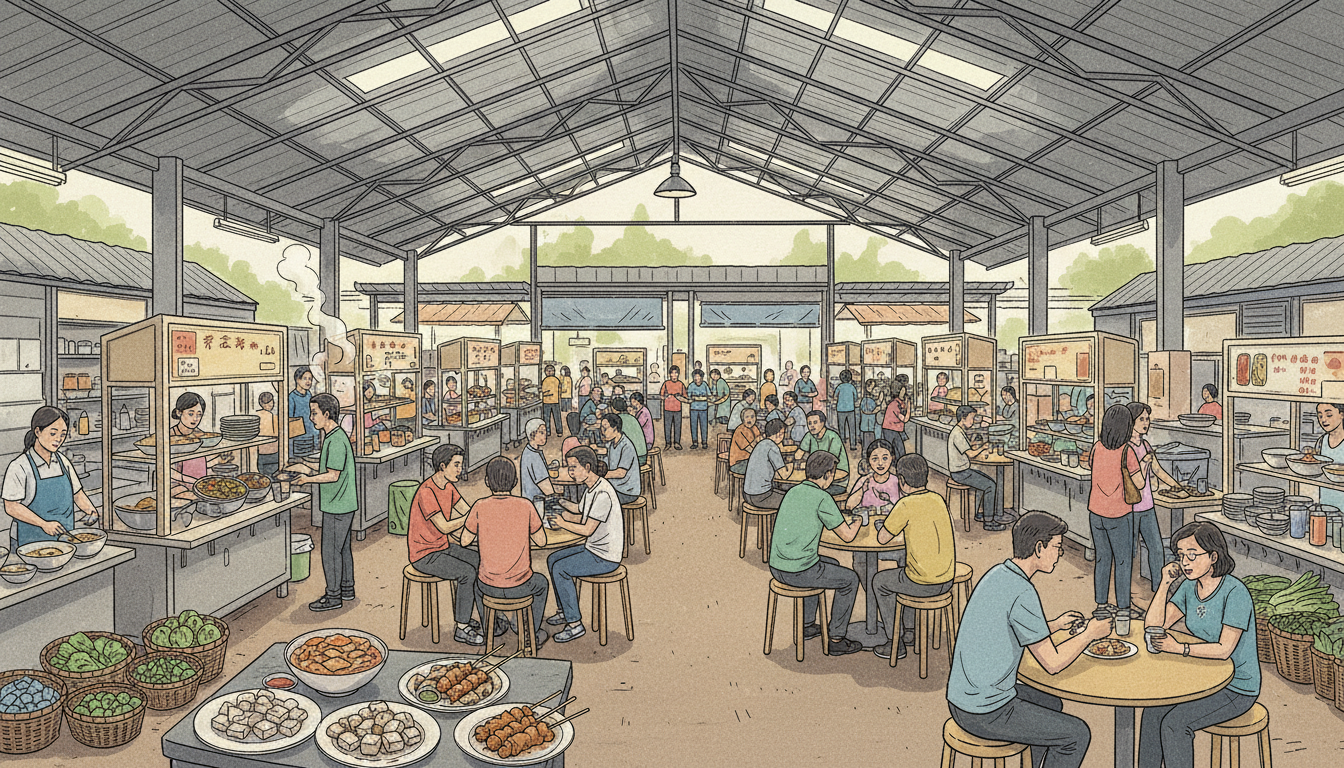
Featured image is an original conceptual illustration of a hawker centre, not a photograph of the current 2A Jalan Seh Chuan interim market.
In this guide: What is the difference between a wet market and a hawker centre? · Why did the original Bukit Timah Market close? · Where is the interim market and food centre? · Did every trader simply move across the road? · Why not rebuild the market one stall at a time? · What is expected in 2029—and what is still uncertain? · How can visitors support local hawkers while plans evolve?
1. What is the difference between a wet market and a hawker centre?
A wet market typically includes vendors selling ingredients such as vegetables, fish, meat and other groceries. A hawker centre is primarily where people buy prepared food and drinks to eat on site or take away. At Bukit Timah, both types of activity shared the broader market and food centre setting.
The distinction matters when a development relocates. A vegetable stall needs different handling, storage and operating routines from a cooked-food stall. Food preparation, waste management and delivery schedules make a relocation more complicated than changing the number on a shop door.
NEA oversees the management and public-health framework of many Singapore markets and hawker centres, but an interim site can involve different tenancy arrangements. Visitors may still call the entire place simply ‘Bukit Timah market’, which can cause confusion when the original and temporary sites have different addresses.
2. Why did the original Bukit Timah Market close?
The old market at Block 51 was earmarked for redevelopment as part of the planned Bukit Timah Integrated Development. Public plans describe a future building combining a new market and food centre with community uses such as Bukit Timah Community Club and an indoor sports hall for a neighbouring primary school.
The idea behind an integrated building is to place several local services on one site. A family might buy groceries, have lunch, attend a community activity and use another facility within the same complex. This can be more convenient than spreading amenities across separate parcels of land.
However, integrated construction takes time. Existing users must relocate while demolition and new building works take place. The need for an interim arrangement is therefore part of the redevelopment challenge, not an accidental interruption.
3. Where is the interim market and food centre?
The reported location of the interim Bukit Timah market is 2A Jalan Seh Chuan, near the Jalan Jurong Kechil and Beauty World area. This is separate from the former Block 51 site, even though both are associated with Bukit Timah Market in visitor guides.
A practical mistake is to search for an old review and follow the former building’s address. When visiting in 2026, check the intended stall’s current address and operating day rather than assuming a stall kept its old unit number.
The official NEA closure listing is for the old Bukit Timah Market. It should not be interpreted as saying all nearby hawker dining has ceased; the interim location and other food centres in the Beauty World area are distinct places.
4. Did every trader simply move across the road?
No. Reporting before the closure described around 180 original stallholders, with roughly half expected to relocate to the approximately 100-unit interim site. Some operators faced different choices depending on their business model and the new tenancy conditions.
For an individual hawker, the calculation is practical. Can regular customers find the new stall? Does the new unit suit the equipment? Are rent, utilities and staffing manageable? Can suppliers make deliveries? Is temporary business interruption affordable?
This is why a redevelopment can be good for the longer-term public environment while still creating difficulties for some existing traders. Both realities deserve attention. It would be misleading to say every stall transferred smoothly or every merchant returned to the same position.
5. Why not rebuild the market one stall at a time?
A large integrated project requires space for structural work, utilities, site access and safety separation. These processes do not fit neatly around all the activities of a live wet market, where daily food handling and large numbers of visitors continue.
An interim market separates everyday trade from the main construction site. That reduces direct conflict between construction hazards and public food shopping. It also keeps a portion of local business activity operating while a new building takes shape.
The downside is that temporary stalls may have different foot traffic and overheads. Customers also need time to relearn where to go. The best arrangements consider workers and businesses, not simply the building completion date.
6. What is expected in 2029—and what is still uncertain?
Earlier project announcements described an integrated development targeted for completion around the end of 2029. NEA’s closure listing currently uses 31 December 2029 as a tentative marker. That is a planning horizon, not a guarantee of a precise reopening day.
A new building may eventually reopen with fresh amenities, but the exact tenant mix, stall assignments, opening programme and completed design should be checked against later official announcements. Do not assume every former business will occupy the new facility or that construction will finish on the originally projected date.
One useful habit when reading redevelopment news is to separate three categories: what has already happened (the old centre closed), what currently operates (the interim site), and what is proposed or scheduled (the future integrated facility).
7. How can visitors support local hawkers while plans evolve?
Parents can turn a visit into a short local-economics lesson. Ask a child to compare the old and temporary market locations on a map. What happens when hundreds of regular customers need to change their routine? Why does a new footpath or bus stop matter to a small food business?
The longer story of Bukit Timah Market is about more than construction. It is about keeping everyday community services alive while a mature neighbourhood makes room for new needs.
- Search for the specific stall, not just the old market name.
- Confirm whether the stall is at 2A Jalan Seh Chuan or somewhere else.
- Check each stall’s business days and operating hours, since these may vary.
- Use official NEA market and hawker-centre information for closure updates.
- Allow some flexibility: temporary operations and construction nearby may affect walking routes.
Frequently asked questions
Is Bukit Timah Market open in 2026?
The original market at 51 Upper Bukit Timah Road is closed for redevelopment. An interim market and food centre operates nearby at 2A Jalan Seh Chuan; verify individual stalls before visiting.
When did the old Bukit Timah Market close?
NEA lists the closure as beginning on 1 October 2024.
When will the new Bukit Timah Market reopen?
The published development and NEA closure timeline points to around 2029, but the date is tentative and should not be treated as confirmed.
Will all of the old hawkers return?
That is not established. Initial relocation reporting indicated that only about half of the existing traders planned to move to the temporary site. Future tenant arrangements should be confirmed through official updates.
Official sources and further reading
Official sources help distinguish established facts from plans and changing visitor arrangements. For current access, operating hours and development schedules, check the responsible authority.
- NEA: Hawker management and centre closure dates
- CNA: Bukit Timah Market stallholders and interim relocation, November 2023
- The Straits Times: Bukit Timah Market redevelopment and integrated development plans
- eduKateSG: Bukit Timah Market closed — 2026 location guide
Keep exploring how Bukit Timah works
- How Bukit Timah Works | Why Granite, Quarries and Hills Shaped the Area
- How Bukit Timah Works | How the Rainforest Survives Inside Singapore
- How Bukit Timah Works | How the Rail Corridor Connects History and Nature
- How Bukit Timah Works | Why Schools and MRT Stations Follow the Main Road
- How Bukit Timah Works | Why Floods Happen and How the 2026 Canal Upgrade Helps
- How Bukit Timah Works | How Beauty World Grew from a Market into a Town Centre
- How Bukit Timah Works | How Kampongs, Temples and Fuyong Estate Shaped the Neighbourhood
- How Bukit Timah Works | Why Bukit Timah Was Crucial in World War II
- How Bukit Timah Works | How Dairy Farm Became a Nature Park
- How Bukit Timah Works | Why Hawkers Moved to an Interim Market (you are here)
- How Bukit Timah Works | How the Former Fire Station Became a Community Hub
- How Bukit Timah Works | Why Singapore Botanic Gardens Is UNESCO Heritage
Related learning: Secondary 1 Mathematics tutorials near Sixth Avenue — original small-groups information explains how students can build foundations through focused lessons. This is a separate resource and has not been changed.