
Did you know that saving a rainforest plant can begin with something smaller than your fingernail? Inside the Singapore Botanic Gardens, a building near the Bukit Timah Gate houses a project dedicated to preserving seeds and plant genetic diversity.
It is tempting to imagine seed banking as collecting seeds, putting them in a refrigerator and closing the door. In practice, researchers must identify each collection, understand the biology of the seeds and decide whether conventional storage will keep them alive.
The quick answer: established in 2019, the Singapore Botanic Gardens Seed Bank is designed to hold as many as 75,000 seed collections from roughly 25,000 plant species. As of the Gardens’ June 2026 update, it stores seeds from more than 300 plant species, including over 100 native to Singapore. Its biggest scientific challenge is that many tropical forest seeds do not survive the drying and freezing needed for conventional seed banking.
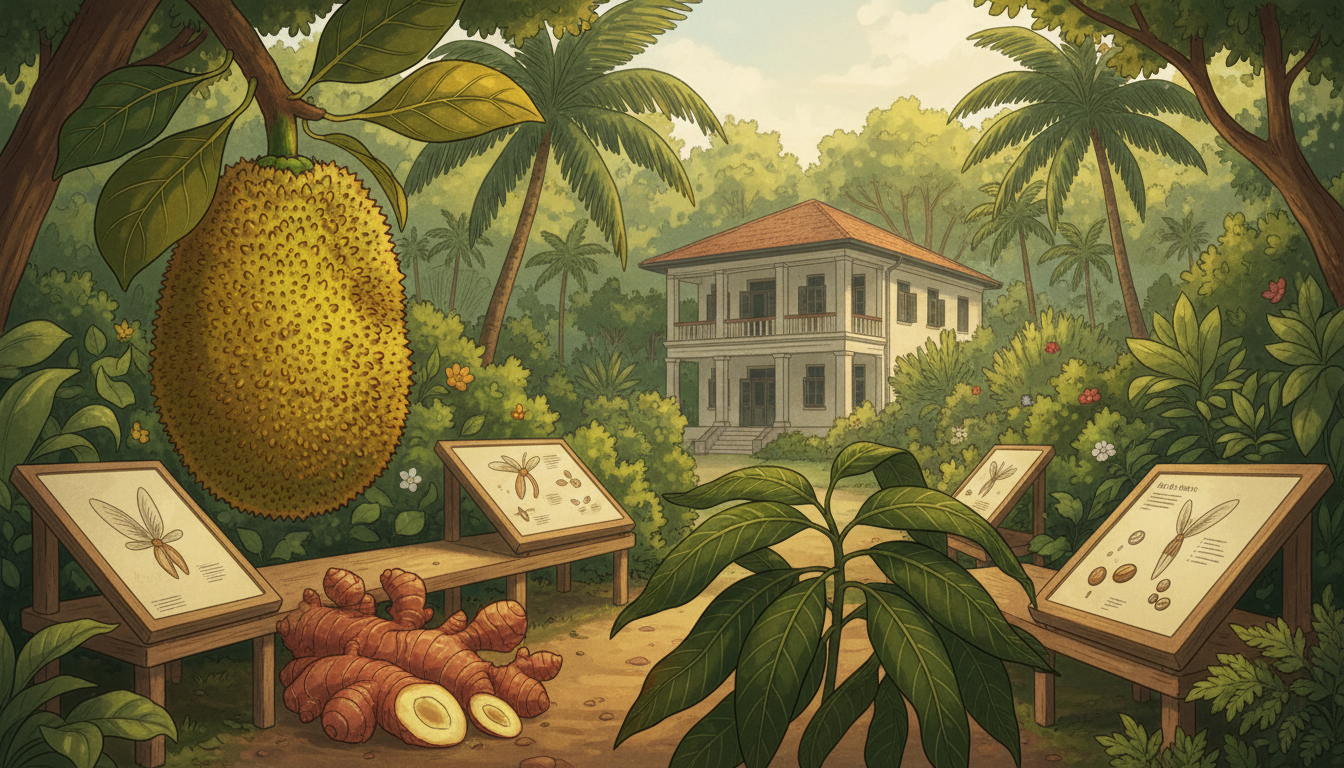
Featured image is an original conceptual illustration inspired by botanical displays at the Seed Bank and Centre for Ethnobotany; not a photograph of a conservation laboratory.
Jump to: Why conserve seeds instead of only growing trees? · What actually happens when seeds reach a seed bank? · Why can’t all tropical seeds go into a freezer? · Why do the collection numbers look so different? · Where is the Seed Bank located? · What can visitors learn at the Seed Dispersal Garden? · How can families visit and learn responsibly? · Why this matters beyond Bukit Timah
1. Why conserve seeds instead of only growing trees?
Living plants in parks and gardens provide shade, habitat, beauty and educational value. But keeping every endangered species alive as mature trees in one place is difficult. Trees take space, are vulnerable to disease and extreme weather, and may have complicated reproductive requirements.
A seed bank stores genetic material that can potentially support future research, cultivation, restoration and conservation. It is a complementary strategy, not a substitute for protecting living forests.
Consider the difference between a library and a living classroom. A seed collection can preserve biological options for the future, but it does not recreate the web of soil, animals, microbes and environmental relationships of a functioning rainforest.
That is why scientists use both in-situ conservation (protecting species in their natural habitat) and ex-situ conservation (protecting genetic material or living collections elsewhere).
2. What actually happens when seeds reach a seed bank?
The broad process starts with careful collection and record-keeping. A seed sample is not useful simply because it has a label saying ‘forest tree’. Researchers need to know the species, where the sample came from, when it was collected and how it should be handled.
Seeds are then assessed. For species that tolerate it, preparation may include cleaning, controlled drying, packaging and storage at low temperatures. Scientists also need tests or monitoring to determine whether a stored sample remains viable.
A useful phrase is provenance: the origin of the material. Two seed samples of the same species from different populations may contain different genetic information. Careful records help future researchers understand those differences.
The exact handling protocol varies by species. A home gardener’s method for storing beans is not an adequate conservation protocol for every tropical tree.
3. Why can’t all tropical seeds go into a freezer?
Here is the surprising biological problem: NParks says the majority of tropical native species have seeds that do not tolerate the drying and freezing conditions required for conventional storage.
Some seeds are described as recalcitrant. They can be damaged when their moisture content is reduced too far or when they are subjected to temperatures they cannot tolerate. Unlike some dry, dormant seeds, they cannot simply be placed in a freezer and expected to remain viable for decades.
The Seed Bank therefore studies alternative ways to preserve plant germplasm. The term germplasm means the biological material capable of transmitting a plant’s genetic information to future generations.
Do not interpret a large headline storage capacity as proof that all of Singapore’s tropical flora can already be stored successfully. Capacity and biological compatibility are two different problems.
4. Why do the collection numbers look so different?
NParks gives the Seed Bank a design capacity of 75,000 seed collections from about 25,000 species. Those are potential capacities, not the number of species actually held.
The same official page says seeds from over 300 species were being stored in its June 2026 update, with more than 100 native species. Many of those native species are threatened.
A collection is not always synonymous with a species. Researchers may store multiple collections from one species, perhaps from different places or gathered at different times. That is why dividing the capacity by a species count would not tell you how many seeds a single plant produces.
The important numbers answer separate questions: how much the facility was designed to hold, how diverse its current collections are and which species need special conservation attention.
5. Where is the Seed Bank located?
The Seed Bank is in a refurbished two-storey conserved building that once formed part of Raffles College, established in 1928. This gives the site a historical link to Bukit Timah’s wider educational landscape.
That is an elegant example of adaptive reuse: a former educational building now supports scientific research and public learning. Heritage architecture and modern conservation equipment share the same premises.
The nearest entrance listed by the Singapore Botanic Gardens is the Bukit Timah Gate. This is part of the Botanic Gardens, not the separate Bukit Timah Nature Reserve.
An ordinary visitor cannot assume free access to every laboratory or cold-storage room. The public areas are designed to explain the work safely while research continues behind the scenes.
6. What can visitors learn at the Seed Dispersal Garden?
Outside the building, the Seed Dispersal Garden displays plants with different ways of moving their seeds. Some scatter seeds mechanically; some produce fruits attractive to animals; others rely on wind or water.
Think of a seed as a tiny passenger needing transport. A wing-like structure may make wind dispersal possible. A fibrous fruit might float. A hook can cling to fur, while a fleshy fruit may encourage animals to carry seeds elsewhere.
Different solutions work under different environmental conditions. The point is not that one dispersal mechanism is ‘better’ in every situation; evolution produces varied strategies associated with where species live and how they reproduce.
NParks also mentions a living specimen of the double coconut palm, famous for producing exceptionally large seeds. Contrasting that with smaller wind-dispersed seeds makes a memorable lesson about botanical diversity.
7. How can families visit and learn responsibly?
The official Gardens page lists the Seed Bank public visitor hours as 9am to 6pm daily, except the last Wednesday of each month. Check the Gardens’ latest notices before travelling, since arrangements can change.
At the interpretive gallery, look for the stages between collecting a seed in the forest and preparing it for long-term care. Windows and interactive panels give visitors a glimpse of work that is usually hidden in laboratories.
An easy student activity is to select three examples of seed dispersal, then ask: what moves the seed, what environmental condition helps, and how might human activity interfere? Finish by asking why a seed bank cannot replace protection of the living forest.
The lesson brings ecology, climate resilience and practical conservation together without needing anyone to handle research samples.
8. Why this matters beyond Bukit Timah
The Seed Bank protects genetic diversity from Singapore and parts of Southeast Asia. Its research responds to a broader conservation challenge: changing habitats, threatened species and the difficulty of storing tropical plant material.
Conservation is a partnership between living landscapes, scientific collections and long-term stewardship. Protecting a tree species today may require both healthy populations outside the laboratory and good storage research inside it.
Did you know a visit to a small Seed Bank gallery could explain why saving tropical forests is far more complex than planting a few replacement trees? That is the larger story worth taking home.
Frequently asked questions
When did the Singapore Botanic Gardens Seed Bank open?
The Seed Bank was established in 2019 as a conservation facility for plants from Singapore and the surrounding region.
How many seeds and plant species can it hold?
NParks lists a design capacity of 75,000 seed collections from around 25,000 plant species, which is not the same as the number currently stored.
Why are tropical seeds harder to preserve?
Many tropical native seeds do not tolerate the drying and freezing necessary for conventional seed storage, so alternative methods must be researched.
Can members of the public visit?
Yes. The interpretive gallery and outdoor Seed Dispersal Garden are visitor attractions. The official page lists 9am to 6pm daily, except the last Wednesday of the month; check current notices.
Sources and further reading
These references are primarily government heritage, conservation and transport sources. For construction timelines and visitor access, always check the relevant agency’s latest guidance.
- Singapore Botanic Gardens: Seed Bank (updated June 2026)
- Singapore Botanic Gardens: Visitor information and notices
- NParks: Bukit Timah Nature Reserve conservation context
Explore related Bukit Timah guides
- Why the Botanic Gardens is UNESCO heritage
- How the Bukit Timah rainforest survives
- How Rifle Range Nature Park restores habitat
- How Bukit Timah Works | Why Tin Hill May Really Mean Temak Tree
- How Bukit Timah Works | Why King Albert Park MRT Will Be Singapore’s Deepest Interchange
- How Bukit Timah Works | Why Railway Truss Bridges Use Steel Triangles