
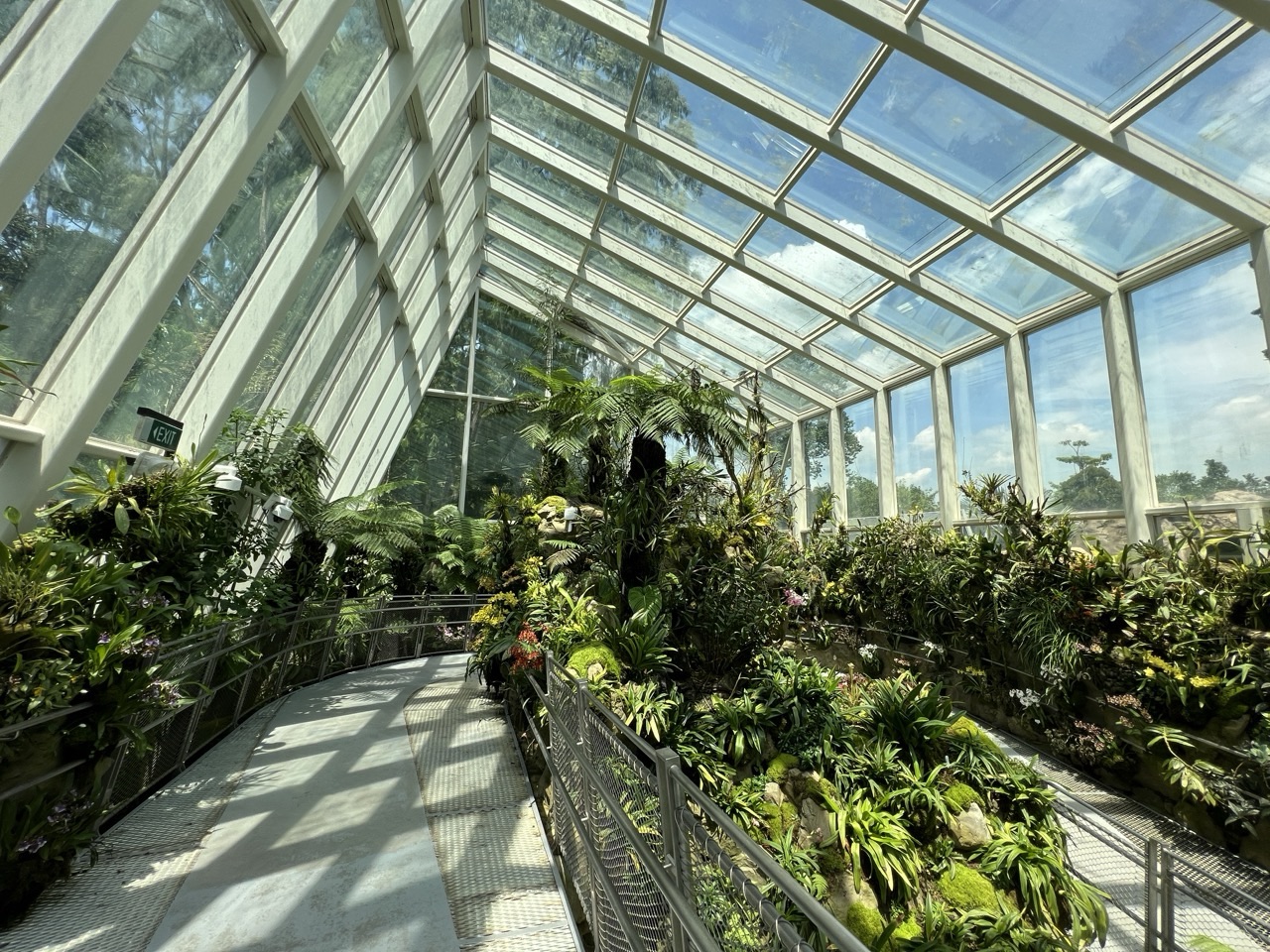
Did you know you can enter a tropical mountain climate in the middle of warm, low-lying Singapore? The Sembcorp Cool House at the National Orchid Garden is designed to make high-elevation orchids feel at home even though the building sits near sea level.
Those orchids would not necessarily survive outdoors in Singapore’s normal heat. A mountain has cooler temperatures and particular patterns of humidity, mist and light. The glasshouse recreates important parts of that environment with architectural and mechanical engineering.
The quick answer: the Tropical Montane Orchidetum, opened in April 2021, includes a Cool House representing tropical highland conditions around 1,000–2,000 metres above sea level. It maintains approximately 16–23°C using coordinated cooling and ventilation. Selective glazing, cooled floor slabs, managed airflow and solar generation help reduce energy use while protecting valuable orchid collections.
Featured photograph: a cooled glasshouse containing tropical plants at the National Orchid Garden, Singapore Botanic Gardens.
Read by question: Why are mountain orchids different from lowland orchids? · What does ‘montane’ mean? · Why doesn’t ordinary air-conditioning solve the whole problem? · How can glass transmit light but block some heat? · What happens under a visitor’s feet? · Why is the cool air concentrated low in the building? · Where do solar panels and reused materials fit in? · How does the Cool House support conservation? · A simple science activity for young visitors · What should visitors check before going?
1. Why are mountain orchids different from lowland orchids?
Not all tropical plants live in a hot lowland rainforest. As elevation rises, air temperature generally falls, and many mountainous forests experience frequent clouds, damp air and distinctive day–night conditions.
An orchid adapted to a cooler mountain habitat may struggle if exposed continuously to the warm conditions typical of Singapore’s outdoor climate. Leaves, roots and flowers respond to temperature, humidity, light and moisture, and different species have different requirements.
The orchids in the Cool House are not simply being chilled so visitors feel comfortable. The controlled environment supports species that might otherwise be difficult to grow and study locally.
That is one reason botanical gardens maintain specialised collections rather than keeping every plant in the same greenhouse.
2. What does ‘montane’ mean?
Montane refers to mountainous environments. The Orchidetum interprets a progression from lower-elevation conditions to cooler and more specialised high-elevation tropical habitats.
The route includes the Yuen Peng McNeice Bromeliad Collection, Tan Hoon Siang Mist House and Sembcorp Cool House, as well as the Lowland Habitat Trail and Secret Ravine. These areas are related but do not share identical climatic settings.
Some parts use mist and shade to evoke intermediate mountain environments, while the Cool House relies on more intensive environmental control to maintain cooler conditions.
The display is a designed ecological interpretation, not a literal transplanted mountain. A visitor should distinguish simulated conditions from the complexities of an entire natural cloud forest.
3. Why doesn’t ordinary air-conditioning solve the whole problem?
A large plant house must control more than the temperature felt by a visitor. Plants require suitable light, humidity and airflow, and high indoor humidity can affect condensation and equipment operation.
Putting a large conventional air-conditioner in a glass box could create high energy demand because sunlight continually adds heat. The system needs to reduce heat entering the space as well as remove heat already present.
The Cool House design therefore combines passive and active strategies: selective glass, thoughtful distribution of cool air, chilled floor surfaces and automated management.
This is an important engineering idea: lowering demand is often better than simply installing a larger machine to counteract unnecessary heat gain.
4. How can glass transmit light but block some heat?
Plants require visible light for photosynthesis. At the same time, incoming solar radiation can raise temperatures inside an enclosed glasshouse.
The Cool House uses spectrally selective glass to let useful visible light through while reflecting a substantial proportion of infrared radiation. Project descriptions indicate about 60% of infrared energy is reflected by the glazing.
This percentage describes a particular optical performance claim, not a reduction of 60% in the building’s total energy bills. The two measurements are different.
Imagine a window that admits enough light for a plant while blocking much of the invisible energy that would otherwise warm the interior. It reduces the cooling work that must follow.
5. What happens under a visitor’s feet?
One of the distinctive strategies is a chilled floor slab. Water circulating in embedded pipes helps cool the slab, allowing it to absorb heat from the lower part of the space.
Project information describes a slab surface temperature of around 17°C. That is not the same as saying every visitor’s feet are at 17°C or that the air is uniformly that temperature.
Cooling surfaces and managing airflow can make the lower occupied area comfortable without needing to chill every cubic metre near the roof to the same degree.
This illustrates the concept of thermal stratification: air at different heights can have different temperatures, especially in a tall enclosed space.
6. Why is the cool air concentrated low in the building?
The Cool House uses displacement ventilation strategies. Cool air is supplied near the lower levels, including outlets integrated into the landscape, while warmer air can rise higher.
In a tall space, treating the occupied and planted zones carefully can be more efficient than forcing the same air temperature everywhere from floor to roof.
Automatic controls monitor conditions and can allow warm air near the top to escape through openings when appropriate. Exactly when these open depends on conditions, not a simple fixed daily timetable.
This is why the visitor experience involves a carefully managed combination of airflow, cooling and building geometry rather than a single air-conditioning switch.
7. Where do solar panels and reused materials fit in?
The enhanced Cool House includes building-integrated photovoltaic elements that can help offset electricity use. It also retained and adapted structural elements of the previous glasshouse rather than rebuilding everything from entirely new material.
Retaining suitable existing steelwork can reduce the demand for additional building materials, though the actual environmental outcome still depends on engineering and life-cycle factors.
Project materials describe energy use roughly 30% lower than the previous structure, despite the larger new display area. That is a reported design and performance comparison, not proof of a carbon-neutral facility.
Another important distinction: solar electricity contributes to operating needs but does not automatically power every cooling system continuously through the night.
8. How does the Cool House support conservation?
Some rare and threatened tropical highland orchids are difficult to grow in ordinary outdoor gardens in Singapore. Maintaining suitable conditions allows horticulturists to cultivate, observe and potentially support ex-situ conservation of such plants.
Ex-situ conservation means safeguarding organisms or genetic material outside their natural habitats. It complements, rather than replaces, protecting living mountain forests.
A greenhouse collection can help with research and awareness, but it does not preserve the whole ecosystem that wild orchids depend upon—such as suitable host trees, pollinators, fungal partners and climate.
The more complete conservation lesson is that specialised cultivation is valuable alongside protection of the habitats from which these plants originate.
9. A simple science activity for young visitors
Stand at an appropriate visitor point and compare the outdoor garden with the Cool House. What differences do you notice in temperature, mist, lighting and plant form?
Draw three boxes labelled outside lowland environment, mist house and cool house. Note one environmental challenge for a plant in each setting. Ask which features of the building help solve that challenge.
Then discuss why cooling a plant habitat is a useful scientific goal but has an energy cost. Which strategies reduce that cost before mechanical cooling is even needed?
Do not touch or collect orchids. Many collections contain plants kept for research or conservation, and the labels are there to support careful observation.
10. What should visitors check before going?
Did you know that recreating a mountain forest in Singapore requires biology and building physics to cooperate? The Cool House makes that connection visible in the flowers, glass and air around you.
- The Tropical Montane Orchidetum is inside the National Orchid Garden at Singapore Botanic Gardens.
- The National Orchid Garden is a ticketed attraction; use NParks for the current admission prices.
- Current Gardens information lists 8.30am–7pm opening, with last ticket sales and entry at 6pm.
- Check whether any display house or route has temporary maintenance restrictions.
- Do not assume every orchid is flowering on the day you visit.
- Use official maps for the route through the Bromeliad Collection, Mist House and Cool House.
Frequently asked questions
What temperature is the Sembcorp Cool House?
Its highland display is designed to maintain approximately 16–23°C, according to project and NParks descriptions.
How high are the mountain habitats it represents?
The exhibit approximates tropical montane environments at around 1,000–2,000 metres elevation.
When did the Tropical Montane Orchidetum open?
It opened in April 2021 as an enhancement to the National Orchid Garden.
How does the glasshouse save energy?
Design features include selective glazing, chilled-floor cooling, managed air stratification, automated hot-air removal, photovoltaic generation and reuse of existing steelwork.
Does the selective glass block all sunlight?
No. It permits useful visible light while reducing some infrared heat gain.
Is the Cool House a substitute for wild orchid conservation?
No. It supports cultivation and ex-situ research but cannot replace natural habitat protection.
Sources and further reading
The government, conservation and research sources below support the central facts. Visitor access and technical performance figures should always be read in their stated context.
- Singapore Botanic Gardens: National Orchid Garden
- NParks: Tropical Montane Orchidetum, Gardenwise 2021
- Sembcorp: Cool House climate and design
- Sembcorp: Cool House cooling and sustainability infographic
- Singapore Botanic Gardens: 2026 visitor information
Explore the How Bukit Timah Works series
- How the National Orchid Garden creates new hybrids
- How the Seed Bank protects future forests
- Why Botanic Gardens is UNESCO Heritage
Other explanations in this four-part batch: How Bukit Timah Works | Why Rail Corridor Trails Use Different Surfaces · How Bukit Timah Works | Why Chun Tin Road’s Five-Foot Ways Keep Pedestrians Sheltered · How Bukit Timah Works | How Raffles College Used Arches and Quadrangles to Stay Cool