
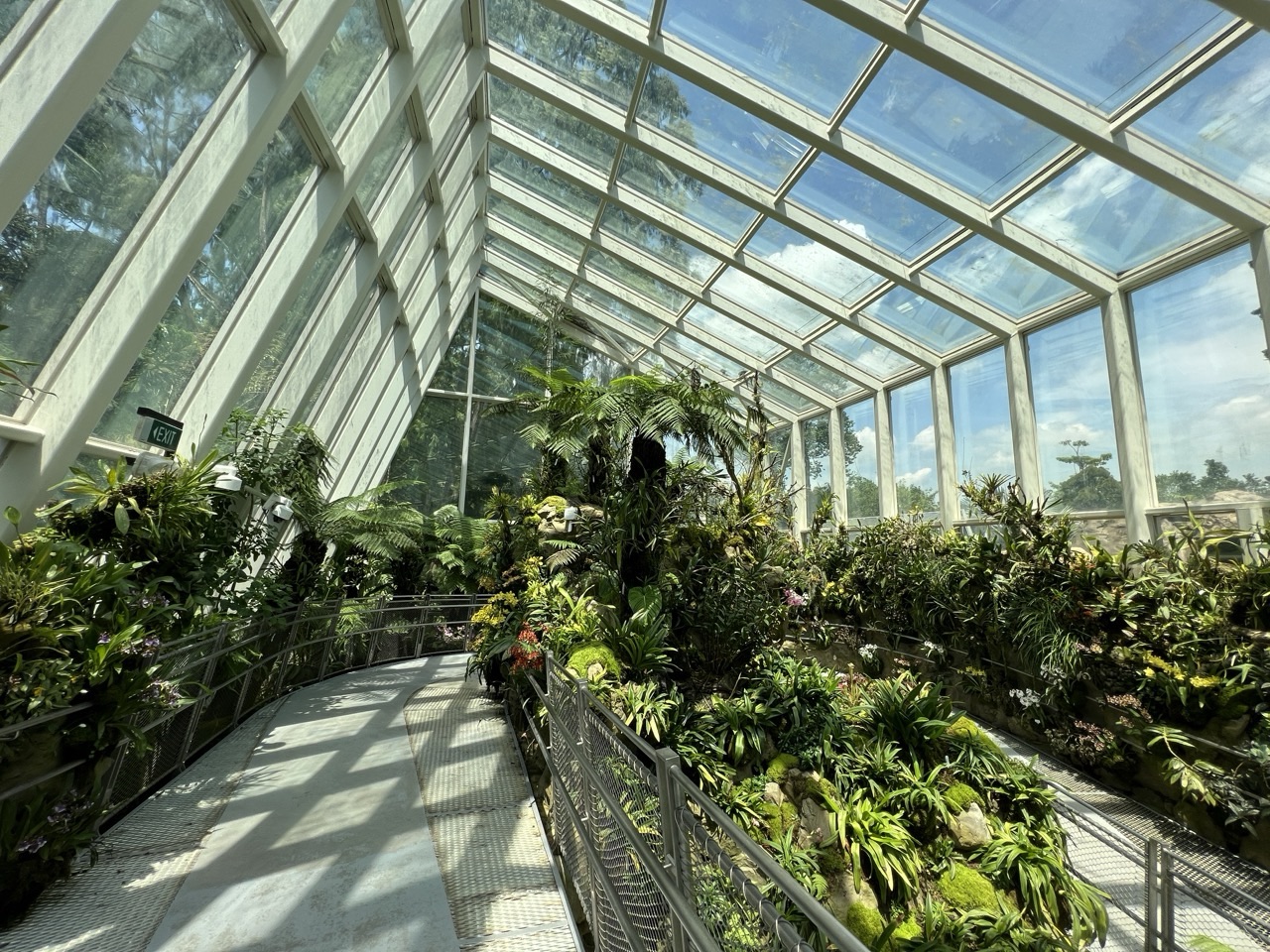
Is the Sembcorp Cool House included in National Orchid Garden admission, and which of the three display houses should you visit? The Tropical Montane Orchidetum (TMO) is a specialised mountain-orchid collection inside the ticketed National Orchid Garden at Singapore Botanic Gardens. Opened on 3 April 2021, it recreates different tropical mountain habitats through the outdoor Lowland Habitat Trail and Secret Ravine plus three display houses: Tan Hoon Siang Mist House for orchids with Begonias and Aroids, Yuen-Peng McNeice Bromeliad Collection for Bromeliaceae, and the spectacular Sembcorp Cool House with more than 1,000 species represented from five major biogeographic regions. The houses are part of the normal National Orchid Garden experience; the visitor page lists one National Orchid Garden admission ticket, not a second separate Cool House ticket.
For people searching Sembcorp Cool House ticket price, Tropical Montane Orchidetum Singapore, National Orchid Garden Cool House, Tan Hoon Siang Mist House, Yuen Peng McNeice Bromeliad Collection, Secret Ravine, orchids in cool climate, orchid house wheelchair access, orchid garden price 2026, Tyersall Entrance parking and orchid photography, the practical answer is precise. National Orchid Garden opens 8.30am–7pm daily, with last ticket sales and entry at 6pm. The official October 2026 admission table charges S$5 for local adults and S$15 standard, S$1 local / S$3 standard for seniors aged 60+ and eligible students, and free entry for children under 12. ‘Local’ includes citizens, PRs and people living in Singapore on eligible passes, not only Singapore citizens.
Our useful first visit: arrive at the Tyersall Entrance, which NParks identifies as the most convenient drop-off and parking zone for National Orchid Garden, purchase the correct admission ticket at its entrance, then use the orchid map to plan the Lowland Habitat Trail, Secret Ravine and three display houses. If someone uses a wheelchair, follow the designated step-free route that bypasses the stairs at the eastern end; NParks specifically says visitors can still reach Sembcorp Cool House that way. Allow time for humidity, rest and photography. Not every orchid will be flowering, and living displays or indoor houses may close temporarily during maintenance or weather-related advisories.
Quick comparison: the three orchid display houses
| Attraction | What it interprets | What to notice |
| Tan Hoon Siang Mist House | Award-winning orchids with Begonias and Aroids | Moisture, foliage texture and flower diversity |
| Yuen-Peng McNeice Bromeliad Collection | Bromeliads including Ananas, Neoregelia and Guzmania | Rosette forms, leaf structure and epiphytic habits |
| Sembcorp Cool House | Cool montane plant ecosystems from five regions | Highland orchid adaptations, cooler air and mist |
| Lowland Habitat Trail | Lowland tropical habitat and streamside plants | Transition from warm lowland ecology |
| Secret Ravine | Deep narrow mountain-valley habitat interpretation | Humidity, shade, plant communities |
| Garden admission — adult | Local S$5; standard S$15 | Includes the National Orchid Garden and its TMO features |
| Admission — senior 60+ | Local S$1; standard S$3 | Proof of eligibility may be required |
| Admission — eligible student | Local S$1; standard S$3 | Check accepted student identification |
| Admission — under 12 | Free | Age rule applies to ticket, not supervision |
| Garden hours | 8.30am–7pm; last entry 6pm | Not the wider Gardens’ midnight closing |
| Access | Wheelchair route bypasses east-end stairs | Ask ticket counter or Visitor Services for current map |
Contents: altitude, orchids and practical visiting
- Why the Tropical Montane Orchidetum was built
- How an orchid’s habitat changes with altitude
- Mist House, bromeliads and Cool House compared
- Lowland Habitat Trail and Secret Ravine
- Conservation, epiphytes and global plant regions
- Ticket prices and admission eligibility
- Wheelchair and family routes
- Timing, photography and weather
- FAQs and official National Orchid Garden sources
1. The Orchidetum belongs to the National Orchid Garden
The TMO is part of the ticketed National Orchid Garden, not a free general garden bed near Botanic Gardens MRT. The National Orchid Garden first opened in 1995 and added the TMO in 2021.
A person entering only the free public Gardens needs a ticket to pass into the National Orchid Garden and explore its specialised display houses.
2. There is no separate public Cool House ticket listed
NParks’ admission table covers entry to the National Orchid Garden, which includes the Orchidetum and its houses. It does not advertise a second standard admission charge for Sembcorp Cool House.
Special programmes, private events or unusual closures can have their own terms, but ordinary visitors should use the main official ticket counter.
3. The collection was enhanced in April 2021
NParks records the opening of the Tropical Montane Orchidetum on 3 April 2021, following major renovation and expansion of its orchid display areas.
That explains why an older guide from 2019 might not contain the current Cool House, enhanced Mist House or surrounding Secret Ravine route.
4. An orchidetum is a botanical collection
An orchidetum is an area or institution devoted to orchids and their cultivation or study. Here, the concept extends beyond orchid flowers to the habitats and associated plants that support them.
The visitor experience includes living communities of plants rather than a simple aisle of potted orchids arranged by colour.
5. The TMO is about altitudinal habitats
Mountain environments can have different temperatures, rainfall, cloud cover and plant communities as altitude rises. TMO interprets these differences through outdoor and managed-climate displays.
The journey is educational rather than a literal climb to a tropical summit. Each house recreates conditions that would otherwise require travelling to different mountain regions.
6. Lowland tropical orchids live under different conditions
Orchids in lowland rainforest, streamside or warm valley habitats may experience relatively warm, humid conditions compared with higher-elevation cloud forests.
The correct conditions depend on species. Not every orchid thrives in the same sun, shade, temperature or moisture.
7. The Lowland Habitat Trail starts the ecological story
NParks’ 2021 research article describes the refreshed Lowland Habitat Trail, including landscapes modelled on Neram forests of Peninsular Malaysia.
A visitor can look for changes in vegetation and moisture before entering the controlled display houses. This helps connect botanical interpretation to broader rainforest ecology.
8. Neram trees are associated with stream habitats
The lowland habitat section draws on Dipterocarpus oblongifolius, known as Neram, a tree that can grow near waterways and support epiphytic plant communities.
That relationship helps explain why an orchid might be found growing on a tree trunk rather than rooted in garden soil.
9. What is an epiphyte?
An epiphyte grows on another plant for physical support without automatically taking food directly from the host. Many orchids and bromeliads are epiphytic.
Do not confuse epiphytes with parasites. The distinction is important for understanding canopy biodiversity.
10. Rainforests have vertical habitat layers
A tree can provide shaded, exposed, wet and relatively dry surfaces at different heights. Epiphytes occupy niches shaped by light, airflow and rainfall.
A display house can bring these otherwise hard-to-see forest-canopy interactions closer to visitors without requiring climbing a living tree.
11. The Secret Ravine creates a deep-valley atmosphere
NParks identifies the Secret Ravine as an outdoor feature recreating conditions associated with deep, narrow valleys of tropical mountains.
Observe shade, the surrounding planted surfaces and moisture. Respect handrails and do not scramble across decorative rocks to photograph a specimen.
12. A ravine is not a waterfall theme-park ride
The Secret Ravine is an interpretive botanical landscape, not a private climbing course or waterplay zone.
Its main purpose is to show how topography and moisture can affect the plants that survive in a mountain habitat.
13. The three display houses make the altitude journey tangible
The Tan Hoon Siang Mist House, Yuen-Peng McNeice Bromeliad Collection and Sembcorp Cool House each focus on different groups or environmental conditions.
A visitor will learn more by comparing the houses than by trying to photograph every flowering plant without noticing why the collection is arranged that way.
14. Mist House combines orchids and foliage plants
NParks describes the Tan Hoon Siang Mist House as home to award-winning orchids among Begonias and Aroids.
The interplay of flower and leaf forms helps explain that horticultural interest extends beyond bright orchid blossoms.
15. Why mist matters
Many forest plants are adapted to high humidity or periods when fog and mist add moisture to leaves and surrounding air.
Artificial misting in a display house is a managed horticultural tool; do not assume every visitor is permitted to enter technical misting systems or adjust the equipment.
16. Begonias often have distinctive foliage
Begonias include many species with unusual leaf shapes, patterns and textures. They can provide visual interest even when orchids are between flowering periods.
Observe how leaf colour and pattern vary rather than touching delicate plants. Display specimens can be sensitive to handling.
17. Aroids add a second botanical family
Aroids include plants in the Araceae family, with varied leaf form and growth strategies. In a humid house they provide a contrasting structure around orchid displays.
A botanical collection gains educational depth when visitors compare plant families rather than grouping every tropical plant as an orchid.
18. A flower display is not constant
Orchids have species-specific growth and flowering cycles. An award-winning hybrid may not be in bloom at the exact time you visit.
This is not evidence that the house is poorly maintained. Observe plant form, habitat and labels as well as flowers.
19. Tan Hoon Siang is part of the Gardens’ orchid heritage
The Mist House bears the name of a supporter associated with orchid cultivation in Singapore, reflecting the history of botanical collections and philanthropy.
A named display house has an institutional and horticultural story, not just a sponsor logo. Read available interpretation for context.
20. Bromeliads are not orchids
The Yuen-Peng McNeice Bromeliad Collection features members of the Bromeliaceae family rather than orchids alone. The two groups can share epiphytic habitats.
A rosette of leaves is not automatically an orchid. Comparing structures teaches visitors to look beyond general tropical appearance.
21. Ananas is part of the bromeliad family
The official Garden page highlights Ananas, the genus that includes pineapple, as an accessible reference for bromeliad diversity.
A familiar edible fruit can help children appreciate plant relationships, but the public display is not for harvesting.
22. Neoregelia has striking rosettes
Neoregelia species and cultivars often form rosettes with colourful leaves. Some bromeliads retain water between leaves in their natural habitats.
Use the display to observe leaf structure without pouring water into plants or disturbing small organisms living in the rosette.
23. Guzmania makes another colourful comparison
Guzmania bromeliads can display conspicuous coloured bracts and flowers. Their structure differs from the familiar broad petals of many orchid hybrids.
Ask which coloured parts are true petals and which are bracts. Careful botanical observation is more rewarding than guessing.
24. Bromeliads can support miniature habitats
Some bromeliads collect water and organic material within leaf rosettes, creating microhabitats for invertebrates and other organisms in the wild.
In a managed conservatory, staff control irrigation and conservation. Visitors should not introduce insects or touch displayed water to imitate natural processes.
25. Sembcorp Cool House is the highland showpiece
The official page calls the Sembcorp Cool House the showstopper, with over 1,000 species from five broad regions representing cool tropical montane ecosystems.
That figure describes the specialised Cool House collection, not proof that 1,000 orchid species are flowering at one time.
26. The five regions provide a global perspective
NParks names Malesia, Continental Southeast Asia and South Asia, Australasia, Afrotropics and Neotropics as the five broad biogeographic origins represented.
These regions are not five nearby rooms arranged like continents in a museum. Use labels to identify where actual plant species originated.
27. The Neotropics include tropical parts of the Americas
Neotropical montane orchids can be adapted to cool, misty high-elevation environments. The Cool House demonstrates how tropical latitude does not guarantee hot conditions at every altitude.
Students can compare climate, height and rainfall without assuming that every mountainous plant from the Americas requires exactly the same conditions.
28. Malesia is a biogeographic region
The Malesian region covers much of maritime Southeast Asia and nearby areas, known for extraordinary tropical plant diversity.
It is not identical to the modern political country Malaysia. Biological regions and national borders are different ways of dividing a map.
29. Australasia expands the collection’s range
Australasia contains distinctive orchid and epiphyte floras. The Cool House interprets such botanical relationships within a controlled environment.
A visitor can compare plant shape or leaf habit with Southeast Asian specimens without needing to memorise every species.
30. Afrotropical montane habitats add another contrast
High-elevation African tropical regions support plants adapted to different patterns of cool air, moisture and light.
A greenhouse can interpret those conditions, but it does not recreate a complete wild mountain forest ecosystem or all its animal interactions.
31. Climate control supports plants that may fail outdoors
A plant adapted to cool cloud-forest temperatures may struggle in Singapore’s lowland heat. A managed Cool House uses controlled air and moisture to maintain suitable conditions.
This is conservation and horticulture infrastructure, not simply a place to escape the afternoon heat. Visitors should respect the staff’s climate control and plant care.
32. The cool air can feel very different from the path outside
Moving from Singapore’s warm humidity into the managed environment can be refreshing. It also makes the relationship between climate and orchid distribution easier to understand.
Some visitors prefer a light layer for comfort, but the exact indoor temperature is not stated in the public visitor table and should not be invented.
33. Why orchid conservation matters
Wild orchids can face pressure from habitat loss, unsustainable collection and environmental change. Living collections, identification and research can contribute to conserving biodiversity.
Ex situ display does not replace protecting wild habitats. A botanical institution can educate visitors while supporting broader research.
34. Don’t remove or purchase plant material from displays
All orchids and associated plants are managed botanical specimens. Taking cuttings, seeds or flowers harms the collection and may breach conservation rules.
If you wish to grow an orchid, use a legitimate licensed retailer and suitable horticultural advice, not the conservatory’s public displays.
35. The wider Orchid Garden holds enormous diversity
NParks lists more than 1,500 orchid species and 3,000 hybrids across the National Orchid Garden. This is separate from the Cool House’s more than 1,000 displayed species figure.
Different denominators describe different collections. Do not add the figures together as though no species appears in more than one category.
36. An orchid species and a hybrid are different
A species is a naturally recognised taxonomic group, while a horticultural hybrid results from crosses between parent plants or lineages.
Some celebrated hybrid orchids are bred for a particular flower colour or shape. A visitor can compare botanical species with cultivated selections.
37. Orchid breeding has a long Singapore history
The Gardens’ orchid collection developed through the late nineteenth and twentieth centuries. Research, propagation and naming have made orchids part of Singapore’s botanical identity.
This historical narrative complements the mountain-habitat focus of TMO; not every orchid in the collection is an endangered wild species.
38. The admission counter is at the Orchid Garden entrance
NParks asks visitors to purchase tickets directly at the ticket counter of the National Orchid Garden. The TMO lies within this paid garden.
A general free Gardens entry does not include the ticketed orchid collection. A third-party reseller is not needed for ordinary direct admission.
39. Adult ticket rates differ for local and standard visitors
The official 2026 table gives S$5 for eligible local adults and S$15 standard admission. The local definition includes citizens, PRs and many residents with eligible passes.
Carry appropriate proof and allow ticket staff to determine the correct category. A visitor living in Singapore may qualify even without citizenship.
40. Senior ticket rates are lower
For seniors aged 60 and above, the published rate is S$1 local or S$3 standard.
The age band and residency status must be met. Do not automatically apply the senior concession to everyone accompanying an older relative.
41. Student ticket rates need identification
The posted rates are S$1 local or S$3 standard for eligible students. The local student definition specifies attendance at recognised local education institutions and valid student identification.
If eligibility is uncertain, ask the ticket counter rather than assuming every person under 25 is a student concession.
42. Children under twelve enter free
NParks lists free National Orchid Garden admission for children below 12. Their accompanying adults may still need admission tickets.
Free child entry does not replace adult supervision. A young child might prefer a shorter route through the houses rather than a full botanical study.
43. Last entry is 6pm, not 7pm
The National Orchid Garden opens 8.30am–7pm but sells the last tickets and admits the last visitors at 6pm.
Arriving at 6.15pm hoping to start the Cool House visit would conflict with the current entry rule. Plan earlier and allow time to walk to the houses.
44. Tyersall is the recommended parking and drop-off entrance
NParks identifies Tyersall Entrance as the most convenient parking and drop-off for National Orchid Garden. The wider Gardens has multiple different entrance zones.
Using the entrance nearest Botanic Gardens MRT may be valid but add substantial walking. Select transport based on the correct Orchid Garden location.
45. Parking is not included in a ticket
The general Gardens visitor page gives S$0.02 per minute parking at approved zones, including the Tyersall/Learning Forest vicinity. Charges and lot availability remain separate.
A S$5 local adult ticket does not include a free private parking bay. Use the live carpark signage for the final rate.
46. Accessibility has a specific eastern stair bypass
NParks states that the Orchid Garden is wheelchair accessible and provides a dedicated route avoiding stairs at the eastern end, allowing wheelchair users to reach Sembcorp Cool House.
Follow the marked accessible path rather than a shortcut shown on an old staircase photograph. Ask the ticketing desk about any temporary diversion.
47. Free wheelchair loans may be available
The broader Gardens provides wheelchair loans through staffed Visitor Services desks from around 8am–5.30pm, subject to availability.
Arrange assistance and route choice if needed. Equipment availability and the number of helpers matter on garden gradients.
48. Families can choose one display house first
For a child or visitor with limited attention, Sembcorp Cool House may provide the strongest climate contrast; the Mist House and bromeliad collection offer different plant forms.
One meaningful experience is preferable to racing through every greenhouse. Let the visitor choose which plant or habitat interests them.
49. An older visitor can avoid unnecessary steps
Start with the designated step-free route and build in rest points. The indoor environment may feel more comfortable than a long outdoor walk in the midday heat.
A ‘wheelchair accessible’ designation is useful, but individual fatigue, gradients and seating arrangements should still shape the visit.
50. Take photos without blocking displays
Misty foliage and close-up orchid blooms can look beautiful, but greenhouse spaces may be narrow or busy. A tripod or extended pose can block the route for other visitors.
Use permitted photography and avoid moving leaves, touching flowers or standing in maintenance spaces for a better angle.
51. Mist and humidity can affect cameras
Moving from a warm humid exterior into a cooler display may cause condensation on lenses and glasses. Let equipment acclimatise rather than wiping a wet lens against delicate plants.
Keep camera straps secure around fragile living specimens. A photograph should not interrupt horticultural care.
52. Thunderstorms can change outdoor portions
Some outdoor Orchid Garden paths are exposed, and severe weather can result in temporary visitor restrictions. Follow the Gardens’ Notices page and staff instructions.
An indoor Cool House isn’t a reason to cross open lawns in lightning. Seek proper safe shelter before resuming a visit.
53. A one-hour focused orchid visit
The Gardens’ self-guided page suggests that one hour can introduce the National Orchid Garden. For a TMO-focused hour, select the principal houses and avoid trying to cover distant unrelated Garden cores.
Allow for ticketing, path length, congestion and accessible route requirements. One hour is only a planning suggestion.
54. A 90-minute montane habitats visit
A more relaxed visit can explore Lowland Habitat Trail, Secret Ravine and all three display houses, with time to compare humidity, leaf form and flower structure.
Ninety minutes is not a fixed operator-guided tour. The experience may last longer if you enjoy photography or reading labels.
55. A half-day orchids-and-learning trip
Combine the Orchid Garden with Ginger Garden or a short free Learning Forest walk, if the group’s energy and the separate attraction hours permit.
TMO is ticketed inside the National Orchid Garden; Learning Forest remains free and closes at 7pm. They are different visitor areas with different rules.
56. Why the Cool House is not a children’s indoor playground
The houses contain valuable research and ornamental plants with controlled climate infrastructure. Visitors should move gently, avoid running and keep children supervised.
Enjoyment can come from seeing unusual orchids and cool mist rather than touching every plant or treating the house as a place to play.
57. The value goes beyond colourful flowers
The Orchidetum shows how tropical mountains, species distributions, conservation and horticulture interact. Bromeliads, Aroids and orchids tell a richer story together than orchids alone.
A visitor may leave understanding why a cool highland species needs a special managed environment in Singapore’s lowland climate.
58. The essential 2026 ticket-and-access answer
Buy National Orchid Garden admission at the official counter, arrive before last entry at 6pm, plan from Tyersall Entrance and follow the wheelchair route when required.
The Cool House, Mist House, bromeliad collection, Lowland Habitat Trail and Secret Ravine are all part of the same specialised Orchidetum experience.
Frequently asked questions about the Tropical Montane Orchidetum
Where is Tropical Montane Orchidetum?
Inside the ticketed National Orchid Garden at Singapore Botanic Gardens.
Is Sembcorp Cool House free?
It is included in ordinary National Orchid Garden admission, which is ticketed; no separate standard Cool House admission is listed.
What are National Orchid Garden hours?
8.30am–7pm daily, last ticket sales and entry at 6pm.
When did the Orchidetum open?
3 April 2021, according to NParks.
What are its three display houses?
Tan Hoon Siang Mist House, Yuen-Peng McNeice Bromeliad Collection and Sembcorp Cool House.
What are the outdoor features?
Lowland Habitat Trail and Secret Ravine.
What is Sembcorp Cool House famous for?
Over 1,000 species representing cool tropical montane floras from five broad regions.
How cold is the Cool House?
NParks does not provide a single guaranteed visitor temperature in its public attraction listing; expect a managed cooler environment.
Can children enter the Cool House?
Yes with appropriate adult supervision and the correct National Orchid Garden admission arrangements.
How much is a local adult ticket?
S$5, under the current official admissions table.
How much is a standard adult ticket?
S$15.
Who qualifies as a local?
The table includes citizens, PRs and those living in Singapore on eligible residence or work/dependent passes.
How much do seniors pay?
Aged 60 or older: S$1 local or S$3 standard.
How much do students pay?
S$1 local or S$3 standard for eligible students; carry valid proof.
Do children under twelve enter free?
Yes. NParks lists admission free below age 12.
Where should tickets be purchased?
Directly at the National Orchid Garden ticket counter, under the current official guidance.
Does a National Orchid Garden ticket include all TMO houses?
The houses are named attractions within the ticketed National Orchid Garden; no ordinary separate house ticket is listed.
Which entrance is best for driving?
Tyersall Entrance is the official recommended drop-off and parking zone.
Which MRT station serves the wider Gardens?
Botanic Gardens MRT and Napier MRT, with different entrances and distances; use the Gardens’ map for the orchid location.
Is the Orchid Garden wheelchair accessible?
Yes. NParks identifies a route that bypasses steps at the eastern end and reaches Sembcorp Cool House.
Can I rent or borrow a wheelchair?
The wider Gardens offers free wheelchair loans at staffed Visitor Services during operational hours, subject to availability.
What is Tan Hoon Siang Mist House?
A humid orchid display with award-winning orchids, Begonias and Aroids.
What is the Bromeliad Collection?
A specialised collection highlighting bromeliads including Ananas, Neoregelia and Guzmania.
Are bromeliads orchids?
No. They are botanically different plant families although both may grow as epiphytes.
What is an epiphyte?
A plant that grows on another plant for support, without necessarily being parasitic.
Can I touch the orchids?
No. Protect living specimens and follow all visitor signs; do not remove flowers or cuttings.
Will every orchid be flowering?
No. Flowering depends on species, season and horticultural management.
Does the Cool House show only Asian plants?
No. The collection spans five global biogeographic regions including Afrotropics and Neotropics.
What is the Secret Ravine?
An outdoor display inspired by shaded narrow ravines in tropical mountain habitats.
Is there a lift or step-free route?
The Gardens documents a dedicated wheelchair route; ask the ticket counter for current route and diversion details.
Can I visit after 6pm?
Last entry is 6pm. Do not assume you can start a visit after that even though closing is 7pm.
Can I use the public garden after 7pm?
Some wider Gardens areas remain open until midnight, but National Orchid Garden closes at 7pm.
How much is parking?
General Singapore Botanic Gardens parking charges are S$0.02 per minute in approved zones, subject to posted updates.
Can I bring a dog into the National Orchid Garden?
No. The Gardens identifies it as a No Pets Zone.
Can I take photos?
Follow current garden photography rules and avoid flash or equipment use where restricted; do not touch plants.
Does the Orchidetum have a separate guided-tour ticket?
Check current NParks event listings for special programmes; ordinary TMO entry is through the National Orchid Garden ticket.
How long should I allow?
About 60–90 minutes or more is a useful visitor planning range for focused TMO exploration, depending on access and interest.
Can I combine it with Learning Forest?
Yes as a separate neighbouring visit if time and weather allow. Learning Forest is free but closes at 7pm.
Why are montane orchids kept cooler?
Different elevations have different climate conditions; controlled houses support species adapted to cooler, mistier habitats.
Can I buy orchids inside?
A Gardens shop may offer souvenirs or suitable horticultural items; visitors cannot take display specimens.
Where can I get the latest admission table?
The official Singapore Botanic Gardens National Orchid Garden page, not a third-party ticket screenshot.
Related Bukit Timah and Botanic Gardens guides
- National Orchid Garden general tickets, prices and gardens
- Ginger Garden waterfall and tropical plants
- Learning Forest and Keppel Discovery Wetlands
- Gallop Extension and botanical art
- Botanic Gardens Heritage Museum and orchid research history
- Free self-guided Botanic Gardens tours
Official Orchid Garden admission, access and research sources
Editorial review: 23 October 2026. Ticket prices, eligibility and last entry follow NParks’ current National Orchid Garden page. The Tropical Montane Orchidetum’s 2021 history and ecological features come from the Gardens’ official scientific interpretation.
- NParks — National Orchid Garden, TMO, three display houses and 2026 tickets
- Singapore Botanic Gardens — accessibility bypass route, Tyersall entrance, parking and public rules
- Singapore Botanic Gardens — suggested one-hour orchid visit and walking routes
- Singapore Botanic Gardens — 2021 Tropical Montane Orchidetum development
- Singapore Botanic Gardens — current display maintenance and weather advisories
- NParks Gardenwise — scientific accounts of TMO ecology, lowland habitats and plant conservation
- Singapore Botanic Gardens — orchid no-pet zone and protected exhibit etiquette
- Meteorological Service Singapore — weather and lightning information