
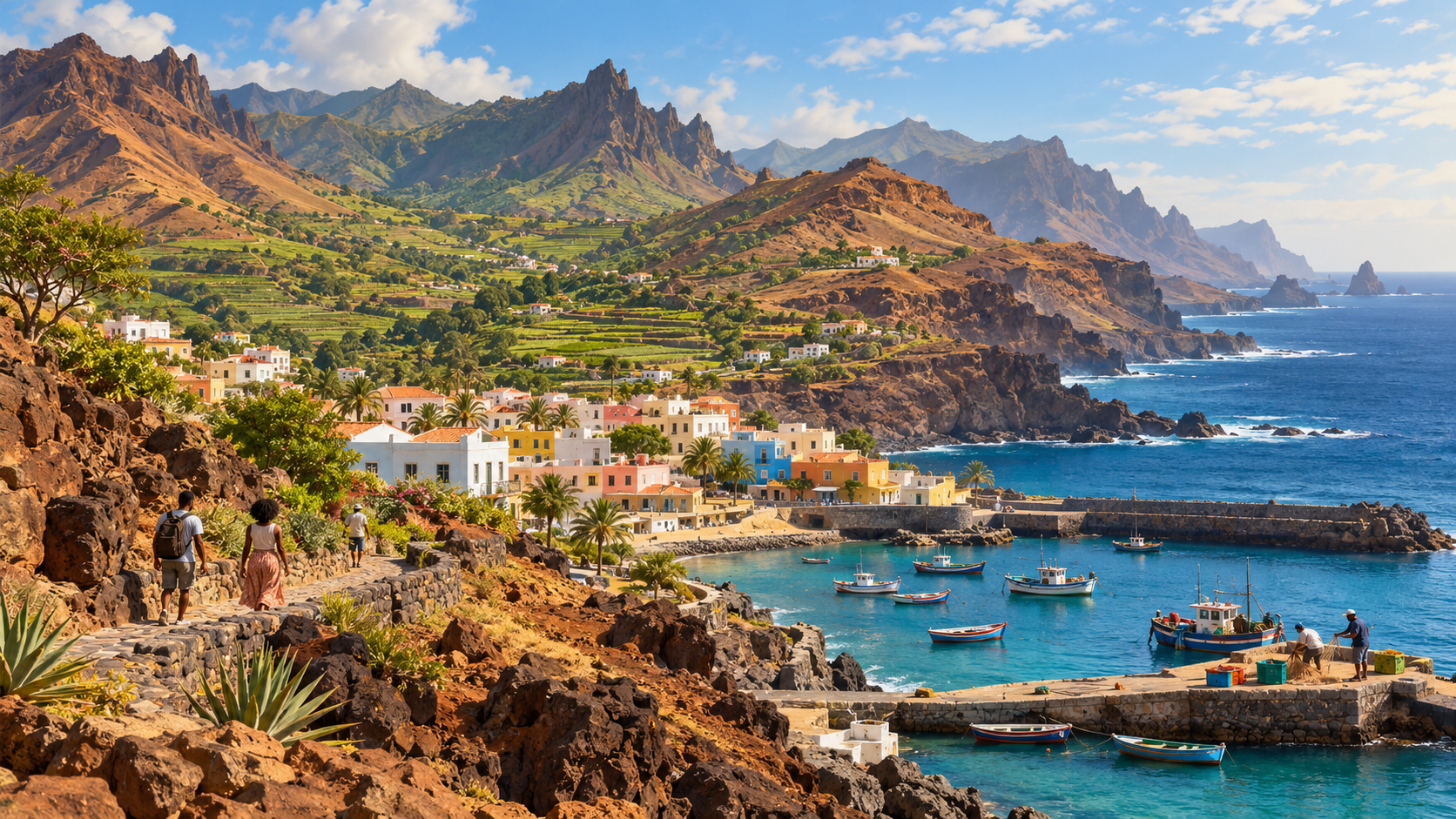
How does Cabo Verde’s government work, why are its ten islands so different, and how do tourism, ferries, remittances and climate shape daily life? Cabo Verde, also called Cape Verde in English, is a parliamentary republic in the Atlantic Ocean off West Africa. The president is head of state; the prime minister leads government. After the 17 May 2026 legislative election, Francisco Carvalho became prime minister on 19 June, succeeding Ulisses Correia e Silva. The archipelago has ten principal islands, nine of which are inhabited, and 22 municipalities.
To understand Cabo Verde, picture the country as connected islands rather than one continuous road network. National decisions → island airports and harbours → jobs, water, electricity, goods and public services → families. A hotel on Sal may earn foreign currency while a farmer on Santo Antão needs an affordable ferry to sell produce. Schools, clinics and shops all depend on ships, aircraft, energy and reliable information. This guide explains the hidden links in simple language.
Cabo Verde at a glance: seven quick answers
- Government: parliamentary republic with a president, prime minister, cabinet and 72-member National Assembly.
- President in October 2026: José Maria Neves; the next presidential election was scheduled for 15 November 2026, after this review date.
- Prime minister: Francisco Carvalho, appointed on 19 June 2026 after the PAICV won 37 of 72 assembly seats.
- Territory: ten principal islands, nine inhabited, administered through 22 municipalities.
- Capital: Praia on Santiago Island.
- Economy: tourism, transport, services, remittances, fisheries, some agriculture and small businesses.
- Currency: Cabo Verdean escudo, linked to the euro at 110.265 escudos per euro.
The National Elections Commission confirms the May 2026 election result. The Official Gazette of 19 June 2026 confirms the new prime minister. For why the islands’ connectivity matters economically, see the World Bank’s July 2026 economic update.
1. Is Cabo Verde the same country as Cape Verde?
Yes. Cabo Verde is the country’s official name, derived from Portuguese; Cape Verde is a widely used English name. Both refer to the same independent Atlantic island republic. Using ‘Cabo Verde’ respects the country’s preferred official international name, but an article can reasonably mention ‘Cape Verde’ to help readers searching under the older English usage.
The nation became independent from Portugal in 1975. Its public institutions, language, diaspora relationships, cultural traditions and maritime economy developed through this history. Portuguese is the official language, while Cabo Verdean Creole languages are widely spoken in daily life.
A name is a starting point, not the whole picture. To understand the country, also learn where its islands are, what connects them and which authorities provide services.
2. Who is Cabo Verde’s prime minister in October 2026?
Francisco Avelino Vieira de Carvalho became prime minister on 19 June 2026 following a change in parliamentary majority. The African Party for the Independence of Cabo Verde, known as PAICV, won the legislative election in May. Francisco Carvalho succeeded Ulisses Correia e Silva, whose Movement for Democracy had governed since 2016.
The appointment is documented in Presidential Decree No. 14/2026, signed by President José Maria Neves. This is important because an article written before June 2026 may still identify the former prime minister.
A parliamentary election can change government leadership without changing every school rule, ferry schedule or local authority at once. Institutions continue to operate, while the new cabinet can propose legislation and alter its programme through lawful processes.
3. What happened in the May 2026 parliamentary election?
Cabo Verde voted on 17 May 2026 for its 72-member National Assembly. The electoral commission confirmed that the PAICV won 37 seats, the Movement for Democracy (MpD) won 33 and the Independent and Democratic Cape Verdean Union (UCID) won two. The PAICV therefore secured a narrow overall majority.
Turnout was 46.5% according to the final electoral commission report. The newly elected Assembly first met on 18 June, and Janira Hopffer Almada became speaker, the first woman to hold that position in the country. These details are significant features of the 2026 political transition.
An election result determines representation and government formation, but cannot alone measure whether electricity becomes more reliable or whether ferry fares fall. The public-service test begins once institutions implement and evaluate their decisions.
4. Is the president different from the prime minister?
Yes. Cabo Verde has a president with constitutional head-of-state responsibilities and a prime minister leading the executive government within the parliamentary system. The offices are elected or formed through different processes and are not interchangeable.
President José Maria Neves was in office at this article’s review date. The next presidential election was scheduled for 15 November 2026, and its result was not yet known on 20 October. Any later reader should verify the outcome before using this page as a current officeholder directory.
The National Elections Commission published the schedule and official candidate information. An announced future vote should not be confused with an election that has already happened.
5. What are the ten islands of Cabo Verde?
The principal islands are Santo Antão, São Vicente, Santa Luzia, São Nicolau, Sal, Boa Vista, Maio, Santiago, Fogo and Brava. Santa Luzia is uninhabited. The islands also contain smaller islets, coastlines, mountains, volcanic landscapes, ports and tourism or farming centres.
The islands are often grouped as Barlavento (windward) and Sotavento (leeward). Their geographic separation means a school, port or hospital on one island is not as easily accessible to a resident of another island as facilities across one mainland city.
This is why the archipelago operates through a network of air and maritime links. A map showing ten dots makes the country look simple; the more important map shows the permitted, frequent and affordable journeys between those dots.
6. Why do islands face very different opportunities?
Sal and Boa Vista are major tourism centres with beaches and resort infrastructure. Santiago contains Praia, the capital and a large share of administration and population. São Vicente includes Mindelo and important maritime and cultural activities. Santo Antão is known for dramatic landscapes and agriculture; Fogo includes volcanic terrain and specialised farming.
A visitor may fly directly to an island resort, while a small farmer elsewhere needs shipping or a ferry connection to reach hotel customers. The same country may therefore experience high visitor spending in one place and limited market access in another.
The World Bank’s 2026 economic update argues that weak island-to-island connections concentrate tourism benefits and reduce opportunities for local businesses. It is not enough to have an airport on one island if domestic freight and passenger routes are unpredictable.
7. How do Cabo Verde’s 22 municipalities work?
Cabo Verde is divided into 22 municipalities, also called concelhos. Local councils and elected municipal authorities provide or manage assigned public services and community responsibilities. National ministries retain their own competencies, so every road, school or utility cannot simply be assigned to one mayor.
In December 2024 municipal elections, PAICV won 15 municipalities and MpD won seven, according to the World Bank’s 2026 country overview. A local election and national election have different electoral constituencies and can yield different balances of power.
When residents report a damaged path or streetlight, the first useful question is who owns or operates the asset. The local municipality, specialised utility or national ministry may each have a role depending on legislation and arrangements.
8. Why is Praia so important?
Praia is the capital, situated on Santiago Island. It hosts many national institutions, services and commercial activities. Decisions about national budgets, ministerial programmes and diplomatic relationships can originate there, but their effects must still travel across the archipelago.
A family on Brava may need official documents or specialist health care while living far from the capital. Digital services and local offices can reduce travel, but their usefulness depends on reliable systems, clear rules and assistance when difficulties arise.
The real performance question is whether a person can complete a task from the island where they live rather than how grand the capital’s buildings appear.
9. Why do ferries and domestic flights determine economic opportunity?
A landlocked household and an island household face different kinds of transport friction. Cabo Verde’s islands require air or sea connections. A farmer’s produce, a patient’s referral, a replacement part or a student’s journey may depend on services whose frequency, price and reliability change.
The World Bank’s 2026 inter-island connectivity report identifies domestic transport as a major constraint. It notes irregular ferry services, expensive or unpredictable aviation and financial risks involving state-supported operators.
Transport policy is therefore employment, healthcare, food and education policy at the same time. A missed ferry can mean a missed market day, appointment or examination even when the destination facility is excellent.
10. A worked example: how one ferry delay affects four families
Original fictional scenario: a fishing supplier needs to send refrigerated seafood, a student is travelling to a college, a patient has a specialist appointment and a technician carries a spare part for a water pump. All are booked on the same island connection.
Bad weather or an operational fault cancels the sailing. The supplier’s stock may lose value; the student misses classes; the patient must reschedule; the pump repair is delayed. The disruption looks like four unrelated problems, but the shared cause is a transport link.
A strong system needs accurate notices, safe alternatives where possible, suitable storage, contingency planning and transparent responsibility. A company announcing a new route cannot solve the issue unless the route operates reliably in ordinary conditions.
11. How does tourism support the national economy?
Tourism brings income through accommodation, restaurants, travel, activities, transport, construction and services. Visitors also demand electricity, drinking water, waste treatment, communications, imported supplies and public safety. Tourism is a whole service network rather than a collection of resort buildings.
The World Bank reported that Cabo Verde’s real economy grew by 6.3% in 2025, driven partly by strong tourist demand. The July 2026 report projected growth of 4.8% in 2026 at that time; the later overall country overview gave a different estimate as data changed. Projections must be dated and never written as completed facts.
Even successful tourism can be unevenly distributed. A household on an island with few direct visitors may benefit mainly if it can sell goods or services to the busy destinations. Ferry cost, access to finance and product quality determine how much of the industry spreads to other islands.
12. Why do Sal and Boa Vista receive so much tourism?
Sal and Boa Vista have international air connections, resort investment and beach environments that appeal to many visitors. Their geography and established hospitality capacity have concentrated a large share of tourism activity on those islands. Other islands may offer hiking, heritage, music, volcanic scenery or local food experiences but face different transport or investment constraints.
Tourism concentration creates advantages for established businesses while exposing the economy to shocks affecting a few destinations or international visitor markets. A policy encouraging other islands can help diversify opportunities only if roads, ferries, accommodation, trained staff and environmental safeguards develop together.
The goal is not to reproduce an identical resort model on every island. It is to help different communities build viable activities around their own assets without damaging the landscapes that attract visitors.
13. What is the Cabo Verdean escudo, and how does its euro peg work?
Cabo Verde uses the Cabo Verdean escudo (CVE). Its monetary arrangement fixes the rate at €1 = 110.265 escudos. This relationship is important for imports, tourism, payments and economic policy, given the country’s links with Europe.
A fixed exchange rate can reduce uncertainty in converting between the euro and escudo, but it does not make all goods equally affordable. A shipment of fuel may become more expensive at world-market prices even though the currency’s official parity stays unchanged.
Banco de Portugal’s official statistical series records 110.265 escudos per euro in September 2026, confirming the fixed relationship. Currency stability and household purchasing power remain separate questions.
14. Why are remittances so important to households?
Many Cabo Verdean families have links with relatives living overseas. Money sent home can help pay for housing, education, healthcare, small businesses and day-to-day expenses. Remittances also bring foreign currency into the economy and support its wider financial position.
The World Bank’s 2026 economic update estimated remittances at roughly 10% of GDP in 2025 under the measure used in that report. This is a national statistic, not a guarantee that every family receives overseas income. Benefits vary by household and the circumstances of people working abroad.
Migration is therefore both a social and economic connection. A child’s schooling, a family home renovation or a small-shop investment may be partly financed through work in another country.
15. Why does Cabo Verde import so much food and fuel?
Island geography, limited freshwater and constrained agricultural land create challenges for producing all the food and energy a population and tourism industry need. Imports provide essential goods and variety, but they create exposure to shipping, overseas prices, exchange conditions and port operations.
A hotel can have full rooms yet struggle when a shipment of replacement equipment or food ingredients is delayed. A small rural farmer can have fresh produce but find it difficult to sell to a hotel on another island because the ferry is too expensive or unreliable.
A resilient food strategy is not necessarily complete self-sufficiency. It can combine local production where viable, diverse import sources, safe storage, efficient distribution and fair opportunities for domestic suppliers.
16. Why is water supply difficult in Cabo Verde?
Many islands have arid or semi-arid climates and limited reliable freshwater resources. Rainfall variability, drought and growing demand from homes and visitors create water-security challenges. Desalination, groundwater, storage, treatment and careful distribution contribute to supply.
A new desalination plant can increase production, but a household still requires pipes, pumps, safe water-quality testing and affordable service. Electricity is often important to operating desalination equipment. When electricity costs rise, water production and distribution can become more expensive.
The key systems lesson is simple: count water reaching taps reliably, not only the rated capacity of treatment plants. Water planning must coordinate energy, storage, infrastructure and household needs.
17. How does renewable energy fit into climate resilience?
Cabo Verde has solar and wind resources and aims to reduce dependence on imported fossil fuels over time. Its national goal of 100% renewable electricity penetration by 2040 is a policy ambition, not a claim that every island already runs on renewable power.
Wind and solar electricity are variable, so dependable service needs suitable grids, storage, maintenance and backup arrangements. Island electricity systems face additional challenges because some networks are geographically separate and cannot exchange power with each other easily.
The World Bank climate analysis explains both the energy ambition and the investment needed. The right question is how many households and businesses gain reliable lower-cost power, not how many panels appear in a proposal.
18. How can climate change affect islands differently?
Coastal erosion, rising seas, extreme weather, ocean warming and drought can influence tourism, fisheries, housing, water and ports. A low-lying beach resort faces different hazards from an inland hillside community or a volcanic landscape on Fogo. A good national adaptation strategy does not pretend every island is exposed in precisely the same way.
A coastal hotel needs responsible shoreline planning and emergency procedures; a farmer may need drought-resistant crops and water management; a port operator needs safe infrastructure and reliable weather information. Each response requires different technical expertise.
The World Bank has warned that unmitigated climate effects could damage national income and reduce tourism receipts over future decades. Those are modelled risks and should not be presented as losses already measured in October 2026.
19. What does the ocean contribute besides tourism?
Fisheries, marine biodiversity, shipping and coastal livelihoods are important parts of Cabo Verde’s blue economy. A fishing household needs boats, landing facilities, cold storage, safety rules, market access and healthy marine stocks. Protecting ocean resources can safeguard income and food supply over time.
A fish caught safely can still lose value if refrigeration fails or transport is delayed. Better landing sites and reliable ferry services may increase its value to buyers on other islands. Marine development therefore depends on electricity and logistics as much as on catching fish.
A responsible policy balances fisheries livelihoods, environmental monitoring and long-term conservation rather than treating ocean resources as unlimited.
20. How do schools support the future economy?
Cabo Verde has basic education and secondary pathways, vocational options and higher education. Education builds the reading, mathematics, science and communication skills needed by teachers, healthcare workers, technicians, mariners, tourism managers, business owners and engineers. Its importance reaches well beyond examination grades.
Schooling also depends on geography. A child may live on an island with different programme availability from a student in Praia. Transport, internet access, teachers and resources can affect the pathway that is realistically accessible.
For the stage-by-stage detail, use Schools of Cabo Verde, How Education System of Cabo Verde Works and How Ministry of Education for Cabo Verde Works. Those companion articles cover schooling; this page shows how learning fits into national life.
21. Why do healthcare services depend on transport?
Every island needs appropriate access to healthcare, but not every island can support the same range of specialist facilities. A routine consultation may be available locally while more complex care requires referral and travel. Patient safety depends on trained staff, equipment, communications and reliable inter-island connections.
Fictional illustration: a patient on a smaller island needs a specialist test in Praia. The local clinic makes a referral, but the scheduled ferry or flight is delayed. The healthcare system may be clinically sound at the destination yet practically unavailable to the patient on the appointment day.
The appropriate measurement must therefore include travel, appointment reliability and affordability. Building a hospital in one city is not the entire answer to an archipelago’s medical access challenge.
22. How does a government budget affect a ferry service?
Transport operators need aircraft or vessels, trained crews, fuel, maintenance, safety inspection, insurance and sufficient revenue. If an essential domestic route is commercially difficult, public support may be considered. But support must have clear objectives, transparent contracts and ways to evaluate performance.
The World Bank’s 2026 report warns of significant financial risks from state-owned enterprises and state-supported transport. It calls for stronger rules, better regulation and performance-linked incentives, rather than assuming all public ownership or all private contracts will automatically work.
The key question for residents is whether the service is safe, reliable, affordable and available at the times needed. Government subsidy figures by themselves cannot answer that question.
23. One day in Cabo Verde: a connected systems example
Original fictional family: a parent works in tourism, another runs a small food business, and a child attends secondary school. The household buys imported food, uses municipal water and depends on reliable electricity. A relative abroad sometimes sends money to help with school expenses.
A ferry cancellation delays ingredients from a neighbouring island. The business earns less and must change its menu. At the same time, the student’s planned inter-island school journey is postponed. A single transport disruption now affects commerce, learning and family income.
The right response may include clearer ferry notices, alternative freight, local storage and better contingency planning. The family sees an ordinary difficult week; the country sees a shared infrastructure problem.
24. Why is tourism growth not the same as prosperity for every island?
Tourism earnings can concentrate in specific airports, resorts and businesses. Many island communities may have skills and products to offer but face expensive transport or lack access to finance. A national GDP increase measures production, not how easily every family can find stable work.
The World Bank’s 2026 report shows this clearly: even amid strong 2025 growth, the country faced youth-employment challenges, high public debt and weak inter-island market integration. A country can make real progress while important distribution and sustainability problems remain.
Fair evaluation asks where jobs were created, whether women and young people gained opportunities, whether small enterprises could sell to visitors and whether public services improved outside the busiest islands.
25. Cabo Verde compared with Singapore
Both Cabo Verde and Singapore are ocean-connected states with a strong interest in reliable transport, skills and international commerce. Singapore is a compact, densely urbanised maritime city-state where one domestic road system connects most urban journeys. Cabo Verde is a dispersed Atlantic archipelago where journeys between islands depend on boats and aircraft.
The governing functions are related: connect goods, people, information and services safely. Their engineering solutions differ sharply. An expressway cannot replace a ferry across open sea; a harbour cannot provide the same doorstep access as a town street.
Compare the How Singapore Works archive and Singapore’s road and junction network to see how geography changes the design of public infrastructure.
Six checks for reading news about Cabo Verde
- Which date? Ulisses Correia e Silva ceased to be prime minister in June 2026; the November presidential election had not happened at this review date.
- Which island? Sal, Boa Vista, Santiago and Brava may have very different economic and transport circumstances.
- Which institution? President, parliament, cabinet, municipality, ferry operator or utility?
- Which measure? Tourist arrivals, fiscal surplus, public debt, ferry frequency and jobs are different quantities.
- Which stage? A transport plan, signed contract, operational service and verified improvement are not equivalent.
- Who benefits? Does the decision improve real access to goods, jobs, schools or healthcare outside the main tourism centres?
Try writing a short travel story about a bag of vegetables grown on Santo Antão and sold to a restaurant on another island. Name every boat, truck, storage and payment step. Then consider what happens when one sailing is cancelled. That exercise turns a distant map into an understandable national system.
Frequently asked questions about how Cabo Verde works
Is Cabo Verde the same as Cape Verde?
Yes. Cabo Verde is the country’s official name; Cape Verde remains a common English name.
Who is prime minister of Cabo Verde in October 2026?
Francisco Carvalho, appointed on 19 June 2026 after PAICV won the May legislative election.
Who is president in October 2026?
José Maria Neves. A new presidential election was scheduled for 15 November 2026, so later readers should check the result.
How many islands does Cabo Verde have?
Ten main islands, nine of them inhabited. Santa Luzia is uninhabited.
How many municipalities are there?
Twenty-two. They administer assigned local matters alongside national institutions and service operators.
Why are ferries so important?
They move people and freight among islands, connecting food supply, business, schooling and healthcare. Unreliable sailings can affect several sectors together.
Why is tourism concentrated on Sal and Boa Vista?
International air access, beaches and established resort investment have helped concentrate many visitor arrivals there.
Is the escudo the same currency as the euro?
No. Cabo Verde uses its own escudo, pegged at a fixed rate of 110.265 escudos per euro.
Does Cabo Verde already use 100% renewable electricity?
No. The 100% renewable energy figure is a policy target for 2040, and reaching it requires infrastructure and dependable operations.
What is the best way to study how Cabo Verde works?
Choose an everyday need and trace it through local administration, inter-island transport, financing, utilities and the person who finally benefits.
Continue the connected world country library
This article belongs to How Countries Work, sibling to How Singapore Works. Compare Bulgaria’s government, EU and euro, Burkina Faso’s security and gold economy, Burundi’s five provinces and coffee trade and the next alphabetical country guide How Cambodia Works.
Sources and editorial review
- Cabo Verde Elections Commission, 2026 parliamentary results — 37/33/2 seats.
- Official Gazette, 19 June 2026 — Francisco Carvalho’s prime ministerial appointment.
- World Bank Cabo Verde overview, 2026 — leadership, municipalities, economy and challenges.
- World Bank Economic Update, 14 July 2026 — growth and inter-island transport.
- World Bank 2026 analysis — ferry and airline constraints, state-company fiscal risks and jobs.
- Banco de Portugal official CVE exchange series — euro peg.
- World Bank climate and renewable-energy report — 2040 target and climate risks.
- Cabo Verde Elections Commission — scheduled November 2026 presidential election.
- Reviewed: 20 October 2026. Family and delivery scenarios are fictional. Forecasts and targets are not presented as achieved results.