
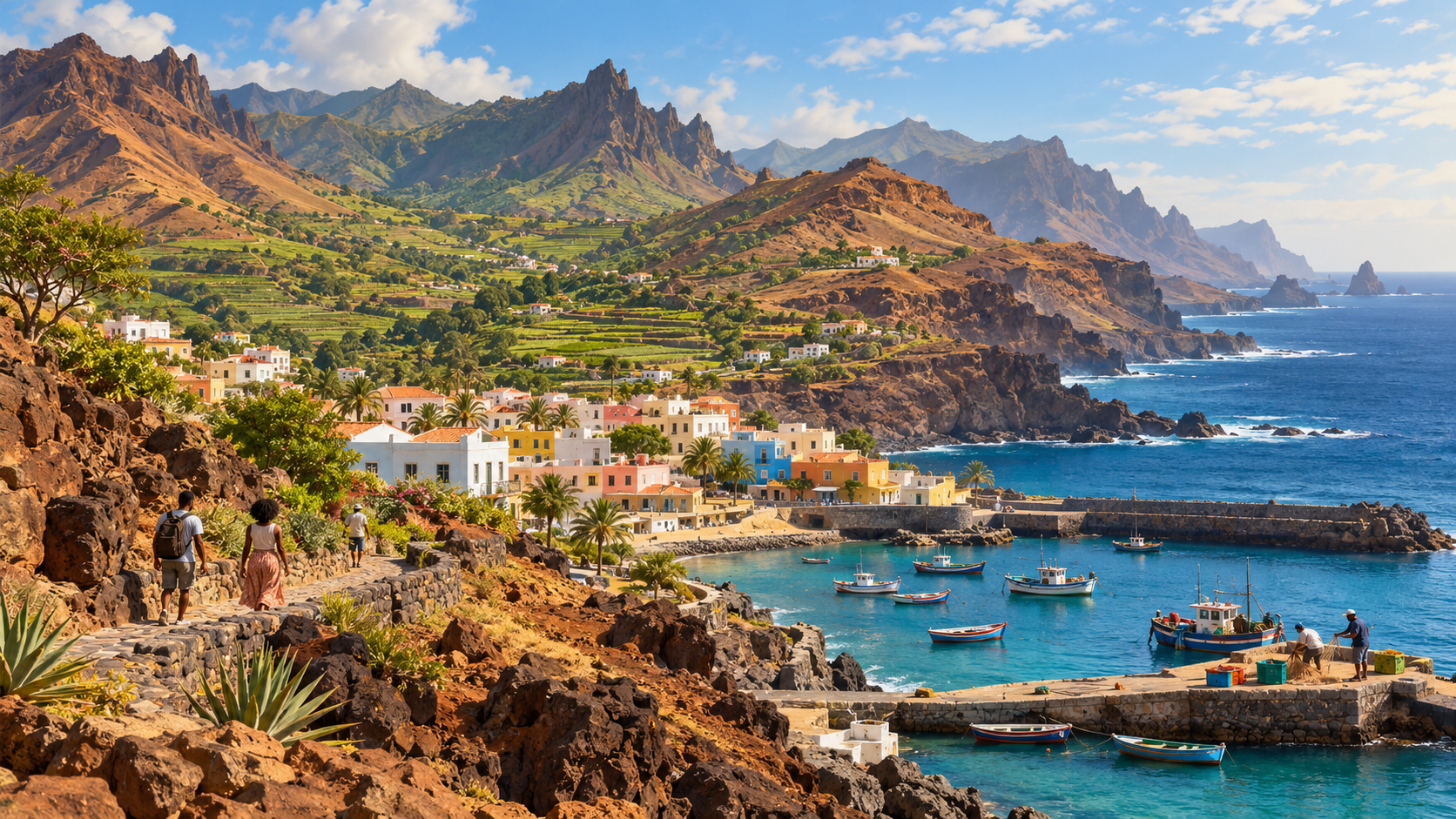
Cabo Verde becomes much more interesting when you look beyond an Atlantic beach and ask how islands create connections. Volcanoes shape land and farming, a historic port opens a difficult chapter of global history, and songs preserve stories of migration, affection and distance. These top 10 things to learn when visiting and touring Cabo Verde introduce its geography, history, heritage, nature, music and food as connected subjects rather than unrelated stops on a holiday itinerary.
For Singapore families and curious readers exploring Cabo Verde travel, Cape Verde culture and educational journeys through island countries, the following ten lessons offer a friendly way to understand what you see. Study UNESCO’s accounts of Cidade Velha, the Fogo and Maio biosphere reserves, morna music and public history. Each lesson includes thoughtful questions and source links, with English–Chinese vocabulary for students and travellers. You can enjoy the whole Cabo Verde country learning guide from home or use selected topics to enrich a responsibly planned visit.
Before planning a journey: Check current official Cabo Verde travel advice for entry, health, transport and safety information. Island crossings, sea conditions, flight schedules, volcanic restrictions and protected wildlife rules are separate matters that must be confirmed locally. This guide does not give instructions for volcano ascents, swimming, turtle-watching or unsupervised coastal access.
Choose your reading route
Enjoy these ten lessons in order or start with the topic that catches your attention. One good observation and one reliable explanation can make a stronger memory than a dozen hurried stops. Full contents · Family learning route · Vocabulary · Country directory
Contents
- Read the ten islands as a varied Atlantic archipelago
- Use Cidade Velha to understand Atlantic history, not just old buildings
- Notice the Fortaleza Real and Pillory Square as historical evidence
- Hear morna as poetry, sound and a tradition people transmit
- Understand Creole language and the voices of a diaspora
- Study Fogo’s volcano as a landscape of risk and livelihood
- Learn from Maio’s protected marine and island habitats
- Meet Praia and Mindelo without collapsing different islands
- Read Tarrafal’s Resistance Museum with care and humanity
- Follow cachupa from ingredients to community memory
First find Cabo Verde on a map west of the African mainland in the Atlantic Ocean. The archipelago has ten principal islands, nine of which are inhabited. Locate Santiago, São Vicente, Santo Antão, Fogo, Maio, Sal and Boa Vista. Resist the urge to imagine them as interchangeable dots surrounded by identical beaches; differences in geology, elevation and exposure help shape very different everyday settings.
An island map is particularly good at revealing the limits of an easy itinerary. Two locations that appear close on a broad map may need a flight or ferry and can be affected by weather or operating schedules. A learning guide is not a promise that you can visit every island. Choose an area and explore it properly instead of treating distance as an inconvenience to be dismissed.
Cabo Verde’s location also prompts historical questions. The islands sit along routes that connected Africa, Europe and the Americas. Maritime connections brought people, goods, languages and ideas, but not all travel was voluntary. This distinction matters before we discuss Cidade Velha and the history of enslaved people across the Atlantic.
Pause on the deeper question: How can islands in one country have very different landscapes and routes? Try answering with the name of a place, a particular observation and an attributed explanation. The source may establish a date or context; your own impression is worth describing, but it should not be silently promoted into a fact.
Compare a satellite image with a political map and a relief map. A photograph makes vegetation and the sea visible; a relief map reveals high terrain; a political map names settlements and administrative boundaries. Each offers different evidence. None alone can tell the full history of the people living in the archipelago.
For a family observation task, choose three islands and label one documented contrast for each. Make every claim traceable to a source. A simple line such as ‘Fogo is volcanic; Maio is notably arid’ is more useful than describing all ten islands as an anonymous tropical paradise.
Source to explore: UNESCO: Cabo Verde Fogo and Maio Biosphere Reserves. Use its factual account for learning; check live venue rules and current travel conditions separately before taking any action.
Notice and discuss: How can islands in one country have very different landscapes and routes? An effective answer includes one verified detail, one reason that detail matters and one new question. Children can explain it aloud, while older readers can add a source link.
LESSON 2 OF 10
2. Use Cidade Velha to understand Atlantic history, not just old buildings
Cidade Velha, the Historic Centre of Ribeira Grande on Santiago island, was inscribed on the UNESCO World Heritage List in 2009. UNESCO identifies it as the first European colonial town built in the tropics, preserving historic streets and remains connected with the beginnings of European expansion into the Atlantic. That description makes the town historically important; it does not make its past uncomplicated.
Ribeira Grande became part of networks of maritime commerce that connected Africa with Europe and the Americas. UNESCO explicitly documents the town’s role in the transatlantic trade of enslaved people. Any guide that celebrates an attractive colonial façade without acknowledging coercion misses an essential part of what the site helps the world remember.
Historic architecture can provide evidence without answering every question. The street layout, religious buildings and public spaces reveal ways a colonial town was organised. However, interpreting the experience of people forced into slavery requires deeper historical work and respect for sources that document suffering, resistance and power.
Pause on the deeper question: Whose history is visible in a surviving street, and whose needs more careful reconstruction? Try answering with the name of a place, a particular observation and an attributed explanation. The source may establish a date or context; your own impression is worth describing, but it should not be silently promoted into a fact.
Approach the site with two questions rather than one. What survives materially, and whose experiences could be left out of an account that focuses only on monuments? A fort and church may be visible; lives shaped by violent historical systems often require archives and careful interpretation to become legible.
Use UNESCO’s description to build a short chronology: settlement, colonial expansion, the development of Atlantic trade, later transformations and present conservation. The aim is neither to romanticise nor to flatten history into a single slogan. We can appreciate historic craftsmanship while describing injustice accurately.
Source to explore: UNESCO World Heritage: Cidade Velha. Use its factual account for learning; check live venue rules and current travel conditions separately before taking any action.
Notice and discuss: Whose history is visible in a surviving street, and whose needs more careful reconstruction? An effective answer includes one verified detail, one reason that detail matters and one new question. Children can explain it aloud, while older readers can add a source link.
LESSON 3 OF 10
3. Notice the Fortaleza Real and Pillory Square as historical evidence
Within Cidade Velha, UNESCO identifies the royal fortress, churches and Pillory Square among significant features of the historic centre. These are useful case studies because they belong to the organisation of a town and to systems of authority, faith, trade and punishment. A building’s appearance may be appealing while its historical functions demand serious questions.
Begin with purpose. A fortress occupies a position selected for defence and control, while a civic square may have served different social and political roles. A church can be a place of worship and a feature of a colonial urban layout. It is important to establish specific functions from historical sources instead of guessing from a structure’s age or scale.
The pillory at the square has an especially difficult context. UNESCO describes the material traces of colonial domination and the trade of enslaved people. A reader should not treat a place associated with punishment or coercion as merely a clever photo opportunity. Words chosen in a guide communicate what it values.
Pause on the deeper question: How can architecture express institutions and unequal power? Try answering with the name of a place, a particular observation and an attributed explanation. The source may establish a date or context; your own impression is worth describing, but it should not be silently promoted into a fact.
Heritage conservation also raises questions about the present. Walls weather, spaces are reused and residents live alongside protected monuments. UNESCO notes the importance of management and rehabilitation. A meaningful encounter can therefore explore both historic evidence and current responsibilities without expecting the city to remain frozen in one century.
For a home-learning exercise, annotate a publicly available UNESCO map with three labels: defence, civic space and religious architecture. Add a sentence saying what you know from the source and one question you cannot settle from a plan. Precise interpretation is more memorable than a list of dates.
Source to explore: UNESCO: Cidade Velha historical description and plans. Use its factual account for learning; check live venue rules and current travel conditions separately before taking any action.
Notice and discuss: How can architecture express institutions and unequal power? An effective answer includes one verified detail, one reason that detail matters and one new question. Children can explain it aloud, while older readers can add a source link.
UNESCO inscribed morna, the musical practice of Cabo Verde, on its Representative List of the Intangible Cultural Heritage of Humanity in 2019. It describes a practice combining voice, instrumental music, poetry and sometimes dance, with themes such as departure, separation, reunion, love, the ocean and home. The description immediately suggests that the meaning of a song can involve much more than its melody.
An authorised recording is a lovely way to start. Listen for the guitar and other instrumental relationships without feeling that you must identify every instrument from hearing alone. UNESCO names several string instruments among those traditionally associated with morna, while recognising that musical practice also evolves.
Language shapes the lyrics. Morna texts have been composed in Portuguese, and UNESCO explains that Cabo Verdean Creole is now used widely. A translation may convey a theme of longing but not every nuance of wordplay or local expression. Be curious about this gap rather than pretending that an English caption gives the full meaning.
Pause on the deeper question: What can a song reveal about memories of departure and belonging? Try answering with the name of a place, a particular observation and an attributed explanation. The source may establish a date or context; your own impression is worth describing, but it should not be silently promoted into a fact.
Living heritage belongs to its performers and listeners. UNESCO records community transmission through family occasions, workshops, radio, performances and festivals. A professional stage recording and a song shared at a family gathering may present different contexts; neither should be reduced to an anonymous soundtrack for a beach video.
Choose one official recording and write two observations about its sound, then one sourced observation about its cultural context. If a child asks whether all islanders sing the same way, the answer is to look for variations rather than invent a uniform national voice.
Source to explore: UNESCO Intangible Heritage: Morna. Use its factual account for learning; check live venue rules and current travel conditions separately before taking any action.
Notice and discuss: What can a song reveal about memories of departure and belonging? An effective answer includes one verified detail, one reason that detail matters and one new question. Children can explain it aloud, while older readers can add a source link.
Travel accounts often tell you that Portuguese is the official language of Cabo Verde, but that fact alone does not explain the sound of daily conversation. Cabo Verdean Creole, also commonly referred to as Kriolu, is central to everyday expression and cultural life, while varieties differ across islands and contexts.
Languages are not simply interchangeable labels. A song lyric, a public notice, a school document and a conversation may use different choices of language or register. It is better to record the exact words you encounter and ask how they are used than to assume every resident speaks in precisely the same style.
UNESCO’s morna description is a good starting source because it directly mentions a shift toward singing in Cabo Verdean Creole. This introduces a connection between language, memory and performance: a song can give people a way to articulate attachment to home even when they live far away.
Pause on the deeper question: How do language choices keep a connection with place alive? Try answering with the name of a place, a particular observation and an attributed explanation. The source may establish a date or context; your own impression is worth describing, but it should not be silently promoted into a fact.
Migration is part of Cabo Verde’s story, but the experiences of individuals and families vary. The word diaspora can describe communities with ties across countries; it should not be used to suggest that all migration has one cause, one feeling or one historical period. Avoid using ‘saudade’ as an explanation for every person’s private emotions.
A multilingual Singapore household can use this lesson without trying to imitate a language it does not know. Compare a source’s original place name, the available translation and the context in which the term appears. Three carefully attributed examples will do more than a page of inaccurate travel phrases.
Source to explore: UNESCO Morna: Language and transmission. Use its factual account for learning; check live venue rules and current travel conditions separately before taking any action.
Notice and discuss: How do language choices keep a connection with place alive? An effective answer includes one verified detail, one reason that detail matters and one new question. Children can explain it aloud, while older readers can add a source link.
Fogo is Cabo Verde’s volcanically active southern island, and UNESCO designated the Fogo Biosphere Reserve in 2020. The reserve’s public description places the summit at approximately 2,829 metres and discusses both distinctive species and agricultural communities. The landscape therefore invites a dual question: what does a volcano create, and what dangers must people live with?
Geology is visible through the island’s form, rock and soils, but a photograph is not a current hazard assessment. Volcanic conditions and access rules can change; the presence of a tourism operator or hiking photograph never establishes that an ascent is safe. This chapter is about understanding geology, not a route or equipment guide.
UNESCO also explains how local livelihoods include fruit, coffee, vegetables and vineyards associated with volcanic soils. The relationship is interesting precisely because it cannot be reduced to a slogan: landforms, water, soil, cultivation knowledge, work and markets all matter.
Pause on the deeper question: How can a geological hazard and a productive landscape exist together? Try answering with the name of a place, a particular observation and an attributed explanation. The source may establish a date or context; your own impression is worth describing, but it should not be silently promoted into a fact.
Look at the reserve as a social and ecological landscape. Conservation programmes consider species and habitats, while residents maintain practices tied to their surroundings. A biosphere reserve is not the same category as a UNESCO World Heritage property, and its designation is not permission to enter protected, private or dangerous zones.
Try a cause-and-relationship map: volcanic geology, soil, farming, community and conservation. Where a connection requires more evidence, draw a question mark. Students do not need to climb a volcano to understand why it presents both a distinctive landscape and real responsibilities.
Source to explore: UNESCO Man and Biosphere: Fogo. Use its factual account for learning; check live venue rules and current travel conditions separately before taking any action.
Notice and discuss: How can a geological hazard and a productive landscape exist together? An effective answer includes one verified detail, one reason that detail matters and one new question. Children can explain it aloud, while older readers can add a source link.
Maio’s UNESCO Biosphere Reserve was designated in 2020 and includes both land and surrounding marine space. UNESCO describes an arid island with coastal and marine habitats supporting turtles, seabirds and other wildlife. This is a natural-history lesson about interconnected environments, not a guarantee of any particular animal sighting.
Notice the relationship between dry conditions on land and the sea nearby. Different species use beaches, shallow water or offshore habitats in different ways. An attractive photograph of sand cannot tell you which location is appropriate for nesting wildlife, or whether a beach is accessible at a given time.
UNESCO’s reserve description also links conservation to local livelihoods including agriculture, salt and tourism. The central question is how communities manage environments that support both ecological needs and human activity. Avoid assuming either that tourism is always damaging or that a marketed ‘eco’ activity always benefits wildlife.
Pause on the deeper question: What does responsible marine conservation require from visitors and residents? Try answering with the name of a place, a particular observation and an attributed explanation. The source may establish a date or context; your own impression is worth describing, but it should not be silently promoted into a fact.
Wildlife protection begins with restraint. Do not approach nesting turtles, touch eggs, use lights for a photograph or disturb protected areas. Follow the rules set by conservation authorities and accredited local programmes. Study publicly provided records and images instead when that is more appropriate.
Family learning can begin with a diagram of land, shore and marine water. Attach one documented relationship and one question about stewardship. The aim is to understand why boundaries on a protected-area map matter beyond the traveller’s desire to stand in a certain place.
Source to explore: UNESCO Man and Biosphere: Maio. Use its factual account for learning; check live venue rules and current travel conditions separately before taking any action.
Notice and discuss: What does responsible marine conservation require from visitors and residents? An effective answer includes one verified detail, one reason that detail matters and one new question. Children can explain it aloud, while older readers can add a source link.
Praia on Santiago is Cabo Verde’s capital, while Mindelo on São Vicente is strongly associated with musical and cultural life. Placing these two cities on different islands is a small but useful antidote to the habit of imagining the archipelago as one continuous coastal resort.
Cities can be approached through functions rather than marketing labels. A capital is a centre of national institutions, while a port city may illuminate trade, movement and cultural exchange. These are starting questions, not fixed identities for every resident. Both places contain ordinary neighbourhoods, work and changing urban life.
Mindelo’s connection with music is especially tempting to describe through famous performers alone. Yet UNESCO’s account of morna emphasises community bearers, writers, performers and intergenerational teaching. That wider frame reminds us that cultural vitality relies on many people, not just one celebrity or festival.
Pause on the deeper question: How can two cities belong to one country while telling different stories? Try answering with the name of a place, a particular observation and an attributed explanation. The source may establish a date or context; your own impression is worth describing, but it should not be silently promoted into a fact.
History and everyday life also meet in language. A public sign, community event announcement or market interaction can tell you something about local communication, but only if you avoid treating one observation as representative of everyone in a whole city.
Choose an official map of Santiago and São Vicente and write a short compare-and-contrast paragraph. It should mention different island locations, one reliably sourced cultural or institutional connection and something still unknown. There is no need to manufacture an ambitious inter-island itinerary to make the comparison valuable.
Source to explore: Cabo Verde Tourism: About the archipelago. Use its factual account for learning; check live venue rules and current travel conditions separately before taking any action.
Notice and discuss: How can two cities belong to one country while telling different stories? An effective answer includes one verified detail, one reason that detail matters and one new question. Children can explain it aloud, while older readers can add a source link.
The former concentration camp at Tarrafal on Santiago is an essential place of remembrance. Cabo Verde’s Cultural Heritage Institute describes the prison camp, established by the Portuguese colonial dictatorship in 1936, and its different phases involving Portuguese anti-fascist prisoners and later anti-colonial political prisoners.
The institution describes its modern use as a museum of resistance and collective memory. This creates a serious educational task: how should a site associated with incarceration, suffering and struggles for freedom be presented? Dates, institutional responsibility and the voices of those affected matter far more than dramatic descriptions of the buildings.
The museum’s exhibits and interpretation have been developed through several stages. As a reader, ask which part of the exhibition belongs to which period. Avoid using photographs of empty cells to invent quotations or claim that you know an imprisoned person’s thoughts. Careful attribution is a form of respect.
Pause on the deeper question: How can a museum preserve difficult memory without making it entertainment? Try answering with the name of a place, a particular observation and an attributed explanation. The source may establish a date or context; your own impression is worth describing, but it should not be silently promoted into a fact.
Be precise about UNESCO status. Tarrafal appears on Cabo Verde’s indicative or tentative heritage-related processes, but it is not the same as the inscribed World Heritage site of Cidade Velha. The Cultural Heritage Institute’s explanation helps separate national remembrance work from a completed international inscription.
An ethical family activity is to make a small timeline identifying the camp’s establishment, its different uses and the museum’s creation. Follow the institution’s language and avoid sensational images. Learning can connect this history to broad questions about rights and liberty without making suffering into a sightseeing spectacle.
Source to explore: Cabo Verde Cultural Heritage Institute: Tarrafal Museum. Use its factual account for learning; check live venue rules and current travel conditions separately before taking any action.
Notice and discuss: How can a museum preserve difficult memory without making it entertainment? An effective answer includes one verified detail, one reason that detail matters and one new question. Children can explain it aloud, while older readers can add a source link.
Cachupa is one of Cabo Verde’s best-known foods, and the official tourism site describes it as a dish built around maize with beans and other ingredients, prepared in different versions. That variety makes it a fine ending to our journey. Food traditions are shaped by ingredients, skill, household resources, celebration and personal preference.
Start with maize. Ask how a crop becomes a cooked staple and why preparing a dish can involve careful timing, repeated knowledge and choices about additions. A recipe is not a complete social history, and a photograph of a bowl cannot tell you how every family cooks it.
The tourism description distinguishes versions of cachupa and explains its place in community meals. Instead of declaring one recipe universally authentic, identify the exact version you are discussing. Islanders may cook differently, and the same dish can be connected with routine meals or special occasions.
Pause on the deeper question: How do ingredients and shared preparation become part of cultural heritage? Try answering with the name of a place, a particular observation and an attributed explanation. The source may establish a date or context; your own impression is worth describing, but it should not be silently promoted into a fact.
The ingredients also invite geographical questions about climate, agriculture, imports and the routes through which foods circulate. UNESCO’s Cidade Velha account documents historical movement of plants across the Atlantic. Do not leap from that general fact to an unsupported claim about the origin of every ingredient in modern cachupa.
Make a small family food map with five connections: maize, preparation, regional variation, shared table and historical enquiry. Then return to the other nine lessons. The strongest memory of Cabo Verde may be how a humble meal connects landscape, history and everyday care, rather than simply knowing what to order.
Source to explore: Official Cabo Verde Tourism: Gastronomy. Use its factual account for learning; check live venue rules and current travel conditions separately before taking any action.
Notice and discuss: How do ingredients and shared preparation become part of cultural heritage? An effective answer includes one verified detail, one reason that detail matters and one new question. Children can explain it aloud, while older readers can add a source link.
A gentle family learning route
Start with a map and a single question. Would you like to understand why the island is volcanic, what a preserved colonial street can reveal or how a musical practice is taught? Collect just two trustworthy sources for that first question, rather than gathering endless snippets from unsourced travel pages.
On a suitable day, explore one responsibly accessible heritage or cultural place. Respect local staff, residents and rules about photography. Some sites are places of worship or difficult remembrance, not merely backgrounds for photographs. Leave extra time for conversation and rest rather than trying to make every hour educational.
On another day, use a recorded performance, a map or a museum interpretation to compare a different form of evidence. What did you learn directly by looking or listening? What did a reliable explanation add? Where did it stop short of answering everything?
At the end, invite every family member to write three lines: what surprised me, what the source actually explained and what I still want to know. The result is a careful, personal learning account that is enjoyable precisely because it does not demand that a holiday become a classroom.
English–Chinese vocabulary for reading Cabo Verde
These are English–Chinese conceptual learning equivalents, not translations of Kriolu or Portuguese. Use the terms in a sentence about a named place, documented custom or source.
| English | 中文 | Learning use |
|---|---|---|
| archipelago | 群岛 | Identify a documented setting. |
| volcanic landscape | 火山地貌 | Explain a relationship. |
| maritime trade | 海上贸易 | Distinguish observation from interpretation. |
| enslavement | 奴役 | Name the source that supports a claim. |
| colonial history | 殖民历史 | Identify a documented setting. |
| intangible heritage | 非物质文化遗产 | Explain a relationship. |
| diaspora | 离散社群 | Distinguish observation from interpretation. |
| oral transmission | 口传;代际传承 | Name the source that supports a claim. |
| biosphere reserve | 生物圈保护区 | Identify a documented setting. |
| coastal habitat | 海岸栖息地 | Explain a relationship. |
| collective memory | 集体记忆 | Distinguish observation from interpretation. |
| staple food | 主食 | Name the source that supports a claim. |
Questions families often ask
Do we need to travel between many islands to learn about Cabo Verde?
No. Each chapter can be understood through an official source, map or authorised recording. If travelling, choose a realistic island focus and recheck inter-island transport rather than treating ten islands as one convenient loop.
Does the country have UNESCO recognition for both places and music?
Yes, but under different programmes. Cidade Velha is a World Heritage property, morna is on the Intangible Cultural Heritage Representative List, and Fogo and Maio are UNESCO biosphere reserves. These designations mean different things.
Can children learn about Cidade Velha without glossing over colonial violence?
Yes. Use clear, age-appropriate language about the documented trade in enslaved people, avoid graphic speculation and distinguish beautiful surviving buildings from the systems of power in which they stood.
Is it safe to hike Fogo’s volcano or approach nesting turtles?
This guide gives no such permission or guarantee. Volcanic access must follow current local restrictions and professional advice, while wildlife protection rules should always be respected. Remote learning is a complete alternative.
Are the Chinese words translations of Kriolu?
No. They are English–Chinese conceptual equivalents intended for reading and discussion, not Cabo Verdean Creole translations.
What makes a useful family reflection?
Choose one landscape, one cultural practice and one historically difficult topic. Give a specific fact with a source, explain a relationship and end with a question rather than a forced conclusion.
Continue the country learning journey
Return to the World Country Learning Directory. The preceding alphabetical guide is Burundi. Continue with Cambodia, Cameroon and Canada.
Browse the Travel Vocabulary Directory and the World Travel Hub to connect this island country’s lessons to wider history, geography and culture.