
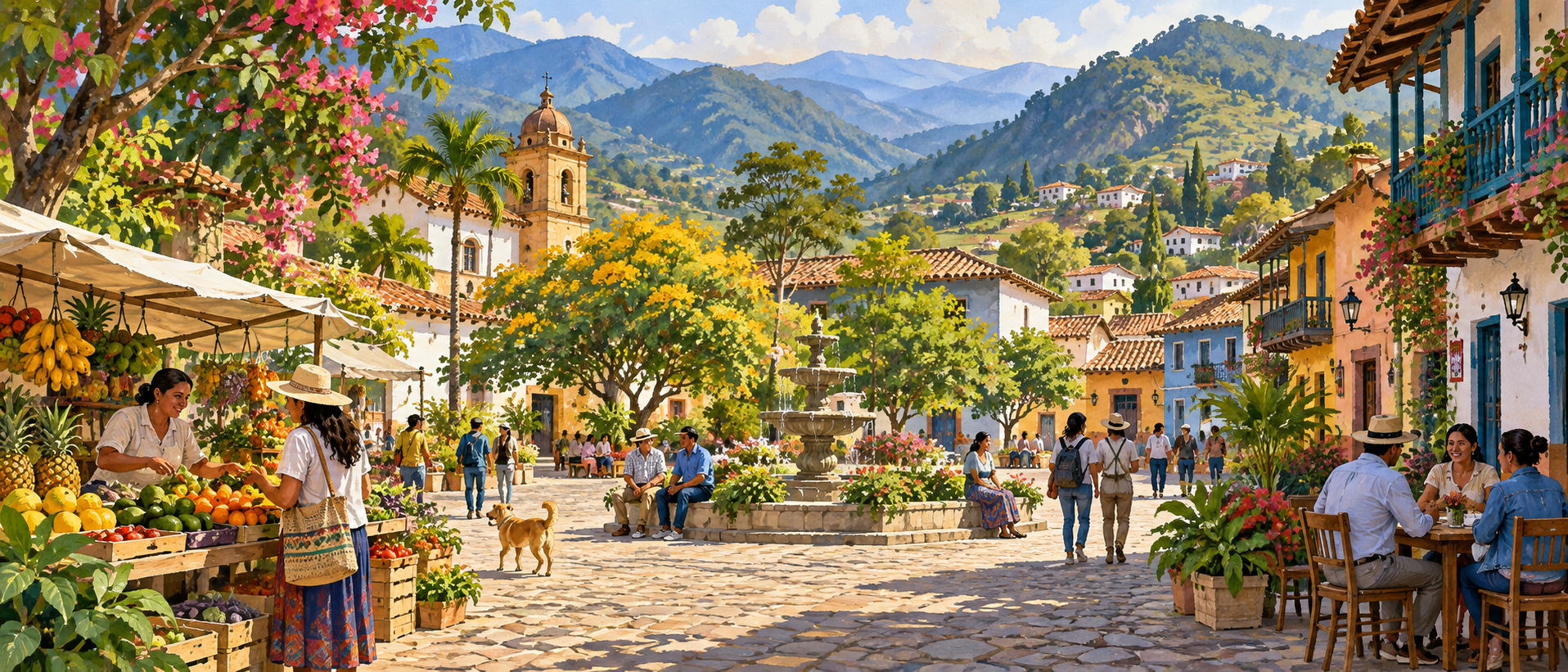
How does Colombia’s government work, why does it have 32 departments, and how do coffee, oil, ports, schools and hospitals affect daily life? Colombia is a presidential republic in northern South America with both Caribbean and Pacific coasts. Abelardo de la Espriella became president on 7 August 2026, succeeding Gustavo Petro following the presidential runoff in June. The country has a bicameral Congress, 32 departments, and Bogotá Capital District with a special administrative status. Each level of government has different responsibilities.
The easy way to understand the country is to follow national decisions → departments and municipalities → public finance and infrastructure → businesses, schools and healthcare → results for households. Colombia exports famous coffee but farms depend on mountain roads. It has ports on two oceans but freight still crosses difficult terrain. A person may be insured for healthcare yet struggle with specialist access. This article follows those connections, separates plans from results, and explains which institutions do what.
Colombia at a glance: the quick answers
- Government: unitary but decentralised presidential republic; national Congress consists of a Senate and Chamber of Representatives.
- President in October 2026: Abelardo de la Espriella, inaugurated on 7 August for a term ending in 2030.
- Administrative structure: 32 departments and Bogotá Capital District, plus municipalities and other legally defined territorial authorities.
- Economy: services, agriculture, coffee, oil, coal, manufacturing, commerce, technology and tourism.
- International trade: Caribbean ports such as Cartagena and Pacific operations at Buenaventura, connected to inland markets.
- Schools: primary, basic secondary and upper secondary; Saber 11 is an important national examination.
- Healthcare: insurance arrangements involve contributory and subsidised schemes, EPS administrators and IPS providers.
- Geography: the Andes, Magdalena basin, Caribbean and Pacific coasts, eastern plains and Amazonian areas create diverse infrastructure needs.
The official presidency profile identifies the 2026–2030 officeholder. The National Electoral Council’s June 2026 declaration records the election. Detailed current services are explained by Colombia’s Health Ministry and ICFES. This educational guide was reviewed on 20 October 2026.
1. Who governs Colombia in 2026?
President Abelardo de la Espriella heads the executive and directs his administration’s policy with ministers. The 2026 election led to a change from Gustavo Petro’s government. The national government operates within constitutional law, while Congress, the courts, oversight institutions and territorial authorities have separate functions.
The Reuters inauguration report of 7 August 2026 describes proposed priorities concerning security, fiscal policy and the oil-and-gas sector. A campaign pledge is not a completed project, and an executive announcement is not necessarily a law passed by Congress.
Readers should always distinguish who may make a decision from whether residents experience better services. A new transport policy must pass through budgets, professional staff, road construction and maintenance before journeys become safer.
2. Is Colombia a federal state like Brazil?
No. Colombia is a unitary republic with decentralisation. National constitutional law operates across the country, and departments, districts and municipalities carry important assigned functions. This differs from Brazil’s federation or Canada’s constitutionally defined provinces.
The distinction matters for school administration, budget responsibility and local infrastructure. A departmental governor has elected authority under Colombian law but does not exercise the same constitutional powers as the governor of a Brazilian federal state.
When describing any country’s territorial structure, labels alone can be misleading. The important questions are which level sets the rule, which level raises or receives the money, and which level must supply the practical service.
3. What does the Colombian Congress do?
Congress has a Senate and a Chamber of Representatives. Its members consider national legislation, debate budgets and exercise constitutionally assigned oversight. The president leads the executive, while courts and other bodies perform distinct judicial or supervisory functions.
Imagine legislation changing how health resources are paid. Congress may establish a rule, the executive and regulators may implement it, and insurers and hospitals must update their processes. A law cannot by itself ensure that a medicine reaches a patient on time.
Colombia’s political debates can be contentious, making it especially important to identify whether a proposal was merely announced, passed, challenged in court or actually put into effect. Each is a separate stage.
4. Why does Colombia have 32 departments?
The country’s 32 departments connect national policy with different territories. They have elected governors and assemblies with responsibilities specified by law. Those territories vary from dense cities and coffee-growing mountains to Amazonian forest, river settlements and Caribbean coastal areas.
Departamental authorities can coordinate programmes and public investment within their lawful competencies. Municipal governments operate closer to local communities. Not every road or health facility in a department belongs to its governor; the specific asset and legal responsibility determine the correct authority.
A programme designed for a Bogotá neighbourhood cannot automatically work in a river community without road access. Fair national planning must take geography and population needs into account.
5. Is Bogotá a department or a capital city?
Bogotá is the national capital and a Capital District with a special administrative regime. It is not simply an ordinary municipality and should not be counted as a thirty-third department. It also serves as the capital of Cundinamarca, but Bogotá’s district government is legally distinct from that surrounding department.
Bogotá has district sectors and agencies responsible for matters such as education, transport, health, finance and public space. Its localities also have administrative arrangements. The city’s official organisational chart shows the many services involved.
A broken neighbourhood crossing, district bus route and nearby school may have different operators even when they occupy the same city block. Effective service depends on the agencies cooperating.
6. What do governors and mayors control?
Governors lead departmental administration, while mayors lead municipal or district executives. Departments and municipalities have elected bodies and assigned roles in planning and services. The exact authority depends on national legislation, funding arrangements and ownership of an asset.
Worked example: a parent reports a dangerous junction beside a school. A local government may have responsibility for the street, while a departmental or national road agency may control a nearby highway. The correct response begins by identifying the road and its owner.
The measurable public benefit is a safe, functioning crossing, not the number of letters sent between offices. Finding the correct authority can save time for families.
7. Why is Colombia’s geography so varied?
Colombia includes several Andean mountain ranges, the Magdalena and Cauca river systems, Amazonian and Orinoquía landscapes, and extensive Caribbean and Pacific coastlines. The climate, settlement patterns and infrastructure costs differ greatly between these regions.
An urban commuter in Medellín may depend on buses and metro systems; a coffee farmer needs a mountain road; an Amazonian community may use a riverboat or plane; and a coastal fisher requires safe harbours and weather information.
A national figure for road length or healthcare facilities says little about a specific household’s journey until geography and actual access are considered.
8. Why is coffee important to the economy?
Colombian coffee supports farming households, processing businesses, transport companies, exporters, roasters and brands. The chain begins with cultivation and harvesting but continues through drying, grading, financing, freight and international sales. The global reputation of Colombian coffee depends on quality and consistent supply.
Coffee prices vary with world markets and exchange conditions. A high international price does not mean every small farmer receives the same amount: wages, fertiliser costs, yields, processing fees and transport shape farm income.
The National Coffee Growers Federation’s monthly export reports are a better basis for current figures than undated statements about Colombian coffee being universally profitable.
9. How does a bag of coffee reach a customer overseas?
Original fictional case: a farmer picks coffee cherries and arranges processing and drying. The beans are graded and collected by a cooperative or buyer, packed, shipped along mountain roads and moved through an export terminal. The overseas importer then sends them to a roaster and café.
If a landslide blocks the farm road, the processing plant may wait and the farmer’s payment may be delayed. If the beans are stored improperly, quality deteriorates. If customs paperwork is incomplete, the shipment might miss the vessel.
The process demonstrates a wider principle: a fine agricultural product only reaches a valuable market when roads, finance, quality control and trade all work.
10. Did coffee exports fall in early 2026?
The Colombian coffee exporters’ association Asoexport reported 5.23 million 60-kilogram bags exported in the first half of 2026, down about 18% in volume compared with the same period of 2025. Reported export value declined about 12.3% in that comparison.
Those statistics describe January through June 2026, not the final full-year total. Coffee prices and export volumes do not always change in the same direction. Differences between production, shipments and sales value matter.
Read the 21 August 2026 export analysis for the time period and details.
11. Is Colombia’s economy only coffee and tourism?
No. Colombia’s economy includes oil, coal, mining, manufacturing, finance, professional services, agriculture, commerce, tourism and technology. Different industries contribute different types of jobs and public revenues.
Oil and coal projects require special infrastructure, environmental safeguards and finance. A technology firm relies on skilled people and fast data networks. Farmers depend on land, water, roads and storage. A diverse economy is a network of different productive activities rather than one export commodity.
National economic growth cannot be assumed to benefit all households equally. Salaries, unemployment, security and local costs determine how a growing industry is experienced.
12. Why are oil and gas politically debated?
Fossil fuels can earn export revenue, generate taxes and support skilled jobs, but they also raise environmental, health and climate concerns. Different governments emphasise extraction, energy transition and fiscal priorities differently.
The 2026 president proposed a more expansionary approach to some oil and gas activity. Announcing an exploration policy does not automatically create new output or prove that an investment meets regulatory and community requirements.
A serious assessment compares jobs, revenue, lawful approvals, water impacts and long-term climate risk. Economic and ecological consequences belong in the same analysis.
13. How do Caribbean ports support Colombia?
Cartagena, Barranquilla and Santa Marta are important Caribbean commercial gateways. They connect exporters and importers to Atlantic shipping routes, while road and logistics networks move goods inland.
A factory can produce goods on schedule but face delays if the port lacks storage capacity, customs documentation is incomplete or the final truck route is obstructed. A port functions only when vessels, terminals and inland movement cooperate.
Ports also connect tourism and coastal communities to the economy, making environmental management and resilient transport important to several sectors at once.
14. Why does Buenaventura matter on the Pacific?
Buenaventura serves as Colombia’s principal Pacific maritime gateway. It is strategically important to the country’s trade with Pacific markets and to industries inland around Cali and beyond. Its effectiveness depends on freight corridors, staging areas, cargo handling and customs procedures.
In February 2026, Colombia’s transport authorities issued measures to address container returns and truck coordination at the port. The Transport Ministry’s announcement is an example of how better scheduling and rules can improve a large physical facility.
The performance measure is a reliable full shipment journey, not simply the number of ships entering harbour.
15. Why are roads and bridges difficult in the Andes?
Steep slopes and changing weather make road engineering demanding in Colombia. Tunnels, bridges, retaining walls and drainage are needed in many areas, and landslides can interrupt routes. A highway project can therefore cost more per kilometre than a flat-land road elsewhere.
For a family, travel time matters more than straight-line distance. A school that appears only a few kilometres away across a valley may still require a long drive or walk using the available safe crossing.
A good infrastructure project plans construction, inspection, slope stability, access roads and long-term maintenance, rather than simply announcing a new route.
16. What does the Magdalena River do?
The Magdalena River is an important waterway, ecological system and historical trade route. Towns and agricultural communities depend on its basin, while river transport offers opportunities for certain cargo. Flooding, water quality and sediment conditions affect those opportunities.
A river route is not automatically suitable for every product. Vessels need navigable conditions, terminals, handling equipment and schedules. Goods must still travel by road from the river port to the final customer.
River management is therefore both an environmental and economic challenge, connecting water systems to agriculture and trade.
17. Why is the Amazon region part of national policy?
Colombia’s Amazonian areas include forests, rivers, Indigenous territories and extraordinary biodiversity. Human livelihoods, mining, agriculture, logging, environmental protection and transport access can all come into conflict when land is managed poorly.
Forest protection must include lawful land and territorial rights, scientific monitoring and communities’ participation. A declaration that an area is protected is not proof that enforcement and livelihoods are secure.
A responsible development strategy values the environmental functions that make future agriculture, water and healthy communities possible.
18. How does Colombia’s health insurance system work?
Colombia’s General System of Social Security in Health includes contributory and subsidised pathways. EPS organisations have insurance and administrative roles, while IPS institutions such as hospitals and clinics provide services. Ministry regulations and territorial administration determine how the system operates.
Under the subsidised regime, eligible poorer or vulnerable residents can receive coverage according to applicable criteria. The Health Ministry’s guide explains decentralised enrolment responsibilities.
Insurance access is not the same as care received. A person still needs a functioning provider network, appropriate medical staff, medicine availability and transport to an appointment.
19. What is the difference between EPS, IPS and ADRES?
EPS are important insurance-management entities. IPS are the care-providing institutions, including eligible clinics and hospitals. ADRES is a public administrator of health-system resources. These organisations handle different parts of financing, enrolment and delivery.
In 2026 the Health Ministry described plans and measures to increase direct transfers of resources to providers under specific conditions. The official August 2026 explanation identifies the financial flows under discussion.
The important question is whether these changes improve timely care, medicine supply and hospital sustainability. A change in who receives a payment does not automatically mean a patient’s appointment takes place on time.
20. How can health coverage be broad but service access unequal?
A household in a large city may live close to a hospital, while a resident of a rural mountain or river community may face a lengthy referral journey. Both might be insured, yet travel, specialist capacity and local resources can produce different experiences.
Fictional example: a rural patient requires a scan. The local clinic makes a referral, the EPS network identifies a provider and the person books travel. Heavy rain damages a bridge, delaying the trip. The health problem has become a transport problem.
To measure a health system fairly, compare not only enrolment but also waiting time, geography, continuity of care and successful treatment.
21. Who runs Colombia’s schools?
The national Ministry of Education sets important policy and legal frameworks. Departments, districts and certified territorial education secretariats administer many school functions locally. Colombia’s usual general education pathway has five years of primary schooling, four of basic secondary and two of upper secondary, through Grade 11.
Schools may offer academic and technical orientations and different public or private arrangements. Families should use the actual education secretariat or school for registration, curriculum and qualification information.
For full education detail see Schools of Colombia, How Education System of Colombia Works and How Ministry of Education for Colombia Works.
22. What is Saber 11?
Saber 11 is a nationally administered upper-secondary assessment, managed by ICFES. It evaluates critical reading, mathematics, social and citizenship studies, natural sciences and English. Results can inform education quality and support higher-study applications under particular institutions’ admission rules.
The ICFES official guide explains the tested domains. For the second 2026 examination, the Education Ministry reported that more than 500,000 candidates could access their results from 25 September, following the 26 July exam.
A student should check the current calendar and relevant university admission requirements; exam dates and processes differ by academic year.
23. Why does a school’s location matter?
A school’s quality depends on teachers and learning resources, but children also need a safe way to attend. In Colombia’s difficult terrain, rivers, steep hills and seasonal weather can turn a short map distance into an exhausting journey.
A student whose bus cannot cross a damaged bridge misses education despite having a registered school place. Household instability or insecurity can create further barriers. The education solution may therefore involve transport, social support or safety measures as well as the school administration.
This is why meaningful education outcomes should include learning and attendance, not merely the number of classroom buildings.
24. How does insecurity affect national services?
Colombia’s 2016 peace agreement with FARC marked a major change, but it did not end all armed conflict or criminal activity. Other armed groups, dissident organisations and illicit networks have affected particular regions. Violence and displacement disrupt livelihoods, schooling, healthcare and normal movement.
No country guide should describe every region as equally secure or equally dangerous. Risks vary by location and time, and current safety information must be checked with credible authorities when practical decisions are involved.
Long-term improvement requires civilian protection, justice, rights, lawful policing, economic opportunity and service access as well as appropriate security measures.
25. Why are 2026 protest-policing rules debated?
In October 2026, the new government revised some police protocols for demonstrations. It argued that roadblocks affecting essential services and violence should be addressed, while opposition figures and human-rights advocates worried that broader police discretion could lead to disproportionate force.
An Associated Press report in October 2026 described those competing arguments. The protection of peaceful protest and the safety of people needing medicine, transport or work are both public interests. Actual decisions should be judged against law, proportionality and independent oversight.
The ability to discuss criticism without fear is part of assessing a political system, not a separate issue from how the government operates.
26. How do the peso and inflation affect a family?
The Colombian peso is the national currency, and the Banco de la República is the central bank. Interest rates, exchange rates and inflation affect households through borrowing costs, imported goods, job opportunities and business pricing.
A coffee exporter paid in foreign currency may gain or lose in peso terms when exchange conditions change. A café importing a machine can face higher prices even without any change in the machine’s original price. Neither effect can be understood from the currency rate alone.
Households should be analysed through income, food, housing, transport, health and education costs rather than one national inflation number.
27. A worked case: one bridge affects four systems
Original fictional scenario: a family in a mountain farming district uses the same bridge to take children to school, sell coffee, reach a clinic and bring food from a larger town. A landslide damages the bridge, and traffic is stopped for safety.
The farmer loses access to buyers, the child misses lessons, the clinic’s medicine delivery is delayed and the food shop runs short. These look like four sector problems, but the shared bottleneck is one crossing.
A practical response begins with engineering safety and alternatives, then coordinates schools, health services, traders and households. One well-managed repair can restore several important opportunities at once.
28. Colombia and Singapore compared
Both Colombia and Singapore depend on ports, skills, trade, public services and reliable transport. However, Colombia’s Andes, river basins, vast forests and dual-coast geography present conditions very different from Singapore’s compact, highly urbanised island.
A Colombian mountain road and Singapore’s expressways serve related purposes but cannot be designed or administered identically. The same principle of connected services applies: infrastructure matters when people can travel, study, work and receive care safely.
Read How Singapore Works and How Singapore Connects | Roads, Expressways and Junctions.
29. What should readers check in any Colombia headline?
- Current leadership: was the decision under Gustavo Petro or President de la Espriella after August 2026?
- Institution: president, Congress, departmental governor, mayor, port operator, ministry or health insurer?
- Evidence: a promise, approved law, funded project, operating service or independently measured outcome?
- Geography: Bogotá, Andes, Caribbean coast, Pacific coast or Amazonian community?
- Livelihood: does the programme improve work, learning, water, safe travel or medical care?
- Rights: can people express concerns and obtain fair treatment when a service fails?
A useful study habit is to write two lines under every development claim: ‘The official announcement says X.’ ‘The evidence shows Y, while Z remains unknown.’ It is a simple way to explain a complicated country without overstating what is proven.
Frequently asked questions about how Colombia works
Who is president of Colombia in October 2026?
Abelardo de la Espriella, inaugurated on 7 August 2026.
Is Colombia a federation?
No. It is a unitary but decentralised republic with departments and municipalities.
How many departments are there?
Thirty-two, plus Bogotá Capital District with its distinct legal status.
Is Bogotá also the capital of Cundinamarca?
Yes. Bogotá serves as the national capital and as Cundinamarca’s capital, while the two territorial administrations remain separate.
Is coffee the only major Colombian export?
No. Oil, coal, other agricultural goods, manufacturing and services also contribute to the economy.
Why is Buenaventura important?
It is Colombia’s leading Pacific maritime gateway, connected to inland commercial and industrial centres.
Does a Colombian EPS operate the same role as a hospital?
No. EPS entities have insurance or administrative functions, while IPS institutions provide medical care.
What is Saber 11?
Colombia’s national upper-secondary assessment administered by ICFES, covering reading, mathematics, science, citizenship-related studies and English.
Did the 2016 peace agreement end every conflict?
No. It was an important agreement with FARC, while other armed violence and displacement have continued in some places.
Why can coffee earnings vary so much?
Global prices, yields, quality, weather, input costs, transport and exchange rates all affect income.
What is the best way to understand Colombia?
Trace a household need through the legal authority, finance, transport and actual service that fulfils it.
Continue the country-by-country civilisation collection
This article belongs to How Countries Work, the global sibling to How Singapore Works. Compare Brazil’s federal system, Chile’s copper economy and regions, China’s manufacturing and transport and Cambodia’s Mekong and garment industries.
References and editorial review
- Presidency of Colombia — 2026–2030 president.
- National Electoral Council, June 2026 — election declaration.
- Reuters, 7 August 2026 — inauguration and policy priorities.
- Bogotá city government — district administration.
- National Coffee Growers Federation — monthly export reports.
- Asoexport, August 2026 — first-half coffee exports.
- Ministry of Transport, February 2026 — Pacific port logistics.
- Ministry of Health — subsidised insurance.
- ICFES Saber 11 examination — scope and assessment.
- Associated Press, October 2026 — protest-protocol debate.
- Reviewed: 20 October 2026. Household examples are fictional; political claims and future economic plans are distinguished from measured outcomes.