
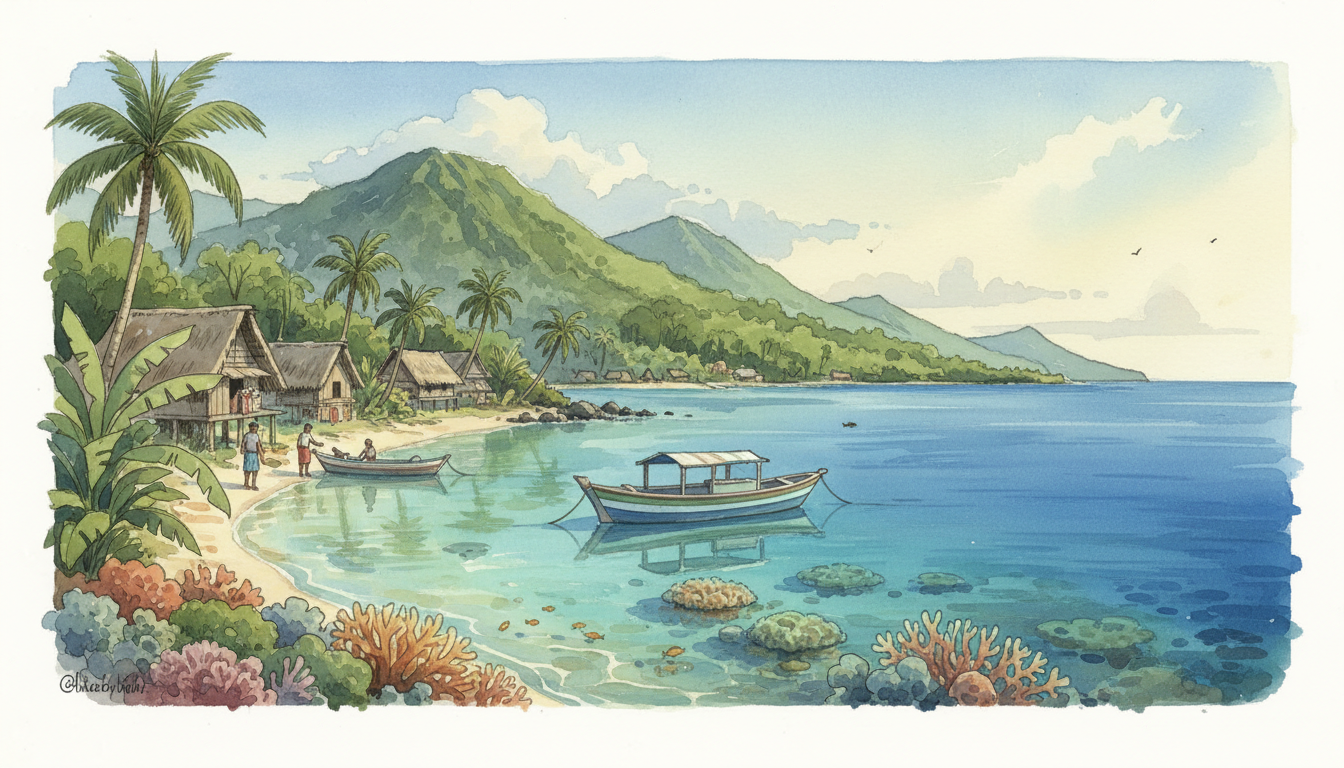
How does Fiji work? Fiji is a parliamentary republic spread across hundreds of Pacific islands. Its national government makes laws and runs countrywide services; communities, landowners, businesses, schools and local organisations shape what happens on the ground. Because homes and services are separated by sea, ferries, ports, roads, flights and reliable communications matter as much as any building in the capital.
Why is Fiji organised this way? Geography sets the daily puzzle. Most people live on the larger islands, but a school, clinic, shop or family on a more distant island still needs teachers, medicines, deliveries and dependable ways to reach the outside world. To understand Fiji, follow one ordinary service from the government budget through roads, boats and people to the household that needs it.
This guide explains Fiji’s government, island transport, customary land, the economy, education, healthcare, climate resilience and public decisions in plain language. It is a country-systems introduction, not a travel booking guide or an official legal manual. Check live rules and public notices with the relevant authorities.
Fiji at a glance: the quick answer
| Question | Quick explanation |
|---|---|
| Who makes national laws? | The Parliament of Fiji, under the Constitution. |
| Who runs the government? | The Prime Minister and Cabinet lead the executive; government must maintain parliamentary confidence. |
| Why are transport and shipping vital? | People, food, medicines and building materials have to cross water between islands. |
| How do schools and healthcare fit? | National policies depend on teachers, facilities, transport and local delivery. |
| What shapes economic life? | Tourism, services, agriculture, fisheries, trade and remittances, with different opportunities across the islands. |
| What is the big risk to plan around? | Tropical cyclones, flooding, coastal exposure and disruption to transport, livelihoods and public infrastructure. |
1. Why does Fiji’s geography change how the country works?
Imagine planning a public service for a town on one connected landmass. A bus can deliver a teacher, a truck can bring medicine, and an emergency team may drive to a nearby facility. Now divide that same service across an archipelago. The plan requires a port, a vessel, a suitable weather window, a receiving point and local people who can finish the job. Distance is measured in travel reliability, not just kilometres.
Fiji has more than 300 islands, with population and major services concentrated particularly on Viti Levu and Vanua Levu. That does not make the remaining inhabited islands unimportant. It means public planners face two simultaneous duties: operate busy centres efficiently and maintain reasonable access for smaller, more distant communities. An apparently simple decision—where to place a clinic or an upper-secondary class—has a geographic cost.
Think of Fiji as several overlapping maps. The political map marks laws and jurisdictions. The transport map marks roads, jetties, shipping schedules and air links. The social map marks villages, family networks and customary relationships. The climate map marks coasts, hills, rivers and potential exposure to storms. A national decision works when these maps agree enough for people to reach a real service.
That is why comparisons based only on population or GDP can mislead. Two countries can have similar budgets but very different delivery costs. In Fiji, reaching a small island may require resources that would reach many more people in a dense city. Fairness is therefore partly a question of designing for distance.
2. How does Fiji’s government work?
Fiji’s Constitution establishes three arms of the state: Parliament, the executive and the judiciary. Parliament is the lawmaking and scrutiny arm; the executive manages government programmes and implements law; and courts interpret and apply the law independently. This separation matters because the institution that proposes a decision is not supposed to be the only institution capable of questioning it.
Fiji has a parliamentary system. Citizens vote in general elections to choose members of Parliament. The government is formed through the parliamentary process, with the Prime Minister leading Cabinet. Ministers oversee specific portfolios such as education, health, infrastructure or finance. A minister may announce a policy, but delivery still depends on legislation where needed, administrative rules, public funding and the agencies that carry out the work.
An ordinary resident usually encounters the state through services rather than constitutional vocabulary. A school repair needs a department and an approved budget. A business licence involves administrative processes. A complaint about a public service may go through an agency, oversight mechanism or representative. Parliamentary debates help the public see why competing priorities are being chosen.
Do not confuse the President and Prime Minister. Under Fiji’s constitutional structure, the President is head of state, while the Prime Minister leads the government. Their roles are not interchangeable. For the exact current officeholders, legislation and composition of Parliament, use the Parliament of Fiji’s official pages rather than an older social-media graphic.
- Parliament: makes laws, examines decisions and represents voters.
- Cabinet and ministries: choose policies and organise administration.
- Courts: resolve disputes and interpret law independently.
- Citizens and communities: vote, participate, question and use public processes.
3. What happens between a law and a useful service?
Writing a policy is the beginning, not the finish line. Suppose Fiji wants safer school buildings. The idea may start with disaster-risk evidence, community reports or a political commitment. Officials then cost possible repairs, rank the highest-risk facilities and seek budget authority. Technical teams develop specifications. Contractors or public works teams carry out the work. Inspectors and school leaders check whether the result can actually be used.
The chain has many weak points: incomplete maps, late shipping, materials delayed at port, heavy rain, shortages of skilled labour, or a design that does not reflect local needs. A policy can be sensible yet produce uneven results if these delivery conditions are ignored. This is one reason maintaining roads, bridges, docks and basic records matters so much.
A useful question to ask of any new government announcement is: Who is responsible for the next visible step? If the answer is a general promise rather than a named agency, timetable or budget process, the reader does not yet know how the announcement will reach the household. Good public administration turns intentions into accountable tasks.
Another question is how outcomes are measured. Counting schools repaired is useful, but ask whether classrooms stay open through bad weather, whether students can reach them, and whether the repair cost is sustainable. The last kilometre of delivery is where a national plan either becomes real or remains a document.
4. How do provinces, villages and customary land fit into Fiji?
Fiji is not organised only through national ministries. Communities have histories, relationships and customary forms of organisation that matter to land, identity and local decisions. In many places, iTaukei communities have important connections with ancestral land and communal institutions. This cultural and land dimension cannot be understood by looking only at a map of state offices.
Land questions are especially practical. A tourism project, road improvement, agricultural activity or community facility may need to account for land tenure, customary ownership, leasing arrangements and environmental safeguards. An investor’s interest does not erase the rights of the people connected to the land. Equally, communities may seek income and infrastructure while protecting long-term interests.
Local and municipal administration also has work to do: roads and drainage, sanitation, public places, planning, services and the everyday interface with residents. Their exact powers differ by institution and legislation. Avoid assuming that a village leader, municipal council, provincial structure and national ministry all have the same authority.
For students, a helpful approach is to separate three questions: Who owns or holds rights over the land? Who has legal power to approve the activity? Who will operate and maintain the resulting service? Those answers may involve different people, so respectful consultation is not an optional extra.
5. How do Fiji’s roads, ferries, ports and flights connect people?
On Viti Levu, a road can link a town to a hospital, farm market or port. But travel between islands may depend on ferries, cargo vessels or flights. A shipping timetable is therefore part of the social and economic infrastructure, not just an item for tourists. A missed delivery may mean a shop runs short of stock, a construction site waits for materials or a patient needs another transport arrangement.
Roads and ports also rely on each other. Improving a jetty is of limited value if cargo cannot leave it over a safe road. A new rural road is less useful if freight services to the island are irregular. Systems planning therefore examines the whole journey rather than celebrating one isolated project. The same principle appears in Singapore’s integrated road, rail and port links, though the geography is very different.
Weather introduces uncertainty. Rough seas or cyclone warnings can cancel travel, and a damaged bridge can disconnect a community despite its being relatively close to a town. Planning must include backup routes, communication, storage of essentials, maintenance schedules and clear safety decisions. Reliability should count as an outcome alongside speed.
An excellent way to understand Fiji is to follow a bag of rice from its supplier to an outer-island shop. List each handling point, waiting period, transport mode and fee. You will see why some products cost more outside major centres, even when the same item is being sold.
6. How does Fiji make money and create jobs?
Tourism is an important part of Fiji’s economy: it supports accommodation, food, transport, construction, retail and many local services. But ‘tourism’ is not one job. A hotel relies on food deliveries, electricity, trained staff, sewage management, safe beaches and air access. When these inputs work together, visitor spending can move through several local businesses; when they fail, the effect can spread.
Agriculture and fisheries are also vital, especially for rural livelihoods and food supply. In one community, a family may earn income from crops, fishing and small enterprise alongside wage work or money sent by relatives. A national employment statistic cannot fully explain these mixed livelihoods or the value of subsistence activities.
Imports and exports add another layer. Businesses need dependable transport, payments and rules to move goods. Tourism brings external demand, but it can also expose households to global downturns and travel disruptions. Building a more varied economy can help reduce over-reliance on one market or one kind of visitor.
To assess development, ask more than whether visitor arrivals rise. Are stable jobs created? Are businesses owned locally? Does training reach young people? Are transport and sanitation maintained? Do rural and maritime communities benefit? Does a destination preserve its natural assets rather than use them up?
7. How do schools work across Fiji’s islands?
Education is both a national promise and a local logistics challenge. A school needs a suitable building, qualified teachers, teaching materials, attendance arrangements, clean water and safe travel. When the nearest suitable higher-level programme is far away, families may face boarding, transport or relocation decisions that are much more consequential than a timetable change in a large city.
Language, community context and the transition between education stages also matter. Students must learn academic knowledge while navigating the language of classroom instruction and the expectations of examinations and further study. Some learners can reach a large secondary school easily; others may need extra support because the route between home and school is longer or less predictable.
Imagine two children studying the same mathematics topic. One can ask a teacher after class and find a library or reliable internet connection nearby. Another may have fewer specialist resources and periodic interruptions. Comparing test scores without examining these conditions tells only part of the story. Good education policy must consider access, instructional quality and the conditions in which students actually learn.
Our companion guide to Fiji’s education system explores schooling in more detail. This country overview concentrates on how education connects with transport, household income and national development rather than duplicating the school guide.
8. How are healthcare and emergency services delivered?
Healthcare works through a chain of prevention, routine services, clinical professionals, medicine supply and referral pathways. In a central location, several parts may sit close together. On a smaller island, a nurse or local facility may provide initial care while a patient must travel for advanced diagnostics or specialist treatment. That journey becomes part of the healthcare system itself.
Think about the practical requirements of a referral: someone recognises a serious condition; communicates with a receiving team; obtains a safe route; checks weather; arranges the right equipment; and keeps the patient’s information available. An unexpected ferry cancellation can turn a transport problem into a health problem. That is why dependable communications and emergency planning are public-health investments.
Prevention matters just as much. Clean drinking water, sanitation, safe food handling, vaccination programmes and community health information reduce illness before patients need specialist care. Facilities and staffing are necessary, but they cannot replace reliable water systems or trust between communities and health workers.
A sensible reader’s checklist is whether a government health plan specifies who provides first contact, who receives referrals, how medicines are replenished, and what happens during severe weather. ‘More healthcare’ is not yet an operational plan until those questions have answers.
9. Where do electricity, drinking water and digital connections come in?
Electricity and water are less visible when they work, but almost every other service rests upon them. A school needs lighting and sanitation; a clinic needs dependable electricity for equipment and temperature-sensitive supplies; a shop may need refrigeration; a family needs water for daily life. A failure in one utility can quickly affect several systems at once.
In island settings, infrastructure choices also involve scale. A dense settlement may justify a networked solution, while a distant community may benefit from a more localised arrangement. The right technology depends on demand, maintenance capacity, parts, staffing and long-term running costs. Installing a new system is usually easier than supporting it reliably for the next decade.
Digital connections change access as well. A working phone network can share cyclone warnings, coordinate deliveries, support study and simplify some transactions. But software cannot unload a vessel, repair a road or replace a health worker. Digital government succeeds best when it reduces paperwork while still serving people who have weaker devices or less reliable connections.
Ask whether infrastructure is measured by its installation or by the hours it is available, whether a family can afford to use it, and how quickly faults can be repaired. Availability and affordability are different questions.
10. How does Fiji prepare for cyclones and climate change?
Tropical cyclones, coastal flooding, landslides, heavy rainfall and sea-level rise can damage infrastructure and interrupt livelihoods. The Fiji Meteorological and Hydrological Services monitors weather and publishes seasonal information and warnings. A seasonal outlook is a planning tool, not a prediction of the exact day or route of a future storm.
Climate resilience is partly a construction question: where should a school sit, how high should infrastructure be, and what standards should a bridge meet? It is also a finance question: can repairs be funded quickly without crowding out essential services? And it is a social question: can elderly residents, people with disabilities and remote communities receive warnings and reach safer places?
A disaster plan needs more than a list of shelters. It needs trusted communication channels, clear responsibilities, spare supplies, access routes, resilient water systems, arrangements for interrupted schooling and a method for restoring services. Rebuilding a structure to the same vulnerable design may leave the original risk unchanged.
The World Bank’s Fiji climate and development work connects resilience with jobs, infrastructure and growth. That is a useful perspective: climate protection is not a separate environmental hobby. Protecting a port, classroom, crop or drinking-water network also protects economic opportunity and family stability.
11. How does a public budget become a national priority?
A government budget is a statement of choices under constraints. Fiji cannot fund every road, health facility, school upgrade and coastal protection project immediately. Money must cover salaries, operations, debt obligations, maintenance and new investment. When a cyclone damages assets, some priorities may need to change quickly.
Consider three proposals: a coastal road frequently cut by flooding, a new tourist facility and equipment for rural health clinics. An honest decision weighs who benefits, what happens if nothing is done, running costs, available financing and whether investment in one project makes another more useful. The most visible ribbon-cutting is not necessarily the most valuable intervention.
Public scrutiny matters because the full cost is often hidden. A donated building still needs staff and maintenance. A new ferry needs fuel, trained crew and a viable timetable. A digital service needs connectivity, security, updates and an alternative route for people who cannot use it. Good policy explains the recurring bill.
For students, build a simple priority matrix: urgency, number and vulnerability of beneficiaries, lifetime cost, delivery readiness and resilience benefit. It will reveal why budget debates are about trade-offs rather than merely wishing for more good things.
12. How does Fiji connect to the wider Pacific and the world?
Fiji operates inside a regional and global network. International flights bring visitors, workers, investment and trade connections. Shipping routes bring food, fuel, equipment and consumer goods. Regional cooperation can affect disaster response, diplomacy, environmental questions and opportunities for education or work.
Small states sometimes influence international discussions by focusing attention on problems they know directly, such as ocean protection and climate risk. But influence is not the same as control. The country still faces world prices, investor choices and transport shocks beyond its borders. Resilience depends on both internal capability and reliable relationships.
This is another reason to distinguish a country’s physical size from its connection footprint. An island state can be geographically dispersed yet economically tied to distant markets. A policy made overseas may affect fuel bills or tourism income inside Fiji, even without a domestic law changing.
Children can see the connection through ordinary objects. Choose a school notebook, medicine packet or imported food item. Trace where it may have come from, which transport route carried it, how it was paid for and what happens if a storm interrupts the route. World systems begin at home.
13. A worked example: how does medicine reach an outer-island family?
Illustrative learning scenario, not an account of a specific Fijian patient: A parent on a smaller island visits a local health worker because a child needs continuing treatment. The health worker confirms the medicine and quantity, checks what is in stock, and contacts the relevant supply or referral service. If the medicine is not available locally, a replenishment request enters a wider distribution process.
Step one is clinical: the right medicine and instructions must be identified. Step two is administrative: inventory, purchasing and authorisation must work. Step three is physical: the item moves through storage, road transport, port or air route, and safe final delivery. Step four is human: somebody verifies the item, communicates with the family, and explains how it should be used.
Now add bad weather. A boat is delayed. A good system needs an escalation plan: early ordering, alternative supplies where feasible, communication about delays, and clear instructions if symptoms change. Adding an online inventory system might help everyone see the shortage earlier, but it does not eliminate the need for a vessel or trained person.
Readers can use the same method for textbooks, fisheries exports, school repairs or emergency generators. Follow the journey; mark every handoff; ask who owns each step; identify one backup. This is systems thinking made practical.
14. What can Fiji teach us about strong countries?
Fiji shows that national capability is not only a matter of a single strong capital city. A country must work across different sizes of settlement, different travel conditions and different kinds of community life. National laws create a common framework, but dependable local delivery makes that framework meaningful.
It also demonstrates why geography should not be dismissed as background. The distance between a village and an essential service changes choices about transport, staffing, stockpiles, infrastructure and family time. Technology can reduce information delays while physical distance still exists.
Compared with Singapore’s highly concentrated city-state, Fiji has a much more dispersed delivery challenge. Singapore can often join housing, transport, hospitals and schools through dense networks. Fiji needs multiple service patterns, including maritime connections, and must plan for conditions in which weather interrupts an entire route. Neither model can be copied blindly.
The larger lesson is that a working civilisation is a chain of promises kept: a budget that becomes a service; a service that remains reachable; a road or boat that operates safely; an institution that listens; and a community whose knowledge has a real place in decisions.
15. Reader checklist: five questions that reveal how Fiji works
- Who makes the rule, and who has the legal responsibility to apply it?
- Which road, port, vessel, digital connection or local worker delivers the service?
- Whose land, cultural interests or community needs must be considered?
- What keeps the service working during cyclones or delayed shipping?
- How can residents verify performance, raise a problem or obtain the latest official guidance?
Try the five questions with a school bus, clinic, produce market, ferry service or coastal road. If you can answer them, you understand more than a memorised list of landmarks or ministries.
Frequently asked questions about Fiji
Is Fiji a democracy?
Fiji has a constitutional parliamentary system with elections, Parliament, executive government and courts. Understanding how democratic institutions perform also requires examining rights, accountability and actual practice, not just naming the institutions.
Who is the head of government in Fiji?
The Prime Minister leads the government and Cabinet. Fiji also has a President as head of state; the offices have different constitutional roles. Check current officeholders through official government sources.
Why is inter-island transport important in Fiji?
Because people and essential goods must cross sea routes to reach many communities. A cancelled sailing can affect food prices, appointments, school materials and local business deliveries.
What is Fiji’s biggest economic sector?
Tourism and other services are particularly important, while agriculture, fisheries, trade and many smaller activities support families. The answer depends on whether you are measuring output, employment or household livelihoods.
What is the role of customary land in Fiji?
Customary land and iTaukei communal relationships are important parts of Fiji’s social and economic landscape. Ownership, leasing and permissions are distinct legal matters; consult authoritative institutions for a specific parcel or project.
How does Fiji manage cyclone risk?
Through forecasting and alerts, disaster preparedness, resilient infrastructure, local communication and recovery planning. No warning system removes every risk, and seasonal forecasts should not be mistaken for precise event predictions.
Does Fiji have the same public-service structure as Singapore?
No. The two countries have different geography, laws, histories and administrative arrangements. Compare how each links people to water, schools, jobs and transport rather than assuming the organisational charts should match.
Where can I learn more about Fiji’s schools or travel routes?
Use the specialised eduKateSG education and travel guides below for those narrower questions, and consult Fiji’s responsible authorities for live policy or operational details.
Read next: follow the connected country systems
- How Countries Work — world civilisation series
- How Singapore Works — the Singapore civilisation companion
- How Singapore Connects — Roads, Expressways and Junctions
- Understanding the Education System of Fiji
- Top 10 Places to Visit When Touring Fiji
- Top 10 Things to Learn When Visiting and Touring Fiji
- How Finland Works — schools, taxes and public services
- How France Works — president, Parliament and local government
- How Gabon Works — forests, oil and public services
Sources and what to verify
Key institutional facts and background were checked against these public sources on 20 October 2026. Policies, officeholders, shipping timetables and storm warnings can change. Follow current notices for decisions involving travel, law, health or safety.
- Parliament of Fiji — Fiji’s system of government
- Parliament of Fiji — elections and representation
- World Bank — Fiji geography and economic context
- World Bank — Fiji Country Climate and Development Report
- Fiji Meteorological and Hydrological Services — tropical cyclone outlook (check latest advisory)
- World Bank — Vanua Levu tourism and infrastructure programme