
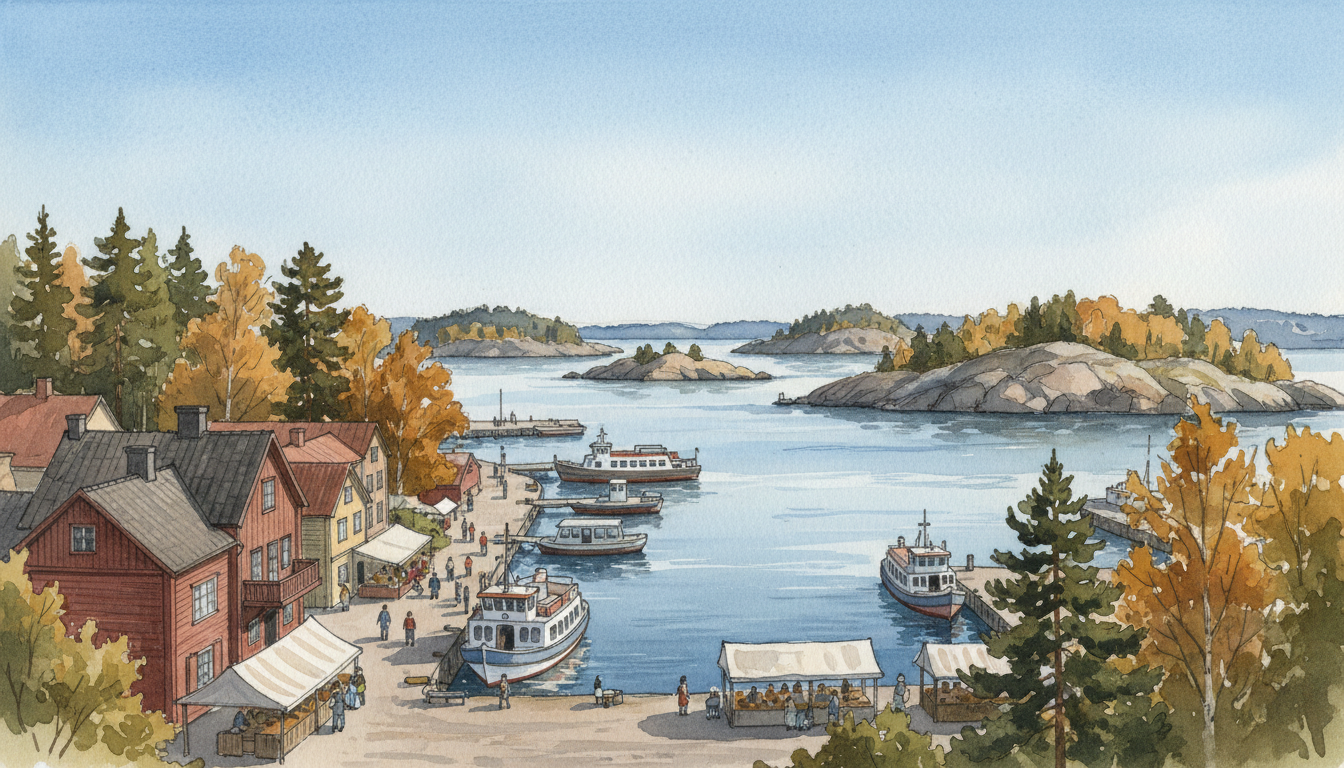
How does Finland work? Finland is a parliamentary democracy in which national laws, local municipalities, wellbeing services counties and specialised public institutions divide responsibility for daily life. Parliament makes laws and approves public finances; the government carries out national policy; municipalities organise much of basic education; wellbeing services counties organise most health, social and rescue services; and Kela administers important social-security benefits.
Why do Finnish schools and public services seem so closely connected? They are funded, regulated and delivered through linked but distinct institutions. Free basic education does not mean every service is free or that all taxes go into one pot. A child’s classroom, a hospital appointment, a family allowance and a local library may each have a different responsible organisation. Knowing which does what is the fastest way to understand Finland.
This guide follows an ordinary household through government, schools, tax, healthcare, work, housing, transport and social security. It also explains where the model faces difficult trade-offs. It is a practical introduction, not personal legal, benefit, immigration or tax advice. Benefit rules and payment amounts can change.
Finland at a glance: who does what?
| Everyday question | Main part of the system |
|---|---|
| Who passes laws and scrutinises government? | Parliament (Eduskunta / Riksdagen). |
| Who directs central administration? | The Government, led by the Prime Minister, and its ministries. |
| Who arranges basic schooling? | Municipalities and other approved education providers, within national rules. |
| Who organises most health and social services? | Wellbeing services counties; Helsinki and Åland have distinctive arrangements. |
| Who pays many national benefits? | Kela, subject to the law and eligibility rules. |
| Who collects and administers many taxes? | The Finnish Tax Administration; different taxes finance public responsibilities. |
1. How is Finland governed?
Finland’s national institutions are designed around parliamentary democracy and the rule of law. Parliament enacts legislation, decides on national finances and holds the Government accountable. The Government prepares and implements policy, with the Prime Minister coordinating the work of ministers. The President has an important constitutional role, notably in foreign and security affairs in cooperation with the Government, but is not a substitute for Parliament or the Cabinet.
Why does this matter to someone simply trying to understand a school or hospital? Because every service starts with legal authority and a public decision about responsibility. Parliament might change the framework for education or benefits; the relevant ministry develops the details; an agency or municipality implements the rule; and a resident experiences its effects.
The Finnish Government’s official explanation emphasises that it needs the support of Parliament. That is the essence of the parliamentary relationship. A cabinet programme describes political priorities, but each significant change still has to pass through legal, financial and administrative processes.
Readers should separate three kinds of statement: what the law currently says; what the Government wants to change; and what a municipality or service provider has already implemented. A proposal, even one announced publicly, is not automatically an operative entitlement.
- Parliament: legislation, budgets and scrutiny.
- Government and ministries: policy preparation and execution.
- Agencies: administration under legislation.
- Local and regional bodies: service delivery in their defined responsibilities.
2. Why are municipalities so important in Finland?
A municipality is much more than a name on an address. Municipalities are local self-government bodies with elected councils and responsibilities for services that affect daily life. Education, local infrastructure, planning and several cultural and community services connect strongly with municipal decisions.
Consider a new residential neighbourhood. Families need school places, transport arrangements, recreation spaces and routes to other services. A municipality has to think about the area not only as a housing project, but as a place where children will grow and residents will move for years. School-building decisions therefore connect with population trends, the local tax base, land-use plans and public transport.
Municipalities also differ. Helsinki and a small northern municipality face quite different densities, distances and staffing markets. An institution that is easy to operate in a large urban centre may require a different timetable or shared arrangement where settlements are far apart. Equal national rights do not always produce identical local delivery models.
When comparing two Finnish towns, do not assume that a service’s local quality is determined solely by the national curriculum or a national ministry. Ask what resources and arrangements the municipality provides, how pupils actually travel, and what support is available if a family’s needs change.
3. Who runs healthcare after Finland’s service reform?
One of the easiest mistakes is saying that Finnish municipalities still run all healthcare and social services exactly as before. Finland transferred organising responsibilities for most health, social welfare and rescue services to wellbeing services counties at the start of 2023. Statistics Finland’s 2026 classification describes 21 wellbeing services counties, with the City of Helsinki and Åland handled through their own arrangements.
This split is important. The municipality remains essential for schools and many local functions. The wellbeing services county is generally the place to look for public healthcare, social welfare and rescue services. Kela, meanwhile, administers many benefits under separate national legislation. These three institutions may all matter to one household in the same week.
Imagine an older resident who needs home support. A healthcare issue may involve county services, a benefit question may involve Kela, and a change to the nearby bus or pavement may involve municipal or transport organisations. The resident does not experience these as three isolated legal boxes. A good system must provide clear handoffs and useful information.
The reform itself is a reminder that governance can change. Do not rely on an explanation written before 2023 that still assigns every health function to municipalities. For a real appointment, contact the relevant service provider, not a general overview article.
4. How does the Finnish education system work?
Finland’s education system begins with early childhood education and care, then pre-primary education, nine years of basic education and routes into general upper-secondary or vocational education. Higher education includes universities and universities of applied sciences. The Finnish National Agency for Education explains that compulsory education covers ages 6 to 18, with details determined by current law.
Basic education is not a hunt for the single correct answer to every learning problem. The national curriculum provides common objectives, while education providers and teachers organise learning and assessment within that framework. Children are supported through teaching, materials and welfare arrangements, but national principles do not guarantee that every classroom faces identical challenges.
After basic education, a young person may follow a general upper-secondary route that culminates in the matriculation examination or a vocational route leading to a qualification. These pathways serve different learning goals. Vocational education should not automatically be understood as a failed academic route; it is a structured part of the national education and labour system.
An important distinction for families: free basic education includes important supports such as learning materials and meals, as the official education agency explains. Other costs, entry requirements, study routes and eligibility questions vary by stage and status. Read the current provider guidance for a real application.
5. What makes Finnish schooling different from a test-only model?
School performance is visible in grades, but a school system also has to keep children attending, learning, belonging and moving toward further opportunities. Finland’s approach joins curriculum, trained teachers, local responsibility and student welfare. Those systems interact: an excellent lesson is less effective when a child is hungry, exhausted, persistently absent or unable to understand the teaching language.
Suppose a pupil falls behind in fractions. Giving fifty extra worksheet questions may produce more practice but not reveal the misconception. The teacher needs to find out whether the child misunderstands part-whole relationships, multiplication or mathematical language. Support can then target the missing idea. That principle is universal even when countries organise their schools differently.
Similarly, school meals and educational materials are not decorative generosity. They reduce common barriers to participation and make the learning day more predictable. But they have a cost: food procurement, staffing, buildings and public finance. Explaining the benefit without explaining its operating system leaves the story incomplete.
The official Finnish education framework is a starting point, not a promise that every school is perfect. Learning outcomes, rural access, language differences, special support, staff workload and financial constraints are all legitimate public questions. A reliable guide explains strengths and limits together.
6. Where do taxes go, and why are Finnish taxes often discussed?
Finland finances public responsibilities through a mixture of tax revenues and other legally defined funding arrangements. Income-related taxation, consumption taxes and other revenues operate under separate rules. Some services are organised by municipalities, others by the state or wellbeing services counties, and benefits may be funded through complex combinations of public and contribution-based systems.
Value-added tax is a useful everyday example. When a consumer buys an item subject to VAT, the tax is built into the transaction and collected through the seller’s reporting obligations. Finland’s Tax Administration explains that different categories can carry different rates and that rates have changed over time. Quoting a single VAT percentage for every purchase would be incorrect.
What does a household receive in return? The answer is not a personal refund matched to every euro paid. Public finance supports institutions and services across society and different stages of life. A person may be a pupil for years, an employee later, a caregiver, an entrepreneur, and eventually a pensioner. The mix of taxes paid and services used shifts over time.
Tax policy also involves debate. Higher revenue can support services, but taxes may affect purchasing power, incentives and businesses. Lower taxation can leave less fiscal room or require different spending choices. The meaningful question is not simply whether Finland taxes more than another country, but what outcomes its financing arrangements deliver and at what cost.
7. What is Kela, and how does Finnish social security work?
Kela is Finland’s Social Insurance Institution. It administers a range of national benefits for eligible people at different stages of life, including support related to children, studies, unemployment, illness and other circumstances. Kela is not the same thing as a hospital, a municipality or the entire welfare state.
Benefit eligibility is rule-based. Residence, work history, income, family circumstances, other insurance and the precise benefit can all matter. A Finnish passport or a Finnish address alone should not be treated as proof that any particular payment is available. Applicants should check their situation through current Kela guidance and official application processes.
Social security is also a changing policy area. Kela began paying a general social-security benefit for some unemployed people in May 2026, replacing two earlier basic benefits. This is a concrete example of why an article describing the 2024 benefit system should not be used as an up-to-date application checklist in late 2026.
Benefits can be essential safety nets, yet the design raises difficult questions about eligibility, work incentives, administrative burden and how to protect vulnerable people. A good explanation does not present every change as automatically generous or automatically punitive. It tells readers what institution decides, what condition applies and where a current official answer lives.
8. How do children, parents and workers move through the system?
Think of a family over twenty years. A child enters early childhood education, then school. A parent works and pays taxes; the other parent might have a period away from work after a birth or need support during illness. The family uses transport, utilities and community facilities. As the child grows, education choices change, and after school there may be university, vocational training or work.
At each transition, responsibility may shift. A municipality arranges schooling; a higher-education institution handles its admissions; employers and employment services influence working life; Kela provides certain benefits when conditions are met; healthcare services are generally organised by the responsible wellbeing services county. The family experiences one life, not one ministry.
This is why good public communication matters. Suppose a school-age child needs learning support and medical assessment. The family may have to coordinate a teacher, educational support service, healthcare professionals and a benefit application. Unclear boundaries create stress even when every institution is competent inside its own office.
An effective system should make three things easy: identifying the right doorway, understanding the next step and knowing how to challenge a mistaken decision. Those are practical measures of accessibility that numbers about public spending alone cannot show.
9. How do jobs, industry and business fit into Finland?
Finland’s economy is not simply a large tax-funded public sector. Private businesses, employers, entrepreneurs and international trade create work and taxable activity. Technology, manufacturing, forestry, services and research-based industries contribute in different ways. Public education, infrastructure and institutions can support capability, but they do not replace market demand or enterprise.
Consider a forestry-based product. Trees are grown and managed; material is processed; firms use machinery, logistics and skilled workers; goods travel toward customers. Environmental rules and energy costs influence production, while education and research affect future techniques. The sector is a network of incentives and constraints, not one commodity sold from a forest.
New companies face practical questions: access to people with skills, infrastructure, finance, customers and predictable administration. Public services also depend on a healthy economic base. Where growth weakens or the population ages, budgets become harder to balance, regardless of the country’s social commitments.
For readers comparing Finland with Singapore, focus on mechanisms. Both countries depend on capable people and links to the outside world, but their land, climate, energy needs, industries and local-government structure differ. Importing one institutional design unchanged would not automatically reproduce its outcomes.
10. Why do transport, housing and distance matter?
Finland combines dense urban areas with sparsely populated regions and long winter conditions. Transport must serve commuters, freight, remote communities and international connections. Trains, roads, buses, ferries and airports serve different routes. A public transport choice that works in central Helsinki may be unrealistic for a remote household.
Housing planning likewise connects with jobs, schools and healthcare. A cheap home far from employment may have high travel costs or limited access to services. A convenient home in a major employment centre may be expensive. Municipal land-use choices therefore shape more than the street map; they help decide which life patterns are feasible.
Winter resilience matters to infrastructure. Energy demand, snow clearance and safe transport are not optional details in northern regions. But it would be simplistic to describe Finland as frozen everywhere all year. Conditions vary strongly by location and season.
Try a practical audit of a neighbourhood: How long does it take to reach a school, basic shop and healthcare service? Are the routes dependable in winter? Who is responsible for maintenance? What happens if a family cannot drive? These questions reveal how land use and service delivery interact.
11. How does Finland manage energy, forests and environmental choices?
Forests are economically, environmentally and culturally significant in Finland. They support timber-related industries and recreation while storing carbon and providing habitats. Policymakers and communities must weigh production, biodiversity, climate goals, land rights and long-term management. ‘Protect the forest’ and ‘use the forest’ are not always simple opposites; the hard question is what form, place and timing of use is sustainable.
Energy is another systems problem. Homes, businesses and public facilities need reliable heat and electricity. Energy supply involves choices about domestic production, imports, infrastructure, emissions and price stability. A technologically impressive project is not useful if it cannot be maintained or connected to the right demand.
Environmental choices also create distribution questions. People in cities and those whose livelihoods depend on land or industry may experience the costs and benefits differently. Evidence-based debate needs to show who gains, who pays and what assumptions determine the projected impact.
Students can investigate a wooden table, a paper notebook or a heated classroom. Trace the resource, processing, energy, transport, price and waste pathway. A familiar object becomes a map of Finland’s national economy.
12. What is distinctive about Finnish public trust and accountability?
Finland is often praised in international comparisons, but a country should not be explained through flattering rankings alone. Trust grows through repeated experiences: rules that are understandable, services that are reachable, decisions that can be questioned and institutions that usually do what they say. A population can value public institutions while still debating policies fiercely.
Administrative reliability matters in ordinary moments. A parent should be able to understand a school decision. A taxpayer needs clear instructions and appeal routes. A benefit claimant needs an explanation of eligibility and what evidence to supply. Public trust is strengthened by procedural fairness even when a person does not receive the answer they hoped for.
Good institutions also admit errors and revise practices. A system that changes can be stronger than one that insists every old rule was perfect. Finland’s recent healthcare organising reform and its 2026 social-security changes illustrate that institutional arrangements are active political choices, not timeless features of national character.
A useful measure is whether someone who is new to the country, unfamiliar with local terminology or living outside the capital can still find the right service and exercise their rights. That person is an especially informative test of whether a system is genuinely navigable.
13. A worked example: a family moves to a new municipality
Illustrative learning scenario: A family with a school-age child moves from one Finnish town to another. It would be incorrect to assume that one national office handles every part of the move. The family needs an address and registration processes, then information about local school placement and potentially changes to health-service contacts, transport and benefits.
Start with education. The municipality and education provider are the appropriate starting points for the child’s school arrangements and any learning-support questions. Next, check healthcare through the correct county-level or local provider. Then examine Kela directly if housing, childcare or other benefits may be affected. Check residency and eligibility facts rather than guessing.
Now suppose the child has an existing learning-support plan. The new school needs an accurate handover; the parent wants continuity; and information must be handled responsibly. This is a coordination problem. The child experiences the move as one disruption, even when several organisations own different parts of it.
What makes the journey successful? Clear contact details, a named next action, documentation transferred correctly, a realistic timeline and a way to escalate an unresolved problem. These are useful qualities to demand from public systems in any country, not just Finland.
14. Where are the limits and difficult trade-offs?
Finland’s institutions face the same fundamental constraint as any country: limited resources must serve changing needs. The population’s age profile, access to workers, uneven regional growth, public debt, prices and international shocks all affect what services can be sustained. Promising universal quality is easier than financing, staffing and delivering it everywhere.
A sparsely populated area can be expensive to serve; closing local facilities can reduce direct costs while increasing travel burdens. Digital services can improve access for some residents and exclude others. A well-intended benefit can be difficult to administer. High professional standards are valuable, but staff shortages can still lengthen waiting times.
These are policy trade-offs, not reasons to dismiss the entire model. Evidence-based comparison asks what problem a reform is solving, what changes for different groups, how outcomes will be measured and what unintended costs might appear.
If an international article claims that Finland has no examinations, no tuition, no inequality, no health waiting times or no administrative mistakes, read it sceptically. Simplifying the system into a miracle story does readers a disservice.
15. What can other countries learn from Finland without copying it blindly?
The strongest lesson is institutional clarity. Children, families and businesses benefit when the rules, responsible agencies, funding and appeal routes are understandable. Education can be designed to remove avoidable barriers, but its effectiveness still rests on teachers, materials, learning support and local conditions.
A second lesson is that a service does not stand alone. Schools connect to healthcare and transport. Employment connects to training and public revenue. Tax decisions affect what the state can fund; social benefits affect household security and incentives. Public institutions succeed only when those relationships are understood.
A third lesson is honesty about reform. Finland changes policies, sometimes significantly. Its model is a continuing political and administrative project, not a finished formula. Other countries should ask what particular problem a Finnish practice solves and whether the necessary local institutions exist.
That is also how we compare Finland with Fiji, France, Gabon and Singapore in this series: not by crowning a single winner, but by tracing how each country converts laws, knowledge, money and infrastructure into daily life.
16. A five-step worksheet for understanding Finland
- Pick one service: a school, hospital visit, social benefit, bus route or local library.
- Name the body that sets the rule and the body that actually delivers the service.
- Find the current official guidance and note the date of the latest change.
- List the money, skills, buildings and digital tools needed for reliable delivery.
- Ask which resident might struggle to access the service, then identify a remedy.
Try the exercise with a fictional sixteen-year-old choosing between general and vocational upper-secondary routes. You will quickly see that school guidance, entry requirements, family information, local availability and later career options all matter.
Frequently asked questions about Finland
Is Finland a democracy?
Yes. Finland is a parliamentary democracy with constitutional institutions. Parliament makes laws and holds the Government accountable. The President, Government and courts have distinct functions.
Is school free in Finland?
Pre-primary and basic education are free of charge under the official system, including important support such as learning materials and daily meals. Eligibility and costs in other education stages require more specific checking.
Who operates hospitals in Finland?
Most public healthcare and social-welfare organising responsibility sits with wellbeing services counties. Helsinki and Åland have special arrangements. The service provider and your eligibility determine practical access.
What is Kela?
Kela is the Social Insurance Institution of Finland. It administers many benefits, not the entire welfare system. Benefit amounts and eligibility are set through law and can change.
Does Finland have exams?
Yes. The general upper-secondary pathway concludes with a national matriculation examination, while assessment throughout education varies by stage and programme. Claims that Finnish education contains no exams are misleading.
Why does Finland collect substantial taxes?
Taxes fund public obligations and services under various financing arrangements. There are different taxes and rates; public outcomes and the tax burden should be analysed together.
How can I apply for a Finnish benefit?
Start with current Kela or other relevant official information, confirm your individual eligibility and use the stated application route. This guide is educational, not an entitlement determination.
Is Finland’s model the same as Singapore’s?
No. Both have strong education and infrastructure interests, but their political structures, regional geography, service responsibility and fiscal choices differ considerably.
Keep reading: the connected country and education guides
- How Countries Work — country systems companion archive
- How Singapore Works — civilisation archive
- How Singapore Education Works — schooling companion
- Education | Finland
- How Finland Got So Rich — the economic history
- Top 100 Sauna Culture Vocabulary Words | Finland
- Top 10 Places to Visit When Touring Finland
- How Fiji Works — islands, government and daily life
- How France Works — president, Parliament and regions
- How Gabon Works — forests, oil and services
Sources and update note
The explanations above draw on authoritative institution pages checked on 20 October 2026. Finnish law and social-security benefits continue to change; for applications or payments always check the latest rules with the responsible agency.
- Finnish Government — how the Government works
- Finnish National Agency for Education — education system
- Finnish National Agency for Education — who is responsible for education
- Finnish National Agency for Education — basic education
- Statistics Finland — wellbeing services counties (2026)
- Kela — benefits and services
- Kela — current changes to benefits
- Finnish Tax Administration — VAT rates and changes