
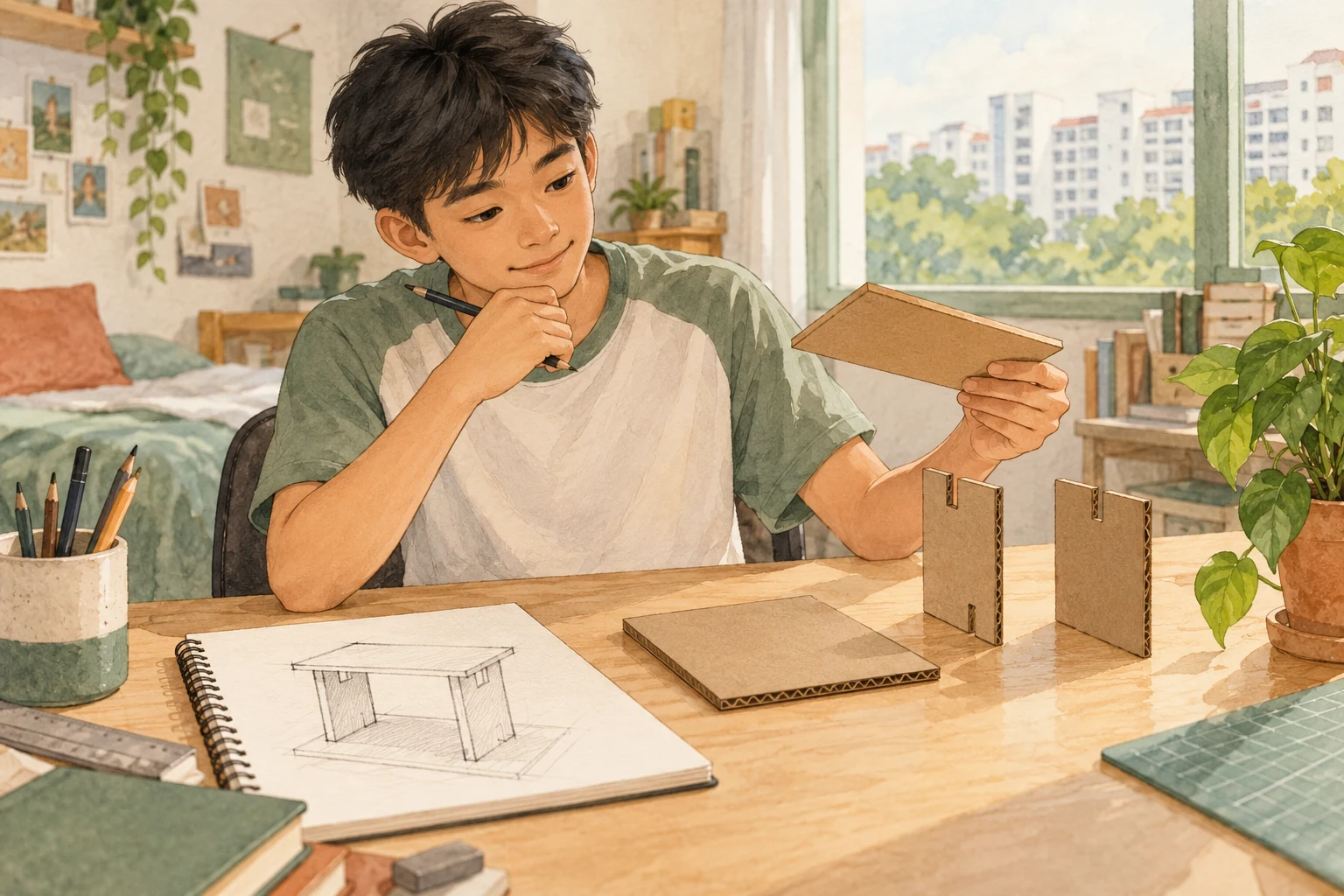
G2 Art in the 2027 Singapore–Cambridge Secondary Education Certificate (SEC) is subject K236. The assessment has two equally weighted components: a 2-hour-15-minute Visual Response paper and a Portfolio completed in 30 hours within 12 weeks. Each is worth 50 marks and contributes 50% to the subject grade.
This is not an examination that rewards only students who can draw a beautiful picture quickly. The syllabus asks learners to observe visual evidence, explore ideas, make purposeful artistic decisions, reflect on their development and communicate the meaning of their work. Being able to explain a choice—why this image, medium, contrast, layout or reference suits the intended message—is as important as demonstrating technical control.
The authoritative references are SEAB’s 2027 G2 Art K236 syllabus and the 2027 G2 SEC subject directory. The earlier reference code was 6127. This guide explains the published scheme and practical preparation without reproducing the examination’s copyrighted visual stimuli. The examples are original learning situations, not official artwork prompts.
Find what you need to know
- K236 paper and portfolio structure
- Paper 1: Visual Analysis and Exploratory Sketching
- What art forms, materials and visual language mean
- Paper 2: Portfolio screens and commentary
- Turning observation into personal artistic intent
- Common mistakes and how to repair them
- A practical four-week preparation cycle
- Frequently asked questions and sources
How the 2027 G2 Art K236 assessment works
| Component | Official structure | Marks | Overall grade |
|---|---|---|---|
| Paper 1 — Visual Response | Section A: Visual Analysis, one unseen stimulus and question with two parts | 10 | Within Paper 1’s 50% |
| Paper 1 — Visual Response | Section B: Exploratory Sketching, one practical task based on the stimulus | 40 | Within Paper 1’s 50% |
| Paper 2 — Portfolio | Part A: selection of visual materials, maximum ten screens | 30 | Within Paper 2’s 50% |
| Paper 2 — Portfolio | Part B: commentary based on two of the candidate’s works | 20 | Within Paper 2’s 50% |
Paper 1 lasts 2 hours 15 minutes in a single sitting. Candidates write and sketch in the provided question-paper spaces. Paper 2 is completed over 30 hours within 12 weeks, following the school’s formal arrangements. The school internally assesses the portfolio and SEAB externally moderates it, while the Visual Response paper is externally marked.
The split makes an important difference to preparation. A learner who is comfortable with studio work still needs visual analysis and timed idea development. A learner who can write convincing statements about art but lacks evidence of exploration across media also needs portfolio work. Neither half should be treated as an optional add-on.
What the assessment objectives mean
SEAB groups learning into knowledge with understanding, application skills and communication skills. Students should recognise visual qualities, investigate art forms and processes, generate and refine work, make connections, and articulate artistic intent using appropriate art vocabulary. Attribution of sources also matters.
A mark is not awarded simply because a visual response looks attractive at first glance. A thoughtful image can be visually simple but meaningful because of its composition, contrast and connection with the stated concept. An elaborate image may be less effective when it has little relationship to the task.
Paper 1: from an unseen image to a visual response
Section A — Visual Analysis: ten marks
Students are shown an unseen visual stimulus and answer one question with two subparts. They must describe or interpret the work and analyse or evaluate it. The most useful response moves from specific observation to explained meaning rather than beginning with a generic statement such as ‘The artwork is interesting’.
Imagine a fictional illustration of a small figure standing in front of a vast row of windows. The literal observation is that one figure occupies a relatively small part of the image. The scale contrast might communicate vulnerability, isolation or the overwhelming character of the environment, depending on other details. The student must connect the interpretation to actual evidence.
Use the language of art accurately
Students can talk about colour, line, shape, texture, form, space, balance, proportion, contrast, rhythm, emphasis and composition where relevant. A label by itself does not complete analysis. For example, saying ‘there is contrast’ is vague; identifying a very dark foreground against a pale background and explaining its effect is useful.
Do not attach a fixed emotional meaning to every colour. Red can suggest danger, celebration, warmth or other ideas depending on context and cultural reference. Analysis should respond to this visual stimulus, not a memorised dictionary of colour symbolism.
Section B — Exploratory Sketching: forty marks
The second section asks students to develop a two-dimensional visual concept or composition inspired by the stimulus and one of the syllabus’s Big Ideas. Students may sketch different possibilities and annotate them, ultimately presenting a clear concept for an under-drawing for a painting or illustration, or for a design. The syllabus specifically says a finished rendered artwork is not expected.
That distinction saves students from spending the whole examination shading a single polished picture. The marks reward exploration, selection, development, originality, communication and personal interpretation. A sequence of purposeful sketches that evolves into a clear concept can show more thinking than one highly rendered drawing with no alternatives.
The five Paper 1 assessment criteria
| Criterion | Marks | What good evidence looks like |
|---|---|---|
| Visual Analysis | 10 | Accurate observation and considered interpretation of the unseen work |
| Exploration of Visuals and Ideas | 10 | Multiple relevant options and development towards a concept |
| Creative Synthesis | 10 | Connecting visual choices to the prompt and an original outcome |
| Artistic Perception and Visual Communication | 10 | Appropriate visual elements, strategies and composition |
| Personal Interpretation | 10 | A relevant, meaningful response showing curiosity and thought |
The first criterion applies to Section A; the remaining four support Section B’s forty marks. A student should not mechanically split the examination time equally across the criteria. Instead, inspect the whole task, make observations, choose a meaningful direction and develop it in the time available.
Which drawing media may students use?
The syllabus permits appropriate pencils, pens and markers, including colour pencils and colour markers. It prohibits dry media such as charcoal, soft graphite, chalk or soft pastels and oil pastels, as well as all wet media for Paper 1. Students must follow the full school and examination instructions for permissible equipment.
A learner accustomed to oil paint or a favourite digital drawing application should not assume those tools can be used in the timed Visual Response paper. Practise the skills under the official medium restrictions to avoid an unpleasant surprise on examination day.
How to use 135 minutes sensibly
There is no universal minute-by-minute method because the stimulus and student strengths differ. A practical approach is to allocate time for reading and visual observation, written analysis, several initial concepts, purposeful selection and final development. The final check should confirm the chosen concept still relates to both the visual stimulus and the assigned Big Idea.
Students should try some full timed practices, but their first practice can be shorter. For a weaker learner, begin by taking ten minutes to observe a fresh image and explaining three meaningful details. Then develop two sketch variations that change layout or emphasis. Gradually combine those abilities into a complete timed response.
Four content areas: how artists make meaning
Art forms and media
The syllabus supports exploration of different art forms and media, including Fine Art and Design or Time-based categories. Students should learn what materials can do and why one medium is suitable for an intention. A pencil study, collage, photograph, digital composition and moving-image work offer different possibilities; not every option fits every idea.
In a study of memory, for example, a layered collage might communicate fragments and overlap, while sequential photography might show change across time. These are possible artistic strategies, not required solutions. The student should choose based on what they want to say, not simply because the technique is fashionable.
Visual qualities, strategies and design concepts
Visual choices influence how a viewer notices and connects information. Placing a single small object in a large empty space can create isolation; repeating a shape can suggest rhythm or habit; cropping a subject may redirect attention to a detail. None of these effects is guaranteed without context.
Art preparation improves when students can ask: where does the eye go first, which relationship is emphasised, what has been omitted, and how does the work’s form support its subject? Those questions help students critique and refine their own compositions.
Context: audiences and cultural perspectives
An artwork is encountered by people with experiences and values. The same image can be read differently depending on cultural background, historical setting and familiarity with the artist’s references. SEAB emphasises awareness of identity, culture and society, including Singaporean artistic experiences.
This does not mean students must always make work about national symbols or local landmarks. A meaningful response can come from an ordinary family ritual, a daily commute, a neighbourhood experience or a personal question, provided the idea is developed thoughtfully and grounded in the assessment task.
Artistic processes: revisiting and refining
Making art is iterative. A student may begin with a sketch, examine other approaches, test materials, receive feedback and change the work. The process is evidence of thinking. Rather than hiding every abandoned idea, the portfolio can demonstrate how a learner made choices and improved their communication.
The ability to explain why one version worked better than another is particularly important in the portfolio commentary. A statement such as ‘I liked the second one more’ is less useful than identifying what changed and what effect it created.
Paper 2 Portfolio: the requirements students must not miss
Part A: Selection of Visual Materials — thirty marks
The portfolio’s first part is a selection of material created or collected throughout the student’s upper-secondary Art learning, such as journal spreads, research findings, experimentation records and work in progress. It should show exploration of ideas and development across at least two art forms and media. At least one must be from Fine Art, and another from a Design or Time-based category.
The final selection has a maximum of ten screens submitted electronically. SEAB says students need not sequence or annotate these screens. That does not mean their choice is random: a thoughtful selection should demonstrate range and development. Consult the teacher about the correct file requirements, screen arrangement and deadline.
The thirty marks are divided into ten each for Ideas and Influences; Visual Language; and Art Forms, Media and Technical Processes. Review the official rubric to understand what evidence demonstrates exploration rather than mere accumulation of finished works.
How to select ten meaningful screens
Suppose a student explored family photographs, then tested drawing and digital image composition. The selection could show the early idea, visual research, material trials, changes after feedback and later outcomes. It should not be ten nearly identical photographs of the same final result. The purpose is to show learning across approaches.
A good selection is not necessarily chronological, and the official scheme does not require annotations on each screen. Ask whether someone examining the screens could see how the student’s investigation of visual ideas became more deliberate. That is a stronger selection criterion than picking only the most attractive-looking images.
Part B: Commentary — twenty marks
The commentary discusses two works by the candidate and the learner’s own artistic growth. It should articulate artistic intentions, connections with others’ artworks, relevant influences and evaluation of the student’s process. It must use accurate subject-specific language and meaningful evidence, not a generic statement that art is important.
The commentary must be no more than 500 words, submitted electronically, and a softcopy file of no more than eight A4-sized pages if relevant images accompany it. The school’s instructions for filename, citations, file type and size must also be followed. These constraints reward editing and selection rather than lengthy narrative.
Its two ten-mark criteria are Artistic Intent and Making Connections. A concise reflection should explain why the candidate made particular choices, what changed during the process and how the work relates to ideas or methods investigated from others.
Citations and authenticity are part of the submission
SEAB expressly requires citations and appropriate acknowledgement of images and other artists’ work. Students should not copy an online image into the portfolio without attribution and present it as their own. They should also avoid writing a commentary that describes imaginary trials they never conducted.
Parents and tutors can ask questions that prompt reflection, but the actual assessed artwork, portfolio selection and commentary must remain the candidate’s own work within the school’s rules. Artistic integrity is part of learning to respect other people’s expression.
Three Big Ideas that organise G2 Art learning
Art helps us to see in new ways
One syllabus Big Idea is that art can change how a viewer notices familiar things. A student might investigate ordinary objects from unexpected angles, explore scale or reveal a usually overlooked detail. This is a creative way of asking whether our habits of seeing limit what we notice.
For an illustrative study of a bus stop, an artist might focus on hands holding objects, silhouettes at different times or reflections in the shelter’s surface. The point is not to reproduce a stock image of public transport; it is to choose a viewpoint that communicates a meaningful observation.
Art tells stories about our world
Art can record personal and shared experiences, including stories of culture, identity and change. The student might explore a family celebration, a changing neighbourhood or a routine that conveys something important about contemporary life. The challenge is to communicate an experience through visual choices, not merely write its explanation beside the image.
An effective response can be intimate rather than grand. A repeated household object or the sequence of spaces in a familiar journey may hold a strong narrative when deliberately composed. Students should be able to say which details carry the story and why.
Art influences how we live
Images, objects and designed spaces affect how people navigate choices, perceive information and interact with environments. This Big Idea opens opportunities to explore how visual messages can influence attention, behaviour or social understanding. A student should recognise that art’s effect depends on context and audience.
A fictional poster designed to promote care for a shared space might use scale, contrast and focal point to make a message noticeable. The student should evaluate whether the intended viewers can understand it. Saying only that the poster uses bright colours does not explain its communication.
Common mistakes and practical corrections
| Problem | Why it limits the work | Targeted correction |
|---|---|---|
| Section A only describes objects | Visual impact and interpretation are not explained | Choose a visual detail and explain its effect |
| Section B creates one polished drawing immediately | Exploration and synthesis are hidden | Show meaningful variations before selection |
| Every design decision is described as ‘nice’ | Artistic intent is unclear | Explain choices through audience, meaning and form |
| Portfolio contains only one medium | Breadth requirement is missed | Check Fine Art and Design/Time-based evidence |
| Ten screens show only finished products | Artistic development is invisible | Select experiments and meaningful refinements |
| Commentary is long and generic | 500-word constraint and specificity are missed | Reflect on two actual candidate works |
| Other artists’ images have no citations | Academic honesty and connection are weakened | Attribute relevant sources properly |
An illustrative 90-minute art-learning session
- Observe an unfamiliar visual stimulus and name three concrete visual details.
- Explain two possible readings and the evidence for each.
- Sketch several variations of a concept linked to a chosen Big Idea.
- Compare how changing placement, scale or contrast alters the message.
- Choose one idea and develop it independently with short notes.
- Review whether the result has a clear artistic intention and textual or visual support.
This diagnostic session follows the same principle as eduKateSG’s Clementi three-student tutorial reference: identify the actual difficulty, demonstrate the missing skill and retest it independently. The reference concerns Mathematics instruction; this is an illustrative adaptation, not a claim that a particular SEC Art class is currently available.
A four-week preparation and review cycle
| Week | Paper 1 work | Portfolio awareness | Evidence of progress |
|---|---|---|---|
| 1 — Baseline | Short analysis of an unfamiliar artwork and initial sketches | Check current school portfolio instructions and available authentic work | Identify weaknesses in observation, ideation or communication |
| 2 — Explore | Practise visual language and several concept variations | Review whether at least two required art forms/media are documented | Ideas become purposeful, not merely decorative |
| 3 — Reflect | Try a new stimulus and explain the developed concept | Use the two candidate works to practise concise personal reflection | Explanations name influences, intentions and actual changes |
| 4 — Integrate | Attempt a timed 135-minute Visual Response with correct media | Review teacher feedback, citations and official deadlines | Fewer repeated errors and a realistic next goal |
This four-week learning cycle is not a substitute for the official 30-hour, 12-week portfolio requirement. Nor is it a guarantee of any particular grade. Some students need longer to develop drawing confidence or analytical language. Improvement should be measured through better observation, clearer decisions and more independent communication.
Frequently asked questions
What is the G2 Art code for the 2027 SEC?
K236, with 6127 as the older reference code. The new scheme includes a Visual Response paper and a Portfolio.
How long is Paper 1?
Two hours and fifteen minutes, assessing a ten-mark visual analysis and a forty-mark exploratory-sketching response.
Must the Paper 1 sketch be fully painted or shaded?
No. The syllabus says the exploratory work is a visual concept, not a finished artwork, and that rendering, shading and colouring are not expected.
Which media are allowed in Paper 1?
Appropriate pens, markers and pencils, including colour pencils and colour markers. Charcoal, soft graphite, soft pastels, oil pastels and wet media are prohibited under the published rules.
What is the portfolio weighting?
Paper 2 is worth 50% of K236. It is completed in 30 hours within 12 weeks under school arrangements and internally assessed with external moderation.
How many screens may Part A contain?
A maximum of ten submitted electronic screens, showing exploration across two art forms/media, including Fine Art and Design or Time-based work.
What is the commentary word limit?
No more than 500 words, based on two of the candidate’s own works, with an electronic file of no more than eight A4 pages when accompanying images are included.
May a parent or tutor create the portfolio commentary?
No. Assessed artistic reflection must represent the student’s own work and comply with school and examination integrity requirements. Outside support should focus on developing the student’s skills.
Does every student need natural drawing talent to do well?
The syllabus assesses observation, exploration, experimentation, communication and reflection as well as technical processes. Students can develop these through guided practice; there is no basis for guaranteeing a grade based on talent.
Can students use digital media in portfolio work?
The syllabus permits exploration in specified art forms and media, including Design or Time-based categories. The exact school requirements and appropriate formats must be confirmed. Paper 1 has separate media restrictions.
Official sources and related reading
- SEAB — 2027 G2 Art K236 official syllabus and assessment rubrics
- SEAB — 2027 G2 SEC school-candidate subject directory
- How G2 Design and Technology Works — Idea Development and Prototyping
- How G2 Literature in English Works — Evidence and Interpretation
- The three-pupil diagnostic teaching reference
Reviewed 4 November 2026. SEAB’s latest syllabus and the school’s official instructions take precedence for portfolio formats, equipment and examination details.
A useful next step
Choose one sketch and one artist reference from the student’s current art journal. Ask what the student noticed, what they changed from the initial idea and what that change helped communicate. Then test the same decision-making on an unfamiliar image. When the student can use observation to create a purposeful new concept, art preparation is developing real independence.
For questions about appropriate academic support or programme availability, contact eduKate Singapore. Confirm the tutor’s subject expertise and ensure assessed Art submissions remain the student’s original work.
Properly taught kids shine a bright light into the future.