
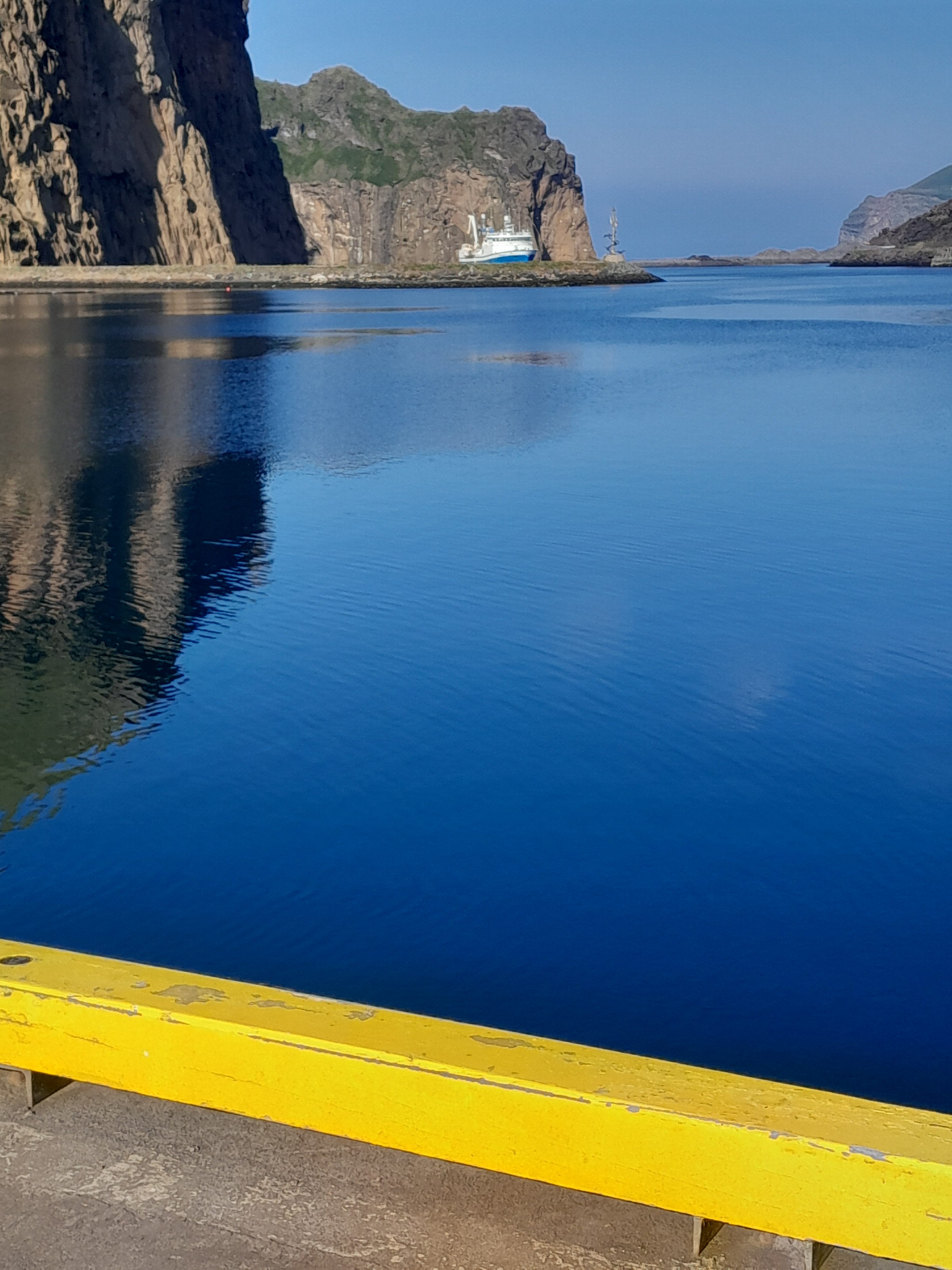
How do Iceland’s fishing quotas work? In the main quota system, a vessel holds a percentage share associated with a regulated fishery. Its catch entitlement for a fishing year or season is calculated using the relevant allowable catch and that share. The percentage and the resulting tonnes are different quantities: the share can remain unchanged while the permitted catch falls. Iceland’s Directorate of Fisheries explains the relationship.
Who decides how much can be caught? Scientific assessment, government decisions and vessel allocation are separate stages. The Marine and Freshwater Research Institute provides advice. The government sets legally applicable catch limits, and the Directorate administers allocations and controls. A scientific recommendation is not, by itself, a boat’s permission to fish. See MFRI’s advisory role and the Directorate’s allocation information.
This guide connects the survey vessel, the legal limit, the fishing boat and the coastal community. It expands How Iceland Works | Parliament, Energy and Daily Life. The numbers below are either clearly labelled teaching examples or dated scientific advice—not a live commercial fishing authorisation.
Jump to: Quota terms · Stock surveys · A quota calculation · 2026 advice · Catch monitoring · Coastal communities · Frequently asked questions.
1. Which numbers should not be confused?
| Term | What it describes | What it does not establish |
|---|---|---|
| Stock estimate | An assessment of a fish population or a defined part of it. | Permission to catch the whole estimated population. |
| Scientific catch advice | A recommended harvest under a stated assessment and management approach. | The final legal entitlement of an individual vessel. |
| Total allowable catch | The legally determined catch limit for the relevant fishery and period. | A guarantee that the full quantity will be caught. |
| Quota share | A percentage used in the allocation system. | A permanently fixed tonnage. |
| Vessel catch quota | The quantity allocated to the vessel under the applicable arrangements. | A reserved patch of ocean containing exactly that weight of fish. |
| Recorded landings | Catch brought ashore and entered into the recording system. | The same thing as a future allocation or a stock estimate. |
The institutional distinctions follow the quota-system guide and MFRI’s advice portal. Underline the term before reading a large tonnage in a headline. Otherwise, a recommended catch can accidentally become a claim about actual fishing or about all the fish remaining in the sea.
2. How can scientists estimate fish they cannot count individually?
They use observations and sampling rather than trying to identify every fish in the ocean. For example, the joint Icelandic–Greenlandic capelin survey announced in August 2026 combined vessel observations, acoustic measurements, biological sampling and environmental work. Scientists also coordinated data-quality procedures across the participating vessels. The survey plan describes those methods.
The resulting estimate has uncertainty. A survey can be carefully designed yet still encounter storms, sea ice or uneven coverage. An estimate should therefore be read with its method and limitations, not treated as a literal inventory checked fish by fish.
For a classroom analogy, imagine estimating the number of trees in a large area by measuring selected plots. Your answer depends on whether those plots represent the wider area and whether you can reach them. The analogy does not reproduce fishery science, but it shows why sampling design matters.
3. Who checks the scientific advice?
MFRI states that assessment and advice for the main Icelandic stocks are reviewed annually through the International Council for the Exploration of the Sea, or ICES. Its advice uses precautionary considerations and the ICES approach to maximum sustainable yield. The institute explains this review framework.
Review does not make uncertainty disappear. It provides a structured way to examine evidence and methods. A useful question is whether new observations support the previous estimate, require a revision or reveal a gap needing further research.
It is also important to distinguish scientific review from the political allocation of opportunities. Researchers can assess what a harvest may mean for a stock without deciding every question about which town, company or worker should receive the economic benefit.
4. What is a harvest control rule?
A harvest control rule connects an assessed stock condition with a prescribed way of calculating or adjusting harvest advice. It is intended to make the response to changing evidence more structured. In June 2026, MFRI explicitly applied Iceland’s government harvest control rule when recommending the next cod catch limit. The dated recommendation identifies that basis.
In a deliberately simplified example, a rule might reduce the advised harvest when an assessed population falls. The real rule may contain safeguards, thresholds and smoothing provisions. Do not substitute an invented classroom percentage for the actual fishery’s management rule.
A rule can improve consistency without eliminating the need for accurate observations. If the input estimate changes, the calculation can change too. That is not necessarily arbitrary policy; it can be the intended consequence of responding to new evidence.
5. A worked example: why the same share can mean fewer tonnes
Suppose a hypothetical pool available for vessel allocation is 100,000 tonnes. A vessel with a 1% share receives 0.01 × 100,000 = 1,000 tonnes. If the comparable allocation pool falls to 80,000 tonnes while its share stays at 1%, the allocation becomes 800 tonnes.
The percentage has not been reduced, but the quantity has. That is the difference between holding a slice of an adjustable total and being promised a fixed weight forever.
These are fictional numbers. Actual allocations can involve deductions, special arrangements and transfers under the applicable rules. The example uses an already-defined allocation pool so that students do not assume every tonne in a national headline is divided by one simple calculation.
6. Can vessels transfer quota?
The Icelandic system provides for transfers under specified conditions. The Directorate publishes procedures and limits rather than treating every entitlement as unrestricted. Separate arrangements can apply to different vessel and quota systems. Its transfer guidance should be read alongside the commercial-permit requirements.
Consider an imagined vessel temporarily unable to fish because it needs repair. An authorised transfer could allow another vessel to use an entitlement under the rules. That does not enlarge the biological resource or create additional fish. It changes who may use a defined opportunity.
It would also be misleading to confuse a transfer of this season’s catch entitlement with a transfer of a longer-term quota share. The commercial and legal consequences need to be checked for the actual transaction. This article is not advice on purchasing quota or operating a fishing business.
7. What did the June 2026 cod recommendation say?
On 12 June 2026, MFRI recommended a cod catch of 201,674 tonnes for the 2026/2027 fishing year, about 1% below the comparable previous level. It pointed to weaker year classes entering the assessed stock and slower growth in some groups of fish. The institute considered poor capelin conditions a likely contributor to that growth pattern. Read the original advice.
The figure is quoted here as scientific advice, not as confirmation of the final regulation, an individual vessel’s allocation or the amount already landed. Those must be checked through the relevant government and Directorate records.
The explanation also shows why a quota discussion can involve more than the number of adult fish seen today. The size and growth of younger groups affect what may enter the fishable stock later. Future supply is partly a question about the development of those groups, not simply today’s boats.
8. Why did capelin advice change in October 2026?
On 12 October 2026, MFRI and Greenland’s research institute reported revised capelin catch advice of 105,773 tonnes, replacing the initial 358,044-tonne advice. The autumn survey was constrained by storms and sea ice, leaving incomplete northern coverage. The institutes said the fishable stock was therefore likely underestimated and planned further winter measurements before final advice. The update explains both the revision and its uncertainty.
It would be wrong to keep quoting the earlier figure as the newest advice. It would also be wrong to interpret the revision as proof that precisely the difference between the two numbers had disappeared from the sea. Advice depends on the assessment, survey coverage and the rule applied.
This is an unusually useful case for learning how evidence changes a decision. Save the original statement, then place the update beside it. Identify what was measured differently and what remains uncertain before judging whether the change was justified.
9. How do catch logbooks make the system checkable?
Captains of commercially permitted fishing vessels are required to keep catch logbooks under the applicable regulations. The Directorate identifies these records as fundamental to monitoring, traceability and certification. Its logbook guidance explains the obligation.
Imagine a system that allocates a quota but never records what a vessel catches. It would have no dependable way to compare permission with activity. Keeping records does not guarantee honesty, but it creates information that can be checked against other observations.
The same principle appears in many public systems. A budget needs expenditure records, a library needs loan records and a fishing allocation needs catch information. Announcing a limit is the beginning of administration, not the end.
10. What happens when fish are landed?
Iceland’s public guidance describes weighing and registering catches when they are landed, with authorised arrangements and oversight. The purpose is to connect physical fish arriving ashore with recorded quantities. The Directorate’s weighing page explains that step.
In its January 2026 description of surveillance work, the Directorate identified checks on landings and weighing, along with at-sea monitoring, logbooks and discard-related concerns. This shows that controls occur at more than one point in the chain. The dated operational description lists those functions.
A useful classroom question is where two independent records can be compared. If a landing measurement and a vessel record disagree, the difference needs investigation. It should not automatically be dismissed as harmless, but neither should a student invent the cause without evidence.
11. Is a national catch limit enough to protect every habitat?
No. A tonnage limit does not, by itself, specify where fishing occurs or which other organisms may be affected. MFRI publishes area-based advice and work on seabird and marine-mammal bycatch alongside fish-stock recommendations. Its advice portal separates these subjects.
Consider two hypothetical fishing operations landing the same weight of a target species. They may use different methods in different habitats and have different unintended effects. Catch weight alone would not establish that their environmental performance was identical.
That is why a claim of responsible fishing needs a defined fishery, place, method and period. A country’s reputation is not a substitute for checking the stock and operation concerned. Avoid labelling every activity sustainable merely because it occurs in Icelandic waters.
12. Why do coastal communities care about quota allocation?
Iceland has regional quota arrangements intended to support eligible communities facing difficulties connected with declines in fishing activity and dependence on the industry. The Directorate publishes the programme’s conditions and allocation information. Read its regional-quota explanation.
The distinction is between the size of the resource available for harvest and the distribution of the resulting opportunity. A scientifically justified national limit does not automatically decide how the economic activity is shared among communities.
Imagine a small harbour where one vessel supports crew work, processing, repairs and deliveries. A change in its activity can affect several local businesses. That is a hypothetical illustration, not a claim about every town. A serious assessment traces the particular connections rather than assuming one boat creates the same employment everywhere.
13. Does a larger catch always mean a better economic result?
Not necessarily. Imagine a fictional operator landing 100 tonnes and receiving 200,000 units in gross sales. If the costs included in this simplified example total 150,000 units, the difference is 50,000 before any excluded obligations. Gross sales and profit are not the same number.
Now suppose higher volume arrives with a lower selling price or much higher costs. More tonnes could coexist with a smaller remainder. Conversely, improving quality or reducing avoidable losses might improve revenue without increasing the catch.
These are invented business examples, not Icelandic prices or industry accounts. They show why the economic question needs value, costs and distribution alongside catch quantity. They do not justify exceeding a biological or legal limit to meet an income target.
14. How can a renewable fish resource still become vulnerable?
Renewable does not mean unlimited. In its June 2026 advice, MFRI recommended zero catch for the deep-sea redfish stock discussed in that assessment, because the spawning stock was below precautionary limits. This was a stock-specific finding, not a zero-catch recommendation for all redfish or all Icelandic fisheries. The original advice distinguishes the stocks.
A population can reproduce while still being depleted if losses and poor recruitment outweigh replenishment. A management system must therefore respond to the particular stock, rather than rely on the reassuring general word “renewable.”
The learning question is not whether a country has a quota system on paper. Ask whether assessments are credible, limits respond to evidence, actual catches are controlled and wider ecosystem effects are addressed. Each part needs evidence of its own.
15. A five-minute exercise for reading a fisheries headline
Take the fictional sentence “The quota rose to 10,000 tonnes.” Before interpreting it, ask which stock, area and period it concerns. Is it scientific advice, a legal total, a vessel allocation or recorded landings? Is it an initial figure or an update? What is the comparison period?
Then ask what conclusion the number supports. It may establish that a specified allowance increased. It does not automatically establish better stock health, higher profit, more jobs or weaker protection. Those require additional evidence.
For comparison, read Honduras’s coral-reef and coastal-community guide. A reef programme and a fishing-quota system use different tools, but both need clear distinctions between activities undertaken and ecological results achieved.
Frequently asked questions
Is a quota share the same as a fixed number of tonnes?
No. A percentage share is used to calculate an allocation from the relevant total. The Directorate’s guide distinguishes the two quantities.
Does MFRI issue the final legal permit to a fishing boat?
No. Scientific advice, legal catch limits and vessel permissions are separate stages. Check the applicable allocation records and permit requirements.
Why can a catch recommendation change after a survey?
New observations and revised uncertainty can change the assessment. The October 2026 capelin update is a dated example.
Does a transfer create more fish?
No. A transfer changes an entitlement under the permitted rules. It does not enlarge the biological stock or remove the overall management constraints.
Why are fish weighed when they come ashore?
Weighing connects physical landings with recorded quantities and monitoring. The official landing guidance explains the procedure.
Can this guide tell someone how much they may catch today?
No. A real trip requires the current rules for its fishery, vessel, location and activity. Commercial, recreational and specialised arrangements must not be assumed identical.
Continue exploring Iceland’s working systems
Return to Iceland’s national overview, compare its electricity and industrial system, or browse How Countries Work. The independent sibling How Singapore Works collection offers another setting for asking how rules, infrastructure and evidence turn resources into dependable everyday benefits.