
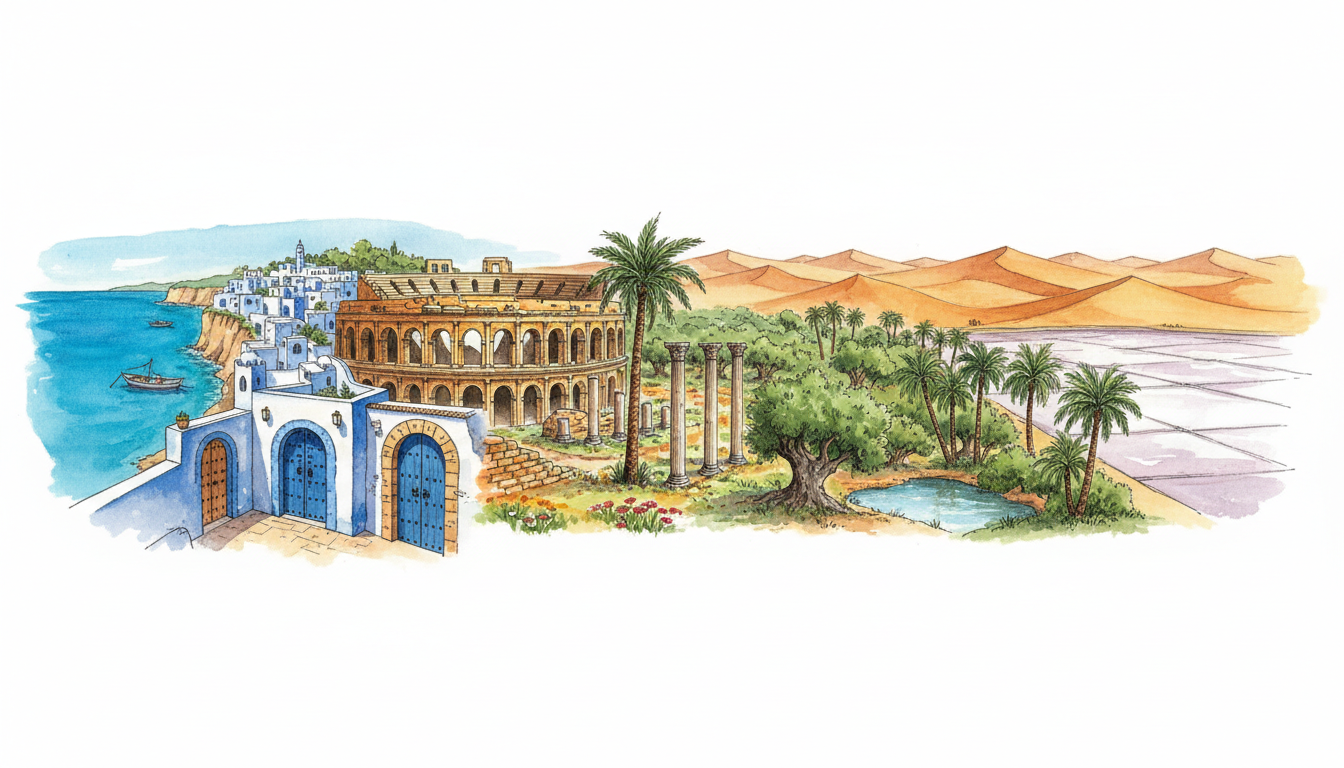
How does Tunisia work? Tunisia connects a strong presidency under its 2022 constitution, two legislative chambers, 24 governorates, olive farming, industry, Mediterranean trade and water systems. Its everyday challenges become clear when we follow a farm, a factory or a school through the real services they need.
This independent overview belongs to the How Countries Work A–Z hub and explains both formal institutions and practical outcomes.
Tunisia at a glance
Official name: Republic of Tunisia. Capital: Tunis. Region: North Africa, on the Mediterranean Sea. Government: republic with a powerful presidency under the 2022 constitution and a two-chamber legislature. Administrative divisions: 24 governorates. Currency: Tunisian dinar (TND). Main activities: services, industry, farming, tourism, trade, transport and public administration.
A simple question explains much of the country: how does olive oil reach a family in another country? The chain involves rainfall, farms, harvesting, mills, quality checks, transport, export rules and wages. Public policy matters, but work on the ground determines the result.
How does Tunisia work in one minute?
Tunisia connects Mediterranean coastal cities, inland farming and industrial regions, desert environments and international trade. Its government sets rules and budgets, while businesses, workers and municipalities deliver many services and products. Water, jobs, energy and transport influence the opportunities available to families.
Political institutions have changed significantly since the 2011 revolution and again under the 2022 constitution. Anyone using an older civics textbook needs to check which constitutional rules are actually in effect rather than assuming previous parliamentary arrangements still apply.
How is Tunisia governed under its 2022 constitution?
The president has substantial executive authority under the constitution adopted in 2022. The head of government and ministers exercise responsibilities under the constitutional framework, and the structure differs from the earlier parliamentary balance of power.
Independent observers and opposition groups have raised serious concerns about political freedoms, arrests, judicial independence and constraints on civic activity. Formal constitutional institutions and the practical ability to challenge government should therefore be examined separately. Presenting the system as uncontroversially representative would mislead readers.
Does Tunisia still have a parliament?
Yes. The 2022 constitution provides for two chambers: the Assembly of the Representatives of the People and the National Council of Regions and Districts. Their constitutional roles include legislative functions, although their powers and relationship with the presidency differ from the previous system.
The name and number of chambers are not enough to assess oversight. Ask whether budget choices are scrutinised, what information is public, how courts function and whether citizens can express disagreement safely. Democratic accountability requires more than a government organisational chart.
How do Tunisia’s 24 governorates work?
Tunisia is divided into 24 governorates, covering coastal cities, agricultural districts and inland areas. Below that level are additional administrative and local arrangements. A decision about a regional school or water service may require cooperation between national institutions and local implementers.
Regional inequality matters. The same national policy can yield different results when one community has a busy port and another faces high unemployment or water scarcity. A fair comparison examines access, quality and costs at the local level.
Why are Tunis and the coastal cities so important?
Tunis is the capital and a centre for administration, education and business. Other cities, including Sfax, Sousse and Bizerte, have important industrial, transport and commercial roles. Mediterranean ports help move exports and imported inputs.
A coastal location is an economic advantage only when railways, roads, warehouses, customs services, finance and workers connect it to producers inland. Shipping efficiency alone cannot solve the need for decent wages or reliable farm irrigation.
How does olive oil production work?
Olive trees are central to Tunisian agriculture and exports. Growers harvest olives, mills extract oil, producers assess quality and traders arrange bottling or bulk export. Seasonal rainfall, soil and careful handling affect yield and quality.
Tunisia produces both olive oil sold under domestic brands and oil handled in international supply chains. Farm income is not the same as the retail price of a bottle sold overseas. To understand who benefits, follow the difference between farmgate prices, processing, packaging, storage and final sales.
Why are rainfall and drought serious issues?
Much of Tunisia has a dry or seasonally dry climate. Rainfall differs widely by region, and hotter conditions or drought can strain farming, reservoir storage and household water supplies. Groundwater withdrawals and irrigation demand add additional pressures.
Having a dam or a desalination plant does not automatically create dependable supply. Water has to be stored, treated and transported safely, networks need maintenance, and authorities must consider agriculture, urban use, ecosystems and long-term affordability.
Does Tunisia desalinate seawater?
Tunisia has pursued desalination to strengthen water supply in relevant regions. It is a useful technology for particular coastal or brackish-water settings, but it uses energy, requires skilled operations and creates brine that needs responsible handling.
Desalination is therefore one part of water security, alongside leak repair, conservation, wastewater treatment, groundwater management and careful agricultural use. Residents care about uninterrupted safe water, not simply the technology shown in a project’s press release.
Why do phosphates and fertiliser matter?
Tunisia has a longstanding phosphate industry, particularly associated with the Gafsa mining basin and chemical-processing activities. Phosphates can be used in fertiliser production and are linked to international demand and transport.
Mining jobs and export earnings come with questions about environmental impacts, investment and regional benefit. A mine’s output should be separated from the income reaching workers, the cost of pollution controls and the state’s capacity to maintain public services.
What other industries does Tunisia have?
Manufacturing includes activities linked to mechanical and electrical components, textiles, food processing and other export supply chains. Factories depend on imported materials, skilled labour, transport, power and commercial relationships with European and other markets.
A supplier producing a component for a foreign manufacturer needs to meet specifications and delivery schedules. Export competitiveness is therefore connected to schools, technical training, customs performance and dependable electricity.
How important is tourism to Tunisia?
Visitors come for historic cities, Mediterranean beaches, archaeological sites, landscapes and culture. The tourism chain includes hotels, restaurants, guides, transportation, maintenance, artisans and local food suppliers.
Tourism revenue changes with seasonal demand, international travel conditions and perceptions of safety. A full flight or a busy hotel does not by itself prove broad economic gains. Ask whether local staff earn sustainable incomes and whether water use, waste and heritage are managed responsibly.
How does Tunisia trade with Europe and Africa?
Tunisia’s location places it near European markets while keeping commercial links with North Africa and beyond. Exports and imports move through ports, roads and international contracts. The European Union is a major economic partner, but Tunisia is not an EU member.
Changes in demand, tariffs, standards or exchange rates can affect employment. A successful sale requires customs documentation, quality assurance, predictable logistics and payment—conditions that are easier to understand by following one shipment than by memorising abstract trade totals.
What currency does Tunisia use?
Tunisia uses the Tunisian dinar (TND). Its value and domestic purchasing power can be affected by inflation, import costs and monetary policy. Exchange arrangements can affect residents and businesses differently depending on the transaction.
Never assume a simple online conversion tells the full cost of an import or trip. Banks, card providers, transfer charges, currency regulations and the timing of payment may all matter. Visitors and businesses should check official current rules.
Why do energy imports and electricity prices matter?
Tunisia needs reliable electricity for homes, manufacturing, irrigation, hospitals and hotels. The system uses various energy sources, including domestic and imported fuels, with growing interest in renewables and energy efficiency.
Fuel imports can create budget and foreign-exchange pressures. A factory may have enough machines yet face rising production costs when electricity prices or energy supply are unstable. Long-term reform depends on network maintenance, transparent planning and affordability.
How are schools and qualifications connected to jobs?
Tunisia has schools, higher education institutions and professional training. Students may learn academic foundations or technical subjects that support industry, business and public services. Many families value qualifications, but a certificate cannot guarantee a job.
Employers need specific skills, access to markets and investment before they can hire. A graduate who has studied engineering may still face a weak local labour market. Effective education policy therefore considers foundational learning, internships, entrepreneurship and fair employment opportunities.
What does youth unemployment mean for households?
A national unemployment rate is an average and can hide different experiences by age, gender, location and qualification. Tunisia has faced persistent employment challenges, including among young people and graduates. Growth in one sector does not automatically reach another region.
The better question is whether new positions provide stable wages, working conditions and a route for skill development. Public investment, business conditions, transport and education need to operate together to make that possible.
How do healthcare and local services work?
Healthcare delivery depends on clinics, hospitals, trained staff, medicines, financing and patient access. Conditions may differ between urban and rural communities. A family needs more than an institution’s name: it needs appointments, treatment, affordable transport and clear records.
Water, sanitation, power and education also influence health outcomes. Better service delivery involves predictable budgets, maintenance and honest measurement of what residents can actually use.
Worked example: olive oil from a farm to an overseas customer
Imagine an olive farmer selling a harvest to a mill. The mill tests quality and extracts oil, a packer handles containers and labels, transport takes the product to a port, and the buyer checks specifications before payment. A delay, drought or quality defect changes the earnings at several stages.
This is a teaching example, not a named company’s actual transaction. It demonstrates why farming policy, laboratories, transport and currency issues belong together in an explanation of the national economy.
Worked example: a school facing water shortages
Imagine a school that has classrooms and teachers but an unreliable water supply. Local authorities must identify the source of the problem, whether it is drought, pump failure, pipe leakage, treatment or storage. A short-term delivery may be necessary while technicians design a durable repair.
Students can map the actors: water utility, school administration, responsible ministry, repair contractors and families. The success measure is whether safe water remains available through the next dry period, not whether a tank was photographed at its opening.
How can readers evaluate claims about Tunisia?
Distinguish laws in force from proposed changes, export value from household benefit, and public announcements from operational services. Read political rights concerns alongside official institutional descriptions. For economy and infrastructure claims, preserve the year and the underlying definition of the indicator.
Useful sources include constitutional texts, public statistics, independent assessment and reports describing local experiences. One dataset rarely answers every question about a country.
Frequently asked questions about Tunisia
What is Tunisia’s capital? Tunis.
What currency is used? The Tunisian dinar.
How many governorates does Tunisia have? Twenty-four.
Does Tunisia have a president? Yes. The 2022 constitutional system gives the presidency extensive authority.
Is Tunisia in the European Union? No.
Why is olive oil important? It links agriculture and international exports, with quality and rainfall shaping outcomes.
Does Tunisia have two chambers of Parliament? The 2022 constitution provides for the Assembly of Representatives and a National Council of Regions and Districts.
Why is water scarcity a challenge? Dry conditions, differing rainfall, demand and ageing infrastructure interact.
Sources and further reading
Read Tunisia’s 2022 Constitution for institutional design and the World Bank’s Tunisia overview for source-dated economic and development discussion. Consult independent reports when evaluating political freedoms.
Continue in How Countries Work — A–Z guide and the country series archive.