
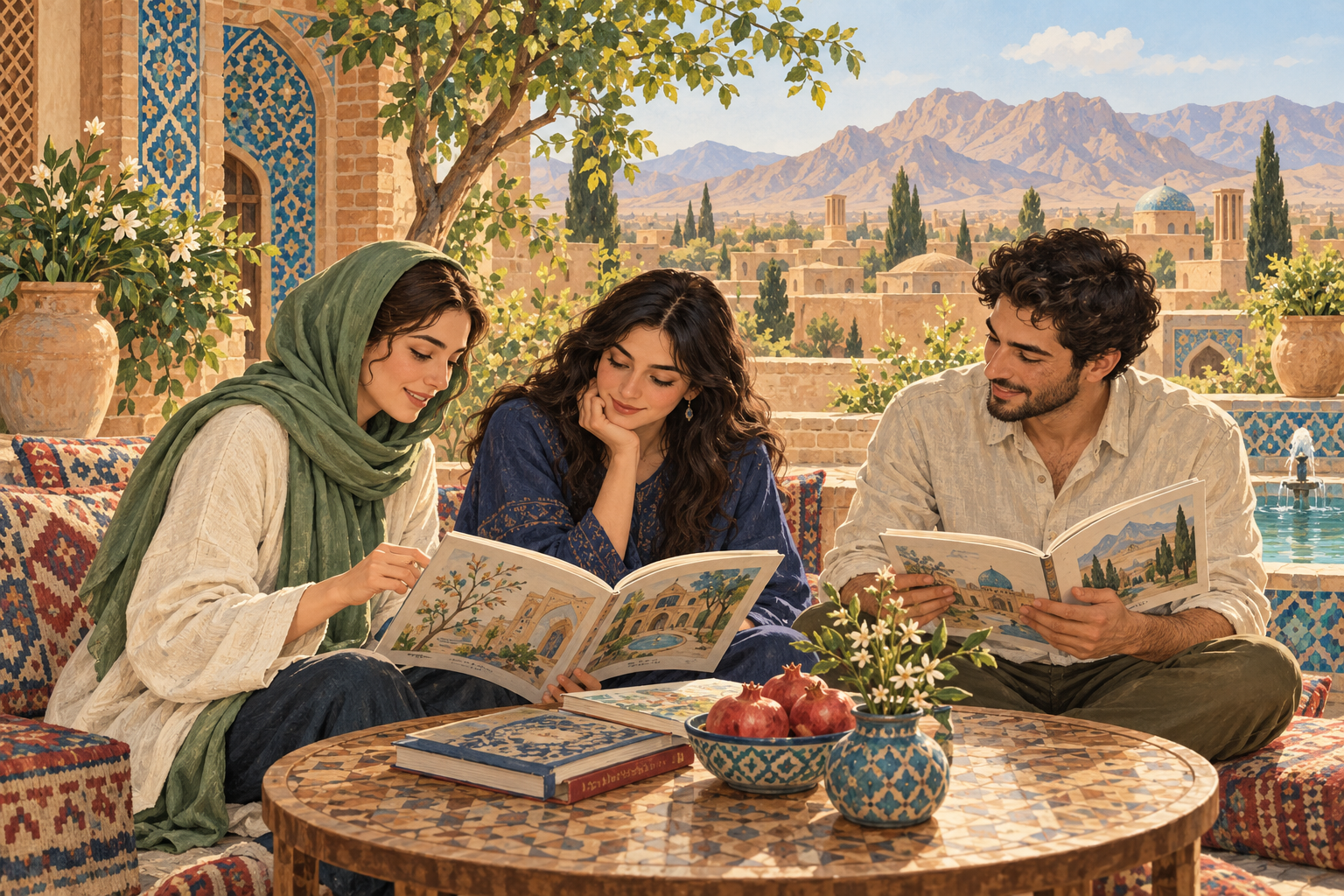
How does Iran work? Iran is a large West Asian country with elected institutions operating within an Islamic Republic whose Supreme Leader holds overriding constitutional authority. Its President directs much of the executive administration, the Majles legislates, the Guardian Council reviews laws and election candidates, and provincial and municipal institutions deliver many local services. Everyday life also depends on water systems, oil and gas, farms, schools, hospitals, roads and the ability to obtain affordable goods.
Who rules Iran in October 2026? Mojtaba Khamenei became Supreme Leader in March 2026 following the death of his father, Ali Khamenei, during the February military strikes; Masoud Pezeshkian remains President. The change occurred amid war, sanctions, economic disruption and debate over political legitimacy. The formal constitutional structure and the actual influence of military, security and elected institutions must be understood separately. This article does not treat a disputed political judgment as a settled fact.
We will trace how decisions move from national authority to a family, a small business or a student. This is a clear guide to institutions and public systems, not real-time security advice, approval of a government, or a substitute for current legal and travel guidance. International sanctions, economic conditions and political offices can change quickly.
Iran at a glance: the essential answers
| Question | Short explanation |
|---|---|
| Who holds the highest constitutional authority? | Supreme Leader Mojtaba Khamenei, selected in March 2026 by the Assembly of Experts. |
| Who is President? | Masoud Pezeshkian, responsible for significant executive and administrative functions. |
| Who makes laws? | The Islamic Consultative Assembly, commonly called the Majles, subject to constitutional review. |
| What is the Guardian Council? | A 12-member body that reviews laws and vets candidates for important elections. |
| What funds and shapes the economy? | Oil and gas alongside industry, trade, services, agriculture and substantial domestic markets. |
| What currency is used? | Iranian rial; changing prices and currency conditions affect everyday purchasing power. |
| What is an urgent resource challenge? | Water shortages and energy disruptions, compounded by conflict and investment constraints. |
| What makes public services work? | Lawful authority, practical staff, reliable transport, utilities, finance, records and accountability. |
1. Where is Iran, and why does geography matter?
Iran connects the Caspian Sea in the north with the Persian Gulf and Gulf of Oman in the south. Mountains, plateaus, deserts, major cities and agricultural districts create very different conditions for residents. Tehran has dense transport and administrative systems, while a rural settlement may depend on distant roads, irrigation and smaller clinics.
Geography is not just a map to memorise. It affects water availability, road-building costs, food production and the movement of oil or other exports. If a hospital is concentrated in a large city, a patient elsewhere needs a dependable referral and transport route. The same public guarantee may therefore be harder to use in one place than another.
To understand the country, draw three maps: where people live, where water and energy are available, and where schools, hospitals and employment centres are located. The gaps between those maps explain many everyday challenges more effectively than a single national income number.
2. What is Iran’s political system?
The Islamic Republic combines elected bodies with unelected religious and supervisory institutions. The 1979 Constitution, revised in 1989, established the office of Supreme Leader, a presidency, Parliament, judiciary and additional oversight structures. The Constitution gives the Supreme Leader extensive powers over strategic policy and high-level appointments.
The President and Majles have real administrative and legislative responsibilities, but they do not operate independently of the constitutional religious-supervisory system. Candidates for key elections are subject to Guardian Council screening. Analysts and rights organisations disagree with official claims about the extent of political competition and accountability, and those disagreements should be identified rather than hidden.
The useful lesson is to distinguish constitutional design from democratic performance and from daily administration. A ministry can distribute school funds under the law while citizens debate whether political institutions offer meaningful representation. Both questions matter, but they are not interchangeable.
3. What is the Supreme Leader, and how is the office chosen?
The Supreme Leader is the highest authority under Iran’s constitutional structure. Powers include broad strategic oversight, important security functions and appointments to key institutions. The Assembly of Experts, whose members are elected subject to candidate vetting, is constitutionally assigned the function of selecting and overseeing the Supreme Leader.
After Ali Khamenei was killed on 28 February 2026, the Assembly announced Mojtaba Khamenei’s selection in March. Reuters and other reporting described his ties to senior security institutions and the unusually low public visibility that followed his appointment. These reported circumstances are distinct from the formal powers written into the Constitution.
Students should not confuse the Assembly of Experts with the ordinary lawmaking Majles, or assume that the President can dismiss the Supreme Leader. Knowing how separate bodies are chosen is the first step in understanding who can actually make or review a national decision.
4. What does President Masoud Pezeshkian do?
The President leads important parts of Iran’s executive and administrative Government, including ministries and implementation of many domestic policies. Cabinet members must operate under applicable legislative and constitutional processes, and Parliament plays a role in ministerial approval and scrutiny.
Imagine a proposal to improve water networks. Ministries and associated organisations may assess shortages, find funding, procure pumps or pipes and organise operations. Political approval does not itself deliver safe water. Engineers, local providers, monitoring and maintenance complete the chain.
In practice, the President’s freedom of action is constrained by the Supreme Leader’s overarching authority and other powerful institutions, especially on security and strategic issues. Explaining this difference is more useful than describing the President simply as either all-powerful or entirely irrelevant.
5. How do Parliament and the Guardian Council share lawmaking power?
The Majles, or Islamic Consultative Assembly, debates and approves legislation. The Guardian Council then reviews legislation for consistency with the Constitution and Islamic requirements. The Council also plays a decisive role in candidate screening for elected offices.
When the Majles and Guardian Council disagree about a measure, Iran’s Expediency Discernment Council has a dispute-resolution role within the system. It would be misleading to describe the Majles as having the same independent final lawmaking authority as Parliament in every other country.
Consider a proposed education or tax reform. An announcement may become a bill, then move through parliamentary approval, Guardian Council consideration and applicable implementation stages. A family should check the enacted and operative rule, not treat political discussion as an existing entitlement.
6. What roles do the judiciary and security institutions play?
Iran has courts and a judiciary responsible for the application of law, alongside regular armed forces and the Islamic Revolutionary Guard Corps. These institutions are arranged within a distinctive constitutional power structure and have influence that extends beyond ordinary administrative functions.
Independent monitoring and reporting have raised serious concerns about civic freedoms, repression, due process and the treatment of protesters. Authorities present their own justification for various security policies, but competing claims should be assessed against credible evidence and relevant legal standards rather than simply adopted.
Public confidence depends on more than organisations existing on a chart. Residents need fair procedures, intelligible rules, access to remedies and protection from arbitrary treatment. The practical question is whether a person can challenge a wrong decision safely and effectively.
7. How do provinces and municipalities affect daily life?
Iran is divided into provinces, with governors and other administrative structures, and has municipalities involved in local urban functions. Some important decisions are centralised, while roads, local services and city management require operating institutions near residents.
Imagine a family reporting a broken drainage connection, a damaged local street or waste-collection failure. The correct route depends on the legal responsibility of the relevant municipal or utility operator, not merely on which public building is closest.
Tehran and a smaller provincial city have different density, water and transport challenges. Good national policy must allow technical planning for those conditions while maintaining accountability and common public standards.
Local service quality is best measured by time to resolve a problem, clarity of responsibility and whether people can obtain a usable response—not only by how many offices the municipality operates.
8. Why is oil important to Iran’s economy?
Iran has some of the world’s largest petroleum and natural-gas reserves. Production, processing and domestic energy use support businesses and public revenues, while exports are affected by international demand, shipping, financial arrangements and sanctions.
The World Bank describes Iran’s economy as more varied than that of some oil exporters, with important agriculture, services and manufacturing, yet oil remains a significant source of volatility. A refinery or gasfield does not automatically create good jobs in every community; that requires skills, contractors, safe utilities and a wider commercial network.
High resource value is therefore an opportunity rather than an outcome. To judge prosperity, ask whether income supports dependable schools, clinics, infrastructure and productive businesses, and whether spending remains sustainable when oil exports become difficult.
9. How have sanctions and the 2026 conflict affected trade?
International sanctions restrict parts of Iran’s access to finance, technology, shipping and commercial partners. The 2026 conflict has added major disruption. The World Bank’s 2026 country overview describes damage, pressure on imports and exports, severe economic uncertainty, and increased risks of inflation and poverty.
In October 2026, Reuters reported that Iran’s seaborne crude exports had sharply declined and that the rial had weakened substantially during renewed restrictions. Those figures describe a particular moment and should not be treated as fixed for a future transaction.
Imagine a factory needing a specialised replacement machine part. It must find a lawful supplier, make payment, obtain transport and bring the component into operation. If finance or shipping is disrupted, workers can lose productive hours despite having skills and customers. Economic sanctions and conflict can affect ordinary households through these indirect connections.
Explaining the mechanics does not require endorsing any government’s conduct or the use of military force. A responsible account distinguishes the policy goals stated by those imposing restrictions from their documented economic and humanitarian consequences.
10. What is the Iranian rial, and why do prices change?
The Iranian rial is the country’s monetary unit. Many everyday conversations use the term toman as a counting convention, making it essential to check units in prices and official documents. Currency exchange rules and rates can change and may differ according to the authorised transaction.
Inflation reduces the purchasing power of money when prices rise faster than income. The cost of food or medicine may reflect domestic supply, currency pressures, imports, sanctions, distribution and government measures. One headline about the exchange rate cannot explain every price.
A useful student exercise is to choose a household basket with fixed quantities of bread, vegetables, fuel and transport. Compare what the same basket costs at two dates, then ask which items changed most. This teaches the difference between inflation, wages and the family’s real standard of living.
11. How do Iran’s roads, trains and ports connect regions?
Roads, railways and maritime terminals carry agricultural goods, industrial inputs, passengers and exports. Mountains and deserts influence construction costs, while large cities require transport networks capable of handling busy commuter demand.
Ports along the southern coast connect Iran to the Gulf of Oman and Persian Gulf, and the Strait of Hormuz is an internationally important maritime passage. Shipping safety and restrictions can therefore affect export capacity and the cost of imports.
A functioning rail route is more than tracks. It needs locomotives, signalling, maintenance, terminals, staff and dependable connections to trucks and warehouses. A successful infrastructure project should reduce real journey costs and delays, not only add kilometres to a map.
Transport is also a social network: students need access to schools, patients to clinics, and workers to jobs. If a critical bridge or train route stops operating, several public systems feel the consequence.
12. How does Iran manage water in a dry country?
Water is central to Iran’s agricultural, urban and ecological challenges. Many regions are arid or semi-arid, while aquifer depletion, drought, infrastructure demand and climate stress can make shortages worse. Water systems have to connect sources, treatment, reservoirs, distribution and careful management of groundwater.
The UNESCO-listed Persian Qanat is a remarkable example of historic engineering. Underground galleries conduct water from aquifers toward settlements and farms by gravity, supported by maintenance shafts and communal management. This illustrates that water access has shaped Iranian civilisation for centuries.
Traditional qanats do not solve every modern water problem. Large urban demand and changing environmental conditions require contemporary conservation, leakage reduction, allocation choices and credible monitoring. A water source can be physically present but insufficiently sustainable for rising demand.
Ask which uses are essential, how much water is lost, and which communities bear the costs of a new project. Water policy must recognise household supply, farming and ecosystem health together.
13. How do power shortages affect public services?
Electricity and natural gas are the operating foundations of modern schools, hospitals, businesses and water networks. A reliable national energy resource still needs production equipment, substations, wires, maintenance and sufficient capacity for demand.
During energy shortages or disruption, factories may lose output, families may face discomfort and clinics may need emergency power arrangements. The World Bank identifies persistent water and energy shortages as among Iran’s structural economic pressures, worsened by conflict and underinvestment.
Imagine a hospital medicine refrigerator during a prolonged outage. Appropriate backup and monitoring can be essential, but equipment alone is not enough without trained operators and supplies. An energy problem becomes a healthcare problem at the point of use.
A strong public system measures the hours of dependable service, safety and maintenance response rather than just the country’s reserves of oil or gas.
14. How does Iranian agriculture support food supply?
Iranian farmers produce crops and livestock under very different climatic conditions. Farming depends on suitable water, land, seed, expertise, labour, storage, transport and markets. Drought may affect production and rural livelihoods even when cities are growing.
A bag of grain or a crate of fruit follows a chain from field to collection point, processor, warehouse and shop. A transport delay or shortage of irrigation water can reduce saleable output before the product reaches consumers.
Imports and export restrictions can also change the price and availability of food. The World Bank’s recent economic assessment warns about food-security pressures from import disruptions and inflation. It is therefore useful to measure both national food supply and whether low-income households can afford the food available.
Protecting agriculture means addressing sustainable water use, technical knowledge and market access, not merely calling on farmers to grow more.
15. How does Iran’s education system work?
Education includes primary and secondary stages, technical and vocational routes and higher education. Families encounter school attendance, examinations and the competitive university-entry process often known as Konkur. The exact rules and eligibility pathways depend on current national policy and institutions.
Iran has a significant educated workforce and academic traditions, but school access, resource quality and continuity can vary with household conditions and regional disruption. An educational explanation must distinguish student ability from the resources and stability available to the learner.
Suppose a pupil remembers formulae but cannot solve a problem involving negative numbers. More examination drills may reproduce the same error. Effective teaching identifies the misunderstanding, builds the underlying principle, uses guided practice and checks independent understanding.
Our companion Education in Iran: Schools, Konkur, Technical Training and University Routes explains examinations more fully. This country article connects learning with public finance, household income, electricity, connectivity and future work.
16. How do clinics, health houses and hospitals connect?
Iran has developed a notable primary-healthcare network, including rural health houses staffed by trained community health workers known as behvarz. WHO’s case studies describe how this approach extended basic preventative care and helped improve health outcomes across earlier decades.
Primary care is different from specialist hospital care. A patient may receive initial advice and screening locally, then need referral for diagnostics or treatment. Health insurance arrangements and personal eligibility vary by scheme, and current costs cannot be inferred from historical success stories.
During conflict and import restrictions, medical supplies, staffing, electricity and transport may be disrupted. A useful health system must therefore protect the route from the patient’s first contact to a qualified provider, while ensuring safe medicines and reliable information.
For a real health concern, follow qualified clinical guidance. This article explains the operating architecture rather than making treatment or coverage promises.
17. Why is local communication important during emergencies?
During a military or natural emergency, people need verified information about safety, transport, water and healthcare. A technically correct central notice may be inadequate if telecommunications are unavailable or the message does not reach the people affected.
Officials and service operators need clear responsibility for warnings, temporary facilities and restoring essential networks. Communities need safe ways to confirm information. If a road closes, alternative routes should be explained only when they have been assessed by competent authorities.
The 2025–26 conflict and telecommunications disruptions have shown the importance of information reliability. A general country guide cannot be used as live safety advice, because the situation may change much faster than any published article.
The broader lesson is that information is infrastructure: it connects public decisions to the people whose behaviour and wellbeing depend on them.
18. How do Iran’s languages and cultural communities shape public life?
Persian (Farsi) is the official national language, while Iran also has many communities using other languages and cultural traditions. Cities, villages and regions have different histories, livelihoods and identities. It would be inaccurate to treat all Iranian residents as one political or cultural opinion.
Public services work better when people can understand application procedures, school instructions and healthcare advice. Clear communication matters for a household that needs an answer more than for an administrative organisation that has produced a complex document.
Iran’s cultural history includes literature, architecture, craft, science and long traditions of civic life. UNESCO’s documentation of historic qanats provides one example of how engineering, settlement and shared social arrangements can be understood as cultural heritage.
An informative national guide should represent both contemporary difficulties and the diversity of people who teach, care, trade, farm and create. A population is not equivalent to its government.
19. Worked example: following drinking water to a household
Illustrative learning scenario: A settlement needs a more reliable water supply during a dry period. Engineers first examine safe sources and existing consumption. A public body must approve any necessary financing, treatment arrangements, pipes and operating responsibilities.
The water may move through pumping, storage, treatment and distribution before arriving at a household tap. Each step requires energy, staff, maintenance and quality monitoring. A successful project should measure water safety and dependable availability, not only the length of pipe laid.
Suppose the pump fails because electricity is interrupted. The family’s water shortage is now linked to energy reliability. Installing an online reporting tool may improve fault awareness but cannot replace a repair crew or backup power. This is systems thinking applied to a glass of water.
20. Worked example: how does medicine arrive at a provincial clinic?
Illustrative exercise, not a report about a particular facility: A provincial clinic requests an essential medicine. An authorised supplier must arrange stock, payment, safe handling, transport and receipt. Staff then verify the item and use it under the proper clinical guidance.
If an imported component, bank transaction or shipping route is disrupted, delivery may take longer. A national health programme therefore depends on commerce, logistics and payment rules. If power is needed for storage, the electrical system becomes part of the same chain.
Students can write five boxes—request, financing, supply, transport and patient—and mark one potential failure at each handoff. The exercise makes clear why promising more healthcare is not the same as guaranteeing that every clinic has the supplies it needs.
21. What should be measured when evaluating Iran’s economic future?
Public discussion can focus on oil output or currency values, yet families experience the economy through food affordability, reliable employment, power, health costs and access to education. These outcomes should be considered alongside broader growth statistics.
Important indicators include inflation, real wages, employment quality, stable water and electricity, trade access and credible public finance. Conflict and sanctions add major uncertainty, so dated estimates must not be presented as precise forecasts of what will happen next.
Good analysis also separates public policy choices from external restrictions and natural constraints. A shortage might reflect drought, underinvestment, disrupted imports or several causes at once. Understanding the cause leads to more useful proposals than assigning every problem to a single explanation.
22. What can the rest of the world learn from Iran?
Iran illustrates how a country’s political design can contain both electoral bodies and powerful unelected institutions. Readers need to trace constitutional authority and the practical influence of security institutions rather than assume the word republic means identical institutions everywhere.
It also shows how natural resources do not automatically remove water scarcity, inflation or the need for high-quality public services. The same country can possess vast gas reserves and still face difficulties delivering dependable energy or medicines to certain households.
Compare Iran’s qanat heritage with Iraq’s river systems, Iceland’s geothermal energy and Singapore’s modern water engineering. Different resources demand different institutions and techniques, but all depend on maintenance and responsible planning.
The central lesson is that national strength is measured not only by resources or formal offices but by whether people can learn, work, remain healthy and obtain fair, dependable services through disruption.
A five-question Iran country-systems checklist
- Who has the constitutional authority: Supreme Leader, President, Majles, Guardian Council or another institution?
- What ministry, utility, public operator or business must execute the decision?
- Does water, electricity, money, transport or external trade interrupt the route to the resident?
- What part of the claim is official policy, independent observation, legal fact or prediction?
- Which household-level outcome would demonstrate an actual improvement?
Frequently asked questions about Iran
Who is Iran’s Supreme Leader in October 2026?
Mojtaba Khamenei, selected in March 2026 after Ali Khamenei was killed in February. The office has overriding constitutional authority.
Who is Iran’s President?
Masoud Pezeshkian holds the presidency and has executive duties, but the office does not override the Supreme Leader.
Does Iran have elections?
Yes, for institutions including the presidency and Majles. Candidate screening and the wider constitutional power structure limit the range of political competition.
What does the Guardian Council do?
It reviews laws for constitutional and Islamic compliance and screens candidates for certain elections.
Is Iran’s economy only about oil?
No. Services, agriculture, manufacturing and domestic trade matter, though hydrocarbons remain important to exports and public finance.
What currency does Iran use?
The rial. Many people refer to amounts in toman, so readers must check the unit used for a quoted price.
Why does Iran face water shortages?
Dry climate, drought, groundwater pressures, infrastructure and demand interact; the causes and suitable responses differ by region.
What are qanats?
Traditional underground channels that carry water toward settlements and farmland, often using gravity and communal maintenance arrangements.
Does Iran have public primary healthcare?
Yes. Iran has a longstanding health-house and community-worker network, alongside hospitals and insurance arrangements with varying entitlements.
Explore Iran and the wider civilisation series
- How Countries Work | World-Civilisation Archive
- How Singapore Works | Companion Civilisation Series
- Education in Iran | Schools, Konkur and Universities
- Top 10 Places to Visit When Touring Iran
- How Iraq Works | Federalism, Oil and Public Services
- How India Works | State Governments, Railways and Payments
- How Indonesia Works | Islands and Transport
- How Ireland Works | Parliament, Economy and Services
- How Israel Works | Parliament, Technology and Services
Sources and verification: October 2026
Official institutional frameworks, international economic studies and independently reported leadership changes are dated and attributed. This guide distinguishes the legal structure from contested political practice. Security, public-health and currency circumstances can change rapidly; seek up-to-date authoritative advice for actual decisions.
- Council on Foreign Relations — Iranian institutional power centres
- Reuters — Iran’s system of political power
- Reuters — Iran’s leadership after March 2026
- Reuters — President and Supreme Leader in August 2026
- World Bank — Iran 2026 economy, sanctions, conflict and water
- World Bank — Iran Macro Poverty Outlook, 2026
- World Health Organization — rural health houses and primary care
- UNESCO — the Persian Qanat water system
- Reuters — October 2026 currency and sanctions