
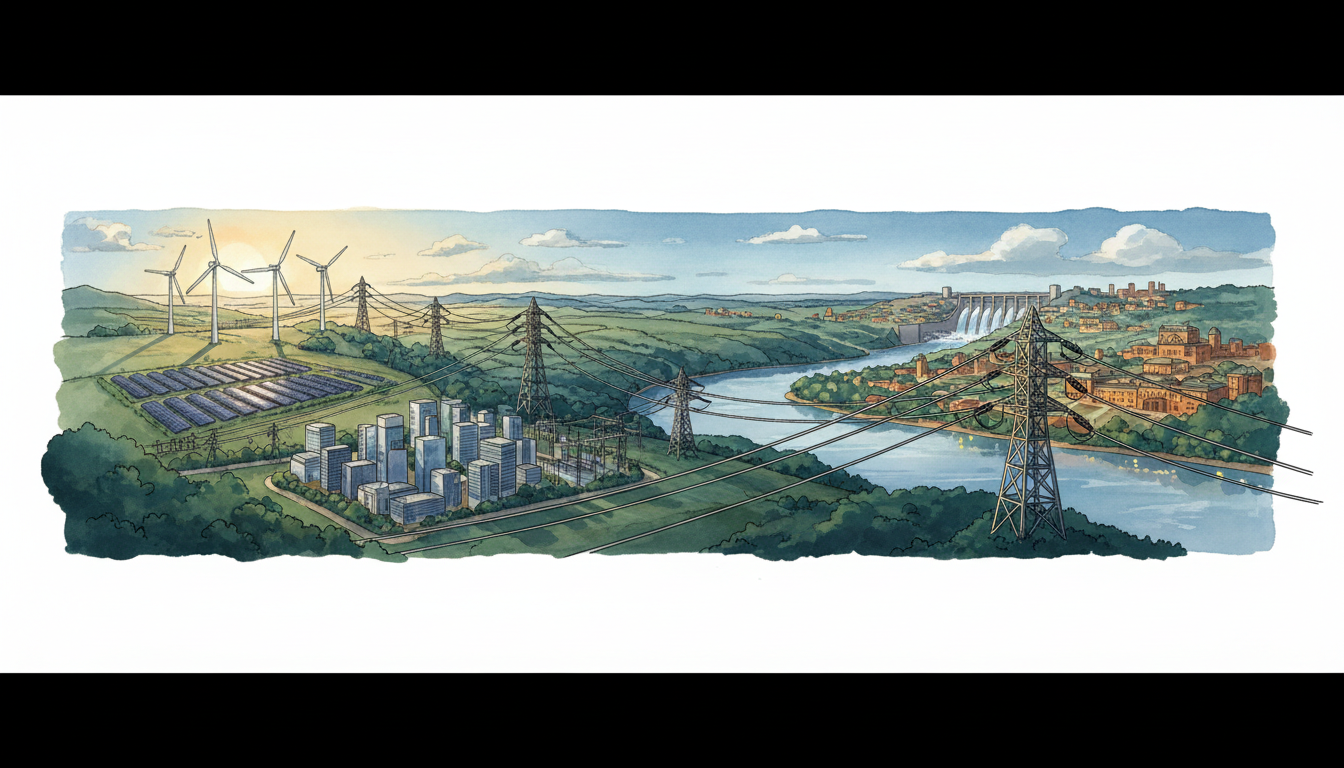
Did you know? A solar farm can produce electricity while the wider system has trouble using all of it. The sun is shining, the panels are working, yet the local power network may not have enough room to transfer that output—or demand at that moment may be lower than the available supply.
That is one important way renewable energy deployment stalls. Building solar panels or wind turbines is not the same as delivering secure electricity throughout the day. Power systems must match supply and demand, move electricity where it is needed and maintain safe operating conditions.
Quick answer: solar and wind integration can slow when grid connections take too long, transmission capacity is constrained, system flexibility is insufficient or planning does not align generation with demand. Storage, forecasting, adaptable demand, capable networks and appropriate rules can reduce these problems. Intermittent output does not mean renewable energy is inherently unworkable.
The missing distinction: power produced versus power delivered
An electricity generator and a household are connected through a wider network. Energy must travel through suitable equipment under technical rules that protect the system. Building additional capacity changes what can be produced, but the grid must also be able to accept and deliver the output.
Imagine a windy region that installs several new turbines. During high-wind hours, generation may exceed nearby demand and the transfer capacity to other regions. Some available output must then be reduced or not used. This is called curtailment.
The International Energy Agency’s Renewables 2025 report notes that curtailment and periods of negative wholesale electricity prices have increased in several markets as generation grows, illustrating the need for flexible systems, transmission and storage.
Curtailment is not necessarily proof of bad engineering. Some curtailment may be economically sensible or unavoidable. The critical issue is whether system design creates excessive wasted opportunity or delays otherwise useful projects.
Six places renewable integration can slow
- Connection queues: projects cannot join the network promptly because required studies, approvals or upgrades are incomplete.
- Congested networks: transmission and distribution lines cannot carry all desirable electricity flows at certain times.
- Timing mismatch: solar or wind output is high when demand is low and lower when demand is higher.
- Insufficient flexibility: available generators, storage, demand response or interconnections cannot adjust quickly or economically enough.
- Operating and stability needs: grid services, control systems, forecasting and protection must be adapted for the changing generation mix.
- Misaligned rules and investment: market design, financing, permitting or procurement do not support the complementary infrastructure needed alongside generation.
These mechanisms interact. A new solar project may be technically ready but wait for a network upgrade. An upgraded network may still benefit from more flexible demand. A battery may help balance daily variation but be unsuitable for a prolonged shortage of generation.
Why a battery is useful but not a universal answer
A battery has at least two distinct characteristics: how rapidly it can deliver electricity and how much energy it holds. Think of the difference between the flow from a tap and the amount of water in a tank.
A hypothetical storage unit that can deliver 10 megawatts for two hours contains enough energy for approximately 20 megawatt-hours of output before accounting for losses and operating limits. It does not automatically supply 10 megawatts for twenty hours.
That distinction explains why storage must be matched to the actual system problem. A short-duration battery may help with rapid balancing or moving solar output into the evening. Multi-day or seasonal variability can require different solutions and a broader portfolio of resources.
The IEA’s Electricity 2026 chapter on flexibility discusses batteries alongside dispatchable supply, flexible demand and network improvements. These are complementary tools, not interchangeable promises.
A worked example: the sunny afternoon and the busy evening
Illustrative example. A district has strong solar output at midday while offices and households use a moderate amount of electricity. By early evening, solar output falls while cooking, cooling and other activities still create demand.
One response is to store some earlier electricity and discharge it later, where technically and economically suitable. Another is to shift selected flexible uses to periods of plentiful supply. Stronger interconnection can also move electricity from regions with spare output to regions that need it.
A well-designed solution examines the actual hourly pattern, operational limits, costs and reliability requirements. Adding more midday panels alone may not resolve the evening peak. Equally, building a battery without understanding the duration and location of the constraint may fail to address the real issue.
What the IEA says about Southeast Asia
The IEA’s 2025 report on Integrating Solar and Wind in Southeast Asia finds that countries in the region differ substantially in readiness and that many near-term integration challenges can be managed with proven measures.
Those measures include better forecasting, updated grid requirements, more flexible operation of existing resources and more precise real-time planning. The report does not say every country needs the same amount of battery storage or identical grid upgrades.
For Singapore readers, the useful connection is that electricity systems depend on both domestic assets and wider regional considerations. Cross-border electricity trade can offer opportunities but introduces coordination, connection and regulatory requirements.
The earlier How Countries Work | How Do Countries Trade Electricity While Following Different Energy Policies? examines that international coordination from the positive side.
Why project approval and operational readiness are different
Developers may secure land, equipment or project financing before the necessary network connection is available. Grid operators must review potential effects on network capacity and protection systems. New lines or substations may require their own land, materials, approvals and construction schedules.
That creates a planning challenge: if investment in the grid lags far behind investment in generation, projects can be completed or proposed without a practical route to delivering their electricity.
The IEA Electricity 2026 executive summary highlights a large worldwide queue of generation, storage and major electricity-load projects seeking network connections and calls for more grid investment and flexibility.
A queue does not mean every project will eventually be built, nor that renewables alone caused the delay. It illustrates why network capacity is an economic and institutional constraint as well as an engineering one.
Forecasting is useful even though the weather changes
Solar and wind production depend in part on environmental conditions. Forecasts help operators plan for the likely generation profile, schedule available flexibility and manage uncertainty.
A forecast is not a guarantee; errors remain possible. But better forecasting, updated operating procedures and suitable reserves can reduce the cost of uncertainty. Grid operators have always managed changing demand and equipment contingencies; a larger share of variable generation adds new patterns to that existing challenge.
The IEA’s Integrating Solar and Wind analysis describes how high-renewable systems are using commercially available approaches to provide the services needed for secure operation. Technical difficulty should be discussed precisely rather than equated with impossibility.
The danger of optimising one project instead of the whole system
A developer may logically prioritise maximum output from a new solar farm. A utility may prioritise network costs. Consumers want reliable, affordable electricity. If those goals are not connected, project-level success can coexist with system-level frustration.
For example, if every developer chooses a similar region because its solar resource is excellent, available grid capacity may become congested. The best site for one project is not always the best location for the next addition to the power system.
System-level planning considers location, timing, network upgrades, storage, land use, environmental effects, costs and the mix of resources that support reliability.
A reliability checklist for renewable expansion
- Resource: what generation is reasonably expected at different times, including uncertainty?
- Network: where can that output be connected, and what limitations or upgrades apply?
- Demand: which electricity uses can adjust in time without sacrificing essential needs?
- Storage and flexible supply: what duration, response and capacity are required for the actual constraint?
- Operations: are forecasting, system services, protection and emergency procedures appropriate?
- Rules and finance: who pays for shared infrastructure, and how are necessary services procured?
- Environmental and community impacts: which people and ecosystems are affected, and how are trade-offs assessed?
This is a conceptual framework rather than instructions to design or operate a power network. Electricity assets and networks require qualified engineering and regulated oversight.
How readers can interpret energy headlines
If a headline says ‘renewables were curtailed’, ask how much, where, when and why. A temporary reduction under unusual conditions is different from persistent congestion that materially restricts output.
If a headline says ‘a battery can power the city’, ask for the power rating, energy capacity, intended duration and assumptions about other available supply. Without those details, the claim may confuse a short demonstration with long-term reliability.
If someone claims renewable generation is ‘free’, distinguish operating fuel costs from the costs of construction, financing, land, networks, storage and other system services. Serious comparisons should be transparent about what is included.
When does a renewable deployment strategy need adjustment?
- Connection delays persist while generation investment grows without corresponding network plans.
- Unnecessary curtailment repeatedly increases without credible flexibility measures.
- Storage is purchased without specifying the duration and service it must provide.
- Policy targets are counted in installed capacity while actual delivered energy or reliability is overlooked.
- Communities and affected environments are consulted too late for meaningful choices.
These indicators do not imply the energy transition should stop. They indicate that the next stage of deployment may need a better mix of investments and coordination.
Frequently asked questions
Does solar energy fail when the sun goes down?
Solar panels stop producing after sunset, as expected. A reliable electricity system must plan for demand during those hours using a suitable mix of storage, other generation, grid connections and demand flexibility.
Can adding more batteries fix all renewable-energy challenges?
No. Batteries can help with several forms of flexibility but have duration, cost, siting and operational constraints. Networks, market rules and other resources may also need attention.
What does curtailment mean?
It means available generation is reduced or not used, often because of network, operational or economic conditions. The significance depends on its magnitude, timing and causes.
Are high shares of solar and wind technically possible?
Yes. Some electricity systems already operate with substantial variable renewable shares. Doing so reliably requires appropriate planning, flexibility, operations and investment suited to local conditions.
The final idea
Renewable energy stalls not simply when power cannot be generated, but when generation cannot be integrated into a dependable electricity system. Grids, storage, demand, rules and operational capability must grow together. The goal is electricity that can be used securely and affordably—not just more equipment on a capacity chart.
Continue exploring the How Things Fail series
- How Language Learning Stalls | When Vocabulary Cannot Become Conversation
- How Renewable Energy Stalls | When Generation, Storage and Grids Disconnect (this guide)
- How Housing Affordability Breaks | When Incomes, Prices and Supply Diverge
- How Disaster Recovery Stalls | When Relief Does Not Become Rebuilding
The broader educational perspective appears in How Education Fails. The unchanged Secondary 1 Mathematics Tutor Clementi | Small Groups Tutorials illustrates why an intervention should respond to a specific learner’s actual understanding.
Sources and further reading
- International Energy Agency: Renewables 2025
- IEA (2025): Integrating Solar and Wind in Southeast Asia
- IEA (2024): Integrating Solar and Wind
- IEA: Electricity 2026 — Flexibility
- IEA: Electricity 2026 — Executive Summary
- eduKateSG: Why Power Grids Collapse
Illustrative examples are fictional. The explanations are educational and should not be mistaken for a diagnosis, a guarantee of results or instructions to operate a regulated system.