
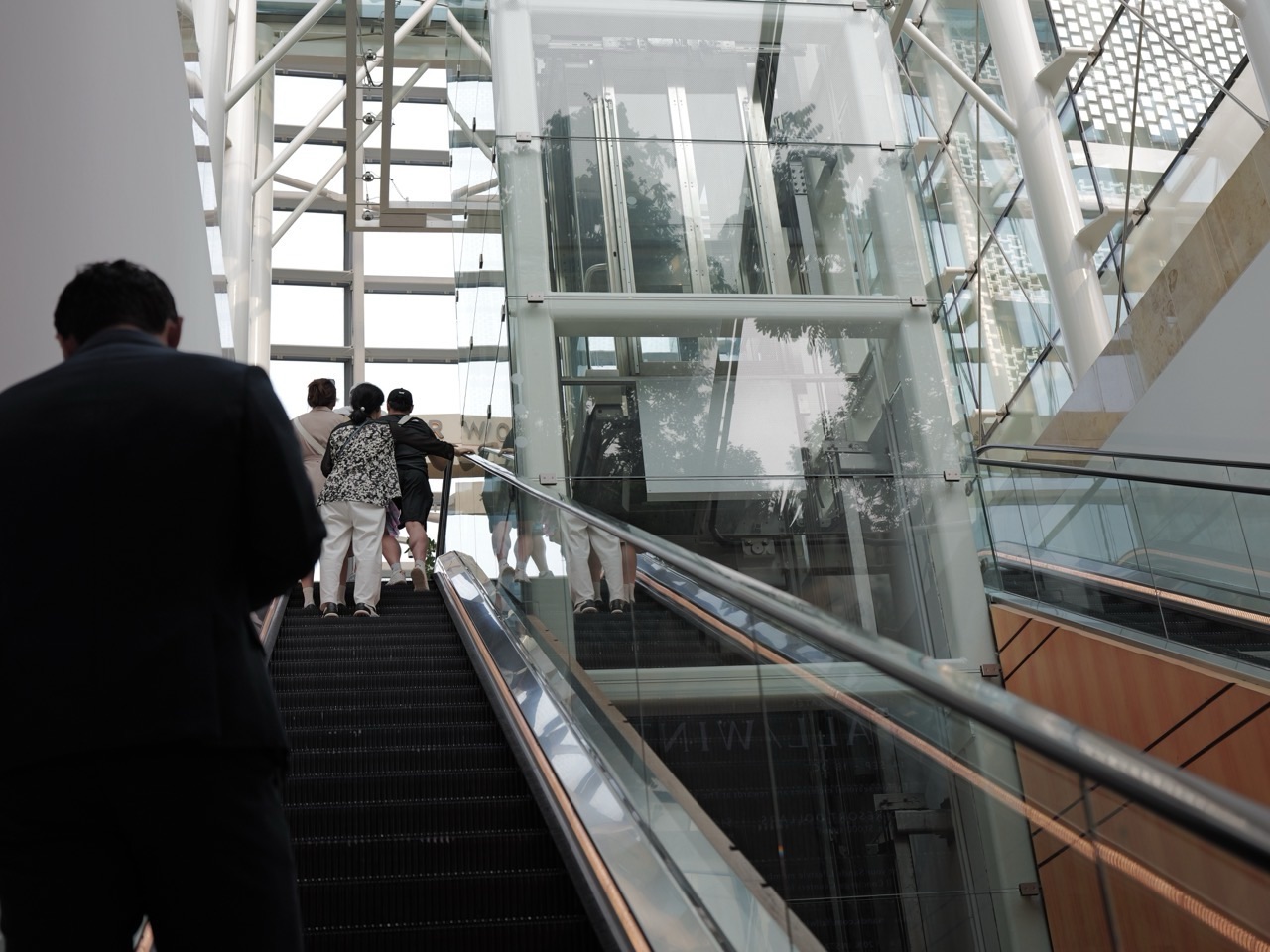
How Singapore connects is not only a question of moving north, south, east or west.
Did you know that one of the most important directions in a dense city is simply up?
Singapore is full of vertical journeys. We rise from MRT platforms to concourses, from underpasses to street level, from void decks to homes, from car parks to roof gardens, from ground-floor shops to clinics, libraries and community spaces, and from one transport level to another inside large interchanges.
Lifts and escalators make those changes in height feel ordinary.
That ordinariness is the magic. When vertical movement works well, most people barely notice the engineering, maintenance, accessibility planning, wayfinding and safety systems that make it possible.
This article follows the vertical connection layer. It folds lifts and escalators into eduKateSG’s larger Singapore graph: MRT, HDB, accessibility, integrated transport hubs, shopping centres, hospitals, schools, public spaces and the everyday design of a dense island.
The canonical transport owners remain elsewhere in the graph. How Singapore Works | The MRT owns the rail machine. How an Accessible MRT Journey Works from Street Level to Train Door owns the accessible station journey. Here the question is the connection itself: how does Singapore turn height into a usable route?
Did You Know? A Lift Is a Tiny Vertical Bus
Think about what a lift does.
People wait at a node. A cabin arrives. Doors open. Passengers enter. The cabin travels along a fixed path. It stops at selected destinations. Doors open again. People transfer back into corridors, homes, platforms or public spaces.
That sounds surprisingly like public transport.
The scale is smaller and the direction is different, but the systems idea is similar: shared movement between known stops.
A lift shaft is therefore a vertical corridor.
In a high-rise city, vertical corridors are not optional decoration. They are part of the movement network.
Singapore Is a Three-Dimensional City
Maps often flatten cities into two dimensions.
But Singapore is stacked.
- rail platforms may sit underground;
- bus interchanges may sit below housing or retail;
- pedestrian bridges may cross above roads;
- underpasses may run below traffic;
- homes rise many storeys;
- car parks can support gardens or facilities on their roofs;
- malls connect several levels of transport and retail; and
- hospitals, schools and offices distribute functions vertically.
The result is a city where the shortest route may not be a straight line on a map.
Sometimes the important question is: which level are you on?
Lifts Turn Height into Access
LTA’s current Inclusive Public Transport System page explains that lifts, ramps and other accessibility aids are provided across public transport so elderly commuters, people with disabilities and families with young children can travel more conveniently.
The important word is access.
A station can be physically close yet functionally unreachable if the only route requires stairs that a traveller cannot use.
A lift changes the route from theoretical to practical.
That is why accessibility is not an optional extra. It determines whether the network actually reaches the person.
Escalators Move Flow, Not Just People
An escalator does something subtly different from a lift.
A lift moves batches.
An escalator creates a continuous stream.
That makes escalators especially useful where many people need to change level in the same direction over time: stations, malls, airports and major public buildings.
The engineering question is therefore partly about flow.
How many people arrive? How quickly? In which direction? At what time? Where do they accumulate before and after the ride?
The escalator itself may be only one machine, but its performance affects the space around it.
The Landing Is Part of the Machine
A moving stair cannot solve congestion if the landing is blocked.
This is a recurring systems principle: the output of one component becomes the input of another.
An escalator feeds a concourse. A lift feeds a corridor. A station exit feeds a pavement. A bridge feeds a stair or ramp.
If the receiving space is too narrow, confusing or obstructed, the whole connection slows.
So good vertical mobility depends on more than the mechanical device.
It depends on the handoff.
Did You Know? The Hardest Journey Can Be One Storey
Imagine a wheelchair user at a station.
The train ride across the island may be smooth.
The difficult part may be a single level change between the platform and the street.
Or imagine a parent with a stroller, a traveller with luggage, a senior with knee pain or someone carrying bulky groceries.
The vertical distance may be only a few metres.
Yet without the right lift, ramp or alternative route, those few metres can become a barrier larger than the kilometres travelled by train.
Distance is not only horizontal.
How Vertical Mobility Connects to the MRT
MRT stations are layered spaces.
A typical underground journey may involve street level, a station entrance, a concourse, fare gates, another level change and finally the platform.
Lifts and escalators make those transitions legible and repeatable.
That is why How Singapore Connects | Covered Walkways, Underpasses and Pedestrian Links belongs beside this article. Horizontal pedestrian links and vertical mobility are two halves of the same first-and-last-mile network.
A sheltered route that ends at the wrong level is incomplete. A lift that opens onto an unclear route is incomplete. Connectivity requires both.
How Vertical Mobility Connects to HDB Life
In high-rise public housing, the lift is part of everyday independence.
It connects the home to the void deck, the letterbox, the playground, the market, the bus stop, the school route and the rest of the city.
That means a housing lift is also the first transport system many residents use each morning.
Before the bus. Before the MRT. Before the car.
The journey begins inside the block.
The Lift Lobby Is a Social Node
A lift lobby is not only a place to wait.
It is one of the few locations where neighbours whose schedules overlap may repeatedly encounter one another.
People greet, hold doors, exchange small information, notice changes and recognise familiar faces.
This is a modest form of social infrastructure.
The machine moves vertically. The waiting space can connect socially.
Integrated Hubs Depend on Vertical Choreography
eduKateSG’s How Integrated Transport Hubs Stack Homes, Shops, Buses and MRT Access on Limited Land explains the larger mixed-use arrangement.
Inside those developments, lifts and escalators are the choreography.
A commuter may move from underground rail to bus level, then to retail, then to housing or offices.
The building works because users can change not only mode, but level.
Vertical mobility is therefore what allows multiple city functions to occupy the same footprint.
Hospitals Reveal Why Redundancy Matters
In a hospital, vertical movement is not merely convenient.
Patients, staff, beds, equipment, food, supplies and waste may all need to move between levels.
Different flows may require different lifts or operating rules.
This reveals another systems principle: when a connection is critical, one path may not be enough.
Redundancy, maintenance and backup procedures matter because the cost of failure is higher.
Schools Use Vertical Movement Too
A multi-storey school distributes classrooms, labs, halls, offices and shared facilities across levels.
Stairs may handle routine student movement while lifts provide accessibility and operational support.
The building becomes a small timetable written in space.
At lesson changes, movement surges. At assembly, flows concentrate. During emergencies, routes must be clear.
Architecture becomes scheduling.
Shopping Centres Turn Vertical Movement into Choice
Retail spaces often make escalators highly visible.
That is not accidental.
Escalators distribute visitors across floors while keeping movement visually connected to shops and activity.
A lift is often more direct. An escalator is often more exposed to the surrounding environment.
Two machines can therefore move people between the same levels while producing different behaviours.
Design changes movement; movement changes what people see.
The Same Machine Means Different Things to Different Users
- a commuter sees speed;
- a wheelchair user sees access;
- a parent sees stroller mobility;
- a cleaner sees service movement;
- a technician sees maintenance responsibility;
- a planner sees capacity;
- a firefighter sees emergency constraints;
- a retailer sees footfall; and
- a child sees something wonderfully mechanical.
One device sits at the intersection of many needs.
That is why infrastructure is rarely only engineering. It is engineering plus users.
Maintenance Is Invisible Connectivity
A lift is most noticeable when it does not work.
That tells us something important.
Reliable infrastructure disappears into routine.
Maintenance is what keeps it invisible.
Inspections, servicing, cleaning, component replacement and fault response do not create a new route. They preserve an existing one.
Civilisation depends heavily on this quiet category of work: keeping useful things useful.
Wayfinding Must Explain the Vertical Route
The sign ‘Exit A’ is not enough if the accessible lift to Exit A begins somewhere else.
Users need to understand:
- which lift reaches which level;
- whether a lift connects to street level;
- where the accessible route continues;
- which escalator direction is operating;
- how to reach another platform;
- whether a bridge, underpass or concourse is involved; and
- what alternative route exists during maintenance.
This is why maps inside complex stations increasingly behave like diagrams of layers rather than simple street maps.
The city must explain its third dimension.
A Small Example: Home to MRT
A resident leaves a flat.
Lift to ground floor.
Covered walkway to station.
Lift or escalator to concourse.
Fare gate.
Escalator or lift to platform.
Train.
Then the whole sequence reverses.
The celebrated rail journey is nested inside several smaller vertical and pedestrian journeys.
A Small Example: Parent with a Stroller
The shortest stair route may be useless.
The parent needs a lift, enough turning space, a barrier-free path and a continuation route that does not suddenly end at another staircase.
This exposes the true meaning of universal design.
The system is not complete when one accessible feature exists.
The accessible route must remain continuous.
A Small Example: Morning Peak
At peak hour, small delays multiply.
If an escalator carries a continuous stream but the next corridor narrows, a queue forms.
If a lift has limited capacity, users may wait several cycles.
If people stop immediately after an escalator landing, the moving flow meets a stationary obstacle.
Crowd behaviour and machine capacity interact.
This is why transport operations are partly a study of human movement.
What Can Break the Vertical Connection?
- a lift outage with no clearly signed alternative;
- an accessible route that ends at stairs;
- poorly placed wayfinding;
- crowding at escalator landings;
- people blocking exits or doorways;
- maintenance closures that are not communicated early;
- insufficient space for wheelchairs, prams or luggage;
- confusing floor naming;
- multiple towers with similar lift lobbies; and
- a route that technically works but requires a long, indirect detour.
Notice again: many failures happen at interfaces, not inside the machine itself.
How to Read Vertical Singapore Like a Systems Thinker
1. Count the levels
Where does the journey change height? Street, concourse, platform, bridge, podium, roof garden, home?
2. Find the continuous accessible route
Do not stop at the first lift. Follow the whole journey.
3. Watch the landing
Where does the flow go immediately after the machine ends?
4. Compare lift and escalator roles
One moves batches; the other moves streams.
5. Observe peak times
Capacity problems often appear only when many people arrive together.
6. Look for redundancy
What happens if one route is unavailable?
7. Notice the social layer
Lift lobbies, concourses and waiting areas are also places where people encounter one another.
The eduKate Singapore Graph: Up and Down Are Part of Connectivity
This article sits between eduKateSG’s transport, town-planning, accessibility and neighbourhood branches.
The graph becomes richer when we stop treating height as an architectural detail.
A park on a roof, a station underground, a flat on the twentieth storey and a bus interchange under a development are all parts of one city.
Lifts and escalators translate between them.
They are the verbs between floors.
Frequently Asked Questions
Why are lifts important to public transport?
They provide step-free vertical access between levels, making journeys usable for people who cannot comfortably use stairs or escalators.
Why use escalators if lifts exist?
Escalators can move a continuous stream of passengers and are useful for high-volume level changes, while lifts serve different accessibility and operational needs.
Are HDB lifts part of the transport system?
They are not public transport in the formal sense, but functionally they are often the first and last vertical movement in a resident’s daily journey.
Why is the landing area important?
Because the machine feeds people into another space. If that next space is blocked or confusing, the connection can still fail.
How does vertical mobility support accessibility?
LTA’s current inclusive transport guidance highlights lifts, ramps and other aids that make the network easier to use for elderly commuters, people with disabilities and families with young children.
What does universal design mean here?
It means designing routes and facilities so they are usable by a wide range of people rather than requiring special workarounds wherever possible.
Why does wayfinding matter?
Users need to know which vertical route reaches the correct level and whether that route remains continuous to the destination.
What happens during a lift outage?
The impact depends on available alternatives and communication. For some users an outage is an inconvenience; for others it can remove the only practical route.
Is this article the main eduKateSG page on accessible MRT journeys?
No. Read How an Accessible MRT Journey Works from Street Level to Train Door for the dedicated station-access mechanism.
What is the main systems lesson?
A dense city is not connected in two dimensions. Vertical movement is part of the network.
Helpful Reading and Singapore Graph Connections
- LTA | An Inclusive Public Transport System
- How an Accessible MRT Journey Works from Street Level to Train Door
- How Integrated Transport Hubs Stack Homes, Shops, Buses and MRT Access
- How Singapore Connects | Covered Walkways, Underpasses and Pedestrian Links
- How Singapore Works | The MRT
- How Singapore Works | The Whole Machine
How Singapore Connects: Sometimes the City Moves You Up
Did you know that the most ordinary lift ride can connect a home to an island-wide transport system?
Press one button.
A cabin arrives.
A few seconds later, you have changed level.
Then the void deck connects to the walkway. The walkway connects to the station. The station connects to the train. The train connects to another station. Another lift returns you to street level.
The city has translated height into continuity.
That is what good infrastructure does.
It removes friction until movement feels natural.
And once you notice the vertical layer, Singapore looks different.
Not flatter.
More connected.