
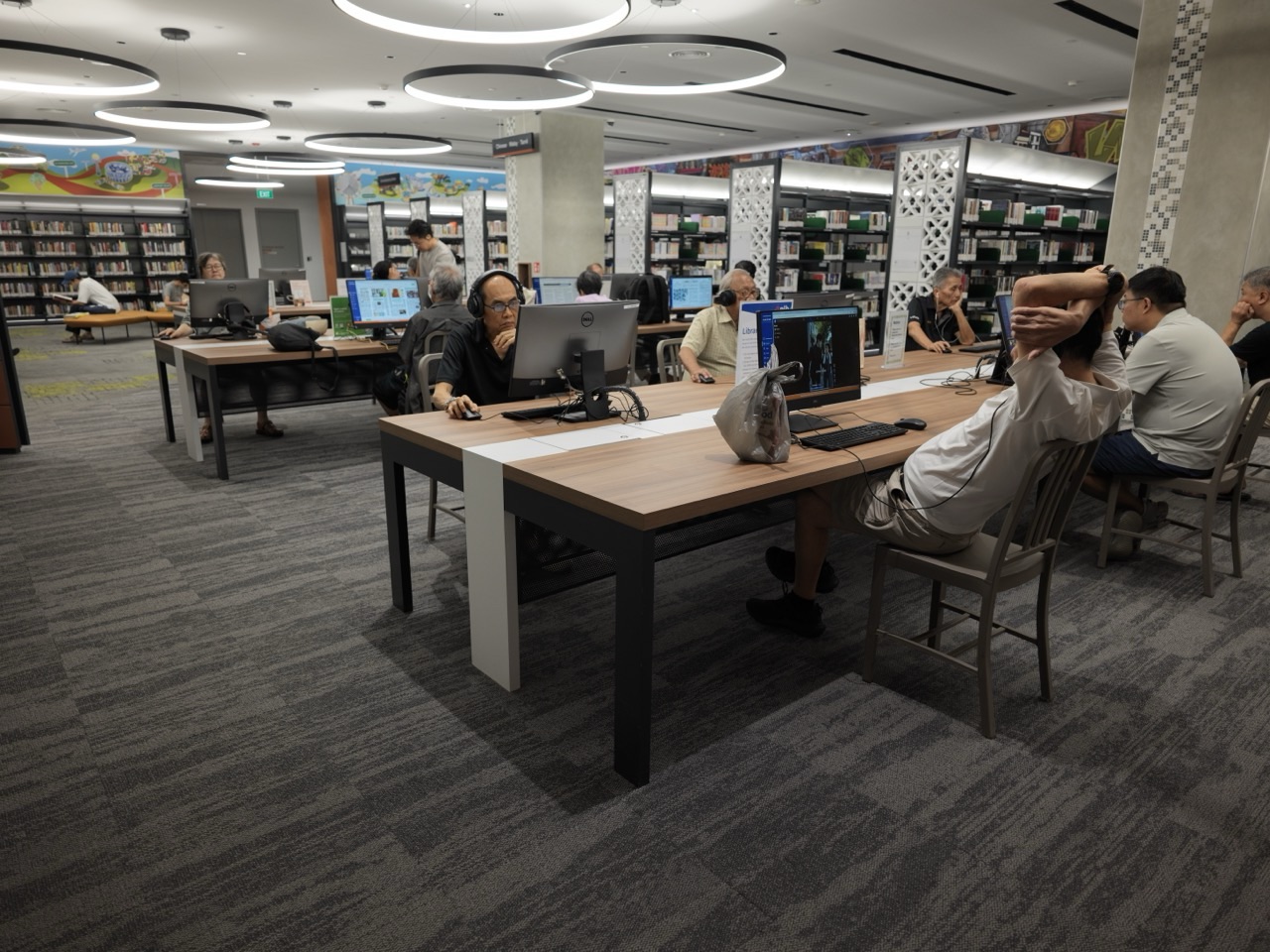
How Singapore connects is not only about physical libraries.
A library card can now open a reading network that follows the reader onto a phone, tablet or computer.
Did you know that NLB’s digital library lets readers discover, borrow and read eBooks and audiobooks without travelling to a branch?
The printed book remains physical.
The catalogue becomes digital.
The loan becomes an account transaction.
The book can arrive instantly on a screen.
The reader can move from an NLB shelf to Libby, eNewspapers, eMagazines and eLearning resources without leaving the wider library ecosystem.
This article follows Singapore’s digital-reading connection layer: NLB Mobile, Libby, eBooks, audiobooks, digital newspapers, account access, QR borrowing and the way one national library membership connects physical and digital reading.
The physical reading-node layer is explored in How Singapore Connects | Reading Nodes Beyond the Library. Public memory is explored in How Singapore Connects | Museums, Archives and Public Memory. Here we ask the access question: what happens when the library travels with the reader?
Did You Know? NLB Mobile Is Designed as a Personal Library Anywhere, Anytime
NLB’s current NLB Mobile page describes the app as a personal library that can be used anywhere and anytime.
The app supports eBooks and audiobooks, eMagazines and eNewspapers, account functions and other NLB digital resources.
The library building becomes one access point among several.
The Digital Library Changes the Meaning of Opening Hours
A physical library has doors.
It closes at night.
An eBook platform can remain accessible after the building closes.
The reader’s access time becomes less dependent on branch opening hours.
Libby Is the Dedicated eBook and Audiobook Reader
NLB’s current Libby FAQ says both NLB Mobile and Libby allow users to borrow NLB eBooks and audiobooks.
Libby adds a built-in reading and listening experience for borrowed and downloaded titles.
NLB Mobile acts as the wider NLB discovery and account interface.
Did You Know? The Old OverDrive App Was Discontinued
NLB’s Libby FAQ says the legacy OverDrive app was discontinued in early 2023, while the OverDrive website remains available through web browsers.
New mobile users are directed toward Libby.
The collection remained.
The interface changed.
One Library Account Connects Physical and Digital Loans
A library user can borrow a physical book in a branch and an eBook from home.
Both activities belong to one membership relationship.
The medium changes.
The institutional access layer remains connected.
Digital Borrowing Is Still Borrowing
An eBook loan is not the same as owning a permanent file.
The title is checked out under a lending model.
Loan periods and licensing conditions apply.
When the borrowing period ends, digital access can expire automatically.
The Return Trip Can Disappear
A physical book has to return to the library or approved return point.
A digital loan can expire or be returned electronically.
One entire logistics journey disappears.
Digital Holds Replace the Reservation Shelf
Popular eBooks may have waiting lists because publishers often license library copies under controlled lending models.
The reader places a hold.
The platform queues demand.
When the title becomes available, the reader is notified.
A reservation becomes software.
The Waitlist Reveals Digital Scarcity
Digital files can be copied technically.
Library licensing can still limit how many borrowers access a title simultaneously.
The scarcity is contractual rather than physical.
Did You Know? NLB Mobile Also Opens eNewspapers and eMagazines
NLB Mobile provides access to eNewspapers and eMagazines alongside eBooks and audiobooks.
A single app can therefore connect a reader to several publishing formats.
The Library App Becomes a Content Router
Book.
Magazine.
Newspaper.
Audiobook.
Course.
Account.
Reservation.
The reader chooses the content type.
The app routes to the appropriate service.
NLB Mobile Connects to Physical Borrowing Too
NLB has supported barcode scanning through the NLB Mobile app for borrowing physical library items in supported contexts.
The phone can therefore become a self-service borrowing interface.
The Phone Can Become a Library Card
The NLB eCard can be used for supported entry and borrowing functions.
That reduces dependence on carrying another physical card.
Identity has moved into the device.
Grab-n-Go Libraries Extend the Self-Service Model
NLB’s current Grab-n-Go Libraries use NLB Mobile and eCard-based access to support self-service borrowing in selected locations.
The branch can become smaller and more distributed when access, identity and borrowing are digital.
Reading Nodes Can Sit Outside Conventional Libraries
Community centres, pop-up locations and other NLB nodes can host curated collections.
Digital catalogues and self-service systems reduce the amount of full branch infrastructure required.
The Digital Collection Extends Every Physical Node
A small reading node may hold only a few thousand physical books.
The reader standing there can still access far more digital titles through NLB services.
Physical scale no longer determines collection scale.
Did You Know? NLB Mobile Includes Recommendations and Discovery
NLB Mobile includes discovery features such as recommendations, highlighted titles and digital-resource access.
The digital library is not only a search box.
It tries to recreate some of the discovery experience of wandering through shelves.
Search Changes How Readers Discover
A shelf encourages browsing by physical adjacency.
Search encourages discovery by title, author, subject or keyword.
These are different discovery systems.
Algorithms Add Another Discovery Layer
Digital recommendation systems can suggest titles based on categories or reading patterns.
That gives the library a personalised interface.
The user’s reading path becomes more individual.
Librarians Still Matter in a Digital Collection
Curation does not disappear when books become digital.
Librarians select, organise and recommend collections, create reading lists and design programmes.
The professional role shifts from only managing shelves toward managing access and discovery across media.
Digital Access Helps Readers with Mobility Constraints
A person who cannot travel easily can still access eBooks and audiobooks from home.
That connects digital reading to How Singapore Connects | Public Transport Accessibility, Barrier-Free Routes and Priority Travel by reducing the need for a physical trip in the first place.
Audiobooks Create Another Accessibility Path
Some readers learn or enjoy stories more easily by listening.
Audiobooks support commuters, readers with visual strain and people who prefer audio.
The book becomes portable through sound.
Font Size Can Become User-Controlled
An eReader can often enlarge text, change spacing or adjust background settings.
The printed page is fixed.
The digital page can adapt to the reader.
Offline Downloads Reduce Dependence on Constant Connectivity
Libby supports downloading borrowed eBooks and audiobooks to compatible devices.
That lets the reader continue during flights, MRT tunnels or periods without reliable data connectivity.
The Digital Library Still Depends on Broadband
Discovery, borrowing, synchronisation and new downloads require digital connectivity.
That places NLB’s eLibrary on top of How Singapore Connects | Broadband, Mobile Networks and Public Wi-Fi.
The Digital Library Still Depends on Data Centres
Catalogues, account systems, content platforms and authentication services run on servers.
That connects reading to How Singapore Connects | Data Centres, Cloud Services and the Internet.
The library feels weightless.
Its digital infrastructure is physical somewhere.
Digital Newspapers Change the Archive Experience
A printed newspaper is organised by date and page.
A digital archive can be searched by keyword.
That changes research speed dramatically.
Searchable Archives Connect Reading to Public Memory
A researcher can move from a recent digital article into historical newspaper or archive material where licensed and available.
The reading network becomes a research network.
Digital Reading Connects to Schools
Students can borrow eBooks outside school hours.
Teachers can point students toward digital resources.
Reading becomes less constrained by whether the school library owns one physical copy.
Digital Reading Connects to Adult Learning
Business books, language materials, audiobooks, magazines and eLearning can support lifelong learning.
The public library becomes part of workforce and adult-education infrastructure.
Reading on the Commute Changes Dead Time
A 35-minute MRT journey can become reading or listening time.
Digital access turns transport waiting into learning capacity.
The Library Connects to the Phone as a Multi-Use Device
The same device handles banking, transport, health and reading.
That makes the phone a major civilisation interface.
The library competes for attention inside the same screen as entertainment and social media.
Digital Convenience Can Increase Reading Frequency
A reader who finishes a book at 11pm can borrow another immediately if available.
The friction between intention and action becomes smaller.
But Digital Reading Creates New Frictions
- screen fatigue;
- device battery limits;
- account-password issues;
- licensing waitlists;
- format compatibility;
- distraction from other apps;
- internet access; and
- readers who simply prefer paper.
Digital does not replace physical reading for everyone.
The Strongest Library Is Hybrid
Physical libraries provide space, programmes, human help, printed collections and public gathering.
Digital libraries provide remote access, search, portability and extended hours.
The two systems are complements.
Did You Know? NLB Is Testing ‘Pass It On’ in NLB Mobile
NLB’s current NLB Mobile page lists a pilot feature called Pass It On that allows users to transfer borrowed physical books directly to friends and family without first returning them to a branch, under the trial conditions.
That is a fascinating example of the library experimenting with new physical-loan handoffs.
Pass It On Rewrites the Return Journey
Traditional loan path: library → borrower → library.
Experimental path: library → borrower A → borrower B.
The physical book can continue moving socially while the account system updates digitally.
The Library Account Is the Ledger
Who borrowed this?
When is it due?
Is there a hold?
Which items are digital?
The library account keeps the relationship between reader and collection coherent.
A Small Example: Evening eBook
Reader finishes a novel at home.
Opens Libby.
Searches next title.
Borrows it.
Downloads to device.
Begins reading immediately.
The library has crossed distance and opening hours.
A Small Example: Physical Book Through NLB Mobile
Reader browses shelf.
Scans book barcode using supported NLB Mobile borrowing function.
Loan is recorded to account.
Reader leaves without using a conventional borrowing station.
The phone has become library infrastructure.
A Small Example: Audiobook Commute
User borrows audiobook through Libby.
Downloads it over Wi-Fi.
Listens on MRT commute.
Playback resumes later at home.
Reading has become continuous across places.
What Can Break the Digital-Library Connection?
- forgotten account credentials;
- expired membership;
- title unavailable because all licensed copies are on loan;
- device storage full;
- app incompatibility;
- poor network connectivity;
- reader confusing NLB Mobile and Libby functions;
- content licensing changing;
- screen fatigue; and
- digital access excluding readers who need human assistance.
A strong digital library still needs clear support and physical alternatives.
How to Read a Digital Library Like a Systems Thinker
1. Find the identity
Which library account is borrowing?
2. Find the catalogue
Physical item, eBook, audiobook, newspaper or course?
3. Find the platform
NLB Mobile, Libby, web browser or another NLB eResource?
4. Find the licence
Is a copy available or is there a waiting list?
5. Find the device
Phone, tablet, computer or eReader?
6. Find the connectivity
Online reading or downloaded offline access?
7. Find the next handoff
Return, expiry, hold or recommendation?
The eduKate Singapore Graph: A Library Can Be Larger Than Its Building
A building has walls.
A collection has no need to stop at them.
NLB Mobile connects account and discovery.
Libby connects borrowing and reading.
Digital archives connect present readers to past publications.
The library becomes a distributed knowledge network.
Frequently Asked Questions
What is NLB Mobile?
NLB’s app for discovering content, accessing eResources, borrowing selected content and managing library-account functions.
What is Libby?
OverDrive’s primary app for borrowing, downloading and reading or listening to NLB eBooks and audiobooks.
Did Libby replace the OverDrive app?
Yes. NLB says the legacy OverDrive app was discontinued in early 2023, although the OverDrive website remains available.
Can NLB Mobile borrow eBooks?
Yes. NLB says both NLB Mobile and Libby support borrowing eBooks and audiobooks.
What is the difference between NLB Mobile and Libby?
NLB Mobile is the broader NLB discovery and account app; Libby is a dedicated eBook and audiobook reading/listening app with offline downloads.
Can I read without internet after downloading?
Libby supports downloaded eBooks and audiobooks for offline use on compatible devices.
Can NLB Mobile borrow physical books?
NLB supports barcode-scanning and self-service physical borrowing functions in supported library contexts.
What are Grab-n-Go Libraries?
NLB self-service library formats where visitors can access and borrow collections using digital entry and NLB Mobile-supported functions.
Is NLB testing new physical-loan handoffs?
Yes. NLB Mobile currently lists a pilot feature called Pass It On for transferring borrowed physical books directly to friends and family under trial conditions.
Where can I check current official information?
NLB | NLB Mobile and NLB | Libby FAQ.
Helpful Reading and Singapore Graph Connections
- NLB | NLB Mobile
- NLB | Libby FAQ
- NLB | Grab-n-Go Libraries
- How Singapore Connects | Reading Nodes Beyond the Library
- How Singapore Connects | Broadband, Mobile Networks and Public Wi-Fi
How Singapore Connects: The Library Can Follow You Home
Did you know that one of Singapore’s largest reading rooms may be the phone in your hand?
Search.
Borrow.
Download.
Read.
Listen.
Return.
The building still matters.
The network lets the knowledge travel.