
HOW SINGAPORE EDUCATION WORKS · Kindergarten number sense
Find your next learning step
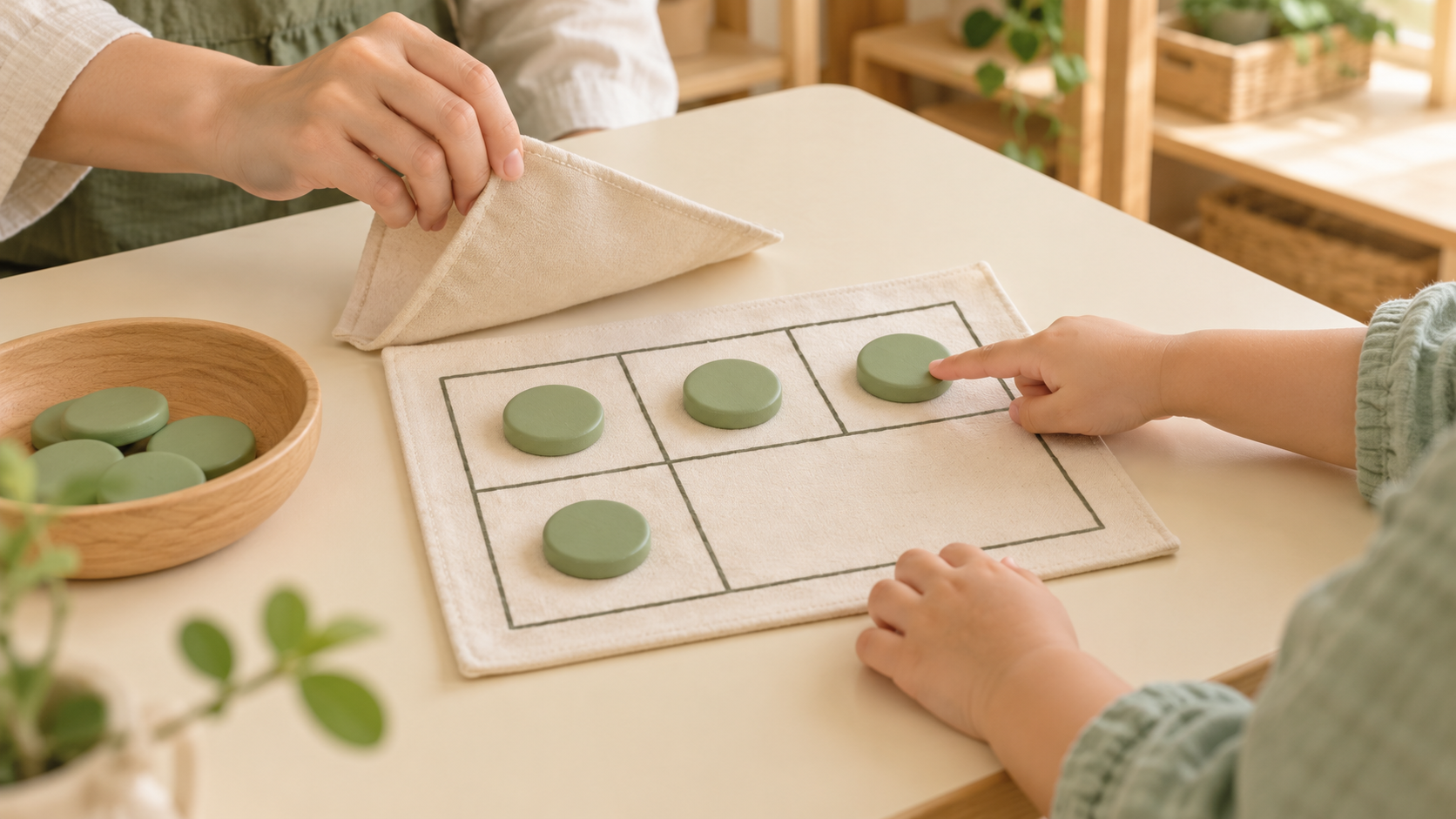
Show a small arranged set briefly, hide it, ask what the child saw, then reveal it for a slow count. The explanation matters more than speed.
Full chapter index · Practice and checking · Sources and next reading · How Singapore Education Works
Subitising means recognising a small quantity without counting each object one by one. A child may see four counters as two and two, or as three and one. The useful learning is not a fast guess; it is the link between the visual groups, the number word and a later check.
This is a play-based teaching suggestion, not a developmental screen or a prescribed preschool lesson. Singapore’s Nurturing Early Learners materials place subitising within counting skills and number sense. Preschools decide how broad framework goals appear in their own programmes, and children may need different quantities, arrangements and response time.
The choices at a glance
| What you notice | Likely issue | Useful next move |
|---|---|---|
| The child says a number immediately but cannot explain it | The response may be a guess or remembered pattern | Ask: “What groups did your eyes notice?” and rebuild the set |
| The child always touches every counter | One-by-one counting is secure but visual grouping is not yet trusted | Use two or three counters in familiar arrangements before increasing the set |
| The answer changes when the same quantity is rearranged | The child may know one picture rather than the quantity | Compare two arrangements side by side and verify both by counting |
Full chapter index
See the structure
Work and diagnose
Repair and practise
Recall, transfer and questions
A quantity is how many objects are in the set. Its arrangement can change while the quantity stays the same. Subitising helps a child hold the whole set in mind, while counting provides a dependable way to verify it.
Begin with one to three objects, then four and five. Use dot cards, counters on a five-frame, fingers or familiar game patterns. Keep the exposure short enough to invite a whole-set view, but not so short that the activity becomes a memory contest.
Accept different explanations. Four can be seen as two pairs, three and one, or one empty space in a five-frame. Each description exposes a useful number relationship.
Structured arrangements make groups visible. A straight line may invite one-by-one counting; two close pairs invite “two and two”; a five-frame makes “one less than five” visible. None is the only correct picture of four.
| Display | Possible first sight | Useful follow-up |
|---|---|---|
| Three dots in a triangle | Two and one | Can you show the two you saw first? |
| Four as two close pairs | Two and two | How does that make four? |
| Four on a five-frame | One empty space | How many would fill the frame? |
| Four scattered dots | Less obvious grouping | Can you move them into groups without changing how many? |
Rotate or spread the card only after the child understands the set. The changed view tests whether quantity is separated from appearance.
Assumptions: an adult places four counters on a five-frame—three in the top row and one in the lower-left space. The card is shown for about two seconds, then covered. The child says “four because I saw three and one.”
The card is revealed. The child points to the three counters in the top row, then the single lower counter. Together they count one, two, three, four. Next, the adult rearranges the same four counters into two pairs and repeats the look.
Checked answer: both displays contain four counters. In the first, 3 + 1 = 4; in the second, 2 + 2 = 4. The count verifies the quantity, while the two explanations show that four can be composed in more than one way.
If the child gives a number before looking, slow the reveal and ask for the groups rather than praising speed. If the child forgets the display, leave it visible and practise naming groups before adding a cover.
If one-by-one counting restarts after every rearrangement, keep the quantity small and place the old and new arrangements beside each other. Ask what moved and what stayed the same.
If number words are uncertain, let the child show the amount with fingers or counters. The activity can connect language and quantity without demanding a perfect spoken sentence first.
Use the same calm sequence each time: reveal, hide, answer, explain, reveal again, count. A wrong first answer is useful evidence. The child can compare the remembered picture with the actual set and adjust the explanation.
Change only one feature at a time. Keep four counters but alter the arrangement, or keep the arrangement and change from four to five. Changing quantity, colour, spacing and exposure time together makes the cause of difficulty hard to see.
End with a successful set the child can explain. The goal is a reliable relationship, not a high score or a race against another child.
Guided round
- Adult shows two or three counters in a clear group.
- Child says how many and points to the group seen.
- Both count slowly to verify.
Shared round
- Use four or five counters in two arrangements.
- Take turns explaining the groups.
- Include one deliberate mistake and let the child repair it.
Independent round
The child creates two cards for the same quantity, shows them to another person and asks both “How many?” and “How did you see it?”
On another day, show one familiar card and one changed arrangement. Ask the child to recall a useful group, then verify by counting. Delayed recall shows whether the relationship survives beyond the game.
Dot patterns, fingers, dominoes, dice and bead arrangements appear in games and classrooms around the world. Their designs differ, but the transferable idea is the same: recognise groups, combine them and check the total.
Changed-context check: show four everyday objects—a pair of socks and two spoons—rather than identical counters. The child must ignore object type while preserving the quantity.
Is subitising the same as counting?
No. Subitising recognises a small quantity as a whole or as groups. Counting assigns one number word to each item and verifies the total. The skills support each other.
How many objects should I show?
Start below the point where the child guesses or becomes anxious. Build from one to three, then four and five when explanations remain dependable.
Should the card be flashed very quickly?
Only briefly enough to discourage immediate one-by-one counting. Extend the view when memory or attention becomes the main difficulty.
What if the child’s grouping differs from mine?
Ask the child to point it out and verify it. Different correct decompositions are valuable evidence of flexible number sense.
Sources and next reading
- MOE Singapore — Nurturing Early Learners Framework 2022
- MOE NEL Portal — Counting Skills and Number Sense
- MOE NEL Portal — Educators’ Guide for Numeracy