
HOW SINGAPORE EDUCATION WORKS · Kindergarten routes
Find your next learning step
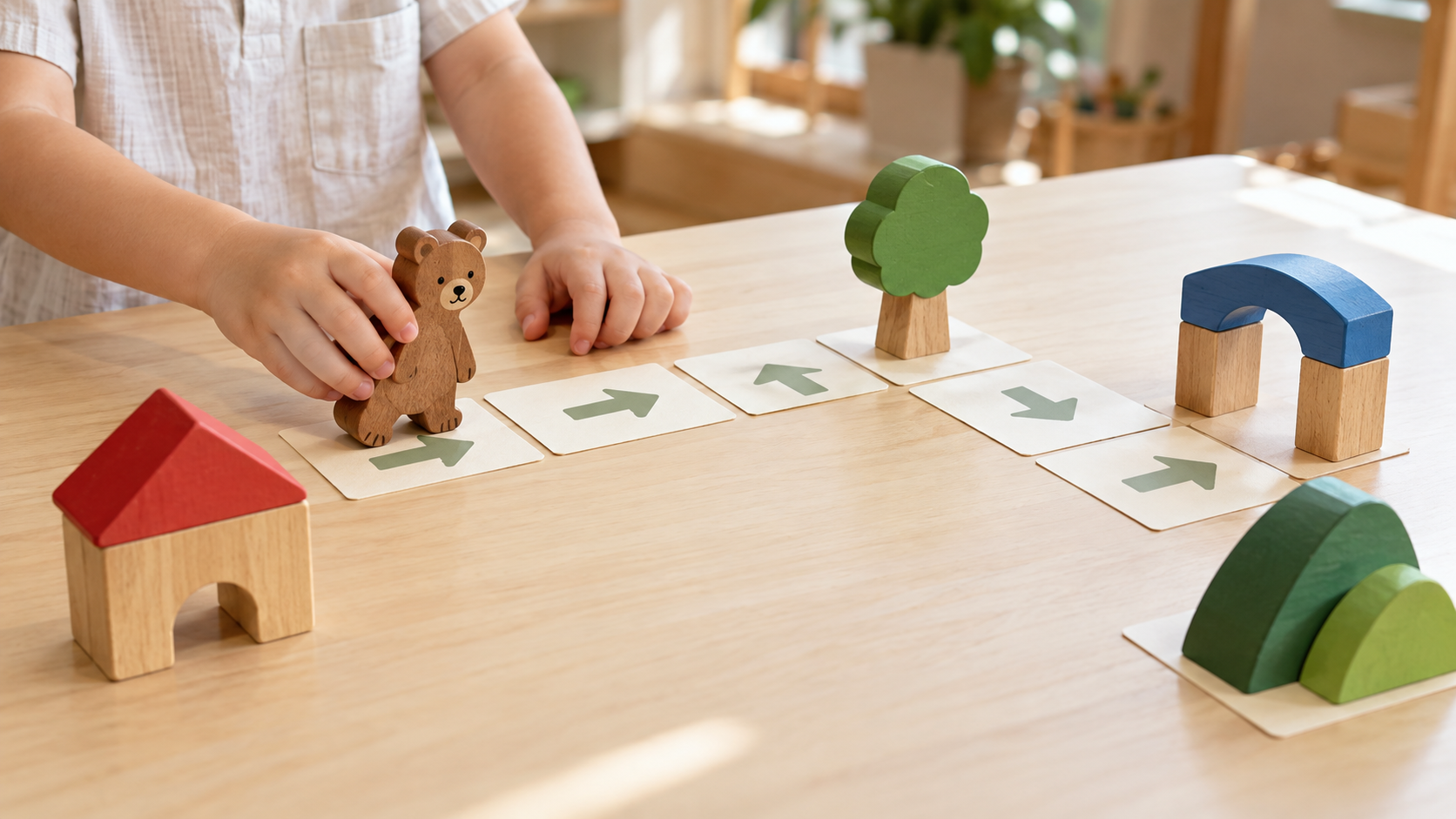
Start with one short route. Let the child move a figure, say the arrow action and check each landmark before adding another turn.
Full chapter index · Practice and checking · Sources and next reading · How Singapore Education Works
A route becomes understandable when a child can connect three things: where they are now, what the next arrow asks them to do, and which landmark confirms that the move was correct. Build the route on the floor or a table before expecting the child to read a drawn map.
This is a playful teaching suggestion, not a developmental test or a prescribed kindergarten lesson. Singapore’s Nurturing Early Learners framework includes awareness of position, direction and distance while emphasising active, purposeful learning. Preschools decide how those principles appear in their own programmes.
The choices at a glance
| What you notice | Likely issue | Useful next move |
|---|---|---|
| The child names every arrow but moves the figure randomly | Symbol meaning is known, but sequence is not | Cover later cards and reveal only the next instruction |
| The child follows arrows but misses the destination | The route is detached from landmarks | Pause at each landmark and name what it confirms |
| Left and right reverse when the board turns | Direction is tied to the room, not the traveller | Use forward and turn first; add left/right from the figure’s viewpoint |
Full chapter index
Repair and practise
Recall, transfer and questions
A route is an ordered set of moves from a start to a destination. An arrow is not decoration: it is an instruction. A landmark is not merely an object: it is evidence that the traveller is still on the intended path.
Begin with a toy person on a three-card path: go forward, turn, stop at the red block. Ask the child to touch the current card before moving. This separates “what comes next?” from the excitement of rushing to the end.
The smallest useful unit is current place → next action → confirming landmark. When that unit is secure, several units can be joined into a longer journey.
A child may see an arrow correctly yet act from the adult’s viewpoint. Put a small face or coloured sticker on the front of the traveller. “Forward” now means the direction the face points, even when the board is rotated.
| Card | Action | Check |
|---|---|---|
| ↑ | Move one space forward | The figure faces the same way |
| ↷ | Turn right without moving | The front sticker now points right |
| ● | Stop | Name the nearby landmark |
Delay left and right if they create noise. First use forward, turn and stop. Then introduce one turn direction, contrast it with the other, and return to mixed routes only after the child can explain the difference.
Assumptions: a bear begins at the blue mat facing a chair. The route cards are forward two spaces, turn right, forward one space, stop. A paper tree stands beside the turning point and the reading tent is the destination.
Move one space and count “one”; move again and count “two”. The bear should now be beside the tree. Turn the bear right without changing spaces. Move one space. The bear should now be at the tent, so the stop card is satisfied.
Checked answer: four instructions were completed in order. The tree confirms the turn happened at the correct place, and the tent confirms the final move. If the bear reaches the tent without passing the tree, the result is accidental rather than a verified route.
If the child skips a card, reduce the visible route to two cards and place a small counter on the active one. Move the counter only after the action is complete.
If a turn card causes an extra forward move, practise “turn on the spot” with the child’s own body. Draw a circle around the turning square to show that position stays fixed while orientation changes.
If the child reaches a landmark but cannot say why it matters, ask a bounded question: “Does the tree tell us to turn here, or to finish here?” The explanation is more useful than another unobserved attempt.
Set up a route that is correct until one turn. State the fixed facts: the start is correct, the first two moves are correct, and the destination has not moved. Ask the child to locate the first place where the travelled path and the cards disagree.
Return the figure to that place, rotate it to the orientation it had before the error, and replay only the remaining cards. This preserves successful work and makes repair a normal part of navigation.
After the correction, trace the route backwards with a finger. The backward trace is not a new route; it is a check that every adjacent place connects as expected.
Guided round
- Adult reveals one card at a time.
- Child moves the figure and names the landmark.
- Adult asks which fact shows the move was correct.
Shared round
- Child chooses the destination; adult arranges three route cards.
- Swap roles and include one deliberate wrong card.
- Repair the route by changing only the card that breaks it.
Independent round
The child builds a four- to six-card route for another person, adds at least two landmarks and explains the route before the traveller begins. A usable route should work for someone who did not design it.
The next day, remove the old route and ask the child to rebuild it from memory using only the start, destination and landmarks. If the exact cards are forgotten, let the child test and revise rather than supplying the answer.
Transfer the idea to a neighbourhood walk, a museum floor plan, a transit diagram or a treasure route from another country. Symbols differ, but people everywhere need a sequence, orientation cues and checkpoints.
Changed-context check: give a picture-only route with no arrows. Ask the child to create arrow cards that would make the pictured journey repeatable. This reverses the task from following instructions to encoding them.
Should a kindergarten child memorise compass directions?
Not for this activity. Begin with body-centred language and visible landmarks. North, map scale and formal coordinates can come later.
What if left and right are still inconsistent?
Use one turn direction at a time and keep the traveller’s front visible. Direction vocabulary develops through meaningful use, not rapid correction.
Can a route have more than one correct answer?
Yes. Two routes may reach the same destination. Compare them by whether the instructions are complete and whether a new traveller can follow them.
Is this the same as testing school readiness?
No. It is a short play invitation for spatial language, sequencing and explanation. It should not be used to label a child.
Sources and next reading
Continue inside eduKateSG
- Spatial language and turning shapes in kindergarten
- Kindergarten ordinal positions
- Kindergarten fine-motor learning